
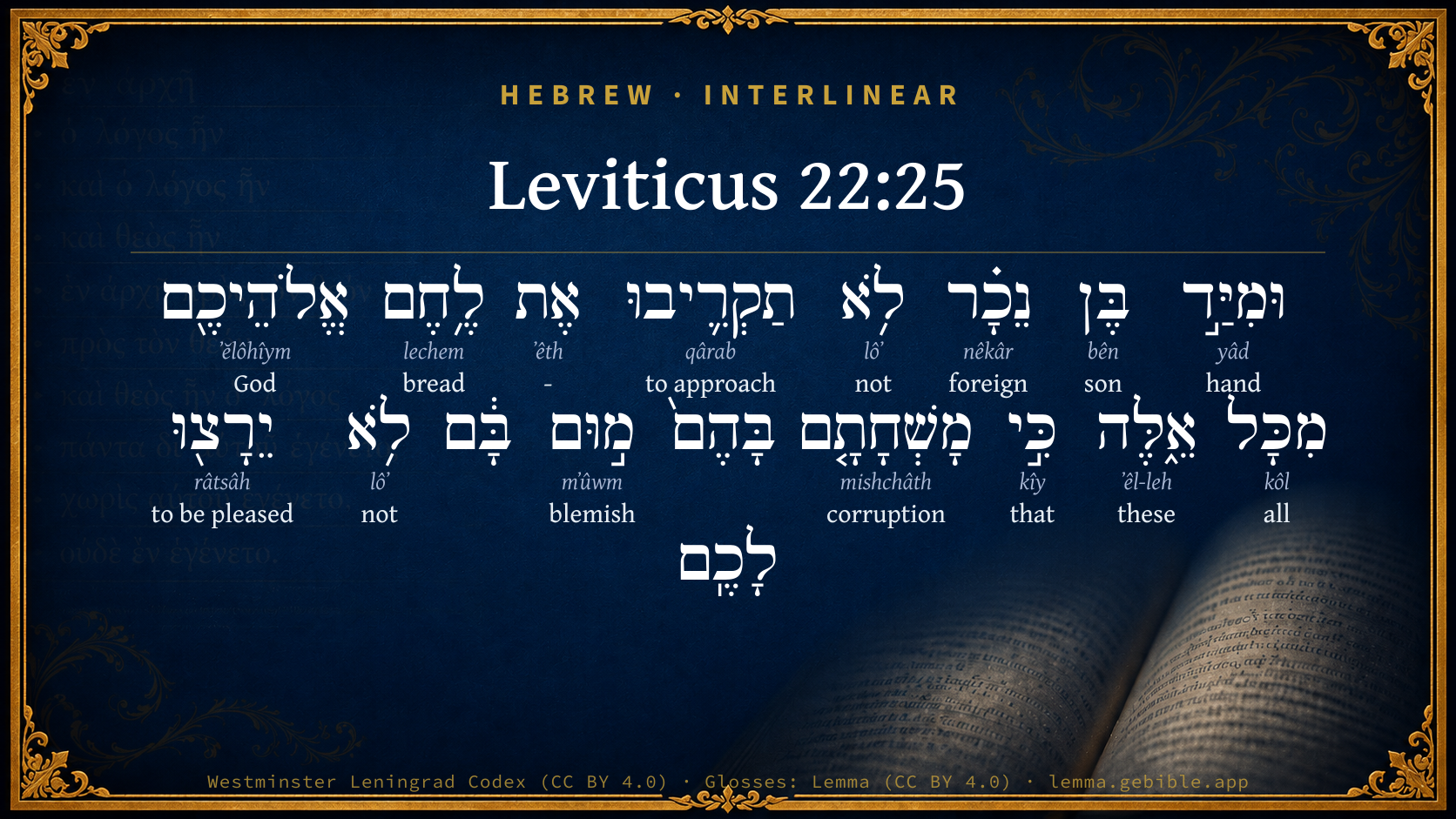
Leviticus 22:25

Hebrew (Westminster Leningrad Codex) Leviticus 22:25 appears in the Hebrew Old Testament. The text above is from the Westminster Leningrad Codex. Each word links to its Strong’s number, a concise gloss, and parsing drawn from the Open Scriptures Hebrew Bible morphology. Click any word for its full Brown-Driver-Briggs (BDB) entry.
Download image
Cite this verse

Leviticus 22:25 (World English Bible). Public Domain. Lemma interlinear Bible study tool, https://lemma.gebible.app/v/leviticus/22/25.

Show BibTeX & RIS
BibTeX
RIS
English Translation
Neither from the hand of a foreigner shall you offer the bread of your God of any of these; because their corruption is in them. There is a blemish in them. They shall not be accepted for you.'"
World English Bible · Public Domain
Highlights
  • 1 first appearance in the Hebrew Bible
Full analysis ↓
Download a study sheet

One document with this verse’s original text, its word-by-word gloss line, the meaning frame, cross-references with their text, attributed commentary, and full source and license credits — printable, and it pastes into notes with its structure intact.

This verse Autodidact and up

Study sheet (.html) Plain text (.txt)

A passage Seminary Student

Up to 50 verses in one chapter. A passage sheet keeps up to 6 commentary sources and 12 cross-references per verse, in the order this page ranks them, and says so on the sheet whenever that leaves anything out. Ask for a single verse and you get the Autodidact verse sheet above.

Everything on this page stays free to read, with no account — the sheet is a download of what is already on screen, not access to it.

Want to remove ads? Support Godless Engineer
Compare translations 3

The same verse in 3 English versions, stacked beneath the original-language interlinear above. Click any original word for its lexicon entry.

Each is an independent rendering of the whole verse — the interlinear is not word-aligned to these translations.

Highlighted words mark where these versions differ — a whole-verse word diff, not a word-by-word alignment.

  • World English Bible Public Domain
    Neither from the hand of a foreigner shall you offer the bread of your God of any of these; because their corruption is in them. There is a blemish in them. They shall not be accepted for you.'"
  • King James Version Public Domain
    Neither from a stranger's hand shall ye offer the bread of your God of any of these; because their corruption is in them, and blemishes be in them: they shall not be accepted for you.
  • unfoldingWord Literal Text CC BY-SA 4.0
    And from the hand of a son of a foreigner, you shall not present the bread of your God from any of these because their being ruined is on them and a blemish is on them. They will not be accepted for you.’”

unfoldingWord Literal Text — © unfoldingWord, licensed CC BY-SA 4.0. Word-aligned USFM3 via Door43 (git.door43.org/unfoldingWord/en_ult).

Versions to compare (up to 4)

3 of 4 selected

Show all 18 translations

Every available English version of this verse, each an independent rendering of the whole verse.

  • World English Bible Public Domain
    Neither from the hand of a foreigner shall you offer the bread of your God of any of these; because their corruption is in them. There is a blemish in them. They shall not be accepted for you.'"
  • Berean Standard Bible Public Domain
    Neither you nor a foreigner shall present food to your God from any such animal. They will not be accepted on your behalf, because they are deformed and flawed.’”
  • Majority Standard Bible Public Domain
    Neither you nor a foreigner shall present food to your God from any such animal. They will not be accepted on your behalf, because they are deformed and flawed.’”
  • King James Version Public Domain
    Neither from a stranger's hand shall ye offer the bread of your God of any of these; because their corruption is in them, and blemishes be in them: they shall not be accepted for you.
  • American Standard Version (1901) Public Domain
    Neither from the hand of a foreigner shall ye offer the bread of your God of any of these; because their corruption is in them, there is a blemish in them: they shall not be accepted for you.
  • Revised Version (1885) Public Domain
    Neither from the hand of a foreigner shall ye offer the bread of your God of any of these; because their corruption is in them, there is a blemish in them: they shall not be accepted for you.
  • Geneva Bible (1599) Public Domain
    Neither of ye hand of a strager shall ye offer ye bread of your God of any of these, because their corruption is in them, there is a blemish in them: therefore shall they not be accepted for you.
  • Douay-Rheims (1899) Public Domain
    You shall not offer bread to your God, from the hand of a stranger, nor any other thing that he would give: because they are all corrupted, and defiled: you shall not receive them.
  • Young's Literal Translation Public Domain
    And from the hand of a son of a stranger ye do not bring near the bread of your God, of any of these, for their corruption `is' in them; blemish `is' in them; they are not pleasing for you.'
  • Literal Standard Version CC BY-SA 4.0
    And you do not bring the bread of your God near from the hand of a son of a stranger, from any of these, for their corruption [is] in them; blemish [is] in them; they are not pleasing for you.”
  • Unlocked Literal Bible CC BY-SA 4.0
    You must not present the bread of your God from the hand of a foreigner. Those animals are deformed and have defects in them, they will not be accepted for you.'”
  • unfoldingWord Literal Text CC BY-SA 4.0
    And from the hand of a son of a foreigner, you shall not present the bread of your God from any of these because their being ruined is on them and a blemish is on them. They will not be accepted for you.’”
  • Darby Bible Public Domain
    Nor from the hand of the stranger shall ye present the bread of your God, of any of these; for their corruption is in them: a defect is in them; they shall not be accepted for you.
  • World Messianic Bible Public Domain
    You must not offer any of these as the bread of your God from the hand of a foreigner, because their corruption is in them. There is a defect in them. They shall not be accepted for you.’”
  • Webster's Bible Public Domain
    Neither from a stranger's hand shall ye offer the bread of your God of any of these; because their corruption is in them, and blemishes are in them: they shall not be accepted for you.
  • Free Bible Version CC BY-SA 4.0
    Nor are you allowed to accept such animals from a foreigner that are damaged and defective.”
  • Bible in Basic English Public Domain
    And from one who is not an Israelite you may not take any of these for an offering to the Lord; for they are unclean, there is a mark on them, and the Lord will not be pleased with them.
  • JPS Tanakh (1917) Public Domain
    Neither from the hand of a foreigner shall ye offer the bread of your God of any of these, because their corruption is in them, there is a blemish in them; they shall not be accepted for you.

Literal Standard Version (2020), Covenant Press — licensed CC BY-SA 4.0. Text via the HelloAO Bible API (eBible.org). Unlocked Literal Bible (unfoldingWord) — licensed CC BY-SA 4.0. Text via the HelloAO Bible API (eBible.org). unfoldingWord Literal Text — © unfoldingWord, licensed CC BY-SA 4.0. Word-aligned USFM3 via Door43 (git.door43.org/unfoldingWord/en_ult). Free Bible Version, Dr. Jonathan Gallagher — licensed CC BY-SA 4.0. Text via the HelloAO Bible API (eBible.org).

Word by word

More ways to search: Search by grammar → Find every occurrence → Compare this word →

Practice this passage: Drill this verse → Learn its vocabulary →

מָשְׁחָתָ֤ם
mishchâth
H4893
“corruption · their”
Noun, Common, Masculine, Singular, Construct + Suffix, Personal, 3rd Person, Masculine, Plural
Part of Speech
Noun
Type
Common
Gender
Masculine
Number
Singular
State
Construct
Full BDB Definition

Origin: from H7843

TWOT: 2370c

disfigurement (of face), corruption
  1. וּמִיַּ֣ד yâd H3027 “and · from · hand of” Conjunction + Preposition + Noun, Common, Both, Singular, Construct
  2. בֶּן bên H1121 “son of” Noun, Common, Masculine, Singular, Construct
  3. נֵכָ֗ר nêkâr H5236 “foreign” Noun, Common, Masculine, Singular, Absolute
  4. לֹ֥א lôʼ H3808 “not” Particle, Negative
  5. תַקְרִ֛יבוּ qârab H7126 “to approach” Verb, Hiphil, Imperfect, 2nd Person, Masculine, Plural
  6. אֶת ʼêth H853 “-” Particle, Direct Object
  7. לֶ֥חֶם lechem H3899 “bread of” Noun, Common, Both, Singular, Construct
  8. אֱלֹהֵיכֶ֖ם ʼĕlôhîym H430 “God(s) · your” Noun, Common, Masculine, Plural, Construct + Suffix, Personal, 2nd Person, Masculine, Plural
  9. מִכָּל kôl H3605 “from · all of” Preposition + Noun, Common, Masculine, Singular, Construct
  10. אֵ֑לֶּה ʼêl-leh H428 “these” Pronoun, Demonstrative, Common, Plural
  11. כִּ֣י kîy H3588 “that” Conjunction
  12. מ֣וּם mʼûwm H3971 “blemish” Noun, Common, Masculine, Singular, Absolute
  13. לֹ֥א lôʼ H3808 “not” Particle, Negative
  14. יֵרָצ֖וּ râtsâh H7521 “to be pleased” Verb, Niphal, Imperfect, 3rd Person, Masculine, Plural

About this verse

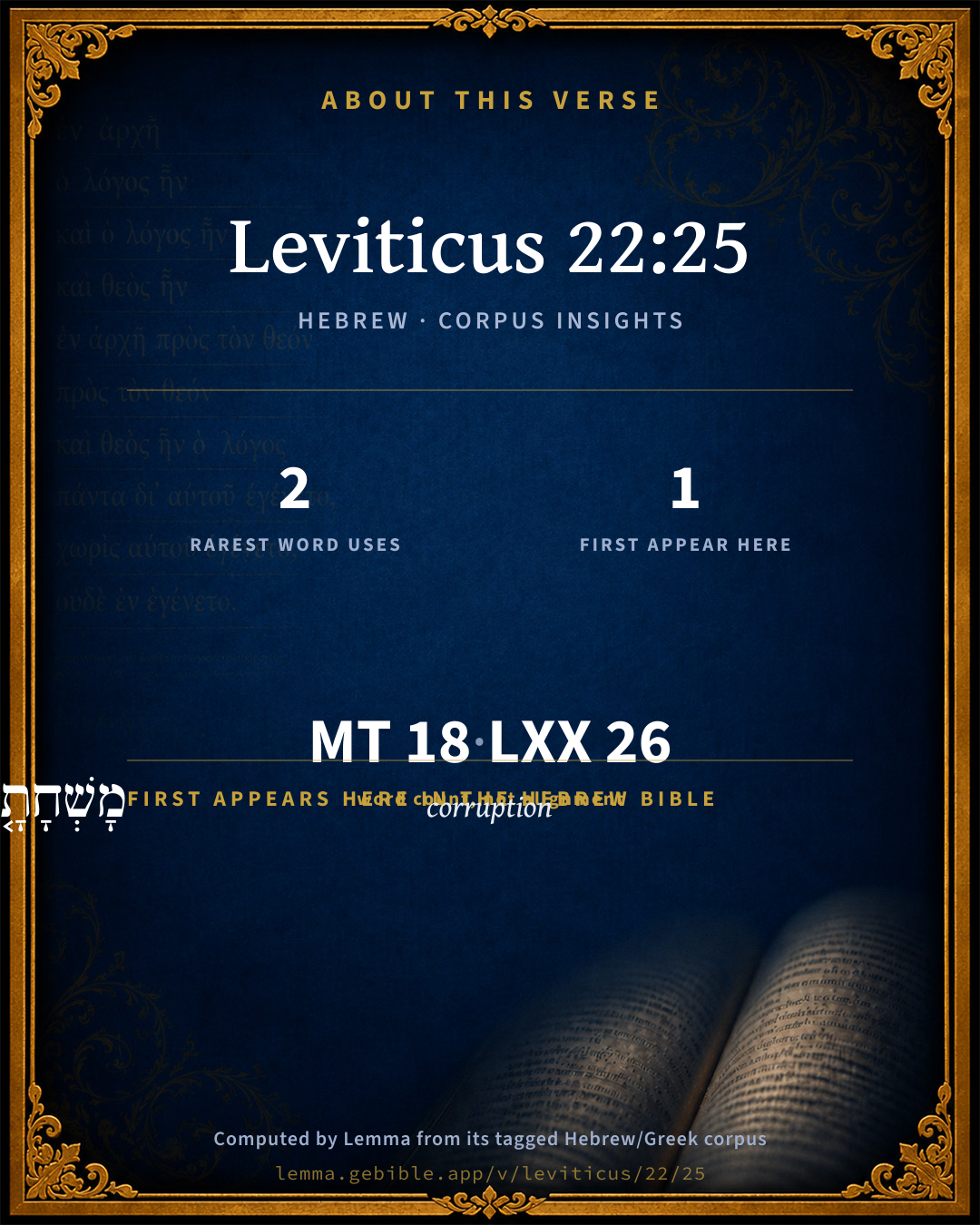
These counts appear in no published source. They are computed here, from the morphology-tagged text and Lemma’s own curated glosses. What Lemma adds →

18
words
14
distinct lemmas
Pentateuch
section

Notable vocabulary

The rarest word here is מָשְׁחָתָ֤ם corruption H4893 — appearing just 2 times in the whole Hebrew Bible.

First appearance in Scripture

This word makes its first canonical appearance in the Hebrew Bible here:

  • מָשְׁחָתָ֤ם corruption H4893

Shared distinctive vocabulary

מָשְׁחָתָ֤ם corruption H4893 occurs in 2 verses of the Hebrew Bible. Also found in:

Grammatical profile

  • 2 verbs
  • 8 nouns
  • 1 pronoun
  • 3 prepositions
  • 1 conjunction
  • 3 particles

Verb forms

  • תַקְרִ֛יבוּ Hiphil · Imperfect
  • יֵרָצ֖וּ Niphal · Imperfect

Repetition

A word recurs within this verse — often emphatic in Hebrew:

Hebrew & Septuagint length

In English translation the verse runs 38 words from the Hebrew and 36 from the Septuagint (LXX English) — closely comparable.

A rough comparison of the two English renderings, which tokenize alike — not a word-level alignment.

Word counts can differ between the Hebrew and the Greek without any difference in meaning — e.g. the Hebrew direct-object marker אֵת has no separate Greek word, and Greek often adds the article ὁ.

In the original languages it is 18 Hebrew tokens and 26 Greek tokens — but the two are counted differently (Hebrew bundles its prefixes and suffixes into one token; the Greek is in lemma form), so that isn’t a like-for-like length.

Cross-references

10

Topical passages linked to Leviticus 22:25 in the Treasury of Scripture Knowledge — connected by theme and wording, ordered by reader-vote popularity; previews shown in the World English Bible.

  • Leviticus 21:6 They shall be holy to their God, and not profane the name of their God; for they offer the offerings of Yahweh made by fire, the bread of their God; therefore they shall be holy.
  • Leviticus 21:8 You shall sanctify him therefore; for he offers the bread of your God: he shall be holy to you: for I Yahweh, who sanctify you, am holy.
  • Numbers 15:14–16 If a stranger lives as a foreigner with you, or whoever may be among you throughout your generations, and will offer an offering made by fire, of a sweet savor to Yahweh; as you do, so he shall do.
  • Ezra 6:8–10 Moreover I make a decree what you shall do to these elders of the Jews for the building of this house of God: that of the king's goods, even of the tribute beyond the River, expenses be given with all diligence to these men, that they be not hindered.
  • Malachi 1:7–8 You offer polluted bread on my altar. You say, 'How have we polluted you?' In that you say, 'Yahweh's table contemptible.'
  • Malachi 1:12–14 "But you profane it, in that you say, 'Yahweh's table is polluted, and its fruit, even its food, is contemptible.'
  • Ephesians 2:12 that you were at that time separate from Christ, alienated from the commonwealth of Israel, and strangers from the covenants of the promise, having no hope and without God in the world.
  • Leviticus 21:21–22 no man of the seed of Aaron the priest, who has a blemish, shall come near to offer the offerings of Yahweh made by fire. Since has a blemish, he shall not come near to offer the bread of his God.
  • Numbers 16:40 to be a memorial to the children of Israel, to the end that no stranger, who isn't of the seed of Aaron, comes near to burn incense before Yahweh; that he not be as Korah, and as his company: as Yahweh spoke to him by Moses.
  • 1 John 5:18 We know that whoever is born of God doesn't sin, but he who was born of God keeps himself, and the evil one doesn't touch him.

Cross-references courtesy of OpenBible.info (CC BY 4.0).

Hebrew and Greek witnesses Masoretic Hebrew ↔ Greek Septuagint

The same verse in the two great witnesses to the Old Testament, shown verse-for-verse.

These are two independent witnesses, not word-aligned to each other, and the Septuagint is shown in lemma (dictionary) form.

Hebrew Leviticus 22:25 Masoretic · Westminster Leningrad Codex

וּמִיַּ֣ד בֶּן נֵכָ֗ר לֹ֥א תַקְרִ֛יבוּ אֶת לֶ֥חֶם אֱלֹהֵיכֶ֖ם מִכָּל אֵ֑לֶּה כִּ֣י מָשְׁחָתָ֤ם בָּהֶם֙ מ֣וּם בָּ֔ם לֹ֥א יֵרָצ֖וּ לָכֶֽם

Neither from the hand of a foreigner shall you offer the bread of your God of any of these; because their corruption is in them. There is a blemish in them. They shall not be accepted for you.'"

World English Bible · Public Domain

Greek LXX Leviticus 22:25 Septuagint · lemma form

καί ἐκ χείρ ἀλλογενής οὐ προςφέρω ὁ δῶρον ὁ θεός σύ ἀπό πᾶς οὗτος ὅτι φθάρμα εἰμί ἐν αὐτός μῶμος ἐν αὐτός οὐ δέχομαι οὗτος σύ

Neither shall you⌃ offer the gifts of your God of all these things by the hand of a stranger, because there is corruption in them, a blemish in them: these shall not be accepted for you.

LXX2012 (modern English Septuagint) · Public Domain

Hebrew: Westminster Leningrad Codex (CC BY 4.0). Greek: Septuagint (public domain); English from LXX2012 (modern English Septuagint) (Public Domain). How the Septuagint differs from the Hebrew →

Targum (Aramaic paraphrase)

2

The Targum is the ancient Jewish Aramaic paraphrase of the Hebrew Scriptures — an interpretive translation, not the Hebrew text itself. Onkelos (literal) and Pseudo-Jonathan (expansive) render the Torah, and Jonathan the Prophets. Coverage is partial: where no permissively-licensed English translation exists for a verse, only the Aramaic is shown. This is verse-level text, not a word-by-word alignment to the Hebrew.

  1. Targum Onkelos Torah (Genesis–Deuteronomy)
    וּמִן בַּר עַמְמִין לָא תְקַרְבוּן יָת קֻרְבַּן אֱלָהֲכוֹן מִכָּל אִלֵין אֲרֵי חִבּוּלְהוֹן בְּהוֹן מוּמָא בְהוֹן לָא לְרַעֲוָא יְהוֹן לְכוֹן

    (no public-domain English translation for this verse)

    Targum Onkelos — Aramaic: “Onkelos Genesis” (public domain); “Onkelos Exodus” (public domain); “Onkelos Leviticus” (public domain); “Onkelos Numbers” (public domain); “Onkelos Deuteronomy” (public domain). English: “Sefaria Community Translation” (CC0 1.0 (public-domain dedication)); “J.W. Etheridge. The Targums of Onkelos and Jonathan Ben Uzziel on the Pentateuch. London: Longmans, Green, 1862” (public domain). Text via Sefaria.

  2. Targum Pseudo-Jonathan Torah (Genesis–Deuteronomy)
    וּמִן יַד בַּר עַמְמִין לָא תְקַרְבוּן יַת קוּרְבַּן אֱלָהָכוֹן מִכָּל אִלֵין אֲרוּם חִבּוּלְהוֹן בְּהוֹן מוּמָא פְּסִילִין הִינוּן לָא לְרַעֲוָא יְהֵי לְכוֹן

    And from the hand of a son of the Gentiles you shall not offer the oblation of your God of any of these, because their corruption is in them; a blemish is in them, they are profane, they shall not be acceptable for you.

    Targum Pseudo-Jonathan — Aramaic: “Targum Jonathan on Genesis” (public domain); “Targum Jonathan on Exodus” (public domain); “Targum Jonathan on Leviticus” (public domain); “Targum Jonathan on Numbers” (public domain); “Targum Jonathan on Deuteronomy” (public domain). English: “The Targum of Jonathan ben Uzziel, trans. J. W. Etheridge, London, 1862” (public domain). Text via Sefaria.

Commentary

Notes on Leviticus 22:25 from classic Christian and Jewish commentators (each source and its license shown beneath its notes). The classic Christian expositions comment on the surrounding passage and are grouped to its opening verse, so a note may address several verses; the Jewish commentaries on the Tanakh (Rashi and others) are per-verse, so they appear only where the commentator wrote on this verse.

Lemma curates 59 commentaries, every one of them public domain or Creative Commons licensed, each selected and text-cleaned for this edition rather than reprinted as found. About our sources →

Trapp's Complete Commentary

John Trapp

Lev 22:25 Neither from a stranger’s hand shall ye offer the bread of your God of any of these; because their corruption [is] in them, [and] blemishes [be] in them: they shall not be accepted for you.

Ver. 25. Their corruption is in them.] As not having their hearts purified by faith; and therefore not in case to please God.

John Trapp, A Commentary or Exposition upon All the Books of the Old and New Testament (1647–1656) — public domain. Text from a community e-Sword module.

Joseph Benson's Commentary

Lev 22:25. Neither from a stranger’s hand — From proselytes: even from those, such should not be accepted, much less from the Israelites. The bread of your God — That is, the sacrifices.

Joseph Benson's Commentary on the Old and New Testaments (1811–1818) — public domain. Text from a community e-Sword module.

Geneva Bible (1599)

Geneva Bible translators

Ye shall not receive any imperfect thing of a stranger, to make it the Lord’s offering: which he calleth the bread of the Lord.

Geneva Bible (1599) marginal notes — public domain. Text via Bolls.life.

Adam Clarke's Commentary

Verse 25. Their corruption is in them] Viz., they are bruised, crushed, broken, &c.

Adam Clarke's Commentary on the Bible (1810–1826) — public domain. Text from a community e-Sword/MySword module.

Ellicott's Commentary for English Readers

(25) Neither from a stranger’s hand shall ye offer.—That is, the prohibition to sacrifice these animals is not restricted to beasts castrated in the land, but extends to all such as have been so treated out of the land, and are imported and sold to the Israelites by the hands of foreigners.

Because their corruption is in them.—That is, their mutilation is in them, though not effected by an Israelite nor in the land. The circumstance that such an animal is purchased from the hand of a foreigner does not alter the case.

They shall not be accepted for you.—That is, if the Israelites bring such mutilated sacrifices, thinking that, because they have been procured from a stranger’s hand, they do not transgress the law laid down in the preceding verse, they will not be accepted by God, who regards them as blemished and illegal. Jewish canonists, however, regard this verse as regulating the sacrifices offered by Gentiles, and maintain that the same law about defective animals is here laid down in their case. But the manifest contrast between the expression, when the deed is done “in your land,” at the end of the preceding verse, and the words “from the hand of a foreigner,” at the beginning of this verse; and more especially the declaration in the clause before us, “they shall not be acceptable for you,” i.e., the Israelites, show beyond doubt that the Israelites themselves are here spoken of as the offerers.

A Bible Commentary for English Readers, edited by Charles John Ellicott (1878–1897) — public domain. Text from a community e-Sword module.

The Cambridge Bible for Schools and Colleges

gen. ed. J. J. S. Perowne

25. The case apparently is that of a foreigner who desires to offer sacrifice, and is forbidden to present an animal with a blemish. So Dillm. It is much less probable that the prohibition is directed against an Israelite buying blemished animals from a foreigner for a sacrificial purpose.

the bread of your God] See on Lev_22:6.

The Cambridge Bible for Schools and Colleges (gen. ed. J. J. S. Perowne; Cambridge University Press, 1878–1918) — public domain. Text from a community e-Sword module.

John Gill's Exposition

And the Lord spake unto Moses,.... At the same time, as before, in a continued discourse, the subject being of the same kind, relating to sacrifices:

saying, as follows.

John Gill's Exposition of the Whole Bible (1746–1763) — public domain (CC PDM 1.0). Text via the HelloAO Bible API.

Albert Barnes' Notes on the Bible

A stranger’s hand - The word here rendered “stranger”, is not the same as that in Lev 22:10, Lev 22:18 : it means literally, “the son of the unknown”, and probably refers to one dwelling in another land who desired to show respect to the God of Israel. See 1Ki 8:41.

Albert Barnes' Notes on the Bible (1834–1885) — public domain. Text from a community e-Sword/MySword module.

Haydock's Catholic Bible Commentary

Bread, which always accompanies the sacrifices for sin. Holocausts might be offered by the Gentiles. (2 Machabees iii. 3.; 1 Esdras vi. 9.; Josephus, Antiquities xviii. 7.; Selden, Jur. 3, 4, 7.) --- Them. To reconcile this with ver. 18, we must understand because in the sense of in as much as; they are all corrupted, when contrary to these regulations. The strangers shall not be allowed to offer any blemished victim. Hebrew, "Neither from the hand of a stranger shall you offer the bread (or victims) of your God of any of these; because....blemishes are in them: they shall not be accepted (by God) for you (or them)." The Chaldean and other versions explain it in the same sense. Presents of gold, &c., were accepted, and kept in the temple. The family of Augustus shewed their generosity in this respect. (Philo, Legat.) (Calmet) --- Strangers, or pagans, could not offer victims, but they might give money to purchase them. (Tirinus)

George Leo Haydock (1774–1849), Haydock's Catholic Family Bible and Commentary, 1859 edition — public domain. Excludes Psalms (Douay-Rheims chapter numbering differs from Protestant) and Deuterocanonical books (Catholic canon only).

Matthew Poole's English Annotations

Neither from a stranger’s hand, to wit, from proselytes, from whom less might seem to be expected, and in whom God might bear with some things which he would not bear with in his own people; yet even from those such should not be accepted, much less from the Israelites.

The bread, i.e. the sacrifices. See on Lev 21:8. Of any of these, i.e. corrupted or defective; which clause limits the sense and kinds of offerings, and cuts off another more general interpretation received by many, to wit, that he forbids the receiving of any offering, whether blemished or perfect, from the hands of a stranger remaining in heathenism.

Their corruption is in them, i.e. they are corrupt, vicious, and unlawful sacrifices. For you, or, from you, O priests, to whom it belongs to offer. You shall bear the blame of it, for the strangers might do so through ignorance of God’s law.

Matthew Poole's English Annotations on the Holy Bible (1683–1685) — public domain. Text from a community e-Sword/MySword module.

John Wesley's Explanatory Notes

A stranger's hand - From proselytes: even from those, such should not be accepted, much less from the Israelites. The bread of your God - That is, the sacrifices.

John Wesley, Explanatory Notes Upon the Whole Bible (1754–1765) — public domain. Text via the GEBible commentary corpus.

Keil & Delitzsch

C. F. Keil & F. Delitzsch

Again, the Israelites were not to accept any one of all these, i.e., the faulty animals described, as sacrifice from a foreigner. "For their corruption is in them," i.e., something corrupt, a fault, adheres to them; so that such offerings could not procure good pleasure towards them. - In Lev 22:26-30 three laws are given of a similar character.

Keil & Delitzsch — Biblical Commentary on the Old Testament (1861–1891) — public domain (CC PDM 1.0). Text via the HelloAO Bible API. (Old Testament only.)

Rashi

Rabbi Shlomo Yitzchaki (Rashi)

ומיד בן נכר AND FROM ANY STRANGER’S HAND who has brought a sacrifice through the agency of a priest to offer it to the Lord, לא תקריבו YOU SHALL NOT OFFER a blemished animal on his behalf. And though blemished animals are not forbidden as sacrifices of the “Sons of Noah” (the non-Israelite world) except such as lack one of their limbs (as derived from the text: Genesis 6:19; cf. Avodah Zarah 5b) — this rule applies only to animals offered to God by the “Sons of Noah” themselves on a Bamah (an altar, lit., an elevated place) in the open field, but on the altar in the Tabernacle shall you not offer blemished animals on their behalf (cf. Temurah 7a). An animal, however, that has no blemish you may accept from them as an offering on your altar. It is for this reason that Scripture says above (v. 18): איש “Any man… who offers”, in order to include in this law the heathens also — that they, too, are permitted to undertake to bring vowed animals (נדרים) and free-will offerings (נדבות) just the same as the Israelites (Chullin 13b).

משחתם THEIR CORRUPTION — Translate this as the Targum does: חבולהון, their wound (defect).

לא ירצו לכם THEY SHALL NOT BE ACCEPTED FOR YOU — i. e. to atone for you.

Rashi on the Tanakh — English translations: “The Judaica Press complete Tanach with Rashi, translated by A. J. Rosenberg” (CC BY 4.0); “Pentateuch with Rashi's commentary by M. Rosenbaum and A.M. Silbermann, 1929-1934” (public domain); “The Metsudah Tanach series, Lakewood, N.J” (CC BY 4.0); and “The Book of Joshua, Metsudah Publications, 1997” (CC BY 4.0). Text via Sefaria.

Lesson kit

Teaching starters — assembled from the data on this page, not authored interpretation. Every prompt links to the verse data it draws on. Edit before teaching.

Leviticus, in the Pentateuch, opens this verse with 18 words (14 distinct Hebrew lemmas). Its most distinctive word is mishchâth (“corruption”). A historical commentator’s framing appears above. Read the whole chapter for the surrounding context.

Discussion questions

  1. The word mishchâth carries the sense “corruption.” How does it shape the verse?
  2. This is the first place “corruption” appears in Scripture (first appears here). What does its debut here establish?
  3. How does Isaiah 52:14, which shares the word «corruption», read alongside this verse?
  4. What does the repetition of “not” (2× in this one verse) do in this verse?
  5. These translations render this verse differently; the difference is in the English rendering, not the original. What questions does that raise?
  6. «תַקְרִ֛יבוּ» is a Hiphil Imperfect verb. How does that grammatical form shape the action described?
  7. Compare how Trapp's Complete Commentary and Joseph Benson's Commentary read this verse. Where do they agree or differ?

Things to notice

Reading settings

Reading text

Shown beneath each verse's original-language words.

Old Testament
Old Testament edition

Read the OT as the Masoretic Hebrew (MT) or the Greek Septuagint (LXX).

English shown for the Greek Septuagint (in the Hebrew ↔ Greek comparison).

Comparing translations? Open the Compare panel on any verse page to stack up to four side by side.