
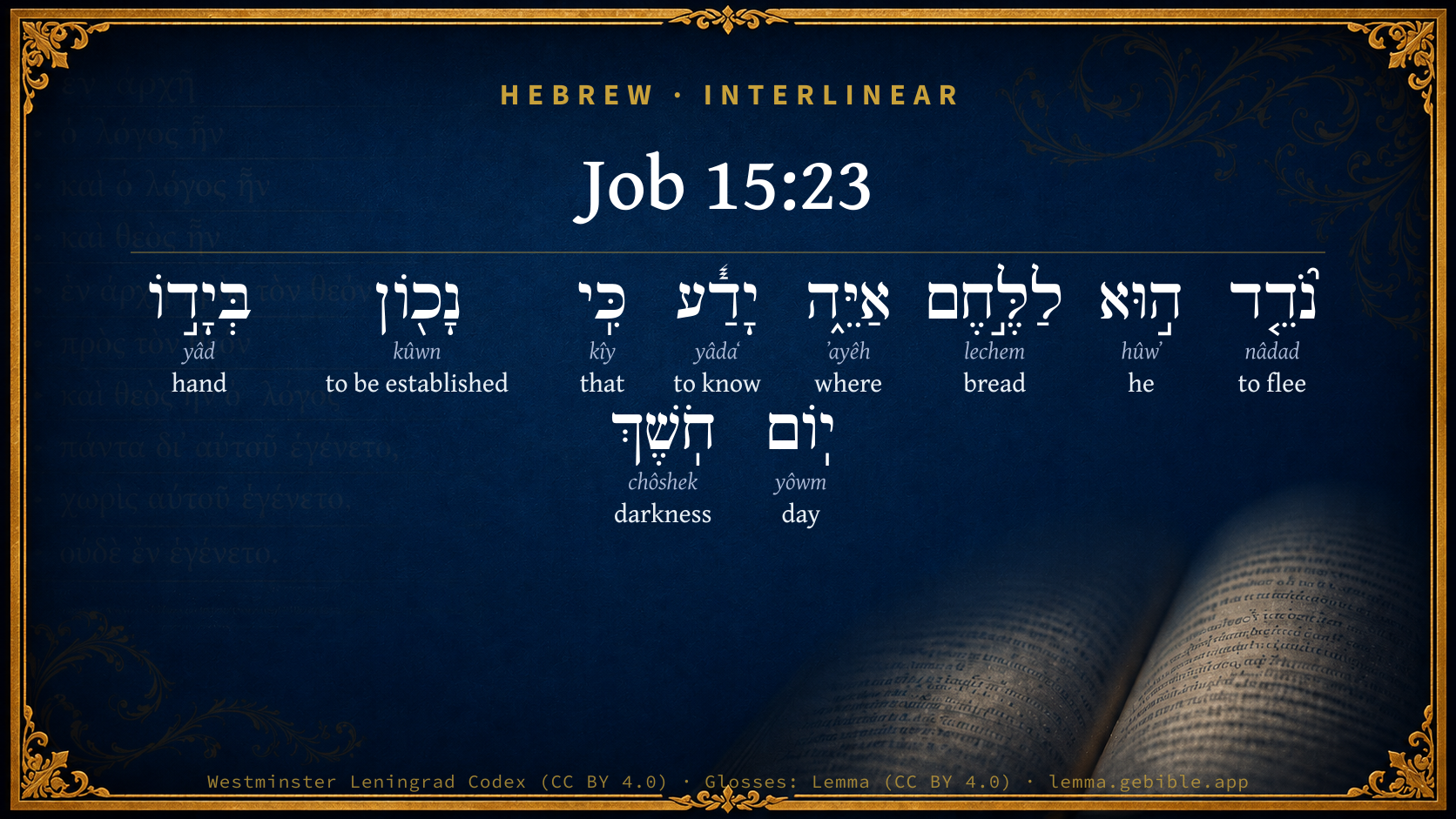
Job 15:23

Hebrew (Westminster Leningrad Codex) Job 15:23 appears in the Hebrew Old Testament. The text above is from the Westminster Leningrad Codex. Each word links to its Strong’s number, a concise gloss, and parsing drawn from the Open Scriptures Hebrew Bible morphology. Click any word for its full Brown-Driver-Briggs (BDB) entry.
Download image
Cite this verse

Job 15:23 (World English Bible). Public Domain. Lemma interlinear Bible study tool, https://lemma.gebible.app/v/job/15/23.

Show BibTeX & RIS
BibTeX
RIS
English Translation
He wanders abroad for bread, saying, 'Where is it?' He knows that the day of darkness is ready at his hand.
World English Bible · Public Domain
Download a study sheet

One document with this verse’s original text, its word-by-word gloss line, the meaning frame, cross-references with their text, attributed commentary, and full source and license credits — printable, and it pastes into notes with its structure intact.

This verse Autodidact and up

Study sheet (.html) Plain text (.txt)

A passage Seminary Student

Up to 50 verses in one chapter. A passage sheet keeps up to 6 commentary sources and 12 cross-references per verse, in the order this page ranks them, and says so on the sheet whenever that leaves anything out. Ask for a single verse and you get the Autodidact verse sheet above.

Everything on this page stays free to read, with no account — the sheet is a download of what is already on screen, not access to it.

Want to remove ads? Support Godless Engineer
Compare translations 3

The same verse in 3 English versions, stacked beneath the original-language interlinear above. Click any original word for its lexicon entry.

Each is an independent rendering of the whole verse — the interlinear is not word-aligned to these translations.

Highlighted words mark where these versions differ — a whole-verse word diff, not a word-by-word alignment.

  • World English Bible Public Domain
    He wanders abroad for bread, saying, 'Where is it?' He knows that the day of darkness is ready at his hand.
  • King James Version Public Domain
    He wandereth abroad for bread, saying, Where is it? he knoweth that the day of darkness is ready at his hand.
  • unfoldingWord Literal Text CC BY-SA 4.0
    He wandering for bread—‘Where?’ He knows that the day of darkness prepared at hand.

unfoldingWord Literal Text — © unfoldingWord, licensed CC BY-SA 4.0. Word-aligned USFM3 via Door43 (git.door43.org/unfoldingWord/en_ult).

Versions to compare (up to 4)

3 of 4 selected

Show all 18 translations

Every available English version of this verse, each an independent rendering of the whole verse.

  • World English Bible Public Domain
    He wanders abroad for bread, saying, 'Where is it?' He knows that the day of darkness is ready at his hand.
  • Berean Standard Bible Public Domain
    He wanders about as food for vultures; he knows the day of darkness is at hand.
  • Majority Standard Bible Public Domain
    He wanders about as food for vultures; he knows the day of darkness is at hand.
  • King James Version Public Domain
    He wandereth abroad for bread, saying, Where is it? he knoweth that the day of darkness is ready at his hand.
  • American Standard Version (1901) Public Domain
    He wandereth abroad for bread, `saying', Where is it? He knoweth that the day of darkness is ready at his hand.
  • Revised Version (1885) Public Domain
    He wandereth abroad for bread, saying, Where is it? he knoweth that the day of darkness is ready at his hand:
  • Geneva Bible (1599) Public Domain
    He wandreth to and from for bread where he may: he knoweth that the day of darkenesse is prepared at hande.
  • Douay-Rheims (1899) Public Domain
    When he moveth himself to seek bread, he knoweth that the day of darkness is ready at his hand.
  • Young's Literal Translation Public Domain
    He is wandering for bread -- `Where `is' it?' He hath known that ready at his hand Is a day of darkness.
  • Literal Standard Version CC BY-SA 4.0
    He is wandering for bread: Where [is] it? He has known that ready at his hand || Is a day of darkness.
  • Unlocked Literal Bible CC BY-SA 4.0
    He goes to various places for bread, saying, 'Where is it?' He knows that the day of darkness is at hand.
  • unfoldingWord Literal Text CC BY-SA 4.0
    He wandering for bread—‘Where?’ He knows that the day of darkness prepared at hand.
  • Darby Bible Public Domain
    He wandereth abroad for bread, -- where may it be? He knoweth that the day of darkness is ready at his hand.
  • World Messianic Bible Public Domain
    He wanders abroad for bread, saying, ‘Where is it?’ He knows that the day of darkness is ready at his hand.
  • Webster's Bible Public Domain
    He wandereth abroad for bread, saying, Where is it? he knoweth that the day of darkness is ready at his hand.
  • Free Bible Version CC BY-SA 4.0
    They wander around looking for food, asking ‘Where is it?’ They know that their day of darkness is close at hand.
  • Bible in Basic English Public Domain
    He is wandering about in search of bread, saying, Where is it? and he is certain that the day of trouble is ready for him:
  • JPS Tanakh (1917) Public Domain
    He wandereth abroad for bread: 'Where is it?' He knoweth that the day of darkness is ready at his hand.

Literal Standard Version (2020), Covenant Press — licensed CC BY-SA 4.0. Text via the HelloAO Bible API (eBible.org). Unlocked Literal Bible (unfoldingWord) — licensed CC BY-SA 4.0. Text via the HelloAO Bible API (eBible.org). unfoldingWord Literal Text — © unfoldingWord, licensed CC BY-SA 4.0. Word-aligned USFM3 via Door43 (git.door43.org/unfoldingWord/en_ult). Free Bible Version, Dr. Jonathan Gallagher — licensed CC BY-SA 4.0. Text via the HelloAO Bible API (eBible.org).

Word by word

More ways to search: Search by grammar → Find every occurrence → Compare this word →

Practice this passage: Drill this verse → Learn its vocabulary →

נֹ֘דֵ֤ד
nâdad
H5074
“fleeing”
Verb, Qal, Participle Active, Masculine, Singular, Absolute
Part of Speech
Verb
Stem
Qal
Form
Participle Active
Gender
Masculine
Number
Singular
State
Absolute
Full BDB Definition

Origin: a primitive root

TWOT: 1300

to retreat, flee, depart, move, wander abroad, stray, flutter - (Qal) - to retreat, flee - to flee, depart - to wander, stray - to flutter (of birds) - (Poal) to flee away, be chased - (Hiphil) to chase away - (Hophal) to be chased away - (Hithpolel) to flee away
  1. ה֣וּא hûwʼ H1931 “he” Pronoun, Personal, 3rd Person, Masculine, Singular
  2. לַלֶּ֣חֶם lechem H3899 “to/for the · bread” Preposition, Determined + Noun, Common, Both, Singular, Absolute
  3. אַיֵּ֑ה ʼayêh H346 “where” Particle, Interrogative
  4. יָדַ֓ע yâdaʻ H3045 “to know” Verb, Qal, Perfect, 3rd Person, Masculine, Singular
  5. כִּֽי kîy H3588 “that” Conjunction
  6. נָכ֖וֹן kûwn H3559 “being established” Verb, Niphal, Participle Active, Masculine, Singular, Absolute
  7. בְּיָד֣וֹ yâd H3027 “in/at · hand · his” Preposition + Noun, Common, Both, Singular, Construct + Suffix, Personal, 3rd Person, Masculine, Singular
  8. יֽוֹם yôwm H3117 “day of” Noun, Common, Masculine, Singular, Construct
  9. חֹֽשֶׁךְ chôshek H2822 “darkness” Noun, Common, Masculine, Singular, Absolute

About this verse

These counts appear in no published source. They are computed here, from the morphology-tagged text and Lemma’s own curated glosses. What Lemma adds →

10
words
10
distinct lemmas
Wisdom
section

Shared distinctive vocabulary

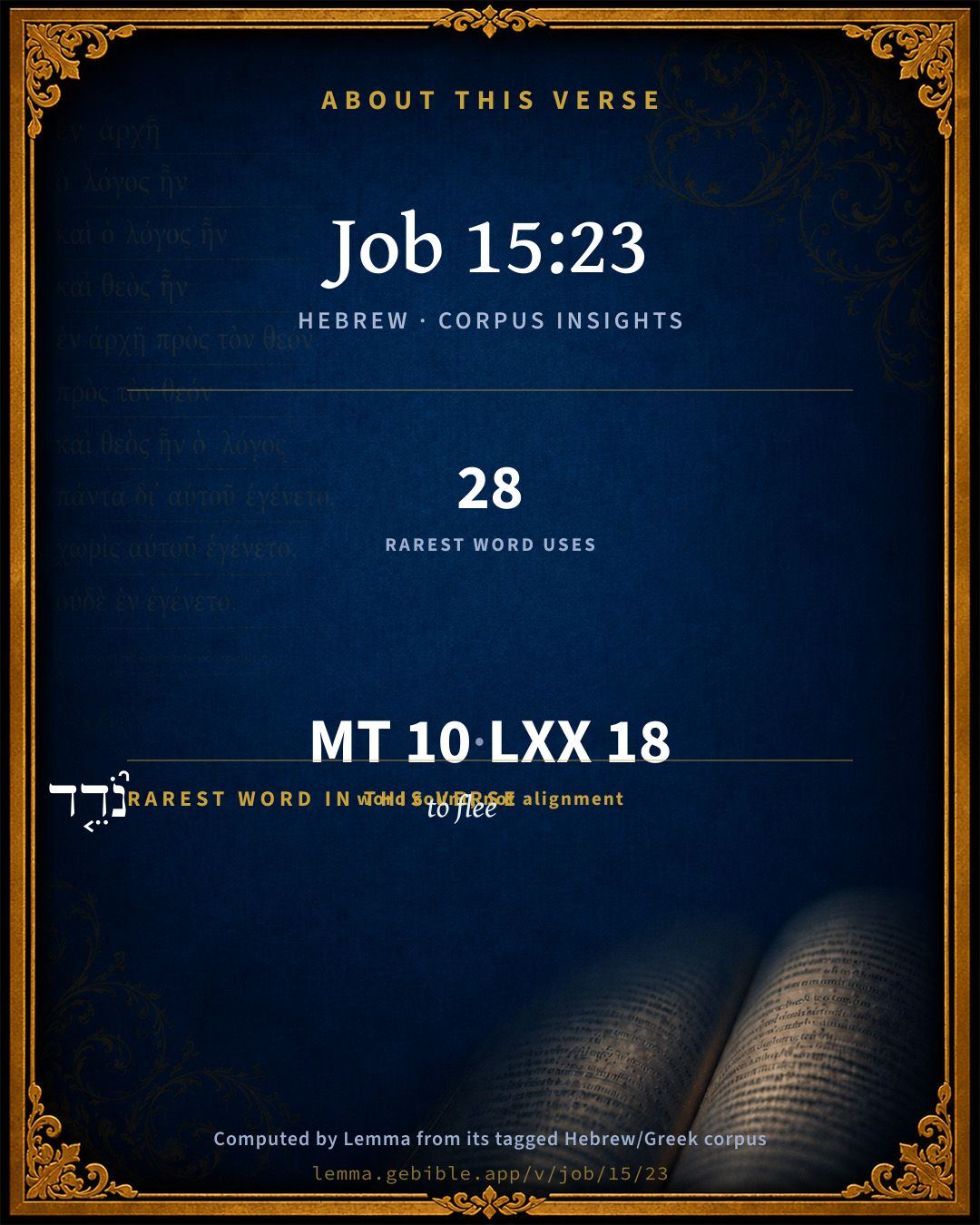
נֹ֘דֵ֤ד to flee H5074 occurs in 26 verses of the Hebrew Bible. Also found in:

Grammatical profile

  • 3 verbs
  • 4 nouns
  • 1 pronoun
  • 1 conjunction
  • 1 particle

Verb forms

  • נֹ֘דֵ֤ד Qal · Participle Active
  • יָדַ֓ע Qal · Perfect
  • נָכ֖וֹן Niphal · Participle Active

Hebrew & Septuagint length

In English translation the verse runs 21 words from the Hebrew and 35 from the Septuagint (LXX English) — the Septuagint runs noticeably longer here. See the side-by-side →

A rough comparison of the two English renderings, which tokenize alike — not a word-level alignment.

Word counts can differ between the Hebrew and the Greek without any difference in meaning — e.g. the Hebrew direct-object marker אֵת has no separate Greek word, and Greek often adds the article ὁ.

In the original languages it is 10 Hebrew tokens and 18 Greek tokens — but the two are counted differently (Hebrew bundles its prefixes and suffixes into one token; the Greek is in lemma form), so that isn’t a like-for-like length.

Cross-references

15

Topical passages linked to Job 15:23 in the Treasury of Scripture Knowledge — connected by theme and wording, ordered by reader-vote popularity; previews shown in the World English Bible.

  • Job 18:12 His strength shall be famished, Calamity shall be ready at his side.
  • Psalms 59:15 They shall wander up and down for food, And wait all night if they aren't satisfied.
  • Psalms 109:10 Let his children be wandering beggars. Let them be sought from their ruins.
  • Ecclesiastes 11:8 Yes, if a man lives many years, let him rejoice in them all; But let him remember the days of darkness, for they shall be many. All that comes is vanity.
  • Amos 5:20 Will the day of Yahweh not be darkness, and not light? Even very dark, and no brightness in it?
  • Genesis 4:12 From now on, when you till the ground, it won't yield its strength to you. You shall be a fugitive and a wanderer in the earth."
  • Job 18:5–6 "Yes, the light of the wicked shall be put out, The spark of his fire shall not shine.
  • Job 18:18 He shall be driven from light into darkness, And chased out of the world.
  • Job 30:3–4 They are gaunt from lack and famine. They gnaw the dry ground, in the gloom of waste and desolation.
  • Lamentations 5:6 We have given the hand to the Egyptians, To the Assyrians, to be satisfied with bread.
  • Lamentations 5:9 We get our bread at the peril of our lives, Because of the sword of the wilderness.
  • Joel 2:2 A day of darkness and gloominess, A day of clouds and thick darkness. As the dawn spreading on the mountains, A great and strong people; There has never been the like, Neither will there be any more after them, Even to the years of many generations.
  • Zephaniah 1:15 That day is a day of wrath, a day of distress and anguish, a day of trouble and ruin, a day of darkness and gloom, a day of clouds and blackness,
  • Hebrews 10:27 but a certain fearful expectation of judgment, and a fierceness of fire which will devour the adversaries.
  • Hebrews 11:37–38 They were stoned. They were sawn apart. They were tempted. They were slain with the sword. They went around in sheep skins and in goat skins; being destitute, afflicted, ill-treated

Cross-references courtesy of OpenBible.info (CC BY 4.0).

Hebrew and Greek witnesses Masoretic Hebrew ↔ Greek Septuagint

The same verse in the two great witnesses to the Old Testament, shown verse-for-verse.

Here the Septuagint runs noticeably longer than the Hebrew — LXX2012 (modern English Septuagint) 35 words vs World English Bible 21. A rough length comparison of the two English translations, not a word-level alignment — read both below.

These are two independent witnesses, not word-aligned to each other, and the Septuagint is shown in lemma (dictionary) form.

Hebrew Job 15:23 Masoretic · Westminster Leningrad Codex

נֹ֘דֵ֤ד ה֣וּא לַלֶּ֣חֶם אַיֵּ֑ה יָדַ֓ע כִּֽי נָכ֖וֹן בְּיָד֣וֹ יֽוֹם חֹֽשֶׁךְ

He wanders abroad for bread, saying, 'Where is it?' He knows that the day of darkness is ready at his hand.

World English Bible · Public Domain

Greek LXX Job 15:23 Septuagint · lemma form

κατατάσσω δέ εἰς σῖτος γύψ οἶδα δέ ἐν ἑαυτοῦ ὅτι μένω εἰς πτῶμα ἡμέρα δέ αὐτός σκοτεινός στροβέω

And he has been appointed to be food for vultures; and he knows within himself that he is doomed to be a carcass: and a dark day shall carry him away as with a whirlwind.

LXX2012 (modern English Septuagint) · Public Domain

On this verse, Trapp's Complete Commentary discusses the Septuagint’s reading. Read the note in Commentary ↓

Hebrew: Westminster Leningrad Codex (CC BY 4.0). Greek: Septuagint (public domain); English from LXX2012 (modern English Septuagint) (Public Domain). How the Septuagint differs from the Hebrew →

Commentary

Notes on Job 15:23 from classic Christian and Jewish commentators (each source and its license shown beneath its notes). The classic Christian expositions comment on the surrounding passage and are grouped to its opening verse, so a note may address several verses; the Jewish commentaries on the Tanakh (Rashi and others) are per-verse, so they appear only where the commentator wrote on this verse.

Lemma curates 59 commentaries, every one of them public domain or Creative Commons licensed, each selected and text-cleaned for this edition rather than reprinted as found. About our sources →

Trapp's Complete Commentary

John Trapp

Job 15:23 He wandereth abroad for bread, [saying], Where [is it]? he knoweth that the day of darkness is ready at his hand.

Ver. 23. He wandereth abroad for bread, saying, Where is it?] He is hard put to it for necessaries, and would be glad of a piece of bread, as 1Sa 2:5; 1Sa 2:36. This was the case of Pythias, once so rich, that he entertained a million men (even Xerxes’ whole huge host) for three days’ time at his own proper charge; but afterwards so poor, that he died through hunger (Herodot.). And the like befell Gillimer, king of Vandals, of whom the story is told, that being overcome and beleaguered by Belisarius, he sent to him for a sponge to dry his tears, a cittern to ease his grief, and a piece of bread to save his life. Belisarius himself was afterwards glad to beg for his bread. And Henry IV, emperor of Germany, after ten years’ reign, was deposed and driven to the like exigent; whereupon he is said to have made use of those words of Job, Job 19:21, "Have pity upon me, have pity upon me, O ye my friends, for the hand of God hath touched me." And there is no doubt but Eliphaz glanceth at Job in all these expressions, as if he were the man whom he here describeth with much eloquence, but small charity.

He knoweth that the day of darkness is ready at his hand] His conscience telleth him that he is not yet at worst; he knows in himself, say the Septuagint, that further evil shall be upon him, that his misery is inevitable, and next door; and this knowledge being full of fear, is also full of torment; it is even hell aforehand, and above ground.

John Trapp, A Commentary or Exposition upon All the Books of the Old and New Testament (1647–1656) — public domain. Text from a community e-Sword module.

The Biblical Illustrator

Joseph S. Exell

Job_15:23

He wandereth abroad for bread, saying, Where is it?

The cry for bread

There are certain things which if men want they will have. I have heard say that in the old bread riots, when men were actually starving for bread, no word had such a terrible threatening and alarming power about it as the word Bread, when shouted by a starving crowd. I have read a description by one who once heard this cry. He said he had been startled at night by a cry of Fire! but when he heard the cry of Bread! Bread! from those who were hungry, it seemed to cut him like a sword. Whatever bread had been in his possession he must at once have handed it out. (C. H. Spurgeon.)

.

The Biblical Illustrator, edited by Joseph S. Exell (c. 1880s–1900s) — public domain. Text from a community e-Sword module.

Joseph Benson's Commentary

Job 15:23. He wandereth abroad for bread — His poverty is so great, that he is forced to wander hither and thither to seek for bread, and cannot find it, a just punishment for him that took away the bread and substance of others by violence. He knoweth that the day of darkness is ready at his hand — He is assured, from his own guilty conscience, that the time of his total, and irrecoverable, and everlasting destruction is ready to seize upon him, and arrest him, as an officer of justice arrests a criminal; that it is appointed to him and cannot be put by, that it is hastening on and cannot be put off. The Hebrew נכון בידו, nachon bejado, may be properly rendered, Is prepared by his own hand, that is, by his works or actions. So the sense is, He is conscious to himself that, by his wicked life, he hath prepared and treasured up calamities and destruction for himself. This day of darkness is something beyond death; it is that day of the Lord which, to all the wicked, will be darkness and not light, and in which they will be doomed to utter, endless darkness.

Joseph Benson's Commentary on the Old and New Testaments (1811–1818) — public domain. Text from a community e-Sword module.

Tyndale Open Study Notes

Tyndale Open Resources

15:23 They wander around, saying, “Where can I find bread?”: Like the wicked (15:20), Job either experienced hunger (see 15:27) or (following the Greek Old Testament) had been “appointed to be food for a vulture,” which would parallel “marked for the sword” (15:22).

Tyndale Open Study Notes — © Tyndale Open Resources, licensed CC BY-SA 4.0. Text via the HelloAO Bible API.

Geneva Bible (1599)

Geneva Bible translators

God doth not only impoverish the wicked oft times, but even in their prosperity he punisheth them with a greediness evermore to gather: which is as a beggary.

Geneva Bible (1599) marginal notes — public domain. Text via Bolls.life.

Jamieson, Fausset & Brown

Robert Jamieson, A. R. Fausset & David Brown

Wandereth in anxious search for bread. Famine in Old Testament depicts sore need (Isa 5:13). Contrast the pious man's lot (Job 5:20-22).

knoweth--has the firm conviction. Contrast the same word applied to the pious (Job 5:24-25).

ready at his hand--an Arabic phrase to denote a thing's complete readiness and full presence, as if in the hand.

Jamieson, Fausset & Brown — Commentary Critical and Explanatory on the Whole Bible (1871) — public domain (CC PDM 1.0). Text via the HelloAO Bible API.

Adam Clarke's Commentary

Verse 23. He wandereth abroad for bread] He is reduced to a state of the utmost indigence, he who was once in affluence requires a morsel of bread, and can scarcely by begging procure enough to sustain life.

Is ready at his hand.] Is בידו beyado, in his hand - in his possession. As he cannot get bread, he must soon meet death.

Adam Clarke's Commentary on the Bible (1810–1826) — public domain. Text from a community e-Sword/MySword module.

Ellicott's Commentary for English Readers

(23) He wandereth abroad for bread.—This is one of the points in which the picture seems inconsistent, because overdrawn, except that forage as well as plunder may be the object of marauding raids.

A Bible Commentary for English Readers, edited by Charles John Ellicott (1878–1897) — public domain. Text from a community e-Sword module.

The Cambridge Bible for Schools and Colleges

gen. ed. J. J. S. Perowne

23. He anticipates the time when he shall be a hungry wanderer, roving in search of bread and crying, Where is it? The picture of the rich oppressor tormented by visions of famine is very graphic.

ready at hand] Or, at his side; the dark day of calamity stands constantly beside him ready to envelop him in its shadows. Such is his own foreboding (“he knows”).

The Cambridge Bible for Schools and Colleges (gen. ed. J. J. S. Perowne; Cambridge University Press, 1878–1918) — public domain. Text from a community e-Sword module.

John Gill's Exposition

Trouble and anguish shall make him afraid,.... Either his present troubles shall frighten him, they being so very dismal, terrible, and distressing, and make him fear that others were coming on, more dreadful and formidable; or those troubles he fears will be his portion hereafter, these terrify him beyond measure, even that indignation and wrath, tribulation and anguish, that shall come upon every soul of man that doeth evil, Rom 2:8;

they shall prevail against him as a king ready to the battle; that is, trouble and anguish shall prevail against him; he will be no more able to resist them than a very inferior force, or even a single man, is able to resist a warlike king, attended with a numerous army, and these set in battle array; such a man's troubles will come upon him as an armed man, against which he cannot stand; the Targum is,

"they shall surround him as a king prepared for a footstool;''

who being taken by the enemy shall be used as a footstool to mount on horseback; and as the word has the signification of a globe or ball, see Isa 22:18; some think it has respect to the manner of kings, when taken captive, put into an iron cage, as Bajazet was by Tamerlane; or into an iron hoop, bound hand and foot, and hung up in chains; or, as Ben Gersom thinks, to the manner of drowning persons, who used to be tied hand and foot, as if rolled up in the form of a globe, and so cast into the water; but rather the reference is to an army, besieging a place all around in the form of a ball or globe, so that there is no escaping them; or rather it may be to a king drawing up his army in such a form, ready to engage in battle; or putting it in such a position when encamped or entrenched, waiting the motion of the enemy; see Sa1 26:5; and such are the troubles that surround and prevail against a wicked man, see Isa 29:3; the reasons of the wicked man being brought into such a woeful condition follow.

John Gill's Exposition of the Whole Bible (1746–1763) — public domain (CC PDM 1.0). Text via the HelloAO Bible API.

Albert Barnes' Notes on the Bible

He wandereth abroad for bread - The Septuagint renders this, “he is destined to be food for vultures” - κατατέτακται δὲ εἰς σῖτα γυψίν katatetaktai de eis sitos gupsin. The meaning of the Hebrew is, simply, that he will be reduced to poverty, and will not know where to obtain a supply for his returning needs.

He knoweth that the day of darkness is ready at his hand - He is assured that the period of calamity is not far remote. It must come. He has no security that it will not come immediately. The whole design of this is to show that there is no calmness and security for a wicked man; that in the midst of apparent prosperity his soul is in constant dread.

Albert Barnes' Notes on the Bible (1834–1885) — public domain. Text from a community e-Sword/MySword module.

Matthew Poole's English Annotations

His poverty is so great, that he is forced to wander hither and thither to seek for bread, and cannot find it. A just punishment for him that took away the bread and substance of others by violence.

He knoweth; he is assured of it from his own guilty conscience.

The day of darkness, i.e. the time of his total, and irrecoverable, and everlasting destruction.

Is ready at his hand, i.e. ready to seize upon him, or take him by the hand or shoulder like a serjeant to arrest him. The words may well he rendered, was prepared by his hand, i.e. by his works or actions; which being most commonly done with the hand, are oft called by that name, as Exo 14:31; Jdg 9:16; Pro 10:4; 12:24. So the sense is, He is conscious to himself that by his wicked life he hath prepared and stored up calamities and destruction for himself, and therefore he expected nothing less.

Matthew Poole's English Annotations on the Holy Bible (1683–1685) — public domain. Text from a community e-Sword/MySword module.

Whedon's Commentary on the Bible

Daniel D. Whedon

23. Where is it — אוה. This word, differently pointed, may signify vulture, (γρυψιν, Septuagint,) which leads Merx to render the passage, “He wanders about to be the food of vultures.” Better the text, with its outcry “where?” The one touch of the pencil paints the confusion and despair of famine. “He sees himself in the mirror of the future reduced to beggary.” — Delitzsch. The imagination — that faculty by which we form images, real or unreal — is a powerful agent which God uses for the punishment of men in this present life.

Daniel D. Whedon (gen. ed.), Commentary on the Old and New Testaments (1874–1909) — public domain. Text from a community e-Sword module.

The Pulpit Commentary

He wandereth abroad for bread, saying, Where is it? This, again, might appropriately have been said of Cain, who was "a fugitive and a vagabond in the earth", (Gen_4:14) and may at times have had difficulty in procuring his daily bread. At any rate, it is the frequent experience of the wicked who lose their ill-gotten gains, and are brought down to abject poverty, and actual want of the necessaries of life. "He wanders abroad to be the food of vultures" is a translation of the passage suggested by some moderns (as Merx), and has the support of the Septuagint, katatetaktai eiv sita quqin . But it requires a slight change in the pointing. He knoweth that the day of darkness is nigh at hand. "The day of darkness" is probably the day of his decease: this he "knows," or at any rate, surmises, to be near.

The Pulpit Commentary (1880–1919), ed. H.D.M. Spence-Jones & Joseph S. Exell — public domain. Text from a community e-Sword module.

John Wesley's Explanatory Notes

Knoweth - From his own guilty conscience.

John Wesley, Explanatory Notes Upon the Whole Bible (1754–1765) — public domain. Text via the GEBible commentary corpus.

Rashi

Rabbi Shlomo Yitzchaki (Rashi)

He wanders i.e., he is assured of wandering.

He knows in fact.

that...is ready and prepared to come to his hand, i.e., to him, and with him is the day of darkness. at his hand Like (Gen. 32: 14), “from what came into his hand.”

Rashi on the Tanakh — English translations: “The Judaica Press complete Tanach with Rashi, translated by A. J. Rosenberg” (CC BY 4.0); “Pentateuch with Rashi's commentary by M. Rosenbaum and A.M. Silbermann, 1929-1934” (public domain); “The Metsudah Tanach series, Lakewood, N.J” (CC BY 4.0); and “The Book of Joshua, Metsudah Publications, 1997” (CC BY 4.0). Text via Sefaria.

Lesson kit

Teaching starters — assembled from the data on this page, not authored interpretation. Every prompt links to the verse data it draws on. Edit before teaching.

Job, in the Wisdom, opens this verse with 10 words (10 distinct Hebrew lemmas). Its most distinctive word is nâdad (“to flee”). The Greek Septuagint runs longer here. A historical commentator’s framing appears above. Read the whole chapter for the surrounding context.

Discussion questions

  1. How does “to flee” (nâdad) shape what this verse is saying?
  2. Genesis 31:40 shares the word «to flee» with this verse. How do the two illuminate each other?
  3. Compared with the Hebrew, the Septuagint runs longer here. What questions does that raise?
  4. These translations render this verse differently. What is at stake in choosing one wording over another?
  5. The verb «נֹ֘דֵ֤ד» is Qal Participle Active. How does its form color the action?
  6. Reading how Trapp's Complete Commentary and The Biblical Illustrator read this verse, where do the two commentators agree and where do they part?

Things to notice

Reading settings

Reading text

Shown beneath each verse's original-language words.

Old Testament
Old Testament edition

Read the OT as the Masoretic Hebrew (MT) or the Greek Septuagint (LXX).

English shown for the Greek Septuagint (in the Hebrew ↔ Greek comparison).

Comparing translations? Open the Compare panel on any verse page to stack up to four side by side.