
Job 42:11

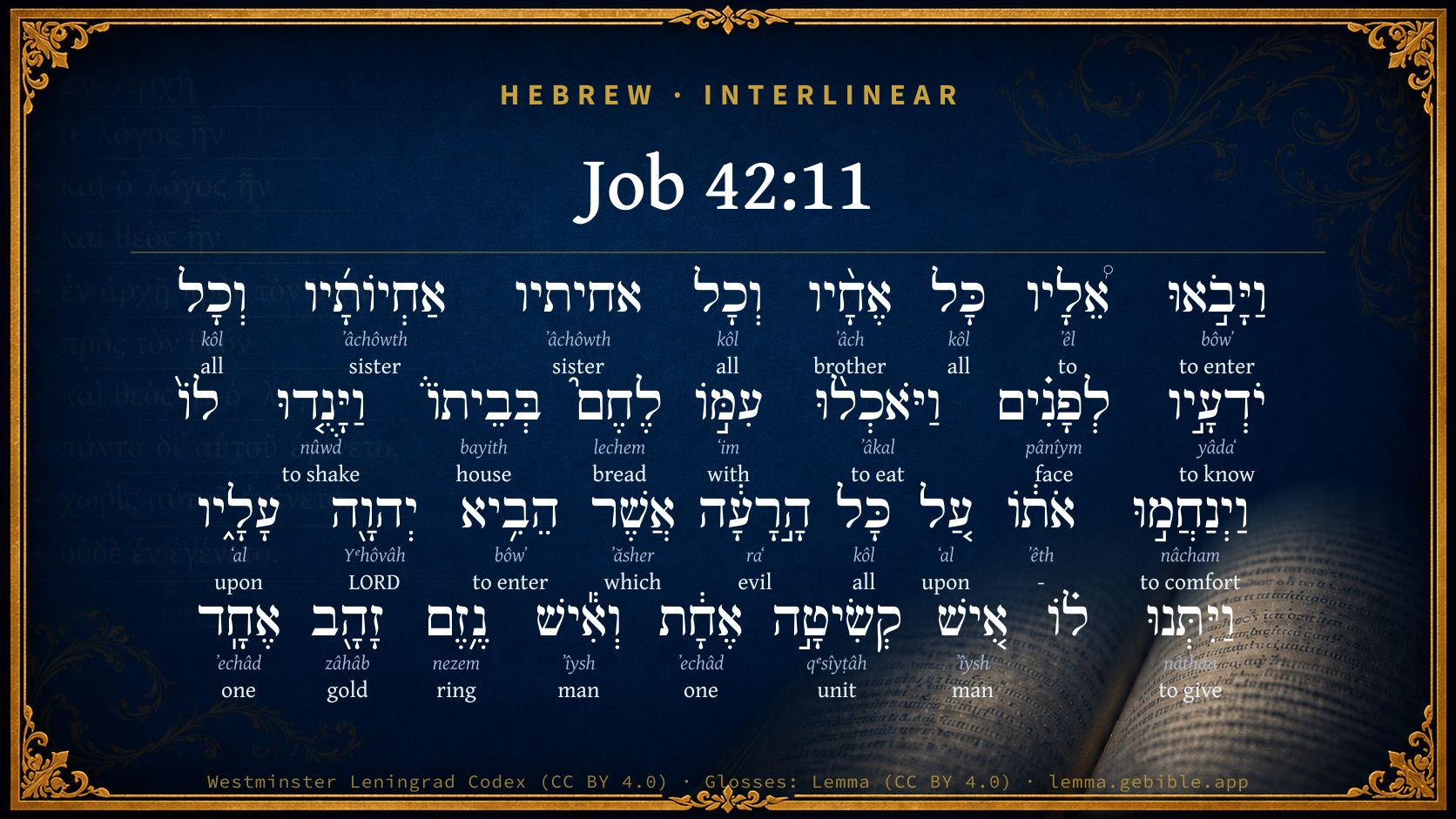
Hebrew (Westminster Leningrad Codex) Job 42:11 appears in the Hebrew Old Testament. The text above is from the Westminster Leningrad Codex. Each word links to its Strong’s number, a concise gloss, and parsing drawn from the Open Scriptures Hebrew Bible morphology. Click any word for its full Brown-Driver-Briggs (BDB) entry.
Download image
Cite this verse

Job 42:11 (World English Bible). Public Domain. Lemma interlinear Bible study tool, https://lemma.gebible.app/v/job/42/11.

Show BibTeX & RIS
BibTeX
RIS
English Translation
Then came there to him all his brothers, and all his sisters, and all those who had been of his acquaintance before, and ate bread with him in his house. They comforted him, and consoled him concerning all the evil that Yahweh had brought on him. Everyone also gave him a piece of money, and everyone a ring of gold.
World English Bible · Public Domain
Download a study sheet

One document with this verse’s original text, its word-by-word gloss line, the meaning frame, cross-references with their text, attributed commentary, and full source and license credits — printable, and it pastes into notes with its structure intact.

This verse Autodidact and up

Study sheet (.html) Plain text (.txt)

A passage Seminary Student

Up to 50 verses in one chapter. A passage sheet keeps up to 6 commentary sources and 12 cross-references per verse, in the order this page ranks them, and says so on the sheet whenever that leaves anything out. Ask for a single verse and you get the Autodidact verse sheet above.

Everything on this page stays free to read, with no account — the sheet is a download of what is already on screen, not access to it.

Want to remove ads? Support Godless Engineer
Compare translations 3

The same verse in 3 English versions, stacked beneath the original-language interlinear above. Click any original word for its lexicon entry.

Each is an independent rendering of the whole verse — the interlinear is not word-aligned to these translations.

Highlighted words mark where these versions differ — a whole-verse word diff, not a word-by-word alignment.

  • World English Bible Public Domain
    Then came there to him all his brothers, and all his sisters, and all those who had been of his acquaintance before, and ate bread with him in his house. They comforted him, and consoled him concerning all the evil that Yahweh had brought on him. Everyone also gave him a piece of money, and everyone a ring of gold.
  • King James Version Public Domain
    Then came there unto him all his brethren, and all his sisters, and all they that had been of his acquaintance before, and did eat bread with him in his house: and they bemoaned him, and comforted him over all the evil that the LORD had brought upon him: every man also gave him a piece of money, and every one an earring of gold.
  • unfoldingWord Literal Text CC BY-SA 4.0
    And all of his brothers and all of his sisters and all of the ones knowing him before came to him, and they ate bread with him in his house. And they consoled him and comforted him for all of the troubles that Yahweh had brought upon him, and they each gave one kesitah to him and each one earring of gold.

unfoldingWord Literal Text — © unfoldingWord, licensed CC BY-SA 4.0. Word-aligned USFM3 via Door43 (git.door43.org/unfoldingWord/en_ult).

Versions to compare (up to 4)

3 of 4 selected

Show all 18 translations

Every available English version of this verse, each an independent rendering of the whole verse.

  • World English Bible Public Domain
    Then came there to him all his brothers, and all his sisters, and all those who had been of his acquaintance before, and ate bread with him in his house. They comforted him, and consoled him concerning all the evil that Yahweh had brought on him. Everyone also gave him a piece of money, and everyone a ring of gold.
  • Berean Standard Bible Public Domain
    All his brothers and sisters and prior acquaintances came and dined with him in his house. They consoled him and comforted him over all the adversity that the LORD had brought upon him. And each one gave him a piece of silver and a gold ring.
  • Majority Standard Bible Public Domain
    All his brothers and sisters and prior acquaintances came and dined with him in his house. They consoled him and comforted him over all the adversity that the LORD had brought upon him. And each one gave him a piece of silver and a gold ring.
  • King James Version Public Domain
    Then came there unto him all his brethren, and all his sisters, and all they that had been of his acquaintance before, and did eat bread with him in his house: and they bemoaned him, and comforted him over all the evil that the LORD had brought upon him: every man also gave him a piece of money, and every one an earring of gold.
  • American Standard Version (1901) Public Domain
    Then came there unto him all his brethren, and all his sisters, and all they that had been of his acquaintance before, and did eat bread with him in his house: and they bemoaned him, and comforted him concerning all the evil that Jehovah had brought upon him: every man also gave him a piece of money, and every one a ring of gold.
  • Revised Version (1885) Public Domain
    Then came there unto him all his brethren, and all his sisters, and all they that had been of his acquaintance before, and did eat bread with him in his house: and they bemoaned him, and comforted him concerning all the evil that the LORD had brought upon him: every man also gave him a piece of money, and every one a ring of gold.
  • Geneva Bible (1599) Public Domain
    Then came vnto him all his brethren, and all his sisters, and all they that had bene of his acquaintance before, and did eate bread with him in his house, and had compassion of him, and comforted him for al the euil, that the Lord had brought vpon him, and euery man gaue him a piece of money, and euery one an earing of golde.
  • Douay-Rheims (1899) Public Domain
    And all his brethren came to him, and all his sisters, and all that knew him before, and they ate bread with him in his house: and bemoaned him, and comforted him upon all the evil that God had brought upon him. And every man gave him one ewe, and one earring of fold.
  • Young's Literal Translation Public Domain
    And come unto him do all his brethren, and all his sisters, and all his former acquaintances, and they eat bread with him in his house, and bemoan him, and comfort him concerning all the evil that Jehovah had brought upon him, and they gave to him each one kesitah, and each one ring of gold.
  • Literal Standard Version CC BY-SA 4.0
    And all his brothers come to him, and all his sisters, and all his former acquaintances, and they eat bread with him in his house, and bemoan him, and comfort him concerning all the calamity that YHWH had brought on him, and they each gave to him one kesitah, and each one ring of gold.
  • Unlocked Literal Bible CC BY-SA 4.0
    Then all Job's brothers, and all his sisters, and all who knew him before, came to him and ate food with him in his house. They showed him sympathy and comforted him for all the disasters that Yahweh had brought upon him, and each of them gave Job a piece of silver and a ring of gold.
  • unfoldingWord Literal Text CC BY-SA 4.0
    And all of his brothers and all of his sisters and all of the ones knowing him before came to him, and they ate bread with him in his house. And they consoled him and comforted him for all of the troubles that Yahweh had brought upon him, and they each gave one kesitah to him and each one earring of gold.
  • Darby Bible Public Domain
    And all his brethren, and all his sisters, and all they that had been of his acquaintance before, came to him, and they ate bread with him in his house, and they condoled with him, and comforted him concerning all the evil that Jehovah had brought upon him; and every one gave him a piece of money, and every one a golden ring.
  • World Messianic Bible Public Domain
    Then all his brothers, all his sisters, and all those who had been of his acquaintance before, came to him and ate bread with him in his house. They comforted him, and consoled him concerning all the evil that the LORD had brought on him. Everyone also gave him a piece of money, and everyone a ring of gold.
  • Webster's Bible Public Domain
    Then came there to him all his brethren, and all his sisters, and all they that had been of his acquaintance before, and ate bread with him in his house: and they condoled with him, and comforted him over all the evil that the LORD had brought upon him: every man also gave him a piece of money, and every one an ear-ring of gold.
  • Free Bible Version CC BY-SA 4.0
    Then all his brothers and sisters and friends he'd previously known came and ate with him at his home. They showed him sympathy and comforted him because of all the trouble the Lord had caused him. Each one of them gave him money and a gold ring.
  • Bible in Basic English Public Domain
    And all his brothers and sisters, and his friends of earlier days, came and took food with him in his house; and made clear their grief for him, and gave him comfort for all the evil which the Lord had sent on him; and they all gave him a bit of money and a gold ring.
  • JPS Tanakh (1917) Public Domain
    Then came there unto him all his brethren, and all his sisters, and all they that had been of his acquaintance before, and did eat bread with him in his house; and they bemoaned him, and comforted him concerning all the evil that the LORD had brought upon him; every man also gave him a piece of money, and every one a ring of gold.

Literal Standard Version (2020), Covenant Press — licensed CC BY-SA 4.0. Text via the HelloAO Bible API (eBible.org). Unlocked Literal Bible (unfoldingWord) — licensed CC BY-SA 4.0. Text via the HelloAO Bible API (eBible.org). unfoldingWord Literal Text — © unfoldingWord, licensed CC BY-SA 4.0. Word-aligned USFM3 via Door43 (git.door43.org/unfoldingWord/en_ult). Free Bible Version, Dr. Jonathan Gallagher — licensed CC BY-SA 4.0. Text via the HelloAO Bible API (eBible.org).

Word by word

More ways to search: Search by grammar → Find every occurrence → Compare this word →

Practice this passage: Drill this verse → Learn its vocabulary →

קְשִׂיטָ֣ה
qᵉsîyṭâh
H7192
“unit”
Noun, Common, Feminine, Singular, Absolute
Part of Speech
Noun
Type
Common
Gender
Feminine
Number
Singular
State
Absolute
Full BDB Definition

Origin: from an unused root (probably meaning to weigh out)

TWOT: 2081a

a unit of unknown value - perhaps weight, money
  1. וַיָּבֹ֣אוּ bôwʼ H935 “and · to enter” Conjunction + Verb, Qal, Sequential Imperfect, 3rd Person, Masculine, Plural
  2. אֵ֠לָיו ʼêl H413 “to · him” Preposition + Suffix, Personal, 3rd Person, Masculine, Singular
  3. כָּל kôl H3605 “all of” Noun, Common, Masculine, Singular, Construct
  4. אֶחָ֨יו ʼâch H251 “brothers · his” Noun, Common, Masculine, Plural, Construct + Suffix, Personal, 3rd Person, Masculine, Singular
  5. וְכָל kôl H3605 “and · all of” Conjunction + Noun, Common, Masculine, Singular, Construct
  6. אחיתיו ʼâchôwth H269 “sisters · his” Noun, Common, Feminine, Plural, Construct + Suffix, Personal, 3rd Person, Masculine, Singular
  7. אַחְיוֹתָ֜יו ʼâchôwth H269 “sisters · his” Noun, Common, Feminine, Plural, Construct + Suffix, Personal, 3rd Person, Masculine, Singular
  8. וְכָל kôl H3605 “and · all of” Conjunction + Noun, Common, Masculine, Singular, Construct
  9. יֹדְעָ֣יו yâdaʻ H3045 “knowing · him” Verb, Qal, Participle Active, Masculine, Plural, Construct + Suffix, Personal, 3rd Person, Masculine, Singular
  10. לְפָנִ֗ים pânîym H6440 “to/for · face(s)” Preposition + Noun, Common, Both, Plural, Absolute
  11. וַיֹּאכְל֨וּ ʼâkal H398 “and · to eat” Conjunction + Verb, Qal, Sequential Imperfect, 3rd Person, Masculine, Plural
  12. עִמּ֣וֹ ʻim H5973 “with · him” Preposition + Suffix, Personal, 3rd Person, Masculine, Singular
  13. לֶחֶם֮ lechem H3899 “bread” Noun, Common, Both, Singular, Absolute
  14. בְּבֵיתוֹ֒ bayith H1004 “in/at · house · his” Preposition + Noun, Common, Masculine, Singular, Construct + Suffix, Personal, 3rd Person, Masculine, Singular
  15. וַיָּנֻ֤דוּ nûwd H5110 “and · to shake” Conjunction + Verb, Qal, Sequential Imperfect, 3rd Person, Masculine, Plural
  16. וַיְנַחֲמ֣וּ nâcham H5162 “and · to comfort” Conjunction + Verb, Piel, Sequential Imperfect, 3rd Person, Masculine, Plural
  17. אֹת֔וֹ ʼêth H853 “- · him” Particle, Direct Object + Suffix, Personal, 3rd Person, Masculine, Singular
  18. עַ֚ל ʻal H5921 “upon” Preposition
  19. כָּל kôl H3605 “all of” Noun, Common, Masculine, Singular, Construct
  20. הָ֣רָעָ֔ה raʻ H7451 “the · evil” Particle, Definite Article + Noun, Common, Feminine, Singular, Absolute
  21. אֲשֶׁר ʼăsher H834 “which” Particle, Relative
  22. הֵבִ֥יא bôwʼ H935 “to enter” Verb, Hiphil, Perfect, 3rd Person, Masculine, Singular
  23. יְהוָ֖ה Yᵉhôvâh H3068 “LORD” Noun, Proper
  24. עָלָ֑יו ʻal H5921 “upon · him” Preposition + Suffix, Personal, 3rd Person, Masculine, Singular
  25. וַיִּתְּנוּ nâthan H5414 “and · to give” Conjunction + Verb, Qal, Sequential Imperfect, 3rd Person, Masculine, Plural
  26. אִ֚ישׁ ʼîysh H376 “man” Noun, Common, Masculine, Singular, Absolute
  27. אֶחָ֔ת ʼechâd H259 “one” Adjective, Cardinal number, Feminine, Singular, Absolute
  28. וְאִ֕ישׁ ʼîysh H376 “and · man” Conjunction + Noun, Common, Masculine, Singular, Absolute
  29. נֶ֥זֶם nezem H5141 “ring of” Noun, Common, Masculine, Singular, Construct
  30. זָהָ֖ב zâhâb H2091 “gold” Noun, Common, Masculine, Singular, Absolute
  31. אֶחָֽד ʼechâd H259 “one” Adjective, Cardinal number, Masculine, Singular, Absolute

About this verse

These counts appear in no published source. They are computed here, from the morphology-tagged text and Lemma’s own curated glosses. What Lemma adds →

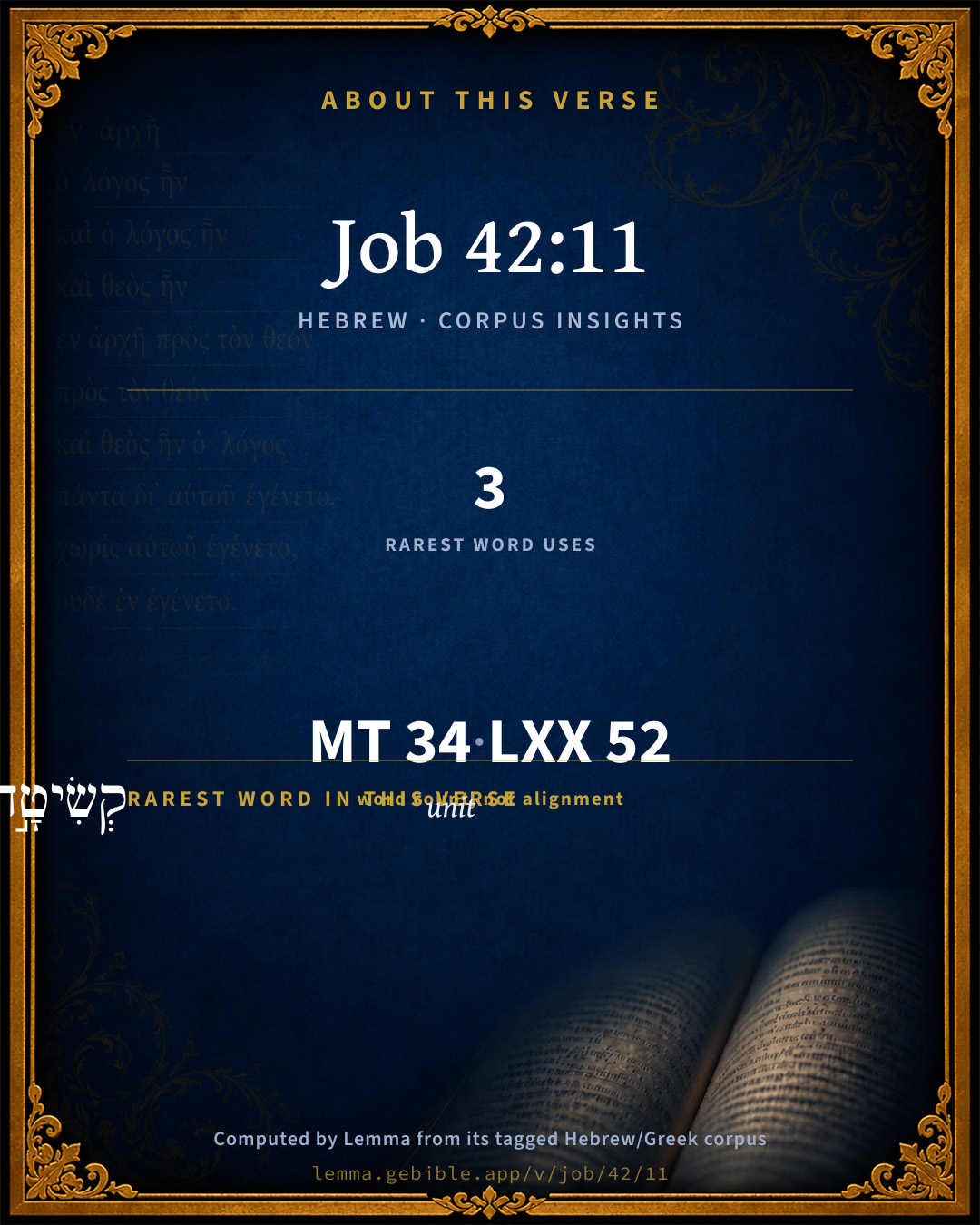
34
words
24
distinct lemmas
Wisdom
section

Notable vocabulary

The rarest word here is קְשִׂיטָ֣ה unit H7192 — appearing just 3 times in the whole Hebrew Bible.

Shared distinctive vocabulary

קְשִׂיטָ֣ה unit H7192 occurs in 3 verses of the Hebrew Bible. Also found in:

Grammatical profile

  • 7 verbs
  • 17 nouns
  • 2 adjectives
  • 6 prepositions
  • 2 particles

Verb forms

  • וַיָּבֹ֣אוּ Qal · Sequential Imperfect
  • יֹדְעָ֣יו Qal · Participle Active
  • וַיֹּאכְל֨וּ Qal · Sequential Imperfect
  • וַיָּנֻ֤דוּ Qal · Sequential Imperfect
  • וַיְנַחֲמ֣וּ Piel · Sequential Imperfect
  • הֵבִ֥יא Hiphil · Perfect
  • וַיִּתְּנוּ Qal · Sequential Imperfect

Repetition

Words recur within this verse — often emphatic in Hebrew:

  • כָּל all H3605 ×4
  • וַיָּבֹ֣אוּ to enter H935 ×2
  • אחיתיו sister H269 ×2
  • עַ֚ל upon H5921 ×2
  • אִ֚ישׁ man H376 ×2
  • אֶחָ֔ת one H259 ×2

Hebrew & Septuagint length

In English translation the verse runs 60 words from the Hebrew and 68 from the Septuagint (LXX English) — closely comparable.

A rough comparison of the two English renderings, which tokenize alike — not a word-level alignment.

Word counts can differ between the Hebrew and the Greek without any difference in meaning — e.g. the Hebrew direct-object marker אֵת has no separate Greek word, and Greek often adds the article ὁ.

In the original languages it is 34 Hebrew tokens and 52 Greek tokens — but the two are counted differently (Hebrew bundles its prefixes and suffixes into one token; the Greek is in lemma form), so that isn’t a like-for-like length.

Cross-references

17

Topical passages linked to Job 42:11 in the Treasury of Scripture Knowledge — connected by theme and wording, ordered by reader-vote popularity; previews shown in the World English Bible.

  • Job 2:11 Now when Job's three friends heard of all this evil that had come on him, they each came from his own place: Eliphaz the Temanite, Bildad the Shuhite, and Zophar the Naamathite, and they made an appointment together to come to sympathize with him and to comfort him.
  • Job 19:13–14 "He has put my brothers far from me. My acquaintances are wholly estranged from me.
  • Genesis 24:22 It happened, as the camels had done drinking, that the man took a golden ring of half a shekel weight, and two bracelets for her hands of ten shekels weight of gold,
  • Proverbs 16:7 When a man's ways please Yahweh, He makes even his enemies to be at peace with him.
  • Romans 12:15 Rejoice with those who rejoice. Weep with those who weep.
  • Hebrews 12:12 Therefore, lift up the hands that hang down and the feeble knees,
  • Genesis 24:53 The servant brought forth jewels of silver, and jewels of gold, and clothing, and gave them to Rebekah. He gave also to her brother and to her mother precious things.
  • Genesis 37:35 All his sons and all his daughters rose up to comfort him; but he refused to be comforted. He said, "For I will go down to Sheol to my son mourning." His father wept for him.
  • Joshua 24:32 The bones of Joseph, which the children of Israel brought up out of Egypt, buried they in Shechem, in the parcel of ground which Jacob bought of the sons of Hamor the father of Shechem for a hundred pieces of money: and they became the inheritance of the children of Joseph.
  • 1 Samuel 10:27 But certain worthless fellows said, How shall this man save us? They despised him, and brought him no present. But he held his peace.
  • Job 4:4 Your words have supported him who was falling, You have made firm the feeble knees.
  • Job 16:5 But I would strengthen you with my mouth. The solace of my lips would relieve you.
  • Isaiah 35:3–4 Strengthen you the weak hands, and confirm the feeble knees.
  • 1 Corinthians 12:26 When one member suffers, all the members suffer with it. Or when one member is honored, all the members rejoice with it.
  • Hebrews 13:3 Remember those who are in bonds, as bound with them; and those who are ill-treated, since you are also in the body.
  • Job 6:22–23 Did I say, 'Give to me?' Or, 'Offer a present for me from your substance?'
  • John 11:19 Many of the Jews had joined the women around Martha and Mary, to console them concerning their brother.

Cross-references courtesy of OpenBible.info (CC BY 4.0).

Hebrew and Greek witnesses Masoretic Hebrew ↔ Greek Septuagint

The same verse in the two great witnesses to the Old Testament, shown verse-for-verse.

These are two independent witnesses, not word-aligned to each other, and the Septuagint is shown in lemma (dictionary) form.

Hebrew Job 42:11 Masoretic · Westminster Leningrad Codex

וַיָּבֹ֣אוּ אֵ֠לָיו כָּל אֶחָ֨יו וְכָל אחיתיו אַחְיוֹתָ֜יו וְכָל יֹדְעָ֣יו לְפָנִ֗ים וַיֹּאכְל֨וּ עִמּ֣וֹ לֶחֶם֮ בְּבֵיתוֹ֒ וַיָּנֻ֤דוּ לוֹ֙ וַיְנַחֲמ֣וּ אֹת֔וֹ עַ֚ל כָּל הָ֣רָעָ֔ה אֲשֶׁר הֵבִ֥יא יְהוָ֖ה עָלָ֑יו וַיִּתְּנוּ ל֗וֹ אִ֚ישׁ קְשִׂיטָ֣ה אֶחָ֔ת וְאִ֕ישׁ נֶ֥זֶם זָהָ֖ב אֶחָֽד

Then came there to him all his brothers, and all his sisters, and all those who had been of his acquaintance before, and ate bread with him in his house. They comforted him, and consoled him concerning all the evil that Yahweh had brought on him. Everyone also gave him a piece of money, and everyone a ring of gold.

World English Bible · Public Domain

Greek LXX Job 42:11 Septuagint · lemma form

ἀκούω δέ πᾶς ὁ ἀδελφός αὐτός καί ὁ ἀδελφή αὐτός πᾶς ὁ συνβαίνω αὐτός καί ἔρχομαι πρός αὐτός καί πᾶς ὅσος οἶδα αὐτός ἐκ πρῶτος ἐσθίω δέ καί πίνω παρά αὐτός παρακαλέω αὐτός καί θαυμάζω ἐπί πᾶς ὅς ἐπιἄγω αὐτός ὁ κύριος δίδωμι δέ αὐτός ἕκαστος ἀμνάς εἷς καί τετράδραχμον χρυσοῦς ἄσημος

And all his brethren and his sisters heard all that had happened to him, and they came to him, and so did all that had known him from the first: and they ate and drank with him, and comforted him, and wondered at all that the Lord had brought upon him: and each one gave him a lamb, and four drachmas' weight of gold, even of unstamped gold.

LXX2012 (modern English Septuagint) · Public Domain

On this verse, Adam Clarke's Commentary discusses the Septuagint’s reading. Read the note in Commentary ↓

Hebrew: Westminster Leningrad Codex (CC BY 4.0). Greek: Septuagint (public domain); English from LXX2012 (modern English Septuagint) (Public Domain). How the Septuagint differs from the Hebrew →

Commentary

Notes on Job 42:11 from classic Christian and Jewish commentators (each source and its license shown beneath its notes). The classic Christian expositions comment on the surrounding passage and are grouped to its opening verse, so a note may address several verses; the Jewish commentaries on the Tanakh (Rashi and others) are per-verse, so they appear only where the commentator wrote on this verse.

Lemma curates 59 commentaries, every one of them public domain or Creative Commons licensed, each selected and text-cleaned for this edition rather than reprinted as found. About our sources →

Trapp's Complete Commentary

John Trapp

Job 42:11 Then came there unto him all his brethren, and all his sisters, and all they that had been of his acquaintance before, and did eat bread with him in his house: and they bemoaned him, and comforted him over all the evil that the LORD had brought upon him: every man also gave him a piece of money, and every one an earring of gold.

Ver. 11. Then came there unto him all his brethren] Then, when God had begun to restore him. As his adversity had scattered his friends, so his prosperity brought them together again. This is the world’s usage.

Dum fueris faelix multos numerabis amicos;

Tempera si fuerint nubila, solus eris.

Summer birds there are not a few; Samaritans who would own the Jews while they flourished but otherwise disavow them; as they did to Antiochus Epiphanes: rich Job had many friends, Pro 14:20. Qui tamen persistebant amicitia sicut lepus iuxta tympanum, as the proverb is. All this good Job passeth by, and forgetting all unkindnesses, magnificently treateth them; as Isaac in like case had done Abimelech and his train, Gen 26:30.

And did eat bread with him in his house] It is likely they came with their cost to make Job a feast of comfort, such as were usual in those days, Jer 16:7 Eze 24:17. But whether they did or not, they were welcome to Job; who now never upbraids them with their forsaking him in his distress (which yet was then a great grief to him), but friendly again embraceth them, and courteously entertaineth them. This is contrary to the practice of many fierce and implacable spirits in these days, whose wrath, like that of the Athenians, is αειμνηστος, long lasting; and although they themselves are mortal, yet their hearts are immortal.

And they bemoaned him] They condoled with him, and shook their heads, as the word signifieth; not by way of deriding him, as once they had done, Job 16:1-22, but of sorrow for their former deserting him, and assurance that they would henceforth better stick to him in what estate soever.

And comforted him over all the evil, &c.] So they should have done long before. A friend is made for the day of adversity; but better late than never. Nunquam sane sero si serio. See here, saith Brentius, the change of affairs, and the right hand of the Most High, and learn the fear of God; for as he frowneth or favoureth any man, so will the world do.

Every man also gave him apiece of money] Or, a lamb, to stock him again. Beza rendereth it, Some one of his cattle, and paraphraseth thus: Yea, every one of them gave him either a sheep, or an ox, or a camel, and also an earring of gold; partly as a pledge of their good will and friendship renewed toward him, and partly in consideration and recompense of that loss which he had before, by the will and previous appointment of God, sustained. Honoraria obtulerunt, saith Junius, they brought him these presents as pledges of their love and observance; for so were great men wont to be saluted with some gift, 1Sa 10:27 2Ch 17:5. And the same custom was among the Persians and Parthians, whose kings might not be met without some token of congratulation and symbol of honour (Sen. Epist. 17).

And every one an earring of gold] Inaurem auream, an earring or pendant of gold, at the receipt whereof Job might well say, as the poet did (Theog.),

Sοι μεν τουτο φιλε σμικρον, εμοι δε μεγα.

To thee this is a small matter, but to me a great.

John Trapp, A Commentary or Exposition upon All the Books of the Old and New Testament (1647–1656) — public domain. Text from a community e-Sword module.

Joseph Benson's Commentary

Job 42:11. Then came unto him all his brethren — “The author here presents us with a striking view of human friendship. His brethren, who in the time of his affliction kept at a distance from him; his kins-folks, who ceased to know him; his familiar friends, who had forgotten him; and his acquaintance, who had made themselves perfect strangers to him; those, to whom he had shown kindness, and who yet had ungratefully neglected him; on the return of his prosperity, now come and condole with him, desirous of renewing their former familiarity, and, according to the custom of the eastern countries, where there is no approaching of a great man without a present, each brings him, קשׂישׂה, kesitah, (a piece of money, with the stamp, or impress, of a lamb upon it, as the original word signifies,) and each a jewel of gold. The word נזם, nezem, signifies properly a nose-jewel, which is commonly worn in the East to this day.” — Dodd.

Joseph Benson's Commentary on the Old and New Testaments (1811–1818) — public domain. Text from a community e-Sword module.

Tyndale Open Study Notes

Tyndale Open Resources

42:11 Although Job was restored, he still needed to be consoled and comforted for the loss of his children. Following Job’s own earlier practice (4:4; 16:5), his family and former friends took up where the three other friends left off (2:11; cp. 2 Cor 7:6). • The gift of money was not so much charity to provide a financial basis for Job’s restored fortune as it was to honor and seek the favor of an influential man (e.g., Prov 18:16), and perhaps even to assuage disfavor (e.g., Gen 32:20; 33:10; 43:11; 1 Sam 25:27). • A gold ring was worn in a woman’s nose (Gen 24:47; Prov 11:22; Isa 3:21) or on the ears of either men or women (Gen 35:4; Exod 32:2-3; Judg 8:24).

Tyndale Open Study Notes — © Tyndale Open Resources, licensed CC BY-SA 4.0. Text via the HelloAO Bible API.

Geneva Bible (1599)

Geneva Bible translators

That is, all his kindred, read Job 19:13.

Or, lamb, or money so marked.

Geneva Bible (1599) marginal notes — public domain. Text via Bolls.life.

Jamieson, Fausset & Brown

Robert Jamieson, A. R. Fausset & David Brown

It was Job's complaint in his misery that his "brethren," were "estranged" from him (Job 19:13); these now return with the return of his prosperity (Pro 14:20; Pro 19:6-7); the true friend loveth at all times (Pro 17:17; Pro 18:24). "Swallow friends leave in the winter and return with the spring" [HENRY].

eat bread--in token of friendship (Psa 41:9).

piece of money--Presents are usual in visiting a man of rank in the East, especially after a calamity (Ch2 32:23). Hebrew, kesita. MAGEE translates "a lamb" (the medium of exchange then before money was used), as it is in Margin of Gen 33:19; Jos 24:32. But it is from the Arabic kasat, "weighed out" [UMBREIT], not coined; so Gen 42:35; Gen 33:19; compare with Gen 23:15, makes it likely it was equal to four shekels; Hebrew kashat, "pure," namely, metal. The term, instead of the usual "shekel," &c., is a mark of antiquity.

earring--whether for the nose or ear (Gen 35:4; Isa 3:21). Much of the gold in the East, in the absence of banks, is in the shape of ornaments.

Jamieson, Fausset & Brown — Commentary Critical and Explanatory on the Whole Bible (1871) — public domain (CC PDM 1.0). Text via the HelloAO Bible API.

Adam Clarke's Commentary

Verse 11. Then came there unto him all his brethren] "Job being restored to his former health and fortunes, the author," says Mr. Heath, "presents us with a striking view of human friendship. His brethren, who, in the time of his affliction, kept at a distance from him; his kinsfolk, who ceased to know him; his familiar friends, who had forgotten him; and his acquaintance, who had made themselves perfect strangers to him; those to whom he had showed kindness, and who yet had ungratefully neglected him, on the return of his prosperity now come and condole with him, desirous of renewing former familiarity; and, according to the custom of the Eastern countries, where there is no approaching a great man without a present, each brings him a kesitah, each a jewel of gold." See Job 42:12.

A piece of money] קשיטה kesitah signifies a lamb; and it is supposed that this piece of money had a lamb stamped on it, as that quantity of gold was generally the current value for a lamb. See Clarke on Ge 33:19, where the subject is largely considered. The Vulgate, Chaldee, Septuagint, Arabic, and Syriac, have one lamb or sheep; so it appears that they did not understand the kesitah as implying a piece of money of any kind, but a sheep or a lamb.

Earring of gold] Literally, a nose-jewel. The Septuagint translate, τετραδραχμον χρυσου, a tetra-drachm of gold, or golden daric; but by adding καιασημου, unstamped, they intimate that it was four drachms of uncoined gold.

Adam Clarke's Commentary on the Bible (1810–1826) — public domain. Text from a community e-Sword/MySword module.

Ellicott's Commentary for English Readers

(11) Every man also gave him a piece of money.—The Hebrew word is kesîtâh, which is found also in the narrative of Jacob’s purchase of the field of the children of Hamor (Gen_33:19). Some have supposed, from a comparison of this passage with Gen_23:16, which relates the corresponding transaction between Abraham and the sons of Heth, that the value of the kesîtâh was four shekels, but this is, of course, not certain from these narratives. Tradition says that the kesîtâh was a coin with the figure of & lamb stamped upon it.

A Bible Commentary for English Readers, edited by Charles John Ellicott (1878–1897) — public domain. Text from a community e-Sword module.

The Cambridge Bible for Schools and Colleges

gen. ed. J. J. S. Perowne

11. Comp. Job’s sorrowful lamentations over the alienation of all his friends and acquaintances, ch. Job_19:13 seq.

piece of money] The Heb. is Kesita, probably an uncoined piece of silver, of a certain weight, Gen_33:19; Jos_24:32.

The Cambridge Bible for Schools and Colleges (gen. ed. J. J. S. Perowne; Cambridge University Press, 1878–1918) — public domain. Text from a community e-Sword module.

John Gill's Exposition

So the Lord blessed the latter end of Job more than his beginning,.... Which verified the words of Bildad, Job 8:6; though they were spoken by him only by way of supposition. All blessings are of the Lord, temporal and spiritual; and sometimes the last days of a good man are his best, as to temporal things, as were David's, and here Job's; though this is not always the case: however, if their last days are but the best in spiritual things, that is enough: if they have more faith, hope, love, patience, humility, and self-denial, and resignation of will to the will of God; are more holy, humble, spiritually and heavenly minded; have more light and knowledge in divine things; have more peace and joy, and are more fruitful in every good work, and more useful; and often they are in their very last moments most cheerful and comfortable: the best wine is reserved till last;

for he had fourteen thousand sheep, and six thousand camels, and a thousand yoke of oxen, and a thousand she asses: just double the number of each of what he had before, Job 1:3.

John Gill's Exposition of the Whole Bible (1746–1763) — public domain (CC PDM 1.0). Text via the HelloAO Bible API.

Albert Barnes' Notes on the Bible

Then came there unto him all his brethren ... - It seems remarkable that none of these friends came near to him during his afflictions, and especially that his “sisters” should not have been with him to sympathize with him. But it was one of the bitter sources of his affliction, and one of the grounds of his complaint, that in his trials his kindred stood aloof from him; so in Job 19:13-14, he says, “He hath put my brethren far from me, and mine acquaintance are verily estranged from me. My kinsfolk have failed, and my familiar friends have forgotten me.” It is not easy to account for this. It may have been, however, that a part were kept from showing any sympathy, in accordance with the general fact that there are always professed friends, and sometimes kindred, who forsake a man in affliction; and that a part regarded him as abandoned by God, and forsook him on that account - from a mistaken view of what they regarded as duty, that they ought to forsake one whom God had forsaken. When his calamities had passed by, however, and he again enjoyed the tokens of the divine favor, all returned to him full of condolence and kindness; part, probably, because friends always cluster around one who comes out of calamity and rises again to honor, and the other portion because they supposed that as “God” regarded him now with approbation, it was proper for “them” to do it also. A man who has been unfortunate, and who is visited with returning prosperity, never lacks friends. The rising sun reveals many friends that darkness had driven away, or brings to light many - real or professed - who were concealed at midnight.

And did eat bread with him in his house - An ancient token of friendship and affection; compare Psa 41:9; Pro 9:5; Pro 23:6; Jer 41:1.

And every man also gave him a piece of money - This is probably one of the earliest instances in which money is mentioned in history. It is, of course, impossible now to determine the form or value of the “piece of money” here referred to. The Hebrew word (קשׂיטה qeśı̂yṭâh), occurs only in this place and in Gen 33:19, where it is rendered “pieces of money,” and in Jos 24:32, where it is rendered “pieces of silver.” It is evident, therefore, that it was one of the earliest names given to coin, and its use here is an argument that the book of Job is of very early origin. Had it been composed at a later age, the word “shekel,” or some word in common use to denote money, would have been used. The Vulgate here renders the word “ovem,” a sheep; the Septuagint in like manner, ἀμνάδα amnada, “a lamb;” and so also the Chaldee. In the margin, in both the other places where the word occurs Gen 33:19; Jos 24:32, it is also rendered “lambs.”

The reason why it is so rendered is unknown. it may have been supposed that in early times a sheep or lamb having something like a fixed value, might have been the standard by which to estimate the value of other things; but there is nothing in the etymology of the word to support this interpretation. The word in Arabic (kasat) means to divide out equally, to measure; and the Hebrew word probably had some such signification, denoting that which was measured or weighed out, and hence became the name of a certain “weight” or “amount” of money. It is altogether probable that the first money consisted of a certain amount of the precious metals “weighed out,” without being “coined” in any way. It is not an improbable supposition, however, that the figure of a sheep or lamb was the first figure stamped on coins, and this may be the reason why the word used here was rendered in this manner in the ancient versions. On the meaning of the word, Bochart may be consulted, “Hieroz.” P. i. Lib. c. xliii. pp. 433-437; Rosenmuller on Gen 33:19; Schultens “in loc;” and the following work in Ugolin’s “Thes. Antiq. Sacr.” Tom. xxviii., “Otthonis Sperlingii Diss. de nummis non cusis,” pp. 251-253, 298-306. The arguments of Bochart to prove that this word denotes a piece of money, and not a lamb, as it is rendered by the Vulgate, the Septuagint, the Syriac, the Arabic, and by Onkelos, are briefly:

(1) That in more than an hundred places where reference is made in the Scriptures to a lamb or a sheep, this word is not used. Other words are constantly employed.

(2) The testimony of the rabbis is uniform that it denotes a piece of money. Akiba says that when he traveled into Africa he found there a coin which they called kesita. So Rabbi Solomon, and Levi Ben Gerson, in their commentaries, and Kimchi, Pomarius, and Aquinas, in their Lexicons.

(3) The authority of the Masoretes in relation to the Hebrew word is the same. According to Bochart, the word is the same as קשׁט qāshaṭ or קשׁט qosheṭ, changing the Hebrew letter שׁ for the Hebrew letter שׂ. The word means true, sincere, Psa 60:6; Pro 22:21. According to this, the name was given to the coin because it was made of pure metal - unadulterated silver or gold. See this argument at length in Bochart.

(4) The feminine form of the noun used here shows that it does not mean a lamb - it being wholly improbable that the friends of Job would send him ewe lambs only.

(5) In the early times of the patriarchs - as early as the time of Jacob - money was in common use, and the affairs of merchandise were conducted by that as a medium; Gen 17:12-13; Gen 47:16.

(6) The statement in Act 7:16, leads to the supposition that “money” is referred to by the word as used in Gen 33:19. If, as is there supposed, the purchase of the same field is referred to in Gen 23:16; Gen 23:19, then it is clear that money is referred to by the word. In Gen 23:16 it is said that Abraham paid for the field of Ephron iu Macpelah “four hundred shekels of silver, current money with the merchant.” And if the same purchase is referred to in both these places, then by a comparison of the two, it appears that the kesita was heavier than the shekel, and contained about four shekels. It is not easy, however, to determine its value.

And every one an earring of gold - The word rendered “earring” (נזם nezem) may mean a ring for the nose Gen 24:47; Isa 3:21; Pro 11:22; Hos 2:13, as well as for the ear, Gen 35:4. The word “ring” would better express the sense here without specifying its particular use; compare Jdg 8:24-25; Pro 25:12. Ornaments of this kind were much worn by the ancients (compare Isa. 3; Gen 24:22), and a contribution of these from each one of the friends of Job would constitute a valuable property; compare Exo 32:2-3. It was not uncommon for friends thus to bring presents to one who was restored from great calamity. See the case of Hezekiah, 2Ch 32:23.

Albert Barnes' Notes on the Bible (1834–1885) — public domain. Text from a community e-Sword/MySword module.

Haydock's Catholic Bible Commentary

Brethren. Who had before shamefully abandoned him, chap. vi. 13. (Calmet) --- Bemoaned. Literally, "shaked their heads at him," (Haydock) out of pity, (Menochius) or astonishment, (Tirinus; Calmet) at his fallen state, and at the present change for the better. They helped to restore him to affluence, in conformity with the will of God, who caused their presents of multiply. The kindred and friends of Job were undoubtedly numerous. (Haydock) --- Ewe. Kesita, "lamb," as most of the ancients agree, (Spanheim) or a piece of money, (Bochart) marked with the figure of a lamb. (Grotius) See Genesis xxxiii. 19. (Calmet) --- Ear-ring. Hebrew Nezem, an ornament (Haydock) "for the nose," still very common in the East. Symmachus adds, "it was unadorned," (Calmet) or plain. Septuagint, "a piece of gold worth four drachms, and not coined," Greek: asemon. (Haydock) --- Oleaster supposes that the nose was perforated, like the ear. But the ornament would thus be very inconvenient, and we may rather conclude that it hung down from the forehead upon the nose. (St. Jerome, in Ezechiel xvi.) (Pineda)

George Leo Haydock (1774–1849), Haydock's Catholic Family Bible and Commentary, 1859 edition — public domain. Excludes Psalms (Douay-Rheims chapter numbering differs from Protestant) and Deuterocanonical books (Catholic canon only).

Matthew Poole's English Annotations

Then, when Job had humbled himself, and God was reconciled to Job, he quickly turned the hearts of his friends to favour him, according to Pro 16:7; as during his impenitency, and for his trial and humiliation, lie had alienated their hearts from him, of which Job so sadly complains.

His brethren and his sisters; largely so called, according to the Scripture use of these titles, to wit, his kindred distinguished from his other acquaintance.

Did eat bread with him, i.e. feasted with him, as that phrase is commonly used in Scripture, to congratulate with him for God’s great and glorious favour already vouchsafed to him in so eminent a vision and revelation.

They bemoaned him; they declared the sense which they had of his calamities whilst they were upon him, although they had hitherto wanted opportunity to express it.

Over all the evil; or, concerning all the evil; which though it was bitter to endure when it was present, yet the remembrance of it revived in him by the discourses of his friends was very delightful, as is usual in such cases.

Every man also gave him a piece of money, and every one an earring of gold; partly to make up his former losses, and partly as a testimony of their honourable respect to him.

Matthew Poole's English Annotations on the Holy Bible (1683–1685) — public domain. Text from a community e-Sword/MySword module.

Whedon's Commentary on the Bible

Daniel D. Whedon

11. All his sisters — This is the first intimation given that Job had sisters; and as, consequently, they do not appear in the six classes Job enumerates of those who were estranged from him, (Job_19:13-14,) we may conjecture, at least, that they did not join in the general ill treatment of Job. It is deeply significant that no mention is made of Job’s wife after his return to prosperity. The last time she appears is in a painful allusion Job makes to her want of sympathy. Job_19:17.

All they that had been of his acquaintance — Literally, all his knowers. Same term as in Job_19:13. They bemoaned him — The Hebrew word noudh (same as in Job_2:11 — see note) expresses oneness of feeling with the sufferer, whether it be of grief or joy, and corresponds to our word sympathize. Friends who stood aloof from him as the accursed of God, (see note. Job_2:8,) gather around him as evidences are given of the removal of the divine ban. “Of Job’s adversities the loss of friends was last; of his prosperities the return of friends was first.” — Kitto.

A piece of money — The etymological signification of the word קשׂישׂה, kesitah, is probably a piece weighed out, from kasat, to divide, measure, or weigh, (Furst.) A similar word is the Arabic kistah, from the same root, signifying a pair of scales, a balance; notwithstanding which, in the ancient versions, kesitah was rendered lamb. This ancient reading is accounted for by some on the supposition that the kesitah was stamped with the image of a lamb, in accordance with an Egyptian and Assyrian custom of making weights in the form of bulls, lions, and other animals. (See note on Job_6:2.) The most ancient coins of the Phoenicians, also, have the impress of a sheep. The Latin word for money, pecunia, finds its root in pecus, sheep or cattle. (Concerning the antiquity of coinage see RAWLINSON, Herodotus, 1:563-568.) The word appears, besides, in the Scriptures, only in Gen_33:19, and Jos_24:32, in both of which reference is made to the purchase of a “parcel of ground” by Jacob for a hundred kesitahs. That, these kesitahs could not have been sheep is probable from Act_7:16, where we are told Jacob bought this piece of land for a “sum of money.” By comparing Gen_33:19, with Gen_23:16, Gesenius supposes the value of the kesitah to have been about four shekels. It is generally assumed to have been of silver. Hitzig, on account of its association with the earrings of gold, thinks it also was gold. As this word appears elsewhere in the scriptures only in connection with the patriarchs, its use here affords evidence of the remote origin of this book.

Earring — נזם, (same as in Gen_24:22; Gen_24:47,) is thought by Schroeder, Rosenmuller, and Gesenius to have been a nose-ring, and seems to have been, according to Exo_32:3, an ornament for men as well as women. Madden (Jewish Coinage, p. 3,) suggests that these rings may have been employed as a medium of exchange. Among the ancient Egyptians money consisted of rings of gold and silver, as represented on many of the monuments of Thebes. For a picture of these rings the reader is referred to page 60; also to WILKINSON’S Domestic Habits of the Egyptians, p. 92, for a like pictorial representation of scales, in which the weight bearing the impress of a sheep balances three rings. It is by no means improbable that three rings were of the value of one kesitah. Rings of gold are still used as a medium of exchange in Sennaar and neighbouring countries. It is the custom in Oriental countries, even to the present day, for those who go into the presence of the great to offer gifts, as a tacit recognition of their own inferiority. To such an extent is this system of symbolic gifts carried, that, according to Sir John Chardin, “It is the custom when one invites a superior, to make him a present after the repast, as it were in acknowledgment of his trouble. Frequently it is done before the repast — it being no augmentation of honour to come to the house of one who is an inferior. But they make no presents to equals or those that are below themselves.” See HARMER’S Observations, (Adam Clarke’s edition,) 296-326; also WINER, Rwb. 1:411, 412. Among the Hebrews, in some cases, presents were brought to monarchs upon their recovery from some great calamity, and served both as tokens of affection and of homage. After the restoration of King Hezekiah from his grievous malady, many brought gifts unto the Lord and presents to Hezekiah, “so that he was magnified in the sight of all nations from henceforth.” 2Ch_32:23. Compare Psa_76:11, and Isa_39:1.

Daniel D. Whedon (gen. ed.), Commentary on the Old and New Testaments (1874–1909) — public domain. Text from a community e-Sword module.

The Pulpit Commentary

Then came there unto him all his brethren. Job"s "brethren," and his desertion by them in his misfortunes, had been mentioned in Job_19:13. Now these fair-weather friends flocked to him again, and professed affection and interest, ignoring probably, or excusing, their long absence and neglect. And all his sisters. One sex had behaved no better to him than the other. His nearest female relatives had failed to show themselves the "ministering angels" that they are commonly accounted, even when "pain and anguish" most "wrung his brow." And all they that had been of his acquaintance before. Job, like other wealthy and prosperous men had during the time of his prosperity had "troops of friends". (see Job_29:8-10, Job_29:21-25) When adversity swooped down they fell away. Now they had the effrontery to claim his acquaintance once more, and to come and be his guests; they did eat bread with him in his house. Nay, more, they bemoaned him, and comforted him over all the evil that the Lord had brought upon him, whereof the worst part was their own coldness and desertion. (Job_19:13, Job_19:14, Job_19:19) Finally, to establish the renewed friendship, every man also gave him a piece of money, and every one an ear-ring of gold. The money given is said to have been a kesitah" which means probably a certain weight of silver, though whether a shekel or not is uncertain. The word belongs to the earlier Hebrew, being found only in Gen_33:19 Jos_24:32, and in the present passage. Ear-rings were commonly worn in the East by men as well as women, as appears from the Egyptian, Assyrian, and Persian sculptures.

Vers. 11-17The return of prosperity.

Job is now restored to the favour of God. The result is earthly prosperity. With our Christian light we know that this does not always follow, nor is it the best blessing. But as the portrait of Job is painted in the colours of his day, we must accept the lessons which it contains in sympathy with his age and circumstances. Let us, then, look at the ingredients of the new prosperity.

I A REVIVAL OF OLD FRIENDSHIPS. We are horrified to have it brought distinctly before us on the last page of the book that Job had had brothers and sisters as well as other acquaintances during the whole time of his affliction; and yet they had discreetly retired from the unpleasant neighbourhood of the afflicted man. Now they reappear with his prosperity. This common experience of life is often commented on with some bitterness. But Job shows no bitterness. His grand soul forgets the previous unkindness. In his own humility he ignores the faults of his brethren. With princely magnanimity he accepts their presents when he does not need them, though they had not thought fit to offer them him in the time of his dire necessity. This is the Christ-spirit. There is no true happiness in selfish isolation. Even though our acquaintances may not deserve much attention, it is a miserably selfish thing to throw them off. Generosity is a mark of genuine health of soul. The Christian must learn to be brotherly and to cultivate social sympathies.

II A RECOVERY OF GREAT POSSESSIONS. Job is now richer than ever, and he is now more than ever fitted to hold wealth. He will receive it back with double gratitude. He will recognize more clearly that it all comes from the hand of God. Having himself suffered from hardships and troubles, he will be the better able to succour the afflicted. Therefore he can well be trusted with great wealth. It is not every good man to whom wealth would be a blessing, or who would make a good use of it. But when God gives temporal prosperity to one of his true servants, this should be accepted not only as a token of his kindness, but also as a trust. The talents are increased; so is the responsibility.

III THE GIFT OF A NEW FAMILY. Property is a poor recompense to offer to the bereaved and desolate man. A true father values his children above all flocks and herds. Job is to be restored in all respects. And yet we cannot but feel that to have more children, but other ones, could not make up for the loss of the first family. Job"s fatherly heart could not have been thus easily satisfied. All we can say is that the picture of the return of prosperity is made as complete as it could be. But we have a brighter prospect through Christ in again meeting the blessed dead, who are not lost, but who have only gone on before us.

IV THE ENJOYMENT OF FULNESS OF LIFE. Job lives to a green old age. In his misery he had prayed for death; in his renewed prosperity life is a boon. The value of life depends on the use that is made of it. In Christ the poorest earthly life is rich; and the most unfortunate life is well worth living when it is given to God. But the Old Testament blessedness of long life is enlarged in the New Testament, and appears as the gift of eternal life the greatest blessing enjoyed by God"s redeemed children. W.F.A.

The Pulpit Commentary (1880–1919), ed. H.D.M. Spence-Jones & Joseph S. Exell — public domain. Text from a community e-Sword module.

John Wesley's Explanatory Notes

Then - When Job had humbled himself, and God was reconciled to him. Sisters - His kindred. Eat - Feasted with him, to congratulate with him God's great and glorious favour. Bemoaned - They declared the sense which they had of his calamities while they were upon him, although they had hitherto wanted opportunity to express it.

John Wesley, Explanatory Notes Upon the Whole Bible (1754–1765) — public domain. Text via the GEBible commentary corpus.

Rashi

Rabbi Shlomo Yitzchaki (Rashi)

previous All who were his friends and acquaintances before the sufferings befell him.

and they bemoaned him Complaindre in Old French, to complain.

one piece of money a ma’ah.

and each one and every one of them.

Rashi on the Tanakh — English translations: “The Judaica Press complete Tanach with Rashi, translated by A. J. Rosenberg” (CC BY 4.0); “Pentateuch with Rashi's commentary by M. Rosenbaum and A.M. Silbermann, 1929-1934” (public domain); “The Metsudah Tanach series, Lakewood, N.J” (CC BY 4.0); and “The Book of Joshua, Metsudah Publications, 1997” (CC BY 4.0). Text via Sefaria.

Lesson kit

Teaching starters — assembled from the data on this page, not authored interpretation. Every prompt links to the verse data it draws on. Edit before teaching.

Job, in the Wisdom, opens this verse with 34 words (24 distinct Hebrew lemmas). Its most distinctive word is qᵉsîyṭâh (“unit”). A historical commentator’s framing appears above. Read the whole chapter for the surrounding context.

Discussion questions

  1. What does “unit” (qᵉsîyṭâh) contribute to the verse as a whole?
  2. How does Genesis 33:19, which shares the word «unit», read alongside this verse?
  3. What does the repetition of “all” (4× in this one verse) do in this verse?
  4. These translations render this verse differently; the difference is in the English rendering, not the original. What questions does that raise?
  5. «וַיָּבֹ֣אוּ» is a Qal Sequential Imperfect verb. How does that grammatical form shape the action described?
  6. Compare how Trapp's Complete Commentary and Joseph Benson's Commentary read this verse. Where do they agree or differ?

Things to notice

Reading settings

Reading text

Shown beneath each verse's original-language words.

Old Testament
Old Testament edition

Read the OT as the Masoretic Hebrew (MT) or the Greek Septuagint (LXX).

English shown for the Greek Septuagint (in the Hebrew ↔ Greek comparison).

Comparing translations? Open the Compare panel on any verse page to stack up to four side by side.