
Haggai 2:12

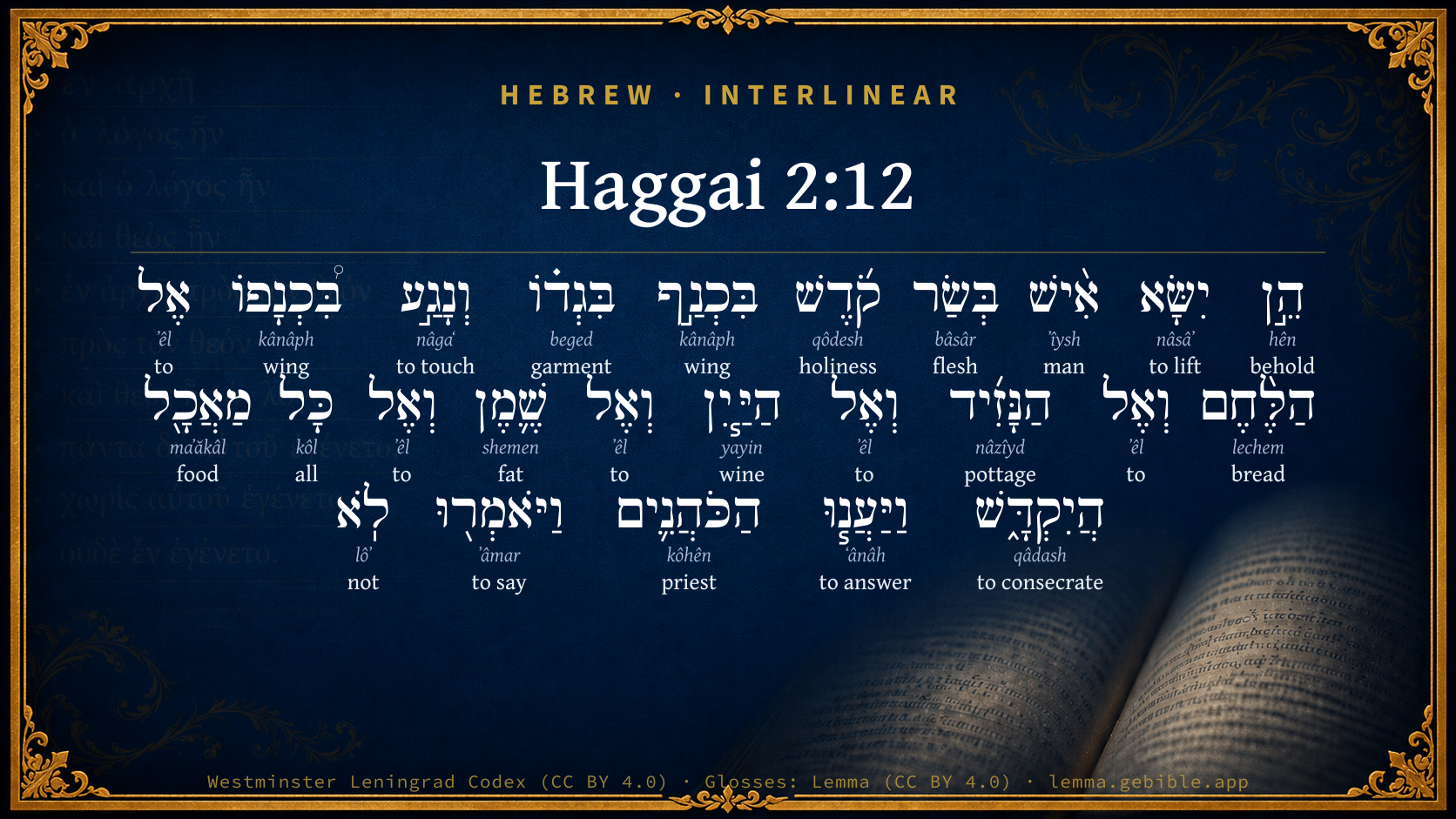
Hebrew (Westminster Leningrad Codex) Haggai 2:12 appears in the Hebrew Old Testament. The text above is from the Westminster Leningrad Codex. Each word links to its Strong’s number, a concise gloss, and parsing drawn from the Open Scriptures Hebrew Bible morphology. Click any word for its full Brown-Driver-Briggs (BDB) entry.
Download image
Cite this verse

Haggai 2:12 (World English Bible). Public Domain. Lemma interlinear Bible study tool, https://lemma.gebible.app/v/haggai/2/12.

Show BibTeX & RIS
BibTeX
RIS
English Translation
'If someone carries holy meat in the fold of his garment, and with his fold touches bread, stew, wine, oil, or any food, will it become holy?'" The priests answered, "No."
World English Bible · Public Domain
Download a study sheet

One document with this verse’s original text, its word-by-word gloss line, the meaning frame, cross-references with their text, attributed commentary, and full source and license credits — printable, and it pastes into notes with its structure intact.

This verse Autodidact and up

Study sheet (.html) Plain text (.txt)

A passage Seminary Student

Up to 50 verses in one chapter. A passage sheet keeps up to 6 commentary sources and 12 cross-references per verse, in the order this page ranks them, and says so on the sheet whenever that leaves anything out. Ask for a single verse and you get the Autodidact verse sheet above.

Everything on this page stays free to read, with no account — the sheet is a download of what is already on screen, not access to it.

Want to remove ads? Support Godless Engineer
Compare translations 3

The same verse in 3 English versions, stacked beneath the original-language interlinear above. Click any original word for its lexicon entry.

Each is an independent rendering of the whole verse — the interlinear is not word-aligned to these translations.

Highlighted words mark where these versions differ — a whole-verse word diff, not a word-by-word alignment.

  • World English Bible Public Domain
    'If someone carries holy meat in the fold of his garment, and with his fold touches bread, stew, wine, oil, or any food, will it become holy?'" The priests answered, "No."
  • King James Version Public Domain
    If one bear holy flesh in the skirt of his garment, and with his skirt do touch bread, or pottage, or wine, or oil, or any meat, shall it be holy? And the priests answered and said, No.
  • unfoldingWord Literal Text CC BY-SA 4.0
    “If a man carries holy flesh in the fold of his garment and he touches with his fold upon bread or upon stew or upon wine or upon oil or upon any food, does it become holy?”’” And the priests answered and said, “No.”

unfoldingWord Literal Text — © unfoldingWord, licensed CC BY-SA 4.0. Word-aligned USFM3 via Door43 (git.door43.org/unfoldingWord/en_ult).

Versions to compare (up to 4)

3 of 4 selected

Show all 18 translations

Every available English version of this verse, each an independent rendering of the whole verse.

  • World English Bible Public Domain
    'If someone carries holy meat in the fold of his garment, and with his fold touches bread, stew, wine, oil, or any food, will it become holy?'" The priests answered, "No."
  • Berean Standard Bible Public Domain
    If a man carries consecrated meat in the fold of his garment, and it touches bread, stew, wine, oil, or any other food, does that item become holy?’” “No,” replied the priests.
  • Majority Standard Bible Public Domain
    If a man carries consecrated meat in the fold of his garment, and it touches bread, stew, wine, oil, or any other food, does that item become holy?’” “No,” replied the priests.
  • King James Version Public Domain
    If one bear holy flesh in the skirt of his garment, and with his skirt do touch bread, or pottage, or wine, or oil, or any meat, shall it be holy? And the priests answered and said, No.
  • American Standard Version (1901) Public Domain
    If one bear holy flesh in the skirt of his garment, and with his skirt do touch bread, or pottage, or wine, or oil, or any food, shall it become holy? And the priests answered and said, No.
  • Revised Version (1885) Public Domain
    If one bear holy flesh in the skirt of his garment, and with his skirt do touch bread, or pottage, or wine, or oil, or any meat, shall it become holy? And the priests answered and said, No.
  • Geneva Bible (1599) Public Domain
    Thus sayth the Lord of hostes, Aske nowe the Priests concerning the Law, and say,
  • Douay-Rheims (1899) Public Domain
    Thus saith the Lord of hosts: Ask the priests the law, saying:
  • Young's Literal Translation Public Domain
    Lo, one doth carry holy flesh in the skirt of his garment, and he hath come with his skirt against the bread, or against the pottage, or against the wine, or against the oil, or against any food -- is it holy?' And the priests answer and say, `No.'
  • Literal Standard Version CC BY-SA 4.0
    Behold, [when] one carries holy flesh in the skirt of his garment, and he has come with his skirt against the bread, or against the stew, or against the wine, or against the oil, or against any food—is it holy?” And the priests answer and say, “No.”
  • Unlocked Literal Bible CC BY-SA 4.0
    'If a man carries meat that is set apart to Yahweh in the fold of his garment, and the fold touches bread or stew, wine or oil, or any kind of food, does it become holy?'” The priests answered and said, “No.”
  • unfoldingWord Literal Text CC BY-SA 4.0
    “If a man carries holy flesh in the fold of his garment and he touches with his fold upon bread or upon stew or upon wine or upon oil or upon any food, does it become holy?”’” And the priests answered and said, “No.”
  • Darby Bible Public Domain
    If one bear holy flesh in the skirt of his garment, and with his skirt do touch bread, or pottage, or wine, or oil, or any food -- shall it become holy? And the priests answered and said, No.
  • World Messianic Bible Public Domain
    ‘If someone carries holy meat in the fold of his garment, and with his fold touches bread, stew, wine, oil, or any food, will it become holy?’” The priests answered, “No.”
  • Webster's Bible Public Domain
    If one shall bear holy flesh in the skirt of his garment, and with his skirt shall touch bread, or pottage, or wine, or oil, or any food, shall it be holy? And the priests answered and said, No.
  • Free Bible Version CC BY-SA 4.0
    If someone carries some meat from a holy sacrifice in a fold of their clothes and that fold touches some bread or stew or wine or olive oil or any other kind of food, does that food become holy?” And the priests answered, “No.”
  • Bible in Basic English Public Domain
    If anyone has some holy flesh folded in the skirt of his robe, will bread or soup or wine or oil or any other food be made holy if touched by his skirt? And the priests answering said, No.
  • JPS Tanakh (1917) Public Domain
    If one bear hallowed flesh in the skirt of his garment, and with his skirt do touch bread, or pottage, or wine, or oil, or any food, shall it be holy?' And the priests answered and said: 'No.'

Literal Standard Version (2020), Covenant Press — licensed CC BY-SA 4.0. Text via the HelloAO Bible API (eBible.org). Unlocked Literal Bible (unfoldingWord) — licensed CC BY-SA 4.0. Text via the HelloAO Bible API (eBible.org). unfoldingWord Literal Text — © unfoldingWord, licensed CC BY-SA 4.0. Word-aligned USFM3 via Door43 (git.door43.org/unfoldingWord/en_ult). Free Bible Version, Dr. Jonathan Gallagher — licensed CC BY-SA 4.0. Text via the HelloAO Bible API (eBible.org).

Word by word

More ways to search: Search by grammar → Find every occurrence → Compare this word →

Practice this passage: Drill this verse → Learn its vocabulary →

הַנָּזִ֜יד
nâzîyd
H5138
“the · pottage”
Particle, Definite Article + Noun, Common, Masculine, Singular, Absolute
Part of Speech
Particle + Noun
Type
Common
Gender
Masculine
Number
Singular
State
Absolute
Full BDB Definition

Origin: from H2102

TWOT: 547d

boiled food, soup, pottage, thing sodden or boiled
  1. הֵ֣ן hên H2005 “behold” Particle, Demonstrative
  2. יִשָּׂא nâsâʼ H5375 “to lift” Verb, Qal, Imperfect, 3rd Person, Masculine, Singular
  3. אִ֨ישׁ ʼîysh H376 “man” Noun, Common, Masculine, Singular, Absolute
  4. בְּשַׂר bâsâr H1320 “flesh of” Noun, Common, Masculine, Singular, Construct
  5. קֹ֜דֶשׁ qôdesh H6944 “holiness” Noun, Common, Masculine, Singular, Absolute
  6. בִּכְנַ֣ף kânâph H3671 “in/at · wing of” Preposition + Noun, Common, Feminine, Singular, Construct
  7. בִּגְד֗וֹ beged H899 “garment · his” Noun, Common, Masculine, Singular, Construct + Suffix, Personal, 3rd Person, Masculine, Singular
  8. וְנָגַ֣ע nâgaʻ H5060 “and · to touch” Conjunction + Verb, Qal, Perfect, 3rd Person, Masculine, Singular
  9. בִּ֠כְנָפוֹ kânâph H3671 “in/at · wing · his” Preposition + Noun, Common, Feminine, Singular, Construct + Suffix, Personal, 3rd Person, Masculine, Singular
  10. אֶל ʼêl H413 “to” Preposition
  11. הַלֶּ֨חֶם lechem H3899 “the · bread” Particle, Definite Article + Noun, Common, Both, Singular, Absolute
  12. וְאֶל ʼêl H413 “and · to” Conjunction + Preposition
  13. וְאֶל ʼêl H413 “and · to” Conjunction + Preposition
  14. הַיַּ֧יִן yayin H3196 “the · wine” Particle, Definite Article + Noun, Common, Masculine, Singular, Absolute
  15. וְאֶל ʼêl H413 “and · to” Conjunction + Preposition
  16. שֶׁ֛מֶן shemen H8081 “fat” Noun, Common, Masculine, Singular, Absolute
  17. וְאֶל ʼêl H413 “and · to” Conjunction + Preposition
  18. כָּל kôl H3605 “all of” Noun, Common, Masculine, Singular, Construct
  19. מַאֲכָ֖ל maʼăkâl H3978 “food” Noun, Common, Masculine, Singular, Absolute
  20. הֲיִקְדָּ֑שׁ qâdash H6942 “to consecrate” Particle, Interrogative + Verb, Qal, Imperfect, 3rd Person, Masculine, Singular
  21. וַיַּעֲנ֧וּ ʻânâh H6030 “and · to answer” Conjunction + Verb, Qal, Sequential Imperfect, 3rd Person, Masculine, Plural
  22. הַכֹּהֲנִ֛ים kôhên H3548 “the · priests” Particle, Definite Article + Noun, Common, Masculine, Plural, Absolute
  23. וַיֹּאמְר֖וּ ʼâmar H559 “and · to say” Conjunction + Verb, Qal, Sequential Imperfect, 3rd Person, Masculine, Plural
  24. לֹֽא lôʼ H3808 “not” Particle, Negative

About this verse

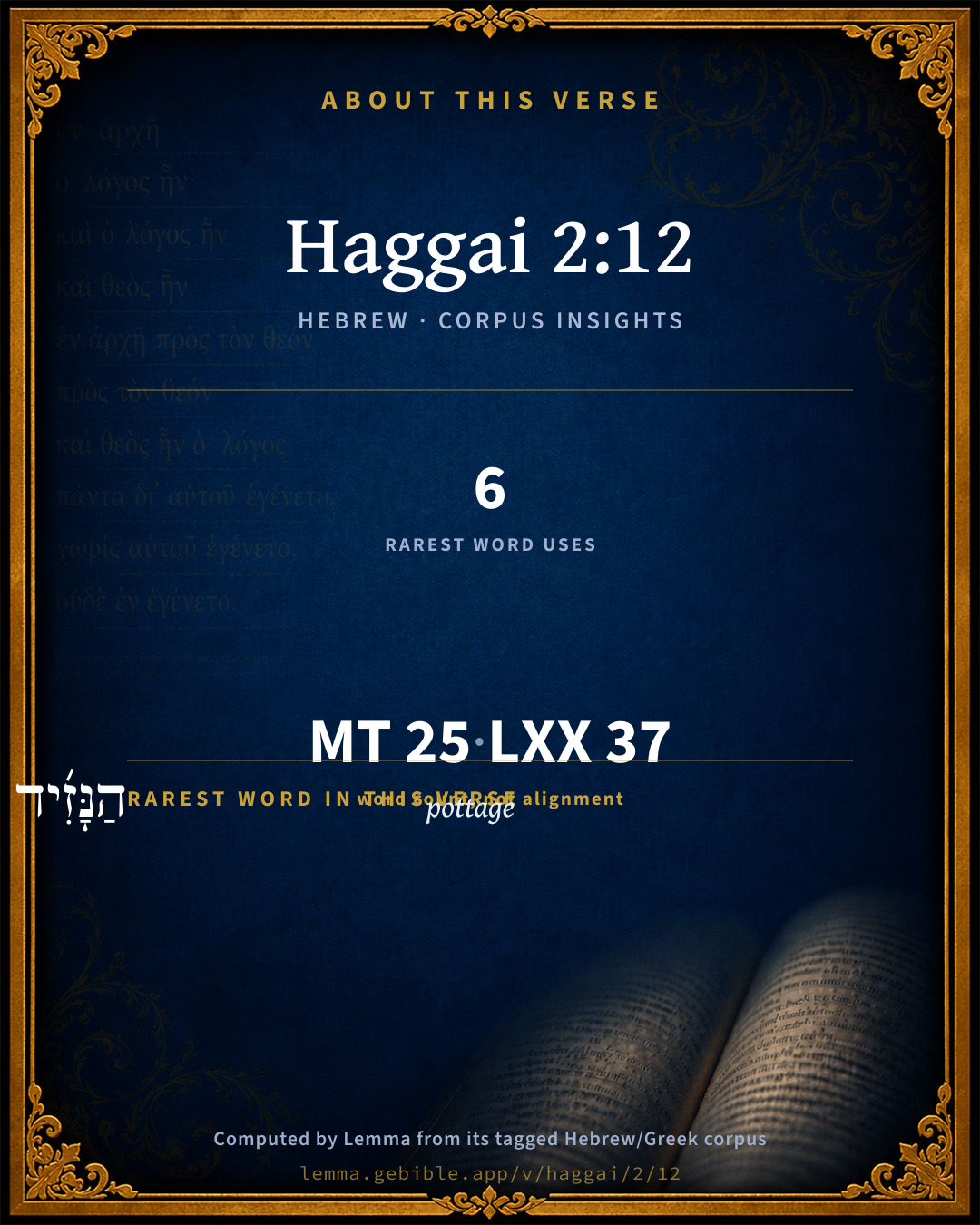
These counts appear in no published source. They are computed here, from the morphology-tagged text and Lemma’s own curated glosses. What Lemma adds →

25
words
20
distinct lemmas
Prophets
section

Notable vocabulary

The rarest word here is הַנָּזִ֜יד pottage H5138 — appearing just 6 times in the whole Hebrew Bible.

Shared distinctive vocabulary

הַנָּזִ֜יד pottage H5138 occurs in 6 verses of the Hebrew Bible. Also found in:

Grammatical profile

  • 5 verbs
  • 13 nouns
  • 5 prepositions
  • 2 particles

Verb forms

  • יִשָּׂא Qal · Imperfect
  • וְנָגַ֣ע Qal · Perfect
  • הֲיִקְדָּ֑שׁ Qal · Imperfect
  • וַיַּעֲנ֧וּ Qal · Sequential Imperfect
  • וַיֹּאמְר֖וּ Qal · Sequential Imperfect

Repetition

Words recur within this verse — often emphatic in Hebrew:

  • בִּכְנַ֣ף wing H3671 ×2
  • אֶל to H413 ×5

Hebrew & Septuagint length

In English translation the verse runs 31 words from the Hebrew and 14 from the Septuagint (LXX English) — the Septuagint runs noticeably shorter here. See the side-by-side →

A rough comparison of the two English renderings, which tokenize alike — not a word-level alignment.

Word counts can differ between the Hebrew and the Greek without any difference in meaning — e.g. the Hebrew direct-object marker אֵת has no separate Greek word, and Greek often adds the article ὁ.

In the original languages it is 25 Hebrew tokens and 37 Greek tokens — but the two are counted differently (Hebrew bundles its prefixes and suffixes into one token; the Greek is in lemma form), so that isn’t a like-for-like length.

Cross-references

6

Topical passages linked to Haggai 2:12 in the Treasury of Scripture Knowledge — connected by theme and wording, ordered by reader-vote popularity; previews shown in the World English Bible.

  • Leviticus 6:27 Whatever shall touch its flesh shall be holy. When there is any of its blood sprinkled on a garment, you shall wash that on which it was sprinkled in a holy place.
  • Matthew 23:19 You blind fools! For which is greater, the gift, or the altar that sanctifies the gift?
  • Exodus 29:37 Seven days you shall make atonement for the altar, and sanctify it: and the altar shall be most holy; whatever touches the altar shall be holy.
  • Leviticus 6:29 Every male among the priests shall eat of it: it is most holy.
  • Leviticus 7:6 Every male among the priests may eat of it. It shall be eaten in a holy place. It is most holy.
  • Ezekiel 44:19 When they go forth into the outer court, even into the outer court to the people, they shall put off their garments in which they minister, and lay them in the holy chambers; and they shall put on other garments, that they not sanctify the people with their garments.

Cross-references courtesy of OpenBible.info (CC BY 4.0).

Hebrew and Greek witnesses Masoretic Hebrew ↔ Greek Septuagint

The same verse in the two great witnesses to the Old Testament, shown verse-for-verse.

Here the Septuagint runs noticeably shorter than the Hebrew — LXX2012 (modern English Septuagint) 14 words vs World English Bible 31. A rough length comparison of the two English translations, not a word-level alignment — read both below.

These are two independent witnesses, not word-aligned to each other, and the Septuagint is shown in lemma (dictionary) form.

Hebrew Haggai 2:12 Masoretic · Westminster Leningrad Codex

הֵ֣ן יִשָּׂא אִ֨ישׁ בְּשַׂר קֹ֜דֶשׁ בִּכְנַ֣ף בִּגְד֗וֹ וְנָגַ֣ע בִּ֠כְנָפוֹ אֶל הַלֶּ֨חֶם וְאֶל הַנָּזִ֜יד וְאֶל הַיַּ֧יִן וְאֶל שֶׁ֛מֶן וְאֶל כָּל מַאֲכָ֖ל הֲיִקְדָּ֑שׁ וַיַּעֲנ֧וּ הַכֹּהֲנִ֛ים וַיֹּאמְר֖וּ לֹֽא

'If someone carries holy meat in the fold of his garment, and with his fold touches bread, stew, wine, oil, or any food, will it become holy?'" The priests answered, "No."

World English Bible · Public Domain

Greek LXX Haggai 2:12 Septuagint · lemma form

ἐάν λαμβάνω ἄνθρωπος κρέας ἅγιος ἐν ὁ ἄκρος ὁ ἱμάτιον αὐτός καί ἅπτομαι ὁ ἄκρος ὁ ἱμάτιον αὐτός ἄρτος ἤ ἕψεμα ἤ οἶνος ἤ ἔλαιον ἤ πᾶς βρῶμα εἰ ἁγιάζω καί ἀποκρίνω ὁ ἱερεύς καί εἶπον οὐ

Thus says the Lord Almighty; Inquire now of the priest concerning the law, saying,

LXX2012 (modern English Septuagint) · Public Domain

On this verse, The Cambridge Bible for Schools and Colleges discusses the Septuagint’s reading. Read the note in Commentary ↓

Hebrew: Westminster Leningrad Codex (CC BY 4.0). Greek: Septuagint (public domain); English from LXX2012 (modern English Septuagint) (Public Domain). How the Septuagint differs from the Hebrew →

Targum (Aramaic paraphrase)

1

The Targum is the ancient Jewish Aramaic paraphrase of the Hebrew Scriptures — an interpretive translation, not the Hebrew text itself. Onkelos (literal) and Pseudo-Jonathan (expansive) render the Torah, and Jonathan the Prophets. Coverage is partial: where no permissively-licensed English translation exists for a verse, only the Aramaic is shown. This is verse-level text, not a word-by-word alignment to the Hebrew.

  1. Targum Jonathan Prophets (Joshua–Malachi)
    הָא יִטוֹל גְבַר בְּסַר קוּדְשָׁא בִכְנַף לְבוּשֵׁיהּ וְיַקְרֵיב בִּכְסוּתֵיהּ לְלַחְמָא וּלְתַבְשִׁילָא וּלְחַמְרָא וּלְמִשְׁחָא וְכָל דְמִתְאָכֵיל הֲיִסְתָּאָב וְאָתִיבוּ כַהֲנַיָא וַאֲמָרוּ לָא:

    (no public-domain English translation for this verse)

    Targum Jonathan — Aramaic: “Mikraot Gedolot” (public domain). English: “Sefaria Community Translation” (CC0 1.0 (public-domain dedication)); “London "Chaldee Paraphrase," 1871” (public domain). Text via Sefaria.

Commentary

Notes on Haggai 2:12 from classic Christian and Jewish commentators (each source and its license shown beneath its notes). The classic Christian expositions comment on the surrounding passage and are grouped to its opening verse, so a note may address several verses; the Jewish commentaries on the Tanakh (Rashi and others) are per-verse, so they appear only where the commentator wrote on this verse.

Lemma curates 59 commentaries, every one of them public domain or Creative Commons licensed, each selected and text-cleaned for this edition rather than reprinted as found. About our sources →

Trapp's Complete Commentary

John Trapp

Hag 2:12 If one bear holy flesh in the skirt of his garment, and with his skirt do touch bread, or pottage, or wine, or oil, or any meat, shall it be holy? And the priests answered and said, No.

Ver. 12. If one bear holy flesh in the skirt, &c.] Problems and parables are notable helps to the bolting out of the truth, and conviction of the gainsayers. For problems see Mat 13:10-15; Mat 21:25; Mat 22:42. For parables see Jdg 9:7-15, that of Jotham, of Nathan, 2Sa 12:1-4, of the woman of Tekoah, 2Sa 14:5-7, of our Saviour concerning the two brethren sent into the vineyard, the wedding of the king’s son, the sower. {See Trapp on "Hag 2:10"}

And the priests answered and said, No] Roundly and readily; without hacking and hewing, without doubling and dissembling; as those perverse priests, those self-condemned hierophants, {a} Mat 21:27, that, against their consciences, "answered Jesus and said, We cannot tell." The wit of graceless persons will better serve them to falter and fumble, deny, or devise a thousand shifts to evade and elude the truth, than their malice will suffer them to yield to it, or profess it. This is to detain the truth in unrighteousness, Rom 1:18, as Plato, who had the knowledge of one God, yet he dared not to communicate it to the common people; and as some of the chief champions of Popery, who held justification by faith alone, but refused to say so, lest their Dagon should down, their Diana be despised. Let every spiritual man (but especially ministers) be ready, as to every good work, so to this of comparing spiritual things with spiritual, that he may judge or discern of all things, 1Co 2:13; 1Co 2:15, according to the analogy of faith, Rom 12:6, the tenor of the Scriptures, his sure cynosura; and laying up all in his heart, Luk 2:18, he may have a treasure there of new and old, a word of wisdom and a word of knowledge too, 1Co 12:8, both as a teacher and as a pastor, to bring forth for common benefit.

{a} Antiq. An official expounder of sacred mysteries or religious ceremonies, esp. in ancient Greece; an initiating or presiding priest. ŒD

John Trapp, A Commentary or Exposition upon All the Books of the Old and New Testament (1647–1656) — public domain. Text from a community e-Sword module.

Tyndale Open Study Notes

Tyndale Open Resources

2:12 will it also become holy? This question refers to meat from a holy sacrifice and the way in which ceremonial purity and impurity could be transferred (see “Clean, Unclean, and Holy” Theme Note). Carrying the holy sacrifice—the meat set aside and prepared for the offering—rendered one’s robe holy (cp. Lev 6:18). This holiness, however, could not be transmitted to a third object.

Tyndale Open Study Notes — © Tyndale Open Resources, licensed CC BY-SA 4.0. Text via the HelloAO Bible API.

Jamieson, Fausset & Brown

Robert Jamieson, A. R. Fausset & David Brown

"Holy flesh" (that is, the flesh of a sacrifice, Jer 11:15), indeed, makes holy the "skirt" in which it is carried; but that "skirt" cannot impart its sanctity to any thing beyond, as "bread," &c. (Lev 6:27). This is cited to illustrate the principle, that a sacrifice, holy, as enveloping divine things (just as the "skirt" is "holy" which envelops "holy" flesh), cannot by its inherent or opus operatum efficacy make holy a person whose disobedience, as that of the Jew while neglecting God's house, made him unholy.

Jamieson, Fausset & Brown — Commentary Critical and Explanatory on the Whole Bible (1871) — public domain (CC PDM 1.0). Text via the HelloAO Bible API.

Ellicott's Commentary for English Readers

(12) Holy flesh.—The flesh of the sacrifice hallowed the person who touched it (Lev_6:27), but this sanctification was not conveyed to anything he might afterwards touch. On the other hand (Hag_2:13), he who was defiled by such a pollution as contact with a dead body, conveyed defilement even to the tabernacle. (See Num_19:13 : “Whosoever toucheth the dead body of any man that is dead, and purifieth not himself, defileth the tabernacle of the Lord.”) Even so, according to Haggai, the guilt of impiety incurred by the Jews in neglecting the Temple had tainted the labour of their hands, and caused famine. And what merit they might claim for restoring the altar-worship and keeping the prescribed feasts (Ezr_3:2-6) was not conveyed further. It was cancelled by their neglect of an equally important duty. This latter point, however, is not brought out, but is left to be supplied by the prophet’s hearers.

A Bible Commentary for English Readers, edited by Charles John Ellicott (1878–1897) — public domain. Text from a community e-Sword module.

The Cambridge Bible for Schools and Colleges

gen. ed. J. J. S. Perowne

12. If one bear] Lit. Lo! one bears. “See, there is a man bearing—what will happen?” An emphatic Oriental way of saying, “suppose, put the case, that one bears.” So in Jer_3:1 we have, “Lo! a man puts away his wife.” And in 2Ch_7:13, where “if” occurs three times in A. V. the Hebrew has “lo” the first and second time, and “if” the third time.

holy flesh] i.e. flesh which has been offered in sacrifice to God. Comp. Jer_11:15.

the skirt] Lit. the wing. So πτέρυξ, πτερύγιον are used for the skirts or flaps of a cloak or dress.

meat] i.e. food, or eatables. LXX. βρῶμα.

the priests answered and said, No] In Lev_6:27 we read of the sin-offering, “Whatsoever shall touch the flesh thereof shall be holy.” The garment therefore in which the flesh was carried would be holy, but the holiness would not extend, so the priests ruled it, to anything which the garment touched.

The Cambridge Bible for Schools and Colleges (gen. ed. J. J. S. Perowne; Cambridge University Press, 1878–1918) — public domain. Text from a community e-Sword module.

John Gill's Exposition

Then said Haggai,.... To the priests; having nothing to object to their answer; but being satisfied with it, he puts another question:

if one that is unclean by a dead body; by the touch of it, Num 19:11,

touch any of these, shall it be unclean? that is, if such an impure person, who was so in a ceremonial sense, should touch any of the above things, bread, pottage, wine, or oil, or any meat, would not they become unclean thereby, and so not fit for use?

and the priests answered and said, it shall be unclean; which was rightly answered; for whatsoever such an unclean person touched was unclean, according to the law, Lev 19:22. Pollution is more easily and more extensively conveyed than holiness.

John Gill's Exposition of the Whole Bible (1746–1763) — public domain (CC PDM 1.0). Text via the HelloAO Bible API.

Haydock's Catholic Bible Commentary

The law. "He who knows it not, shews himself to be no priest of the Lord," Deuteronomy xvii. (St. Jerome)

George Leo Haydock (1774–1849), Haydock's Catholic Family Bible and Commentary, 1859 edition — public domain. Excludes Psalms (Douay-Rheims chapter numbering differs from Protestant) and Deuterocanonical books (Catholic canon only).

Matthew Poole's English Annotations

If one, any one, bear, carry away from the altar, or the priest’s hands,

holy flesh, part of the sacrifice, legally and ceremonially sanctified, or made holy by the altar on which the whole was sanctified, of which a part is supposed to be carried away

in the skirt of his garment, in the lap of his garment, or in any other cloth or napkin, and this cloth touch any common thing,

as bread, & c., shall that common thing by such contact become legally or ceremonially holy?

The priests answered: who these priests were is not mentioned, but it is likely that there were some among the people who did by the prophet’s persuasion go and propose the case, and they received the answer as here in the negative, for neither mediate nor yet immediate touch of holy things could make common things or unholy persons holy.

Matthew Poole's English Annotations on the Holy Bible (1683–1685) — public domain. Text from a community e-Sword/MySword module.

Whedon's Commentary on the Bible

Daniel D. Whedon

12, 13. Two questions are propounded to the priests: (1) Whether or not a garment made holy through contact with holy flesh (compare Lev_6:27) transmits this holiness to other articles which might come in contact with it.

Holy flesh — Flesh of an animal slain for sacrificial purposes (Jer_11:15).

Skirt — Literally, wing. A corner of the large outer garment (see on Amo_2:8) could be turned in so as to form a convenient place in which to carry articles of various kinds. The articles named are common articles of food. The specific case laid before the priests is not provided for in the ceremonial law. To this question the priests give a negative answer. (2) When one who is made unclean by contact with something that is unclean touches the same articles of food, do they become unclean? In this case the answer is in the affirmative, in accordance with Num_19:22.

Unclean by a dead body — By coming in contact with a dead body (compare Num_9:10; Lev_21:11). This was the most dreaded kind of uncleanness.

In Hag_2:14 the prophet applies the priestly decisions to the case of the people.

So — Refers to the substance of the priestly decisions, more especially to the second.

This people — The people gathered about him (see on Hag_1:2).

Before me — In my estimate.

Every work of their hands — Their life and conduct permeated with selfishness (Hag_1:4).

That which they offer — All their offerings and sacrifices.

There — Upon the altar mentioned in Ezr_3:3; near it the prophet probably stood when he delivered the address. All the offerings offered there are an abomination to Jehovah. Why? The answer must be supplied from the context. The people offering sacrifice are like the man carrying the holy flesh; but in neglecting Jehovah and looking only after their own interests they are like the man made unclean through contact with an unclean body. Since the powers of infection of an unclean thing are greater than those of a clean thing, their unclean conduct exerts greater influence than their clean sacrifices and makes unclean their otherwise clean offerings. Haggai does not carry the application further; by implication, however, his words contain an exhortation to change their conduct; in this case, to carry on more earnestly the building operations. After Hag_2:14, LXX. has a lengthy addition which is, however, in all probability, not an original part of the prophecy.

In Hag_2:15-19 the prophet refers once more to the calamities present and past and urges the people to bear in mind that they are the direct result of their indifference, and that any change in their condition depends entirely upon their zeal in building the temple.

And now — Perhaps better, but now. These words are really the introduction to Hag_2:18. A change in their conduct has already begun, hence he may place by the side of the warning in Hag_2:14 a message of commendation and promise. Before he utters the latter he refers once more to the past calamity, so as to bring out more strongly the contrast between the calamity of the past and the prosperity of the future.

Consider — As in Hag_1:5-7.

From this day and upward — R.V., “backward.” The R.V. translation has no support (compare 1Sa_16:13); the word points to the future. The mistranslation is due to a misinterpretation of the entire verse. The meaning becomes clear if a stop is made after upward; “Consider from this day and upward!” — that is, consider or bear in mind continually, from this moment on, what I am about to say: on the one hand, that your past neglectfulness brought disaster (15-17); on the other, that zeal and faithfulness will bring prosperity (18, 19).

After this summons to consider, a new beginning should be made: “Before a stone was laid upon a stone in the temple of Jehovah; since those days were, (it happened that) when one came.… “

Before a stone was laid — Before building operations were commenced.

Since those days were — R.V., “Through all that time.” An obscure expression. The reading of R.V. gives good enough sense, though the words seem superfluous after 15a, but the Hebrew hardly warrants the translation. LXX. reads, “who were ye,” which may represent an original “how were ye.” These might be the closing words of a question which has its beginning in Hag_2:15, “Before a stone was laid upon a stone in the temple of Jehovah, how did ye fare?” The temporal clause is placed first, because the emphasis rests upon it.

How they did fare is stated in the rest of Hag_2:16 and in Hag_2:17. The thought is similar to that expressed in Hag_1:6; Hag_1:9-11; disappointment and disaster on every hand.

Heap of twenty — That is, a heap of sheaves estimated to give twenty measures; but when it was threshed it yielded ten, only one half of what was expected.

Pressfat — R.V., “winevat.” The receptacle in which wine juice is kept after the grapes are pressed out. The grapes, instead of yielding fifty measures of wine, yielded only twenty.

Out of the press — Omitted in R.V. The noun occurs elsewhere in the sense of winepress (so A.V.; compare Isa_63:3). Some think that it is used in the more general sense of measure (so R.V.), or that it is the name of a measure, equivalent to bath (Isa_5:10), which is of the same size as the ephah (see on Amo_8:5). This is not likely. If the text is correct the translation of A.V. is to be preferred; otherwise the word must be omitted as an explanatory gloss to the preceding “winevat.”

Daniel D. Whedon (gen. ed.), Commentary on the Old and New Testaments (1874–1909) — public domain. Text from a community e-Sword module.

The Pulpit Commentary

If one bear; literally, behold, one beareth, which is equivalent to "suppose a man bears." Perowne compares Jer_3:1, "Lo, a man puts away his wife;" and 2Ch_7:13. Holy flesh. The flesh of animals sacrificed to God, which was set apart from profane uses, and might be eaten only by the priests or persons ritually pure (Lev_6:26 Lev_7:15-20 Lev_10:13; comp. Jer_11:15) The skirt of his garment; literally, wing of his garment , as Deu_22:12; 1Sa_15:27. Any meat; pantomatov: anything eatable. And said, No. The priests answered correctly according to Lev_6:27. Whatever touched the hallowed flesh became itself holy, but it could not communicate this holiness to anything else.

The Pulpit Commentary (1880–1919), ed. H.D.M. Spence-Jones & Joseph S. Exell — public domain. Text from a community e-Sword module.

John Wesley's Explanatory Notes

Holy flesh - Part of the sacrifice, legally sanctified, or made holy by the altar on which the whole was sanctified. In the skirt - In the lap of his garment, or in any other cloth, and if this cloth touch any common thing as bread, &c., shall that become legally holy?

John Wesley, Explanatory Notes Upon the Whole Bible (1754–1765) — public domain. Text via the GEBible commentary corpus.

Scofield Reference Notes

C. I. Scofield

holy flesh (See Scofield "Jer 11:15") .

The Scofield Reference Bible (1917 edition), notes by C. I. Scofield — public domain. Text from a community e-Sword module.

Rashi

Rabbi Shlomo Yitzchaki (Rashi)

contaminated flesh flesh of contamination of a carcass as a creeping thing.

and the pottage a cooked food

“No.” It [the food] will [not] become contaminated. Rav and Shmuel disagree over this matter. One [Rav] says that the priests erred, for he [Haggai] asked them concerning a fourth degree contamination in reference to hallowed things, and they replied that it [the food] is ritually pure. One [Shmuel] says that the priests did not err, that he [Haggai] asked them concerning a fifth degree contamination in reference to hallowed things.

if it touches in his skirt It did not touch the creeping thing itself but the garment, which is the first degree of contamination.

will it become contaminated? Heb. הֲיִקְדָּשׁ

Rashi on the Tanakh — English translations: “The Judaica Press complete Tanach with Rashi, translated by A. J. Rosenberg” (CC BY 4.0); “Pentateuch with Rashi's commentary by M. Rosenbaum and A.M. Silbermann, 1929-1934” (public domain); “The Metsudah Tanach series, Lakewood, N.J” (CC BY 4.0); and “The Book of Joshua, Metsudah Publications, 1997” (CC BY 4.0). Text via Sefaria.

Lesson kit

Teaching starters — assembled from the data on this page, not authored interpretation. Every prompt links to the verse data it draws on. Edit before teaching.

Haggai, in the Prophets, opens this verse with 25 words (20 distinct Hebrew lemmas). Its most distinctive word is nâzîyd (“pottage”). The Greek Septuagint runs shorter here. A historical commentator’s framing appears above. Read the whole chapter for the surrounding context.

Discussion questions

  1. What does “pottage” (nâzîyd) contribute to the verse as a whole?
  2. Genesis 25:29 shares the word «pottage» with this verse. How do the two illuminate each other?
  3. “wing” occurs 2× in this one verse. What is the effect of the repetition?
  4. Compared with the Hebrew, the Septuagint runs shorter here. What questions does that raise?
  5. These translations render this verse differently. What is at stake in choosing one wording over another?
  6. The verb «יִשָּׂא» is Qal Imperfect. How does its form color the action?
  7. Reading how Trapp's Complete Commentary and Tyndale Open Study Notes read this verse, where do the two commentators agree and where do they part?

Things to notice

Reading settings

Reading text

Shown beneath each verse's original-language words.

Old Testament
Old Testament edition

Read the OT as the Masoretic Hebrew (MT) or the Greek Septuagint (LXX).

English shown for the Greek Septuagint (in the Hebrew ↔ Greek comparison).

Comparing translations? Open the Compare panel on any verse page to stack up to four side by side.