
2 Kings 25:29

Hebrew (Westminster Leningrad Codex) 2 Kings 25:29 appears in the Hebrew Old Testament. The text above is from the Westminster Leningrad Codex. Each word links to its Strong’s number, a concise gloss, and parsing drawn from the Open Scriptures Hebrew Bible morphology. Click any word for its full Brown-Driver-Briggs (BDB) entry.
Download image
Cite this verse

2 Kings 25:29 (World English Bible). Public Domain. Lemma interlinear Bible study tool, https://lemma.gebible.app/v/2-kings/25/29.

Show BibTeX & RIS
BibTeX
RIS
English Translation
and changed his prison garments. [Jehoiachin] ate bread before him continually all the days of his life:
World English Bible · Public Domain
Highlights
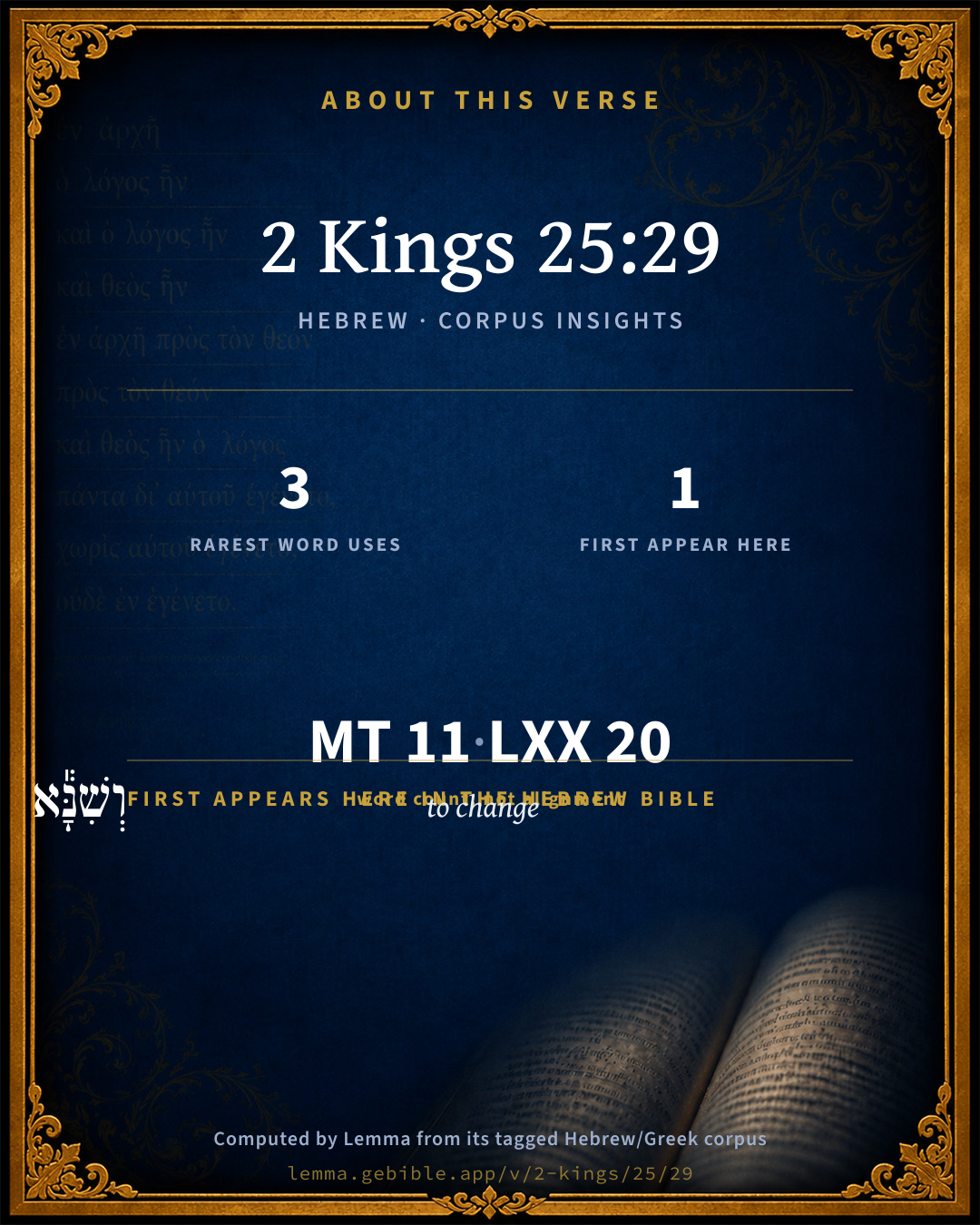
  • 1 first appearance in the Hebrew Bible
Full analysis ↓
Download a study sheet

One document with this verse’s original text, its word-by-word gloss line, the meaning frame, cross-references with their text, attributed commentary, and full source and license credits — printable, and it pastes into notes with its structure intact.

This verse Autodidact and up

Study sheet (.html) Plain text (.txt)

A passage Seminary Student

Up to 50 verses in one chapter. A passage sheet keeps up to 6 commentary sources and 12 cross-references per verse, in the order this page ranks them, and says so on the sheet whenever that leaves anything out. Ask for a single verse and you get the Autodidact verse sheet above.

Everything on this page stays free to read, with no account — the sheet is a download of what is already on screen, not access to it.

Want to remove ads? Support Godless Engineer
Compare translations 3

The same verse in 3 English versions, stacked beneath the original-language interlinear above. Click any original word for its lexicon entry.

Each is an independent rendering of the whole verse — the interlinear is not word-aligned to these translations.

Highlighted words mark where these versions differ — a whole-verse word diff, not a word-by-word alignment.

  • World English Bible Public Domain
    and changed his prison garments. [Jehoiachin] ate bread before him continually all the days of his life:
  • King James Version Public Domain
    And changed his prison garments: and he did eat bread continually before him all the days of his life.
  • unfoldingWord Literal Text CC BY-SA 4.0
    And he changed the clothes of his imprisonment, and he ate bread regularly to his face all of the days of his life.

unfoldingWord Literal Text — © unfoldingWord, licensed CC BY-SA 4.0. Word-aligned USFM3 via Door43 (git.door43.org/unfoldingWord/en_ult).

Versions to compare (up to 4)

3 of 4 selected

Show all 18 translations

Every available English version of this verse, each an independent rendering of the whole verse.

  • World English Bible Public Domain
    and changed his prison garments. [Jehoiachin] ate bread before him continually all the days of his life:
  • Berean Standard Bible Public Domain
    So Jehoiachin changed out of his prison clothes, and he dined regularly at the king’s table for the rest of his life.
  • Majority Standard Bible Public Domain
    So Jehoiachin changed out of his prison clothes, and he dined regularly at the king’s table for the rest of his life.
  • King James Version Public Domain
    And changed his prison garments: and he did eat bread continually before him all the days of his life.
  • American Standard Version (1901) Public Domain
    and changed his prison garments. And `Jehoiachin' did eat bread before him continually all the days of his life:
  • Revised Version (1885) Public Domain
    and he changed his prison garments, and did eat bread before him continually all the days of his life.
  • Geneva Bible (1599) Public Domain
    And changed his prison garments: and he did continually eate bread before him, all the dayes of his life.
  • Douay-Rheims (1899) Public Domain
    And he changed his garments which he had in prison, and he ate bread always before him, all the days of his life.
  • Young's Literal Translation Public Domain
    and hath changed the garments of his restraint, and he hath eaten bread continually before him all days of his life,
  • Literal Standard Version CC BY-SA 4.0
    and has changed the garments of his restraint, and he has eaten bread continually before him all [the] days of his life,
  • Unlocked Literal Bible CC BY-SA 4.0
    Awel-Marduk removed Jehoiachin's prison clothes, and Jehoiachin ate regularly at the king's table for the rest of his life.
  • unfoldingWord Literal Text CC BY-SA 4.0
    And he changed the clothes of his imprisonment, and he ate bread regularly to his face all of the days of his life.
  • Darby Bible Public Domain
    And he changed his prison garments; and he ate bread before him continually all the days of his life;
  • World Messianic Bible Public Domain
    and changed his prison garments. Jehoiachin ate bread before him continually all the days of his life;
  • Webster's Bible Public Domain
    And changed his prison garments: and he ate bread continually before him all the days of his life.
  • Free Bible Version CC BY-SA 4.0
    So Jehoiachin was able to remove his prison clothes, and he ate frequently at the king's table for the rest of his life.
  • Bible in Basic English Public Domain
    And his prison clothing was changed, and he was a guest at the king's table every day for the rest of his life.
  • JPS Tanakh (1917) Public Domain
    And he changed his prison garments, and did eat bread before him continually all the days of his life.

Literal Standard Version (2020), Covenant Press — licensed CC BY-SA 4.0. Text via the HelloAO Bible API (eBible.org). Unlocked Literal Bible (unfoldingWord) — licensed CC BY-SA 4.0. Text via the HelloAO Bible API (eBible.org). unfoldingWord Literal Text — © unfoldingWord, licensed CC BY-SA 4.0. Word-aligned USFM3 via Door43 (git.door43.org/unfoldingWord/en_ult). Free Bible Version, Dr. Jonathan Gallagher — licensed CC BY-SA 4.0. Text via the HelloAO Bible API (eBible.org).

Word by word

More ways to search: Search by grammar → Find every occurrence → Compare this word →

Practice this passage: Drill this verse → Learn its vocabulary →

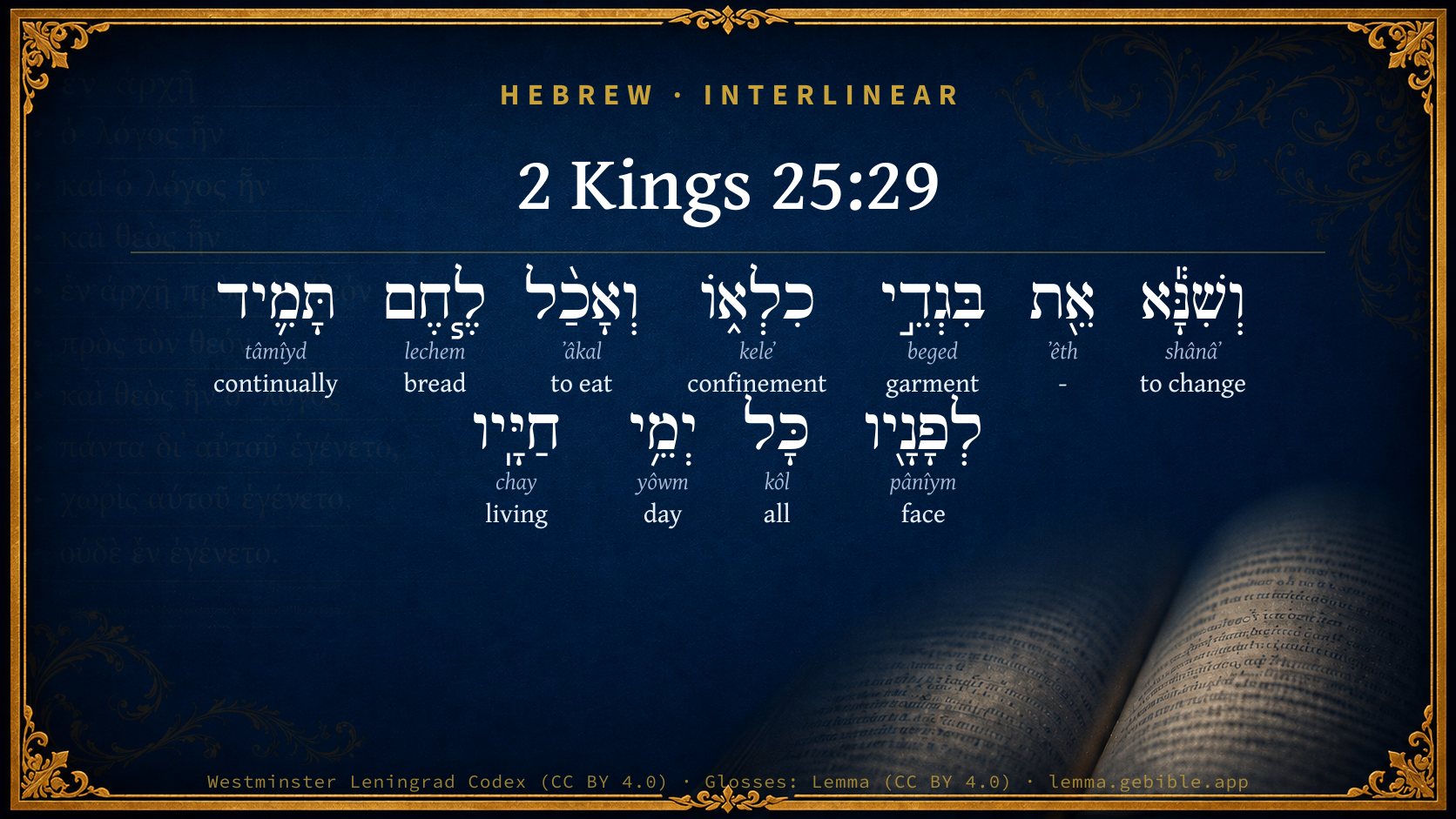
וְשִׁנָּ֕א
shânâʼ
H8132
“and · to change”
Conjunction + Verb, Piel, Sequential Perfect, 3rd Person, Masculine, Singular
Part of Speech
Conjunction + Verb
Stem
Piel
Form
Sequential Perfect
Person
3rd Person
Gender
Masculine
Number
Singular
Full BDB Definition

Origin: a primitive root

TWOT: 2419

to change, alter - (Qal) to change - (Piel) to change, alter - (Pual) to be changed
  1. אֵ֖ת ʼêth H853 “-” Particle, Direct Object
  2. בִּגְדֵ֣י beged H899 “garments of” Noun, Common, Masculine, Plural, Construct
  3. כִלְא֑וֹ keleʼ H3608 “confinement · his” Noun, Common, Masculine, Singular, Construct + Suffix, Personal, 3rd Person, Masculine, Singular
  4. וְאָכַ֨ל ʼâkal H398 “and · to eat” Conjunction + Verb, Qal, Sequential Perfect, 3rd Person, Masculine, Singular
  5. לֶ֧חֶם lechem H3899 “bread” Noun, Common, Both, Singular, Absolute
  6. תָּמִ֛יד tâmîyd H8548 “continually” Noun, Common, Masculine, Singular, Absolute
  7. לְפָנָ֖יו pânîym H6440 “to/for · face(s) · his” Preposition + Noun, Common, Both, Plural, Construct + Suffix, Personal, 3rd Person, Masculine, Singular
  8. כָּל kôl H3605 “all of” Noun, Common, Masculine, Singular, Construct
  9. יְמֵ֥י yôwm H3117 “days of” Noun, Common, Masculine, Plural, Construct
  10. חַיָּֽיו chay H2416 “living things · his” Noun, Common, Masculine, Plural, Construct + Suffix, Personal, 3rd Person, Masculine, Singular

About this verse

These counts appear in no published source. They are computed here, from the morphology-tagged text and Lemma’s own curated glosses. What Lemma adds →

11
words
11
distinct lemmas
Historical
section

Notable vocabulary

The rarest word here is וְשִׁנָּ֕א to change H8132 — appearing just 3 times in the whole Hebrew Bible.

First appearance in Scripture

This word makes its first canonical appearance in the Hebrew Bible here:

  • וְשִׁנָּ֕א to change H8132

Shared distinctive vocabulary

וְשִׁנָּ֕א to change H8132 occurs in 3 verses of the Hebrew Bible. Also found in:

Grammatical profile

  • 2 verbs
  • 8 nouns
  • 1 particle

Verb forms

  • וְשִׁנָּ֕א Piel · Sequential Perfect
  • וְאָכַ֨ל Qal · Sequential Perfect

Hebrew & Septuagint length

In English translation the verse runs 17 words from the Hebrew and 18 from the Septuagint (LXX English) — closely comparable.

A rough comparison of the two English renderings, which tokenize alike — not a word-level alignment.

Word counts can differ between the Hebrew and the Greek without any difference in meaning — e.g. the Hebrew direct-object marker אֵת has no separate Greek word, and Greek often adds the article ὁ.

In the original languages it is 11 Hebrew tokens and 20 Greek tokens — but the two are counted differently (Hebrew bundles its prefixes and suffixes into one token; the Greek is in lemma form), so that isn’t a like-for-like length.

Cross-references

9

Topical passages linked to 2 Kings 25:29 in the Treasury of Scripture Knowledge — connected by theme and wording, ordered by reader-vote popularity; previews shown in the World English Bible.

  • 2 Samuel 9:7 David said to him, "Don't be afraid of him; for I will surely show you kindness for Jonathan your father's sake, and will restore you all the land of Saul your father; and you shall eat bread at my table continually."
  • Isaiah 61:3 to appoint to those who mourn in Zion, to give to them a garland for ashes, the oil of joy for mourning, the garment of praise for the spirit of heaviness; that they may be called trees of righteousness, the planting of Yahweh, that he may be glorified.
  • Genesis 41:42 Pharaoh took off his signet ring from his hand, and put it on Joseph's hand, and arrayed him in robes of fine linen, and put a gold chain about his neck,
  • 2 Kings 24:12 and Jehoiachin the king of Judah went out to the king of Babylon, he, and his mother, and his servants, and his princes, and his officers: and the king of Babylon took him in the eighth year of his reign.
  • Esther 4:4 Esther's maidens and her chamberlains came and told it her; and the queen was exceedingly grieved: and she sent clothing to clothe Mordecai, and to take his sackcloth from off him; but he didn't receive it.
  • Esther 8:15 Mordecai went forth from the presence of the king in royal clothing of blue and white, and with a great crown of gold, and with a robe of fine linen and purple: and the city of Shushan shouted and was glad.
  • Zechariah 3:4 He answered and spoke to those who stood before him, saying, "Take the filthy garments off of him." To him he said, "Behold, I have caused your iniquity to pass from you, and I will clothe you with rich clothing."
  • Luke 15:22 "But the father said to his servants, 'Bring out the best robe, and put it on him. Put a ring on his hand, and shoes on his feet.
  • Genesis 41:14 Then Pharaoh sent and called Joseph, and they brought him hastily out of the dungeon. He shaved himself, changed his clothing, and came in to Pharaoh.

Cross-references courtesy of OpenBible.info (CC BY 4.0).

Hebrew and Greek witnesses Masoretic Hebrew ↔ Greek Septuagint

The same verse in the two great witnesses to the Old Testament, shown verse-for-verse.

These are two independent witnesses, not word-aligned to each other, and the Septuagint is shown in lemma (dictionary) form.

Hebrew 2 Kings 25:29 Masoretic · Westminster Leningrad Codex

וְשִׁנָּ֕א אֵ֖ת בִּגְדֵ֣י כִלְא֑וֹ וְאָכַ֨ל לֶ֧חֶם תָּמִ֛יד לְפָנָ֖יו כָּל יְמֵ֥י חַיָּֽיו

and changed his prison garments. [Jehoiachin] ate bread before him continually all the days of his life:

World English Bible · Public Domain

Greek LXX 2 Kings 25:29 Septuagint · lemma form

καί ἀλλοιόω ὁ ἱμάτιον ὁ φυλακή αὐτός καί ἐσθίω ἄρτος διά πᾶς ἐνώπιον αὐτός πᾶς ὁ ἡμέρα ὁ ζωή αὐτός

And changed his prison garments: and he ate bread continually before him all the days of his life.

LXX2012 (modern English Septuagint) · Public Domain

Hebrew: Westminster Leningrad Codex (CC BY 4.0). Greek: Septuagint (public domain); English from LXX2012 (modern English Septuagint) (Public Domain). How the Septuagint differs from the Hebrew →

Targum (Aramaic paraphrase)

1

The Targum is the ancient Jewish Aramaic paraphrase of the Hebrew Scriptures — an interpretive translation, not the Hebrew text itself. Onkelos (literal) and Pseudo-Jonathan (expansive) render the Torah, and Jonathan the Prophets. Coverage is partial: where no permissively-licensed English translation exists for a verse, only the Aramaic is shown. This is verse-level text, not a word-by-word alignment to the Hebrew.

  1. Targum Jonathan Prophets (Joshua–Malachi)
    וְשַׁנִי יַת לְבוּשֵׁי אִסוּרֵיהּ וְאָכִיל לַחֲמָא תְדִירָא קֳדָמוֹהִי כָּל יוֹמֵי חַיוֹהִי:

    (no public-domain English translation for this verse)

    Targum Jonathan — Aramaic: “Mikraot Gedolot” (public domain). English: “Sefaria Community Translation” (CC0 1.0 (public-domain dedication)); “London "Chaldee Paraphrase," 1871” (public domain). Text via Sefaria.

Commentary

Notes on 2 Kings 25:29 from classic Christian and Jewish commentators (each source and its license shown beneath its notes). The classic Christian expositions comment on the surrounding passage and are grouped to its opening verse, so a note may address several verses; the Jewish commentaries on the Tanakh (Rashi and others) are per-verse, so they appear only where the commentator wrote on this verse.

Lemma curates 59 commentaries, every one of them public domain or Creative Commons licensed, each selected and text-cleaned for this edition rather than reprinted as found. About our sources →

Trapp's Complete Commentary

John Trapp

2Ki 25:29 And changed his prison garments: and he did eat bread continually before him all the days of his life.

Ver. 29. And changed his prison garments.] The like whereto befell Joseph, whose fetters one hour changed into a chain of gold, his rags into robes, his stocks into a chariot, his jail into a palace. So God turned again the captivity of Job, as the streams in the south. So Queen Elizabeth, after long restraint, was exalted from misery to majesty, from a prisoner to a princess, &c.

“ Accidit in puncto quod non speratur in anno. ”

John Trapp, A Commentary or Exposition upon All the Books of the Old and New Testament (1647–1656) — public domain. Text from a community e-Sword module.

Jamieson, Fausset & Brown

Robert Jamieson, A. R. Fausset & David Brown

Jehoiachin . . . did eat . . . continually before him--According to an ancient usage in Eastern courts, had a seat at the royal table on great days, and had a stated provision granted him for the maintenance of his exiled court.

Next: 1 Chronicles Introduction

Jamieson, Fausset & Brown — Commentary Critical and Explanatory on the Whole Bible (1871) — public domain (CC PDM 1.0). Text via the HelloAO Bible API.

Ellicott's Commentary for English Readers

(29) And changed.—Rather, and he (i.e., Jehoiachin) changed his prison garments—that is to say, he discarded them for others more suitable to his new condition. Joseph did the same when taken from prison to the Egyptian court (Gen_41:14).

He did eat bread continually before him . . .—Jehoiachin became a perpetual guest at the royal table. (Comp. 2Sa_9:10-13.)

A Bible Commentary for English Readers, edited by Charles John Ellicott (1878–1897) — public domain. Text from a community e-Sword module.

The Cambridge Bible for Schools and Colleges

gen. ed. J. J. S. Perowne

29. And changed [R.V. he changed] his prison garments] For the subject is Jehoiachin, not Evil-merodach. So R.V. omits ‘he’ in the next clause.

did eat bread continually before him] R.V. before him continually. i.e. He himself was a constant guest at the royal table.

The Cambridge Bible for Schools and Colleges (gen. ed. J. J. S. Perowne; Cambridge University Press, 1878–1918) — public domain. Text from a community e-Sword module.

Albert Barnes' Notes on the Bible

Evil-merodach gave him garments befitting his rank. To dress a man suitably to his position was the first thought of an Oriental Gen 41:42; Est 8:15; Dan 5:29; Luk 15:22. So again, Oriental kings regarded it as a part of their greatness to feed daily a vast multitude of persons at their courts (see 1Ki 4:22-23). Of these, as here, a certain number had the special privilege of sitting actually at the royal board, while the others ate separately, generally at a lower level. See Jdg 1:7; 2Sa 9:13; 1Ki 2:7; Psa 41:9.

Albert Barnes' Notes on the Bible (1834–1885) — public domain. Text from a community e-Sword/MySword module.

Matthew Poole's English Annotations

i.e. In his presence, and at his table, the following allowance being given to him for the maintenance of his family and royal dignity. Compare 2Sa 9:10.

Matthew Poole's English Annotations on the Holy Bible (1683–1685) — public domain. Text from a community e-Sword/MySword module.

Whedon's Commentary on the Bible

Daniel D. Whedon

29. Changed his prison garments — By putting them off, and clothing him with apparel worthy of a captive king.

Eat bread continually before him — He was treated with all the familiarity and honour of a royal courtier. Compare 2Sa_11:7.

All the days of his life — How long he lived to enjoy these honours is not said, but he probably died before his benefactor.

Daniel D. Whedon (gen. ed.), Commentary on the Old and New Testaments (1874–1909) — public domain. Text from a community e-Sword module.

The Pulpit Commentary

And changed his prison garments. The subject to "changed" may be either "Jehoiachin" or" Evil-Merodach." Our translators preferred the latter, our Revisers the former. In either case the general meaning is the same. Evil Merodach supplied suitable garments to the released monarch instead of his "prison garments," and Jehoiachin arrayed himself in the comely apparel before taking his seat among his equals. Dresses of honor are among the most common gifts which an Oriental monarch makes to his subjects. (see Gen_41:42; Est_6:8, 11 8:15; Dan_5:29; Xen., "Cyrop.," 5:1. And hei.e. Jehoiachindid eat bread continually before him. Besides giving occasional great feasts, (see Est_1:3-9) Oriental monarchs usually entertain at their table daily a large number of guests, some of whom are specially invited, while others have the privilege of daily attendance (see " Ancient Monarchies," vol. 3. pp. 214, 215). It was to this latter class that Jehoiachin was admitted. 2Sa_9:7-13, which shows that the custom was one not unknown at the Jewish court. All the days of hisi.e. Jehoiachin"slife. Jehoisohin enjoyed this privilege till his death. Whether this fell in the lifetime of Evil-Merodach or not, is scarcely in the writer"s thoughts. He merely means to tell us that the comparative comfort and dignity which Jehoiachin enjoyed after the accession of Evil-Merodach to the throne was not subsequently clouded over or disturbed. He continued a privileged person at the Baby-Ionian court so long as he lived.

The Pulpit Commentary (1880–1919), ed. H.D.M. Spence-Jones & Joseph S. Exell — public domain. Text from a community e-Sword module.

Lesson kit

Teaching starters — assembled from the data on this page, not authored interpretation. Every prompt links to the verse data it draws on. Edit before teaching.

2 Kings, in the Historical, opens this verse with 11 words (11 distinct Hebrew lemmas). Its most distinctive word is shânâʼ (“to change”). A historical commentator’s framing appears above. Read the whole chapter for the surrounding context.

Discussion questions

  1. The word shânâʼ carries the sense “to change.” How does it shape the verse?
  2. The word “to change” first appears here in Scripture. What is being introduced at this debut?
  3. Ecclesiastes 8:1 shares the word «to change» with this verse. How do the two illuminate each other?
  4. These translations render this verse differently; the difference is in the English rendering, not the original. What questions does that raise?
  5. The verb «וְשִׁנָּ֕א» is Piel Sequential Perfect. How does its form color the action?
  6. Reading how Trapp's Complete Commentary and Jamieson, Fausset & Brown read this verse, where do the two commentators agree and where do they part?

Things to notice

Reading settings

Reading text

Shown beneath each verse's original-language words.

Old Testament
Old Testament edition

Read the OT as the Masoretic Hebrew (MT) or the Greek Septuagint (LXX).

English shown for the Greek Septuagint (in the Hebrew ↔ Greek comparison).

Comparing translations? Open the Compare panel on any verse page to stack up to four side by side.