
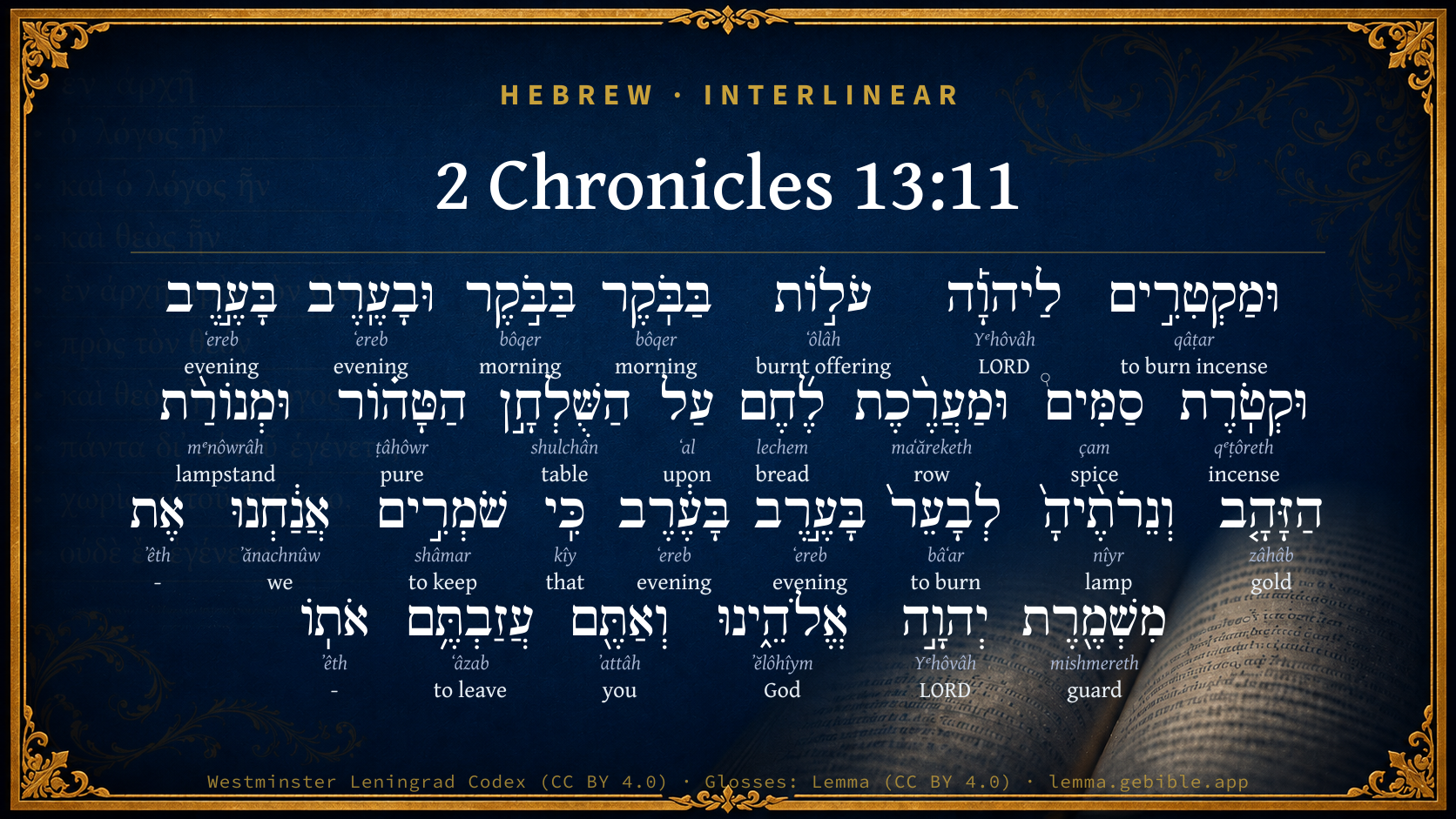
2 Chronicles 13:11

Hebrew (Westminster Leningrad Codex) 2 Chronicles 13:11 appears in the Hebrew Old Testament. The text above is from the Westminster Leningrad Codex. Each word links to its Strong’s number, a concise gloss, and parsing drawn from the Open Scriptures Hebrew Bible morphology. Click any word for its full Brown-Driver-Briggs (BDB) entry.
Download image
Cite this verse

2 Chronicles 13:11 (World English Bible). Public Domain. Lemma interlinear Bible study tool, https://lemma.gebible.app/v/2-chronicles/13/11.

Show BibTeX & RIS
BibTeX
RIS
English Translation
and they burn to Yahweh every morning and every evening burnt offerings and sweet incense: the show bread also [set they] in order on the pure table; and the lampstand of gold with the lamps of it, to burn every evening: for we keep the charge of Yahweh our God; but you have forsaken him.
World English Bible · Public Domain
Download a study sheet

One document with this verse’s original text, its word-by-word gloss line, the meaning frame, cross-references with their text, attributed commentary, and full source and license credits — printable, and it pastes into notes with its structure intact.

This verse Autodidact and up

Study sheet (.html) Plain text (.txt)

A passage Seminary Student

Up to 50 verses in one chapter. A passage sheet keeps up to 6 commentary sources and 12 cross-references per verse, in the order this page ranks them, and says so on the sheet whenever that leaves anything out. Ask for a single verse and you get the Autodidact verse sheet above.

Everything on this page stays free to read, with no account — the sheet is a download of what is already on screen, not access to it.

Want to remove ads? Support Godless Engineer
Compare translations 3

The same verse in 3 English versions, stacked beneath the original-language interlinear above. Click any original word for its lexicon entry.

Each is an independent rendering of the whole verse — the interlinear is not word-aligned to these translations.

Highlighted words mark where these versions differ — a whole-verse word diff, not a word-by-word alignment.

  • World English Bible Public Domain
    and they burn to Yahweh every morning and every evening burnt offerings and sweet incense: the show bread also [set they] in order on the pure table; and the lampstand of gold with the lamps of it, to burn every evening: for we keep the charge of Yahweh our God; but you have forsaken him.
  • King James Version Public Domain
    And they burn unto the LORD every morning and every evening burnt sacrifices and sweet incense: the shewbread also set they in order upon the pure table; and the candlestick of gold with the lamps thereof, to burn every evening: for we keep the charge of the LORD our God; but ye have forsaken him.
  • unfoldingWord Literal Text CC BY-SA 4.0
    And they are making sacrifices to Yahweh, burnt offerings, morning by morning and evening by evening, and spiced incense, and a line of bread on the pure table, and the gold lampstand and its lamps to burn evening by evening. For we are keeping the charge of Yahweh, our God, but you all yourselves have abandoned him.

unfoldingWord Literal Text — © unfoldingWord, licensed CC BY-SA 4.0. Word-aligned USFM3 via Door43 (git.door43.org/unfoldingWord/en_ult).

Versions to compare (up to 4)

3 of 4 selected

Show all 18 translations

Every available English version of this verse, each an independent rendering of the whole verse.

  • World English Bible Public Domain
    and they burn to Yahweh every morning and every evening burnt offerings and sweet incense: the show bread also [set they] in order on the pure table; and the lampstand of gold with the lamps of it, to burn every evening: for we keep the charge of Yahweh our God; but you have forsaken him.
  • Berean Standard Bible Public Domain
    Every morning and every evening they present burnt offerings and fragrant incense to the LORD. They set out the rows of showbread on the ceremonially clean table, and every evening they light the lamps of the gold lampstand. We are carrying out the requirements of the LORD our God, while you have forsaken Him.
  • Majority Standard Bible Public Domain
    Every morning and every evening they present burnt offerings and fragrant incense to the LORD. They set out the rows of showbread on the ceremonially clean table, and every evening they light the lamps of the gold lampstand. We are carrying out the requirements of the LORD our God, while you have forsaken Him.
  • King James Version Public Domain
    And they burn unto the LORD every morning and every evening burnt sacrifices and sweet incense: the shewbread also set they in order upon the pure table; and the candlestick of gold with the lamps thereof, to burn every evening: for we keep the charge of the LORD our God; but ye have forsaken him.
  • American Standard Version (1901) Public Domain
    and they burn unto Jehovah every morning and every evening burnt-offerings and sweet incense: the showbread also `set they' in order upon the pure table; and the candlestick of gold with the lamps thereof, to burn every evening: for we keep the charge of Jehovah our God; but ye have forsaken him.
  • Revised Version (1885) Public Domain
    and they burn unto the LORD every morning and every evening burnt offerings and sweet incense: the shewbread also set they in order upon the pure table; and the candlestick of gold with the lamps thereof, to burn every evening: for we keep the charge of the LORD our God; but ye have forsaken him.
  • Geneva Bible (1599) Public Domain
    And they burne vnto the Lord euery morning and euery euening burnt offerings and sweete incense, and the breade is set in order vpon the pure table, and the candlesticke of golde with the lampes thereof, to burne euery euening: for we keepe the watch of the Lord our God: but ye haue forsaken him.
  • Douay-Rheims (1899) Public Domain
    And they offer holocausts to the Lord, every day, morning and evening, and incense made according to the ordinance of the law, and the leaves are set forth on a most clean table, and there is with us the golden candlestick, and the lamps thereof, to be lighted always in the evening: for we keep the precepts of the Lord our God, whom you have forsaken.
  • Young's Literal Translation Public Domain
    and are making perfume to Jehovah, burnt-offerings morning by morning, and evening by evening, and perfume of spices, and the arrangement of bread `is' on the pure table, and the candlestick of gold, and its lamps, to burn evening by evening, for we are keeping the charge of Jehovah our God, and ye -- ye have forsaken Him.
  • Literal Standard Version CC BY-SA 4.0
    and are making incense to YHWH, burnt-offerings morning by morning, and evening by evening, and incense of spices, and the arrangement of bread [is] on the pure table, and the lampstand of gold, and its lamps, to burn evening by evening, for we are keeping the charge of our God YHWH, and you have forsaken Him.
  • Unlocked Literal Bible CC BY-SA 4.0
    Every morning and evening they burn for Yahweh burnt offerings and sweet incense. They also arrange the bread of the presence on the pure table; they also tend the lampstand of gold with its lamps, for them to burn every evening. We keep the commandments of Yahweh, our God, but you have forsaken him.
  • unfoldingWord Literal Text CC BY-SA 4.0
    And they are making sacrifices to Yahweh, burnt offerings, morning by morning and evening by evening, and spiced incense, and a line of bread on the pure table, and the gold lampstand and its lamps to burn evening by evening. For we are keeping the charge of Yahweh, our God, but you all yourselves have abandoned him.
  • Darby Bible Public Domain
    and they burn to Jehovah every morning and every evening burnt-offerings and sweet incense; the loaves also are set in order upon the pure table; and the candlestick of gold with its lamps to burn every evening: for *we* keep the charge of Jehovah our God; but *ye* have forsaken him.
  • World Messianic Bible Public Domain
    They burn to the LORD every morning and every evening burnt offerings and sweet incense. They also set the show bread in order on the pure table, and care for the gold lamp stand with its lamps, to burn every evening; for we keep the instruction of the LORD our God, but you have forsaken him.
  • Webster's Bible Public Domain
    And they burn to the LORD every morning and every evening burnt-sacrifices and sweet incense: the show-bread also they set in order upon the pure table; and the candlestick of gold with its lamps to burn every evening: for we keep the charge of the LORD our God; but ye have forsaken him.
  • Free Bible Version CC BY-SA 4.0
    Morning and evening they present burnt offerings and burn fragrant incense to the Lord. They place the rows of showbread on the purified table, and light the lamps of the gold lampstand every evening. We are doing what the Lord our God told us to do, while you have abandoned him.
  • Bible in Basic English Public Domain
    By whom burned offerings and perfumes are sent up in smoke before the Lord every morning and every evening; and they put out the holy bread on its table and the gold support for the lights with its lights burning every evening; for we keep the orders given to us by the Lord our God, but you have gone away from him.
  • JPS Tanakh (1917) Public Domain
    and they burn unto the LORD every morning and every evening burnt-offerings and sweet incense; the showbread also set they in order upon the pure table; and the candlestick of gold with the lamps thereof, to burn every evening; for we keep the charge of the LORD our God; but ye have forsaken Him.

Literal Standard Version (2020), Covenant Press — licensed CC BY-SA 4.0. Text via the HelloAO Bible API (eBible.org). Unlocked Literal Bible (unfoldingWord) — licensed CC BY-SA 4.0. Text via the HelloAO Bible API (eBible.org). unfoldingWord Literal Text — © unfoldingWord, licensed CC BY-SA 4.0. Word-aligned USFM3 via Door43 (git.door43.org/unfoldingWord/en_ult). Free Bible Version, Dr. Jonathan Gallagher — licensed CC BY-SA 4.0. Text via the HelloAO Bible API (eBible.org).

Word by word

More ways to search: Search by grammar → Find every occurrence → Compare this word →

Practice this passage: Drill this verse → Learn its vocabulary →

וּמַעֲרֶ֨כֶת
maʻăreketh
H4635
“and · row of”
Conjunction + Noun, Common, Feminine, Singular, Construct
Part of Speech
Conjunction + Noun
Type
Common
Gender
Feminine
Number
Singular
State
Construct
Full BDB Definition

Origin: from H6186

TWOT: 1694e

row, line
  1. וּמַקְטִרִ֣ים qâṭar H6999 “and · burning incense” Conjunction + Verb, Hiphil, Participle Active, Masculine, Plural, Absolute
  2. לַיהוָ֡ה Yᵉhôvâh H3068 “to/for · LORD” Preposition + Noun, Proper
  3. עֹל֣וֹת ʻôlâh H5930 “burnt offerings” Noun, Common, Feminine, Plural, Absolute
  4. בַּבֹּֽקֶר bôqer H1242 “in/at the · morning” Preposition, Determined + Noun, Common, Masculine, Singular, Absolute
  5. בַּבֹּ֣קֶר bôqer H1242 “in/at the · morning” Preposition, Determined + Noun, Common, Masculine, Singular, Absolute
  6. וּבָעֶֽרֶב ʻereb H6153 “and · in/at the · evening” Conjunction + Preposition, Determined + Noun, Common, Masculine, Singular, Absolute
  7. בָּעֶ֣רֶב ʻereb H6153 “in/at the · evening” Preposition, Determined + Noun, Common, Masculine, Singular, Absolute
  8. וּקְטֹֽרֶת qᵉṭôreth H7004 “and · incense of” Conjunction + Noun, Common, Feminine, Singular, Construct
  9. סַמִּים֩ çam H5561 “spices” Noun, Common, Masculine, Plural, Absolute
  10. לֶ֜חֶם lechem H3899 “bread” Noun, Common, Both, Singular, Absolute
  11. עַל ʻal H5921 “upon” Preposition
  12. הַשֻּׁלְחָ֣ן shulchân H7979 “the · table” Particle, Definite Article + Noun, Common, Masculine, Singular, Absolute
  13. הַטָּה֗וֹר ṭâhôwr H2889 “the · pure” Particle, Definite Article + Adjective, Adjective, Masculine, Singular, Absolute
  14. וּמְנוֹרַ֨ת mᵉnôwrâh H4501 “and · lampstand of” Conjunction + Noun, Common, Feminine, Singular, Construct
  15. הַזָּהָ֤ב zâhâb H2091 “the · gold” Particle, Definite Article + Noun, Common, Masculine, Singular, Absolute
  16. וְנֵרֹתֶ֨יהָ֙ nîyr H5216 “and · lamps · her” Conjunction + Noun, Common, Masculine, Plural, Construct + Suffix, Personal, 3rd Person, Feminine, Singular
  17. לְבָעֵר֙ bâʻar H1197 “to burn” Preposition + Verb, Piel, Infinitive Construct
  18. בָּעֶ֣רֶב ʻereb H6153 “in/at the · evening” Preposition, Determined + Noun, Common, Masculine, Singular, Absolute
  19. בָּעֶ֔רֶב ʻereb H6153 “in/at the · evening” Preposition, Determined + Noun, Common, Masculine, Singular, Absolute
  20. כִּֽי kîy H3588 “that” Conjunction
  21. שֹׁמְרִ֣ים shâmar H8104 “keeping” Verb, Qal, Participle Active, Masculine, Plural, Absolute
  22. אֲנַ֔חְנוּ ʼănachnûw H587 “we” Pronoun, Personal, 1st Person, Common, Plural
  23. אֶת ʼêth H853 “-” Particle, Direct Object
  24. מִשְׁמֶ֖רֶת mishmereth H4931 “guard of” Noun, Common, Feminine, Singular, Construct
  25. יְהוָ֣ה Yᵉhôvâh H3068 “LORD” Noun, Proper
  26. אֱלֹהֵ֑ינוּ ʼĕlôhîym H430 “God(s) · our” Noun, Common, Masculine, Plural, Construct + Suffix, Personal, 1st Person, Common, Plural
  27. וְאַתֶּ֖ם ʼattâh H859 “and · you” Conjunction + Pronoun, Personal, 2nd Person, Masculine, Plural
  28. עֲזַבְתֶּ֥ם ʻâzab H5800 “to leave” Verb, Qal, Perfect, 2nd Person, Masculine, Plural
  29. אֹתֽוֹ ʼêth H853 “- · him” Particle, Direct Object + Suffix, Personal, 3rd Person, Masculine, Singular

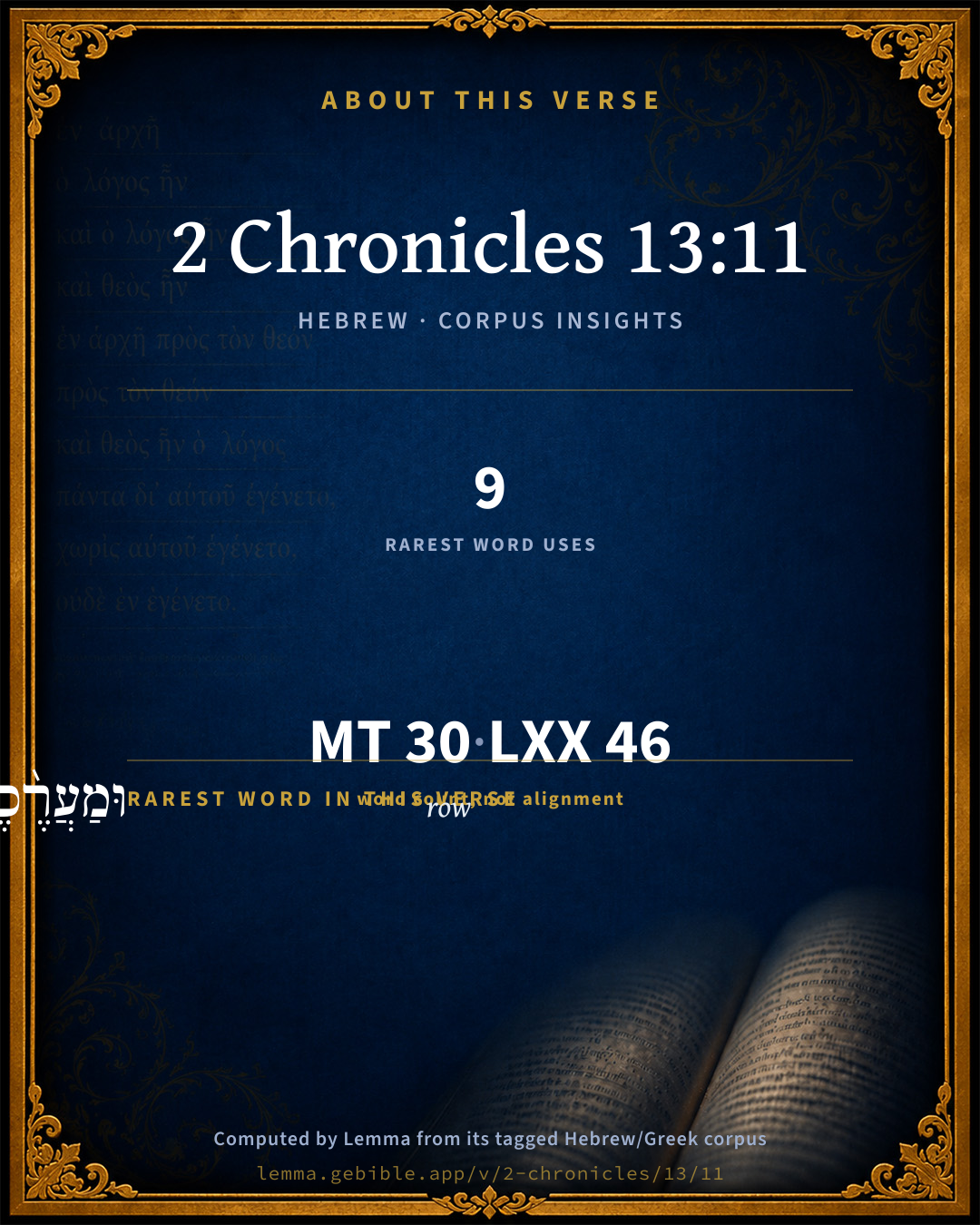
About this verse

These counts appear in no published source. They are computed here, from the morphology-tagged text and Lemma’s own curated glosses. What Lemma adds →

30
words
24
distinct lemmas
Historical
section

Notable vocabulary

The rarest word here is וּמַעֲרֶ֨כֶת row H4635 — appearing just 9 times in the whole Hebrew Bible.

Shared distinctive vocabulary

וּמַעֲרֶ֨כֶת row H4635 occurs in 9 verses of the Hebrew Bible. Also found in:

Grammatical profile

  • 4 verbs
  • 19 nouns
  • 1 adjective
  • 2 pronouns
  • 1 preposition
  • 1 conjunction
  • 2 particles

Verb forms

  • וּמַקְטִרִ֣ים Hiphil · Participle Active
  • לְבָעֵר֙ Piel · Infinitive Construct
  • שֹׁמְרִ֣ים Qal · Participle Active
  • עֲזַבְתֶּ֥ם Qal · Perfect

Repetition

Words recur within this verse — often emphatic in Hebrew:

  • וּבָעֶֽרֶב evening H6153 ×4
  • לַיהוָ֡ה LORD H3068 ×2
  • בַּבֹּֽקֶר morning H1242 ×2

Hebrew & Septuagint length

In English translation the verse runs 55 words from the Hebrew and 56 from the Septuagint (LXX English) — closely comparable.

A rough comparison of the two English renderings, which tokenize alike — not a word-level alignment.

Word counts can differ between the Hebrew and the Greek without any difference in meaning — e.g. the Hebrew direct-object marker אֵת has no separate Greek word, and Greek often adds the article ὁ.

In the original languages it is 30 Hebrew tokens and 46 Greek tokens — but the two are counted differently (Hebrew bundles its prefixes and suffixes into one token; the Greek is in lemma form), so that isn’t a like-for-like length.

Cross-references

16

Topical passages linked to 2 Chronicles 13:11 in the Treasury of Scripture Knowledge — connected by theme and wording, ordered by reader-vote popularity; previews shown in the World English Bible.

  • 2 Chronicles 2:4 Behold, I am about to build a house for the name of Yahweh my God, to dedicate it to him, and to burn before him incense of sweet spices, and for the continual show bread, and for the burnt offerings morning and evening, on the Sabbaths, and on the new moons, and on the set feasts of Yahweh our God. This is [an ordinance] forever to Israel.
  • Leviticus 24:2–9 "Command the children of Israel, that they bring to you pure olive oil beaten for the light, to cause a lamp to burn continually.
  • Exodus 25:30–39 You shall set bread of the presence on the table before me always.
  • Exodus 27:20–21 "You shall command the children of Israel, that they bring to you pure olive oil beaten for the light, to cause a lamp to burn continually.
  • Exodus 29:38 "Now this is that which you shall offer on the altar: two lambs a year old day by day continually.
  • Genesis 26:5 because Abraham obeyed my voice, and kept my charge, my commandments, my statutes, and my laws."
  • Exodus 30:1–10 "You shall make an altar to burn incense on. You shall make it of acacia wood.
  • Leviticus 2:1–3 "'When anyone offers an offering of a meal offering to Yahweh, his offering shall be of fine flour; and he shall pour oil on it, and put frankincense on it.
  • Numbers 9:19 When the cloud stayed on the tabernacle many days, then the children of Israel kept the charge of Yahweh, and didn't travel.
  • Numbers 16:6 This do: take you censers, Korah, and all his company;
  • Numbers 16:46 Moses said to Aaron, Take your censer, and put fire therein from off the altar, and lay incense thereon, and carry it quickly to the congregation, and make atonement for them: for there is wrath gone out from Yahweh; the plague is begun.
  • Ezekiel 44:8 You have not kept the charge of my holy things; but you have set keepers of my charge in my sanctuary for yourselves.
  • Ezekiel 44:15 But the priests the Levites, the sons of Zadok, who kept the charge of my sanctuary when the children of Israel went astray from me, they shall come near to me to minister to me; and they shall stand before me to offer to me the fat and the blood, says the Lord Yahweh:
  • Ezekiel 48:11 [It shall be] for the priests who are sanctified of the sons of Zadok, who have kept my charge, who didn't go astray when the children of Israel went astray, as the Levites went astray.
  • Luke 1:9 according to the custom of the priest's office, his lot was to enter into the temple of the Lord and burn incense.
  • Revelation 8:3–4 Another angel came and stood over the altar, having a golden censer. Much incense was given to him, that he should add it to the prayers of all the saints on the golden altar which was before the throne.

Cross-references courtesy of OpenBible.info (CC BY 4.0).

Hebrew and Greek witnesses Masoretic Hebrew ↔ Greek Septuagint

The same verse in the two great witnesses to the Old Testament, shown verse-for-verse.

These are two independent witnesses, not word-aligned to each other, and the Septuagint is shown in lemma (dictionary) form.

Hebrew 2 Chronicles 13:11 Masoretic · Westminster Leningrad Codex

וּמַקְטִרִ֣ים לַיהוָ֡ה עֹל֣וֹת בַּבֹּֽקֶר בַּבֹּ֣קֶר וּבָעֶֽרֶב בָּעֶ֣רֶב וּקְטֹֽרֶת סַמִּים֩ וּמַעֲרֶ֨כֶת לֶ֜חֶם עַל הַשֻּׁלְחָ֣ן הַטָּה֗וֹר וּמְנוֹרַ֨ת הַזָּהָ֤ב וְנֵרֹתֶ֨יהָ֙ לְבָעֵר֙ בָּעֶ֣רֶב בָּעֶ֔רֶב כִּֽי שֹׁמְרִ֣ים אֲנַ֔חְנוּ אֶת מִשְׁמֶ֖רֶת יְהוָ֣ה אֱלֹהֵ֑ינוּ וְאַתֶּ֖ם עֲזַבְתֶּ֥ם אֹתֽוֹ

and they burn to Yahweh every morning and every evening burnt offerings and sweet incense: the show bread also [set they] in order on the pure table; and the lampstand of gold with the lamps of it, to burn every evening: for we keep the charge of Yahweh our God; but you have forsaken him.

World English Bible · Public Domain

Greek LXX 2 Chronicles 13:11 Septuagint · lemma form

θυμιάω ὁ κύριος ὁλοκαύτωμα πρωί καί δείλη καί θυμίαμα σύνθεσις καί πρόθεσις ἄρτος ἐπί ὁ τράπεζα ὁ καθαρός καί ὁ λυχνία ὁ χρυσοῦς καί ὁ λύχνος ὁ καῦσις ἀναἅπτω δείλη ὅτι φυλάσσω ἐγώ ὁ φυλακή κύριος ὁ θεός ὁ πατήρ ἐγώ καί σύ ἐν καταλείπω αὐτός

they sacrifice to the Lord whole burnt offering, morning and evening, and compound incense, and set the show bread on the pure table; and there is the golden candlestick, and the lamps for burning, to light in the evening: for we keep the charge of the Lord God of our fathers; but you⌃ have forsaken him.

LXX2012 (modern English Septuagint) · Public Domain

Hebrew: Westminster Leningrad Codex (CC BY 4.0). Greek: Septuagint (public domain); English from LXX2012 (modern English Septuagint) (Public Domain). How the Septuagint differs from the Hebrew →

Commentary

Notes on 2 Chronicles 13:11 from classic Christian and Jewish commentators (each source and its license shown beneath its notes). The classic Christian expositions comment on the surrounding passage and are grouped to its opening verse, so a note may address several verses; the Jewish commentaries on the Tanakh (Rashi and others) are per-verse, so they appear only where the commentator wrote on this verse.

Lemma curates 59 commentaries, every one of them public domain or Creative Commons licensed, each selected and text-cleaned for this edition rather than reprinted as found. About our sources →

Trapp's Complete Commentary

John Trapp

2Ch 13:11 And they burn unto the LORD every morning and every evening burnt sacrifices and sweet incense: the shewbread also [set they in order] upon the pure table; and the candlestick of gold with the lamps thereof, to burn every evening: for we keep the charge of the LORD our God; but ye have forsaken him.

Ver. 11. Upon the pure table and the candlestick of gold.] Either it is table, for tables, as 1Ki 7:48; or else this king, who little minded such matters, thought there had been but one such table and candlestick in the temple, as of old in the tabernacle. {a}

{a} Lavat.

John Trapp, A Commentary or Exposition upon All the Books of the Old and New Testament (1647–1656) — public domain. Text from a community e-Sword module.

Joseph Benson's Commentary

2Ch 13:11. The show-bread upon the pure table — So called, because it was made of pure gold, Exo 25:23-24. He saith, table and candlestick, though there were ten of each, because ordinarily there was but one of each used at a time. We keep the charge of the Lord our God —

We worship no images, have no priests but those whom he has ordained, no rites of worship but what he has prescribed. Both the temple-service and the temple-furniture are of his appointing: his appointment we abide by, and neither add nor diminish. Perhaps he flattered himself that his keeping up the external worship of God would make satisfaction for the errors of his life. Or he said this, that he might thereby encourage his own soldiers, and convince or terrify his enemies.

Joseph Benson's Commentary on the Old and New Testaments (1811–1818) — public domain. Text from a community e-Sword module.

Geneva Bible (1599)

Geneva Bible translators

As it was appointed in the Law, Exod. 29:39.

Geneva Bible (1599) marginal notes — public domain. Text via Bolls.life.

Ellicott's Commentary for English Readers

(11) Every morning and every evening.—For the daily sacrifice, see Exo_29:38-42; for the “sweet incense,” or incense of spices, Exo_30:7.

The shewbread also . . .—Literally, and a pile of bread on the pure table. The construction is uncertain. The words seem to depend loosely on the verb they offer (“they burn”) at the beginning of the sentence. But perhaps they should be taken thus: and a pile of bread is on the pure table, and the golden lampstand and its lamps they have to light every evening. (See Exo_25:30; Exo_25:37; Lev_24:5-7.) The Syriac reads, “and the golden lampstands and their lamps; and the lamp-boy lighteth them every evening.” It is noticeable that only one table and one candlestick are mentioned here. (Comp. 2Ch_4:7-8; 2Ch_4:19.)

The observance of these details of ritual is called “keeping the charge of Jehovah” (see Lev_8:35), and neglect of them is “forsaking” Him. (See on 2Ch_13:10).

A Bible Commentary for English Readers, edited by Charles John Ellicott (1878–1897) — public domain. Text from a community e-Sword module.

The Cambridge Bible for Schools and Colleges

gen. ed. J. J. S. Perowne

11. every morning and every evening] Exo_29:38-42.

sweet incense] Exo_30:7.

the shew bread also set they in order] Lit. and an ordering of bread [they set in order]. The Heb. phrase used here for “shewbread” signifies bread arranged as for an offering. Another term is “bread of the presence,” i.e. bread set forth continually before the Lord (Exo_25:30).

the candlestick] Exo_25:31 ff; Exo_40:24-25.

The Cambridge Bible for Schools and Colleges (gen. ed. J. J. S. Perowne; Cambridge University Press, 1878–1918) — public domain. Text from a community e-Sword module.

John Gill's Exposition

And, behold, God himself is with us for our Captain,.... To go before our armies, and fight our battles for us:

and his priests with sounding trumpets to cry alarm against you; which was one use of the trumpets, that the people might be remembered by the Lord, and saved from their enemies, Num 10:9, so that this circumstance was against Jeroboam and his army, and for Abijah and his:

O children of Israel, fight ye not against the Lord God of your fathers; for fighting against his people, that retained the pure worship of him, was fighting against him:

for you shall not prosper; he seems to be assured of victory.

John Gill's Exposition of the Whole Bible (1746–1763) — public domain (CC PDM 1.0). Text via the HelloAO Bible API.

Haydock's Catholic Bible Commentary

Table. It is hence inferred, that Sesac had only left one: (Lyranus; Torniel.) but this does not follow. (Calmet) (Salien)

George Leo Haydock (1774–1849), Haydock's Catholic Family Bible and Commentary, 1859 edition — public domain. Excludes Psalms (Douay-Rheims chapter numbering differs from Protestant) and Deuterocanonical books (Catholic canon only).

Matthew Poole's English Annotations

The pure table; so called, because it was made of pure gold, Exo 25:23,24.

The candlestick; he saith table and candlestick, though there were ten of each, 2Ch 4:7,8; either,

1. Because Shishak had carried away all but one. Or,

2. The singular number is put for the plural, as 1Ki 7:48, and oft elsewhere. Or,

3. Because ordinarily there was but one of each used at a time for those uses.

To burn every evening; and from evening to morning continually, Lev 24:2,3; for which end one candlestick was sufficient, and it is very improbable that all the candlesticks were used every night.

We keep the charge of the Lord our God: this he saith, though he was an ungodly king; either because he flattered himself and fancied that his keeping up the external worship of God would make full satisfaction for the errors of his life; or that he might hereby encourage his own soldiers, and convince or terrify his enemies.

Matthew Poole's English Annotations on the Holy Bible (1683–1685) — public domain. Text from a community e-Sword/MySword module.

John Wesley's Explanatory Notes

Pure table - Made of pure gold, Exod. xxv, 23, 24, he saith table and candlestick, though there were ten of each, because ordinarily there was but one of each used at a time for those uses. We keep - Perhaps he flattered himself, that his keeping up the external worship of God would make satisfaction for the errors of his life.

John Wesley, Explanatory Notes Upon the Whole Bible (1754–1765) — public domain. Text via the GEBible commentary corpus.

Scofield Reference Notes

C. I. Scofield

shewbread

(See Scofield "Exo 25:30").

The Scofield Reference Bible (1917 edition), notes by C. I. Scofield — public domain. Text from a community e-Sword module.

Lesson kit

Teaching starters — assembled from the data on this page, not authored interpretation. Every prompt links to the verse data it draws on. Edit before teaching.

2 Chronicles, in the Historical, opens this verse with 30 words (24 distinct Hebrew lemmas). Its most distinctive word is maʻăreketh (“row”). A historical commentator’s framing appears above. Read the whole chapter for the surrounding context.

Discussion questions

  1. What does “row” (maʻăreketh) contribute to the verse as a whole?
  2. Leviticus 24:6 shares the word «row» with this verse. How do the two illuminate each other?
  3. “evening” occurs 4× in this one verse. What is the effect of the repetition?
  4. These translations render this verse differently; the difference is in the English rendering, not the original. What questions does that raise?
  5. The verb «וּמַקְטִרִ֣ים» is Hiphil Participle Active. How does its form color the action?
  6. Reading how Trapp's Complete Commentary and Joseph Benson's Commentary read this verse, where do the two commentators agree and where do they part?

Things to notice

Reading settings

Reading text

Shown beneath each verse's original-language words.

Old Testament
Old Testament edition

Read the OT as the Masoretic Hebrew (MT) or the Greek Septuagint (LXX).

English shown for the Greek Septuagint (in the Hebrew ↔ Greek comparison).

Comparing translations? Open the Compare panel on any verse page to stack up to four side by side.