
Ezekiel 13:19

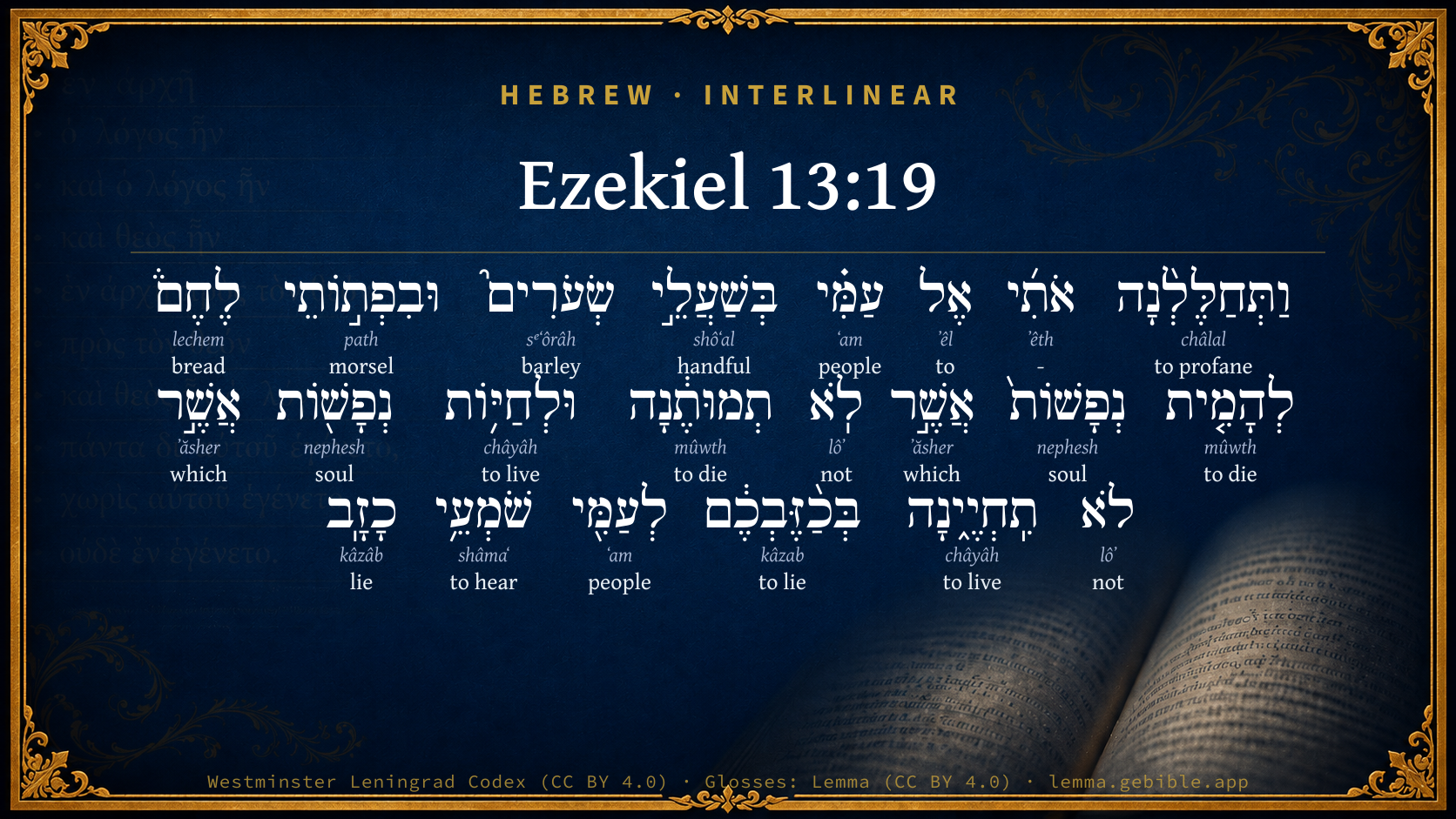
Hebrew (Westminster Leningrad Codex) Ezekiel 13:19 appears in the Hebrew Old Testament. The text above is from the Westminster Leningrad Codex. Each word links to its Strong’s number, a concise gloss, and parsing drawn from the Open Scriptures Hebrew Bible morphology. Click any word for its full Brown-Driver-Briggs (BDB) entry.
Download image
Cite this verse

Ezekiel 13:19 (World English Bible). Public Domain. Lemma interlinear Bible study tool, https://lemma.gebible.app/v/ezekiel/13/19.

Show BibTeX & RIS
BibTeX
RIS
English Translation
You have profaned me among my people for handfuls of barley and for pieces of bread, to kill the souls who should not die, and to save the souls alive who should not live, by your lying to my people who listen to lies.
World English Bible · Public Domain
Download a study sheet

One document with this verse’s original text, its word-by-word gloss line, the meaning frame, cross-references with their text, attributed commentary, and full source and license credits — printable, and it pastes into notes with its structure intact.

This verse Autodidact and up

Study sheet (.html) Plain text (.txt)

A passage Seminary Student

Up to 50 verses in one chapter. A passage sheet keeps up to 6 commentary sources and 12 cross-references per verse, in the order this page ranks them, and says so on the sheet whenever that leaves anything out. Ask for a single verse and you get the Autodidact verse sheet above.

Everything on this page stays free to read, with no account — the sheet is a download of what is already on screen, not access to it.

Want to remove ads? Support Godless Engineer
Compare translations 3

The same verse in 3 English versions, stacked beneath the original-language interlinear above. Click any original word for its lexicon entry.

Each is an independent rendering of the whole verse — the interlinear is not word-aligned to these translations.

Highlighted words mark where these versions differ — a whole-verse word diff, not a word-by-word alignment.

  • World English Bible Public Domain
    You have profaned me among my people for handfuls of barley and for pieces of bread, to kill the souls who should not die, and to save the souls alive who should not live, by your lying to my people who listen to lies.
  • King James Version Public Domain
    And will ye pollute me among my people for handfuls of barley and for pieces of bread, to slay the souls that should not die, and to save the souls alive that should not live, by your lying to my people that hear your lies?
  • unfoldingWord Literal Text CC BY-SA 4.0
    You have profaned me among my people for handfuls of barley and crumbs of bread, to kill people who should not die, and to preserve the lives of those who should not continue to live, because of your lies to my people who heard you.

unfoldingWord Literal Text — © unfoldingWord, licensed CC BY-SA 4.0. Word-aligned USFM3 via Door43 (git.door43.org/unfoldingWord/en_ult).

Versions to compare (up to 4)

3 of 4 selected

Show all 18 translations

Every available English version of this verse, each an independent rendering of the whole verse.

  • World English Bible Public Domain
    You have profaned me among my people for handfuls of barley and for pieces of bread, to kill the souls who should not die, and to save the souls alive who should not live, by your lying to my people who listen to lies.
  • Berean Standard Bible Public Domain
    You have profaned Me among My people for handfuls of barley and scraps of bread. By lying to My people who would listen, you have killed those who should not have died and spared those who should not have lived.
  • Majority Standard Bible Public Domain
    You have profaned Me among My people for handfuls of barley and scraps of bread. By lying to My people who would listen, you have killed those who should not have died and spared those who should not have lived.
  • King James Version Public Domain
    And will ye pollute me among my people for handfuls of barley and for pieces of bread, to slay the souls that should not die, and to save the souls alive that should not live, by your lying to my people that hear your lies?
  • American Standard Version (1901) Public Domain
    And ye have profaned me among my people for handfuls of barley and for pieces of bread, to slay the souls that should not die, and to save the souls alive that should not live, by your lying to my people that hearken unto lies.
  • Revised Version (1885) Public Domain
    And ye have profaned me among my people for handfuls of barley and for pieces of bread, to slay the souls that should not die, and to save the souls alive that should not live, by your lying to my people that hearken unto lies.
  • Geneva Bible (1599) Public Domain
    And will ye pollute me among my people for handfuls of barly, and for pieces of bread to slay the soules of them that shoulde not dye, and to giue life to the soules that should not liue in lying to my people, that heare your lies?
  • Douay-Rheims (1899) Public Domain
    And they violated me among my people, for a handful of barley, and a piece of bread, to kill souls which should not die, and to save souls alive which should not live, telling lies to my people that believe lies.
  • Young's Literal Translation Public Domain
    Yea, ye pierce Me concerning My people, For handfuls of barley, And for pieces of bread, to put to death Souls that should not die, And to keep alive souls that should not live, By your lying to My people -- hearkening to lies.
  • Literal Standard Version CC BY-SA 4.0
    Indeed, you pierce Me concerning My people, || For handfuls of barley, || And for pieces of bread, || To put to death souls that should not die, || And to keep alive souls that should not live, || By your lying to My people—listening to lies.
  • Unlocked Literal Bible CC BY-SA 4.0
    You have profaned me among my people for handfuls of barley and crumbs of bread, to kill people who should not die, and to preserve the lives of those who should not continue to live, because of your lies to my people who heard you.
  • unfoldingWord Literal Text CC BY-SA 4.0
    You have profaned me among my people for handfuls of barley and crumbs of bread, to kill people who should not die, and to preserve the lives of those who should not continue to live, because of your lies to my people who heard you.
  • Darby Bible Public Domain
    And will ye profane me among my people for handfuls of barley and for morsels of bread, to slay the souls that should not die, and to save the souls alive that should not live, by your lying to my people that listen to lying?
  • World Messianic Bible Public Domain
    You have profaned me among my people for handfuls of barley and for pieces of bread, to kill the souls who should not die and to save the souls alive who should not live, by your lying to my people who listen to lies.’
  • Webster's Bible Public Domain
    And will ye profane me among my people for handfuls of barley and for pieces of bread, to slay the souls that should not die, and to save the souls alive that should not live, by your lying to my people that hear your lies?
  • Free Bible Version CC BY-SA 4.0
    You have disgraced me among my people for a few handfuls of barley and scraps of bread. By lying to my people who believe in you, you have killed those who shouldn't have died and let others live who shouldn't.
  • Bible in Basic English Public Domain
    And you have put me to shame among my people for a little barley and some bits of bread, sending death on souls for whom there is no cause of death, and keeping those souls living who have no right to life, by the false words you say to my people who give ear to what is false.
  • JPS Tanakh (1917) Public Domain
    And ye have profaned Me among My people for handfuls of barley and for crumbs of bread, to slay the souls that should not die, and to save the souls alive that should not live, by your lying to My people that hearken unto lies.

Literal Standard Version (2020), Covenant Press — licensed CC BY-SA 4.0. Text via the HelloAO Bible API (eBible.org). Unlocked Literal Bible (unfoldingWord) — licensed CC BY-SA 4.0. Text via the HelloAO Bible API (eBible.org). unfoldingWord Literal Text — © unfoldingWord, licensed CC BY-SA 4.0. Word-aligned USFM3 via Door43 (git.door43.org/unfoldingWord/en_ult). Free Bible Version, Dr. Jonathan Gallagher — licensed CC BY-SA 4.0. Text via the HelloAO Bible API (eBible.org).

Word by word

More ways to search: Search by grammar → Find every occurrence → Compare this word →

Practice this passage: Drill this verse → Learn its vocabulary →

בְּשַׁעֲלֵ֣י
shôʻal
H8168
“in/at · handfuls of”
Preposition + Noun, Common, Masculine, Plural, Construct
Part of Speech
Preposition + Noun
Type
Common
Gender
Masculine
Number
Plural
State
Construct
Full BDB Definition

Origin: from an unused root meaning to hollow out

TWOT: 2432a

hollow hand, hollow of hand, handful - hollow hand, hollow of hand - handful
  1. וַתְּחַלֶּלְ֨נָה châlal H2490 “and · to profane” Conjunction + Verb, Piel, Sequential Imperfect, 2nd Person, Feminine, Plural
  2. אֹתִ֜י ʼêth H853 “- · me” Particle, Direct Object + Suffix, Personal, 1st Person, Common, Singular
  3. אֶל ʼêl H413 “to” Preposition
  4. עַמִּ֗י ʻam H5971 “people · my” Noun, Common, Masculine, Singular, Construct + Suffix, Personal, 1st Person, Common, Singular
  5. שְׂעֹרִים֮ sᵉʻôrâh H8184 “barley” Noun, Common, Feminine, Plural, Absolute
  6. וּבִפְת֣וֹתֵי path H6595 “and · in/at · morsels of” Conjunction + Preposition + Noun, Common, Masculine, Plural, Construct
  7. לֶחֶם֒ lechem H3899 “bread” Noun, Common, Both, Singular, Absolute
  8. לְהָמִ֤ית mûwth H4191 “to die” Preposition + Verb, Hiphil, Infinitive Construct
  9. נְפָשׁוֹת֙ nephesh H5315 “souls” Noun, Common, Both, Plural, Absolute
  10. אֲשֶׁ֣ר ʼăsher H834 “which” Particle, Relative
  11. לֹֽא lôʼ H3808 “not” Particle, Negative
  12. תְמוּתֶ֔נָה mûwth H4191 “to die” Verb, Qal, Imperfect, 3rd Person, Feminine, Plural
  13. וּלְחַיּ֥וֹת châyâh H2421 “and · to live” Conjunction + Preposition + Verb, Piel, Infinitive Construct
  14. נְפָשׁ֖וֹת nephesh H5315 “souls” Noun, Common, Both, Plural, Absolute
  15. אֲשֶׁ֣ר ʼăsher H834 “which” Particle, Relative
  16. לֹא lôʼ H3808 “not” Particle, Negative
  17. תִֽחְיֶ֑ינָה châyâh H2421 “to live” Verb, Qal, Imperfect, 3rd Person, Feminine, Plural
  18. בְּכַ֨זֶּבְכֶ֔ם kâzab H3576 “in/at · to lie · you” Preposition + Verb, Piel, Infinitive Construct + Suffix, Personal, 2nd Person, Masculine, Plural
  19. לְעַמִּ֖י ʻam H5971 “to/for · people · my” Preposition + Noun, Common, Masculine, Singular, Construct + Suffix, Personal, 1st Person, Common, Singular
  20. שֹׁמְעֵ֥י shâmaʻ H8085 “hearing” Verb, Qal, Participle Active, Masculine, Plural, Construct
  21. כָזָֽב kâzâb H3577 “lie” Noun, Common, Masculine, Singular, Absolute

About this verse

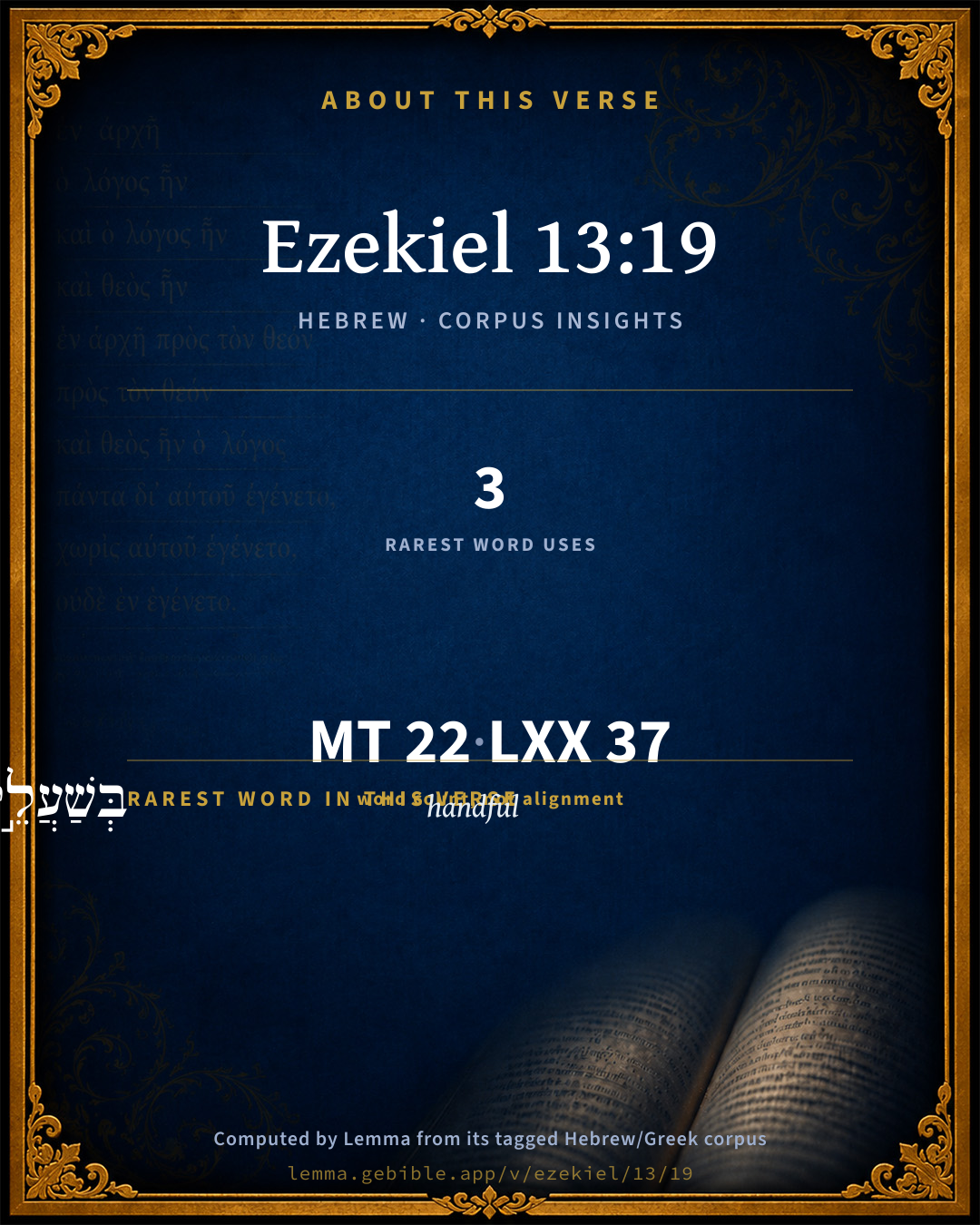
These counts appear in no published source. They are computed here, from the morphology-tagged text and Lemma’s own curated glosses. What Lemma adds →

22
words
16
distinct lemmas
Prophets
section

Notable vocabulary

The rarest word here is בְּשַׁעֲלֵ֣י handful H8168 — appearing just 3 times in the whole Hebrew Bible.

Shared distinctive vocabulary

בְּשַׁעֲלֵ֣י handful H8168 occurs in 3 verses of the Hebrew Bible. Also found in:

Grammatical profile

  • 7 verbs
  • 9 nouns
  • 1 preposition
  • 5 particles

Verb forms

  • וַתְּחַלֶּלְ֨נָה Piel · Sequential Imperfect
  • לְהָמִ֤ית Hiphil · Infinitive Construct
  • תְמוּתֶ֔נָה Qal · Imperfect
  • וּלְחַיּ֥וֹת Piel · Infinitive Construct
  • תִֽחְיֶ֑ינָה Qal · Imperfect
  • בְּכַ֨זֶּבְכֶ֔ם Piel · Infinitive Construct
  • שֹׁמְעֵ֥י Qal · Participle Active

Repetition

Words recur within this verse — often emphatic in Hebrew:

  • עַמִּ֗י people H5971 ×2
  • לְהָמִ֤ית to die H4191 ×2
  • נְפָשׁוֹת֙ soul H5315 ×2
  • וּלְחַיּ֥וֹת to live H2421 ×2
  • אֲשֶׁ֣ר which H834 ×2
  • לֹֽא not H3808 ×2

Hebrew & Septuagint length

In English translation the verse runs 44 words from the Hebrew and 45 from the Septuagint (LXX English) — closely comparable.

A rough comparison of the two English renderings, which tokenize alike — not a word-level alignment.

Word counts can differ between the Hebrew and the Greek without any difference in meaning — e.g. the Hebrew direct-object marker אֵת has no separate Greek word, and Greek often adds the article ὁ.

In the original languages it is 22 Hebrew tokens and 37 Greek tokens — but the two are counted differently (Hebrew bundles its prefixes and suffixes into one token; the Greek is in lemma form), so that isn’t a like-for-like length.

Cross-references

16

Topical passages linked to Ezekiel 13:19 in the Treasury of Scripture Knowledge — connected by theme and wording, ordered by reader-vote popularity; previews shown in the World English Bible.

  • Proverbs 28:21 To show partiality is not good; Yet a man will do wrong for a piece of bread.
  • Micah 3:5 Thus says Yahweh concerning the prophets who lead my people astray; for those who feed their teeth, they proclaim, "Peace!" and whoever doesn't provide for their mouths, they prepare war against him:
  • Jeremiah 23:14 In the prophets of Jerusalem also I have seen a horrible thing: they commit adultery, and walk in lies; and they strengthen the hands of evil-doers, so that none does return from his wickedness: they are all of them become to me as Sodom, and the inhabitants of it as Gomorrah.
  • Jeremiah 23:17 They say continually to those who despise me, Yahweh has said, You shall have peace; and to everyone who walks in the stubbornness of his own heart they say, No evil shall come on you.
  • Ezekiel 20:39 As for you, house of Israel, thus says the Lord Yahweh: Go you, serve everyone his idols, and hereafter also, if you will not listen to me; but my holy name shall you no more profane with your gifts, and with your idols.
  • Ezekiel 22:26 Her priests have done violence to my law, and have profaned my holy things: they have made no distinction between the holy and the common, neither have they caused men to discern between the unclean and the clean, and have hid their eyes from my Sabbaths, and I am profaned among them.
  • 1 Samuel 2:16–17 If the man said to him, They will surely burn the fat first, and then take as much as your soul desires; then he would say, No, but you shall give it me now: and if not, I will take it by force.
  • Micah 3:11 Her leaders judge for bribes, And her priests teach for a price, And her prophets of it tell forturnes for money: Yet they lean on Yahweh, and say, Isn't Yahweh in the midst of us? No disaster will come on us.
  • Romans 16:18 For those who are such don't serve our Lord, Jesus Christ, but their own belly; and by their smooth and flattering speech, they deceive the hearts of the innocent.
  • Proverbs 19:27 If you stop listening to instruction, my son, You will stray from the words of knowledge.
  • Ezekiel 13:22 Because with lies you have grieved the heart of the righteous, whom I have not made sad; and strengthened the hands of the wicked, that he should not return from his wicked way, and be saved alive:
  • Malachi 1:10 "Oh that there were one among you who would shut the doors, that you might not kindle fire on my altar in vain! I have no pleasure in you," says Yahweh of hosts, "neither will I accept an offering at your hand.
  • Romans 14:15 Yet if because of food your brother is grieved, you walk no longer in love. Don't destroy with your food him for whom Christ died.
  • 1 Peter 5:2 Shepherd the flock of God which is among you, exercising the oversight, not under compulsion, but voluntarily, not for dishonest gain, but willingly;
  • 2 Peter 2:2–3 Many will follow their immoral ways, and as a result, the way of the truth will be maligned.
  • 1 Corinthians 8:11 And through your knowledge, he who is weak perishes, the brother for whose sake Christ died.

Cross-references courtesy of OpenBible.info (CC BY 4.0).

Hebrew and Greek witnesses Masoretic Hebrew ↔ Greek Septuagint

The same verse in the two great witnesses to the Old Testament, shown verse-for-verse.

These are two independent witnesses, not word-aligned to each other, and the Septuagint is shown in lemma (dictionary) form.

Hebrew Ezekiel 13:19 Masoretic · Westminster Leningrad Codex

וַתְּחַלֶּלְ֨נָה אֹתִ֜י אֶל עַמִּ֗י בְּשַׁעֲלֵ֣י שְׂעֹרִים֮ וּבִפְת֣וֹתֵי לֶחֶם֒ לְהָמִ֤ית נְפָשׁוֹת֙ אֲשֶׁ֣ר לֹֽא תְמוּתֶ֔נָה וּלְחַיּ֥וֹת נְפָשׁ֖וֹת אֲשֶׁ֣ר לֹא תִֽחְיֶ֑ינָה בְּכַ֨זֶּבְכֶ֔ם לְעַמִּ֖י שֹׁמְעֵ֥י כָזָֽב

You have profaned me among my people for handfuls of barley and for pieces of bread, to kill the souls who should not die, and to save the souls alive who should not live, by your lying to my people who listen to lies.

World English Bible · Public Domain

Greek LXX Ezekiel 13:19 Septuagint · lemma form

καί βεβηλόω ἐγώ πρός ὁ λαός ἐγώ ἕνεκεν δράξ κριθή καί ἕνεκεν κλάσμα ἄρτος ὁ ἀποκτείνω ψυχή ὅς οὐ ἐσθίω ἀποθνήσκω καί ὁ περιποιέω ψυχή ὅς οὐ ἐσθίω ζάω ἐν ὁ ἀποφθέγγομαι σύ λαός εἰςἀκούω μάταιος ἀπόφθεγμα

And they have dishonored me before my people for a handful of barley, and for pieces of bread, to kill the souls which should not die, and to save alive the souls which should not live, while you⌃ speak to a people hearing vain speeches.

LXX2012 (modern English Septuagint) · Public Domain

On this verse, The Cambridge Bible for Schools and Colleges discusses the Septuagint’s reading. Read the note in Commentary ↓

Hebrew: Westminster Leningrad Codex (CC BY 4.0). Greek: Septuagint (public domain); English from LXX2012 (modern English Septuagint) (Public Domain). How the Septuagint differs from the Hebrew →

Targum (Aramaic paraphrase)

1

The Targum is the ancient Jewish Aramaic paraphrase of the Hebrew Scriptures — an interpretive translation, not the Hebrew text itself. Onkelos (literal) and Pseudo-Jonathan (expansive) render the Torah, and Jonathan the Prophets. Coverage is partial: where no permissively-licensed English translation exists for a verse, only the Aramaic is shown. This is verse-level text, not a word-by-word alignment to the Hebrew.

  1. Targum Jonathan Prophets (Joshua–Malachi)
    וְאָחַלְתֵּין רְעוּתִי בְּעַמִי בְּשַׁעֲלֵי סְעָרִן וּבִמְנוּסִין דִלְחֵים לַאֲמָתָא נַפְשָׁן דְלָא חֲזֵי לְהֵין דִימוּתוּן לָא אַתֵּן מְמִיתָן וּלְקַיָמָא נַפְשָׁן דְלָא חֲזֵי לְהֵין לְקַיָמָא דְתִתְקַיְמָן לָא אַתֵּין מְקַיְמָן בְּכַדָבוּתְכֵין לְעַמִי שָׁמְעֵי כַדְבִין:

    (no public-domain English translation for this verse)

    Targum Jonathan — Aramaic: “Mikraot Gedolot” (public domain). English: “Sefaria Community Translation” (CC0 1.0 (public-domain dedication)); “London "Chaldee Paraphrase," 1871” (public domain). Text via Sefaria.

Commentary

Notes on Ezekiel 13:19 from classic Christian and Jewish commentators (each source and its license shown beneath its notes). The classic Christian expositions comment on the surrounding passage and are grouped to its opening verse, so a note may address several verses; the Jewish commentaries on the Tanakh (Rashi and others) are per-verse, so they appear only where the commentator wrote on this verse.

Lemma curates 59 commentaries, every one of them public domain or Creative Commons licensed, each selected and text-cleaned for this edition rather than reprinted as found. About our sources →

Trapp's Complete Commentary

John Trapp

Eze 13:19 And will ye pollute me among my people for handfuls of barley and for pieces of bread, to slay the souls that should not die, and to save the souls alive that should not live, by your lying to my people that hear [your] lies?

Ver. 19. For handfuls of barley end for pieces.] Like so many base gypsies or common beggars. {a} Cato upbraided Marcus Caelius, and worthily, that, being a pleader, he would sell either his tongue or silence for a morsel of bread. These were low prized prophetesses. See Mic 3:5.

To slay the souls,] scil., By denouncing death to them, or by stirring up the people to slay them as miscreants.

That hear your lies.] Such as deceive expectation; for so the word here used signifieth.

{a} A. Gell.

John Trapp, A Commentary or Exposition upon All the Books of the Old and New Testament (1647–1656) — public domain. Text from a community e-Sword module.

Geneva Bible (1599)

Geneva Bible translators

Will ye make my word to serve your bellies?

These sorcerers made the people believe that they could preserve life or destroy it, and that it should come to everyone according as they prophesied.

Geneva Bible (1599) marginal notes — public domain. Text via Bolls.life.

Jamieson, Fausset & Brown

Robert Jamieson, A. R. Fausset & David Brown

handfuls--expressing the paltry gain for which they bartered immortal souls (compare Mic 3:5, Mic 3:11; Heb 12:16). They "polluted" God by making His name the cloak under which they uttered falsehoods.

among my people--an aggravation of their sin, that they committed it "among the people" whom God had chosen as peculiarly His own, and among whom He had His temple. It would have been a sin to have done so even among the Gentiles, who knew not God; much more so among the people of God (compare Pro 28:21).

slay . . . souls that should not die, &c.--to predict the slaying or perdition of the godly whom I will save. As true ministers are said to save and slay their hearers, according to the spirit respectively in which these receive their message (Co2 2:15-16), so false ministers imitate them; but they promise safety to those on the broad way to ruin and predict ruin to those on the narrow way of God.

my people that hear your lies--who are therefore wilfully deceived, so that their guilt lies at their own door (Joh 3:19).

Jamieson, Fausset & Brown — Commentary Critical and Explanatory on the Whole Bible (1871) — public domain (CC PDM 1.0). Text via the HelloAO Bible API.

John Calvin's Commentaries

Here God accuses these women of a double crime; one crime was that which I have mentioned, cruelly to destroy the souls which were sacred to God, and hence were destined to be saved; but he added a more atrocious crime — that of sacrilege, because they had abused the name of God to deceive. Nothing is less tolerable than when God’s truth is turned into a lie, because this is like reducing him to nothing. God is truth; if, therefore, that is abolished, what else will remain behind? God will be, as it were, a dead specter. Hence the Prophet, in God’s name, complains of both: ye have profaned me, says he, before my people. For as the gift of prophecy was a rare and remarkable pledge of God’s love and paternal anxiety towards the Israelites, so when that gift was corrupted, the name of God was at the same time polluted. For God was never willing to be disjoined from his word, because he is himself invisible, and never appears otherwise than in a mirror. Hence God’s glory, and sanctity, and justice, and goodness, and power, ought to shine in the gift of prophecy; but when that gift is contaminated, we see how such a disgrace becomes a reproach against God. In this way his holiness is defiled, his justice, virtue, and fidelity, are corrupted, and his very existence called in question. So it is not without cause that God pronounces his own name to be polluted. Then he adds, among the people. And this circumstance increases the crime, since God’s name was profaned where he wished it to be peculiarly worshipped; for it was also profaned among the Gentiles: but since God had never made himself known there, their profanation was the less detestable. But, because God erected his throne among the people of Israel, and wished his glory to shine there, we see how sacrilege increases, while his name is profaned in that sanctuary which he had chosen. This is one crime.

But he also adds, on account of handfuls of barley and pieces of bread. Here God shows how much and how basely he was despised by those females, who sold their prophecies for a piece of bread or a few grains of barley which any one could hold in his hand. If they had demanded a great reward, their insatiable avarice would not have extenuated their crime; but their impiety is the rather discovered, when on account of a small reward they so prostituted themselves and the name of God. They boasted themselves to be the organs of the Holy Spirit: but when by this mask they deceived the people, injustice was done to the Holy Spirit, since for so paltry a reward they vainly boasted in their prophecies. They prostituted even God himself: and in fine, this was just as if; being corrupted by a small bribe of no value, they did not treat God’s name with sufficient respect to be withheld from the crime by the slightest of the recompense. A comparison will make the matter clearer. If a person is tempted by a moderate reward to the perpetration of any crime and refuses, and then when he is offered a far more valuable reward, and thus yields to the temptation, this shows that his will was upright, though not sufficiently firm. But if any one, for a single farthing, undertakes to do what he is ordered, and refuses no crime, this shows his readiness to all sorts of wickedness. If a girl rejects bribes when she knows her modesty to be assailed, but yet yields for a large reward, here, as I have said, virtue struggles with vice; but if she prostitutes herself for a morsel of bread, here she manifests that depravity which all abominate. This, then, is God’s intention, when he says that these women traded in their lies for handfuls of barley and pieces of bread. If any one objects that prophecies were anciently saleable, since it was customary with the people to offer the prophets rewards, I answer, that the women are not condemned merely for receiving either the handful of barley or the piece of bread, but because they did not hesitate to corrupt God’s truth for a trifling gain, and then to turn it into a lie. The Prophet afterwards points out the nature of their deceit, for it would not have been sufficient to blame these women generally, unless Ezekiel had pointed with his finger at their pestiferous impostures.

Now, therefore, he says, that they slew the souls which were not dying, and kept alive the souls which were not living. We have said before, that by this mark the true and righteous servants of God were distinguished from impostors. For the servants of God, who faithfully discharge the duty enjoined upon them, kill and make alive: for God’s word is life, and brings health to lost mankind; but is a savor of death unto death in those who perish, as Paul says. (2 Corinthians 2:15, 16.) Hence it is true that prophets who faithfully and properly discharge their duty both kill and make alive: but they give life to the souls which are to be freed from death, and slay the souls which are devoted to destruction; for they denounce eternal death to all unbelievers unless they repent; and whatever they bind on earth is also bound in heaven. (Matthew 18:18.) Their teaching, therefore, is effective for destruction, as also Paul elsewhere teaches. We have at hand, says he, vengeance against every high thing which exalts itself against Christ, (2 Corinthians 10:5, 6.) Hence honest teachers are armed by God’s vengeance against all unbelievers who remain obstinate: but they convey life to those who repent, since they are messengers of reconciliation; nay, they reconcile men to God when they offer Christ to them as our peace, and by whom the Father is propitious to us. (Ephesians 2:16.) When false prophets desire to rival God’s servants, they omit the principal part, namely, faith and repentance; hence it happens that they proclaim life to souls already adjudged to destruction; for they give life to the reprobate who are hardened in contempt of God by their flatteries; for they do not require of men either faith or penitence, but only a reward. Hence also it happens that they slay the souls which ought not to die, namely, because nothing is prouder or more cruel than these false prophets. For they fulminate according to their pleasure, and sink even to the lowest hell the whole world when no hope of profit appears.

Here then we see the vices of these women of whom Ezekiel treats so pointedly out, that no one need be any longer deceived by them except through his own fault. Hence also we gather a perpetual rule in examining doctrine, lest the deceits of Satan should surprise us for the word of God. Let us learn, then, that the prophetic word is life-giving to us, if we are dissatisfied with our sins, and fly to God’s pity with true and serious penitence; for all souls are slain who do not receive this kind of life; and whoever compares the papacy with that corruption which Ezekiel describes to us, will see that, although Satan has many methods of deceiving men, yet they will always be discovered like himself. Ezekiel spoke of veils and cushions. We see many rites exhibited in the papacy, so that the incredulous, being snatched as it were out of the world, are not only delirious, but suffer themselves to be drawn in any direction like cattle by the grossest impostures. But in their teaching we perceive what Ezekiel condemns, namely, that they give life to souls devoted to death, and slay souls which thought to be kept alive. For what is the meaning of their immense heap of laws, except to bury wretched consciences? For any one who wishes to satisfy the laws of the papacy from his heart, must cut himself to pieces, so to speak, through his whole life. We now perceive with what intent our Prophet will elsewhere say that legislators of this kind are implacable, since they remit nothing, and exact all their conditions with the utmost rigor. Hence it happens that these miserable souls perish, because despair oppresses them and overwhelms them in the deep. Meanwhile we see how they give life to souls subject to death, since; pardon is prepared for adulterers, robbers, manslayers, and all criminals, if they only buy themselves off, as popish priests and monks pretend that God is appeased by satisfactions and prayers. Hence they thrust expiation’s of no value upon God; and, to speak more correctly, trifles and follies, which do not deceive even children, they call expiation’s, as if God could change his nature. Hence we must diligently remark this passage, that we may know how to distinguish between true and false prophets, and may not despise the test which the Prophet puts before us.

He says, in deceiving my people by listening to a lie. He accuses some of lying, and others of willingly embracing is. For the noun כזב, kezeb, which is repeated, is derived from the same root. Here, again, God undertakes the cause of his people; for though they were all worthy of being drawn into exile by Satan, yet when God took care of them, it was like snatching them out of Satan’s hand, and claiming them as his own peculiar people. This is one point. But meantime these wretches are deprived of all excuse for seeking false oracles. For the Prophet pronounces them deceived because they listened to vanity, that is, because they wished to be deceived, since it was entirely their own fault, and they could not in any way throw it off. It is true they were deceived under false pretenses through the abuse of the prophetic name, and hence their vision was obscured by a darkened cloud; but still they thought to have gone to the fountain, for no opening would have been found for Satan if they had been properly fortified: for God had surrounded them with ramparts by giving them a law to protect them from all fallacies. Since, then, they thus exposed themselves of their own accord, it is not surprising if God allowed them to be deceived.

John Calvin's Commentaries (1540-1563) — public domain. Text from the Calvin Translation Society English edition (1840s-50s) via the Christian Classics Ethereal Library (ccel.org). Calvin's coverage is partial (roughly two-thirds of the Bible); uncommented books and verses are honest gaps, never fabricated. The 19th-century editor's footnotes and remarks are omitted so the notes are faithfully Calvin's own voice.

Ellicott's Commentary for English Readers

(19) Handfuls of barley.—It was an ancient custom to bring presents to a prophet on consulting him (1Sa_9:7-8; 1Ki_14:3); but as barley was a cheap grain, and handfuls a very small quantity, these words show the exceedingly small gains for which these false prophetesses were willing to pervert the truth, and lead the people to destruction. God was “polluted” by attaching His name and authority to that which was not true, and would not come to pass, thus “making Him a liar” like themselves. Like all falsehood, their lies tended both ways—to entice the upright to their ruin, and to give false security to the wicked. It is always impossible that a perversion of the truth, especially in regard to the Divine judgments, can be harmless.

Hear your lies.—Or, hearken to a lie. The words imply a willingness to listen to the pleasing falsehood, and the state of things is that described by Jer_5:31. “The prophets prophesy falsely, and the priests bear rule by their means, and my people love to have it so.”

A Bible Commentary for English Readers, edited by Charles John Ellicott (1878–1897) — public domain. Text from a community e-Sword module.

The Cambridge Bible for Schools and Colleges

gen. ed. J. J. S. Perowne

19. and will ye pollute] Rather, directly: and ye profane me. To “profane” the Lord is to bring him down from the high sphere of purity or truth or power, where men’s thoughts should place him, into the region of the impure, the false or unworthy—the sphere of the common (ch. Eze_20:39). To “profane” is the opposite of to “sanctify.”

for handfuls of barley] may signify, for mean and trifling hire. Others think that the offerings may be described which were presented in order to obtain the oracular response. In this case the rendering would be: with handfuls of barley (see W. R. Smith, Journal of Philology, vol. xiii.). But comp. 1Sa_2:36; 2Ki_23:9 with 1Sa_9:8; 1Ki_14:3; 2Ki_4:42; Mic_3:5. In Jer_44:15 the women are represented as baking cakes to be offered to the queen of heaven.

the souls that should not die] The righteous; cf. Eze_13:22, ye have made the heart of the righteous sad. The meaning appears to be that the tendency and direction of their prophecies, like those of the false prophets, was in support of the wicked and adverse to those like-minded with the true prophets. They “slay” by their prophetic word (Hos_6:5; Jer_1:10, I have set thee to pluck up &c.) when they threaten evil; and so they make the heart sad (faint and despondent) of those whom the Lord hath not made sad.

Eze_13:20-23. Chastisement of the prophetesses.

where with ye there hunt] Or, where (or, wherein) ye hunt. A slight change of reading gives, wherewith ye hunt (Targ. Syr.).

to make them fly] Or, as R.V. marg. like birds (Ew.). LXX. omits.

For “pillows” as above fillets. The expression “from your arms” is not to be forced so as to imply that the bands or fillets were bound upon the arms of the prophetesses themselves (cf. Eze_13:18).

even the souls that ye hunt] The reading here is no doubt corrupt. The easiest change is to read: I will let the souls go, whose life (naphshäm) ye hunt as birds; cf. Pro_6:26 “the adulteress hunteth for the precious life.” Cornill makes the excellent suggestion: “I will let the souls go free [reading othân ḥophshim] that ye hunt.”

The Cambridge Bible for Schools and Colleges (gen. ed. J. J. S. Perowne; Cambridge University Press, 1878–1918) — public domain. Text from a community e-Sword module.

John Gill's Exposition

Your kerchiefs also will one tear,.... From their heads; discover their tricks, and expose them to the contempt of the people, and destroy both them and their works:

and deliver my people out of your hand; from being hunted, ensnared, and deceived by them:

and they shall be no more in your land to be hunted; but should either flee into Egypt, and other countries, for shelter, or be carried captive into Babylon:

and ye shall know that I am the Lord; see Eze 13:9.

John Gill's Exposition of the Whole Bible (1746–1763) — public domain (CC PDM 1.0). Text via the HelloAO Bible API.

Haydock's Catholic Bible Commentary

Violated me. That is, dishonoured and discredited me. (Challoner) --- Protestants, "and will ye pollute?" &c. (Haydock) --- They employed the name of God to give credit to their lies, for the smallest advantage. --- Souls, &c. That is, to sentence souls to death, which are not to die: and to promise life to them who are not to live. (Challoner) --- They contradicted Jeremias, who exhorted the people to surrender. (Calmet)

George Leo Haydock (1774–1849), Haydock's Catholic Family Bible and Commentary, 1859 edition — public domain. Excludes Psalms (Douay-Rheims chapter numbering differs from Protestant) and Deuterocanonical books (Catholic canon only).

Matthew Poole's English Annotations

Will ye pollute me? profanely contradicting what is indeed spoken in my name, and pretending my name for that I never spake, nor will do.

Among my people; who are my peculiar, who have my word and true prophets, by which your lies are discovered, and further will be. What shameless impudence is this, to abuse my name, counterfeit my hand and seal, to them, that do or might know both!

For handfuls of barley; for a mean reward, tell fortunes for a penny! but there may be herein a provision made against the famine which was threatened and would come; this grain might be kept.

For pieces of bread; bread and morsels of bread. Mercenary sorceresses! that thus make sale of their predictions to feed their hungry bellies.

To slay the souls that should not die; you denounce evil to the best, perhaps threatened those in Babylon with death, whom God will keep alive there.

To save the souls alive that should not live; declaring safety, plenty, prosperity, peace, without war, or victory in the war, included in that they live.

By your lying; most falsely flattering those that come to you, and most maliciously threatening those that come not, because they know you speak your own lies. You save whom I will kill, and kill whom I will save.

Matthew Poole's English Annotations on the Holy Bible (1683–1685) — public domain. Text from a community e-Sword/MySword module.

Whedon's Commentary on the Bible

Daniel D. Whedon

19. Will ye pollute me… for handfuls of barley — Literally, ye have. These sorceresses were telling their lies in the name of Jehovah for the sake of the pay. And they were willing to commit this sacrilege for the slightest recompense, like that bestowed on the harlot or beggar (1Sa_2:36; Hos_3:2). “Do you keep alive, for a few handfuls of barley as your reward, the souls of the wicked?” — Mosheh Ben Shesheth.

Daniel D. Whedon (gen. ed.), Commentary on the Old and New Testaments (1874–1909) — public domain. Text from a community e-Sword module.

The Pulpit Commentary

Will ye pollute me, etc.? rather, with the Revised Version, ye have profaned, the interrogative form not being continued in the Hebrew. The prophet dwells with scorn on the miserable pay for which the prophetesses were guilty of so great a sin. Not for rewards of divination, like those of Balsam, (Num_22:7) but for gifts like those bestowed on the harlot or the beggar (1Sa_2:36; Hos_3:2) for handfuls of barley and pieces of bread they plied their wretched trade. For examples of the lower gifts in kind offered to prophets, compare those of 1Sa_9:8) of Jeroboam"s wife, (1Ki_14:3) the false prophets in Mic_3:5. And they did this in direct opposition to the will of Jehovah. They "slew," i.e. drew on to destruction, the souls that were meant for life. They "saved the souls alive," i.e. "their own, which were worthy of death." That was the outcome of their "lying" divinations.

The Pulpit Commentary (1880–1919), ed. H.D.M. Spence-Jones & Joseph S. Exell — public domain. Text from a community e-Sword module.

John Wesley's Explanatory Notes

Pollute me - Pretending my name for what I never spake. My people - My own people. Handfuls of barley - For a mean reward. To slay - You denounce evil to the best, whom God wilt keep alive. To save - Declaring safety, to the worst, whom God will destroy.

John Wesley, Explanatory Notes Upon the Whole Bible (1754–1765) — public domain. Text via the GEBible commentary corpus.

unfoldingWord translationNotes

Door43 World Missions Community

General Information:

Yahweh continues to speak against the false prophetesses in Israel.

handfuls of barley and crumbs of bread

Barley is a grain used to make bread and the word "crumb" is a small amount of bread. Both phrases are small amounts of food and are used to emphasize how small the payment was to the prophetesses. (See: Parallelism)

translationWords

profane

bread

die

life

unfoldingWord translationNotes — © Distant Shores Media and the Door43 World Missions Community, licensed CC BY-SA 4.0. Source: git.door43.org/Door43/en_tn.

Rashi

Rabbi Shlomo Yitzchaki (Rashi)

for fistfuls of barley Heb. בְּשֳּׁעֲלֵי, like (Isa. 40:12): “Who measured water with his fist (בְּשָּׁעֳלוֹ)?” Jaloynes in Old French, double-handfuls. Another explanation: an expression of a measure.

and for morsels of bread E an piyezes in Old French, and with morsels, that you take as your fee.

to slay souls that will not die i.e., to say about souls that will not die, “These will die,” and to say about souls that will not live, “These will live,” for your divinations are false, and My people accept your false divinations.

Rashi on the Tanakh — English translations: “The Judaica Press complete Tanach with Rashi, translated by A. J. Rosenberg” (CC BY 4.0); “Pentateuch with Rashi's commentary by M. Rosenbaum and A.M. Silbermann, 1929-1934” (public domain); “The Metsudah Tanach series, Lakewood, N.J” (CC BY 4.0); and “The Book of Joshua, Metsudah Publications, 1997” (CC BY 4.0). Text via Sefaria.

Lesson kit

Teaching starters — assembled from the data on this page, not authored interpretation. Every prompt links to the verse data it draws on. Edit before teaching.

Ezekiel, in the Prophets, opens this verse with 22 words (16 distinct Hebrew lemmas). Its most distinctive word is shôʻal (“handful”). A historical commentator’s framing appears above. Read the whole chapter for the surrounding context.

Discussion questions

  1. What does “handful” (shôʻal) contribute to the verse as a whole?
  2. How does 1 Kings 20:10, which shares the word «handful», read alongside this verse?
  3. What does the repetition of “people” (2× in this one verse) do in this verse?
  4. These translations render this verse differently. What is at stake in choosing one wording over another?
  5. «וַתְּחַלֶּלְ֨נָה» is a Piel Sequential Imperfect verb. How does that grammatical form shape the action described?
  6. Compare how Trapp's Complete Commentary and Geneva Bible (1599) read this verse. Where do they agree or differ?

Things to notice

Reading settings

Reading text

Shown beneath each verse's original-language words.

Old Testament
Old Testament edition

Read the OT as the Masoretic Hebrew (MT) or the Greek Septuagint (LXX).

English shown for the Greek Septuagint (in the Hebrew ↔ Greek comparison).

Comparing translations? Open the Compare panel on any verse page to stack up to four side by side.