
1 Kings 13:18

Hebrew (Westminster Leningrad Codex) 1 Kings 13:18 appears in the Hebrew Old Testament. The text above is from the Westminster Leningrad Codex. Each word links to its Strong’s number, a concise gloss, and parsing drawn from the Open Scriptures Hebrew Bible morphology. Click any word for its full Brown-Driver-Briggs (BDB) entry.
Download image
Cite this verse

1 Kings 13:18 (World English Bible). Public Domain. Lemma interlinear Bible study tool, https://lemma.gebible.app/v/1-kings/13/18.

Show BibTeX & RIS
BibTeX
RIS
English Translation
He said to him, I also am a prophet as you are; and an angel spoke to me by the word of Yahweh, saying, Bring him back with you into your house, that he may eat bread and drink water. [But] he lied to him.
World English Bible · Public Domain
Download a study sheet

One document with this verse’s original text, its word-by-word gloss line, the meaning frame, cross-references with their text, attributed commentary, and full source and license credits — printable, and it pastes into notes with its structure intact.

This verse Autodidact and up

Study sheet (.html) Plain text (.txt)

A passage Seminary Student

Up to 50 verses in one chapter. A passage sheet keeps up to 6 commentary sources and 12 cross-references per verse, in the order this page ranks them, and says so on the sheet whenever that leaves anything out. Ask for a single verse and you get the Autodidact verse sheet above.

Everything on this page stays free to read, with no account — the sheet is a download of what is already on screen, not access to it.

Want to remove ads? Support Godless Engineer
Compare translations 3

The same verse in 3 English versions, stacked beneath the original-language interlinear above. Click any original word for its lexicon entry.

Each is an independent rendering of the whole verse — the interlinear is not word-aligned to these translations.

Highlighted words mark where these versions differ — a whole-verse word diff, not a word-by-word alignment.

  • World English Bible Public Domain
    He said to him, I also am a prophet as you are; and an angel spoke to me by the word of Yahweh, saying, Bring him back with you into your house, that he may eat bread and drink water. [But] he lied to him.
  • King James Version Public Domain
    He said unto him, I am a prophet also as thou art; and an angel spake unto me by the word of the LORD, saying, Bring him back with thee into thine house, that he may eat bread and drink water. But he lied unto him.
  • unfoldingWord Literal Text CC BY-SA 4.0
    And he said to him, “I also a prophet like you, and an angel spoke to me by the word of Yahweh, saying, ‘Bring him back with you to your house, that he may eat bread and drink water.’” (He lied to him.)

unfoldingWord Literal Text — © unfoldingWord, licensed CC BY-SA 4.0. Word-aligned USFM3 via Door43 (git.door43.org/unfoldingWord/en_ult).

Versions to compare (up to 4)

3 of 4 selected

Show all 18 translations

Every available English version of this verse, each an independent rendering of the whole verse.

  • World English Bible Public Domain
    He said to him, I also am a prophet as you are; and an angel spoke to me by the word of Yahweh, saying, Bring him back with you into your house, that he may eat bread and drink water. [But] he lied to him.
  • Berean Standard Bible Public Domain
    Then the prophet replied, “I too am a prophet like you, and an angel spoke to me by the word of the LORD, saying, ‘Bring him back with you to your house, so that he may eat bread and drink water.’” The old prophet was lying to him,
  • Majority Standard Bible Public Domain
    Then the prophet replied, “I too am a prophet like you, and an angel spoke to me by the word of the LORD, saying, ‘Bring him back with you to your house, so that he may eat bread and drink water.’” The old prophet was lying to him,
  • King James Version Public Domain
    He said unto him, I am a prophet also as thou art; and an angel spake unto me by the word of the LORD, saying, Bring him back with thee into thine house, that he may eat bread and drink water. But he lied unto him.
  • American Standard Version (1901) Public Domain
    And he said unto him, I also am a prophet as thou art; and an angel spake unto me by the word of Jehovah, saying, Bring him back with thee into thy house, that he may eat bread and drink water. `But' he lied unto him.
  • Revised Version (1885) Public Domain
    And he said unto him, I also am a prophet as thou art; and an angel spake unto me by the word of the LORD, saying, Bring him back with thee into thine house, that he may eat bread and drink water. But he lied unto him.
  • Geneva Bible (1599) Public Domain
    And he said vnto him, I am a Prophet also as thou art, and an Angel spake vnto me by the worde of the Lord, saying, Bring him againe with thee into thine house, that hee may eate bread and drinke water: but he lyed vnto him.
  • Douay-Rheims (1899) Public Domain
    He said to him: I also am a prophet like unto thee: and an angel spoke to me in the word of the Lord, saying: Bring him back with thee into thy house, that he may eat bread, and drink water. He deceived him,
  • Young's Literal Translation Public Domain
    And he saith to him, `I also `am' a prophet like thee, and a messenger spake unto me by the word of Jehovah, saying, Bring him back with thee unto thy house, and he doth eat bread and drink water;' -- he hath lied to him.
  • Literal Standard Version CC BY-SA 4.0
    And he says to him, “I [am] also a prophet like you, and a messenger spoke to me by the word of YHWH, saying, Bring him back with you to your house, and he eats bread and drinks water.” He has lied to him.
  • Unlocked Literal Bible CC BY-SA 4.0
    So the old prophet said to him, “I also am a prophet as you are, and an angel spoke to me by the word of Yahweh, saying, 'Bring him back with you into your house, that he may eat food and drink water.'” But he was lying to the man of God.
  • unfoldingWord Literal Text CC BY-SA 4.0
    And he said to him, “I also a prophet like you, and an angel spoke to me by the word of Yahweh, saying, ‘Bring him back with you to your house, that he may eat bread and drink water.’” (He lied to him.)
  • Darby Bible Public Domain
    And he said to him, I am a prophet also as thou art; and an angel spoke to me by the word of Jehovah saying, Bring him back with thee into thy house, that he may eat bread and drink water. He lied unto him.
  • World Messianic Bible Public Domain
    He said to him, “I also am a prophet as you are; and an angel spoke to me by the LORD’s word, saying, ‘Bring him back with you into your house, that he may eat bread and drink water.’” He lied to him.
  • Webster's Bible Public Domain
    He said to him, I am a prophet also as thou art; and an angel spoke to me by the word of the LORD, saying, Bring him back with thee into thy house, that he may eat bread and drink water. But he lied to him.
  • Free Bible Version CC BY-SA 4.0
    But the old prophet told him, “I am also a prophet, just like you. An angel told me God said, ‘Take him home with you so that he can have something to eat and drink’” But he was lying to him.
  • Bible in Basic English Public Domain
    Then he said to him, I am a prophet like you; and an angel said to me by the word of the Lord, Take him back with you and give him food and water. But he said false words to him.
  • JPS Tanakh (1917) Public Domain
    And he said unto him: 'I also am a prophet as thou art; and an angel spoke unto me by the word of the LORD, saying: Bring him back with thee into thy house, that he may eat bread and drink water.' — He lied unto him. —

Literal Standard Version (2020), Covenant Press — licensed CC BY-SA 4.0. Text via the HelloAO Bible API (eBible.org). Unlocked Literal Bible (unfoldingWord) — licensed CC BY-SA 4.0. Text via the HelloAO Bible API (eBible.org). unfoldingWord Literal Text — © unfoldingWord, licensed CC BY-SA 4.0. Word-aligned USFM3 via Door43 (git.door43.org/unfoldingWord/en_ult). Free Bible Version, Dr. Jonathan Gallagher — licensed CC BY-SA 4.0. Text via the HelloAO Bible API (eBible.org).

Word by word

More ways to search: Search by grammar → Find every occurrence → Compare this word →

Practice this passage: Drill this verse → Learn its vocabulary →

כִּחֵ֖שׁ
kâchash
H3584
“to deceive”
Verb, Piel, Perfect, 3rd Person, Masculine, Singular
Part of Speech
Verb
Stem
Piel
Form
Perfect
Person
3rd Person
Gender
Masculine
Number
Singular
Full BDB Definition

Origin: a primitive root

TWOT: 975

to deceive, lie, fail, grow lean, be disappointing, be untrue, be insufficient, be found liars, belie, deny, dissemble, deal falsely - (Qal) to become lean - (Niphal) to cringe, feign obedience - (Piel) - to deceive, deny falsely - to act deceptively - to cringe - to disappoint, fail - (Hithpael) to cringe, feign obedience
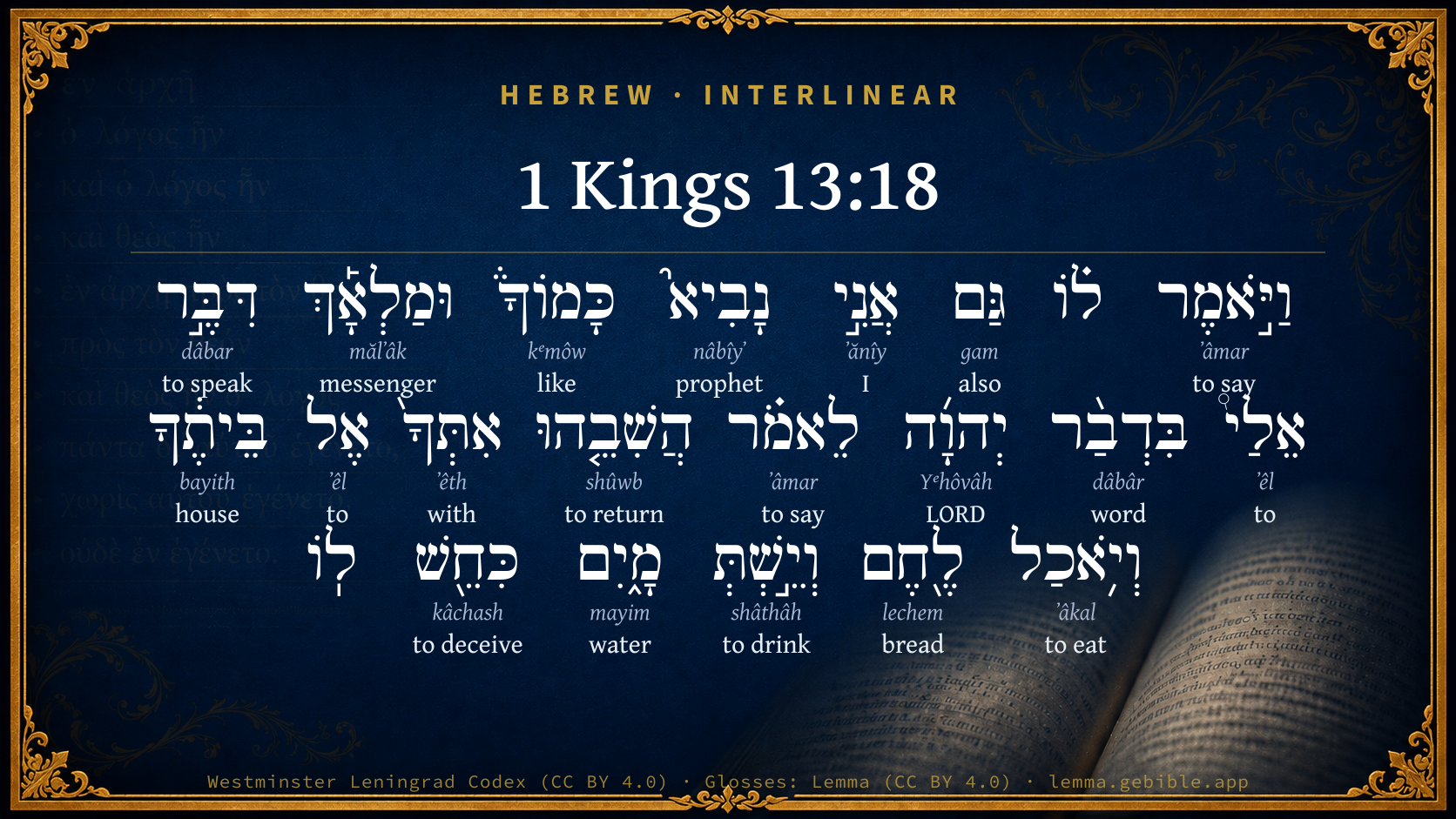
  1. וַיֹּ֣אמֶר ʼâmar H559 “and · to say” Conjunction + Verb, Qal, Sequential Imperfect, 3rd Person, Masculine, Singular
  2. גַּם gam H1571 “also” Particle, Accusative
  3. אֲנִ֣י ʼănîy H589 “I” Pronoun, Personal, 1st Person, Common, Singular
  4. נָבִיא֮ nâbîyʼ H5030 “prophet” Noun, Common, Masculine, Singular, Absolute
  5. כָּמוֹךָ֒ kᵉmôw H3644 “like · you” Preposition + Suffix, Personal, 2nd Person, Masculine, Singular
  6. וּמַלְאָ֡ךְ mălʼâk H4397 “and · messenger” Conjunction + Noun, Common, Masculine, Singular, Absolute
  7. דִּבֶּ֣ר dâbar H1696 “to speak” Verb, Piel, Perfect, 3rd Person, Masculine, Singular
  8. אֵלַי֩ ʼêl H413 “to · me” Preposition + Suffix, Personal, 1st Person, Common, Singular
  9. בִּדְבַ֨ר dâbâr H1697 “in/at · word of” Preposition + Noun, Common, Masculine, Singular, Construct
  10. יְהוָ֜ה Yᵉhôvâh H3068 “LORD” Noun, Proper
  11. לֵאמֹ֗ר ʼâmar H559 “to say” Preposition + Verb, Qal, Infinitive Construct
  12. הֲשִׁבֵ֤הוּ shûwb H7725 “return · him” Verb, Hiphil, Imperative, 2nd Person, Masculine, Singular + Suffix, Personal, 3rd Person, Masculine, Singular
  13. אִתְּךָ֙ ʼêth H854 “with · you” Preposition + Suffix, Personal, 2nd Person, Masculine, Singular
  14. אֶל ʼêl H413 “to” Preposition
  15. בֵּיתֶ֔ךָ bayith H1004 “house · your” Noun, Common, Masculine, Singular, Construct + Suffix, Personal, 2nd Person, Masculine, Singular
  16. וְיֹ֥אכַל ʼâkal H398 “and · to eat” Conjunction + Verb, Qal, Imperfect, 3rd Person, Masculine, Singular
  17. לֶ֖חֶם lechem H3899 “bread” Noun, Common, Both, Singular, Absolute
  18. וְיֵ֣שְׁתְּ shâthâh H8354 “and · to drink” Conjunction + Verb, Qal, Imperfect, 3rd Person, Masculine, Singular
  19. מָ֑יִם mayim H4325 “water(s)” Noun, Common, Masculine, Plural, Absolute

About this verse

These counts appear in no published source. They are computed here, from the morphology-tagged text and Lemma’s own curated glosses. What Lemma adds →

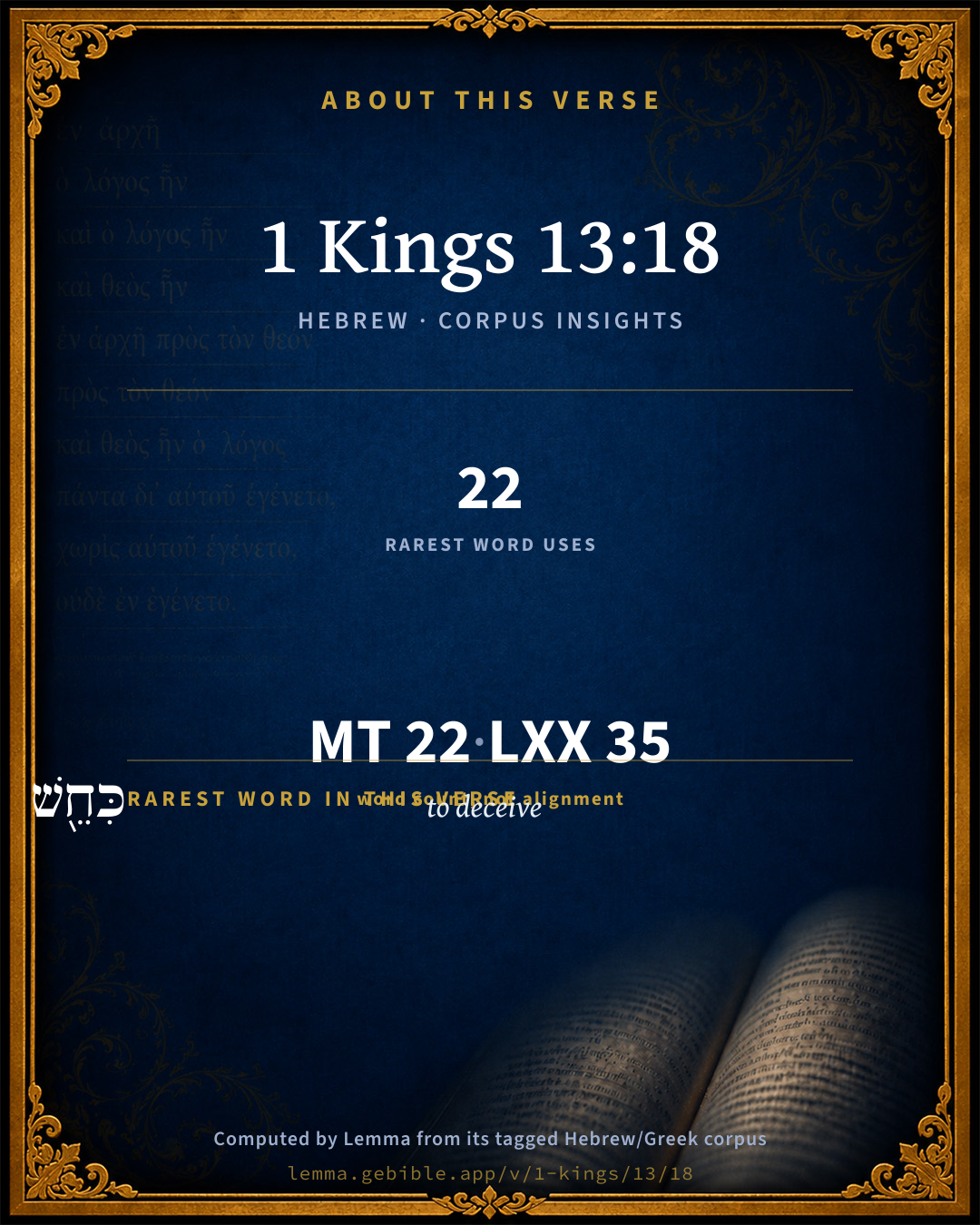
22
words
18
distinct lemmas
Historical
section

Notable vocabulary

The rarest word here is כִּחֵ֖שׁ to deceive H3584 — appearing just 22 times in the whole Hebrew Bible.

Shared distinctive vocabulary

כִּחֵ֖שׁ to deceive H3584 occurs in 22 verses of the Hebrew Bible. Also found in:

Grammatical profile

  • 7 verbs
  • 7 nouns
  • 1 pronoun
  • 6 prepositions
  • 1 particle

Verb forms

  • וַיֹּ֣אמֶר Qal · Sequential Imperfect
  • דִּבֶּ֣ר Piel · Perfect
  • לֵאמֹ֗ר Qal · Infinitive Construct
  • הֲשִׁבֵ֤הוּ Hiphil · Imperative
  • וְיֹ֥אכַל Qal · Imperfect
  • וְיֵ֣שְׁתְּ Qal · Imperfect
  • כִּחֵ֖שׁ Piel · Perfect

Repetition

Words recur within this verse — often emphatic in Hebrew:

  • וַיֹּ֣אמֶר to say H559 ×2
  • אֵלַי֩ to H413 ×2

Hebrew & Septuagint length

In English translation the verse runs 45 words from the Hebrew and 47 from the Septuagint (LXX English) — closely comparable.

A rough comparison of the two English renderings, which tokenize alike — not a word-level alignment.

Word counts can differ between the Hebrew and the Greek without any difference in meaning — e.g. the Hebrew direct-object marker אֵת has no separate Greek word, and Greek often adds the article ὁ.

In the original languages it is 22 Hebrew tokens and 35 Greek tokens — but the two are counted differently (Hebrew bundles its prefixes and suffixes into one token; the Greek is in lemma form), so that isn’t a like-for-like length.

Cross-references

21

Topical passages linked to 1 Kings 13:18 in the Treasury of Scripture Knowledge — connected by theme and wording, ordered by reader-vote popularity; previews shown in the World English Bible.

  • 1 John 4:1 Beloved, don't believe every spirit, but test the spirits, whether they are of God, because many false prophets have gone out into the world.
  • Matthew 7:15 "Beware of false prophets, who come to you in sheep's clothing, but inwardly are ravening wolves.
  • Numbers 22:35 The angel of Yahweh said to Balaam, Go with the men; but only the word that I shall speak to you, that you shall speak. So Balaam went with the princes of Balak.
  • Jeremiah 23:32 Behold, I am against those who prophesy lying dreams, says Yahweh, and do tell them, and cause my people to err by their lies, and by their vain boasting: yet I didn't send them, nor commanded them; neither do they profit this people at all, says Yahweh.
  • Jeremiah 28:15–16 Then said the prophet Jeremiah to Hananiah the prophet, Hear now, Hananiah: Yahweh has not sent you; but you make this people to trust in a lie.
  • Romans 16:18 For those who are such don't serve our Lord, Jesus Christ, but their own belly; and by their smooth and flattering speech, they deceive the hearts of the innocent.
  • 2 Corinthians 11:13–15 For such men are false apostles, deceitful workers, masquerading as Christ's apostles.
  • 2 Peter 2:1 But there also arose false prophets among the people, as among you also there will be false teachers, who will secretly bring in destructive heresies, denying even the Master who bought them, bringing on themselves swift destruction.
  • Genesis 3:4–5 The serpent said to the woman, "You won't surely die,
  • Isaiah 9:15 The elder and the honorable man, he is the head; and the prophet who teaches lies, he is the tail.
  • Jeremiah 5:12 They have denied Yahweh, and said, It is not he; neither shall evil come on us; neither shall we see sword nor famine:
  • Jeremiah 5:31 the prophets prophesy falsely, and the priests bear rule by their means; and my people love to have it so: and what will you do in the end of it?
  • Jeremiah 23:17 They say continually to those who despise me, Yahweh has said, You shall have peace; and to everyone who walks in the stubbornness of his own heart they say, No evil shall come on you.
  • Ezekiel 13:9–10 My hand shall be against the prophets who see false visions, and who divine lies: they shall not be in the council of my people, neither shall they be written in the writing of the house of Israel, neither shall they enter into the land of Israel; and you shall know that I am the Lord Yahweh.
  • Ezekiel 13:22 Because with lies you have grieved the heart of the righteous, whom I have not made sad; and strengthened the hands of the wicked, that he should not return from his wicked way, and be saved alive:
  • 2 Corinthians 11:3 But I am afraid that somehow, as the serpent deceived Eve in his craftiness, so your minds might be corrupted from the simplicity that is in Christ.
  • Judges 6:11–12 The angel of Yahweh came, and sat under the oak which was in Ophrah, that pertained to Joash the Abiezrite: and his son Gideon was beating out wheat in the winepress, to hide it from the Midianites.
  • Judges 13:3 The angel of Yahweh appeared to the woman, and said to her, See now, you are barren, and don't bear; but you shall conceive, and bear a son.
  • Jeremiah 23:14 In the prophets of Jerusalem also I have seen a horrible thing: they commit adultery, and walk in lies; and they strengthen the hands of evil-doers, so that none does return from his wickedness: they are all of them become to me as Sodom, and the inhabitants of it as Gomorrah.
  • Matthew 24:24 For there will arise false christs, and false prophets, and they will show great signs and wonders, so as to lead astray, if possible, even the chosen ones.
  • Revelation 19:20 The beast was taken, and with him the false prophet who worked the signs in his sight, with which he deceived those who had received the mark of the beast and those who worshiped his image. These two were thrown alive into the lake of fire that burns with sulfur.

Cross-references courtesy of OpenBible.info (CC BY 4.0).

Hebrew and Greek witnesses Masoretic Hebrew ↔ Greek Septuagint

The same verse in the two great witnesses to the Old Testament, shown verse-for-verse.

These are two independent witnesses, not word-aligned to each other, and the Septuagint is shown in lemma (dictionary) form.

Hebrew 1 Kings 13:18 Masoretic · Westminster Leningrad Codex

וַיֹּ֣אמֶר ל֗וֹ גַּם אֲנִ֣י נָבִיא֮ כָּמוֹךָ֒ וּמַלְאָ֡ךְ דִּבֶּ֣ר אֵלַי֩ בִּדְבַ֨ר יְהוָ֜ה לֵאמֹ֗ר הֲשִׁבֵ֤הוּ אִתְּךָ֙ אֶל בֵּיתֶ֔ךָ וְיֹ֥אכַל לֶ֖חֶם וְיֵ֣שְׁתְּ מָ֑יִם כִּחֵ֖שׁ לֽוֹ

He said to him, I also am a prophet as you are; and an angel spoke to me by the word of Yahweh, saying, Bring him back with you into your house, that he may eat bread and drink water. [But] he lied to him.

World English Bible · Public Domain

Greek LXX 1 Kings 13:18 Septuagint · lemma form

καί εἶπον πρός αὐτός καΐἐγώ προφήτης εἰμί καθώς σύ καί ἄγγελος λαλέω πρός ἐγώ ἐν ῥῆμα κύριος λέγω ἐπιστρέφω αὐτός πρός σεαυτοῦ εἰς ὁ οἶκος σύ καί ἐσθίω ἄρτος καί πίνω ὕδωρ καί ψεύδομαι αὐτός

And he said to him, I also am a prophet as you are; and an angel spoke to me by the word of the Lord, saying, Bring him back to you into your house, and let him eat bread and drink water: but he lied to him.

LXX2012 (modern English Septuagint) · Public Domain

Hebrew: Westminster Leningrad Codex (CC BY 4.0). Greek: Septuagint (public domain); English from LXX2012 (modern English Septuagint) (Public Domain). How the Septuagint differs from the Hebrew →

Targum (Aramaic paraphrase)

1

The Targum is the ancient Jewish Aramaic paraphrase of the Hebrew Scriptures — an interpretive translation, not the Hebrew text itself. Onkelos (literal) and Pseudo-Jonathan (expansive) render the Torah, and Jonathan the Prophets. Coverage is partial: where no permissively-licensed English translation exists for a verse, only the Aramaic is shown. This is verse-level text, not a word-by-word alignment to the Hebrew.

  1. Targum Jonathan Prophets (Joshua–Malachi)
    וַאֲמַר לֵיהּ אַף אֲנָא נְבִיָא כְּוָתָךְ וּמַלְאָכָא מַלֵיל עִמִי בְּפִתְגָמָא דַייָ לְמֵימָר אֲתֵיבְהִי עִמָךְ לְבֵיתָךְ וְיֵיכוּל לַחְמָא וְיִשְׁתֵּי מַיָא כַּדִיב לֵיהּ:

    (no public-domain English translation for this verse)

    Targum Jonathan — Aramaic: “Mikraot Gedolot” (public domain). English: “Sefaria Community Translation” (CC0 1.0 (public-domain dedication)); “London "Chaldee Paraphrase," 1871” (public domain). Text via Sefaria.

Commentary

Notes on 1 Kings 13:18 from classic Christian and Jewish commentators (each source and its license shown beneath its notes). The classic Christian expositions comment on the surrounding passage and are grouped to its opening verse, so a note may address several verses; the Jewish commentaries on the Tanakh (Rashi and others) are per-verse, so they appear only where the commentator wrote on this verse.

Lemma curates 59 commentaries, every one of them public domain or Creative Commons licensed, each selected and text-cleaned for this edition rather than reprinted as found. About our sources →

Trapp's Complete Commentary

John Trapp

1Ki 13:18 He said unto him, I [am] a prophet also as thou [art]; and an angel spake unto me by the word of the LORD, saying, Bring him back with thee into thine house, that he may eat bread and drink water. [But] he lied unto him.

Ver. 18. I am a prophet also.] A prophet, and yet tell a lie! What a foul business is that! It was wont to be said, Sacerdos est, non fallet: Christianus est, non mentietur. But afterwards it became a proverb, ‘A friar a liar.’

And an angel spake unto me.] Lie and all; unless it were an angel of darkness, such as Pisanus {a} reporteth spake to John of Alvern, a friar, when in a rapture, indeed in a diabolical delusion, he was elevated above every creature; and his soul swallowed up in the abyss of the divinity.

By the word of the Lord.] This Bethelite boasting himself of a false gift, was like clouds and wind without rain, as the wise man hath it. {Pro 25:14}

That he may eat bread.] This, to a hungry man, was a sore temptation, and soon yielded unto.

But he lied unto him.] And thereby cheated him into the lion’s mouth: so do sect masters simple men and silly women, into the devil’s danger. Nothing is so apt to deceive as the fairest semblances, as the sweetest words. We cannot be deceived, saith a reverend writer, if we believe not the speech for the person, but the person for the speech. A good man, saith another, may act for Satan, and not discern it. {Mat 16:23} Mr Archer, a holy man, did hold and broach hellish opinions. The temptation lieth in this, when angels from heaven, men of singular parts and piety, preach other doctrines. {Gal 1:8}

{a} Ex lib. conformitat.

John Trapp, A Commentary or Exposition upon All the Books of the Old and New Testament (1647–1656) — public domain. Text from a community e-Sword module.

The Biblical Illustrator

Joseph S. Exell

1Ki_13:18-19

He said unto him, I am a prophet also as thou art.

Truths about conscience

I. Conscience, of itself alone, is not a sufficient guide for life. Every night, set in the front of the locomotive as it dashes on through the darkness, gleam the rays of the headlight, piercing the gloom for a mile ahead. So, say many, man is himself luminous. Surround him with whatever darkness, and at once it is pierced and thrust aside by a blaze of inherent radiance. But neither Scripture nor experience sustains such notion. Yet conscience is a guide for life. Still, simply in itself conscience is not a sufficient guide for life. For, conscience does not possess the power of origination. It cannot make right right, or wrong wrong. It is only our power of recognising the distinction already made, and as eternal as the heavens. And, just as a blind eye cannot distinguish between night and day; just as a guide-board wrongly written may send the wearied and famished traveller from the warmth and help of home; so may a blinded, misinformed conscience lead toward wrong instead of toward the right. And therefore, if a man would do the right, he must not only follow his conscience, but he must follow a conscience educated into a knowledge of a higher law; of a standard higher than itself; a conscience conformed and bending to some exact and supremely reigning rule. This, then, is the all-important question--where may the conscience find such enlightenment and education? The answer is immediate. In the Bible and especially in the character of Christ, standing out from the pages of the Bible, gathering up into Himself the vigour of its law, the loveliness of its mercy, the winningness of its invitation. God manifest in the flesh is the real standard and education for the conscience.

II. Learn the danger of making feeling, rather than an enlightened conscience, the test for life. Feeling is not to rule. Conscience, educated by the Divine command and teaching, is always to rule.

III. Learn the danger of a conscientious error. It is no less error. It is not less surely sin. The prophet was conscientiously deceived. That did not hinder the Divine retribution. It does make all difference what a man believes. It does make all difference if a man conscientiously hold to what is false. God has not only given conscience; He has also given light for conscience. It is a mans duty to hold his conscience in the light which God has given. (W. Hoyt, D. D.)

The way of the tempter

I. That the tempter of our race assails the best of men. The man who now became the victim of temptation was no other than a prophet of the Lord. He was Heavens appointed delegate. While in this world we are on the tempters ground. His agencies thickly play around us, and try us in every point of our character. If invulnerable in one part we are tried in another. Through them the best of men have been overtaken in faults. Once they turned the meek Moses into a creature of stormy wrath; the spiritually minded David into a hideous adulterer; the bold indomitable Peter into a contemptible coward. Let him that thinketh he standeth take heed lest he fall.

II. That the tempter of our race invariably acts through the agency of man. How did the tempting spirit appear to this prophet of Judah now? Not in the form of a serpent, as he appeared of old in Eden, nor in the form of an angel, but in the form of a man. The devil comes to man through man--acts on man by man. Look for the devil in man. Man is the tempter of man. The fact that man is the tempter of man shows:

1. The moral degradation of human nature. Man has become the tool of Satan. The false religionists, the hypocrites, the infidels, the blasphemers, the carnal, what are they? The instruments of the devil, to seduce and corrupt their fellow-men. Who shall destroy his works? There is One who can, and to Him we look, and in His all-conquering strength we trust. The fact that man is the tempter of man shows:

2. The necessity of constant watchfulness. In social circles be ever on your guard; be cautious as to the companionships you form, as to the books you read, as to the guides you follow.

III. That the tempter of our race always assumes the garb of goodness. The temptation came to this old prophet not only through a man, but under the garb of piety.

O that deceit should steal such gentle shapes!

The fact that the tempter ever assumes the garb of goodness teaches:

1. The latent sympathy with virtue that still exists in human nature. If men had a natural sympathy with error as error, wrong as wrong, the devil need not disguise himself so. All the mis-showings, hypocrisies, hollow pretensions, in this false world, are a practical homage rendered to that sympathy with virtue and truth which still exists in human nature. The devil himself appeals to this in order to succeed. The fact that temptation works under the form of goodness teaches:

2. The importance of cultivating the habit of looking through appearances. Things are not what they seem. Every man walketh in a vain show. Brush off the varnish and examine the wood; ring the coin and test it; melt the metal and ascertain its worth. Believe no man because he says he is a prophet; trust no man because he says he is a Christian; yield to no man because he professes to love you.

IV. That the tempter of our race generally becomes the tormentor of his victim. This tormenting conduct of tempters is:

1. A matter of necessity. A tempter is a sinner, and no sinner has any consolation to offer to a sinner.

2. Prophetic. It shows what must be the case for ever. The response of every appeal in the future world of misery, of the infidel to his agonised disciple, of the seducer to his tormented victim will be What is that to us? see thou to that.

V. That the tempter of our race once yielded to may accomplish our ruin. In the physical fate of this prophet we are reminded of two things:

1. The course of justice. That dead carcass lying in the wayside is an eloquent homily against sin. In it the voice of justice declares, with telling emphasis, that compliance even with the most plausible temptation is a sin, and that sin even in a good man, and a true prophet, must be punished. In the physical fate of this prophet we are reminded of:

2. The interposition of mercy. The ravenous lion, contrary to his instincts, instead of devouring his victim, stands over it as a kind guardian. Justice made that lion do so much, but mercy restrained him from doing more. Mercy triumphs over judgment. The philosophy of all human history is symbolised here. Justice goes with nature. It was the nature of the lion to destroy. Mercy interrupts the course of justice. It was contrary to the nature of the lion to guard rather than devour its victim.

VI. That the tempter of our race is compelled to do homage to the virtue he has assailed. There is not a being in the universe, even the prince of tempters, that is not bound by the laws of conscience to respect the virtue he seeks to destroy. (Homilist.)

Disguises of sin

It is said that a few years ago a detachment of forty Russian soldiers--part of an advanced guard of reconnoitrers--crossed the Yalu river, Korea, to an island in the middle of the river, and there changed their costume, so that they might appear as civilian settlers instead of military invaders. This is said to have been one of the many features of the invasion of Korea compelling the recent strife between Japan and Russia. So sin and error often come in friendly guise, when their intention is very aggressive and destructive. We need much Divine wisdom to recognise the cunning devices of our enemies.

Evil under the guise of good

Sir Charles Follett, the chief of H.M. Customs, speaking on the clever tricks of smugglers says: We have had many extraordinary dodges come under our notice. For instance, innocent looking loaves of bread, when accidentally examined, were discovered to have every particle of crumb removed from them, and the inside crammed with compressed tobacco. This is only one example of manifold specimens of cunning to bring in prohibited goods. How cunning is our great enemy to bring into our souls his contraband. Evil thoughts, desires, and deeds, covered with the most innocent and harmless-looking excuses; so that we need the wisdom from above if we are not to be unmindful of his devices. (H. O. Mackey.)

The Biblical Illustrator, edited by Joseph S. Exell (c. 1880s–1900s) — public domain. Text from a community e-Sword module.

Joseph Benson's Commentary

1Ki 13:18. But he lied unto him — And yet, probably, not with any evil design, but out of curiosity, to know from his own mouth the truth and all the particulars of the message which he had just delivered to Jeroboam; and to express his kindness to him, and relieve his hunger and weariness, whereby, possibly, he thought he should please God. In this, however, he greatly erred, and involved both himself and the prophet from Judah in guilt and wrath.

Joseph Benson's Commentary on the Old and New Testaments (1811–1818) — public domain. Text from a community e-Sword module.

Geneva Bible (1599)

Geneva Bible translators

His fault is here double: first in that he suffereth not the Prophet to obey God’s express commandment: and next, that he feigneth to have a revelation to the contrary.

Geneva Bible (1599) marginal notes — public domain. Text via Bolls.life.

Jamieson, Fausset & Brown

Robert Jamieson, A. R. Fausset & David Brown

an angel spake unto me by the word of the Lord--This circuitous mode of speaking, instead of simply saying, "the LORD spake to me," was adopted to hide an equivocation, to conceal a double meaning--an inferior sense given to the word "angel"--to offer a seemingly superior authority to persuade the prophet, while really the authority was secretly known to the speaker to be inferior. The "angel," that is, "messenger," was his own sons, who were worshippers, perhaps priests, at Beth-el. As this man was governed by self-interest, and wished to curry favor with the king (whose purpose to adhere to his religious polity, he feared, might be shaken by the portents that had occurred), his hastening after the prophet of Judah, the deception he practised, and the urgent invitation by which, on the ground of a falsehood, he prevailed on the too facile man of God to accompany him back to his house in Beth-el, were to create an impression in the king's mind that he was an impostor, who acted in opposition to his own statement.

Jamieson, Fausset & Brown — Commentary Critical and Explanatory on the Whole Bible (1871) — public domain (CC PDM 1.0). Text via the HelloAO Bible API.

Adam Clarke's Commentary

Verse 18. An angel spake unto me] That he lied unto him is here expressly asserted, and is amply proved by the event. But why should he deceive him? The simple principle of curiosity to know all about this prediction, and the strange facts which had taken place, of which he had heard at second hand by means of his sons, was sufficient to induce such a person to get the intelligence he wished by any means. We may add to this, that, as he found the man of God sitting under an oak, probably faint with fatigue and fasting, for he had had no refreshment, his humanity might have led him to practise this deception, in order to persuade him to take some refreshment. Having fallen from God, as I have supposed, 1Kg 13:11, his own tenderness of conscience was gone; and he would not scruple to do a moral evil, if even a temporal good could come of it. Again, is it not possible that the old prophet was himself deceived? for, though he lied unto him, it is possible that he was not conscious of his lie, for Satan, as an angel of light, might have deceived him in order to lead him to deceive the other. He does not say, as the man of God did, It was said to me by the word of the Lord; no: but, An angel spake unto me by the word of the Lord. And I think it very likely that an angel did appear to him on the occasion; an angel of darkness and idolatry, in the garb of an angel of light, who wished to use him as an instrument to bring discredit on the awful transactions which had lately taken place, and to destroy him who had foretold the destruction of his power and influence.

Adam Clarke's Commentary on the Bible (1810–1826) — public domain. Text from a community e-Sword/MySword module.

Ellicott's Commentary for English Readers

(18) An angel spake unto me.—The lie was gross, and ought to have been obvious to one who had received a plain command, and must have known that “God was not a man that He should lie, or the son of man that He should repent.” It was believed, no doubt, because it chimed in with some secret reluctance to obey, and, by obedience, to give up all reward and hospitality. Hence the belief was a self-deceit, and, as such, culpable. It is inexplicable that the condemnation which it drew down should have been thought strange by any who understands human nature, and knows the self-deceiving colour which our wish gives to our thought. (See the famous Sermon of Bishop Butler on “Self-deceit.”)

A Bible Commentary for English Readers, edited by Charles John Ellicott (1878–1897) — public domain. Text from a community e-Sword module.

The Cambridge Bible for Schools and Colleges

gen. ed. J. J. S. Perowne

18. He said unto him] The Hebrew has the conjunction ‘And he said’: there is no reason for its omission in the English.

I am a prophet also] The order of the R.V. is to be preferred. ‘I also am a prophet’ i.e. as well as you.

an angel spake unto me] The old prophet does not lay claim to so solemn a message, as that which the prophet of Judah had received directly ‘by the word of the Lord.’ And in this the Judæan prophet’s sin lay that he did not seek as much confirmation for the reversed order as he had for that which came to him at first.

The Cambridge Bible for Schools and Colleges (gen. ed. J. J. S. Perowne; Cambridge University Press, 1878–1918) — public domain. Text from a community e-Sword module.

John Gill's Exposition

And it came to pass, as they sat at the table,.... The old prophet, with his sons, and the man of God; the Arabic version adds, "and did eat", there being a pause in the Hebrew text, as if something was wanting, and to be understood and supplied:

that the word of the Lord came unto the prophet that brought him back; that is, to the old prophet, who was the means of bringing back the man of God; the word did not come to him who had transgressed the command of the Lord, but to him who was the occasion of it; though Abarbinel is of opinion that the word came to the latter, and so some versions, both ancient and modern, render the clause, "to the prophet whom he had brought back" (f) and which is countenanced by what is said, Kg1 13:26,

according to the word of the Lord which he spoke unto him: but the former sense best agrees with what follows.

(f) Syr. Ar. Junius & Tremellius.

John Gill's Exposition of the Whole Bible (1746–1763) — public domain (CC PDM 1.0). Text via the HelloAO Bible API.

Albert Barnes' Notes on the Bible

But he lied unto him - It is always to be remembered that the prophetic gift might co-exist with various degrees of moral imperfection in the person possessing it. Note especially the case of Balaam.

Albert Barnes' Notes on the Bible (1834–1885) — public domain. Text from a community e-Sword/MySword module.

Haydock's Catholic Bible Commentary

An angel spoke to me, &c. This old man of Bethel was indeed a prophet, but he sinned in thus deceiving the man of God; the more, because he pretended a revelation for what he did; (Challoner; Worthington) though he did it with a good intention, and supposed that the prophet had only been forbidden to eat with Jeroboam and his followers. (Theodoret, q. 42.) --- This lie might cause him to be styled, "a false prophet," by Josephus. Abulensis thinks he was a wicked man, like Balaam; and many suppose that he was the chief instrument in deluding the king. (Josephus; St. Gregory, &c.) --- After the man of God had been torn to pieces, he might easily persuade the people that he was only an impostor, and that the pretended miracles were merely the effects of natural causes. It is not certain that this man was inspired by God, ver. 20. --- Deceived. Hebrew, "he lied unto him, (Calmet) and thus caused him to transgress. (Worthington)

George Leo Haydock (1774–1849), Haydock's Catholic Family Bible and Commentary, 1859 edition — public domain. Excludes Psalms (Douay-Rheims chapter numbering differs from Protestant) and Deuterocanonical books (Catholic canon only).

Matthew Poole's English Annotations

Not with evil design against him, but out of curiosity to know all the truth and circumstances from his own mouth, and to express his kindness to him, and to relieve his pressing hunger; whereby possibly he thought to please God, and to compensate for his miscarriages. But his sin was great; for he did not only tell a premeditated lie, but also made God a liar, and to contradict himself, and all this without any pretence of necessity, or benefit to himself.

Matthew Poole's English Annotations on the Holy Bible (1683–1685) — public domain. Text from a community e-Sword/MySword module.

Whedon's Commentary on the Bible

Daniel D. Whedon

18. I am a prophet also — “The door of his heart seems to have been standing ajar, almost half-opened already, to the invitations of the old man. Otherwise surely he would have said: Thou a prophet! How is it, then, that thou dwellest at Beth-el, the house of Jeroboam’s corrupt worship? If thou hadst been indeed a prophet of the Lord thou wouldst have denounced that worship, and I should not have been sent from Judah to lift up my voice against it.” — Wordsworth.

He lied unto him — Whatever may have been the conflicting emotions and controlling motives of the old prophet of Beth-el, his impious falsehood shows how fallen and depraved was his spiritual state.

Daniel D. Whedon (gen. ed.), Commentary on the Old and New Testaments (1874–1909) — public domain. Text from a community e-Sword module.

The Pulpit Commentary

He said unto him; I am a prophet also as thou art; and an angel (Bahr observes that "he does not venture to say that Jehovah spake to him, but says an angel did." Is it not more probable that the angel was mentioned, partly for the purpose of giving an air of circumstantiality and reality to his story, and partly to convey the idea of his having a superior authority for his message? A communication through a celestial messenger would seem to have been regarded as a higher form of revelation than a subjective communication to the mind of the prophet. Cf. Act_7:53; Heb_2:2; Luk_1:13, Luk_1:29; Act_27:23, etc. Observe, the prophet speaks presently of "the word of Jehovah" spake unto me by Heb. in; same expression as in ver. 17 the word of the Lord, saying, Bring him back with thee into thine house that he may eat Heb. and he shall eat bread and drink water. But he lied to him. These last words are inserted parenthetically; hence there is no "but" in the Heb. The true character and designs and motives of this "old prophet" have long been a crux interpretum (see Hall, Contempl., 2:151-3.) Some, including Josephus and most Jewish commentators, have supposed him to be altogether a false and lying prophet, such as are found plentifully later on in the history (1Ki_22:6; Jer_28:1) but against this is the fact that he was undoubtedly the channel of a Divine communication (ver. 21). The real difficulty, no doubt, lies in the fact that one by whom the Spirit of God spake to man should have acted so base a part as he did. But it must be remembered

(1) that he did not know what a terrible judgment his lie would bring upon "the man of God;

(2) that truth had not the place in the Jewish scheme which it has in Christian morals;

(3) that the gift of prophecy is compatible with much moral imperfection on the part of the prophet the cases of Balaam and Caiaphas will occur to all and

(4) that this man was constrained to prophesy almost in spite of himself; he was compelled, i.e., to proclaim his own falseness, and to announce the punishment of the man he had himself deceived. It is also to be considered that this lying prophet, like those of 1Ki_22:22, accomplished the purpose of God, which was to make the man of God a sign to the men of that generation. Cf. Isa_20:3; Eze_12:6 Eze_24:24. In this latter consideration, indeed, lies the key to the history, The object the old prophet had in view it is not so difficult to divine. He hears that the prophet of Judah has refused the hospitality of King Jeroboam, and has put the city of Bethel and the new cultus under a virtual ban by refusing to eat bread in the place, or to hold any communication with the inhabitants, himself among the rest, although he has taken no part, even by his presence, in the ceremonial of the day. He naturally feels himself condemned and aggrieved by this conduct. A prophet would feel the interdict much more keenly than the people, and there can be little doubt that this man, who had been trying to serve two masters, was deeply mortified by the excommunication pronounced against him. He resolves, therefore, to rehabilitate himself in his own estimation and that of his neighbours, by bringing back the man of God to eat and to drink, and so in effect to remove the interdict, at any cost. If he succeeds, he win make the whole city, and especially the sovereign, whose policy has been so emphatically condemned, his debtor; while by accomplishing what the king had failed to effect, he will at once heal his wounded pride and secure a position of influence in the new kingdom. If it was the hope of temporal advancement had detained him at Bethel, he now sees, as he thinks, an easy way to its attainment; if it was an ardent sympathy with the new state of things, he sees before him an opportunity of expressing it in a most practical and serviceable way.

HOMILIES BY A. ROWLAND Vers. 18, 19.

Lead us not into temptation, but deliver us from evil.

The miraculous element in this chapter is, with many, a reason for its rejection. The same reason might lead us to reject the story of our Saviour"s life, and deny the possibility of supernatural revelation. If miracles and signs ever occurred they would be likely to do so at the time described in this chapter. Idolatrous practices were being set up. Many who had been worshippers of Jehovah had been seduced. Worldly policy, social influences, moral enervation, following on the extravagant prosperity of Solomon"s reign, and an inherent tendency to sensuous worship, were all combining to induce the people to put away all belief in Jehovah. Then, if ever He would fitly reveal His power, as He did at the later crisis when Elijah faced the false prophets on Carmel. The effect on Jeroboam was nil, but the godless had warning, and the secret worshippers of the Lord still left in Israel were encouraged. The story of the temptation and fall of this prophet, who at least delivered one message with fidelity, is tragic and suggestive. After reading it we have left with us the following thoughts:

I THAT A STRONG TEMPTATION HAD BEEN RESISTED. Jeroboam had failed to reach the prophet by violence, but resolved to overcome him by craft. Terrible as had been the effect of Jehovah"s wrath (ver. 4), the king"s conscience was not stirred. His heart was not touched, though his arm was withered. Hence he did not ask the prophet to pray that his sin might be forgiven, but that his arm might be restored. Immediately after, with a show of civility and gratitude, he invited him to his house. Clearly this was not in order to honour the prophet, but to weaken the effect of his message. The people had heard it, and had been moved by it; but if they saw the messenger going down in seeming friendship with their king, this would diminish, perhaps destroy, the effect of his words. Lest this should happen, the prophet had been forbidden to enter any house. As the representative of Jehovah, he was to show that God would not dwell amongst the people. Firmly, therefore, he rejected the invitation of the king, saying, "If thou wilt give me half thine house, I will not go in with thee, neither will I eat bread not drink water in this place," etc. The temptation was resisted; the victory won. Give illustrations of similar moral conquests. A young man tempted to impurity says, "How can I do this great wickedness, and sin against God?" Another sits silent among the scorners, and cannot be induced to join or smile with them, etc. There are times when we are specially able to resist: e.g., when we come fresh from the influences of a Christian home; when we are feeling the impression of an earnest sermon; when we are made serious by the death of a dear friend. Under such influences many obey the command, "Resist the devil, and he will flee from you!

II THAT A NEW TEMPTATION WAS SUCCESSFUL. (Read vers. 1119.)

(1) What were the motives of this old prophet of Bethel? Probably he was not a false prophet, though these existed; as tares amongst the wheat, as Judas among the apostles. Nor must he be charged with the malignant wish to bring this man to his death. Picture him as one who knew his Lord"s will, but did it not. He had been silent, instead of protesting against the impiety of Jeroboam, and now felt rebuked by this daring stranger. To entertain him might reinstate him in his own good opinion, and in the eyes of the people. Hence he gives the invitation, and when it is resisted another sign of his moral decadence appears, and he tells a lie about receiving a message from the Lord.

(2) How came this temptation to succeed? Not improbably there was some self-complacency in one who had just resisted the king successfully, and a sense of false security which is indicated by his resting under the terebinth instead of pressing on homewards. Observe here

1. The conquest of one evil may only bring on the assault of another; e.g., when sensuality is repressed, scepticism may arise and prevail. We sometimes forget that it is not a momentary but a life-long conflict we have to wage. If the Egyptians are drowned, the Amorites and Canaanites await us. A gross sin fails to conquer us, but a subtle sin may lead us to bitter bondage. We can never say to our soul, "Take thine ease;" but always, and everywhere, must listen to the command, "Watch, and pray, lest ye enter into temptation.

2. Lingering near scenes of temptation may imperil us fatally. Had the prophet not rested he might not have been overtaken, but would have crossed the border line of the two kingdoms. As the moth flutters round the candle, so do some hover about sin. They read of vices which they think they would never commit, and choose associates unlike what they mean to be, and yet dare to pray, "Lead us not into temptation." He who "standeth in the way of sinners," as one half inclined to join them, may at last "sit in the seat of the scorners," as one who has united with them. "Avoid it, pass not by it," etc.. (Pro_3:15)

III THAT A TRIVIAL ACT OF DISOBEDIENCE WAS A GREAT SIN. It seemed a small offence to go home with a brother prophet; but observe that he was in no doubt as to the will of God. He was not really deceived by that lie about the angel"s message. He knew that he was forbidden to enter any house, and that the reason for that inhibition was weighty: he knew further that God would not contradict Himself, or alter his command, yet his sensuous wish for food and rest prevailed. An act may seem trifling, but the principle involved in it may be momentous. So it was in Eden. To eat the fruit, or to leave it untouched, might appear a question of small consideration; but man"s decision of it, "brought death into the world, and all our woe." It is in trifles that we test the willingness of our children"s obedience. If they refuse to do an unimportant act because to do it would be to disobey us, we are more satisfied with their sensitive loyalty than if the act were notoriously evil. To sin for the sake of a passing pleasure is morally worse than to sin for the sake of a kingdom, for the temptation is less.

IV THAT A TRAGIC PUNISHMENT WAS INFLICTED. (Read vers. 23-25.) Note the points which marked out this event as the result of God"s displeasure, and not of accident; e.g., that it was foretold (vers. 21, 22), and that the lion did not kill the ass, nor eat the dead body. Show how Jesus Christ used the judgments of God, as recorded in the Old Testament, for purposes of moral and religious instruction. Sin merits punishment. "We are sure that the judgment of God is according to truth, against them which commit such things," etc.. (Rom_2:2-5) In the consciousness of frequent disobedience let the prayer arise, "God be merciful to me a sinner. A.R.

The Pulpit Commentary (1880–1919), ed. H.D.M. Spence-Jones & Joseph S. Exell — public domain. Text from a community e-Sword module.

Scofield Reference Notes

C. I. Scofield

and an An impressive illustration of Gal 1:8; Gal 1:9.

angel (See Scofield "Heb 1:4").

The Scofield Reference Bible (1917 edition), notes by C. I. Scofield — public domain. Text from a community e-Sword module.

unfoldingWord translationNotes

Door43 World Missions Community

an angel spoke to me by the word of Yahweh

"an angel delivered to me a message from Yahweh"

by the word of Yahweh

"the message of Yahweh" or "Yahweh's message"

translationWords

angel

unfoldingWord translationNotes — © Distant Shores Media and the Door43 World Missions Community, licensed CC BY-SA 4.0. Source: git.door43.org/Door43/en_tn.

Lesson kit

Teaching starters — assembled from the data on this page, not authored interpretation. Every prompt links to the verse data it draws on. Edit before teaching.

1 Kings, in the Historical, opens this verse with 22 words (18 distinct Hebrew lemmas). Its most distinctive word is kâchash (“to deceive”). A historical commentator’s framing appears above. Read the whole chapter for the surrounding context.

Discussion questions

  1. How does “to deceive” (kâchash) shape what this verse is saying?
  2. Genesis 18:15 shares the word «to deceive» with this verse. How do the two illuminate each other?
  3. “to say” occurs 2× in this one verse. What is the effect of the repetition?
  4. These translations render this verse differently; the difference is in the English rendering, not the original. What questions does that raise?
  5. The verb «וַיֹּ֣אמֶר» is Qal Sequential Imperfect. How does its form color the action?
  6. Reading how Trapp's Complete Commentary and The Biblical Illustrator read this verse, where do the two commentators agree and where do they part?

Things to notice

Reading settings

Reading text

Shown beneath each verse's original-language words.

Old Testament
Old Testament edition

Read the OT as the Masoretic Hebrew (MT) or the Greek Septuagint (LXX).

English shown for the Greek Septuagint (in the Hebrew ↔ Greek comparison).

Comparing translations? Open the Compare panel on any verse page to stack up to four side by side.