
Numbers 4:7

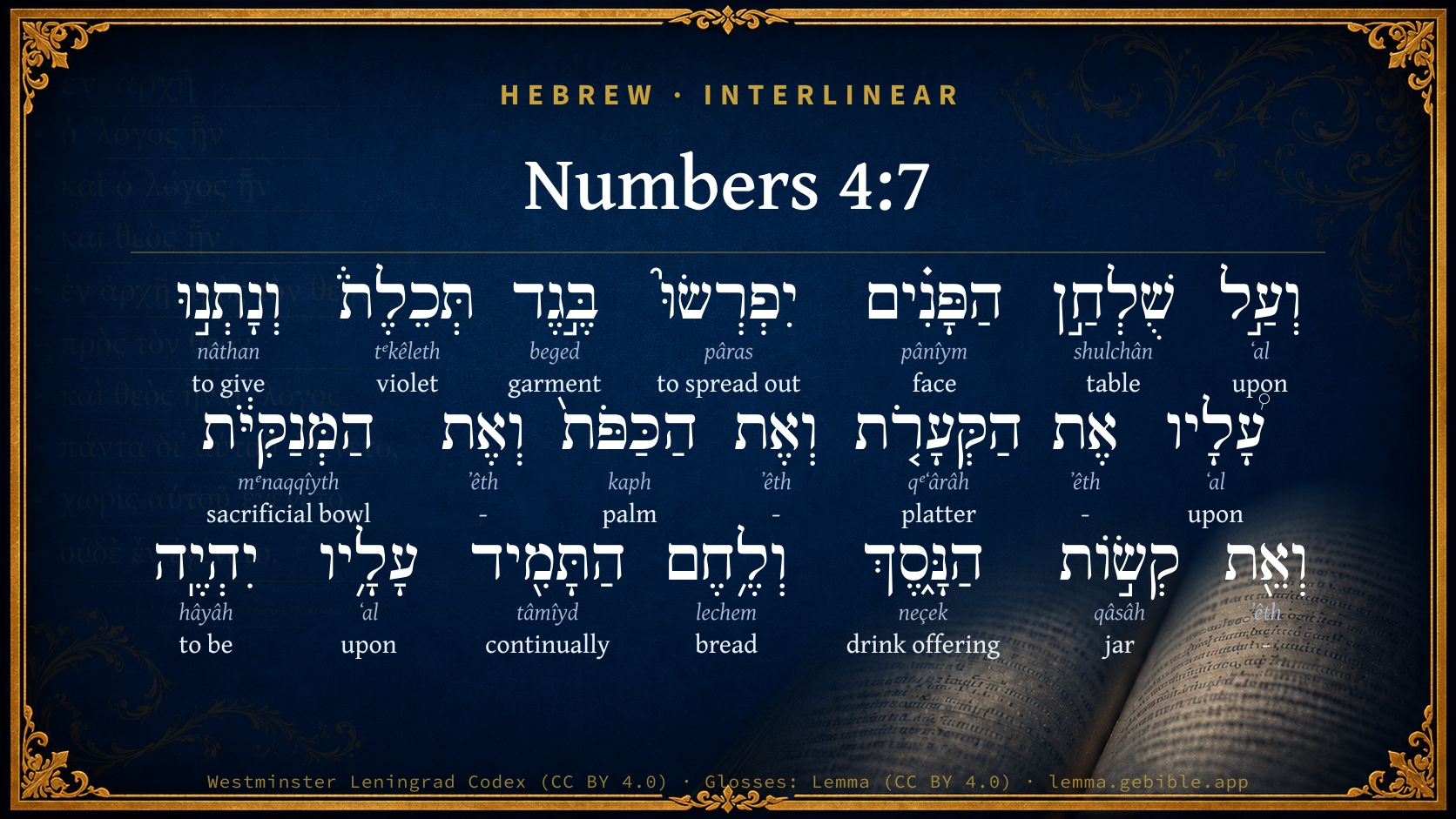
Hebrew (Westminster Leningrad Codex) Numbers 4:7 appears in the Hebrew Old Testament. The text above is from the Westminster Leningrad Codex. Each word links to its Strong’s number, a concise gloss, and parsing drawn from the Open Scriptures Hebrew Bible morphology. Click any word for its full Brown-Driver-Briggs (BDB) entry.
Download image
Cite this verse

Numbers 4:7 (World English Bible). Public Domain. Lemma interlinear Bible study tool, https://lemma.gebible.app/v/numbers/4/7.

Show BibTeX & RIS
BibTeX
RIS
English Translation
On the table of show bread they shall spread a blue cloth, and put on it the dishes, the spoons, the bowls, and the cups with which to pour out; and the continual bread shall be on it.
World English Bible · Public Domain
Download a study sheet

One document with this verse’s original text, its word-by-word gloss line, the meaning frame, cross-references with their text, attributed commentary, and full source and license credits — printable, and it pastes into notes with its structure intact.

This verse Autodidact and up

Study sheet (.html) Plain text (.txt)

A passage Seminary Student

Up to 50 verses in one chapter. A passage sheet keeps up to 6 commentary sources and 12 cross-references per verse, in the order this page ranks them, and says so on the sheet whenever that leaves anything out. Ask for a single verse and you get the Autodidact verse sheet above.

Everything on this page stays free to read, with no account — the sheet is a download of what is already on screen, not access to it.

Want to remove ads? Support Godless Engineer
Compare translations 3

The same verse in 3 English versions, stacked beneath the original-language interlinear above. Click any original word for its lexicon entry.

Each is an independent rendering of the whole verse — the interlinear is not word-aligned to these translations.

Highlighted words mark where these versions differ — a whole-verse word diff, not a word-by-word alignment.

  • World English Bible Public Domain
    On the table of show bread they shall spread a blue cloth, and put on it the dishes, the spoons, the bowls, and the cups with which to pour out; and the continual bread shall be on it.
  • King James Version Public Domain
    And upon the table of showbread they shall spread a cloth of blue, and put thereon the dishes, and the spoons, and the bowls, and covers to cover withal: and the continual bread shall be thereon:
  • unfoldingWord Literal Text CC BY-SA 4.0
    And over the table of the faces they shall spread a cloth of blue, and they shall put on it the dishes and the palm-sized bowls and the bowls and the pitchers of the drink offering, and the bread of continuity shall be on it.

unfoldingWord Literal Text — © unfoldingWord, licensed CC BY-SA 4.0. Word-aligned USFM3 via Door43 (git.door43.org/unfoldingWord/en_ult).

Versions to compare (up to 4)

3 of 4 selected

Show all 18 translations

Every available English version of this verse, each an independent rendering of the whole verse.

  • World English Bible Public Domain
    On the table of show bread they shall spread a blue cloth, and put on it the dishes, the spoons, the bowls, and the cups with which to pour out; and the continual bread shall be on it.
  • Berean Standard Bible Public Domain
    Over the table of the Presence they are to spread a blue cloth and place the plates and cups on it, along with the bowls and pitchers for the drink offering. The regular bread offering is to remain on it.
  • Majority Standard Bible Public Domain
    Over the table of the Presence they are to spread a blue cloth and place the plates and cups on it, along with the bowls and pitchers for the drink offering. The regular bread offering is to remain on it.
  • King James Version Public Domain
    And upon the table of showbread they shall spread a cloth of blue, and put thereon the dishes, and the spoons, and the bowls, and covers to cover withal: and the continual bread shall be thereon:
  • American Standard Version (1901) Public Domain
    And upon the table of showbread they shall spread a cloth of blue, and put thereon the dishes, and the spoons, and the bowls and the cups wherewith to pour out; and the continual bread shall be thereon:
  • Revised Version (1885) Public Domain
    And upon the table of shewbread they shall spread a cloth of blue, and put thereon the dishes, and the spoons, and the bowls, and the cups to pour out withal: and the continual bread shall be thereon:
  • Geneva Bible (1599) Public Domain
    And vpon ye table of shew bread they shall spread a cloth of blewe silke, and put thereon the dishes, and the incense cups, and goblets, and couerings to couer it with, and the bread shall be thereon continually:
  • Douay-Rheims (1899) Public Domain
    They shall wrap up also the table of proposition in a cloth of violet, and shall put with it the censers and little mortars, the cups and bowls to pour out the libations: the leaves shall be always on it:
  • Young's Literal Translation Public Domain
    `And on the table of the presence they spread a garment of blue, and have put on it the dishes, and the spoons, and the bowls, and the cups of the libation, and the bread of continuity is on it,
  • Literal Standard Version CC BY-SA 4.0
    And they spread a garment of blue over the table of the presence, and have put the dishes, and the spoons, and the bowls, and the cups of the drink-offering on it, and the bread of continuity is on it,
  • Unlocked Literal Bible CC BY-SA 4.0
    They are to spread a blue cloth on the table of the bread of the presence. On it they must put the dishes, spoons, bowls, and jars for pouring. Bread must always continue to be on the table.
  • unfoldingWord Literal Text CC BY-SA 4.0
    And over the table of the faces they shall spread a cloth of blue, and they shall put on it the dishes and the palm-sized bowls and the bowls and the pitchers of the drink offering, and the bread of continuity shall be on it.
  • Darby Bible Public Domain
    And upon the table of shewbread they shall spread a cloth of blue; and put thereon the dishes, and the cups, and the bowls, and goblets of the drink-offering; and the continual bread shall be thereon.
  • World Messianic Bible Public Domain
    “On the table of show bread they shall spread a blue cloth, and put on it the dishes, the spoons, the bowls, and the cups with which to pour out; and the continual bread shall be on it.
  • Webster's Bible Public Domain
    And upon the table of show-bread they shall spread a cloth of blue, and put on it the dishes, and the spoons, and the bowls, and covers to cover with: and the continual bread shall be upon it.
  • Free Bible Version CC BY-SA 4.0
    Have them spread a blue cloth over the table of the Presence as well, and put the plates and cups on it, as well as the bowls and jugs for the drink offering. The current bread offering is to stay on it.
  • Bible in Basic English Public Domain
    And on the table of the holy bread they are to put a blue cloth, and on it all the vessels, the spoons and the basins and the cups; and the holy bread with them;
  • JPS Tanakh (1917) Public Domain
    And upon the table of showbread they shall spread a cloth of blue, and put thereon the dishes, and the pans, and the bowls, and the jars wherewith to pour out; and the continual bread shall remain thereon.

Literal Standard Version (2020), Covenant Press — licensed CC BY-SA 4.0. Text via the HelloAO Bible API (eBible.org). Unlocked Literal Bible (unfoldingWord) — licensed CC BY-SA 4.0. Text via the HelloAO Bible API (eBible.org). unfoldingWord Literal Text — © unfoldingWord, licensed CC BY-SA 4.0. Word-aligned USFM3 via Door43 (git.door43.org/unfoldingWord/en_ult). Free Bible Version, Dr. Jonathan Gallagher — licensed CC BY-SA 4.0. Text via the HelloAO Bible API (eBible.org).

Word by word

More ways to search: Search by grammar → Find every occurrence → Compare this word →

Practice this passage: Drill this verse → Learn its vocabulary →

הַמְּנַקִּיֹּ֔ת
mᵉnaqqîyth
H4518
“the · sacrificial bowls”
Particle, Definite Article + Noun, Common, Feminine, Plural, Absolute
Part of Speech
Particle + Noun
Type
Common
Gender
Feminine
Number
Plural
State
Absolute
Full BDB Definition

Origin: from H5352

TWOT: 1412d

sacrificial bowl or cup
  1. וְעַ֣ל ʻal H5921 “and · upon” Conjunction + Preposition
  2. שֻׁלְחַ֣ן shulchân H7979 “table of” Noun, Common, Masculine, Singular, Construct
  3. הַפָּנִ֗ים pânîym H6440 “the · face(s)” Particle, Definite Article + Noun, Common, Both, Plural, Absolute
  4. יִפְרְשׂוּ֮ pâras H6566 “to spread out” Verb, Qal, Imperfect, 3rd Person, Masculine, Plural
  5. בֶּ֣גֶד beged H899 “garment of” Noun, Common, Masculine, Singular, Construct
  6. תְּכֵלֶת֒ tᵉkêleth H8504 “violet” Noun, Common, Feminine, Singular, Absolute
  7. וְנָתְנ֣וּ nâthan H5414 “and · to give” Conjunction + Verb, Qal, Sequential Perfect, 3rd Person, Common, Plural
  8. עָ֠לָיו ʻal H5921 “upon · him” Preposition + Suffix, Personal, 3rd Person, Masculine, Singular
  9. אֶת ʼêth H853 “-” Particle, Direct Object
  10. הַקְּעָרֹ֤ת qᵉʻârâh H7086 “the · platters” Particle, Definite Article + Noun, Common, Feminine, Plural, Absolute
  11. וְאֶת ʼêth H853 “and · -” Conjunction + Particle, Direct Object
  12. הַכַּפֹּת֙ kaph H3709 “the · palms” Particle, Definite Article + Noun, Common, Feminine, Plural, Absolute
  13. וְאֶת ʼêth H853 “and · -” Conjunction + Particle, Direct Object
  14. וְאֵ֖ת ʼêth H853 “and · -” Conjunction + Particle, Direct Object
  15. קְשׂ֣וֹת qâsâh H7184 “jars of” Noun, Common, Feminine, Plural, Construct
  16. הַנָּ֑סֶךְ neçek H5262 “the · drink offering” Particle, Definite Article + Noun, Common, Masculine, Singular, Absolute
  17. וְלֶ֥חֶם lechem H3899 “and · bread of” Conjunction + Noun, Common, Both, Singular, Construct
  18. הַתָּמִ֖יד tâmîyd H8548 “the · continually” Particle, Definite Article + Noun, Common, Masculine, Singular, Absolute
  19. עָלָ֥יו ʻal H5921 “upon · him” Preposition + Suffix, Personal, 3rd Person, Masculine, Singular
  20. יִהְיֶֽה hâyâh H1961 “to be” Verb, Qal, Imperfect, 3rd Person, Masculine, Singular

About this verse

These counts appear in no published source. They are computed here, from the morphology-tagged text and Lemma’s own curated glosses. What Lemma adds →

21
words
16
distinct lemmas
Pentateuch
section

Notable vocabulary

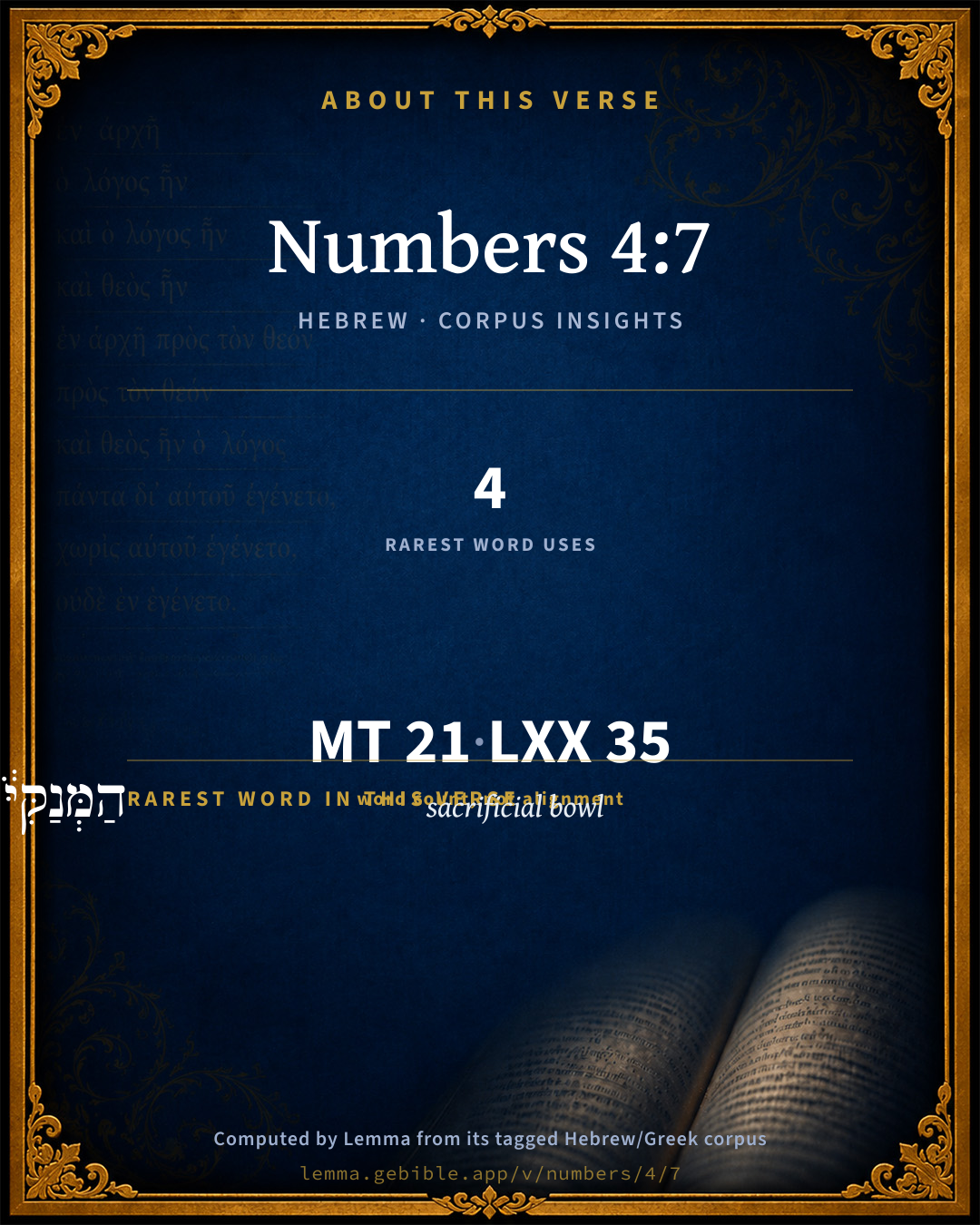
The rarest word here is הַמְּנַקִּיֹּ֔ת sacrificial bowl H4518 — appearing just 4 times in the whole Hebrew Bible.

Shared distinctive vocabulary

הַמְּנַקִּיֹּ֔ת sacrificial bowl H4518 occurs in 4 verses of the Hebrew Bible. Also found in:

Grammatical profile

  • 3 verbs
  • 11 nouns
  • 3 prepositions
  • 4 particles

Verb forms

  • יִפְרְשׂוּ֮ Qal · Imperfect
  • וְנָתְנ֣וּ Qal · Sequential Perfect
  • יִהְיֶֽה Qal · Imperfect

Repetition

A word recurs within this verse — often emphatic in Hebrew:

  • וְעַ֣ל upon H5921 ×3

Hebrew & Septuagint length

In English translation the verse runs 38 words from the Hebrew and 41 from the Septuagint (LXX English) — closely comparable.

A rough comparison of the two English renderings, which tokenize alike — not a word-level alignment.

Word counts can differ between the Hebrew and the Greek without any difference in meaning — e.g. the Hebrew direct-object marker אֵת has no separate Greek word, and Greek often adds the article ὁ.

In the original languages it is 21 Hebrew tokens and 35 Greek tokens — but the two are counted differently (Hebrew bundles its prefixes and suffixes into one token; the Greek is in lemma form), so that isn’t a like-for-like length.

Cross-references

3

Topical passages linked to Numbers 4:7 in the Treasury of Scripture Knowledge — connected by theme and wording, ordered by reader-vote popularity; previews shown in the World English Bible.

  • Leviticus 24:5–8 "You shall take fine flour, and bake twelve cakes of it: two tenth parts of an ephah shall be in one cake.
  • Exodus 25:23–30 "You shall make a table of acacia wood. Two cubits shall be its length, and a cubit its breadth, and one and a half cubits its height.
  • Exodus 37:10–16 He made the table of acacia wood. Its length was two cubits, and its breadth was a cubit, and its height was a cubit and a half.

Cross-references courtesy of OpenBible.info (CC BY 4.0).

Hebrew and Greek witnesses Masoretic Hebrew ↔ Greek Septuagint

The same verse in the two great witnesses to the Old Testament, shown verse-for-verse.

These are two independent witnesses, not word-aligned to each other, and the Septuagint is shown in lemma (dictionary) form.

Hebrew Numbers 4:7 Masoretic · Westminster Leningrad Codex

וְעַ֣ל שֻׁלְחַ֣ן הַפָּנִ֗ים יִפְרְשׂוּ֮ בֶּ֣גֶד תְּכֵלֶת֒ וְנָתְנ֣וּ עָ֠לָיו אֶת הַקְּעָרֹ֤ת וְאֶת הַכַּפֹּת֙ וְאֶת הַמְּנַקִּיֹּ֔ת וְאֵ֖ת קְשׂ֣וֹת הַנָּ֑סֶךְ וְלֶ֥חֶם הַתָּמִ֖יד עָלָ֥יו יִהְיֶֽה

On the table of show bread they shall spread a blue cloth, and put on it the dishes, the spoons, the bowls, and the cups with which to pour out; and the continual bread shall be on it.

World English Bible · Public Domain

Greek LXX Numbers 4:7 Septuagint · lemma form

καί ἐπί ὁ τράπεζα ὁ προκεῖμαι ἐπιβάλλω ἐπί αὐτός ἱμάτιον ὁλοπόρφυρος καί ὁ τρυβλίον καί ὁ θυΐσκη καί ὁ κύαθος καί ὁ σπονδεῖον ἐν ὅς σπένδω καί ὁ ἄρτος ὁ διά πᾶς ἐπί αὐτός εἰμί

And they shall put on the table set forth for show-bread a cloth all of purple, and the dishes, and the censers, and the cups, and the vessels with which one offers drink-offerings; and the continual loaves shall be upon it.

LXX2012 (modern English Septuagint) · Public Domain

Hebrew: Westminster Leningrad Codex (CC BY 4.0). Greek: Septuagint (public domain); English from LXX2012 (modern English Septuagint) (Public Domain). How the Septuagint differs from the Hebrew →

Targum (Aramaic paraphrase)

2

The Targum is the ancient Jewish Aramaic paraphrase of the Hebrew Scriptures — an interpretive translation, not the Hebrew text itself. Onkelos (literal) and Pseudo-Jonathan (expansive) render the Torah, and Jonathan the Prophets. Coverage is partial: where no permissively-licensed English translation exists for a verse, only the Aramaic is shown. This is verse-level text, not a word-by-word alignment to the Hebrew.

  1. Targum Onkelos Torah (Genesis–Deuteronomy)
    וְעַל פָּתוֹרָא דִלְחֵם אַפַּיָא יִפְרְסוּן לְבוּשׁ תִּכְלָא וְיִתְּנוּן עֲלוֹהִי יָת מָגִּיסַיָא וְיָת בָּזִיכַיָא וְיָת מְכִילָתָא וְיָת קַסְווֹת נִסוּכָא וְלַחְמָא תְּדִירָא עֲלוֹהִי יְהֵי

    (no public-domain English translation for this verse)

    Targum Onkelos — Aramaic: “Onkelos Genesis” (public domain); “Onkelos Exodus” (public domain); “Onkelos Leviticus” (public domain); “Onkelos Numbers” (public domain); “Onkelos Deuteronomy” (public domain). English: “Sefaria Community Translation” (CC0 1.0 (public-domain dedication)); “J.W. Etheridge. The Targums of Onkelos and Jonathan Ben Uzziel on the Pentateuch. London: Longmans, Green, 1862” (public domain). Text via Sefaria.

  2. Targum Pseudo-Jonathan Torah (Genesis–Deuteronomy)
    וְעַל פְּתוֹר לְחֵם אַפַּיָא יִפְרְסוּן לְבוּשׁ דְתִכְלָא וְיִתְּנוּן עֲלוֹי יַת פִילַוָותָא וְיַת בָּזִיכַיָא וְיַת מְנַקִיָתָא וְיַת קַסְווֹת נִיסוּכָא וּלְחֵם תְּדִירָא עֲלוֹי יְהֵי

    And over the table of the presence bread they shall spread a wrapper of purple, and set upon it the vials, and the spoons, and the vases, and the libation cups; but the bread shall be upon it evermore.

    Targum Pseudo-Jonathan — Aramaic: “Targum Jonathan on Genesis” (public domain); “Targum Jonathan on Exodus” (public domain); “Targum Jonathan on Leviticus” (public domain); “Targum Jonathan on Numbers” (public domain); “Targum Jonathan on Deuteronomy” (public domain). English: “The Targum of Jonathan ben Uzziel, trans. J. W. Etheridge, London, 1862” (public domain). Text via Sefaria.

Commentary

Notes on Numbers 4:7 from classic Christian and Jewish commentators (each source and its license shown beneath its notes). The classic Christian expositions comment on the surrounding passage and are grouped to its opening verse, so a note may address several verses; the Jewish commentaries on the Tanakh (Rashi and others) are per-verse, so they appear only where the commentator wrote on this verse.

Lemma curates 59 commentaries, every one of them public domain or Creative Commons licensed, each selected and text-cleaned for this edition rather than reprinted as found. About our sources →

Joseph Benson's Commentary

Num 4:7. The dishes — Upon which the show-bread was put. Continual bread — So called because it was continually to be there, even in the wilderness; where, though they had only manna for themselves, yet they reserved corn for the weekly making of these loaves.

Joseph Benson's Commentary on the Old and New Testaments (1811–1818) — public domain. Text from a community e-Sword module.

Geneva Bible (1599)

Geneva Bible translators

Meaning, to cover the bread.

Geneva Bible (1599) marginal notes — public domain. Text via Bolls.life.

Jamieson, Fausset & Brown

Robert Jamieson, A. R. Fausset & David Brown

continual showbread--Though the people were in the wilderness fed upon manna, the sacred loaves were constantly made of corn, which was probably raised in small quantities from the verdant patches of the desert.

Jamieson, Fausset & Brown — Commentary Critical and Explanatory on the Whole Bible (1871) — public domain (CC PDM 1.0). Text via the HelloAO Bible API.

Ellicott's Commentary for English Readers

(7) And covers to cover withal.—Better, and the cups for the drink-offering (or libation).

And the continual bread.—The shew-bread is so called because it was renewed every Sabbath day, and was continually before the face of the Lord even (as it appears from this verse) during the marches of the Israelites through the desert (Exo_25:30; Lev_24:5).

A Bible Commentary for English Readers, edited by Charles John Ellicott (1878–1897) — public domain. Text from a community e-Sword module.

The Cambridge Bible for Schools and Colleges

gen. ed. J. J. S. Perowne

7. shewbread] Presence-bread, i.e. bread that is placed in the divine Presence. 1Sa_21:6 is evidence that the practice was observed in early times. It was probably a relic of the primitive heathen notion that gods actually partook of bread that was offered to them.

the continual bread] The expression is not found elsewhere. Cf. ‘continual meal-offering’ (Num_4:16, Neh_10:33 only), ‘continual [R.V. perpetual] incense’ (Exo_30:8 (P )), and frequently ‘continual burnt-offering’ (Numbers 28, 29). It connotes the regularity with which a ritual act is performed at stated intervals.

The bread also came to be known as pile bread (R.V. ‘shewbread,’ 1Ch_9:32; 1Ch_23:29, Neh_10:33) owing to the arrangement of the loaves in two piles (Lev_24:6, R.V. marg.). And since the root of the word מֲערֶכֶת (‘pile’) denotes to ‘set out’ or ‘arrange’ [a meal], the name appears in the N.T. as ἄρτοι τῆς προθέσεως (lit. ‘bread of the setting out,’ Mat_12:4, Mar_2:26, Luk_6:4) and ἡ πρόθεσις τῶν ἄρτων (lit. ‘the setting out of the loaves,’ Heb_9:2).

The Cambridge Bible for Schools and Colleges (gen. ed. J. J. S. Perowne; Cambridge University Press, 1878–1918) — public domain. Text from a community e-Sword module.

John Gill's Exposition

And upon the table of shewbread they shall spread a cloth of blue,.... That that also might not be seen nor touched by the Levites:

and put thereon the dishes, and the spoons, and the bowls, and the covers to cover withal: all which belonged to the shewbread table; the use of which; see Gill on Exo 25:29; these seem to be put not immediately upon the table, but upon the blue cloth spread over the table:

and the continual bread shall be thereon: the shewbread is called "continual", because it was always on the table; for while the one was removing by a set of priests, which had stood a week, new loaves were placed by another set of priests: this bread seems at this time to be placed also upon the table, spread with the blue cloth; and from hence it appears, that the Israelites had the shewbread in the wilderness; for the making of which they might be supplied with corn from the neighbouring countries, though they themselves needed not any, being daily fed with manna.

John Gill's Exposition of the Whole Bible (1746–1763) — public domain (CC PDM 1.0). Text via the HelloAO Bible API.

Haydock's Catholic Bible Commentary

Loaves. Some imagine this precept was not observed in the desert, as the people fed on manna. But might not they procure some flour of the neighbouring nations? and do not the princes offer flour, chap. vii.? See Deuteronomy xii. 7. (Calmet)

George Leo Haydock (1774–1849), Haydock's Catholic Family Bible and Commentary, 1859 edition — public domain. Excludes Psalms (Douay-Rheims chapter numbering differs from Protestant) and Deuterocanonical books (Catholic canon only).

Matthew Poole's English Annotations

Of shew-bread, Heb. of faces or presence, for of the bread of faces or presence, i.e. of the bread which was continually standing in the presence of the Lord.

The dishes, upon which the shew-bread was put.

The continual bread, i.e. shew-bread; so called because it was continually to be there, even in the wilderness; where though they had only manna for themselves, yet they reserved corn for the weekly making of these loaves, which they might with no great difficulty procure from some of the people bordering upon the wilderness in the innermost parts whereof they were.

Matthew Poole's English Annotations on the Holy Bible (1683–1685) — public domain. Text from a community e-Sword/MySword module.

Whedon's Commentary on the Bible

Daniel D. Whedon

7, 9. The table of show-bread — This is minutely described in Exo_25:23-30. The literal Hebrew here is show table, or, more exactly, table of faces or face, referring to the presence of Jehovah, not of the people, for they were not permitted to see it. It sets forth in a sensible manner the great truth that the unseen Jesus is the bread of life for the believing soul. It, with all its furniture, and the continual bread, was to be prepared for removal. The bread was called “continual” or perpetual, because loaves were always to be on the table, the new always taking the place of the old. The table was to be spread with a cloth of blue, or purple blue, and then, after all the furniture and show-bread were put upon it, was to be covered with a scarlet cloth. Could we authoritatively interpret the significance of this colour, as some assume to do, we should not hesitate to enlighten the reader. In this case the coloured cloth is not for ornament, since it is covered with the tachash skin. The same may be said of the golden candlestick, and all the utensils appertaining to it. This was the symbol of that illumination which is afforded by the Holy Spirit, dispelling doubts, and giving to the believer a sense of the reality of spiritual truth. Hence the Holy Ghost is called by Jesus the Spirit of Truth, or the Spirit of Reality, because he makes real to our spiritual intuition the truth which is dark to our reason.

Snuffdishes — The same word is elsewhere rendered censer.

Lev_10:1; Num_16:6. The one was used for trimming the lamps, and the other for carrying live coals for the purpose of burning incense.

Daniel D. Whedon (gen. ed.), Commentary on the Old and New Testaments (1874–1909) — public domain. Text from a community e-Sword module.

The Pulpit Commentary

The dishes, and the spoons, and the bowls, and covers to cover withal. Rather, "the plates, the bowls, the wine pitchers, and the chalices for pouring out," i.e., the drink offerings. The two first seem to have been used in the meat offering, the two last in the drink offering.

The Pulpit Commentary (1880–1919), ed. H.D.M. Spence-Jones & Joseph S. Exell — public domain. Text from a community e-Sword module.

John Wesley's Explanatory Notes

The dishes - Upon which the shew-bread was put. Continual bread - So called because it was continually to be there, even in the wilderness; where though they had only manna for themselves, yet they reserved corn for the weekly making of these loaves, which they might with no great difficulty procure from some of the people bordering upon the wilderness.

John Wesley, Explanatory Notes Upon the Whole Bible (1754–1765) — public domain. Text via the GEBible commentary corpus.

Keil & Delitzsch

C. F. Keil & F. Delitzsch

Over the table of shew-bread (Exo 25:23) they were to spread a hyacinth cloth, to place the plates, bowls, wine-pitchers, and drink-offering bowls (Exo 25:29) upon the top of this, and to lay shew-bread thereon; and then to spread a crimson cloth over these vessels and the shew-bread, and cover this with a sea-cow skin, and lastly to put the bearing poles in their places.

Keil & Delitzsch — Biblical Commentary on the Old Testament (1861–1891) — public domain (CC PDM 1.0). Text via the HelloAO Bible API. (Old Testament only.)

Scofield Reference Notes

C. I. Scofield

shewbread

(See Scofield "Exo 25:30").

The Scofield Reference Bible (1917 edition), notes by C. I. Scofield — public domain. Text from a community e-Sword module.

unfoldingWord translationNotes

Door43 World Missions Community

the bread of the presence

This bread represents the presence of Yahweh. AT: "the bread of Yahweh's presence" (See: Assumed Knowledge and Implicit Information)

On it they must put

Here "it" refers to the blue cloth.

bowls, and jars for pouring

The full meaning of this statement can be made explicit. AT: "bowls and jars used to pour out drink offerings" (See: Assumed Knowledge and Implicit Information)

They must cover them

Here them refers to "the dishes, spoons, bowls, and jars."

Bread must always continue to be

There must always be bread"

scarlet cloth

"red cloth"

insert poles

The poles were inserted into rings on the corners of the table so that the poles could be used to carry the table. This can be stated clearly. AT: "insert poles into the rings at the corners of the table" (See: Assumed Knowledge and Implicit Information)

translationWords

bread

sea cow

unfoldingWord translationNotes — © Distant Shores Media and the Door43 World Missions Community, licensed CC BY-SA 4.0. Source: git.door43.org/Door43/en_tn.

Rashi

Rabbi Shlomo Yitzchaki (Rashi)

קערת וכפת וקשות ומנקיות — I have already described these in the chapter dealing with the work of the Tabernacle (Exodus XXV).

הנסך means, “covering”, — having the same meaning as מסך, the screen, — as it is written, (Exodus 25:29) “the covers by which they shall be covered (יסך)” (cf. Rashi on that verse and the Note thereon).

Rashi on the Tanakh — English translations: “The Judaica Press complete Tanach with Rashi, translated by A. J. Rosenberg” (CC BY 4.0); “Pentateuch with Rashi's commentary by M. Rosenbaum and A.M. Silbermann, 1929-1934” (public domain); “The Metsudah Tanach series, Lakewood, N.J” (CC BY 4.0); and “The Book of Joshua, Metsudah Publications, 1997” (CC BY 4.0). Text via Sefaria.

Ramban (Nachmanides)

Rabbi Moshe ben Nachman (Ramban / Nachmanides)

AND THE CONTINUAL BREAD SHALL REMAIN THEREON. On the table itself was to be the bread,. Ramban interprets the verse to mean: “and upon the table of showbread, on which the continual bread shall remain, they shall spread a cloth of blue etc.” and upon them [i.e., the twelve loaves of bread] a cloth of blue, and upon this cloth which was on the table they put all the vessels, and afterwards they spread upon the vessels and the table a cloth of scarlet. For in honor of the bread which was arranged on the table according to the precept [of the Torah], they spread this cloth of blue in order to divide between the table and its bread [beneath the cloth], and the vessels [which lay above the cloth]; and the upper cover was a cloth of scarlet, which was a hue of red, because the table is a sign of the crown of royalty, which is [manifested by] the attribute of justice. But the ark and the golden altar were [covered on top] with a cloth of blue, alluding to the attribute which is comprised of hakol (the All), and the altar of the burnt-offering [was covered] with a purple cloth, which is redder than the first [i.e., the cloth of scarlet which was upon the table], for it is there [on the altar of the burnt-offering] that the blood of the offerings, which is a ransom for the souls [of those who offer them], is sprinkled.

Ramban (Nachmanides) on the Tanakh — English translation: “Commentary on the Torah by Ramban (Nachmanides). Translated and annotated by Charles B. Chavel. New York, Shilo Pub. House, 1971-1976” (CC BY 4.0). Text via Sefaria.

Lesson kit

Teaching starters — assembled from the data on this page, not authored interpretation. Every prompt links to the verse data it draws on. Edit before teaching.

Numbers, in the Pentateuch, opens this verse with 21 words (16 distinct Hebrew lemmas). Its most distinctive word is mᵉnaqqîyth (“sacrificial bowl”). A historical commentator’s framing appears above. Read the whole chapter for the surrounding context.

Discussion questions

  1. How does “sacrificial bowl” (mᵉnaqqîyth) shape what this verse is saying?
  2. How does Exodus 25:29, which shares the word «sacrificial bowl», read alongside this verse?
  3. What does the repetition of “upon” (3× in this one verse) do in this verse?
  4. These translations render this verse differently. What is at stake in choosing one wording over another?
  5. «יִפְרְשׂוּ֮» is a Qal Imperfect verb. How does that grammatical form shape the action described?
  6. Compare how Joseph Benson's Commentary and Geneva Bible (1599) read this verse. Where do they agree or differ?

Things to notice

Reading settings

Reading text

Shown beneath each verse's original-language words.

Old Testament
Old Testament edition

Read the OT as the Masoretic Hebrew (MT) or the Greek Septuagint (LXX).

English shown for the Greek Septuagint (in the Hebrew ↔ Greek comparison).

Comparing translations? Open the Compare panel on any verse page to stack up to four side by side.