
Exodus 18:12

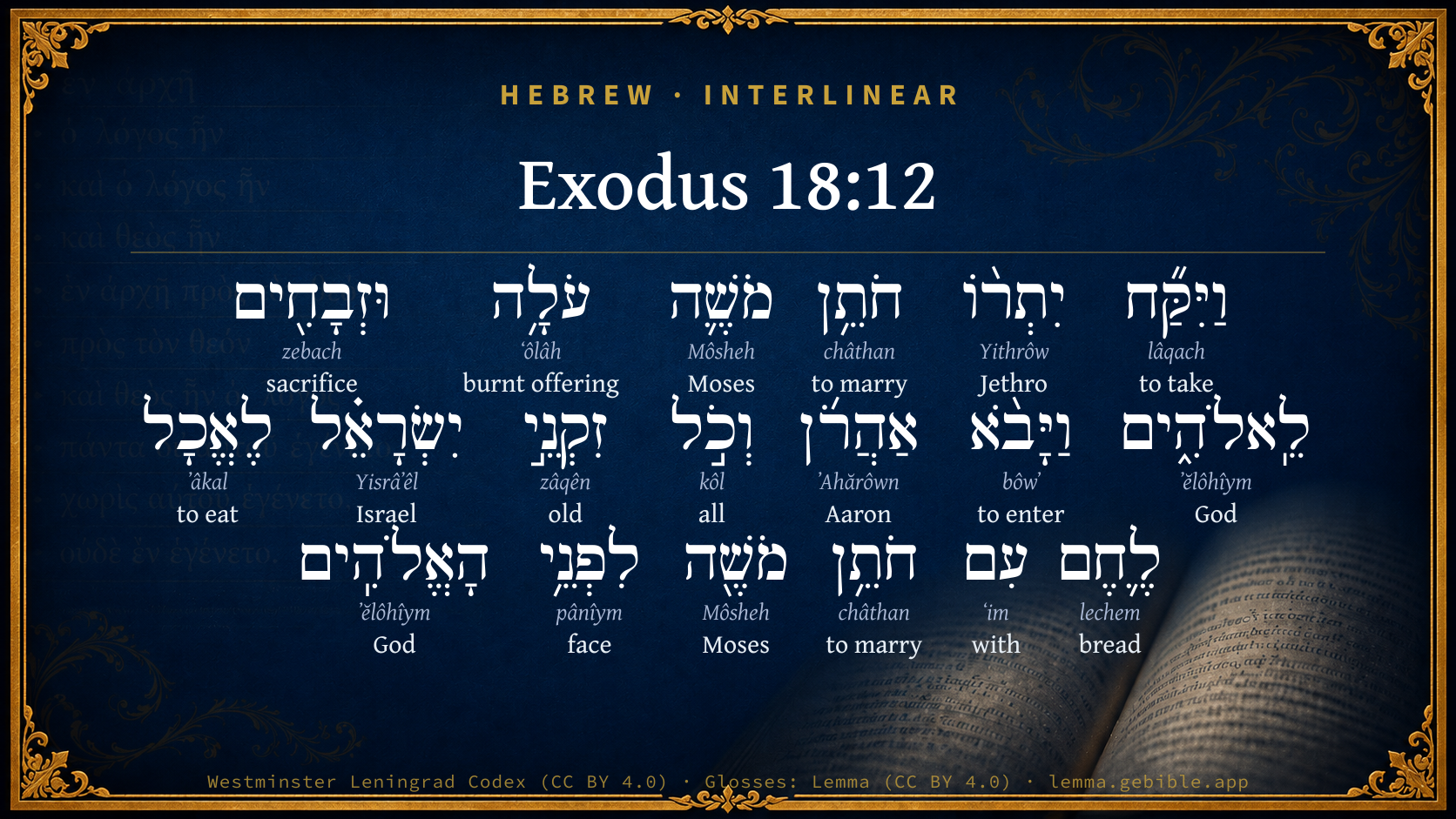
Hebrew (Westminster Leningrad Codex) Exodus 18:12 appears in the Hebrew Old Testament. The text above is from the Westminster Leningrad Codex. Each word links to its Strong’s number, a concise gloss, and parsing drawn from the Open Scriptures Hebrew Bible morphology. Click any word for its full Brown-Driver-Briggs (BDB) entry.
Download image
Cite this verse

Exodus 18:12 (World English Bible). Public Domain. Lemma interlinear Bible study tool, https://lemma.gebible.app/v/exodus/18/12.

Show BibTeX & RIS
BibTeX
RIS
English Translation
Jethro, Moses' father-in-law, took a burnt offering and sacrifices for God. Aaron came with all of the elders of Israel, to eat bread with Moses' father-in-law before God.
World English Bible · Public Domain
Download a study sheet

One document with this verse’s original text, its word-by-word gloss line, the meaning frame, cross-references with their text, attributed commentary, and full source and license credits — printable, and it pastes into notes with its structure intact.

This verse Autodidact and up

Study sheet (.html) Plain text (.txt)

A passage Seminary Student

Up to 50 verses in one chapter. A passage sheet keeps up to 6 commentary sources and 12 cross-references per verse, in the order this page ranks them, and says so on the sheet whenever that leaves anything out. Ask for a single verse and you get the Autodidact verse sheet above.

Everything on this page stays free to read, with no account — the sheet is a download of what is already on screen, not access to it.

Want to remove ads? Support Godless Engineer
Compare translations 3

The same verse in 3 English versions, stacked beneath the original-language interlinear above. Click any original word for its lexicon entry.

Each is an independent rendering of the whole verse — the interlinear is not word-aligned to these translations.

Highlighted words mark where these versions differ — a whole-verse word diff, not a word-by-word alignment.

  • World English Bible Public Domain
    Jethro, Moses' father-in-law, took a burnt offering and sacrifices for God. Aaron came with all of the elders of Israel, to eat bread with Moses' father-in-law before God.
  • King James Version Public Domain
    And Jethro, Moses' father in law, took a burnt offering and sacrifices for God: and Aaron came, and all the elders of Israel, to eat bread with Moses' father in law before God.
  • unfoldingWord Literal Text CC BY-SA 4.0
    And Jethro, the father-in-law of Moses, took a burnt offering and sacrifices to God. And Aaron came, and all of the elders of Israel, to eat bread before the face of God with the father-in-law of Moses.

unfoldingWord Literal Text — © unfoldingWord, licensed CC BY-SA 4.0. Word-aligned USFM3 via Door43 (git.door43.org/unfoldingWord/en_ult).

Versions to compare (up to 4)

3 of 4 selected

Show all 18 translations

Every available English version of this verse, each an independent rendering of the whole verse.

  • World English Bible Public Domain
    Jethro, Moses' father-in-law, took a burnt offering and sacrifices for God. Aaron came with all of the elders of Israel, to eat bread with Moses' father-in-law before God.
  • Berean Standard Bible Public Domain
    Then Moses’ father-in-law Jethro brought a burnt offering and sacrifices to God, and Aaron came with all the elders of Israel to eat bread with Moses’ father-in-law in the presence of God.
  • Majority Standard Bible Public Domain
    Then Moses’ father-in-law Jethro brought a burnt offering and sacrifices to God, and Aaron came with all the elders of Israel to eat bread with Moses’ father-in-law in the presence of God.
  • King James Version Public Domain
    And Jethro, Moses' father in law, took a burnt offering and sacrifices for God: and Aaron came, and all the elders of Israel, to eat bread with Moses' father in law before God.
  • American Standard Version (1901) Public Domain
    And Jethro, Moses' father-in-law, took a burnt-offering and sacrifices for God: and Aaron came, and all the elders of Israel, to eat bread with Moses' father-in-law before God.
  • Revised Version (1885) Public Domain
    And Jethro, Moses’ father in law, took a burnt offering and sacrifices for God: and Aaron came, and all the elders of Israel, to eat bread with Moses’ father in law before God.
  • Geneva Bible (1599) Public Domain
    Then Iethro Moses father in lawe tooke burnt offerings and sacrifices to offer vnto God. And Aaron and all the Elders of Israel came to eat bread with Moses father in law before God.
  • Douay-Rheims (1899) Public Domain
    So Jethro the kinsman of Moses offered holocausts and sacrifices to God: and Aaron and all the ancients of Israel came, to eat bread with them before God.
  • Young's Literal Translation Public Domain
    And Jethro, father-in-law of Moses, taketh a burnt-offering and sacrifices for God; and Aaron cometh in, and all the elders of Israel, to eat bread with the father-in-law of Moses, before God.
  • Literal Standard Version CC BY-SA 4.0
    And Jethro, father-in-law of Moses, takes a burnt-offering and sacrifices [it] for God; and Aaron comes in, and all [the] elderly of Israel, to eat bread with the father-in-law of Moses, before God.
  • Unlocked Literal Bible CC BY-SA 4.0
    Jethro, Moses' father-in-law, brought a burnt offering and sacrifices for God. Aaron and all the elders of Israel came to eat a meal before God with Moses' father-in-law.
  • unfoldingWord Literal Text CC BY-SA 4.0
    And Jethro, the father-in-law of Moses, took a burnt offering and sacrifices to God. And Aaron came, and all of the elders of Israel, to eat bread before the face of God with the father-in-law of Moses.
  • Darby Bible Public Domain
    And Jethro, Moses' father-in-law, took a burnt-offering and sacrifices for God; and Aaron came, and all the elders of Israel, to eat bread with Moses' father-in-law in the presence of God.
  • World Messianic Bible Public Domain
    Jethro, Moses’ father-in-law, took a burnt offering and sacrifices for God. Aaron came with all the elders of Israel, to eat bread with Moses’ father-in-law before God.
  • Webster's Bible Public Domain
    And Jethro, Moses's father-in-law, took a burnt-offering and sacrifices for God: and Aaron came, and all the elders of Israel to eat bread with Moses's father-in-law before God.
  • Free Bible Version CC BY-SA 4.0
    Then Jethro presented a burnt offering and sacrifices to God, and Aaron came with all the elders of Israel to eat a meal with him in God's presence.
  • Bible in Basic English Public Domain
    Then Jethro, Moses' father-in-law, made a burned offering to God: and Aaron came, with the chiefs of Israel, and had a meal with Moses' father-in-law, before God.
  • JPS Tanakh (1917) Public Domain
    And Jethro, Moses' father-in-law, took a burnt-offering and sacrifices for God; and Aaron came, and all the elders of Israel, to eat bread with Moses' father-in-law before God.

Literal Standard Version (2020), Covenant Press — licensed CC BY-SA 4.0. Text via the HelloAO Bible API (eBible.org). Unlocked Literal Bible (unfoldingWord) — licensed CC BY-SA 4.0. Text via the HelloAO Bible API (eBible.org). unfoldingWord Literal Text — © unfoldingWord, licensed CC BY-SA 4.0. Word-aligned USFM3 via Door43 (git.door43.org/unfoldingWord/en_ult). Free Bible Version, Dr. Jonathan Gallagher — licensed CC BY-SA 4.0. Text via the HelloAO Bible API (eBible.org).

Word by word

More ways to search: Search by grammar → Find every occurrence → Compare this word →

Practice this passage: Drill this verse → Learn its vocabulary →

יִתְר֨וֹ
Yithrôw
H3503
“Jethro”
Noun, Proper
Part of Speech
Noun
Type
Proper
Full BDB Definition

Origin: from H3499 with pron. suffix

TWOT: None

Jethro = "his abundance" - father-in-law of Moses; also 'Jether'
  1. וַיִּקַּ֞ח lâqach H3947 “and · to take” Conjunction + Verb, Qal, Sequential Imperfect, 3rd Person, Masculine, Singular
  2. חֹתֵ֥ן châthan H2859 “marrying” Verb, Qal, Participle Active, Masculine, Singular, Construct
  3. מֹשֶׁ֛ה Môsheh H4872 “Moses” Noun, Proper
  4. עֹלָ֥ה ʻôlâh H5930 “burnt offering” Noun, Common, Feminine, Singular, Absolute
  5. וּזְבָחִ֖ים zebach H2077 “and · sacrifices” Conjunction + Noun, Common, Masculine, Plural, Absolute
  6. לֵֽאלֹהִ֑ים ʼĕlôhîym H430 “to/for · God(s)” Preposition + Noun, Common, Masculine, Plural, Absolute
  7. וַיָּבֹ֨א bôwʼ H935 “and · to enter” Conjunction + Verb, Qal, Sequential Imperfect, 3rd Person, Masculine, Singular
  8. אַהֲרֹ֜ן ʼAhărôwn H175 “Aaron” Noun, Proper
  9. וְכֹ֣ל kôl H3605 “and · all of” Conjunction + Noun, Common, Masculine, Singular, Construct
  10. זִקְנֵ֣י zâqên H2205 “old of” Adjective, Adjective, Masculine, Plural, Construct
  11. יִשְׂרָאֵ֗ל Yisrâʼêl H3478 “Israel” Noun, Proper
  12. לֶאֱכָל ʼâkal H398 “to eat” Preposition + Verb, Qal, Infinitive Construct
  13. לֶ֛חֶם lechem H3899 “bread” Noun, Common, Both, Singular, Absolute
  14. עִם ʻim H5973 “with” Preposition
  15. חֹתֵ֥ן châthan H2859 “marrying” Verb, Qal, Participle Active, Masculine, Singular, Construct
  16. מֹשֶׁ֖ה Môsheh H4872 “Moses” Noun, Proper
  17. לִפְנֵ֥י pânîym H6440 “to/for · face(s) of” Preposition + Noun, Common, Both, Plural, Construct
  18. הָאֱלֹהִֽים ʼĕlôhîym H430 “the · God(s)” Particle, Definite Article + Noun, Common, Masculine, Plural, Absolute

About this verse

These counts appear in no published source. They are computed here, from the morphology-tagged text and Lemma’s own curated glosses. What Lemma adds →

19
words
16
distinct lemmas
Pentateuch
section

Notable vocabulary

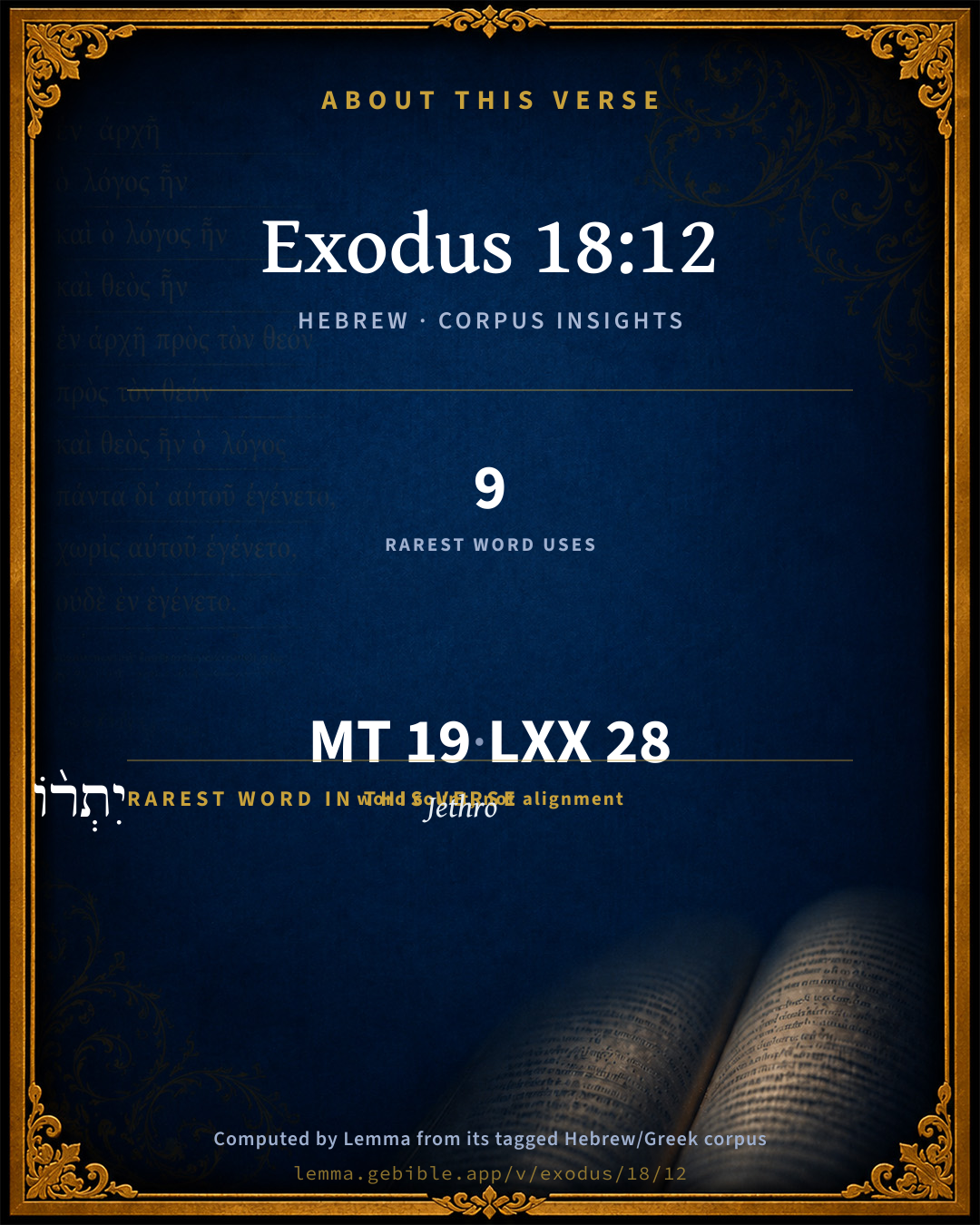
The rarest word here is יִתְר֨וֹ Jethro H3503 — appearing just 9 times in the whole Hebrew Bible.

Shared distinctive vocabulary

יִתְר֨וֹ Jethro H3503 occurs in 9 verses of the Hebrew Bible. Also found in:

Grammatical profile

  • 5 verbs
  • 12 nouns
  • 1 adjective
  • 1 preposition

Verb forms

  • וַיִּקַּ֞ח Qal · Sequential Imperfect
  • חֹתֵ֥ן Qal · Participle Active
  • וַיָּבֹ֨א Qal · Sequential Imperfect
  • לֶאֱכָל Qal · Infinitive Construct
  • חֹתֵ֥ן Qal · Participle Active

Repetition

Words recur within this verse — often emphatic in Hebrew:

  • חֹתֵ֥ן to marry H2859 ×2
  • מֹשֶׁ֛ה Moses H4872 ×2
  • לֵֽאלֹהִ֑ים God H430 ×2

Hebrew & Septuagint length

In English translation the verse runs 28 words from the Hebrew and 33 from the Septuagint (LXX English) — closely comparable.

A rough comparison of the two English renderings, which tokenize alike — not a word-level alignment.

Word counts can differ between the Hebrew and the Greek without any difference in meaning — e.g. the Hebrew direct-object marker אֵת has no separate Greek word, and Greek often adds the article ὁ.

In the original languages it is 19 Hebrew tokens and 28 Greek tokens — but the two are counted differently (Hebrew bundles its prefixes and suffixes into one token; the Greek is in lemma form), so that isn’t a like-for-like length.

Cross-references

24

Topical passages linked to Exodus 18:12 in the Treasury of Scripture Knowledge — connected by theme and wording, ordered by reader-vote popularity; previews shown in the World English Bible.

  • Genesis 31:54 Jacob offered a sacrifice in the mountain, and called his relatives to eat bread. They ate bread, and stayed all night in the mountain.
  • Deuteronomy 12:7 and there you shall eat before Yahweh your God, and you shall rejoice in all that you put your hand to, you and your households, in which Yahweh your God has blessed you.
  • Exodus 24:5 He sent young men of the children of Israel, who offered burnt offerings and sacrificed peace-offerings of oxen to Yahweh.
  • Exodus 24:11 He didn't lay his hand on the nobles of the children of Israel. They saw God, and ate and drank.
  • Genesis 4:4 Abel also brought some of the firstborn of his flock and of the fat of it. Yahweh respected Abel and his offering,
  • Genesis 8:20 Noah built an altar to Yahweh, and took of every clean animal, and of every clean bird, and offered burnt offerings on the altar.
  • Genesis 12:7 Yahweh appeared to Abram, and said, "I will give this land to your seed." He built an altar there to Yahweh, who appeared to him.
  • Genesis 26:25 He built an altar there, and called on the name of Yahweh, and pitched his tent there. There Isaac's servants dug a well.
  • Genesis 43:25 They made ready the present for Joseph's coming at noon, for they heard that they should eat bread there.
  • Exodus 2:20 He said to his daughters, "Where is he? Why is it that you have left the man? Call him, that he may eat bread."
  • Leviticus 7:11–17 "'This is the law of the sacrifice of peace offerings, which one shall offer to Yahweh.
  • Deuteronomy 27:7 and you shall sacrifice peace-offerings, and shall eat there; and you shall rejoice before Yahweh your God.
  • 2 Samuel 9:7 David said to him, "Don't be afraid of him; for I will surely show you kindness for Jonathan your father's sake, and will restore you all the land of Saul your father; and you shall eat bread at my table continually."
  • 1 Chronicles 29:21–22 They sacrificed sacrifices to Yahweh, and offered burnt offerings to Yahweh, on the next day after that day, even one thousand bulls, one thousand rams, and one thousand lambs, with their drink-offerings, and sacrifices in abundance for all Israel,
  • 2 Chronicles 30:22 Hezekiah spoke comfortably to all the Levites who had good understanding [in the service] of Yahweh. So they ate throughout the feast for the seven days, offering sacrifices of peace-offerings, and making confession to Yahweh, the God of their fathers.
  • Job 1:5 It was so, when the days of their feasting had run their course, that Job sent and sanctified them, and rose up early in the morning, and offered burnt offerings according to the number of them all. For Job said, "It may be that my sons have sinned, and renounced God in their hearts." Thus did Job continually.
  • Job 42:8 Now therefore, take to yourselves seven bulls and seven rams, and go to my servant Job, and offer up for yourselves a burnt offering; and my servant Job shall pray for you, for I will accept him, that I not deal with you according to your folly. For you have not spoken of me the thing that is right, as my servant Job has."
  • Job 42:11 Then came there to him all his brothers, and all his sisters, and all those who had been of his acquaintance before, and ate bread with him in his house. They comforted him, and consoled him concerning all the evil that Yahweh had brought on him. Everyone also gave him a piece of money, and everyone a ring of gold.
  • Daniel 10:3 I ate no pleasant bread, neither came flesh nor wine into my mouth, neither did I anoint myself at all, until three whole weeks were fulfilled.
  • Luke 14:1 It happened, when he went into the house of one of the rulers of the Pharisees on a Sabbath to eat bread, that they were watching him.
  • Luke 14:15 When one of those who sat at the table with him heard these things, he said to him, "Blessed is he who will feast in the Kingdom of God!"
  • 1 Corinthians 10:18 Consider Israel after the flesh. Don't those who eat the sacrifices have communion with the altar?
  • 1 Corinthians 10:21 You can't both drink the cup of the Lord and the cup of demons. You can't both partake of the table of the Lord, and of the table of demons.
  • 1 Corinthians 10:31 Whether therefore you eat, or drink, or whatever you do, do all to the glory of God.

Cross-references courtesy of OpenBible.info (CC BY 4.0).

Hebrew and Greek witnesses Masoretic Hebrew ↔ Greek Septuagint

The same verse in the two great witnesses to the Old Testament, shown verse-for-verse.

These are two independent witnesses, not word-aligned to each other, and the Septuagint is shown in lemma (dictionary) form.

Hebrew Exodus 18:12 Masoretic · Westminster Leningrad Codex

וַיִּקַּ֞ח יִתְר֨וֹ חֹתֵ֥ן מֹשֶׁ֛ה עֹלָ֥ה וּזְבָחִ֖ים לֵֽאלֹהִ֑ים וַיָּבֹ֨א אַהֲרֹ֜ן וְכֹ֣ל זִקְנֵ֣י יִשְׂרָאֵ֗ל לֶאֱכָל לֶ֛חֶם עִם חֹתֵ֥ן מֹשֶׁ֖ה לִפְנֵ֥י הָאֱלֹהִֽים

Jethro, Moses' father-in-law, took a burnt offering and sacrifices for God. Aaron came with all of the elders of Israel, to eat bread with Moses' father-in-law before God.

World English Bible · Public Domain

Greek LXX Exodus 18:12 Septuagint · lemma form

καί λαμβάνω ιοθορ ὁ γαμβρός μωυσῆς ὁλοκαύτωμα καί θυσία ὁ θεός παραγίγνομαι δέ ααρων καί πᾶς ὁ πρεσβύτερος ἰσραήλ συνἐσθίω ἄρτος μετά ὁ γαμβρός μωυσῆς ἐναντίον ὁ θεός

And Jothor the father-in-law of Moses took whole burnt offerings and sacrifices for God, for Aaron and all the elders of Israel came to eat bread with the father-in-law of Moses before God.

LXX2012 (modern English Septuagint) · Public Domain

Hebrew: Westminster Leningrad Codex (CC BY 4.0). Greek: Septuagint (public domain); English from LXX2012 (modern English Septuagint) (Public Domain). How the Septuagint differs from the Hebrew →

Targum (Aramaic paraphrase)

2

The Targum is the ancient Jewish Aramaic paraphrase of the Hebrew Scriptures — an interpretive translation, not the Hebrew text itself. Onkelos (literal) and Pseudo-Jonathan (expansive) render the Torah, and Jonathan the Prophets. Coverage is partial: where no permissively-licensed English translation exists for a verse, only the Aramaic is shown. This is verse-level text, not a word-by-word alignment to the Hebrew.

  1. Targum Onkelos Torah (Genesis–Deuteronomy)
    וְקָרִיב יִתְרוֹ חֲמוּהִי דְמשֶׁה עֲלָוָן וְנִכְסַת קוּדְשִׁין קֳדָם יְיָ וַאֲתָא אַהֲרֹן וְכֹל סָבֵי יִשְׂרָאֵל לְמֵיכַל לַחְמָא עִם חֲמוּהִי דְמשֶׁה קֳדָם יְיָ:

    (no public-domain English translation for this verse)

    Targum Onkelos — Aramaic: “Onkelos Genesis” (public domain); “Onkelos Exodus” (public domain); “Onkelos Leviticus” (public domain); “Onkelos Numbers” (public domain); “Onkelos Deuteronomy” (public domain). English: “Sefaria Community Translation” (CC0 1.0 (public-domain dedication)); “J.W. Etheridge. The Targums of Onkelos and Jonathan Ben Uzziel on the Pentateuch. London: Longmans, Green, 1862” (public domain). Text via Sefaria.

  2. Targum Pseudo-Jonathan Torah (Genesis–Deuteronomy)
    וּנְסַב יִתְרוֹ עַלְוָון וְנִכְסַת קוּדְשִׁין קֳדָם יְיָ וְאָתָא אַהֲרן וְכָל סָבֵי יִשְרָאֵל לְמֵיכוֹל לַחֲמָא עִם חָמוֹי דְמשֶׁה קֳדָם יְיָ וּמשֶׁה הֲוָה קָאִי וּמְשַׁמֵּשׁ קֳדָמֵיהוֹן

    And Jethro took burnt offerings and holy sacrifices before the Lord, and Aharon and all the elders of Israel came to eat bread with the father-in-law of Mosheh before the Lord; and Mosheh stood and ministered before them.

    Targum Pseudo-Jonathan — Aramaic: “Targum Jonathan on Genesis” (public domain); “Targum Jonathan on Exodus” (public domain); “Targum Jonathan on Leviticus” (public domain); “Targum Jonathan on Numbers” (public domain); “Targum Jonathan on Deuteronomy” (public domain). English: “The Targum of Jonathan ben Uzziel, trans. J. W. Etheridge, London, 1862” (public domain). Text via Sefaria.

Commentary

Notes on Exodus 18:12 from classic Christian and Jewish commentators (each source and its license shown beneath its notes). The classic Christian expositions comment on the surrounding passage and are grouped to its opening verse, so a note may address several verses; the Jewish commentaries on the Tanakh (Rashi and others) are per-verse, so they appear only where the commentator wrote on this verse.

Lemma curates 59 commentaries, every one of them public domain or Creative Commons licensed, each selected and text-cleaned for this edition rather than reprinted as found. About our sources →

Trapp's Complete Commentary

John Trapp

Exo 18:12 And Jethro, Moses’ father in law, took a burnt offering and sacrifices for God: and Aaron came, and all the elders of Israel, to eat bread with Moses’ father in law before God.

Ver. 12. Before God,] i.e., As in his presence, with reverence and godly fear. "To feed without fear" is a foul fault. {Jdg 1:12} See my "Commonplace of Abstinence."

John Trapp, A Commentary or Exposition upon All the Books of the Old and New Testament (1647–1656) — public domain. Text from a community e-Sword module.

Joseph Benson's Commentary

Exo 18:12. And Jethro took a burnt-offering for God — And probably offered it himself, for he was a priest in Midian, and a worshipper of the true God, and the priesthood was not yet settled in Israel. And they did eat bread before God — Soberly, thankfully, in the fear of God: and their talk was such as became saints. Thus we must eat and drink to the glory of God, as those that believe God’s eye is upon us.

Joseph Benson's Commentary on the Old and New Testaments (1811–1818) — public domain. Text from a community e-Sword module.

Geneva Bible (1599)

Geneva Bible translators

They ate in that place, where the sacrifice was offered: for part was burnt, and the rest eaten.

Geneva Bible (1599) marginal notes — public domain. Text via Bolls.life.

Jamieson, Fausset & Brown

Robert Jamieson, A. R. Fausset & David Brown

Jethro . . . took a burnt offering--This friendly interview was terminated by a solemn religious service--the burnt offerings were consumed on the altar, and the sacrifices were peace offerings, used in a feast of joy and gratitude at which Jethro, as priest of the true God, seems to have presided, and to which the chiefs of Israel were invited. This incident is in beautiful keeping with the character of the parties, and is well worthy of the imitation of Christian friends when they meet in the present day.

Jamieson, Fausset & Brown — Commentary Critical and Explanatory on the Whole Bible (1871) — public domain (CC PDM 1.0). Text via the HelloAO Bible API.

Adam Clarke's Commentary

Verse 12. Jethro - took a burnt-offering] עלה olah. Though it be true that in the patriarchal times we read of a burnt-offering, (see Ge 22:2, c.,) yet we only read of one in the case of Isaac, and therefore, though this offering made by Jethro is not a decisive proof that the law relative to burnt-offerings, c., had already been given, yet, taken with other circumstances in this account, it is a presumptive evidence that the meeting between Moses and Jethro took place after the erection of tabernacle. See Clarke on Ex 18:5.

Sacrifices for God] זבחים zebachim, slain beasts, as the word generally signifies. We have already seen that sacrifices were instituted by God himself as soon as sin entered into our world and we see that they were continued and regularly practised among all the people who had the knowledge of the only true God, from that time until they became a legal establishment. Jethro, who was a priest, (Ex 2:16), had a right to offer these sacrifices nor can there be a doubt of his being a worshipper of the true God, for those Kenites, from whom the Rechabites came, were descended from him; 1Ch 2:55. See also Jer 35:1-19.

And Aaron came, and all the elders of Israel to eat bread] The burnt-offering was wholly consumed; every part was considered as the Lord's portion, and therefore it was entirely burnt up. The other sacrifices mentioned here were such that, after the blood had been poured out before God, the officers and assistants might feed on the flesh. Thus, in ancient times, contracts were made and covenants sealed; See Clarke on Ge 15:13, c. It is very likely, therefore, that the sacrifices offered on this occasion, were those on the flesh of which Aaron and the elders of Israel feasted with Jethro.

Before God.] Before the tabernacle, where God dwelt for it is supposed that the tabernacle was now erected. See Clarke on Ex 18:5; and see De 12:5-7, and 1Ch1 29:21-22, where the same form of speech, before the Lord, is used, and plainly refers to his manifested presence in the tabernacle.

Adam Clarke's Commentary on the Bible (1810–1826) — public domain. Text from a community e-Sword/MySword module.

Ellicott's Commentary for English Readers

(12) Jethro . . . took a burnt offering and sacrifices for God.—Jethro had brought sacrifices with him, and now offered them in token of his thankfulness for God’s mercies towards himself and towards his kinsman. He occupied a position similar to that of Melchizedek (Gen_14:18), holding a priesthood of the most primitive character, probably as patriarch of his tribe, its head by right of primogeniture. As Abraham acknowledged rightly the priesthood of Melchizedek (Gen_14:19; Heb_7:2-9), so Moses and Aaron rightly acknowledged that of Jethro. They markedly indicated their acceptance of his priestly character by participation in the sacrificial meal, which, as a matter of course, followed his sacrifice. They “ate bread with Moses’ father in law” (or rather, brother-in-law) “before God.”

A Bible Commentary for English Readers, edited by Charles John Ellicott (1878–1897) — public domain. Text from a community e-Sword module.

The Cambridge Bible for Schools and Colleges

gen. ed. J. J. S. Perowne

12. a burnt offering and sacrifices] see on Exo_20:24.

to eat bread] i.e. to take part in the sacred meal accompanying the sacrifice: the ‘sacrifice’ here meant being of the nature of the later ‘peace-offering,’ an essential part of which was the accompanying sacred meal, in which the worshipper and his friends partook, and by which they entered symbolically into communion with the Deity (Lev_7:15; Deu_12:7; Deu_12:18; Deu_27:7). For other cases in which ‘eating’ (sometimes accompanied by ‘drinking’) is to be understood similarly of the sacred meal, see Gen_31:54; Exo_24:11; Exo_32:6; Exo_34:15 (in the worship of heathen gods: so Num_25:2, Psa_106:28); 1Sa_9:13; Psa_22:26; Psa_22:29.

before God] i.e. before the altar, presupposed by the sacrifices.

The Cambridge Bible for Schools and Colleges (gen. ed. J. J. S. Perowne; Cambridge University Press, 1878–1918) — public domain. Text from a community e-Sword module.

John Gill's Exposition

And it came to pass on the morrow,.... The above Targum paraphrases it,"on the day after the day of atonement:''and so Jarchi observes the same, out of a book of theirs called Siphri; but rather this was either the day after the entertainment of Jethro with Aaron and the elders in the tent of Moses, or the day after Jethro's coming, as Aben Ezra:

that Moses sat to judge the people; though his father-in-law was come to visit him, yet he did not neglect the care of his people, and the business that lay upon his hands for their good, civil and religious; but, the very day following his coming, closely applied himself to hear and judge causes; and such a vast body of people must find him work enough; and especially if we consider their quarrelsome disposition, for if they were so to one another, as they were to Moses and Aaron, they must be very litigious; however Moses bore with them, and attended to their causes, to do justice and judgment among them, being now made a prince and a judge over them by divine authority, and whom they acknowledged as such:

and the people stood by Moses, from the morning unto the evening; not that a single cause was so long a trying, but there being so many of them in one day, that they lasted from the morning tonight; so that when one cause was dispatched and the parties dismissed, another succeeded, and so continued all the day long: Moses he sat as judge, with great majesty, gravity, and sedateness, hearkening with all attention to what was said on both sides, and the people they "stood", both plaintiff and defendant, as became them.

John Gill's Exposition of the Whole Bible (1746–1763) — public domain (CC PDM 1.0). Text via the HelloAO Bible API.

Albert Barnes' Notes on the Bible

A burnt offering and sacrifices - This verse clearly shows that Jethro was recognized as a priest of the true God, and is of great importance in its bearings upon the relation between the Israelites and their congeners, and upon the state of religion among the descendants of Abraham.

Albert Barnes' Notes on the Bible (1834–1885) — public domain. Text from a community e-Sword/MySword module.

Haydock's Catholic Bible Commentary

Sacrifices. Peace-offerings, of which he might partake with the ancients. (Haydock) --- Jethro being a stranger, and a servant of the true God, might perform this duty in person, even though we allow that the priesthood was restrained to the family of Aaron before this time with regard to the Hebrews. (Calmet) --- Before God. St. Augustine, who supposes that the tabernacle was not yet erected, explains this in honour of God: but others, who believe this happened at the close of the year, say that the feast was made before the tabernacle, the house of God. (Menochius)

George Leo Haydock (1774–1849), Haydock's Catholic Family Bible and Commentary, 1859 edition — public domain. Excludes Psalms (Douay-Rheims chapter numbering differs from Protestant) and Deuterocanonical books (Catholic canon only).

Matthew Poole's English Annotations

Took a burnt-offering, i.e. gave, or offered; as that verb is used Psa 68:18, compared with Eph 4:8; also Exo 25:2. Which he did, that he might publicly testify both his embracing of the true religion, and his thankfulness to God for the great deliverance given to his people, wherein also himself and family were concerned. And he took or offered these, not immediately, or by himself, (which would have seemed a presumptuous and unwarrantable action for a stranger to undertake in the church of Israel,) but by those who were appointed to do it; in which sense David is said to have sacrificed, 2Sa 24:25, and Solomon, 1Ki 8:63, and all those who brought their offerings to the priests to offer for them.

A burnt offering and sacrifices, to wit, of thanksgiving, as is expressed Exo 24:5; for part of these the offerers, with others, did eat, Lev 7:15, whereas no man might eat of the burnt-offerings, Lev 1:9.

To eat bread, i.e. to feast together of the remainders of the sacrifices.

Before God; either before the cloudy pillar; or rather, before the altar, and in the place of public worship; for some such place undoubtedly they had, though the tabernacle was not yet built; and that was the place appointed for such feasts. See Deu 12:7; 27:7; 1Ch 29:21; Psa 116:17.

Matthew Poole's English Annotations on the Holy Bible (1683–1685) — public domain. Text from a community e-Sword/MySword module.

Whedon's Commentary on the Bible

Daniel D. Whedon

12. Burnt offering and sacrifices for God — Jethro, the venerable priest, according to ancient usages of patriarchal worship, presides and officiates at this sacrifice and festival. The Levitical ritual and institutions had not yet been established, and no one but Jethro could, on that occasion, have so appropriately acted as priest. This great patriarch, with an intensified faith in Jehovah as the only true God, (Exo_18:10-11,) worships in thorough accord with Moses and Aaron and all the elders of Israel. All these probably assisted in some form at this sacrifice. Comp. Gen_31:46-54. “This passage is of great importance in its bearings upon the relation between the Israelites and their congeners, and upon the state of religion among the descendants of Abraham.” — Speaker’s Commentary.

Daniel D. Whedon (gen. ed.), Commentary on the Old and New Testaments (1874–1909) — public domain. Text from a community e-Sword module.

The Pulpit Commentary

Jethro took a burnt offering. Or brought a burnt offering;" as the same verb is rendered in Exo_25:2. It is not distinctly related that he offered the victim; but as no other offerer is mentioned, and as he was a priest, (Exo_3:1 Exo_18:1) we may assume that he did so. Moses, Aaron, and the elders, partook of the sacrificial meal, regarding the whole rite as one legitimately performed by a duly qualified person, and so as one in which they could properly participate. Jethro, like Melchisedek, (Gen_14:18) was recognised as a priest of the true God, though it would seem that the Midianites generally.were, a generation later, idolaters. (Num_25:18 Num_31:16) To eat bread before God. This expression designates the feast upon a sacrifice, which was the universal custom of ancient nations, whether Egyptians, Assyrians, Phenicians, Persians, Greeks, or Romans. Except in the case of the "whole burnt offering" (oJlokautwma), parts only of the animals were burnt, the greater portion of the meat being consumed, with bread, at a meal, by the offerer and his friends and relatives

The Pulpit Commentary (1880–1919), ed. H.D.M. Spence-Jones & Joseph S. Exell — public domain. Text from a community e-Sword module.

John Wesley's Explanatory Notes

And Jethro took a burnt offering for God - And probably offered it himself, for he was a priest in Midian, and a worshipper of the true God, and the priesthood was not yet settled in Israel. And they did eat bread before God - Soberly, thankfully, in the fear of God; and their talk such as became saints. Thus we must eat and drink to the glory of God; as those that believe God's eye is upon us.

John Wesley, Explanatory Notes Upon the Whole Bible (1754–1765) — public domain. Text via the GEBible commentary corpus.

Keil & Delitzsch

C. F. Keil & F. Delitzsch

The sacrifices, which Jethro offered to God, were applied to a sacrificial meal, in which Moses joined, as well as Aaron and all the elders. Eating bread before God signified the holding of a sacrificial meal, which was eating before God, because it was celebrated in a holy place of sacrifice, where God was supposed to be present.

Keil & Delitzsch — Biblical Commentary on the Old Testament (1861–1891) — public domain (CC PDM 1.0). Text via the HelloAO Bible API. (Old Testament only.)

unfoldingWord translationNotes

Door43 World Missions Community

translationWords

burnt offering

sacrifice

Aaron

elder

unfoldingWord translationNotes — © Distant Shores Media and the Door43 World Missions Community, licensed CC BY-SA 4.0. Source: git.door43.org/Door43/en_tn.

Rashi

Rabbi Shlomo Yitzchaki (Rashi)

עלה — Translate this according to its usual meaning: a burnt-offering, which was burnt entire and completely.

וזבחים AND SACRIFICES — i. e. peace-offerings.

ויבא אהרן וגו׳ AND AARON CAME, etc. — But where had Moses gone? Was it not he who had gone out to meet him and had been the cause of all the honour shown to him? But the explanation why he is not mentioned as having come to eat bread with Jethro is that he was standing by and waiting upon them (Mekhilta).

לפני האלהים BEFORE GOD — From this statement that they were “before God” we may learn that one who takes part in (more lit., who has enjoyment from) a meal at which scholars sit may be regarded as though he has enjoyment from the splendour of the Shechina (Berakhot 64a; cf. Mekhilta).

Rashi on the Tanakh — English translations: “The Judaica Press complete Tanach with Rashi, translated by A. J. Rosenberg” (CC BY 4.0); “Pentateuch with Rashi's commentary by M. Rosenbaum and A.M. Silbermann, 1929-1934” (public domain); “The Metsudah Tanach series, Lakewood, N.J” (CC BY 4.0); and “The Book of Joshua, Metsudah Publications, 1997” (CC BY 4.0). Text via Sefaria.

Ramban (Nachmanides)

Rabbi Moshe ben Nachman (Ramban / Nachmanides)

AND JETHRO, MOSES’ FATHER-IN-LAW, TOOK A BURNT-OFFERING AND SACRIFICES FOR G-D. All this took place before they came to Mount Sinai., where Ramban develops at length his explanation that Jethro, having arrived at the mount of G-d, sent a messenger to Moses in Rephidim, informing him of his arrival. Moses thereupon went out to meet him and brought him to Rephidim, where this feast took place. It was thus before Israel’s arrival at Mount Sinai that all this took place. It is also possible to explain that Scripture arranged the entire narrative of Jethro [in one section] even though this particular event occurred after he had stayed with the Israelites a long time and, in the meantime, became converted through circumcision, immersion, and the sprinkling of the blood of a sacrifice, according to the law., i.e., of the Passover-offering (above, 12:48). Immersion is mentioned further (19:10), and so is the bringing of a sacrifice (24:5). At the time of the Sanctuary, immersion and a sacrifice were required of a female proselyte. Nowadays, immersion alone is the prerequisite to her entrance into the covenant. See Rambam, Mishneh Torah, Hilchoth Isueri Biah, Chapter 13, for further eludication of these principles. See also Ramban further, 19:10.

AND AARON CAME, AND ALL THE ELDERS OF ISRAEL, TO EAT BREAD. That is, with Jethro in the day of his espousals, [i.e., in the day of his entrance into the covenant with G-d], for he was then as a newly-circumcised child.

Ramban (Nachmanides) on the Tanakh — English translation: “Commentary on the Torah by Ramban (Nachmanides). Translated and annotated by Charles B. Chavel. New York, Shilo Pub. House, 1971-1976” (CC BY 4.0). Text via Sefaria.

Lesson kit

Teaching starters — assembled from the data on this page, not authored interpretation. Every prompt links to the verse data it draws on. Edit before teaching.

Exodus, in the Pentateuch, opens this verse with 19 words (16 distinct Hebrew lemmas). Its most distinctive word is Yithrôw (“Jethro”). A historical commentator’s framing appears above. Read the whole chapter for the surrounding context.

Discussion questions

  1. The word Yithrôw carries the sense “Jethro.” How does it shape the verse?
  2. Exodus 3:1 shares the word «Jethro» with this verse. How do the two illuminate each other?
  3. “to marry” occurs 2× in this one verse. What is the effect of the repetition?
  4. These translations render this verse differently; the difference is in the English rendering, not the original. What questions does that raise?
  5. The verb «וַיִּקַּ֞ח» is Qal Sequential Imperfect. How does its form color the action?
  6. Reading how Trapp's Complete Commentary and Joseph Benson's Commentary read this verse, where do the two commentators agree and where do they part?

Things to notice

Reading settings

Reading text

Shown beneath each verse's original-language words.

Old Testament
Old Testament edition

Read the OT as the Masoretic Hebrew (MT) or the Greek Septuagint (LXX).

English shown for the Greek Septuagint (in the Hebrew ↔ Greek comparison).

Comparing translations? Open the Compare panel on any verse page to stack up to four side by side.