
Psalms 80:5

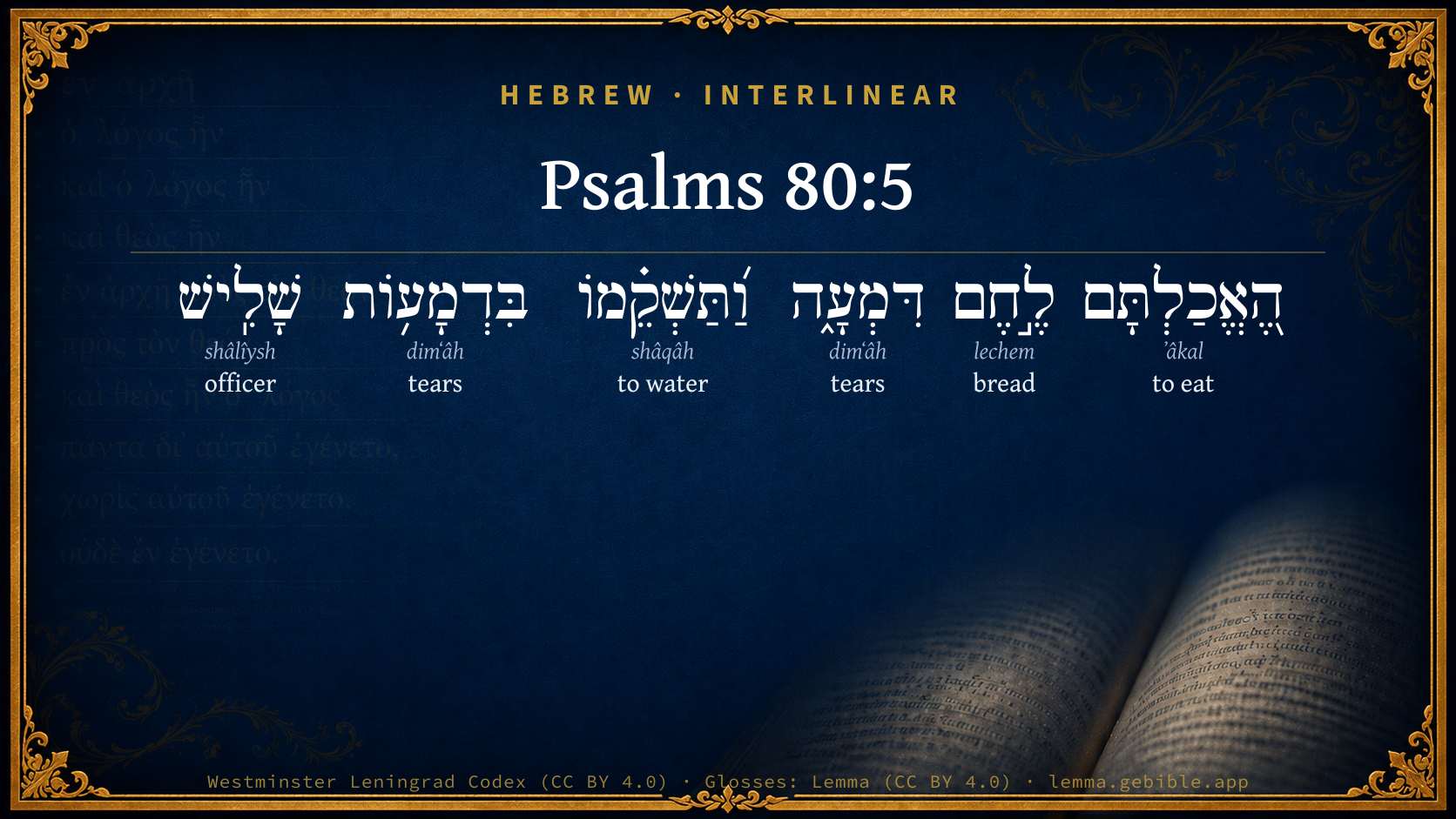
Hebrew (Westminster Leningrad Codex) Psalms 80:5 appears in the Hebrew Old Testament. The text above is from the Westminster Leningrad Codex. Each word links to its Strong’s number, a concise gloss, and parsing drawn from the Open Scriptures Hebrew Bible morphology. Click any word for its full Brown-Driver-Briggs (BDB) entry.
Download image
Cite this verse

Psalms 80:5 (World English Bible). Public Domain. Lemma interlinear Bible study tool, https://lemma.gebible.app/v/psalms/80/5.

Show BibTeX & RIS
BibTeX
RIS
English Translation
You have fed them with the bread of tears, And given them tears to drink in large measure.
World English Bible · Public Domain
Download a study sheet

One document with this verse’s original text, its word-by-word gloss line, the meaning frame, cross-references with their text, attributed commentary, and full source and license credits — printable, and it pastes into notes with its structure intact.

This verse Autodidact and up

Study sheet (.html) Plain text (.txt)

A passage Seminary Student

Up to 50 verses in one chapter. A passage sheet keeps up to 6 commentary sources and 12 cross-references per verse, in the order this page ranks them, and says so on the sheet whenever that leaves anything out. Ask for a single verse and you get the Autodidact verse sheet above.

Everything on this page stays free to read, with no account — the sheet is a download of what is already on screen, not access to it.

Want to remove ads? Support Godless Engineer
Compare translations 3

The same verse in 3 English versions, stacked beneath the original-language interlinear above. Click any original word for its lexicon entry.

Each is an independent rendering of the whole verse — the interlinear is not word-aligned to these translations.

Highlighted words mark where these versions differ — a whole-verse word diff, not a word-by-word alignment.

  • World English Bible Public Domain
    You have fed them with the bread of tears, And given them tears to drink in large measure.
  • King James Version Public Domain
    Thou feedest them with the bread of tears; and givest them tears to drink in great measure.
  • unfoldingWord Literal Text CC BY-SA 4.0
    You have made them eat bread of tears, and you have made them drink tears triple measure.

unfoldingWord Literal Text — © unfoldingWord, licensed CC BY-SA 4.0. Word-aligned USFM3 via Door43 (git.door43.org/unfoldingWord/en_ult).

Versions to compare (up to 4)

3 of 4 selected

Show all 18 translations

Every available English version of this verse, each an independent rendering of the whole verse.

  • World English Bible Public Domain
    You have fed them with the bread of tears, And given them tears to drink in large measure.
  • Berean Standard Bible Public Domain
    You fed them with the bread of tears and made them drink the full measure of their tears.
  • Majority Standard Bible Public Domain
    You fed them with the bread of tears and made them drink the full measure of their tears.
  • King James Version Public Domain
    Thou feedest them with the bread of tears; and givest them tears to drink in great measure.
  • American Standard Version (1901) Public Domain
    Thou hast fed them with the bread of tears, And given them tears to drink in large measure.
  • Revised Version (1885) Public Domain
    Thou hast fed them with the bread of tears, and given them tears to drink in large measure.
  • Geneva Bible (1599) Public Domain
    Thou hast fedde them with the bread of teares, and giuen them teares to drinke with great measure.
  • Douay-Rheims (1899) Public Domain
    O Lord God of hosts, how long wilt thou be angry against the prayer of thy servant?
  • Young's Literal Translation Public Domain
    Thou hast caused them to eat bread of tears, And causest them to drink With tears a third time.
  • Literal Standard Version CC BY-SA 4.0
    You have caused them to eat bread of tears, || And cause them to drink || With tears a third time.
  • Unlocked Literal Bible CC BY-SA 4.0
    You have fed them with the bread of tears and given them tears to drink in great quantities.
  • unfoldingWord Literal Text CC BY-SA 4.0
    You have made them eat bread of tears, and you have made them drink tears triple measure.
  • Darby Bible Public Domain
    Thou hast fed them with the bread of tears, and given them tears to drink in large measure:
  • World Messianic Bible Public Domain
    You have fed them with the bread of tears, and given them tears to drink in large measure.
  • Webster's Bible Public Domain
    \\80:4\\O LORD God of hosts, how long wilt thou be angry against the prayer of thy people?
  • Free Bible Version CC BY-SA 4.0
    You fed them with the bread of tears, and gave them a full bowl of tears to drink.
  • Bible in Basic English Public Domain
    You have given them the bread of weeping for food; for their drink you have given them sorrow in great measure.
  • JPS Tanakh (1917) Public Domain
    (80-6) Thou hast fed them with the bread of tears, and given them tears to drink in large measure.

Literal Standard Version (2020), Covenant Press — licensed CC BY-SA 4.0. Text via the HelloAO Bible API (eBible.org). Unlocked Literal Bible (unfoldingWord) — licensed CC BY-SA 4.0. Text via the HelloAO Bible API (eBible.org). unfoldingWord Literal Text — © unfoldingWord, licensed CC BY-SA 4.0. Word-aligned USFM3 via Door43 (git.door43.org/unfoldingWord/en_ult). Free Bible Version, Dr. Jonathan Gallagher — licensed CC BY-SA 4.0. Text via the HelloAO Bible API (eBible.org).

Word by word

More ways to search: Search by grammar → Find every occurrence → Compare this word →

Practice this passage: Drill this verse → Learn its vocabulary →

About this verse

These counts appear in no published source. They are computed here, from the morphology-tagged text and Lemma’s own curated glosses. What Lemma adds →

6
words
5
distinct lemmas
Wisdom
section

Notable vocabulary

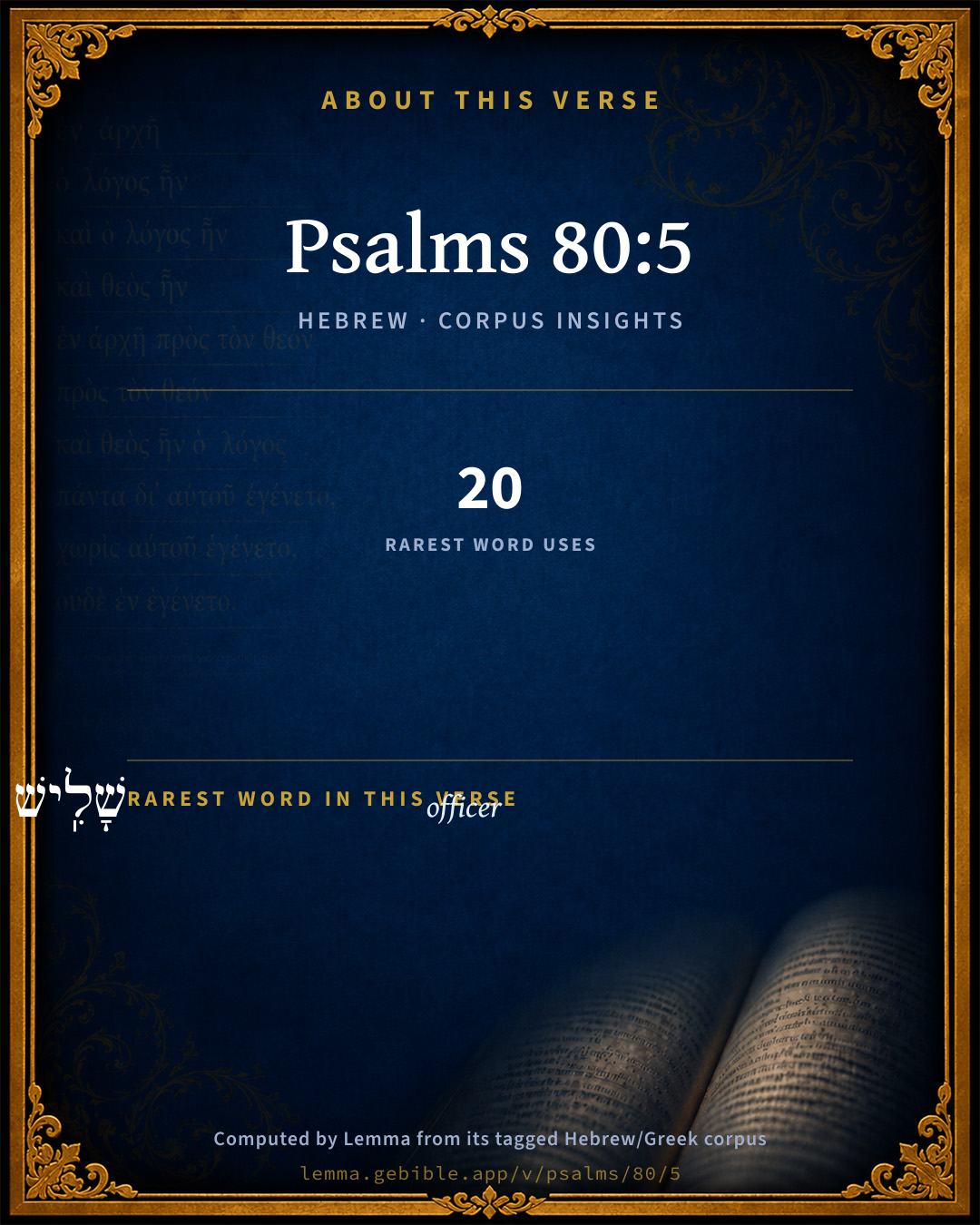
The rarest word here is שָׁלִֽישׁ officer H7991 — appearing just 20 times in the whole Hebrew Bible.

Shared distinctive vocabulary

שָׁלִֽישׁ officer H7991 occurs in 18 verses of the Hebrew Bible. Also found in:

Grammatical profile

  • 2 verbs
  • 4 nouns

Verb forms

  • הֶ֭אֱכַלְתָּם Hiphil · Perfect
  • וַ֝תַּשְׁקֵ֗מוֹ Hiphil · Sequential Imperfect

Repetition

A word recurs within this verse — often emphatic in Hebrew:

  • דִּמְעָ֑ה tears H1832 ×2

Hebrew & Septuagint length

In English translation the verse runs 18 words from the Hebrew and 17 from the Septuagint (LXX English) — closely comparable.

A rough comparison of the two English renderings, which tokenize alike — not a word-level alignment.

Word counts can differ between the Hebrew and the Greek without any difference in meaning — e.g. the Hebrew direct-object marker אֵת has no separate Greek word, and Greek often adds the article ὁ.

Cross-references

5

Topical passages linked to Psalms 80:5 in the Treasury of Scripture Knowledge — connected by theme and wording, ordered by reader-vote popularity; previews shown in the World English Bible.

  • Psalms 42:3 My tears have been my food day and night, While they continually ask me, "Where is your God?"
  • Isaiah 30:20 Though the Lord give you the bread of adversity and the water of affliction, yet shall not your teachers be hidden anymore, but your eyes shall see your teachers;
  • Psalms 102:9 For I have eaten ashes like bread, And mixed my drink with tears,
  • Job 6:7 My soul refuses to touch them; They are as loathsome food to me.
  • Ezekiel 4:16–17 Moreover he said to me, Son of man, behold, I will break the staff of bread in Jerusalem: and they shall eat bread by weight, and with fearfulness; and they shall drink water by measure, and in dismay:

Cross-references courtesy of OpenBible.info (CC BY 4.0).

Hebrew and Greek witnesses Masoretic Hebrew ↔ Greek Septuagint

The same verse in the two great witnesses to the Old Testament, shown verse-for-verse.

You’re reading Greek Psalm 79 (Hebrew Psalm 80). The Septuagint counts the superscription, so verse numbers can differ from the Hebrew — chapter-level alignment, not verse-by-verse. Numbering follows Rahlfs.

These are two independent witnesses, not word-aligned to each other, and the Septuagint is shown in lemma (dictionary) form.

Hebrew Psalms 80:5 Masoretic · Westminster Leningrad Codex

הֶ֭אֱכַלְתָּם לֶ֣חֶם דִּמְעָ֑ה וַ֝תַּשְׁקֵ֗מוֹ בִּדְמָע֥וֹת שָׁלִֽישׁ

You have fed them with the bread of tears, And given them tears to drink in large measure.

World English Bible · Public Domain

Greek LXX Greek Psalm 79:5 Septuagint · lemma form

κύριος ὁ θεός ὁ δύναμις ἕως πότε ὀργίζω ἐπί ὁ προσευχή ὁ δοῦλος σύ

You will feed us with bread of tears; and will cause us to drink tears by measure.

LXX2012 (modern English Septuagint) · Public Domain

On this verse, Ellicott's Commentary for English Readers discusses the Septuagint’s reading. Read the note in Commentary ↓

Hebrew: Westminster Leningrad Codex (CC BY 4.0). Greek: Septuagint (public domain); English from LXX2012 (modern English Septuagint) (Public Domain). How the Septuagint differs from the Hebrew →

Commentary

Notes on Psalms 80:5 from classic Christian and Jewish commentators (each source and its license shown beneath its notes). The classic Christian expositions comment on the surrounding passage and are grouped to its opening verse, so a note may address several verses; the Jewish commentaries on the Tanakh (Rashi and others) are per-verse, so they appear only where the commentator wrote on this verse.

Lemma curates 59 commentaries, every one of them public domain or Creative Commons licensed, each selected and text-cleaned for this edition rather than reprinted as found. About our sources →

Trapp's Complete Commentary

John Trapp

Psa 80:5 Thou feedest them with the bread of tears; and givest them tears to drink in great measure.

Ver. 5. Thou feedest them with the bread of tears] Panibus fletu intinctis (Chald.). It is as ordinary with them to weep as it is with men to eat and drink (Kimchi).

And givest them tears to drink in great measure] Trientales they are Tricongii in a sense, to their sorrow. They are afflicted even to utmost satiety. See Psa 42:3. Holy Bradford oft mused at his meal, having his hat over his eyes, from whence came commonly plenty of tears dropping on his trencher (Acts aud Mon. 1457).

John Trapp, A Commentary or Exposition upon All the Books of the Old and New Testament (1647–1656) — public domain. Text from a community e-Sword module.

J. A. Alexander on Psalms

Joseph Addison Alexander

6. (Psa 80:5) Thou hast made them eat tear-bread, and made them drink of tears a tierce (or measure). The noun tear in Hebrew is commonly collective, but the singular and plural forms are here combined. See above, on Psa 6:6; Psa 39:12; Psa 56:8. The same strong figure of tears as nourishment occurs above, Psa 42:3. The last word in Hebrew means a measure which is the third of another measure, thus corresponding to the old and wide sense of the English tierce. See my note on Isa 40:12. Measure here denotes abundance.

Joseph Addison Alexander, The Psalms Translated and Explained (1850) — public domain. Text from a community e-Sword module.

Adam Clarke's Commentary

Verse 5. Thou feedest them with the bread of tears] They have no peace, no comfort, nothing but continual sorrow.

In great measure.] שליש shalish, threefold. Some think it was a certain measure used by the Chaldeans, the real capacity of which is not known. others think it signifies abundance or abundantly.

Adam Clarke's Commentary on the Bible (1810–1826) — public domain. Text from a community e-Sword/MySword module.

John Calvin's Commentaries

5 Thou hast fed us with bread of tears, etc. By these forms of expression, they depict the greatness of their grief, and the long continuance of their calamities; as if they had said, We are so filled with sorrow, that we can contain no more. They add, in the following verse that they were made a strife to their neighbors This admits of being explained in two ways. It means either that their neighbors had taken up a quarrel against them; or that, having obtained the victory over them, they were contending about the spoil, as is usually the case in such circumstances, each being eager to drag it to himself. The former interpretation, however seems to be the more suitable. The people complain that, whereas neighborhood ought to be a bond of mutual goodwill, they had as many enemies as neighbors. To the same purpose is their language in the second clause, They laugh at us among themselves; that is to say, They talk among themselves by way of sport and mockery at our adversities. To encourage and stir themselves up to repentance, they ascribe all this to the judgment of God, in whose power it is to bend the hearts of men. Since we are all at this day chargeable with the same sins, it is not surprising that our condition is in no degree better than was theirs. But the Holy Spirit having inspired the prophet to write this form of prayer for a people who felt their condition to be almost desperate, it serves to inspire us with hope and boldness, and to prevent us from giving up the exercise of prayer, under a consciousness of the greatness of our guilt. The seventh verse is a repetition of the third; and this repetition is undoubtedly intended as a means of surmounting every obstacle. God did not here intend to endite for his people a vain repetition of words: his object was to encourage them, when bowed down under the load of their calamities, boldly to rise up, heavy though the load might be. This ground of support was often presented to them; and it is repeated the third time in the concluding verse of the psalm.

John Calvin's Commentaries (1540-1563) — public domain. Text from the Calvin Translation Society English edition (1840s-50s) via the Christian Classics Ethereal Library (ccel.org). Calvin's coverage is partial (roughly two-thirds of the Bible); uncommented books and verses are honest gaps, never fabricated. The 19th-century editor's footnotes and remarks are omitted so the notes are faithfully Calvin's own voice.

Ellicott's Commentary for English Readers

(5) Bread of tears.—See Psa_42:3.

In great measure.—Heb., shalîsh, i.e., a third part. (Comp. Isa_40:12, Margin.) Probably meaning a third part of an ephah. (See Exo_16:36; Isa_5:10, LXX.) But here evidently used in a general way, as we say “a peck of troubles.”

A Bible Commentary for English Readers, edited by Charles John Ellicott (1878–1897) — public domain. Text from a community e-Sword module.

The Cambridge Bible for Schools and Colleges

gen. ed. J. J. S. Perowne

5. Thou hast fed them with bread of tears,

And given them tears to drink in large measure.

i.e. made tears their daily portion: cp. Psa_42:3; Psa_102:9. In large measure, lit. by the tierce, or third part of some larger measure, probably the bath (= ephah, in dry measure), and if so containing nearly three gallons: a huge drinking goblet, though but a tiny measure for the dust of the earth, Isa_40:12, the only other place where the word occurs.

LXX, Syr., Jer., read us for them.

The Cambridge Bible for Schools and Colleges (gen. ed. J. J. S. Perowne; Cambridge University Press, 1878–1918) — public domain. Text from a community e-Sword module.

John Gill's Exposition

Thou feedest them with the bread of tears,.... With tears instead of bread, having none to eat; or their bread is mingled with their tears, "dipped" therein, as the Targum; such was their constant grief, and the occasion of it, that they could not cease from tears while they were eating their meals, and so ate them with them (n):

and givest them tears to drink in great measure; or the wine of tears "three fold", as the Targum. Jarchi interprets it of the captivity of Babylon, which was the third part of the two hundred and ten years of Israel's being in Egypt; which exposition, he says, he learned from R. Moses Hadarsan; but he observes, that some interpret it of the kingdom of Grecia, which was the third distress: and so Kimchi and Arama explain it of the third captivity; but Menachem, as Jarchi says, takes "shalish" to be the name of a drinking vessel, and so does Aben Ezra; the same it may be which the Latins call a "triental", the third part of a pint; unless the Hebrew measure, the "seah", which was the third part of an "ephah", is meant; it is translated a "measure" in Isa 40:12 and seems to design a large one, and so our version interprets it; compare with this Isa 30:20.

(n) "----lachrymisque suis jejunia pavit", Ovid. Metamorph. l. 4. Fab. 6.

John Gill's Exposition of the Whole Bible (1746–1763) — public domain (CC PDM 1.0). Text via the HelloAO Bible API.

Albert Barnes' Notes on the Bible

Thou feedest them with the bread of tears - literally, “Thou causest them to eat the bread of tears,” or of weeping. That is, their food was accompanied with tears; even when they ate, they wept. Their tears seemed to moisten their bread, they flowed so copiously. See the notes at Psa 42:3.

And givest them tears to drink - So abundant were their tears that they might constitute their very drink.

In great measure - Or rather by measure; that is, abundantly. The word here rendered “great measure” - שׁלישׁ shâlı̂ysh - means properly a third, and is usually applied to a measure for grain - a third part of another measure - as, the third part of an ephah. See the notes at Isa 40:12. Then the word is used for any measure, perhaps because this was the most common measure in use. The idea seems to be, not so much that God gave tears to them in great measure, but that he measured them out to them, as one measures drink to others; that is, the cup, or cask, or bottle in which their drink was served to them was as if filled with tears only.

Albert Barnes' Notes on the Bible (1834–1885) — public domain. Text from a community e-Sword/MySword module.

Matthew Poole's English Annotations

With the bread of tears; either with tears instead of bread, which they either want, or cannot eat because their grief hath taken away their appetites; or with tears as frequent and constant as their eating it. See the like phrase Psa 42:3.

Matthew Poole's English Annotations on the Holy Bible (1683–1685) — public domain. Text from a community e-Sword/MySword module.

The Treasury of David

Charles H. Spurgeon

Ver. 5. "Thou feedest them with the bread of tears." Their meat is seasoned with brine distilled from weeping eyes. Their meals, which were once such pleasant seasons of social merriment, are now like funeral feasts to which each man contributes his bitter morsel. Thy people ate bread of wheat before, but now they receive from thine own hand no better diet than bread of tears.

"And givest them tears to drink in great measure." Tears are both their food and their drink, and that without stint. They swallow tierces of tears, and swim in gulfs of grief, and all this by God's own appointment; not because their enemies have them in their power by force of arms, but because their God refuses to interpose. Tear bread is even more the fruit of the curse than to eat bread in the sweat of one's face, but it shall by divine love be turned into a greater blessing by ministering to our spiritual health.

Ver. 5. "In great measure." The Hebrew shalish is the name of a measure, so called of three, as containing a third part of the greatest measure, four times as big as the usual cup to drink in. Henry Ainsworth.

Ver. 5. Unpalatable provender.

I. Analyze the Provision.

II. Note the hand which sends it.

III. Consider the healthfulness of the diet.

IV. Remember the alleviating accompaniments.

Psalms 80:6*

Charles H. Spurgeon's The Treasury of David (1869–1885) — public domain. Psalms only. Text from a community e-Sword/MySword module.

Whedon's Commentary on the Bible

Daniel D. Whedon

5. Bread of tears… tears to drink—Hyperbole for great affliction, as Psa_6:6; Psa_42:3; Isa_30:20.

In great measure—Hebrew, in שׁלשׁ, (shalish,) a liquid measure holding about two and a half gallons. The idea of giving “tears to drink” in a shalish is another hyperbole for abundantly.

Daniel D. Whedon (gen. ed.), Commentary on the Old and New Testaments (1874–1909) — public domain. Text from a community e-Sword module.

The Pulpit Commentary

Thou feedest them with the bread of tears. (comp. Psa_42:2, "My tears have been my meat day and night And givest them tears to drink in great measure; or, and givest them to drink a copious draught of tears; literally, shalish is a measure of capacity, probably the third part of an ephah. (see Isa_40:12)

"Tears to drink:" the mission of troublous experiences.

"Givest them tears to drink in great measure." Reference must be to the dreariness and hopelessness and misery of the captives in Babylon. There was no other time in the national history when the expression was so suitable. The misery is forcibly pictured in Psalm 137. When the eyes of the exiles were full of tears, it was bitterness indeed to be asked to sing "one of the songs of Zion." "How could they sing the Lord"s song in a strange land?" Eastern people are very expressive in their grief, and shed tears very freely; but the expression here is poetical. Men are thought of as having so much trouble in their lot that they seemed to feed upon their tears. Stanley says, "The psalms of the time answer to the groans of Ezekiel, the Lamentations of Jeremiah, as deep to deep. No human sorrow has ever found so loud, so plaintive, so long protracted a wail. We see them in the places of their final settlement, often lodged in dungeons with insufficient food, loaded with contumely, their faces spat upon, their hair torn off, their backs torn with the lash. There were the insults of the oppressors, there were the bitter tears which dropped into their daily beverage, the ashes which mingled with their daily bread." This subject may be profitably treated by recalling the fact that our Lord Jesus is recorded to have wept tears on three occasions, and these occasions may be regarded as representative. Jesus wept at the grave of Lazarus; Jesus wept in sight of unreceptive Jerusalem; Jesus wept in the garden of Gethsemane.

I THE MISSION OF THE TEARS OF BEREAVEMENT. Tears seem specially sacred to such times. They are, indeed, nature"s relief. We feel anxious when our bereaved friends cannot weep. Tears are brain relief as well as emotional relief; but they are the sign of the broken heart, the unavailing regret, the love that has become only a memory. But see the mission of such tears.

1. They call out sympathy.

2. They satisfy our feeling that we ought to feel.

3. They honour our departed friends.

4. They are silent prayers which God heeds.

II THE MISSION OF THE TEARS OF CONCERN FOR OTHERS. Illustrated by our Lord"s concern for Jerusalem. Observe that tears are not becoming while there is any hope of their yielding to gracious influence. The tears come when those we would bless seem determined to "resist the Holy Ghost." As long as Jesus could hope to save Jerusalem, there was no room for tears. They came when Jesus was compelled to say, "Now they are hid from thine eyes. Your house is left unto you desolate." We weep when we are forced, in hopelessness, to let alone those whom, from our very hearts, we desire to bless.

III THE MISSION OF THE TEARS FORCED OUT BY MENTAL STRAIN. Illustrated by our Lord"s tears in Gethsemane, Times when we want to understand, and cannot; when we want to believe, and cannot; when we want to obey, and cannot; when we want to see our way, and cannot; when we want to submit, and cannot. Such was the condition of the exiles. R.T.

The Pulpit Commentary (1880–1919), ed. H.D.M. Spence-Jones & Joseph S. Exell — public domain. Text from a community e-Sword module.

Rashi

Rabbi Shlomo Yitzchaki (Rashi)

how long have You been wroth [This refers to] the troubles brought about by the Greek kings, who harmed Israel considerably.

Rashi on the Tanakh — English translations: “The Judaica Press complete Tanach with Rashi, translated by A. J. Rosenberg” (CC BY 4.0); “Pentateuch with Rashi's commentary by M. Rosenbaum and A.M. Silbermann, 1929-1934” (public domain); “The Metsudah Tanach series, Lakewood, N.J” (CC BY 4.0); and “The Book of Joshua, Metsudah Publications, 1997” (CC BY 4.0). Text via Sefaria.

Lesson kit

Teaching starters — assembled from the data on this page, not authored interpretation. Every prompt links to the verse data it draws on. Edit before teaching.

Psalms, in the Wisdom, opens this verse with 6 words (5 distinct Hebrew lemmas). Its most distinctive word is shâlîysh (“officer”). A historical commentator’s framing appears above. Read the whole chapter for the surrounding context.

Discussion questions

  1. How does “officer” (shâlîysh) shape what this verse is saying?
  2. How does Exodus 14:7, which shares the word «officer», read alongside this verse?
  3. What does the repetition of “tears” (2× in this one verse) do in this verse?
  4. These translations render this verse differently; the difference is in the English rendering, not the original. What questions does that raise?
  5. «הֶ֭אֱכַלְתָּם» is a Hiphil Perfect verb. How does that grammatical form shape the action described?
  6. Compare how Trapp's Complete Commentary and J. A. Alexander on Psalms read this verse. Where do they agree or differ?

Things to notice

Reading settings

Reading text

Shown beneath each verse's original-language words.

Old Testament
Old Testament edition

Read the OT as the Masoretic Hebrew (MT) or the Greek Septuagint (LXX).

English shown for the Greek Septuagint (in the Hebrew ↔ Greek comparison).

Comparing translations? Open the Compare panel on any verse page to stack up to four side by side.