
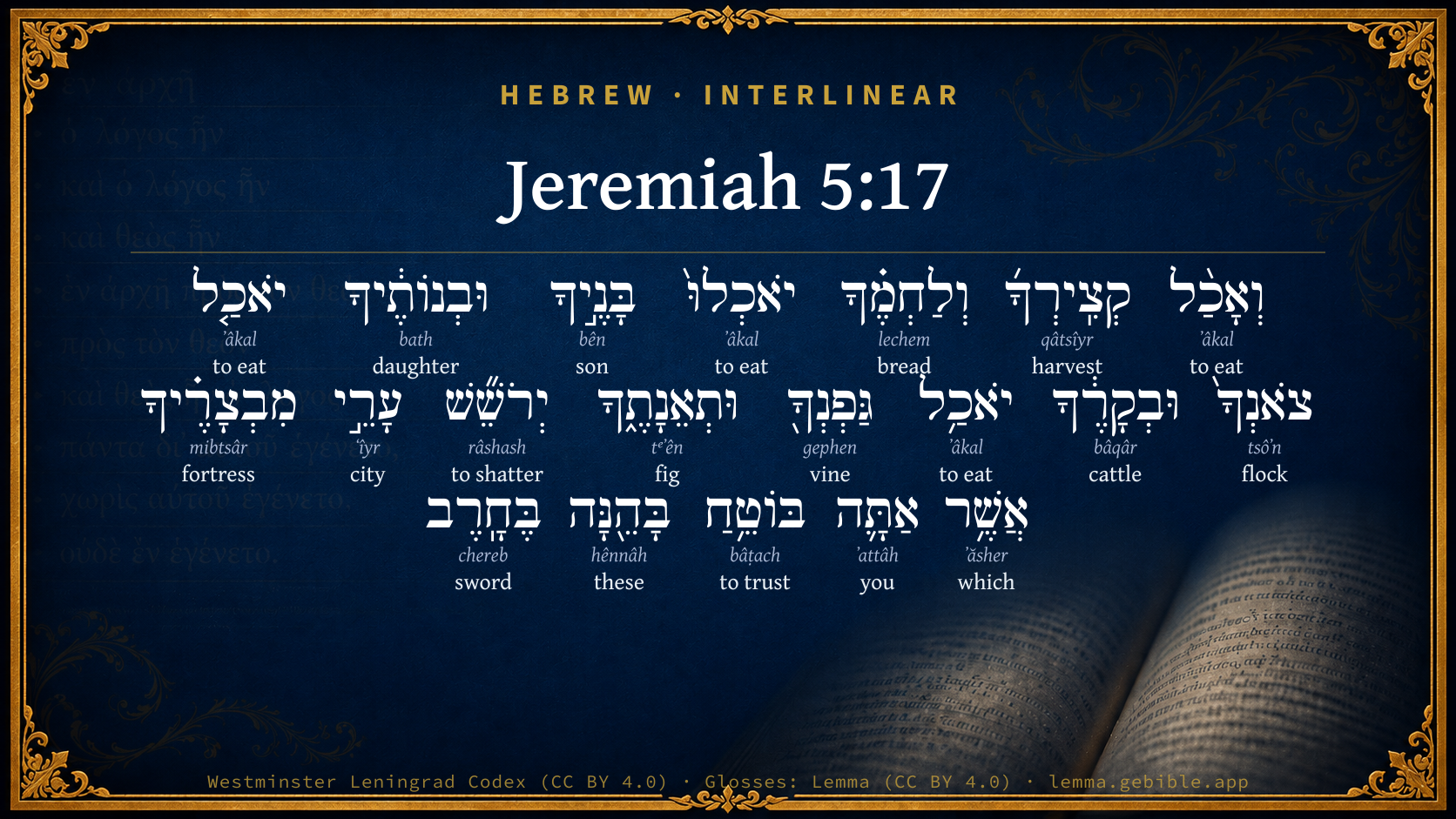
Jeremiah 5:17

Hebrew (Westminster Leningrad Codex) Jeremiah 5:17 appears in the Hebrew Old Testament. The text above is from the Westminster Leningrad Codex. Each word links to its Strong’s number, a concise gloss, and parsing drawn from the Open Scriptures Hebrew Bible morphology. Click any word for its full Brown-Driver-Briggs (BDB) entry.
Download image
Cite this verse

Jeremiah 5:17 (World English Bible). Public Domain. Lemma interlinear Bible study tool, https://lemma.gebible.app/v/jeremiah/5/17.

Show BibTeX & RIS
BibTeX
RIS
English Translation
They shall eat up your harvest, and your bread, [which] your sons and your daughters should eat; they shall eat up your flocks and your herds; they shall eat up your vines and your fig trees; they shall beat down your fortified cities, in which you trust, with the sword.
World English Bible · Public Domain
Highlights
  • 1 first appearance in the Hebrew Bible
Full analysis ↓
Download a study sheet

One document with this verse’s original text, its word-by-word gloss line, the meaning frame, cross-references with their text, attributed commentary, and full source and license credits — printable, and it pastes into notes with its structure intact.

This verse Autodidact and up

Study sheet (.html) Plain text (.txt)

A passage Seminary Student

Up to 50 verses in one chapter. A passage sheet keeps up to 6 commentary sources and 12 cross-references per verse, in the order this page ranks them, and says so on the sheet whenever that leaves anything out. Ask for a single verse and you get the Autodidact verse sheet above.

Everything on this page stays free to read, with no account — the sheet is a download of what is already on screen, not access to it.

Want to remove ads? Support Godless Engineer
Compare translations 3

The same verse in 3 English versions, stacked beneath the original-language interlinear above. Click any original word for its lexicon entry.

Each is an independent rendering of the whole verse — the interlinear is not word-aligned to these translations.

Highlighted words mark where these versions differ — a whole-verse word diff, not a word-by-word alignment.

  • World English Bible Public Domain
    They shall eat up your harvest, and your bread, [which] your sons and your daughters should eat; they shall eat up your flocks and your herds; they shall eat up your vines and your fig trees; they shall beat down your fortified cities, in which you trust, with the sword.
  • King James Version Public Domain
    And they shall eat up thine harvest, and thy bread, which thy sons and thy daughters should eat: they shall eat up thy flocks and thine herds: they shall eat up thy vines and thy fig trees: they shall impoverish thy fenced cities, wherein thou trustedst, with the sword.
  • unfoldingWord Literal Text CC BY-SA 4.0
    And it will consume your harvest and your bread. They will consume your sons and your daughters. It will consume your flock and your cattle; It will consume your vine and your fig tree. It will beat down with a sword your cities of fortification that you trusted in.

unfoldingWord Literal Text — © unfoldingWord, licensed CC BY-SA 4.0. Word-aligned USFM3 via Door43 (git.door43.org/unfoldingWord/en_ult).

Versions to compare (up to 4)

3 of 4 selected

Show all 18 translations

Every available English version of this verse, each an independent rendering of the whole verse.

  • World English Bible Public Domain
    They shall eat up your harvest, and your bread, [which] your sons and your daughters should eat; they shall eat up your flocks and your herds; they shall eat up your vines and your fig trees; they shall beat down your fortified cities, in which you trust, with the sword.
  • Berean Standard Bible Public Domain
    They will devour your harvest and food; they will consume your sons and daughters; they will eat up your flocks and herds; they will feed on your vines and fig trees. With the sword they will destroy the fortified cities in which you trust.”
  • Majority Standard Bible Public Domain
    They will devour your harvest and food; they will consume your sons and daughters; they will eat up your flocks and herds; they will feed on your vines and fig trees. With the sword they will destroy the fortified cities in which you trust.”
  • King James Version Public Domain
    And they shall eat up thine harvest, and thy bread, which thy sons and thy daughters should eat: they shall eat up thy flocks and thine herds: they shall eat up thy vines and thy fig trees: they shall impoverish thy fenced cities, wherein thou trustedst, with the sword.
  • American Standard Version (1901) Public Domain
    And they shall eat up thy harvest, and thy bread, `which' thy sons and thy daughters should eat; they shall eat up thy flocks and thy herds; they shall eat up thy vines and thy fig-trees; they shall beat down thy fortified cities, wherein thou trustest, with the sword.
  • Revised Version (1885) Public Domain
    And they shall eat up thine harvest and thy bread, which thy sons and thy daughters should eat: they shall eat up thy flocks and thine herds: they shall eat up thy vines and thy fig trees: they shall beat down thy fenced cities, wherein thou trustest, with the sword.
  • Geneva Bible (1599) Public Domain
    And they shall eate thine haruest and thy bread: they shall deuoure thy sonnes and thy daughters: they shall eate vp thy sheepe and thy bullocks: they shall eate thy vines and thy figge trees: they shall destroy with the sworde thy fenced cities, wherein thou didest trust.
  • Douay-Rheims (1899) Public Domain
    And they shall eat up thy corn, and thy bread: they shall devour thy sons, and thy daughters: they shall eat up thy flocks, and thy herds: they shall eat thy vineyards, and thy figs: and with the sword they shall destroy thy strong cities, wherein thou trustest.
  • Young's Literal Translation Public Domain
    And it hath consumed thy harvest and thy bread, They consume thy sons, and thy daughters, It consumeth thy flock, and thy herd, It consumeth thy vine, and thy fig-tree, It maketh poor thy fenced cities, In which thou art trusting -- by the sword.
  • Literal Standard Version CC BY-SA 4.0
    And it has consumed your harvest and your bread, || They consume your sons, and your daughters, || It consumes your flock, and your herd, || It consumes your vine and your fig tree, || It makes your fortified cities poor, || In which you are trusting—by the sword.
  • Unlocked Literal Bible CC BY-SA 4.0
    So your harvest will be consumed, your sons and daughters also, and your food. They will eat your flocks and cattle; they will eat the fruit from your vines and fig trees. They will beat down with a sword your fortified cities that you trusted in.
  • unfoldingWord Literal Text CC BY-SA 4.0
    And it will consume your harvest and your bread. They will consume your sons and your daughters. It will consume your flock and your cattle; It will consume your vine and your fig tree. It will beat down with a sword your cities of fortification that you trusted in.
  • Darby Bible Public Domain
    And they shall eat up thy harvest and thy bread, they shall eat up thy sons and thy daughters, they shall eat up thy flocks and thy herds, they shall eat up thy vines and thy fig-trees; they shall destroy with the sword thy strong cities, wherein thou trustedst.
  • World Messianic Bible Public Domain
    They will eat up your harvest and your bread, which your sons and your daughters should eat. They will eat up your flocks and your herds. They will eat up your vines and your fig trees. They will beat down your fortified cities in which you trust with the sword.
  • Webster's Bible Public Domain
    And they shall eat up thy harvest, and thy bread, which thy sons and thy daughters should eat: they shall eat up thy flocks and thy herds: they shall eat up thy vines and thy fig-trees: they shall impoverish with the sword thy fortified cities, in which thou hast trusted.
  • Free Bible Version CC BY-SA 4.0
    They will consume your harvest and your food; they will destroy your sons and your daughters; they will eat your flocks and your herds; they will feed on your vines and your fig trees. They will attack and will destroy the fortified towns that you have so much confidence in.
  • Bible in Basic English Public Domain
    They will take all the produce of your fields, which would have been food for your sons and your daughters: they will take your flocks and your herds: they will take all your vines and your fig-trees: and with the sword they will make waste your walled towns in which you put your faith.
  • JPS Tanakh (1917) Public Domain
    And they shall eat up thy harvest, and thy bread, they shall eat up thy sons and thy daughters, they shall eat up thy flocks and thy herds, they shall eat up thy vines and thy fig-trees; they shall batter thy fortified cities, wherein thou trusteth, with the sword.

Literal Standard Version (2020), Covenant Press — licensed CC BY-SA 4.0. Text via the HelloAO Bible API (eBible.org). Unlocked Literal Bible (unfoldingWord) — licensed CC BY-SA 4.0. Text via the HelloAO Bible API (eBible.org). unfoldingWord Literal Text — © unfoldingWord, licensed CC BY-SA 4.0. Word-aligned USFM3 via Door43 (git.door43.org/unfoldingWord/en_ult). Free Bible Version, Dr. Jonathan Gallagher — licensed CC BY-SA 4.0. Text via the HelloAO Bible API (eBible.org).

Word by word

More ways to search: Search by grammar → Find every occurrence → Compare this word →

Practice this passage: Drill this verse → Learn its vocabulary →

יְרֹשֵׁ֞שׁ
râshash
H7567
“to shatter”
Verb, Poel, Imperfect, 3rd Person, Masculine, Singular
Part of Speech
Verb
Stem
Poel
Form
Imperfect
Person
3rd Person
Gender
Masculine
Number
Singular
Full BDB Definition

Origin: a primitive root

TWOT: 2224

to beat down, shatter - (Poel) to beat down, shatter - (Pual) to be beaten down
  1. וְאָכַ֨ל ʼâkal H398 “and · to eat” Conjunction + Verb, Qal, Sequential Perfect, 3rd Person, Masculine, Singular
  2. קְצִֽירְךָ֜ qâtsîyr H7105 “harvest · your” Noun, Common, Masculine, Singular, Construct + Suffix, Personal, 2nd Person, Masculine, Singular
  3. וְלַחְמֶ֗ךָ lechem H3899 “and · bread · your” Conjunction + Noun, Common, Both, Singular, Construct + Suffix, Personal, 2nd Person, Masculine, Singular
  4. יֹאכְלוּ֙ ʼâkal H398 “to eat” Verb, Qal, Imperfect, 3rd Person, Masculine, Plural
  5. בָּנֶ֣יךָ bên H1121 “sons · your” Noun, Common, Masculine, Plural, Construct + Suffix, Personal, 2nd Person, Masculine, Singular
  6. וּבְנוֹתֶ֔יךָ bath H1323 “and · daughters · your” Conjunction + Noun, Common, Feminine, Plural, Construct + Suffix, Personal, 2nd Person, Masculine, Singular
  7. יֹאכַ֤ל ʼâkal H398 “to eat” Verb, Qal, Imperfect, 3rd Person, Masculine, Singular
  8. צֹאנְךָ֙ tsôʼn H6629 “flock · your” Noun, Common, Both, Singular, Construct + Suffix, Personal, 2nd Person, Masculine, Singular
  9. וּבְקָרֶ֔ךָ bâqâr H1241 “and · cattle · your” Conjunction + Noun, Common, Both, Singular, Construct + Suffix, Personal, 2nd Person, Masculine, Singular
  10. יֹאכַ֥ל ʼâkal H398 “to eat” Verb, Qal, Imperfect, 3rd Person, Masculine, Singular
  11. גַּפְנְךָ֖ gephen H1612 “vine · your” Noun, Common, Both, Singular, Construct + Suffix, Personal, 2nd Person, Masculine, Singular
  12. וּתְאֵנָתֶ֑ךָ tᵉʼên H8384 “and · fig · your” Conjunction + Noun, Common, Feminine, Singular, Construct + Suffix, Personal, 2nd Person, Masculine, Singular
  13. עָרֵ֣י ʻîyr H5892 “cities of” Noun, Common, Feminine, Plural, Construct
  14. מִבְצָרֶ֗יךָ mibtsâr H4013 “fortresses · your” Noun, Common, Masculine, Plural, Construct + Suffix, Personal, 2nd Person, Masculine, Singular
  15. אֲשֶׁ֥ר ʼăsher H834 “which” Particle, Relative
  16. אַתָּ֛ה ʼattâh H859 “you” Pronoun, Personal, 2nd Person, Masculine, Singular
  17. בּוֹטֵ֥חַ bâṭach H982 “trusting” Verb, Qal, Participle Active, Masculine, Singular, Absolute
  18. בָּהֵ֖נָּה hênnâh H2007 “in/at · these” Preposition + Pronoun, Personal, 3rd Person, Feminine, Plural
  19. בֶּחָֽרֶב chereb H2719 “in/at the · sword” Preposition, Determined + Noun, Common, Feminine, Singular, Absolute

About this verse

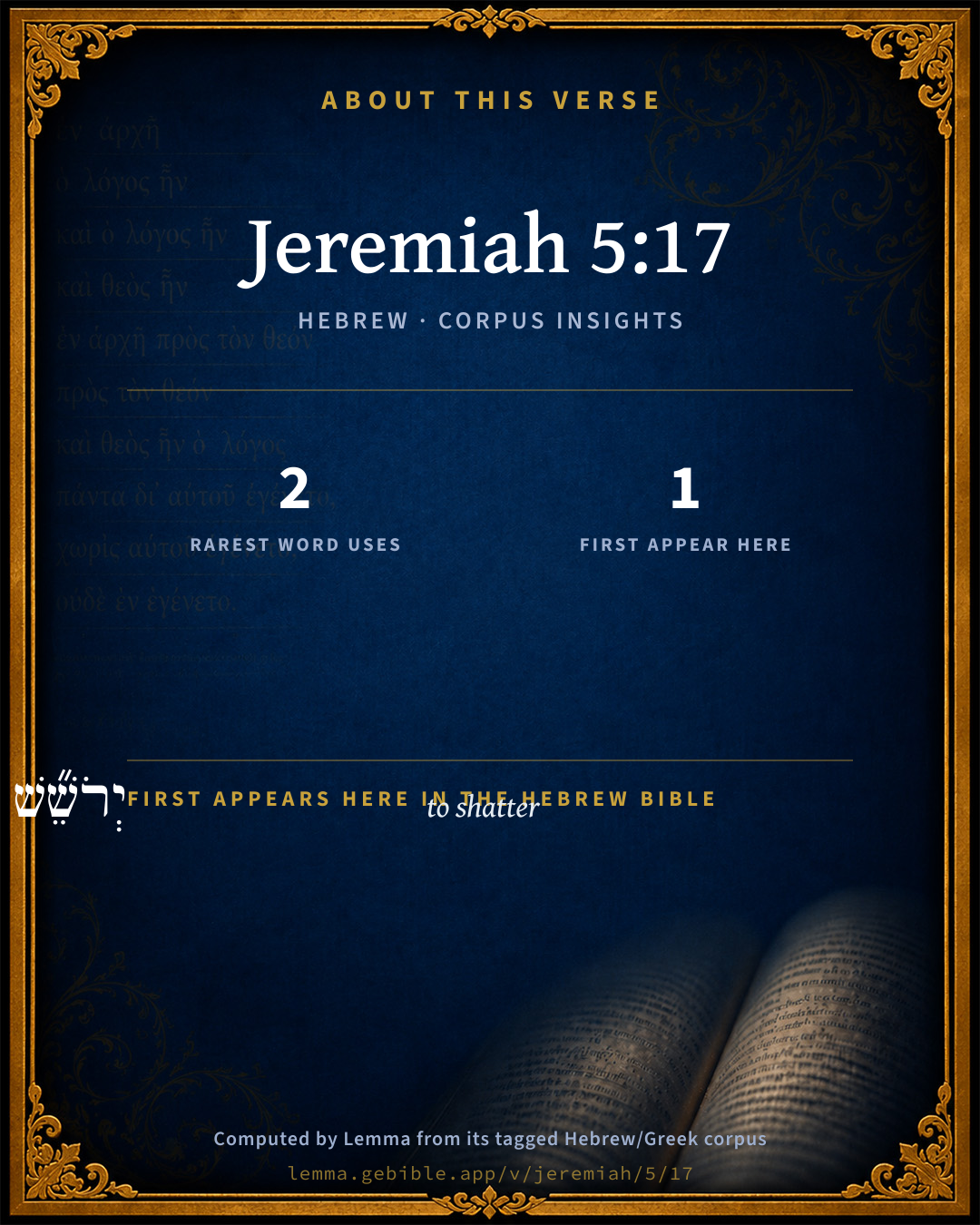
These counts appear in no published source. They are computed here, from the morphology-tagged text and Lemma’s own curated glosses. What Lemma adds →

20
words
17
distinct lemmas
Prophets
section

Notable vocabulary

The rarest word here is יְרֹשֵׁ֞שׁ to shatter H7567 — appearing just 2 times in the whole Hebrew Bible.

First appearance in Scripture

This word makes its first canonical appearance in the Hebrew Bible here:

  • יְרֹשֵׁ֞שׁ to shatter H7567

Shared distinctive vocabulary

יְרֹשֵׁ֞שׁ to shatter H7567 occurs in 2 verses of the Hebrew Bible. Also found in:

Grammatical profile

  • 6 verbs
  • 11 nouns
  • 2 pronouns
  • 1 particle

Verb forms

  • וְאָכַ֨ל Qal · Sequential Perfect
  • יֹאכְלוּ֙ Qal · Imperfect
  • יֹאכַ֤ל Qal · Imperfect
  • יֹאכַ֥ל Qal · Imperfect
  • יְרֹשֵׁ֞שׁ Poel · Imperfect
  • בּוֹטֵ֥חַ Qal · Participle Active

Repetition

A word recurs within this verse — often emphatic in Hebrew:

  • וְאָכַ֨ל to eat H398 ×4

Cross-references

17

Topical passages linked to Jeremiah 5:17 in the Treasury of Scripture Knowledge — connected by theme and wording, ordered by reader-vote popularity; previews shown in the World English Bible.

  • Leviticus 26:16 I also will do this to you: I will appoint terror over you, even consumption and fever, that shall consume the eyes, and make the soul to pine away; and you will sow your seed in vain, for your enemies will eat it.
  • Deuteronomy 28:33 The fruit of your ground, and all your labors, shall a nation which you don't know eat up; and you shall be only oppressed and crushed always;
  • Hosea 8:14 For Israel has forgotten his Maker and built palaces; And Judah has multiplied fortified cities; But I will send a fire on his cities, And it will devour its fortresses."
  • Deuteronomy 28:30–31 You shall betroth a wife, and another man shall lie with her: you shall build a house, and you shall not dwell therein: you shall plant a vineyard, and shall not use the fruit of it.
  • Judges 6:3–4 So it was, when Israel had sown, that the Midianites came up, and the Amalekites, and the children of the east; they came up against them;
  • Isaiah 62:9 but those who have garnered it shall eat it, and praise Yahweh; and those who have gathered it shall drink it in the courts of my sanctuary.
  • Isaiah 65:22 They shall not build, and another inhabit; they shall not plant, and another eat: for as the days of a tree shall be the days of my people, and my chosen shall long enjoy the work of their hands.
  • Jeremiah 1:15 For, behold, I will call all the families of the kingdoms of the north, says Yahweh; and they shall come, and they shall set everyone his throne at the entrance of the gates of Jerusalem, and against all the walls of it round about, and against all the cities of Judah.
  • Jeremiah 4:7 A lion is gone up from his thicket, and a destroyer of nations; he is on his way, he is gone forth from his place, to make your land desolate, that your cities be laid waste, without inhabitant.
  • Jeremiah 4:26 I saw, and, behold, the fruitful field was a wilderness, and all the cities of it were broken down at the presence of Yahweh, [and] before his fierce anger.
  • Jeremiah 8:16 The snorting of his horses is heard from Dan: at the sound of the neighing of his strong ones the whole land trembles; for they are come, and have devoured the land and all that is in it; the city and those who dwell therein.
  • Jeremiah 50:7 All who found them have devoured them; and their adversaries said, We are not guilty, because they have sinned against Yahweh, the habitation of righteousness, even Yahweh, the hope of their fathers.
  • Ezekiel 36:4 therefore, you mountains of Israel, hear the word of the Lord Yahweh: Thus says the Lord Yahweh to the mountains and to the hills, to the watercourses and to the valleys, to the desolate wastes and to the cities that are forsaken, which are become a prey and derision to the residue of the nations that are round about;
  • Habakkuk 3:17–18 For though the fig tree doesn't flourish, Nor fruit be in the vines; The labor of the olive fails, The fields yield no food; The flocks are cut off from the fold, And there is no herd in the stalls:
  • Zephaniah 3:6 I have cut off nations. Their battlements are desolate. I have made their streets waste, so that no one passes by. Their cities are destroyed, so that there is no man, so that there is no inhabitant.
  • Jeremiah 50:17 Israel is a hunted sheep; the lions have driven him away: first, the king of Assyria devoured him; and now at last Nebuchadrezzar king of Babylon has broken his bones.
  • Lamentations 2:2 The Lord has swallowed up all the habitations of Jacob, and has not pitied: He has thrown down in his wrath the strongholds of the daughter of Judah; He has brought them down to the ground; he has profaned the kingdom and the princes of it.

Cross-references courtesy of OpenBible.info (CC BY 4.0).

Hebrew and Greek witnesses Masoretic Hebrew ↔ Greek Septuagint

The same verse in the two great witnesses to the Old Testament, shown verse-for-verse.

These are two independent witnesses, not word-aligned to each other, and the Septuagint is shown in lemma (dictionary) form.

Hebrew Jeremiah 5:17 Masoretic · Westminster Leningrad Codex

וְאָכַ֨ל קְצִֽירְךָ֜ וְלַחְמֶ֗ךָ יֹאכְלוּ֙ בָּנֶ֣יךָ וּבְנוֹתֶ֔יךָ יֹאכַ֤ל צֹאנְךָ֙ וּבְקָרֶ֔ךָ יֹאכַ֥ל גַּפְנְךָ֖ וּתְאֵנָתֶ֑ךָ יְרֹשֵׁ֞שׁ עָרֵ֣י מִבְצָרֶ֗יךָ אֲשֶׁ֥ר אַתָּ֛ה בּוֹטֵ֥חַ בָּהֵ֖נָּה בֶּחָֽרֶב

They shall eat up your harvest, and your bread, [which] your sons and your daughters should eat; they shall eat up your flocks and your herds; they shall eat up your vines and your fig trees; they shall beat down your fortified cities, in which you trust, with the sword.

World English Bible · Public Domain

Greek LXX Structure differs

In the Septuagint, Jeremiah is about an eighth shorter than the Hebrew and arranges its material differently — the Oracles Against the Nations (Hebrew chapters 46–51) appear in the middle of the Greek book, after 25:13. Because the chapter and verse boundaries do not line up, a verse-for-verse comparison with the Hebrew is not shown.

A verse-for-verse comparison isn’t shown here because the chapters and verses don’t line up. Switch to the LXX edition with the MT / LXX toggle above to read the Greek directly.

Hebrew: Westminster Leningrad Codex (CC BY 4.0). Greek: Septuagint (public domain); English from a public-domain English Septuagint. How the Septuagint differs from the Hebrew →

Targum (Aramaic paraphrase)

1

The Targum is the ancient Jewish Aramaic paraphrase of the Hebrew Scriptures — an interpretive translation, not the Hebrew text itself. Onkelos (literal) and Pseudo-Jonathan (expansive) render the Torah, and Jonathan the Prophets. Coverage is partial: where no permissively-licensed English translation exists for a verse, only the Aramaic is shown. This is verse-level text, not a word-by-word alignment to the Hebrew.

  1. Targum Jonathan Prophets (Joshua–Malachi)
    וְיִבּוֹז חַצְרָךְ וּמֵיכְלָךְ יִקְטְלוּן בְנָךְ וּבְנָתָךְ יִשְׁבֵּי עָנָךְ וְתוֹרָךְ יִבּוֹז פְּרִי גוֹפְנָךְ וְתֵינָךְ יְפַגֵר קִרְוֵי אַרְעָךְ כְּרִיכָתָא דְאַתְּ רָחִיץ לְאִשְׁתֵּיזָבָא בְּהוֹן מִן קֳדָם דְקַטְלִין בְּחַרְבָּא:

    (no public-domain English translation for this verse)

    Targum Jonathan — Aramaic: “Mikraot Gedolot” (public domain). English: “Sefaria Community Translation” (CC0 1.0 (public-domain dedication)); “London "Chaldee Paraphrase," 1871” (public domain). Text via Sefaria.

Commentary

Notes on Jeremiah 5:17 from classic Christian and Jewish commentators (each source and its license shown beneath its notes). The classic Christian expositions comment on the surrounding passage and are grouped to its opening verse, so a note may address several verses; the Jewish commentaries on the Tanakh (Rashi and others) are per-verse, so they appear only where the commentator wrote on this verse.

Lemma curates 59 commentaries, every one of them public domain or Creative Commons licensed, each selected and text-cleaned for this edition rather than reprinted as found. About our sources →

Trapp's Complete Commentary

John Trapp

Jer 5:17 And they shall eat up thine harvest, and thy bread, [which] thy sons and thy daughters should eat: they shall eat up thy flocks and thine herds: they shall eat up thy vines and thy fig trees: they shall impoverish thy fenced cities, wherein thou trustedst, with the sword.

Ver. 17. And they shall eat up thy harvest.] Partita gladio, partita gala. Consider the calamity of war, and take course to prevent it.

John Trapp, A Commentary or Exposition upon All the Books of the Old and New Testament (1647–1656) — public domain. Text from a community e-Sword module.

Jamieson, Fausset & Brown

Robert Jamieson, A. R. Fausset & David Brown

(Lev 26:16).

Jamieson, Fausset & Brown — Commentary Critical and Explanatory on the Whole Bible (1871) — public domain (CC PDM 1.0). Text via the HelloAO Bible API.

John Calvin's Commentaries

He continues to speak in a similar way of the cruelty of their enemies; as though he said that victory was already in their hand, for they were the scourges of God. He does not then set before the Jews the troubles of war, but speaks of them as conquered; and he only shews that the Chaldeans would be cruel in the use they would make of their victory. He takes it as granted that the Chaldeans would be conquerors, for they would come armed from above: and he makes this addition, — that they would act cruelly and in an unusual manner towards the vanquished Jews.

Hence he says, They will eat (it will eat, for he changes the number, though the sense remains the same ) thine harvest and thy bread; that is, all that thou gatherest shall become a prey to thine enemies; for by harvest and bread he means every kind of provision. Then he adds, thy sons and thy daughters, which was still worse; it is indeed hard to be deprived of food, but it is still more dreadful for parents to see their children slain before them. The Prophet however says, that such would be the barbarity of their enemies, that they would not spare even boys and girls. He further mentions herds and flocks; and then he adds the vine and the fig-tree; as though he said, nothing would be safe among the Jews, for their enemies would plunder everything, and that being not content with meat and drink, they would kill their very infants. And further, as the Jews had fortified cities, and were on that account insolent towards the prophets, their vain pride is here brought down; for he says, that their fortified cities would be reduced to poverty; and he adds, in which thou trustest All these, he says, shall fall by the sword; for this last word, בחרב, becherab, applies to the whole verse, and to each part of it; as though he had said, “By the right of the sword shall the conquerors lay waste thy whole country, even all thy possessions; yea, and they shall slay thy sons and thy daughters.” It follows —

John Calvin's Commentaries (1540-1563) — public domain. Text from the Calvin Translation Society English edition (1840s-50s) via the Christian Classics Ethereal Library (ccel.org). Calvin's coverage is partial (roughly two-thirds of the Bible); uncommented books and verses are honest gaps, never fabricated. The 19th-century editor's footnotes and remarks are omitted so the notes are faithfully Calvin's own voice.

Ellicott's Commentary for English Readers

(17) Which thy sons and thy daughters should eat.—There is no relative pronoun in the Hebrew, and the clause stands parallel with the others, they shall eat (i.e., destroy) thy sons and thy daughters, and is so translated in all the older versions. In the other clauses the verb is in the singular, “it (i.e., the invading army) shall eat.”

Impoverish.—Better, break down, or shatter. The “sword” is used, as in Eze_26:9, for “battle-axes” and other weapons used in attacking cities.

A Bible Commentary for English Readers, edited by Charles John Ellicott (1878–1897) — public domain. Text from a community e-Sword module.

The Cambridge Bible for Schools and Colleges

gen. ed. J. J. S. Perowne

17. which thy sons and thy daughters should eat] This is the rendering which the Heb. on the whole suggests, though the meaning may be, they shall eat thy sons and thy daughters. Seeing, however, that cannibalism is not to be attributed to the Scythians, it is probable that the clause is either metaphorical (cp. Jer_3:24) or has been inserted through the influence of the closely connected passage, Deu_28:49-53, where, however, it is the besieged who are driven to this resort.

shall beat down] not, as mg. impoverish.

The Cambridge Bible for Schools and Colleges (gen. ed. J. J. S. Perowne; Cambridge University Press, 1878–1918) — public domain. Text from a community e-Sword module.

John Gill's Exposition

And they shall eat up thine harvest,.... The standing corn in the fields, cut it down, and give it as fodder to their horses, which is usually done by armies; or the increase of the earth, when gathered into the barn, which so great an army would consume:

and thy bread; which includes all kind of provisions:

which thy sons and thy daughters should eat; which is an aggravation of the calamity and misery, that that should become the prey of their enemies, which they with so much labour and pains had provided for their children, who would now be deprived of it, and suffer want, The Targum renders it,

"shall kill thy sons and thy daughters;''

that is, with the sword; and so Kimchi interprets it; and so other versions read, "they shall eat up, or devour, thy sons and thy daughters" (z); the sword ate them up, or devoured them; and they who besieged them were the cause or occasion of their being eaten literally, even by their own parents; see Lam 2:20,

they shall eat up thy flocks and thy herds; their sheep and oxen, as the Targum interprets it:

they shall eat up thy vines and thy fig trees: that is, the fruit of them, as the same paraphrase explains it:

they shall impoverish thy fenced cities, wherein thou trustedst, with the sword; that is, such strong and fortified cities as Jerusalem, and others, in which the Jews trusted they should be safe from their enemies; these the Chaldeans would enter into, kill with the sword those they found in garrisons, demolish the fortifications, take away what wealth and riches were laid up there, and so impoverish them, and render them weak and defenceless. The Targum of this clause is,

"shall destroy the fortified cities of thy land, in which thou trustedst thou shouldest be safe from those that kill with the sword.''

(z) "vorabunt filios tuos et filias tuas", Calvin; "devorabunt", Vatablus; "comedent filios tuos et filias tuas", Pagninus, Montanus, Cocceius.

John Gill's Exposition of the Whole Bible (1746–1763) — public domain (CC PDM 1.0). Text via the HelloAO Bible API.

Albert Barnes' Notes on the Bible

Or,

It shall eat “thine harvest and thy bread:”

They shall eat “thy sons and thy daughters.”

It shall eat thy sheep and thy cattle:

It shall eat “thy vines and thy fig-trees.”

They shall impoverish ... - Or, It shall batter thy “fortified cities, wherein thou” trustest, with weapons of war. There is probably reference here to an instrument like a battering-ram, with which the Assyrians beat down the walls of their enemies.

Albert Barnes' Notes on the Bible (1834–1885) — public domain. Text from a community e-Sword/MySword module.

Haydock's Catholic Bible Commentary

Devour. Hebrew, "destroy." They did not eat human flesh.

George Leo Haydock (1774–1849), Haydock's Catholic Family Bible and Commentary, 1859 edition — public domain. Excludes Psalms (Douay-Rheims chapter numbering differs from Protestant) and Deuterocanonical books (Catholic canon only).

Matthew Poole's English Annotations

They shall eat up thine harvest, and thy bread; they shall make clean riddance, leave thee, no supports of life, but bring an utter famine upon thee; it is thus threatened Deu 28:30,48,51.

Which thy sons and thy daughters should eat; or, they shall eat up thy sons and thy daughters; but this is only a metonymy of the effect: but properly, this aggravates the dreadfulness of the judgment; parents, out of the tenderness of their affection, choosing rather to die themselves, than to live to see their children starved before their eyes, and they no ways able to relieve them, Lam 2:10,11.

They shall eat up thy flocks, & c.; a particular enumeration of the desolation that would be made, all tending to the greatness of the former. They shall impoverish thy fenced cities, wherein thou trustedst, with the sword, i.e. beside the waste that the famine would make among persons, their cities also should be depopulated by the sword of the enemy; or rather, possibly the siege should be so strait and strict, as may be implied in the word impoverish, that they should be forced to eat one another, till they were quite wasted, they should be reduced to such poverty and exigencies; or the sword may relate to the mentioned mischiefs, as the cause of them all, the sword shall do all this: in all which he doth not so much tell them that the Chaldeans shall conquer them, for that is taken as it were for granted, as what cruelties they shall use when they have conquered.

Matthew Poole's English Annotations on the Holy Bible (1683–1685) — public domain. Text from a community e-Sword/MySword module.

Whedon's Commentary on the Bible

Daniel D. Whedon

17. They shall eat up thine harvest — The English differs from the other Versions on this passage, and clearly misses the construction. It should be rendered, as by Keil, It shall eat up thy sons and thy daughters: it shall eat up thy flocks and thy cattle; eat up thy vine and thy fig tree.

They shall impoverish — Rather, it shall break down. The word is used besides only in Mal_1:4.

Daniel D. Whedon (gen. ed.), Commentary on the Old and New Testaments (1874–1909) — public domain. Text from a community e-Sword module.

The Pulpit Commentary

Which thy sons and thy daughters, etc.; rather, they shall eat that sons and thy daughters. In the other clauses of the verse the verb is in the singular, the subject being the hostile nation. They shall impoverish , etc.; rather, it shall batter... with weapons of war (so rightly Payne Smith); kherebh, commonly rendered "sword." is applied to any cutting instrument, such as a razor, (Eze_5:1) a mason"s tool, (Exo_20:25) and, as here and Eze_26:9, weapons of war in general.

The Pulpit Commentary (1880–1919), ed. H.D.M. Spence-Jones & Joseph S. Exell — public domain. Text from a community e-Sword module.

Keil & Delitzsch

C. F. Keil & F. Delitzsch

This people will devour the harvest and the bread, the children, the cattle, and the best fruits of the land. Devour, here as often, in the wider sense, destroy; cf. e.g., Jer 3:24 and Jer 10:25, where the first half of the present verse is compressed into the words: they ate up Jacob. We need not wait to refute Hitz.'s absurd remark, that the author imagined the enemy, the assumed Scythians, to be cannibals. In the second half of the verse the words, "the fenced cities wherein thou trustest,"are a reminiscence of Deu 28:52; and hence we may see, that while our prophet is describing the enemy in Jer 5:15-18, Moses' threatening, Deu 28:49-52, was in his mind. רשׁשׁ, break in pieces, as in Mal 1:4. With the sword, i.e., by force of arms; the sword, as principal weapon, being named, instead of the entire apparatus of war. In Jer 5:18 the restriction of Jer 5:10 (cf. Jer 4:27) is repeated, and with it the threatening of judgment is rounded off.

Keil & Delitzsch — Biblical Commentary on the Old Testament (1861–1891) — public domain (CC PDM 1.0). Text via the HelloAO Bible API. (Old Testament only.)

Scofield Reference Notes

C. I. Scofield

Marg

trustedst (See Scofield "Psa 2:12")

The Scofield Reference Bible (1917 edition), notes by C. I. Scofield — public domain. Text from a community e-Sword module.

Rashi

Rabbi Shlomo Yitzchaki (Rashi)

He will impoverish your fortified cities [upon which you rely, with the sword] This verse is in the wrong order [and should be arranged as follows:] He will impoverish with the sword your fortified cities upon which you rely.

impoverish Heb. ירשש, he will impoverish.

with the sword With troops. Comp. “And a sword will not pass in your land” (Lev. 26:6).

Rashi on the Tanakh — English translations: “The Judaica Press complete Tanach with Rashi, translated by A. J. Rosenberg” (CC BY 4.0); “Pentateuch with Rashi's commentary by M. Rosenbaum and A.M. Silbermann, 1929-1934” (public domain); “The Metsudah Tanach series, Lakewood, N.J” (CC BY 4.0); and “The Book of Joshua, Metsudah Publications, 1997” (CC BY 4.0). Text via Sefaria.

Lesson kit

Teaching starters — assembled from the data on this page, not authored interpretation. Every prompt links to the verse data it draws on. Edit before teaching.

Jeremiah, in the Prophets, opens this verse with 20 words (17 distinct Hebrew lemmas). Its most distinctive word is râshash (“to shatter”). A historical commentator’s framing appears above. Read the whole chapter for the surrounding context.

Discussion questions

  1. The word râshash carries the sense “to shatter.” How does it shape the verse?
  2. The word “to shatter” first appears here in Scripture. What is being introduced at this debut?
  3. Malachi 1:4 shares the word «to shatter» with this verse. How do the two illuminate each other?
  4. “to eat” occurs 4× in this one verse. What is the effect of the repetition?
  5. These translations render this verse differently; the difference is in the English rendering, not the original. What questions does that raise?
  6. The verb «וְאָכַ֨ל» is Qal Sequential Perfect. How does its form color the action?
  7. Reading how Trapp's Complete Commentary and Jamieson, Fausset & Brown read this verse, where do the two commentators agree and where do they part?

Things to notice

  • 1 word makes its first canonical appearance in Scripture here.
  • These translations choose different wording for 26 words in this verse.
  • “to eat” occurs 4× in this single verse.
  • 17 distinct Hebrew lemmas span 20 words in this verse.

Reading settings

Reading text

Shown beneath each verse's original-language words.

Old Testament
Old Testament edition

Read the OT as the Masoretic Hebrew (MT) or the Greek Septuagint (LXX).

English shown for the Greek Septuagint (in the Hebrew ↔ Greek comparison).

Comparing translations? Open the Compare panel on any verse page to stack up to four side by side.