

Psalms 78:25

Hebrew (Westminster Leningrad Codex) Psalms 78:25 appears in the Hebrew Old Testament. The text above is from the Westminster Leningrad Codex. Each word links to its Strong’s number, a concise gloss, and parsing drawn from the Open Scriptures Hebrew Bible morphology. Click any word for its full Brown-Driver-Briggs (BDB) entry.
Download image
Cite this verse

Psalms 78:25 (World English Bible). Public Domain. Lemma interlinear Bible study tool, https://lemma.gebible.app/v/psalms/78/25.

Show BibTeX & RIS
BibTeX
RIS
English Translation
Man ate the bread of angels. He sent them food to the full.
World English Bible · Public Domain
Download a study sheet

One document with this verse’s original text, its word-by-word gloss line, the meaning frame, cross-references with their text, attributed commentary, and full source and license credits — printable, and it pastes into notes with its structure intact.

This verse Autodidact and up

Study sheet (.html) Plain text (.txt)

A passage Seminary Student

Up to 50 verses in one chapter. A passage sheet keeps up to 6 commentary sources and 12 cross-references per verse, in the order this page ranks them, and says so on the sheet whenever that leaves anything out. Ask for a single verse and you get the Autodidact verse sheet above.

Everything on this page stays free to read, with no account — the sheet is a download of what is already on screen, not access to it.

Want to remove ads? Support Godless Engineer
Compare translations 3

The same verse in 3 English versions, stacked beneath the original-language interlinear above. Click any original word for its lexicon entry.

Each is an independent rendering of the whole verse — the interlinear is not word-aligned to these translations.

Highlighted words mark where these versions differ — a whole-verse word diff, not a word-by-word alignment.

  • World English Bible Public Domain
    Man ate the bread of angels. He sent them food to the full.
  • King James Version Public Domain
    Man did eat angels' food: he sent them meat to the full.
  • unfoldingWord Literal Text CC BY-SA 4.0
    Man ate the bread of the mighty. He sent to them provision to satisfaction.

unfoldingWord Literal Text — © unfoldingWord, licensed CC BY-SA 4.0. Word-aligned USFM3 via Door43 (git.door43.org/unfoldingWord/en_ult).

Versions to compare (up to 4)

3 of 4 selected

Show all 18 translations

Every available English version of this verse, each an independent rendering of the whole verse.

  • World English Bible Public Domain
    Man ate the bread of angels. He sent them food to the full.
  • Berean Standard Bible Public Domain
    Man ate the bread of angels; He sent them food in abundance.
  • Majority Standard Bible Public Domain
    Man ate the bread of angels; He sent them food in abundance.
  • King James Version Public Domain
    Man did eat angels' food: he sent them meat to the full.
  • American Standard Version (1901) Public Domain
    Man did eat the bread of the mighty: He sent them food to the full.
  • Revised Version (1885) Public Domain
    Man did eat the bread of the mighty: he sent them meat to the full.
  • Geneva Bible (1599) Public Domain
    Man did eate the bread of Angels: hee sent them meate ynough.
  • Douay-Rheims (1899) Public Domain
    Man ate the bread of angels: he sent them provisions in abundance.
  • Young's Literal Translation Public Domain
    Food of the mighty hath each eaten, Venison He sent to them to satiety.
  • Literal Standard Version CC BY-SA 4.0
    Each has eaten food of the mighty, || He sent provision to them to satiety.
  • Unlocked Literal Bible CC BY-SA 4.0
    People ate the bread of angels. He sent them food in abundance.
  • unfoldingWord Literal Text CC BY-SA 4.0
    Man ate the bread of the mighty. He sent to them provision to satisfaction.
  • Darby Bible Public Domain
    Man did eat the bread of the mighty; he sent them provision to the full.
  • World Messianic Bible Public Domain
    Man ate the bread of angels. He sent them food to the full.
  • Webster's Bible Public Domain
    Man ate angels' food: he sent them food to the full.
  • Free Bible Version CC BY-SA 4.0
    Human beings ate the bread of angels; he sent them more than enough food.
  • Bible in Basic English Public Domain
    Man took part in the food of strong ones; he sent them meat in full measure.
  • JPS Tanakh (1917) Public Domain
    Man did eat the bread of the mighty; He sent them provisions to the full.

Literal Standard Version (2020), Covenant Press — licensed CC BY-SA 4.0. Text via the HelloAO Bible API (eBible.org). Unlocked Literal Bible (unfoldingWord) — licensed CC BY-SA 4.0. Text via the HelloAO Bible API (eBible.org). unfoldingWord Literal Text — © unfoldingWord, licensed CC BY-SA 4.0. Word-aligned USFM3 via Door43 (git.door43.org/unfoldingWord/en_ult). Free Bible Version, Dr. Jonathan Gallagher — licensed CC BY-SA 4.0. Text via the HelloAO Bible API (eBible.org).

Word by word

More ways to search: Search by grammar → Find every occurrence → Compare this word →

Practice this passage: Drill this verse → Learn its vocabulary →

About this verse

These counts appear in no published source. They are computed here, from the morphology-tagged text and Lemma’s own curated glosses. What Lemma adds →

8
words
7
distinct lemmas
Wisdom
section

Notable vocabulary

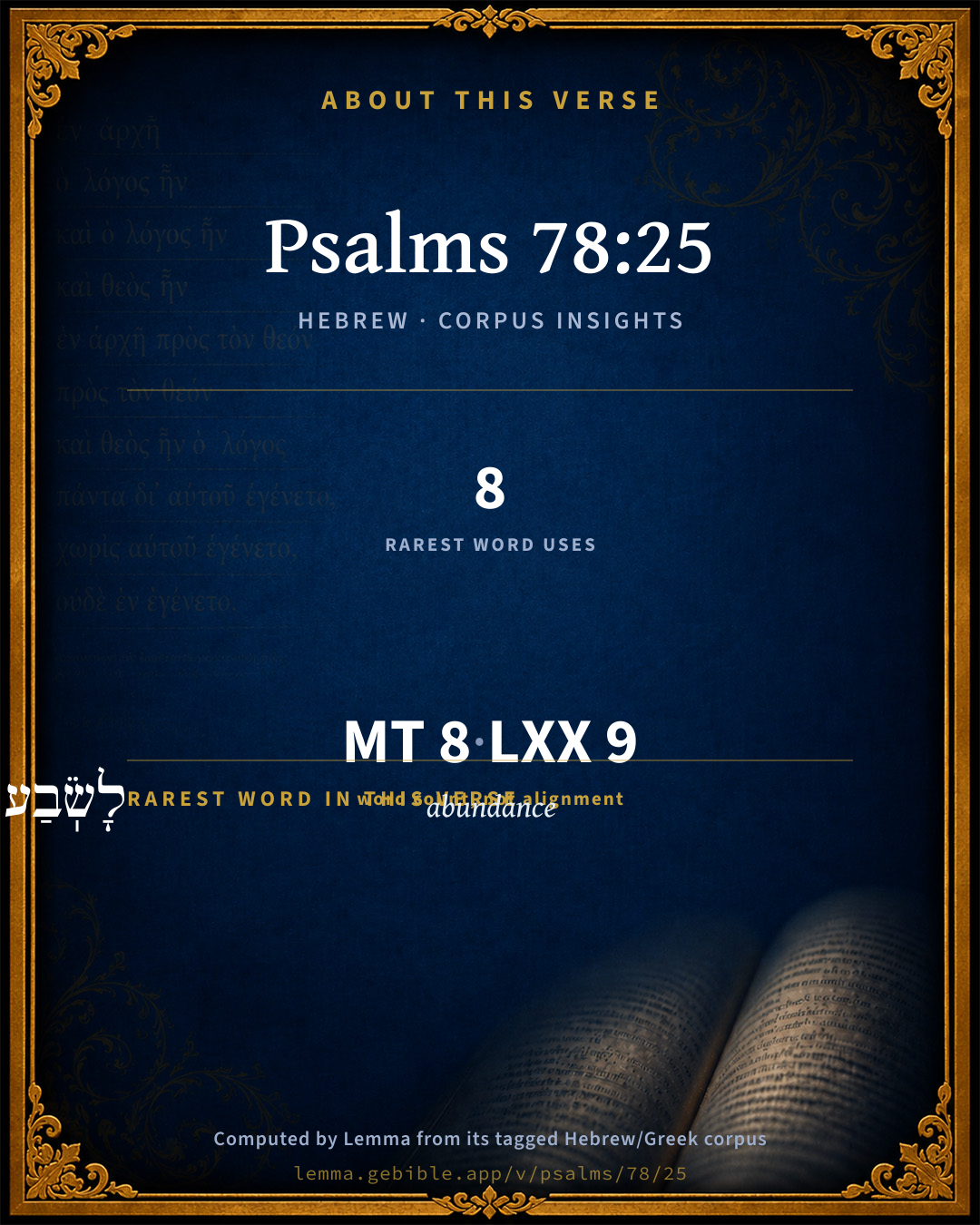
The rarest word here is לָשֹֽׂבַע abundance H7648 — appearing just 8 times in the whole Hebrew Bible.

Shared distinctive vocabulary

לָשֹֽׂבַע abundance H7648 occurs in 8 verses of the Hebrew Bible. Also found in:

Grammatical profile

  • 2 verbs
  • 4 nouns
  • 1 adjective
  • 1 preposition

Verb forms

  • אָ֣כַל Qal · Perfect
  • שָׁלַ֖ח Qal · Perfect

Hebrew & Septuagint length

In English translation the verse runs 13 words from the Hebrew and 11 from the Septuagint (LXX English) — closely comparable.

A rough comparison of the two English renderings, which tokenize alike — not a word-level alignment.

Word counts can differ between the Hebrew and the Greek without any difference in meaning — e.g. the Hebrew direct-object marker אֵת has no separate Greek word, and Greek often adds the article ὁ.

In the original languages it is 8 Hebrew tokens and 9 Greek tokens — but the two are counted differently (Hebrew bundles its prefixes and suffixes into one token; the Greek is in lemma form), so that isn’t a like-for-like length.

Cross-references

4

Topical passages linked to Psalms 78:25 in the Treasury of Scripture Knowledge — connected by theme and wording, ordered by reader-vote popularity; previews shown in the World English Bible.

  • Exodus 16:8 Moses said, "Now Yahweh shall give you meat to eat in the evening, and in the morning bread to satisfy you; because Yahweh hears your murmurings which you murmur against him. And who are we? Your murmurings are not against us, but against Yahweh."
  • Psalms 103:20 Praise Yahweh, you angels of his, Who are mighty in strength, who fulfill his word, Obeying the voice of his word.
  • Matthew 15:37 They all ate, and were filled. They took up seven baskets full of the broken pieces that were left over.
  • Matthew 14:20 They all ate, and were filled. They took up twelve baskets full of that which remained left over from the broken pieces.

Cross-references courtesy of OpenBible.info (CC BY 4.0).

Hebrew and Greek witnesses Masoretic Hebrew ↔ Greek Septuagint

The same verse in the two great witnesses to the Old Testament, shown verse-for-verse.

You’re reading Greek Psalm 77 (Hebrew Psalm 78). The Septuagint counts the superscription, so verse numbers can differ from the Hebrew — chapter-level alignment, not verse-by-verse. Numbering follows Rahlfs.

These are two independent witnesses, not word-aligned to each other, and the Septuagint is shown in lemma (dictionary) form.

Hebrew Psalms 78:25 Masoretic · Westminster Leningrad Codex

לֶ֣חֶם אַ֭בִּירִים אָ֣כַל אִ֑ישׁ צֵידָ֬ה שָׁלַ֖ח לָהֶ֣ם לָשֹֽׂבַע

Man ate the bread of angels. He sent them food to the full.

World English Bible · Public Domain

Greek LXX Greek Psalm 77:25 Septuagint · lemma form

ἄρτος ἄγγελος ἐσθίω ἄνθρωπος ἐπισιτισμός ἀποστέλλω αὐτός εἰς πλησμονή

Man ate angels' bread; he sent them provision to the full.

LXX2012 (modern English Septuagint) · Public Domain

On this verse, J. A. Alexander on Psalms discusses the Septuagint’s reading. Read the note in Commentary ↓

Hebrew: Westminster Leningrad Codex (CC BY 4.0). Greek: Septuagint (public domain); English from LXX2012 (modern English Septuagint) (Public Domain). How the Septuagint differs from the Hebrew →

Commentary

Notes on Psalms 78:25 from classic Christian and Jewish commentators (each source and its license shown beneath its notes). The classic Christian expositions comment on the surrounding passage and are grouped to its opening verse, so a note may address several verses; the Jewish commentaries on the Tanakh (Rashi and others) are per-verse, so they appear only where the commentator wrote on this verse.

Lemma curates 59 commentaries, every one of them public domain or Creative Commons licensed, each selected and text-cleaned for this edition rather than reprinted as found. About our sources →

Trapp's Complete Commentary

John Trapp

Psa 78:25 Man did eat angels’ food: he sent them meat to the full.

Ver. 25. Man did eat angels’ food] Heb. the bread of the mighty, Pan de nobles (Hispan.); (Angels are called mighties, Isa 10:34 Rev 18:21); such delicate bread as might beseem angels to eat, if they did eat any at all; such as the poets feign to be their Nectar, and Ambrosia. Or, the bread of the mighty, sc. that mightily strengthened them.

He sent them meat to the full] Heb. meat taken in hunting; so called, because dainty as venison, or, quia semper ambulabant, et in via quasi eam venabantur, sc. Jos 1:11 (Aben Ezra).

John Trapp, A Commentary or Exposition upon All the Books of the Old and New Testament (1647–1656) — public domain. Text from a community e-Sword module.

The Biblical Illustrator

Joseph S. Exell

Psa_78:25

Man did eat angels food.

Angels food

I. There are in the universe higher order of intelligent creatures than man, Angels. The proofs, the nature, the functions, the varieties of their existence abound in the Scriptures.

II. This higher order of intelligences require food. No creatures, however exalted, can be self-subsisting, i.e. can live of themselves or from themselves; they must appropriate something from without.

III. Of this food man to some extent is a partaker. Revelations of truth, beauty, God, are the food of souls in all worlds, and this food is universal. (Homilist)

Angels food

We soon tell by our appearance what food we have been eating. You cannot hide the bill of fare. The face is a tell-tale. The more the sensualist eats the greater a sensualist he appears to be. He feeds the flesh. He gets coarser every day; what little music there was in his voice is all dead and gone; he has choked it with the food of beasts. Once there was a little child in him, well spoken of, thought to be the germ of a fine man; but that child-angel is dead. Every mouthful of meat the man now takes makes him more beast-like. Say not that it is of no consequence what a man eats. It is of vital consequence. The mystery, however, is this, that even the best food may be turned into evil nutriment, according to the nature of the man who partakes of it. The lion grows as a lion the more he eats; though it be of the daintiest food it all becomes lion. So with us bodily, intellectually, spiritually: we tell what our food is. Under what circumstances may men be said to cat angels food, corn of heaven, bread sent down from God? When earth cannot satisfy him any longer, the good food is beginning to tell upon him. Growing in spirituality is not a metaphysical process; it is concrete, intelligible, patent to the observation; it is not a growth in mere sentiment, it is not an enrichment of the nature in mere foam of ecstasy and rapture: it is a larger outlook, a firmer grasp of things eternal, a clearer view of distant things; it is a growth in preparation, in the estimate of relative values, in sympathy with God. Growing so, the whole world changes; its duties become light, its burdens become comparatively easy, its wealth a handful of dust that may be thrown up and caught again and laid down with a conjurers ease. Growth in spirituality means larger intercourse with God, keener perception of religious essences and moral affinities. Growth in spirituality means a throwing-off of mere burdensomeness and ceremony and ritual; a forsaking of the fleshpots of Egypt, and a yearning for the society of angels and spirits, blessed and immortal. We can now do better than eat angels food, a larger feast has been prepared for us--we can eat the body and drink the blood of Christ. Faith takes the bread, and turns it into the flesh of Christ; faith takes the emblematic wine, and makes it sacrificial blood. Lord, increase our faith! (J. Parker, D. D.)

He sent them meat to the full--

The blessing of harvest

View this verse as applicable to all time and all generations of men; for, just as surely as God fed Israel in the wilderness with manna, so surely is He feeding the whole human race to-day by a miracle not less wonderful.

I. In what sense the statement of the text is true, as applied to all men. Look at the variety of the food God gives us. It is not merely the one food sent directly from above, but we can use a hundred kinds of food, so we cannot comment upon the poor character of the products of the earth. The courses of Nature bring round the seedtime and harvest, cold and heat, summer and winter, and point the Christian back to the God who lies behind them; and he who has the heritage of the Christian has a fountain of gratitude in his soul, because he recognizes that these come from above, for they tell the man who believes and trusts in God that these things are but another sign of that eternal love which has watched over us from infancy, and cares for us all the years of our life.

II. In what sense the statement appears not to be true. How is it that in a world in which there appears to be plenty, or at least in which there is the possibility of plenty, there should be a vast number in every town and city kept pinched and bare? I believe, in many instances, because of their own mismanagement and misconduct. Idleness will clothe a man with rags. It is one of the wise provisions of Gods providence that the earth surrenders her products only to those who work. There is also another explanation. Intemperance is the cause of a vast deal of the want that lies around us. Again, God has never said He will give a successive continuance of rich seasons, and commerce in its whole history has never gone straight on. It has always gone by leaps and falls, and there have been times of scarceness and plenty. But God means every prudent man to lay by in times of success and fulness for a time of scarcity, and I think it is nothing less than sacrilegious for men to blame God for want and poverty if they allow times of fulness to pass without laying by for a time of need. There are, however, some causes outside of a mans or womans own control which lead to poverty and something approaching want. For instance, too many men rush into one trade, possibly because they think it a prosperous one. The result is, that the trade is overstocked, and there is not sufficient work for every one, and a great deal of pain and scarcity often follows, until matters right themselves--and they dont right themselves in a year. Or, again, the greed and cruelty of some may act as a pressure on those who are weak and unable to defend themselves, and because of this injustice and greed of gain they are not able even to make their bread. Or, again, bad economic laws, such as our Corn Laws that Cobden and Bright did so much to abolish, may raise the price of Gods grain to a fictitious value. There is another cause of poverty and want that is perhaps more directly traceable to God Himself, and that is famine. Gods universe is spiritual, and the powers that conquer in it must be Spiritual, and famine itself is, I believe, one of the methods by which God seeks to work out one of the spiritual purposes of the universe. See, for instance, how famine may bring a nation back to simpler and truer modes of life. See how famine disciplines men by bringing out generosity in them, making them go to the help of other nations. I believe that, too, may be the explanation of the fact that there is poverty among us. Does not God seek to lead us, by poverty, to think of that bread which perisheth not? (D. Woodside, B. D.)

The Biblical Illustrator, edited by Joseph S. Exell (c. 1880s–1900s) — public domain. Text from a community e-Sword module.

Joseph Benson's Commentary

Psa 78:25. Man did eat angels’ food — Such as was given by the ministry of angels, and, as the Chaldee reads it, descended from the dwelling of angels. Or, it may be so called because of its excellence, such food as might suit angels, if they needed or could eat food, and such as had some resemblance or relation to the nature of angels, in regard of its heavenly original, its pure and refined substance, its vigour and efficacy in preserving and nourishing those who used it according to God’s appointment. The Hebrew, לחם אבירים, lechem abirim, is literally, the bread of the mighty. So the margin reads it, Every one, even the least child in Israel, did eat the bread of the mighty. The common Israelites fed upon as palatable, wholesome, delicious, nourishing, strengthening, and invigorating food, as the greatest nobles and princes used to do. He sent them meat to the full — Which may refer either, 1st, To the flesh mentioned in the following verses, which God gave them even to satiety or glutting, as he threatened he would do, Num 11:18-20. Or rather, 2d, To the manna, of which he is here speaking, which he gave them in such plenty, that their desire of other food could not proceed from their necessity, but merely from wantonness and lust. We must not neglect to observe here, that this manna, which was given to Israel by a miracle from heaven, was typical of that spiritual or living bread, or bread of life, that doctrine and merits of Christ, which, in due time, was to “come down from heaven to give life unto the world:” see Joh 6:31-58. Hence it is termed by St. Paul spiritual meat, as the water out of the rock, emblematical of the Holy Spirit, is termed spiritual drink. Reader, see that thou apply for and partake of both, for both are necessary to thy salvation; and thus thou wilt be brought to feed on angels’ food, literally and indeed, and shalt be made a happy partaker of everlasting felicity.

Joseph Benson's Commentary on the Old and New Testaments (1811–1818) — public domain. Text from a community e-Sword module.

J. A. Alexander on Psalms

Joseph Addison Alexander

25. (Psa 78:25) Bread of the mighty (ones) did (each) man eat; victual he sent them go the full. The first Hebrew word, as appears from the preceding verse, is used in its specific sense of bread, and not in the generic one of food, which is otherwise expressed in Psa 78:20. Some explain bread of the mighty to mean delicate or costly bread, like that used by the rich and noble. But to these the epithet is nowhere else applied, as a similar one is to the angels in Psa 103:20, a circumstance which favours the old explanation given in the Targum and the Septuagint, according to which manna is called angels' bread, not as being their food, but as coming from the place where they reside. Man is not used generically in antithesis to angels, which would have required another Hebrew word, but distributively in the sense of every one, as it is in the history of this very miracle, Exo 16:16. The idea then is that enough was sent for all without exception. The word translated victual denotes specially provision for a march or journey. See Exo 12:39. To the full, or to satiety, enough and more than enough to satisfy the appetite of every individual; another expression borrowed from the history. See Exo 16:3.

Joseph Addison Alexander, The Psalms Translated and Explained (1850) — public domain. Text from a community e-Sword module.

Adam Clarke's Commentary

Verse 25. Man did eat angels' food] לחם אבירים אכל איש lechem abbirim achal ish, "Man did eat the bread of the mighty ones;" or, each person ate, c. They ate such bread as could only be expected at the tables of the rich and great the best, the most delicate food. How little did this gross people know of the sublime excellence of that which they called light bread, and which they said their soul loathed; Nu 21:5! It was a type of Jesus Christ, for so says St. Paul: "They all ate the same spiritual meat, and drank the same spiritual drink," c., 1Co 10:3-4. And our Lord calls himself "the bread that came down from heaven, that giveth life unto the world," Joh 6:31-35: but a Jew sees nothing but with the eyes of flesh. It is true their doctors or rabbins are full of allegories, mysteries, and conceits but they are, in general, such as would disgrace the Cabinet des Fees, and would not be tolerated in the nursery. O, how thick a veil hangs over their gross and hardened hearts.

Adam Clarke's Commentary on the Bible (1810–1826) — public domain. Text from a community e-Sword/MySword module.

Ellicott's Commentary for English Readers

(25) Angels’ food.—See margin, and comp. Wis_16:20. LXX. and Vulgate, “angels’ bread.” Some explain, after Job_24:22; Job_34:30, lordly food, such as nobles eat—here, quails. But in connection with “food from heaven,” the popular idea of angels’ food which poetry reluctantly gives up may be retained.

A Bible Commentary for English Readers, edited by Charles John Ellicott (1878–1897) — public domain. Text from a community e-Sword module.

The Cambridge Bible for Schools and Colleges

gen. ed. J. J. S. Perowne

25. Everyone did eat the bread of the mighty,

He sent them provision to the full.

The A.V. rendering of the verbs in Psa_78:23-24 as pluperfects is contrary to the rules of Hebrew grammar. The connexion of thought is that God was wroth at the unbelief of the Israelites, and yet He provided for their wants. The Psalmist does not follow the order of time in his recital, but combines the different murmurings, and then the different provisions of manna and quails.

The doors of heaven, as of some vast storehouse: cp. ‘the windows (or ‘flood-gates’) of heaven,’ 2Ki_7:2; 2Ki_7:19; Mal_3:10. The Psalmist closely follows the language of Exo_16:4, “Behold, I will rain bread from heaven for you.” Cp. Psa_105:40; Joh_6:31.

Corn of heaven may allude to the granular form of the manna (Exo_16:31).

Angels’ food (LXX, Vulg., Syr.) is probably a right paraphrase of the words the bread of the mighty, though the term is nowhere applied to the angels. But cp. Psa_103:20. Wis_16:20, “Thou feddest thine own people with angels’ food,” naturally follows the LXX. It is a question whether we should render ‘Everyone did eat’ &c. cp. Exo_16:16; Exo_16:18; Exo_16:21; or man, as contrasted with angels: cp. the Targ. “The sons of men ate bread which came down from the dwelling of the angels”: but the former is probably right. For to the full cp. Exo_16:3; Exo_16:8; Exo_16:12.

The Cambridge Bible for Schools and Colleges (gen. ed. J. J. S. Perowne; Cambridge University Press, 1878–1918) — public domain. Text from a community e-Sword module.

John Gill's Exposition

He caused an east wind to blow in the heavens,.... In the airy heaven: or "he caused it to go" (f); to go forth out of its place, out of the repositories and treasures of it, from whence he brings the wind, Psa 130:7 the winds are under the power and government of God, they are his servants that obey him; he says to one, Go, and it goes; and to another, Come, and it comes; stormy wind fulfils his word of command, and obeys its Creator:

and by his power he brought in the south wind; into the heavens, into the air, as before, and with it he brought the quails; and which made his power to appear the greater, since they do not fly with the south wind, which is too moist and heavy for them, as naturalists observe (g); it looks as if first one wind blew, and then another was used for the bringing of them from the place where they were; perhaps about the Red sea, where they are said to have been in great numbers; and that the east wind brought them to a certain point, and then the south wind blew to bring them into the camp of Israel, where, by the moistness of it, they fell; hence fowlers, as the above naturalists relate, observe the south wind, in order to take them; though it may be that only one wind is intended, namely, the southeast wind; and so Aben Ezra, Kimchi, and Ben Melech, understand it.

(f) "fecit proficisci", Pagninus, Montanus, Gejerus. (g) Aristot. de Hist. Animal. l. 8. c. 12. Plin. Hist. l. 10. c. 23.

John Gill's Exposition of the Whole Bible (1746–1763) — public domain (CC PDM 1.0). Text via the HelloAO Bible API.

Albert Barnes' Notes on the Bible

Man did eat angels’ food - Food that came from heaven; food so directly and manifestly from heaven that it might be supposed to be the same kind that was eaten there, and that had now been sent down by a special miracle for man; food so delicate and so free from the ordinary coarse properties of food, that it might be supposed to be such as angels feed on. The word rendered “angels” - אביר 'abbı̂yr - means properly “strong, mighty,” and may be applied to people in general, Jdg 5:22; Lam 1:15; Jer 46:15; to animals, Psa 22:13 (“bulls of Bashan”); to princes, Psa 68:31; or to nobles, Job 24:22. It might be rendered here food of nobles, or princes; that is, food of richer quality, or of a more delicate nature, than common food; such as nobles or princes have on their tables. The immediate connection, however, would rather seem to demand the rendering in our version, as the food is said to have come down from heaven. It is rendered food of angels in the Septuagint, in the Latin Vulgate, in the ancient versions generally, and also by Luther. DeWette renders it, “Each one ate the food of princes;” that is, they all lived like princes.

He sent them meat to the full - Food to satisfy; or, as much as they wanted.

Albert Barnes' Notes on the Bible (1834–1885) — public domain. Text from a community e-Sword/MySword module.

Matthew Poole's English Annotations

Angels’ food; manna, so called, either,

1. Because was made by the ministry of angels. Or rather,

2. Because of its excellency, such food as might befit the angels they could cat food, and such as hath some resemblance with the blessed angels in regard of its heavenly origin; its pure and spirituous substance, its rigour and efficacy preserving and nourishing those who used it according God’s appointment. Or this place may be translated as is in the margin, every one did eat the bread of the mighty i.e. even the common Israelites fed upon as delicious as the greatest nobles and princes used to do.

Sent them meat to the full; which may belong, either,

1. To the flesh mentioned in the following verses, which God gave them even to satiety or glutting, which he threatened to do, Num 11:18-20. Or rather,

2. To the manna, of which he is here speaking, which he gave them in such plenty, that their desire of other food could not proceed from their necessity, but merely from wantonness and lust.

Matthew Poole's English Annotations on the Holy Bible (1683–1685) — public domain. Text from a community e-Sword/MySword module.

The Treasury of David

Charles H. Spurgeon

Ver. 25. Man did eat angel's food. The delicacies of kings were outdone, for the dainties of angels were supplied. Bread of the mighty ones fell on feeble man. Those who are lower than the angels fared as well. It was not for the priests, or the princes, that the manna fell; but for all the nation, for every man, woman, and child in the camp: and there was sufficient for them all, for

he sent them meat to the full. God's banquets are never stinted; he gives the best diet, and plenty of it. Gospel provisions deserve every praise that we can heap upon them; they are free, full, and preeminent; they are of God's preparing, sending, and bestowing. He is well fed whom God feeds; heaven's meat is nourishing and plentiful. If we have ever fed upon Jesus we have tasted better than angel's food; for

"Never did angels taste above

Redeeming grace and dying love."

It will be our wisdom to eat to the full of it, for God has so sent it that we are not straitened in him, but in our own bowels. Happy pilgrims who in the desert have their meat sent from the Lord's own palace above; let them eat abundantly of the celestial banquet, and magnify the all sufficient grace which supplies all their needs, according to His riches in glory, by Christ Jesus.

Ver. 25. Man. Rather, as Ex 16:6, every man. Not one of them was left without it. A. R. Fausset.

Ver. 25. Man did eat angel's food. It is called angel's food, not because the angels do daily feed upon it, but because it was both made and ministered by the ministry of angels, and that phrase sets forth the excellency of it. Christopher Ness (1621-1705), in "The Sacred History and Mystery of the Old Testament."

Ver. 25. Angels food. Mann is called the bread of angels because it was brought down by their ministry; and it was so pleasant in taste, that if the angels had eaten bread, it might have served them. John Weemse.

Ver. 25. Angel's food. So their manna was called, either,

1. Because it was provided and sent by the ministry of angels; or,

2. Because it seemed to come down from heaven, the dwelling place of the angels; or,

3. To set forth the excellency of this bread, that it was meat, as one would say, fit for angels, if angels needed meat.

And so, indeed, the exceeding glory of Stephen's countenance is set forth by this, that they "saw his face as it had been the face of an angel, "Ac 6:15; and Paul calls an excellent tongue, "the tongue of angels, "1Co 13:1. Arthur Jackson.

Ver. 25. The more excellent the benefit is which God giveth, the greater is the ingratitude of him who doth not esteem of it and make use of it as becometh; as we see in Israel's sin, who did not esteem of manna as they should have done. Had the Lord fed them with dust of earth, or roots of grass, or any other mean thing, they should have had no reason to complain: but when he giveth them a new food, created every morning for their sakes, sent down from heaven as fresh furniture every day, of such excellent colour, taste, smell and wholesomeness; what a provocation of God was it, not to be content now; in special, when he gave them abundantly of it? He sent them meat to the full. David Dickson.

Ver. 25. Different kinds of food. Beast's food, Lu 15:16. Sinners' food, Ho 4:8. Formalists' food, Ho 12:1. Saints' food, Jer 15:16 Joh 6:53-57. Angels' food. Christ's food, Joh 4:34. C. D.

Psalms 78:26*

Charles H. Spurgeon's The Treasury of David (1869–1885) — public domain. Psalms only. Text from a community e-Sword/MySword module.

Whedon's Commentary on the Bible

Daniel D. Whedon

25. Man did eat—Every “man,” without exception. There was no lack at any point to give cause to the complaint. See Exo_16:16-18.

Angels’ food—So called because of its origin and of its excellent quality. The Septuagint has αρτον αγγελων, food of angels, and so the Vulgate, angelorum. So our English version; but the Hebrew word אבירים, (abeereem,) here rendered “angels,” is not the word for celestial beings, but simply denotes one that is physically strong, mighty, whether man or beast, as in Jer_8:16; Lam_1:15, or figuratively, one that is noble, of high rank. If the former is adopted in the text (Hammond) it is a rebuke of their complaint of its being “light food,” unsuited to robust men, (Num_21:5;) if the latter, (Gesenius,) it denotes the high quality of their diet, as belonging to nobles, princes; and in either case is a reproof of their murmurings.

Daniel D. Whedon (gen. ed.), Commentary on the Old and New Testaments (1874–1909) — public domain. Text from a community e-Sword module.

The Pulpit Commentary

Man did eat angels" food; literally, bread of the mighty ones, by which the LXX and most commentators understand "angels" to be meant. "Angels" food" may mean either the actual food on which angels subsist, or food supplied by the ministration of angels, and derived from their dwelling place. It cannot be laid down dogmatically that angels require no food. He sent them meat to the full. (comp. Exo_16:3, where the Israelites contrast with their wretched life in the wilderness their life in Egypt, where they "did eat bread to the full

The Pulpit Commentary (1880–1919), ed. H.D.M. Spence-Jones & Joseph S. Exell — public domain. Text from a community e-Sword module.

John Wesley's Explanatory Notes

Angels food - Manna, so called, because it was made by the ministry of angels.

John Wesley, Explanatory Notes Upon the Whole Bible (1754–1765) — public domain. Text via the GEBible commentary corpus.

Scofield Reference Notes

C. I. Scofield

angels

(See Scofield "Heb 1:4").

The Scofield Reference Bible (1917 edition), notes by C. I. Scofield — public domain. Text from a community e-Sword module.

Rashi

Rabbi Shlomo Yitzchaki (Rashi)

bread of the mighty Bread of the angels. Another explanation: אַבִּירִים means אֵבָרִים, limbs, for it was absorbed into the limbs, and they did not have to excrete.

Rashi on the Tanakh — English translations: “The Judaica Press complete Tanach with Rashi, translated by A. J. Rosenberg” (CC BY 4.0); “Pentateuch with Rashi's commentary by M. Rosenbaum and A.M. Silbermann, 1929-1934” (public domain); “The Metsudah Tanach series, Lakewood, N.J” (CC BY 4.0); and “The Book of Joshua, Metsudah Publications, 1997” (CC BY 4.0). Text via Sefaria.

Lesson kit

Teaching starters — assembled from the data on this page, not authored interpretation. Every prompt links to the verse data it draws on. Edit before teaching.

Psalms, in the Wisdom, opens this verse with 8 words (7 distinct Hebrew lemmas). Its most distinctive word is sôbaʻ (“abundance”). A historical commentator’s framing appears above. Read the whole chapter for the surrounding context.

Discussion questions

  1. How does “abundance” (sôbaʻ) shape what this verse is saying?
  2. Exodus 16:3 shares the word «abundance» with this verse. How do the two illuminate each other?
  3. These translations render this verse differently; the difference is in the English rendering, not the original. What questions does that raise?
  4. The verb «אָ֣כַל» is Qal Perfect. How does its form color the action?
  5. Reading how Trapp's Complete Commentary and The Biblical Illustrator read this verse, where do the two commentators agree and where do they part?

Things to notice

Reading settings

Reading text

Shown beneath each verse's original-language words.

Old Testament
Old Testament edition

Read the OT as the Masoretic Hebrew (MT) or the Greek Septuagint (LXX).

English shown for the Greek Septuagint (in the Hebrew ↔ Greek comparison).

Comparing translations? Open the Compare panel on any verse page to stack up to four side by side.