
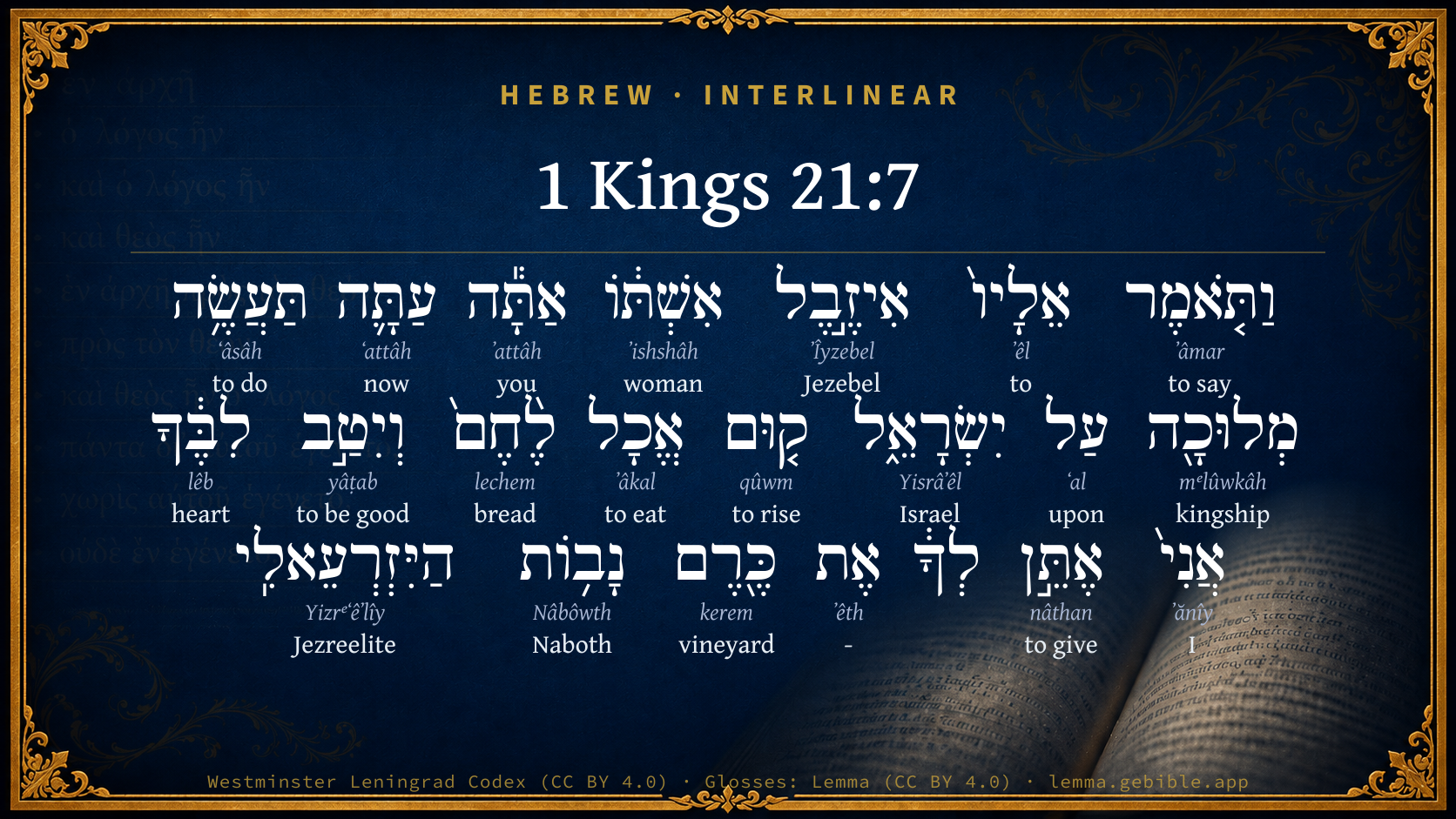
1 Kings 21:7

Hebrew (Westminster Leningrad Codex) 1 Kings 21:7 appears in the Hebrew Old Testament. The text above is from the Westminster Leningrad Codex. Each word links to its Strong’s number, a concise gloss, and parsing drawn from the Open Scriptures Hebrew Bible morphology. Click any word for its full Brown-Driver-Briggs (BDB) entry.
Download image
Cite this verse

1 Kings 21:7 (World English Bible). Public Domain. Lemma interlinear Bible study tool, https://lemma.gebible.app/v/1-kings/21/7.

Show BibTeX & RIS
BibTeX
RIS
English Translation
Jezebel his wife said to him, Do you now govern the kingdom of Israel? arise, and eat bread, and let your heart be merry: I will give you the vineyard of Naboth the Jezreelite.
World English Bible · Public Domain
Download a study sheet

One document with this verse’s original text, its word-by-word gloss line, the meaning frame, cross-references with their text, attributed commentary, and full source and license credits — printable, and it pastes into notes with its structure intact.

This verse Autodidact and up

Study sheet (.html) Plain text (.txt)

A passage Seminary Student

Up to 50 verses in one chapter. A passage sheet keeps up to 6 commentary sources and 12 cross-references per verse, in the order this page ranks them, and says so on the sheet whenever that leaves anything out. Ask for a single verse and you get the Autodidact verse sheet above.

Everything on this page stays free to read, with no account — the sheet is a download of what is already on screen, not access to it.

Want to remove ads? Support Godless Engineer
Compare translations 3

The same verse in 3 English versions, stacked beneath the original-language interlinear above. Click any original word for its lexicon entry.

Each is an independent rendering of the whole verse — the interlinear is not word-aligned to these translations.

Highlighted words mark where these versions differ — a whole-verse word diff, not a word-by-word alignment.

  • World English Bible Public Domain
    Jezebel his wife said to him, Do you now govern the kingdom of Israel? arise, and eat bread, and let your heart be merry: I will give you the vineyard of Naboth the Jezreelite.
  • King James Version Public Domain
    And Jezebel his wife said unto him, Dost thou now govern the kingdom of Israel? arise, and eat bread, and let thine heart be merry: I will give thee the vineyard of Naboth the Jezreelite.
  • unfoldingWord Literal Text CC BY-SA 4.0
    And Jezebel his wife said to him, “Now you, you do the kingship over Israel. Get up, eat bread, and let your heart be good! I, I will give to you the vineyard of Naboth the Jezreelite.”

unfoldingWord Literal Text — © unfoldingWord, licensed CC BY-SA 4.0. Word-aligned USFM3 via Door43 (git.door43.org/unfoldingWord/en_ult).

Versions to compare (up to 4)

3 of 4 selected

Show all 18 translations

Every available English version of this verse, each an independent rendering of the whole verse.

  • World English Bible Public Domain
    Jezebel his wife said to him, Do you now govern the kingdom of Israel? arise, and eat bread, and let your heart be merry: I will give you the vineyard of Naboth the Jezreelite.
  • Berean Standard Bible Public Domain
    But his wife Jezebel said to him, “Do you not reign over Israel? Get up, eat some food, and be cheerful, for I will get you the vineyard of Naboth the Jezreelite.”
  • Majority Standard Bible Public Domain
    But his wife Jezebel said to him, “Do you not reign over Israel? Get up, eat some food, and be cheerful, for I will get you the vineyard of Naboth the Jezreelite.”
  • King James Version Public Domain
    And Jezebel his wife said unto him, Dost thou now govern the kingdom of Israel? arise, and eat bread, and let thine heart be merry: I will give thee the vineyard of Naboth the Jezreelite.
  • American Standard Version (1901) Public Domain
    And Jezebel his wife said unto him, Dost thou now govern the kingdom of Israel? arise, and eat bread, and let thy heart be merry: I will give thee the vineyard of Naboth the Jezreelite.
  • Revised Version (1885) Public Domain
    And Jezebel his wife said unto him, Dost thou now govern the kingdom of Israel? arise, and eat bread, and let thine heart be merry: I will give thee the vineyard of Naboth the Jezreelite.
  • Geneva Bible (1599) Public Domain
    Then Iezebel his wife sayde vnto him, Doest thou nowe gouerne the kingdome of Israel? vp, eate bread, and be of good cheere, I will giue thee the vineyard of Naboth the Izreelite.
  • Douay-Rheims (1899) Public Domain
    Then Jezabel his wife said to him: Thou art of great authority indeed, and governest well the kingdom of Israel. Arise, and eat bread, and be of good cheer, I will give thee the vineyard of Naboth the Jezrahelite.
  • Young's Literal Translation Public Domain
    And Jezebel his wife saith unto him, `Thou now dost execute rule over Israel! rise, eat bread, and let thy heart be glad, -- I do give to thee the vineyard of Naboth the Jezreelite.'
  • Literal Standard Version CC BY-SA 4.0
    And his wife Jezebel says to him, “You now execute rule over Israel! Rise, eat bread, and let your heart be glad—I give the vineyard of Naboth the Jezreelite to you.”
  • Unlocked Literal Bible CC BY-SA 4.0
    So Jezebel his wife replied to him, “Do you not still rule the kingdom of Israel? Get up and eat; let your heart be happy. I will obtain for you the vineyard of Naboth the Jezreelite.”
  • unfoldingWord Literal Text CC BY-SA 4.0
    And Jezebel his wife said to him, “Now you, you do the kingship over Israel. Get up, eat bread, and let your heart be good! I, I will give to you the vineyard of Naboth the Jezreelite.”
  • Darby Bible Public Domain
    And Jezebel his wife said to him, Dost thou now exercise sovereignty over Israel? arise, eat bread, and let thy heart be glad: I will give thee the vineyard of Naboth the Jizreelite.
  • World Messianic Bible Public Domain
    Jezebel his wife said to him, “Do you now govern the kingdom of Israel? Arise, and eat bread, and let your heart be merry. I will give you the vineyard of Naboth the Jezreelite.”
  • Webster's Bible Public Domain
    And Jezebel his wife said to him, Dost thou now govern the kingdom of Israel? arise, and eat bread, and let thy heart be merry: I will give thee the vineyard of Naboth the Jezreelite.
  • Free Bible Version CC BY-SA 4.0
    “Aren't you the king of Israel?” his wife Jezebel replied. “Get up, have something to eat, and cheer up. I'll get you the vineyard of Naboth from Jezreel.”
  • Bible in Basic English Public Domain
    Then Jezebel, his wife, said, Are you now the ruler of Israel? Get up, take food, and let your heart be glad; I will give you the vine-garden of Naboth the Jezreelite.
  • JPS Tanakh (1917) Public Domain
    And Jezebel his wife said unto him: 'Dost thou now govern the kingdom of Israel? arise, and eat bread, and let thy heart be merry; I will give thee the vineyard of Naboth the Jezreelite.'

Literal Standard Version (2020), Covenant Press — licensed CC BY-SA 4.0. Text via the HelloAO Bible API (eBible.org). Unlocked Literal Bible (unfoldingWord) — licensed CC BY-SA 4.0. Text via the HelloAO Bible API (eBible.org). unfoldingWord Literal Text — © unfoldingWord, licensed CC BY-SA 4.0. Word-aligned USFM3 via Door43 (git.door43.org/unfoldingWord/en_ult). Free Bible Version, Dr. Jonathan Gallagher — licensed CC BY-SA 4.0. Text via the HelloAO Bible API (eBible.org).

Word by word

More ways to search: Search by grammar → Find every occurrence → Compare this word →

Practice this passage: Drill this verse → Learn its vocabulary →

הַיִּזְרְעֵאלִֽי
Yizrᵉʻêʼlîy
H3158
“the · Jezreelite”
Particle, Definite Article + Noun, Gentilic, Masculine, Singular, Absolute
Part of Speech
Particle + Noun
Type
Gentilic
Gender
Masculine
Number
Singular
State
Absolute
Full BDB Definition

Origin: patronymically from H3157

TWOT: None

Jezreelite = see Jezreel " sown of God" - an inhabitant of Jezreel
  1. וַתֹּ֤אמֶר ʼâmar H559 “and · to say” Conjunction + Verb, Qal, Sequential Imperfect, 3rd Person, Feminine, Singular
  2. אֵלָיו֙ ʼêl H413 “to · him” Preposition + Suffix, Personal, 3rd Person, Masculine, Singular
  3. אִיזֶ֣בֶל ʼÎyzebel H348 “Jezebel” Noun, Proper
  4. אִשְׁתּ֔וֹ ʼishshâh H802 “woman · his” Noun, Common, Feminine, Singular, Construct + Suffix, Personal, 3rd Person, Masculine, Singular
  5. אַתָּ֕ה ʼattâh H859 “you” Pronoun, Personal, 2nd Person, Masculine, Singular
  6. עַתָּ֛ה ʻattâh H6258 “now” Adverb
  7. תַּעֲשֶׂ֥ה ʻâsâh H6213 “to do” Verb, Qal, Imperfect, 2nd Person, Masculine, Singular
  8. מְלוּכָ֖ה mᵉlûwkâh H4410 “kingship” Noun, Common, Feminine, Singular, Absolute
  9. עַל ʻal H5921 “upon” Preposition
  10. יִשְׂרָאֵ֑ל Yisrâʼêl H3478 “Israel” Noun, Proper
  11. ק֤וּם qûwm H6965 “rise” Verb, Qal, Imperative, 2nd Person, Masculine, Singular
  12. אֱכָל ʼâkal H398 “eat” Verb, Qal, Imperative, 2nd Person, Masculine, Singular
  13. לֶ֨חֶם֙ lechem H3899 “bread” Noun, Common, Both, Singular, Absolute
  14. וְיִטַ֣ב yâṭab H3190 “and · to be good” Conjunction + Verb, Qal, Jussive, 3rd Person, Masculine, Singular
  15. לִבֶּ֔ךָ lêb H3820 “heart · your” Noun, Common, Masculine, Singular, Construct + Suffix, Personal, 2nd Person, Masculine, Singular
  16. אֲנִי֙ ʼănîy H589 “I” Pronoun, Personal, 1st Person, Common, Singular
  17. אֶתֵּ֣ן nâthan H5414 “to give” Verb, Qal, Imperfect, 1st Person, Common, Singular
  18. אֶת ʼêth H853 “-” Particle, Direct Object
  19. כֶּ֖רֶם kerem H3754 “vineyard of” Noun, Common, Both, Singular, Construct
  20. נָב֥וֹת Nâbôwth H5022 “Naboth” Noun, Proper

About this verse

These counts appear in no published source. They are computed here, from the morphology-tagged text and Lemma’s own curated glosses. What Lemma adds →

22
words
21
distinct lemmas
Historical
section

Notable vocabulary

The rarest word here is הַיִּזְרְעֵאלִֽי Jezreelite H3158 — appearing just 8 times in the whole Hebrew Bible.

Shared distinctive vocabulary

הַיִּזְרְעֵאלִֽי Jezreelite H3158 occurs in 8 verses of the Hebrew Bible. Also found in:

Grammatical profile

  • 6 verbs
  • 9 nouns
  • 2 pronouns
  • 3 prepositions
  • 1 adverb
  • 1 particle

Verb forms

  • וַתֹּ֤אמֶר Qal · Sequential Imperfect
  • תַּעֲשֶׂ֥ה Qal · Imperfect
  • ק֤וּם Qal · Imperative
  • אֱכָל Qal · Imperative
  • וְיִטַ֣ב Qal · Jussive
  • אֶתֵּ֣ן Qal · Imperfect

Hebrew & Septuagint length

In English translation the verse runs 34 words from the Hebrew and 53 from the Septuagint (LXX English) — the Septuagint runs noticeably longer here. See the side-by-side →

A rough comparison of the two English renderings, which tokenize alike — not a word-level alignment.

Word counts can differ between the Hebrew and the Greek without any difference in meaning — e.g. the Hebrew direct-object marker אֵת has no separate Greek word, and Greek often adds the article ὁ.

Cross-references

10

Topical passages linked to 1 Kings 21:7 in the Treasury of Scripture Knowledge — connected by theme and wording, ordered by reader-vote popularity; previews shown in the World English Bible.

  • 1 Samuel 8:4 Then all the elders of Israel gathered themselves together, and came to Samuel to Ramah;
  • 1 Samuel 8:14 He will take your fields, and your vineyards, and your olive groves, even the best of them, and give them to his servants.
  • 2 Samuel 13:4 He said to him, Why, son of the king, are you thus lean from day to day? Won't you tell me? Amnon said to him, I love Tamar, my brother Absalom's sister.
  • 1 Kings 21:15–16 It happened, when Jezebel heard that Naboth was stoned, and was dead, that Jezebel said to Ahab, Arise, take possession of the vineyard of Naboth the Jezreelite, which he refused to give you for money; for Naboth is not alive, but dead.
  • Proverbs 30:31 The greyhound, The male goat also; And the king against whom there is no rising up.
  • Ecclesiastes 4:1 Then I returned and saw all the oppressions that are done under the sun: and, behold, the tears of those who were oppressed, and they had no comforter; and on the side of their oppressors there was power; but they had no comforter.
  • Ecclesiastes 8:4 for the king's word is supreme. Who can say to him, "What are you doing?"
  • Daniel 5:19–21 and because of the greatness that he gave him, all the peoples, nations, and languages trembled and feared before him: whom he would he killed, and whom he would he kept alive; and whom he would he raised up, and whom he would he put down.
  • Micah 2:1–2 Woe to those who devise iniquity And work evil on their beds! When the morning is light, they practice it, Because it is in the power of their hand.
  • Micah 7:3 Their hands are on that which is evil to do it diligently. The ruler and judge ask for a bribe; And the powerful man dictates the evil desire of his soul. Thus they conspire together.

Cross-references courtesy of OpenBible.info (CC BY 4.0).

Hebrew and Greek witnesses Masoretic Hebrew ↔ Greek Septuagint

The same verse in the two great witnesses to the Old Testament, shown verse-for-verse.

Here the Septuagint runs noticeably longer than the Hebrew — LXX2012 (modern English Septuagint) 53 words vs World English Bible 34. A rough length comparison of the two English translations, not a word-level alignment — read both below.

These are two independent witnesses, not word-aligned to each other, and the Septuagint is shown in lemma (dictionary) form.

Hebrew 1 Kings 21:7 Masoretic · Westminster Leningrad Codex

וַתֹּ֤אמֶר אֵלָיו֙ אִיזֶ֣בֶל אִשְׁתּ֔וֹ אַתָּ֕ה עַתָּ֛ה תַּעֲשֶׂ֥ה מְלוּכָ֖ה עַל יִשְׂרָאֵ֑ל ק֤וּם אֱכָל לֶ֨חֶם֙ וְיִטַ֣ב לִבֶּ֔ךָ אֲנִי֙ אֶתֵּ֣ן לְךָ֔ אֶת כֶּ֖רֶם נָב֥וֹת הַיִּזְרְעֵאלִֽי

Jezebel his wife said to him, Do you now govern the kingdom of Israel? arise, and eat bread, and let your heart be merry: I will give you the vineyard of Naboth the Jezreelite.

World English Bible · Public Domain

Greek LXX 1 Kings 21:7 Septuagint · lemma form

καί καλέω ὁ βασιλεύς ἰσραήλ πᾶς ὁ πρεσβύτερος καί εἶπον γιγνώσκω δή καί ὁράω ὅτι κακία οὗτος ζητέω ὅτι ἀποστέλλω πρός ἐγώ περί ὁ γυνή ἐγώ καί περί ὁ υἱός ἐγώ καί περί ὁ θυγάτηρ ἐγώ ὁ ἀργύριον ἐγώ καί ὁ χρυσίον ἐγώ οὐ ἀποκωλύω ἀπό αὐτός

And the king of Israel called all the elders of the land, and said, Take notice now and consider, that this man seeks mischief: for he has sent to me concerning my wives, and concerning my sons, and concerning my daughters: I have not kept back from him my silver and my gold.

LXX2012 (modern English Septuagint) · Public Domain

On this verse, Haydock's Catholic Bible Commentary discusses the Septuagint’s reading. Read the note in Commentary ↓

Hebrew: Westminster Leningrad Codex (CC BY 4.0). Greek: Septuagint (public domain); English from LXX2012 (modern English Septuagint) (Public Domain). How the Septuagint differs from the Hebrew →

Targum (Aramaic paraphrase)

1

The Targum is the ancient Jewish Aramaic paraphrase of the Hebrew Scriptures — an interpretive translation, not the Hebrew text itself. Onkelos (literal) and Pseudo-Jonathan (expansive) render the Torah, and Jonathan the Prophets. Coverage is partial: where no permissively-licensed English translation exists for a verse, only the Aramaic is shown. This is verse-level text, not a word-by-word alignment to the Hebrew.

  1. Targum Jonathan Prophets (Joshua–Malachi)
    וַאֲמַרַת לֵיהּ אִיזֶבֶל אִתְּתֵיהּ אַתְּ כְּעַן תַּצְלַח מַלְכוּתָךְ עַל יִשְׂרָאֵל קוּם אֱכוֹל לַחְמָא וְיִשְׁפַּר לִבָּךְ אֲנָא אֶתֵּן לָךְ יַת כַּרְמָא דְנָבוֹת יִזְרְעֶאלָה:

    (no public-domain English translation for this verse)

    Targum Jonathan — Aramaic: “Mikraot Gedolot” (public domain). English: “Sefaria Community Translation” (CC0 1.0 (public-domain dedication)); “London "Chaldee Paraphrase," 1871” (public domain). Text via Sefaria.

Commentary

Notes on 1 Kings 21:7 from classic Christian and Jewish commentators (each source and its license shown beneath its notes). The classic Christian expositions comment on the surrounding passage and are grouped to its opening verse, so a note may address several verses; the Jewish commentaries on the Tanakh (Rashi and others) are per-verse, so they appear only where the commentator wrote on this verse.

Lemma curates 59 commentaries, every one of them public domain or Creative Commons licensed, each selected and text-cleaned for this edition rather than reprinted as found. About our sources →

Trapp's Complete Commentary

John Trapp

1Ki 21:7 And Jezebel his wife said unto him, Dost thou now govern the kingdom of Israel? arise, [and] eat bread, and let thine heart be merry: I will give thee the vineyard of Naboth the Jezreelite.

Ver. 7. Dost thou now govern the kingdom of Israel?] q.d., What a king of clouts art thou! It is not for a king to beg or buy, but to command and call for what he pleaseth, without control. And such afterwards was the speech of wicked Julia to her son-in-law Antonius Caracalla, soliciting him to incestuous marriage; when he answered, Vellem si liceret, I would if I might; she replied impudently, Si libet licet; thou mayest do whatsoever thou wilt: knowest thou not that thou art an emperor, and that it is thy part to give laws to others, and not to receive laws from any one living? So Caligula said to his grandmother Antonia, Memento omnia mihi licere, et in omnes. You must know that I may do whatsoever I wish. Jezebel would persuade Ahab here, that he is lawless, and that since he knew not how to improve his kingly power, she would do it for him.

Let thine heart be merry.] Sing care away for this matter.

I will give thee the vineyard.] Thus the hen crowed, the wife ruled; being impio marito impientior, avaro avarior, crudile crudelior, rapace rapacior, cupido cupidior, as one saith, {a} the worse of the twain, if worse might be. Ambrose {b} maketh her a type of covetousness, which promiseth her clients wealth without right. Another saith truly that she was fax malorum omnium, et quasi furia quaedam inferni, a firebrand of all mischief, a very hell-hag.

{a} A Lapide.

{b} Cap. 9.

John Trapp, A Commentary or Exposition upon All the Books of the Old and New Testament (1647–1656) — public domain. Text from a community e-Sword module.

The Biblical Illustrator

Joseph S. Exell

1Ki_21:7

I will give thee the vineyard of Naboth.

Wifely ambition, good and bad

How important that every wife have her ambition an elevated, righteous, and divinely approved ambition! And here let me say that what I am most anxious for is that woman, not waiting for the rights denied her or postponed, should promptly and decisively employ the rights she already has in possession. Some say she will be in a fair way to get all her rights when she gets the right to the ballot-box. I do not know that it would change anything for the better. But let every wife, not waiting for the vote she may never get, or, getting it, find it outbalanced by some other vote not fit to be cast, arise now in the might of the Eternal God and wield the power of a sanctified wifely ambition for a good approximating the infinite. No one can so inspire a man to noble purposes as a noble woman, and no one so thoroughly degrade a man as a wife of unworthy tendencies. While in my text we have illustration of wifely ambition employed in the wrong direction, in society and history are instances of wifely ambition triumphant in right directions. All that was worth admiration in the character of Henry VI. was a reflection of the heroics of his wife Margaret. William, Prince of Orange, was restored to the right path by the grand qualities of his wife Mary. Justinian, the Roman Emperor confesses that his wise laws were the suggestion of his wife Theodora. Andrew Jackson, the warrior and President, had his mightiest reinforcement in his plain wife, whose inartistic attire was the amusement of the elegant circles in which she was invited. Washington, who broke the chain that held America in foreign vassalage, wore for forty years a chain around his own neck, that chain holding the miniature likeness of her who had been his greatest inspiration, whether among the snows at Valley Forge or the honours of the Presidential chair. Plinys pen was driven through all its poetic and historical dominions by his wife, Calpurnia, who sang his stanzas to the sound of flute, and sat among audiences enraptured at her husbands genius, herself the most enraptured. Pericles said he got all his eloquence and statesmanship from his wife. When the wife of Grotius rescued him from long imprisonment at Lovestein by means of a bookcase that went in and out, carrying his books to and fro, in which he was one day transported, hidden amid the folios; and the women of besieged Wurzburg, getting permission from the victorious army to take with them so much of their valuables as they could carry, under cover of the promise shouldered and took with them, as the most important valuables, their husbands--both achievements in a literal way illustrated what thousands of times has been done in a figurative way, namely, that wifely ambition has been the salvation of men. De Tocqueville, whose writings will be potential and quoted while the world lasts, ascribes his successes to his wife, and says: Of all the blessings which God has given to me, the greatest of all in my eyes is to have lighted on Maria Motley. Martin Luther says of his wife, I would not exchange my poverty with her for all the riches of Croesus without her. Isabella of Spain, by her superior faith in Columbus, put into the hand of Ferdinand, her husband, America. John Adams, President of the United States, said of his wife: She never by word or look discouraged me from running all hazards for the salvation of my countrys liberties. A whole cemetery of monumental inscriptions will not do a wife so much good after she has quit the world as one plain sentence like that which Tom Hood wrote to his living wife when he said: I never was anything till I knew you. O woman, what is your wifely ambition, noble or ignoble? Is it high social position? That will then probably direct your husband, and he will climb and scramble and slip and fall and rise and tumble, and on what level, or in what depth, or on what height he will, after a while, be found, I cannot even guess. The contest for social position is the most unsatisfactory contest in all the world, because it is so uncertain about your getting it, and so insecure a possession after you have obtained it, and so unsatisfactory even if you keep it. The whisk of a ladys fan may blow it out. The growl of one bear, or the bellowing of one bull on Wall Street, may scatter it. Some of us could tell of what influence upon us has been a wifely ambition consecrated to righteousness. A man is no better than his wife will let him be. O wives, swing your sceptres of wifely influence for God and good homes! Do not urge your husbands to annex Naboths vineyard to your palace of success, whether right or wrong, lest the dogs that come out to destroy Naboth come out also to devour you. Righteousness will pay best in life, will pay best in death, will pay best in judgment, will pay best through all eternity. In our effort to have the mother of every household appreciate her influence over her children, we are apt to forget the wifes influence over the husband. In many households the influence upon the husband is the only home influence. In a great multitude of the best and most important and most talented families of the earth there have been no descendants. Multitudes of the finest families of the earth are extinct. As though they had done enough for the world by their genius or wit or patriotism or invention or consecration, God withdrew them. In multitudes of cases all womans opportunity for usefulness is with her contemporaries. How important that it be an improved opportunity! While the French warriors on their way to Rheims had about concluded to give up attacking the castle at Troyes, because it was so heavily garrisoned, Joan of Are entered the room and told them they would be inside the castle in three days. We would willingly wait six days, said one of the leaders. Six! she cried out, you shall be in it to-morrow, and, under her leadership, on the morrow they entered. On a smaller scale, every man has garrisons to subdue and obstacles to level, and every wife may be an inspired Joan of Are to her husband. What a noble, wifely ambition, the determination, God helping, to accompany her companion across the stormy sea of this life and together gain the wharf of the Celestial City! Coax him along with you! You cannot drive him there You cannot nag him there; but you can coax him there. That is Gods plan. He coaxes us all the way--coaxes us out of our sins, coaxes us to accept pardon, coaxes us to heaven. If we reach that blessed place, it will be through a prolonged and Divine coaxing. (T. De Witt Talmage, D. D.)

Wives who mar their husbands

By the fate of Ahab, whose wife induced him to steal; by the fate of Macbeth, whose wife pushed him into massacre; by the fate of James Ferguson, the philosopher, whose wife entered the room while he was lecturing and wilfully upset his astronomical apparatus, so that he turned to the audience and said: Ladies and gentlemen, I have the misfortune to be married to this woman; by the fate of Bulwer, the novelist, whose wifes temper was so incompatible that he furnished her a beautiful house near London, and withdrew from her company; by the fate of John Milton, who married a termagant after he was blind, and when somebody called her a rose, the poet said, I am no judge of colours, but I may be so, for I feel the thorns daily--by all these scenes of disquietude and domestic calamity, we implore you to be cautious and prayerful before you enter upon the connubial state, which decides whether a man shall have two heavens or two hells, a heaven here and a heaven there, or a hell now and a hell hereafter. (T. De Witt Talmage, D. D.)

The Biblical Illustrator, edited by Joseph S. Exell (c. 1880s–1900s) — public domain. Text from a community e-Sword module.

Joseph Benson's Commentary

1Ki 21:7. Jezebel said, Dost thou now govern the kingdom of Israel? — Art thou fit to be a king who canst put up with such affronts from thy subjects, and hast not courage to dispose of them and theirs as seemeth good unto thee? I will give thee the vineyard of Naboth — Trouble thyself no further about it, but leave the matter to me; I will manage it to thy satisfaction, and the vineyard shall be thine, and shall cost thee nothing. Unhappy are those princes, and hurried apace toward their ruin, who have those about them who excite them to acts of tyranny, and teach them how to abuse their power!

Joseph Benson's Commentary on the Old and New Testaments (1811–1818) — public domain. Text from a community e-Sword module.

Tyndale Open Study Notes

Tyndale Open Resources

21:7 I’ll get you Naboth’s vineyard! With her ruthless disposition and actions, Jezebel displayed her cultural upbringing; Canaanite kings did as they pleased (21:8-10, 15, 25; see 19:1-2; 2 Kgs 9:30-31).

Tyndale Open Study Notes — © Tyndale Open Resources, licensed CC BY-SA 4.0. Text via the HelloAO Bible API.

Geneva Bible (1599)

Geneva Bible translators

Hebrew, let thine heart be merry.

As though she said, Thou knowest not what it is to reign. Command and entreat not.

Geneva Bible (1599) marginal notes — public domain. Text via Bolls.life.

Jamieson, Fausset & Brown

Robert Jamieson, A. R. Fausset & David Brown

JEZEBEL CAUSES NABOTH TO BE STONED. (Kg1 21:5-16)

Dost thou now govern the kingdom of Israel?--This is not so much a question as an exclamation--a sarcastic taunt; "A pretty king thou art! Canst not thou use thy power and take what thy heart is set upon?"

arise, and eat bread, and let thine heart be merry: I will give thee the vineyard--After upbraiding Ahab for his pusillanimity and bidding him act as a king, Jezebel tells him to trouble himself no more about such a trifle; she would guarantee the possession of the vineyard.

Jamieson, Fausset & Brown — Commentary Critical and Explanatory on the Whole Bible (1871) — public domain (CC PDM 1.0). Text via the HelloAO Bible API.

Adam Clarke's Commentary

Verse 7. Dost thou now govern the kingdom of Israel?] Naboth, not Ahab, is king. If he have authority to refuse, and thou have no power to take, he is the greater man of the two. This is the vital language of despotism and tyranny.

Adam Clarke's Commentary on the Bible (1810–1826) — public domain. Text from a community e-Sword/MySword module.

Ellicott's Commentary for English Readers

(7) Dost thou now.—The scorn of Jezebel is, like the impatience of Lady Macbeth, expressed in a striking boldness of emphasis. First comes the bitter irony of the question, “Dost thou govern the kingdom of Israel, and yet suffer a subject to cross thy will?” expressing her scornful wonder at one who “lets I dare not, wait upon 1 would.” Then in the invitation, “eat bread, and let thine heart be merry,” there seems the same half-contemptuous recognition of a self-indulgent weakness of nature, which may be traced in Elijah’s words in 1Ki_18:41, “Get thee up, eat and drink, for there is a sound of abundance of rain.” Ahab is fit only to desire and to revel; it is for bolder spirits to act for good or for evil.

A Bible Commentary for English Readers, edited by Charles John Ellicott (1878–1897) — public domain. Text from a community e-Sword module.

The Cambridge Bible for Schools and Colleges

gen. ed. J. J. S. Perowne

7. Dost thou now govern the kingdom of Israel?] There is not expressed here any sign of a question in the original, but there can be no doubt that this is the force of the words. The Hebrew order is ‘Thou now governest, &c.’ the pronoun being emphatically expressed. So that the sense is ‘Thou art king, art thou not? why then let such a matter trouble thee or stand in the way of thy will.’ The proposal of some to take the words as imperative, ‘Thou, do thou use thy sovereignty, &c.’ is opposed to what follows. For Jezebel does not urge Ahab to act the despot’s part, but plays it for him.

I will give thee, &c.] The ‘I’ in this clause is emphatically expressed, just as ‘thou’ in the preceding one.

The Cambridge Bible for Schools and Colleges (gen. ed. J. J. S. Perowne; Cambridge University Press, 1878–1918) — public domain. Text from a community e-Sword module.

John Gill's Exposition

And she wrote in the letters, saying, proclaim a fast,.... Pretending fears of some dreadful calamity coming upon the nation, and therefore fasting and humiliation were necessary to avert it, and it would be right to inquire what crimes were committed by men among them, and punish them for them; and intimated to them that Naboth should be chosen as the great offender, and be accused, condemned, and put to death, R. Joseph Kimchi (a) thinks the phrase signifies "call an assembly or congregation"; convene a court of judicature, from the use of the word in the Talmudic language (b); and so it is thought it is used in Jer 36:6 and indeed it can hardly be thought that Jezebel should have much notion of fasting; and besides, if it was a public fast, why should it be proclaimed only in Jezreel, and not throughout the kingdom?

and set Naboth on high among the people; the court being set, bring him to the bar and arraign him; perhaps in their courts of judicature there was a high place above the heads of the people, where criminals accused used to stand when they took their trials, that they might be seen and heard by all in court.

(a) Apud David. Kimchium in loc. (b) Vid. Buxtorf. Talmud. Lexic. in rad

John Gill's Exposition of the Whole Bible (1746–1763) — public domain (CC PDM 1.0). Text via the HelloAO Bible API.

Albert Barnes' Notes on the Bible

The meaning is, “Art thou king, and yet sufferest thyself to be thwarted in this way by a mere subject? I, the queen, the weak woman, will give thee the vineyard, if thou, the king, the strong man, wilt do nothing.”

Albert Barnes' Notes on the Bible (1834–1885) — public domain. Text from a community e-Sword/MySword module.

Haydock's Catholic Bible Commentary

Israel. Hebrew simply, "Now thou wilt make the kingdom of Israel." (Calmet) --- Protestants, "Dost thou now govern the?" &c. (Haydock) --- Thou art a fit person indeed to establish a kingdom! Ought not a king to take what he has a mind to? Syriac, "Are you fit to reign?" Arabic, "You do not deserve to govern." (Calmet) --- Septuagint, "Dost thou now act the king over Israel, in this manner?" (Haydock)

George Leo Haydock (1774–1849), Haydock's Catholic Family Bible and Commentary, 1859 edition — public domain. Excludes Psalms (Douay-Rheims chapter numbering differs from Protestant) and Deuterocanonical books (Catholic canon only).

Matthew Poole's English Annotations

Dost thou now govern the kingdom of Israel? art thou fit to be king, that canst put up such affronts from thy subjects, and hast not the courage to use thy absolute power to dispose of them and theirs as seemeth good unto thee?

Matthew Poole's English Annotations on the Holy Bible (1683–1685) — public domain. Text from a community e-Sword/MySword module.

Whedon's Commentary on the Bible

Daniel D. Whedon

7. Dost thou now govern the kingdom of Israel — Some take these words, not as a question, or as spoken in irony, but as a command or summons for the king to exercise his royal power, thus: Do thou now govern; that is, exercise now thy sovereign power, and show that thou, not thy subjects, rulest in Israel. But it best suits the connexion to take the words as an ironical exclamation, designed to reproach and censure the imbecile conduct of Ahab: Thou dost now marvellously wield the sovereignty over Israel! That is, thou, surely, art become now a mighty king to be thus set at naught! A powerful ruler to be thus sent to bed disheartened by an obstinate subject!

I will give thee the vineyard — “I, the wife, since thou hast not the courage to act as a man and a king.” — Thenius.

Daniel D. Whedon (gen. ed.), Commentary on the Old and New Testaments (1874–1909) — public domain. Text from a community e-Sword module.

The Pulpit Commentary

And Jezebel his wife said unto him. Dost thou now govern Heb. make; LXX: poieiv basilea the kingdom of Israel? There is no question expressed in the Hebrew which stands, "Thou now makest the kingdom over Israel." The commentators generally, however, understand the words as the LXX and the A.V as an ironical question, "Art thou ruler in aught but name?" though some take it as an imperative: "Do thou now exert authority over the kingdom of Israel," And on the whole, this latter interpretation appears to be preferable. "Do thou now play the king. Make thy power felt. Give me the requisite authority. I will," etc. Arise, and eat bread or food, and let thine heart be merry Heb. good; same words: (1Sa_25:36) I This word is emphatic. "If thou wilt do thy part, I will do mine." will give thee no need to buy it the vineyard of Naboth the Jezreelite.

The Pulpit Commentary (1880–1919), ed. H.D.M. Spence-Jones & Joseph S. Exell — public domain. Text from a community e-Sword module.

John Wesley's Explanatory Notes

Dost thou govern - Art thou fit to be king, that hast not courage to use thy power.

John Wesley, Explanatory Notes Upon the Whole Bible (1754–1765) — public domain. Text via the GEBible commentary corpus.

Lesson kit

Teaching starters — assembled from the data on this page, not authored interpretation. Every prompt links to the verse data it draws on. Edit before teaching.

1 Kings, in the Historical, opens this verse with 22 words (21 distinct Hebrew lemmas). Its most distinctive word is Yizrᵉʻêʼlîy (“Jezreelite”). The Greek Septuagint runs longer here. A historical commentator’s framing appears above. Read the whole chapter for the surrounding context.

Discussion questions

  1. What does “Jezreelite” (Yizrᵉʻêʼlîy) contribute to the verse as a whole?
  2. How does 1 Kings 21:1, which shares the word «Jezreelite», read alongside this verse?
  3. The Septuagint runs longer here than the Hebrew. What might account for the difference?
  4. These translations render this verse differently. What is at stake in choosing one wording over another?
  5. «וַתֹּ֤אמֶר» is a Qal Sequential Imperfect verb. How does that grammatical form shape the action described?
  6. Compare how Trapp's Complete Commentary and The Biblical Illustrator read this verse. Where do they agree or differ?

Things to notice

Reading settings

Reading text

Shown beneath each verse's original-language words.

Old Testament
Old Testament edition

Read the OT as the Masoretic Hebrew (MT) or the Greek Septuagint (LXX).

English shown for the Greek Septuagint (in the Hebrew ↔ Greek comparison).

Comparing translations? Open the Compare panel on any verse page to stack up to four side by side.