
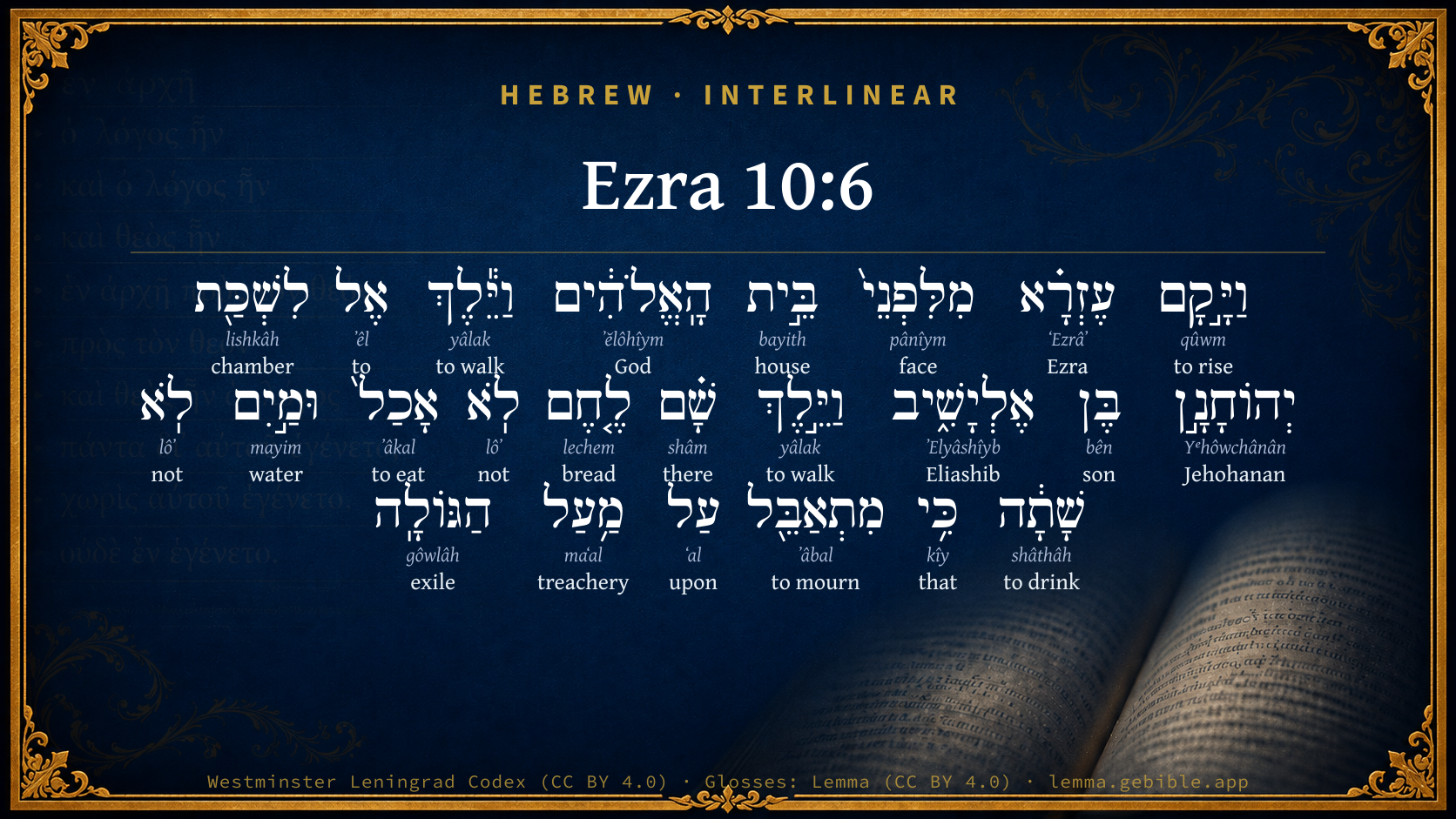
Ezra 10:6

Hebrew (Westminster Leningrad Codex) Ezra 10:6 appears in the Hebrew Old Testament. The text above is from the Westminster Leningrad Codex. Each word links to its Strong’s number, a concise gloss, and parsing drawn from the Open Scriptures Hebrew Bible morphology. Click any word for its full Brown-Driver-Briggs (BDB) entry.
Download image
Cite this verse

Ezra 10:6 (World English Bible). Public Domain. Lemma interlinear Bible study tool, https://lemma.gebible.app/v/ezra/10/6.

Show BibTeX & RIS
BibTeX
RIS
English Translation
Then Ezra rose up from before the house of God, and went into the chamber of Jehohanan the son of Eliashib: and [when] he came there, he ate no bread, nor drink water; for he mourned because of the trespass of them of the captivity.
World English Bible · Public Domain
Download a study sheet

One document with this verse’s original text, its word-by-word gloss line, the meaning frame, cross-references with their text, attributed commentary, and full source and license credits — printable, and it pastes into notes with its structure intact.

This verse Autodidact and up

Study sheet (.html) Plain text (.txt)

A passage Seminary Student

Up to 50 verses in one chapter. A passage sheet keeps up to 6 commentary sources and 12 cross-references per verse, in the order this page ranks them, and says so on the sheet whenever that leaves anything out. Ask for a single verse and you get the Autodidact verse sheet above.

Everything on this page stays free to read, with no account — the sheet is a download of what is already on screen, not access to it.

Want to remove ads? Support Godless Engineer
Compare translations 3

The same verse in 3 English versions, stacked beneath the original-language interlinear above. Click any original word for its lexicon entry.

Each is an independent rendering of the whole verse — the interlinear is not word-aligned to these translations.

Highlighted words mark where these versions differ — a whole-verse word diff, not a word-by-word alignment.

  • World English Bible Public Domain
    Then Ezra rose up from before the house of God, and went into the chamber of Jehohanan the son of Eliashib: and [when] he came there, he ate no bread, nor drink water; for he mourned because of the trespass of them of the captivity.
  • King James Version Public Domain
    Then Ezra rose up from before the house of God, and went into the chamber of Johanan the son of Eliashib: and when he came thither, he did eat no bread, nor drink water: for he mourned because of the transgression of them that had been carried away.
  • unfoldingWord Literal Text CC BY-SA 4.0
    And Ezra rose up from before the face of the house of God, and he went to the chamber of Jehohanan, the son of Eliashib. And he went there. He did not eat bread and he did not drink water, but was mourning on account of the unfaithfulness of the exiles.

unfoldingWord Literal Text — © unfoldingWord, licensed CC BY-SA 4.0. Word-aligned USFM3 via Door43 (git.door43.org/unfoldingWord/en_ult).

Versions to compare (up to 4)

3 of 4 selected

Show all 18 translations

Every available English version of this verse, each an independent rendering of the whole verse.

  • World English Bible Public Domain
    Then Ezra rose up from before the house of God, and went into the chamber of Jehohanan the son of Eliashib: and [when] he came there, he ate no bread, nor drink water; for he mourned because of the trespass of them of the captivity.
  • Berean Standard Bible Public Domain
    Then Ezra withdrew from before the house of God and walked to the chamber of Jehohanan son of Eliashib. And while he stayed there, he ate no food and drank no water, because he was mourning over the unfaithfulness of the exiles.
  • Majority Standard Bible Public Domain
    Then Ezra withdrew from before the house of God and walked to the chamber of Jehohanan son of Eliashib. And while he stayed there, he ate no food and drank no water, because he was mourning over the unfaithfulness of the exiles.
  • King James Version Public Domain
    Then Ezra rose up from before the house of God, and went into the chamber of Johanan the son of Eliashib: and when he came thither, he did eat no bread, nor drink water: for he mourned because of the transgression of them that had been carried away.
  • American Standard Version (1901) Public Domain
    Then Ezra rose up from before the house of God, and went into the chamber of Jehohanan the son of Eliashib: and `when' he came thither, he did eat no bread, nor drink water; for he mourned because of the trespass of them of the captivity.
  • Revised Version (1885) Public Domain
    Then Ezra rose up from before the house of God, and went into the chamber of Jehohanan the son of Eliashib: and when he came thither, he did eat no bread, nor drink water: for he mourned because of the trespass of them of the captivity.
  • Geneva Bible (1599) Public Domain
    And Ezra rose vp from before the house of God, and went into the chamber of Iohanan the sonne of Eliashib: he went euen thither, but he did eate neither bread, nor drunke water: for he mourned, because of the transgression of them of the captiuitie.
  • Douay-Rheims (1899) Public Domain
    And Esdras rose up from before the house of God, and went to the chamber of Johanan the son of Eliasib, and entered in thither: he ate no bread, and drank no water: for he mourned for the transgression of them that were come out of the captivity.
  • Young's Literal Translation Public Domain
    And Ezra riseth from before the house of God, and goeth unto the chamber of Jehohanan son of Eliashib; yea, he goeth there, bread he hath not eaten, and water he hath not drunk, for he is mourning because of the trespass of the removal.
  • Literal Standard Version CC BY-SA 4.0
    And Ezra rises from before the house of God, and goes to the chamber of Jehohanan son of Eliashib; indeed, he goes there, bread he has not eaten, and water he has not drunk, for he is mourning because of the trespass of the expulsion.
  • Unlocked Literal Bible CC BY-SA 4.0
    Then Ezra rose from before God's house and went to the rooms of Jehohanan son of Eliashib. He did not eat any bread or drink any water, since he was mourning concerning the faithlessness of those who had been in captivity.
  • unfoldingWord Literal Text CC BY-SA 4.0
    And Ezra rose up from before the face of the house of God, and he went to the chamber of Jehohanan, the son of Eliashib. And he went there. He did not eat bread and he did not drink water, but was mourning on account of the unfaithfulness of the exiles.
  • Darby Bible Public Domain
    And Ezra arose from before the house of God, and went into the chamber of Jehohanan the son of Eliashib; and when he came thither, he ate no bread and drank no water; for he mourned because of the unfaithfulness of them that had been carried away.
  • World Messianic Bible Public Domain
    Then Ezra rose up from before God’s house, and went into the room of Jehohanan the son of Eliashib. When he came there, he didn’t eat bread or drink water, for he mourned because of the trespass of the exiles.
  • Webster's Bible Public Domain
    Then Ezra arose from before the house of God, and went into the chamber of Johanan the son of Eliashib: and when he came thither, he ate no bread, nor drank water: for he mourned because of the transgression of them that had been carried away.
  • Free Bible Version CC BY-SA 4.0
    Then Ezra left them in front of God's Temple, and went to the room of Jehohanan, son of Eliashib. During the time he stayed there, he didn't eat or drink anything, because he was still mourning the unfaithfulness of the exiles.
  • Bible in Basic English Public Domain
    Then Ezra got up from before the house of God and went into the room of Jehohanan, the son of Eliashib; but when he came there, he took no food or drink, for he was sorrowing for the sin of those who had come back.
  • JPS Tanakh (1917) Public Domain
    Then Ezra rose up from before the house of God, and went into the chamber of Jehohanan the son of Eliashib; and when he came thither, he did eat no bread, nor drink water; for he mourned because of the faithlessness of them of the captivity.

Literal Standard Version (2020), Covenant Press — licensed CC BY-SA 4.0. Text via the HelloAO Bible API (eBible.org). Unlocked Literal Bible (unfoldingWord) — licensed CC BY-SA 4.0. Text via the HelloAO Bible API (eBible.org). unfoldingWord Literal Text — © unfoldingWord, licensed CC BY-SA 4.0. Word-aligned USFM3 via Door43 (git.door43.org/unfoldingWord/en_ult). Free Bible Version, Dr. Jonathan Gallagher — licensed CC BY-SA 4.0. Text via the HelloAO Bible API (eBible.org).

Word by word

More ways to search: Search by grammar → Find every occurrence → Compare this word →

Practice this passage: Drill this verse → Learn its vocabulary →

יְהוֹחָנָ֣ן
Yᵉhôwchânân
H3076
“Jehohanan”
Noun, Proper
Part of Speech
Noun
Type
Proper
Full BDB Definition

Origin: from H3068 and H2603

TWOT: None

Jehohanan = "Jehovah has graced" - a Korhite Levite and one of the doorkeepers to the tabernacle in the time of David - a captain of Judah under king Jehoshaphat - a priest during the high priesthood of Joiakim who returned with Zerubbabel - a high priest in the time of Ezra - a Levite priest who took part in the dedication of the wall in the time of Nehemiah - son of Tobiah - an Ephraimite - an Israelite with a foreign wife in the time of Ezra - a Jewish captain after the fall of Jerusalem - the eldest son of king Josiah - a post-exilic prince of the line of David - father of Azariah, priest in Solomon's time - a Benjamite, one of David's mighty warriors - a Gadite, one of David's mighty warriors - a returning exile
  1. וַיָּ֣קָם qûwm H6965 “and · to rise” Conjunction + Verb, Qal, Sequential Imperfect, 3rd Person, Masculine, Singular
  2. עֶזְרָ֗א ʻEzrâʼ H5830 “Ezra” Noun, Proper
  3. מִלִּפְנֵי֙ pânîym H6440 “from · to/for · face(s) of” Preposition + Preposition + Noun, Common, Both, Plural, Construct
  4. בֵּ֣ית bayith H1004 “house of” Noun, Common, Masculine, Singular, Construct
  5. הָֽאֱלֹהִ֔ים ʼĕlôhîym H430 “the · God(s)” Particle, Definite Article + Noun, Common, Masculine, Plural, Absolute
  6. וַיֵּ֕לֶךְ yâlak H3212 “and · to walk” Conjunction + Verb, Qal, Sequential Imperfect, 3rd Person, Masculine, Singular
  7. אֶל ʼêl H413 “to” Preposition
  8. לִשְׁכַּ֖ת lishkâh H3957 “chamber of” Noun, Common, Feminine, Singular, Construct
  9. בֶּן bên H1121 “son of” Noun, Common, Masculine, Singular, Construct
  10. אֶלְיָשִׁ֑יב ʼElyâshîyb H475 “Eliashib” Noun, Proper
  11. וַיֵּ֣לֶךְ yâlak H3212 “and · to walk” Conjunction + Verb, Qal, Sequential Imperfect, 3rd Person, Masculine, Singular
  12. שָׁ֗ם shâm H8033 “there” Adverb
  13. לֶ֤חֶם lechem H3899 “bread” Noun, Common, Both, Singular, Absolute
  14. לֹֽא lôʼ H3808 “not” Particle, Negative
  15. אָכַל֙ ʼâkal H398 “to eat” Verb, Qal, Perfect, 3rd Person, Masculine, Singular
  16. וּמַ֣יִם mayim H4325 “and · water(s)” Conjunction + Noun, Common, Masculine, Plural, Absolute
  17. לֹֽא lôʼ H3808 “not” Particle, Negative
  18. שָׁתָ֔ה shâthâh H8354 “to drink” Verb, Qal, Perfect, 3rd Person, Masculine, Singular
  19. כִּ֥י kîy H3588 “that” Conjunction
  20. מִתְאַבֵּ֖ל ʼâbal H56 “mourning” Verb, Hithpael, Participle Active, Masculine, Singular, Absolute
  21. עַל ʻal H5921 “upon” Preposition
  22. מַ֥עַל maʻal H4604 “treachery of” Noun, Common, Masculine, Singular, Construct
  23. הַגּוֹלָֽה gôwlâh H1473 “the · exile” Particle, Definite Article + Noun, Common, Feminine, Singular, Absolute

About this verse

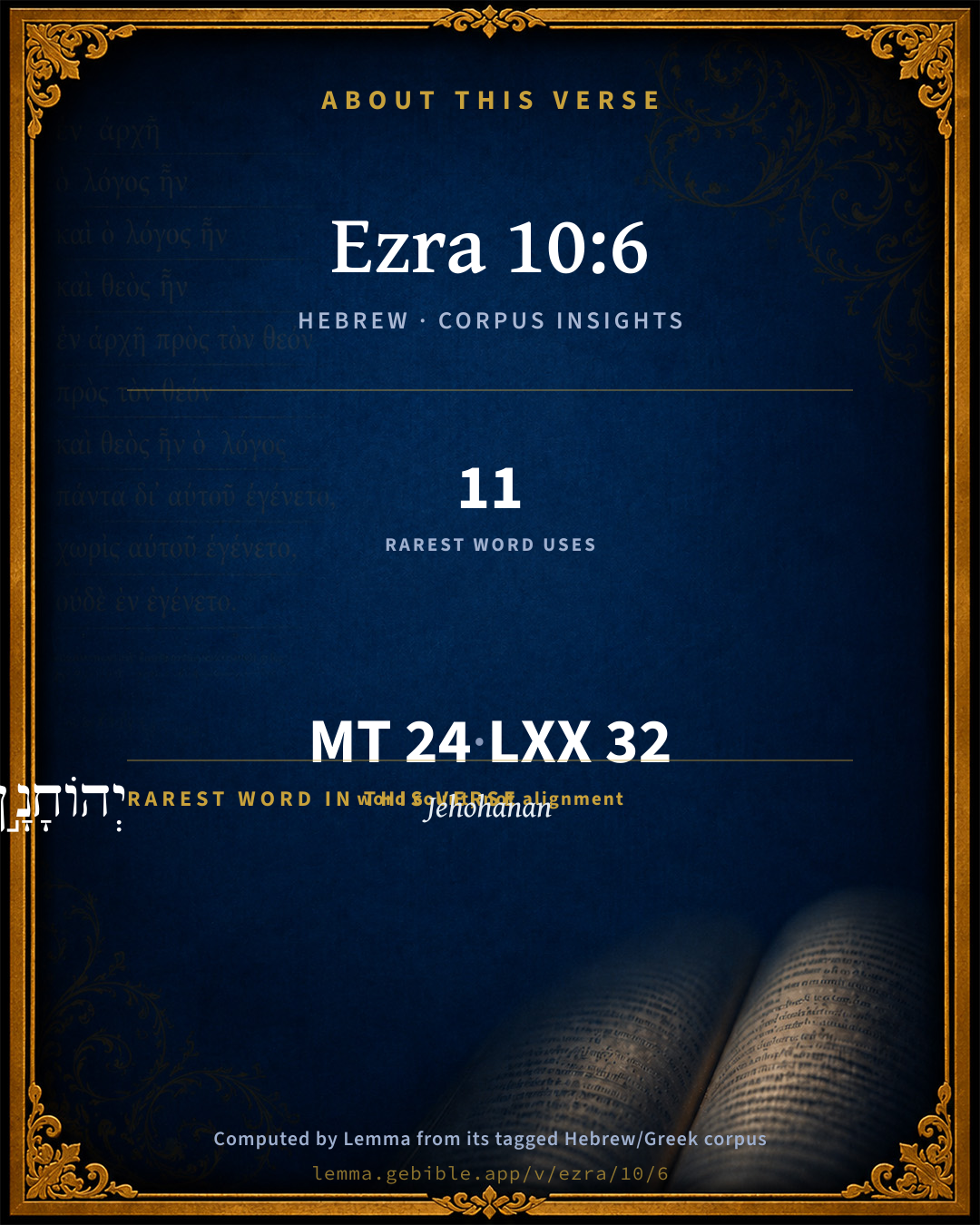
These counts appear in no published source. They are computed here, from the morphology-tagged text and Lemma’s own curated glosses. What Lemma adds →

24
words
22
distinct lemmas
Historical
section

Notable vocabulary

The rarest word here is יְהוֹחָנָ֣ן Jehohanan H3076 — appearing just 11 times in the whole Hebrew Bible.

Shared distinctive vocabulary

יְהוֹחָנָ֣ן Jehohanan H3076 occurs in 11 verses of the Hebrew Bible. Also found in:

Grammatical profile

  • 6 verbs
  • 12 nouns
  • 2 prepositions
  • 1 conjunction
  • 1 adverb
  • 2 particles

Verb forms

  • וַיָּ֣קָם Qal · Sequential Imperfect
  • וַיֵּ֕לֶךְ Qal · Sequential Imperfect
  • וַיֵּ֣לֶךְ Qal · Sequential Imperfect
  • אָכַל֙ Qal · Perfect
  • שָׁתָ֔ה Qal · Perfect
  • מִתְאַבֵּ֖ל Hithpael · Participle Active

Repetition

Words recur within this verse — often emphatic in Hebrew:

  • וַיֵּ֕לֶךְ to walk H3212 ×2
  • לֹֽא not H3808 ×2

Hebrew & Septuagint length

In English translation the verse runs 45 words from the Hebrew and 44 from the Septuagint (LXX English) — closely comparable.

A rough comparison of the two English renderings, which tokenize alike — not a word-level alignment.

Word counts can differ between the Hebrew and the Greek without any difference in meaning — e.g. the Hebrew direct-object marker אֵת has no separate Greek word, and Greek often adds the article ὁ.

In the original languages it is 24 Hebrew tokens and 32 Greek tokens — but the two are counted differently (Hebrew bundles its prefixes and suffixes into one token; the Greek is in lemma form), so that isn’t a like-for-like length.

Cross-references

14

Topical passages linked to Ezra 10:6 in the Treasury of Scripture Knowledge — connected by theme and wording, ordered by reader-vote popularity; previews shown in the World English Bible.

  • Deuteronomy 9:18 I fell down before Yahweh, as at the first, forty days and forty nights; I did neither eat bread nor drink water; because of all your sin which you sinned, in doing that which was evil in the sight of Yahweh, to provoke him to anger.
  • Nehemiah 3:1 Then Eliashib the high priest rose up with his brothers the priests, and they built the sheep gate; they sanctified it, and set up the doors of it; even to the tower of Hammeah they sanctified it, to the tower of Hananel.
  • Nehemiah 12:22 As for the Levites, in the days of Eliashib, Joiada, and Johanan, and Jaddua, there were recorded the heads of fathers' [houses]; also the priests, in the reign of Darius the Persian.
  • John 4:31–34 In the meanwhile, the disciples urged him, saying, "Rabbi, eat."
  • Exodus 34:28 He was there with Yahweh forty days and forty nights; he neither ate bread, nor drank water. He wrote on the tablets the words of the covenant, the ten commandments.
  • Ezra 9:4 Then were assembled to me everyone who trembled at the words of the God of Israel, because of the trespass of them of the captivity; and I sat confounded until the evening offering.
  • Ezra 10:1 Now while Ezra prayed and made confession, weeping and casting himself down before the house of God, there was gathered together to him out of Israel a very great assembly of men and women and children; for the people wept very sore.
  • Nehemiah 3:20 After him Baruch the son of Zabbai earnestly repaired another portion, from the turning [of the wall] to the door of the house of Eliashib the high priest.
  • Nehemiah 12:10 Jeshua became the father of Joiakim, and Joiakim became the father of Eliashib, and Eliashib became the father of Joiada,
  • Nehemiah 13:5 had prepared for him a great chamber, where before they laid the meal-offerings, the frankincense, and the vessels, and the tithes of the grain, the new wine, and the oil, which were given by commandment to the Levites, and the singers, and the porters; and the heave-offerings for the priests.
  • Nehemiah 13:28 One of the sons of Joiada, the son of Eliashib the high priest, was son-in-law to Sanballat the Horonite: therefore I chased him from me.
  • Job 23:12 I haven't gone back from the commandment of his lips. I have treasured up the words of his mouth more than my necessary food.
  • Isaiah 22:12 In that day did the Lord, Yahweh of Hosts, call to weeping, and to mourning, and to baldness, and to girding with sackcloth:
  • Daniel 9:3 I set my face to the Lord God, to seek by prayer and petitions, with fasting and sackcloth and ashes.

Cross-references courtesy of OpenBible.info (CC BY 4.0).

Hebrew and Greek witnesses Masoretic Hebrew ↔ Greek Septuagint

The same verse in the two great witnesses to the Old Testament, shown verse-for-verse.

These are two independent witnesses, not word-aligned to each other, and the Septuagint is shown in lemma (dictionary) form.

Hebrew Ezra 10:6 Masoretic · Westminster Leningrad Codex

וַיָּ֣קָם עֶזְרָ֗א מִלִּפְנֵי֙ בֵּ֣ית הָֽאֱלֹהִ֔ים וַיֵּ֕לֶךְ אֶל לִשְׁכַּ֖ת יְהוֹחָנָ֣ן בֶּן אֶלְיָשִׁ֑יב וַיֵּ֣לֶךְ שָׁ֗ם לֶ֤חֶם לֹֽא אָכַל֙ וּמַ֣יִם לֹֽא שָׁתָ֔ה כִּ֥י מִתְאַבֵּ֖ל עַל מַ֥עַל הַגּוֹלָֽה

Then Ezra rose up from before the house of God, and went into the chamber of Jehohanan the son of Eliashib: and [when] he came there, he ate no bread, nor drink water; for he mourned because of the trespass of them of the captivity.

World English Bible · Public Domain

Greek LXX Ezra 10:6 Septuagint · lemma form

καί ἀναἵστημι εσδρας ἀπό πρόσωπον οἶκος ὁ θεός καί πορεύομαι εἰς γαζοφυλάκιον ιωαναν υἱός ελισουβ καί πορεύομαι ἐκεῖ ἄρτος οὐ ἐσθίω καί ὕδωρ οὐ πίνω ὅτι πένθος ἐπί ὁ ἀσυνθεσία ὁ ἀποικία

And Esdras rose up from before the house of God, and went to the treasury of Joanan the son of Elisub; he even went there: he ate no bread, and drank no water; for he mourned over the unfaithfulness of them of the captivity.

LXX2012 (modern English Septuagint) · Public Domain

In the Septuagint this is one book — Esdras B (2 Esdras): Ezra is chapters 1–10, Nehemiah 11–23.

On this verse, Keil & Delitzsch discusses the Septuagint’s reading. Read the note in Commentary ↓

Hebrew: Westminster Leningrad Codex (CC BY 4.0). Greek: Septuagint (public domain); English from LXX2012 (modern English Septuagint) (Public Domain). How the Septuagint differs from the Hebrew →

Commentary

Notes on Ezra 10:6 from classic Christian and Jewish commentators (each source and its license shown beneath its notes). The classic Christian expositions comment on the surrounding passage and are grouped to its opening verse, so a note may address several verses; the Jewish commentaries on the Tanakh (Rashi and others) are per-verse, so they appear only where the commentator wrote on this verse.

Lemma curates 59 commentaries, every one of them public domain or Creative Commons licensed, each selected and text-cleaned for this edition rather than reprinted as found. About our sources →

Trapp's Complete Commentary

John Trapp

Ezr 10:6 Then Ezra rose up from before the house of God, and went into the chamber of Johanan the son of Eliashib: and [when] he came thither, he did eat no bread, nor drink water: for he mourned because of the transgression of them that had been carried away.

Ver. 6. Then Ezra rose up from before the house of God] Where God had promised to hear prayers for Christ’s sake, whereof that house was a type. See Ezr 10:1.

And went into the chamber of Johanan] As a fit meeting place, where they might consider, consult, and give counsel. Over the council chamber at Venice is written, Let nothing be done here against the public welfare. A professor of the Turks’ law proclaimeth before they advise or attempt aught, That nothing be done against religion. Over the townhall in Zant are set these two verses in letters of gold:

“ Hic locus odit, amat, punit, conservat, honorat,

Nequitiam, pacem, crimina, iura, bonos. ”

Think the same we must needs of this holy conclave or council chamber, where the Sanhedrim was present, and Ezra president.

He did eat no bread, nor drink water] Though fasting and faint with much mourning, yet no food would down with him till he had gone thorough stitch with the work. It was his food and drink to do the will of his heavenly Father. So it was good Job’s, Job 23:12, and our Saviour’s, Mat 21:17; Mat 21:23. It was then, when disappointed of a breakfast at the barren fig tree, and coming hungry into the city, he went not into an eating house nor into a friend’s house to refresh himself; but into God’s house, where he continued teaching the people all that day.

For he mourned because of the transgression] It was not then a natural abstinence, arising from sickness, nor a civil, for health’s sake, or for some other worldly respect; but a religious fast, which is usually to be held out a whole day, usque dum stellae in caelo appareant (as an old canon hath it), till the stars appear in the sky; yet so as that nature be chastised, not disabled for duty.

John Trapp, A Commentary or Exposition upon All the Books of the Old and New Testament (1647–1656) — public domain. Text from a community e-Sword module.

Joseph Benson's Commentary

Ezr 10:6. Then rose up Ezra from before the house — This seems to imply that he made them swear before he would rise up; and went into the chamber of Johanan — That, with the princes and elders, he might consult about the execution of their resolution. And when he came thither — The word when is not in the Hebrew: the clause, therefore, had better be translated, Till he came thither; that is, till he saw something done, he ate nothing.

Joseph Benson's Commentary on the Old and New Testaments (1811–1818) — public domain. Text from a community e-Sword module.

Keil & Delitzsch

C. F. Keil & F. Delitzsch

Hereupon Ezra left the place before the house of God, and went into the chamber of Johanan the son of Eliashib, to fast and mourn there for the unfaithfulness (transgression) of them that had been carried away (הגּולה מעל like Ezr 9:4). Johanan the son of Eliashib cannot actually be Johanan ben Eliashib (Neh 12:23) the high priest, however natural it may be to understand by the chamber of Johanan one of the chambers in the out-buildings of the temple, called after the name of some well-known individual. For the high priest Eliashib was a contemporary of Nehemiah, and the high priest Johanan was not the son, but, according to the definite statement, Neh 12:10, the grandson, of Eliashib, and the son of Joiada (the correct reading of Neh 12:11 being: Joiada begat Johanan and Jonathan). Now a chamber of the temple could not in Ezra's time have been as yet called after a grandson of Eliashib the contemporary of Nehemiah;

(Note: This would not, indeed, be impossible, because, as we shall subsequently show (in our Introduction to the book of Nehemiah, 2), Eliashib's grandson Johanan might be already ten years of age at the time of the transaction in question; so that his grandfather, the high priest Eliashib, might have called a chamber of the temple after the name of his grandson. This view is not, however, a very probable one.)

and both Johanan and Eliashib being names which frequently occur (comp. Ezr 10:24, Ezr 10:27, Ezr 10:36), and one of the twenty-four orders of priests being called after the latter (Ch1 24:12), we, with Ewald (Gesch. iv. p. 228), regard the Johanan ben Eliashib here mentioned as an individual of whom nothing further is known-perhaps a priest descended from the Eliashib of Ch1 24:12, and who possessed in the new temple a chamber called by his name. For there is not the slightest reason to suppose, with Bertheau, that a subsequent name of this chamber is used in this narrative, because the narrator desired to state the locality in a manner which should be intelligible to his contemporaries. Cler. and Berth. desire, after 1 Esdr. 9:1 (καὶ αὐλισθεὶς ἐκεῖ), to change שׁם ויּלך into שׁם ויּלן: and he passed the night there without eating bread or drinking water. But the lxx having καὶ ἐπορεύθη ἐκεῖ, and the repetition of the same word being, moreover, by no means infrequent, comp. e.g., ויּקם in Ezr 10:5, Ezr 10:6, and finally שׁם repeatedly standing for thither, e.g., Sa1 2:14 (שׁם הבּאים), there are no adequate grounds for an alteration of the text. The paraphrase of 1 Esdr. arises merely from the connection, and is devoid of critical value. To eat no bread, etc., means to fast: comp. Exo 34:28; Deu 9:9.

Keil & Delitzsch — Biblical Commentary on the Old Testament (1861–1891) — public domain (CC PDM 1.0). Text via the HelloAO Bible API. (Old Testament only.)

Matthew Henry's Commentary

We have here an account of the proceedings upon the resolutions lately taken up concerning the strange wives; no time was lost; they struck when the iron was hot, and soon set the wheels of reformation a-going. 1. Ezra went to the council-chamber where, it is probable, the priests used to meet upon public business; and till he came thither (so bishop Patrick thinks it should be read), till he saw something done, and more likely to be done, for the redress of this grievance, he did neither eat nor drink, but continued mourning. Sorrow for sin should be abiding sorrow; be sure to let it continue till the sin be put away. 2. He sent orders to all the children of the captivity to attend him at Jerusalem within three days (Ezr 10:7, Ezr 10:8); and, being authorized by the king to enforce his orders with penalties annexed (Ezr 7:26), he threatened that whosoever refused to obey the summons should forfeit his estate and be outlawed. The doom of him that would not attend on this religious occasion should be that his substance should, in his stead, be for ever after appropriated to the service of their religion, and he himself, for his contempt, should for ever after be excluded from the honours and privileges of their religion; he should be excommunicated. 3. Within the time limited the generality of the people met at Jerusalem and made their appearance in the street of the house of God, Ezr 10:9. Those that had no zeal for the work they were called to, nay, perhaps had a dislike to it, being themselves delinquents, yet paid such a deference to Ezra's authority, and were so awed by the penalty, that they durst not stay away. 4. God gave them a token of his displeasure in the great rain that happened at that time (Ezr 10:9 and again Ezr 10:13), which perhaps kept some away, and was very grievous to those that met in the open street. When they wept the heavens wept too, signifying that, though God was angry with them for their sin, yet he was well pleased with their repentance, and (as it is said, Jdg 10:16) his soul was grieved for the misery of Israel; it was also an indication of the good fruits of their repentance, for the rain makes the earth fruitful. 5. Ezra gave the charge at this great assize. He told them upon what account he called them together now, that it was because he found that since their return out of captivity they had increased the trespass of Israel by marrying strange wives, had added to their former sins this new transgression, which would certainly be a means of again introducing idolatry, the very sin they had smarted for and which he hoped they had been cured of in their captivity; and he called them together that they might confess their sin to God, and, having done that, might declare themselves ready and willing to do his pleasure, as it should be made known to them (which all those will do that truly repent of what they have done to incur his displeasure), and particularly that they might separate themselves from all idolaters, especially idolatrous wives, Ezr 10:10, Ezr 10:11. On these heads, we may suppose, he enlarged, and probably made such another confession of the sin now as he made Ezr 9:1-15, to which he required them to say Amen. 6. The people submitted not only to Ezra's jurisdiction in general, but to his inquisition and determination in this matter: "As thou hast said, so must we do, Ezr 10:12. We have sinned in mingling with the heathen, and have thereby been in danger, not only of being corrupted by them, for we are frail, but of being lost among them, for we are few; we are therefore convinced that there is an absolute necessity of our separating from them again." There is hope concerning people when they are convinced, not only that it is good to part with their sins, but that it is indispensably necessary: we must do it, or we are undone. 7. It was agreed that this affair should be carried on, not in a popular assembly, nor that they should think to go through with it all on a sudden, but that a court of delegates should be appointed to receive complaints and to hear and determine upon them. It could not be done at this time, for it was not put into a method, nor could the people stand out because of the rain. The delinquents were many, and it would require time to discover and examine them. Nice cases would arise, which could not be adjudged without debate and deliberation, Ezr 10:13. "And therefore let the crowd be dismissed, and the rulers stand to receive informations; let them proceed city by city, and let the offenders be convicted before them in the presence of the judges and elders of their own city; and let them be entrusted to see the orders executed. Thus take time and we shall have done the sooner; whereas, if we do it in a hurry, we shall do it by halves, Ezr 10:14. If, in this method, a thorough reformation be made, the fierce wrath of God will be turned from us, which, we are sensible, is ready to break forth against us for this transgression." Ezra was willing that his zeal should be guided by the people's prudence, and put the matter into this method; he was not ashamed to own that the advice came from them, any more than he was to comply with it.

Matthew Henry's Commentary on the Whole Bible (1708–1710) — public domain (CC PDM 1.0). Text via the HelloAO Bible API.

Adam Clarke's Commentary

Verse 6. Johanan the son of Eliashib] Eliashib was high priest, and was succeeded in that office by his son Joiada, Ne 12:10. Probably Johanan here is the same as Jonathan in Nehemiah, who was the son of Joiada, and grandson of Eliashib. Some suppose that Johanan and Joiada were two names for the same person.

Adam Clarke's Commentary on the Bible (1810–1826) — public domain. Text from a community e-Sword/MySword module.

The Cambridge Bible for Schools and Colleges

gen. ed. J. J. S. Perowne

6–15. The Assembly and the Reform

6. went into the chamber] See on Ezr_8:29, and cf. Neh_13:4.

Johanan the son of Eliashib] R.V. Jehohanan the son of Eliashib. The best-known Eliashib of this period is the High-priest who appears as a contemporary of Nehemiah (Neh_3:1; Neh_13:4; Neh_13:28). In Neh_12:23 we find the mention of a ‘Johanan the son of Eliashib’, but who, by comparison with Ezr_10:7; Ezr_10:22, must have been this Eliashib’s grandson. It is probable that the ‘Jehohanan the son of Eliashib’ is the same as that ‘Johanan the son of Eliashib’. If so, how are we to account for a chamber, presumably in the Temple precincts, being assigned to one who was the grandson of the High-priest Eliashib? (a) Some suppose that Johanan the grandson of Eliashib was old enough at this time to receive as one of the High-priestly family a special chamber. But why should Ezra betake himself to the chamber of one who must have been but a mere boy? For Eliashib was living 20 years later (cf. Neh_13:7). (b) Others suppose the Compiler to be using the language of a considerably later generation than that of Ezra; he knew of a certain chamber in the Temple’s precincts as Johanan’s chamber, because it had become associated with the name of Eliashib’s grandson during his High-priesthood. This appears to be the most probable explanation. If so, the use of the name helps to determine the date at which Ezra’s Memoirs were compiled. It is however possible that the Jehohanan the son of Eliashib was of a different family from the Johanan the son of Joiada and grandson of Eliashib, and that the difficulty is only an apparent one arising from the similarity of names in the families of the same great house or tribe.

and when he came thither, he did eat, &c.] So the R.V. text. The R.V. marg. says ‘According to some ancient versions, and he lodged there’. The Hebrew word for ‘he came’ is the same as that for ‘went’ in the previous clause. This reading is supported by the Hebrew text and by the LXX. (καὶ ἐπορεύθη ἐκεῖ). It is however hard to believe that it can be the original reading. (1) The repetition of the word is awkward. (2) The clause, stating that he refused to taste food, does not follow suitably upon the mention of his arrival. (3) The adverb in the original does not strictly mean ‘thither’, but ‘there’. The parallel passage in 1 Esdras (Ezr_9:2) has ‘and having lodged there’, and this reading is supported by the Syriac Peshitto and the Arabic. The variation in the Hebrew text requisite to give this meaning is exceedingly small. In the old Hebrew characters the two letters (ן and ך) are very liable to be confused, while the use of the very similar verb just before made an accidental repetition very possible.

This reading is probably correct, and we should accordingly translate ‘And he lodged (or passed the night) there’. The words are then the same as in Gen_28:11, ‘And he tarried there all night’; Gen_32:13, ‘And he lodged there that night’; Jos_8:9, ‘but Joshua lodged that night’. The point emphasized is that Ezra continued in the precincts of the Temple all that night and protracted his fast. ‘He lodged there and did eat no bread nor drink water’: i.e. while he lodged there, he fasted.

because of the transgression of them that had been carried away] R.V. because of the trespass of them of the captivity. ‘Trespass’, cf. Ezr_9:4. ‘Them of the captivity’, i.e. ‘haggolah’, cf. on Ezr_8:35.

The Cambridge Bible for Schools and Colleges (gen. ed. J. J. S. Perowne; Cambridge University Press, 1878–1918) — public domain. Text from a community e-Sword module.

John Gill's Exposition

Then Ezra rose up from before the house of God,.... Departed from thence:

and went into the chamber of Johanan the son of Eliashib; who was of the family of the high priest. Eliashib was grandson of Joshua the high priest, and succeeded his father Joiakim as such; but though Johanan was never high priest, being a younger son, however he was a person of note, and had a chamber in the temple, whither Ezra went, either to advise with the princes and elders in it, Ezr 10:8 or to refresh himself with food:

and when he came thither, he did eat no bread, nor drink water; or rather "not yet had he ate bread" (o), as some render it; that is, not till he came thither, from the time he first heard of the evil the people had committed; which very probably was early in the morning, and it was now evening:

for he mourned for the transgression of them that had been carried away; into captivity, but were now returned from it, and it grieved him the more, that, after such kindness shown them, they should be guilty of such an evil.

(o) "nondum comederat", Junius & Tremellius, Piscator.

John Gill's Exposition of the Whole Bible (1746–1763) — public domain (CC PDM 1.0). Text via the HelloAO Bible API.

Albert Barnes' Notes on the Bible

The “chamber of Johanan” was probably one of those attached externally to the temple (see 1Ki 6:5-6). Eliashib was the grandson of Jeshua Ezr 3:2, and was high priest under Nehemiah Neh 3:1. He could assign chambers in the temple to whomever he pleased (see Neh 13:4-5).

Albert Barnes' Notes on the Bible (1834–1885) — public domain. Text from a community e-Sword/MySword module.

Haydock's Catholic Bible Commentary

Before. 3 Esdras, "the court or hall of the temple." (Haydock) --- Eliasib. His son and successor is styled Joiada, 2 Esdras xii. 10. The same person had often many names, (Calmet) or Johanan might be a younger son. (Menochius) --- Josephus ([Antiquities?] xi. 5.) says, that Esdras went to the apartments of John and Eliasib. (Haydock) --- Esdras, though sent extraordinarily by God, repairs to the son of the priest, as St. Paul conferred with other apostles, Galatians ii. (Worthington)

George Leo Haydock (1774–1849), Haydock's Catholic Family Bible and Commentary, 1859 edition — public domain. Excludes Psalms (Douay-Rheims chapter numbering differs from Protestant) and Deuterocanonical books (Catholic canon only).

Matthew Poole's English Annotations

Went into the chamber, that he with the princes and elders, as it follows, Ezr 10:8, might consult about the execution of their resolution.

Matthew Poole's English Annotations on the Holy Bible (1683–1685) — public domain. Text from a community e-Sword/MySword module.

Whedon's Commentary on the Bible

Daniel D. Whedon

6. Chamber of Johanan — One of the chambers or cells of the temple where this son of Eliashib abode. Compare Neh_13:4-5. Johanan, or Jehohanan, was probably the same as Jonathan in Neh_12:11. In that case we must understand the word son here as grandson. Davidson asserts (Kitto’s Cyc.) that Eliashib lived after Nehemiah, but this does not show but that he lived at the time of Nehemiah and of Ezra also, and long before his death his grandson might have occupied a chamber of the temple, and exercised the priestly functions.

Did eat no bread, nor drink water — Like Moses when he mourned for the transgression of Israel, Deu_9:18.

Daniel D. Whedon (gen. ed.), Commentary on the Old and New Testaments (1874–1909) — public domain. Text from a community e-Sword module.

The Pulpit Commentary

EZRA"S FAST (ver. 6). Matters having reached this point, the covenant having been made, and the only question remaining for consideration being how the decision come to should be carried out, Ezra "rose up," and withdrew himself for a time from the people, entering into one of the side chambers of the temple, and secluding himself there. The guilt of his brethren still pressed heavily on his spirit, and he continued the mourning which he had commenced as soon as it came to his ears. To this mourning he now joined a fast of the strictest kind, an entire abstinence both from eating and drinking, like that of Moses on Mount Sinai. (Exo_34:28) Natural piety seems to have taught men generally, (Jon_3:5-7) and the Jews among them, that such abstinence was a fitting accompaniment of penitential prayer, and might be counted on to lend it additional force with Almighty God. Compare the private and personal fasts of David, (2Sa_12:16) Ahab, (1Ki_21:27) Daniel, (Dan_9:3) and Nehemiah. (Neh_1:4)

The chamber of Johanan. On the temple chambers see comment on Ezr_8:29. Johanan appears by Neh_12:22, Neh_12:23, compared with vers. 10-11, to have been really the grandson of Eliashib, who, as high priest, would have the right of assigning him a chamber in the temple. (compare Neh_13:4, Neh_13:5) I did eat no bread nor drink water. Strict fasts of this kind had been observed by Moses twice Exo_34:28, and, (Deu_9:18) and by the Ninevites, (Jon_3:7) but they were very uncommon. Usually it was considered enough to abstain from eating. (1Sa_1:7 1Sa_20:34; 2Sa_3:35) Sometimes the person who fasted merely abstained from "meat and wine, and pleasant bread. (Dan_10:3) Ezra"s great earnestness appears in the severity of his fast, which (it is to be remembered) was not for his own sins, but for those of his brethren.

Vers. 6-12.

A national call.

We have traced before the probable influence of Ezra"s piety and instructions; how they seem to have aroused the national conscience, and so to have brought to light the secret national sin; and how they afterwards brought together so many of the inhabitants of Jerusalem, first to grieve for it, and then to renounce it, and resolve to suppress it. But these men, however influential, were only a fractional part of the nation. If their resolves were to be carried out satisfactorily, and so as to insure a truly national forsaking of the evil amongst them, they required the general consent, and, at least, the partial co-operation, of all the children of the captivity. And, as a first practical step towards obtaining these things, they would naturally desire, in Jerusalem itself, the presence of all such. Accordingly, we find described to us in this section

(1) such a national call to assemble, and

(2) such a national call to amend.

I THE CALL TO ASSEMBLE. This call is deserving of notice

1. As to its origin. Where did it really arise? In that chamber to which we find Ezra retiring after pledging the assembled inhabitants of Jerusalem to suppress the evil bewailed by them. At first sight it seems strange, when there was so much requiring to be done in public, that he should seek privacy in this manner; but doubtless in that priestly chamber. (see Neh_12:10, Neh_12:22) to which he retired he was in frequent communication with the most like-minded of the princes and priests; and doubtless, also, his penitent abstinence there from bread and water, with other signs of his still continuing grief and alarm, would be an effectual means of stirring them up to do their part of the work. Wherever he was, at this time, there was but one thought in his heart. This would lead in them to but one endeavour, that of putting a stop to the plague. Hence the "proclamation" which "they made" (ver. 7).

2. As to its extent. Here, also, see Ezra"s influence. The proclamation was universal; made "throughout," and made to "all;" to all the "children of the captivity" (ver. 7) to all "those that had been carried away" (ver. 8) to all those, i.e. , for whose transgressions (ver. 6) Ezra was mourning at that time. In this thrice-repeated description of them can we not trace the mainspring of his grief, the recollection, viz., of the great judgment and still greater deliverance which those who thus sinned had experienced (comp. 9:7-9)? It is to all such, therefore, as thus described, that the proclamation goes forth.

3. As to its urgency. How speedily these "children of the captivity" are called to come up. Within "three days" they must all be at Jerusalem. One day, probably, for receiving the message; one day for preparing and travelling; on the third day to be there. (comp. Mar_8:31 9:31) Also, how peremptorily. Every man summoned must come up on pain of two things, the confiscation of his property (comp. Ezr_7:26, as connecting this with Ezra"s influence) and the excommunication of his person. No man so refusing would be considered by the returned remnant as still belonging to their company. If he did so refuse, the sin of it should belong exclusively to himself. (see 1Ti_5:22)

4. As to its success. "All the men of Judah and Jerusalem" came up within the required time. It is also evident that they came up in the requisite spirit. It was a great day a wonderful scene. Both seem to have impressed themselves upon the national memory. "It was the ninth month; the twentieth day." They could see it all still; the restored house, the open court before it, the multitudes there assembled, their weary attitude, their trembling grief. They could even hear still the heavy showers not unusual indeed at that season, yet evidently at this time of very unusual severity which would help so much, in that land of sunshine, to intensify the prevailing gloom; not impossibly, also, reminding some of those present 1Sa_12:18. See how well this call had succeeded; and how much reason there was to trace its success (when we remember Pro_16:1; Mat_6:6) to the secret intercessions of Ezra in the "chamber of Johanan, the son of Eliashib.

II THE CALL TO AMEND. This again was very successful, and, doubtless, from much the same cause. Not only had the people come together, as we have already seen, most willing to hear; but all that followed was also correspondingly bright. For example, observe

1. How faithful the counsel given. Doubly distressing as the distress of the people must have been to Ezra himself, he will not attempt to remove it by any cry of false peace. (Jer_6:14) On the contrary, he states thefact plainly, "Ye have transgressed;" that is certain. Also he states it exactly, "Ye have taken strange wives;" that is the main point of your trespass. Also, once more, he states it fully," To increase the trespass of Israel;" to add to that which was already too great, and which once before, in fact, except for God"s wonderful mercy, would have ruined Israel beyond recovery. That being the case, what ought to be done? First of all, let the truth be acknowledged. The sin has been public. Avow it, "therefore," publicly. Make open "confession" of it before "Jehovah;" before "Jehovah the God of your fathers," against whom ye have sinned. Next, let the sin be forsaken. You have greatly displeased God by this conduct. Now, therefore, seek the opposite, and be ready to "do his pleasure," and not your own. Also do it voluntarily. Separate yourselves from these evil associations; and that, more-over, at whatever sacrifice, and with however much pain the people of the land, and from the strange wives." To all this observe

2. How hearty their response Observe its purport, as direct as an echo: "As thou hast said, so must we do." Its unanimity, from "all" those present, however many, however diverse. Its manner, with outspoken clearness, and therefore without hesitation, or reluctance, or false shame, or indifference all these, as we know, being things which restrain the utterance and prevent it from being "loud." Very grave, very brave, very distinct, and very determined, in the midst of the descending rain-storm, was this their response a truly national, a truly faithful pledge of amendment of life.

Hence we may see, in conclusion

1. How national affairs are determined, viz., so far as men are concerned, rather by the supplication of God"s servants than by the proclamations of rulers. Not cabinet councils so much as closet prayers shape the history of the world. The will of Ezra in Johanan"s chamber was in communication, by the way of God"s throne, with all the wills in the land (comp. Gen_18:23-33 Gen_19:29 Gen_20:7; 1Sa_7:5; Job_42:8; 1Ti_2:1, 1Ti_2:2; and, in a certain sense, 1Ki_19:16; Psa_149:5-9; Jer_1:10)

2. How national judgments may be averted, viz., by that which amounts, however expressed, to a really national confession and subsequent forsaking of sin. The exact mode of making this confession is of minor importance, and may perhaps be a subject admitting of considerable diversity of opinion, provided only that there is no real room for uncertainty as to its meaning and scope. The voice that said what was forbidden, must be the voice, it is clear, to unsay it, so far as lies in its power. This applies not only to nations, but to cities, to Churches, to families, to all associations, in fact, of human beings. Wherever there is association in evil, there must be like association in its repudiation. The fact, also, that such repudiation of evil is the only step that we can take on our part towards its ultimate forgiveness, only makes the duty of taking it, if that be possible, more imperative still. (see Jer_3:12, Jer_3:13) The less God asks, the less excuse for our refusing to give it. (see 2Ki_5:13)

HOMILIES BY J.A. MACDONALD Vers. 6-44.

The reformations.

Roused by the speech of Shechaniah to the work of reformation, Ezra promptly took his measures. These are set forth in the words before us. The consideration of the subject may be conveniently arranged under three heads, viz.

I THE PROCLAMATION.

1. This was drawn up in the temple (vers. 6, 7).

(1) In the "chamber of Johanan, the son of Eliashib." Eliashib was high priest, in which office he was succeeded by his son Joiada. (Neh_12:10) Some think Johanan was another name for Joiada; but Joiada had a son Jonathan, who more probably was this Johanan. (Neh_12:11) In this case Ezra consulted with the grandson of Eliashib. Sagacity for counsel is not always found with age.

(2) Perhaps the chamber of Johanan was the place in which a council of priests assembled. The plural "they" who "made proclamation" shows that Ezra did not issue it upon his sole authority. It would go forth with the sanction of the civil and ecclesiastical rulers of the nation (see ver. 8).

(3) It was also drawn up in a spirit suited to the solemnity of the occasion and the place. Ezra still continued his fast; "for he mourned because of the transgression of them that had been carried away." Mourning should not cease until sin is abandoned. Under the influence of this true spirit the document was framed.

2. Its measures were strong and peremptory.

(1) All the children of the captivity were to assemble in Jerusalem within three days. Sufficient time was given. No man can plead that God has not given him sufficient time for the securing of his salvation. But there was no time to waste. We must not play with repentance. Procrastination is peril.

(2) Failing to appear, the ecclesiastical penalty was excommunication. Exclusion from the society of God"s people upon earth is a fearful forfeiture But what must be the calamity of permanent exclusion from the holy universe!

(3) There was also a civil penalty, viz., "that all his substance should be forfeited." The Hebrew for "forfeited" here is in the margin construed "devoted," which suggests that it should be given to the sacred uses of the temple. This was fitting where civil and ecclesiastical laws were the same; but here is no justification for the infliction of civil penalties by ecclesiastical authority under the gospel.

II THE APPEAL (vers. 10, 11).

1. The people were prepared to hear it.

(1) The fear of God was upon them. "All the people sat in the street of the house of God, trembling because of this matter." The Spirit of God had wrought this conviction m their hearts in answer to Ezra"s prayer.

(2) They were also terrified because of the rain. This rain may have been natural and seasonable, for it was then December, and the Septuagint construes the word for "rain" by winter. It was probably miraculous. (comp. 1Sa_12:18) This agrees best with the terror it occasioned.

2. It urged upon them the duty of reformation.

(1) It brought home to them their sin. Simply the heads of the discourse are given here; but many arguments were doubtless used to force home conviction.

(2) It urged them to make full confession to God. Where conviction is deep and real there will be full confession. God requires this. (1Jn_1:9)

(3) It moved them to forsake their sin. There is an impudent confession of sin which aggravates its turpitude. Sincere confession leads to reformation.

III THE RESPONSE.

1. The people consented to the reformation.

(1) The consent was emphatic. "As thou hast said, so must we do." We must do it, or we are undone.

(2) It was hearty. They said this "with a loud voice." It is well to pronounce ourselves against our sins. It strengthens our courage for God.

(3) It was unanimous. "All the congregation answered." There is a wonderful unanimity in seasons of religious revival. God uses the sympathy of numbers.

2. They suggested measures for carrying it on.

(1) The business was too heavy to be finished m a day. Nice points might arise to be considered. For example, some of the reputed strange wives may have become Jewish proselytes.

(2) The rulers of all the congregation were to be represented by the elders of every city and the judges. Before these local courts justice might be carried out with reasonable expedition.

3. Ezra consented to their proposal.

(1) Three months were accordingly occupied with this business (vers. 16, 17). During this time 113 delinquents were convicted (vers. 18-44).

(2) Amongst these were members of the high priest"s family. They gave their hands in token of their submission. (see 1Ch_29:24, margin) to put away their wives. They also offered a ram for their trespass. This example was doubtless followed by the people, for everything was to be done according to the law. (ver. 3; also Lev_6:4, Lev_6:6)

(3) In these sacrifices the gospel was foreshadowed. Note the children of the captivity" appear to have been settled "in Judah and Jerusalem," which suggests that there were but few of the "ten tribes" among them, who would naturally seek their inheritance in other parts of Palestine. Agreeably to this, the people who assembled in response to the proclamation are described as "all the men of Judah and Benjamin. J.A.M.

The Pulpit Commentary (1880–1919), ed. H.D.M. Spence-Jones & Joseph S. Exell — public domain. Text from a community e-Sword module.

John Wesley's Explanatory Notes

Went - That with the princes and elders, he might consult about the execution of their resolution. Thither - 'Till he saw something done.

John Wesley, Explanatory Notes Upon the Whole Bible (1754–1765) — public domain. Text via the GEBible commentary corpus.

Lesson kit

Teaching starters — assembled from the data on this page, not authored interpretation. Every prompt links to the verse data it draws on. Edit before teaching.

Ezra, in the Historical, opens this verse with 24 words (22 distinct Hebrew lemmas). Its most distinctive word is Yᵉhôwchânân (“Jehohanan”). A historical commentator’s framing appears above. Read the whole chapter for the surrounding context.

Discussion questions

  1. The word Yᵉhôwchânân carries the sense “Jehohanan.” How does it shape the verse?
  2. How does 1 Chronicles 12:4, which shares the word «Jehohanan», read alongside this verse?
  3. What does the repetition of “to walk” (2× in this one verse) do in this verse?
  4. The translations on this page render this verse differently — a whole-verse word diff, not a word-by-word alignment. What might account for the different wordings?
  5. «וַיָּ֣קָם» is a Qal Sequential Imperfect verb. How does that grammatical form shape the action described?
  6. Compare how Trapp's Complete Commentary and Joseph Benson's Commentary read this verse. Where do they agree or differ?

Things to notice

Reading settings

Reading text

Shown beneath each verse's original-language words.

Old Testament
Old Testament edition

Read the OT as the Masoretic Hebrew (MT) or the Greek Septuagint (LXX).

English shown for the Greek Septuagint (in the Hebrew ↔ Greek comparison).

Comparing translations? Open the Compare panel on any verse page to stack up to four side by side.