
Psalms 146:7

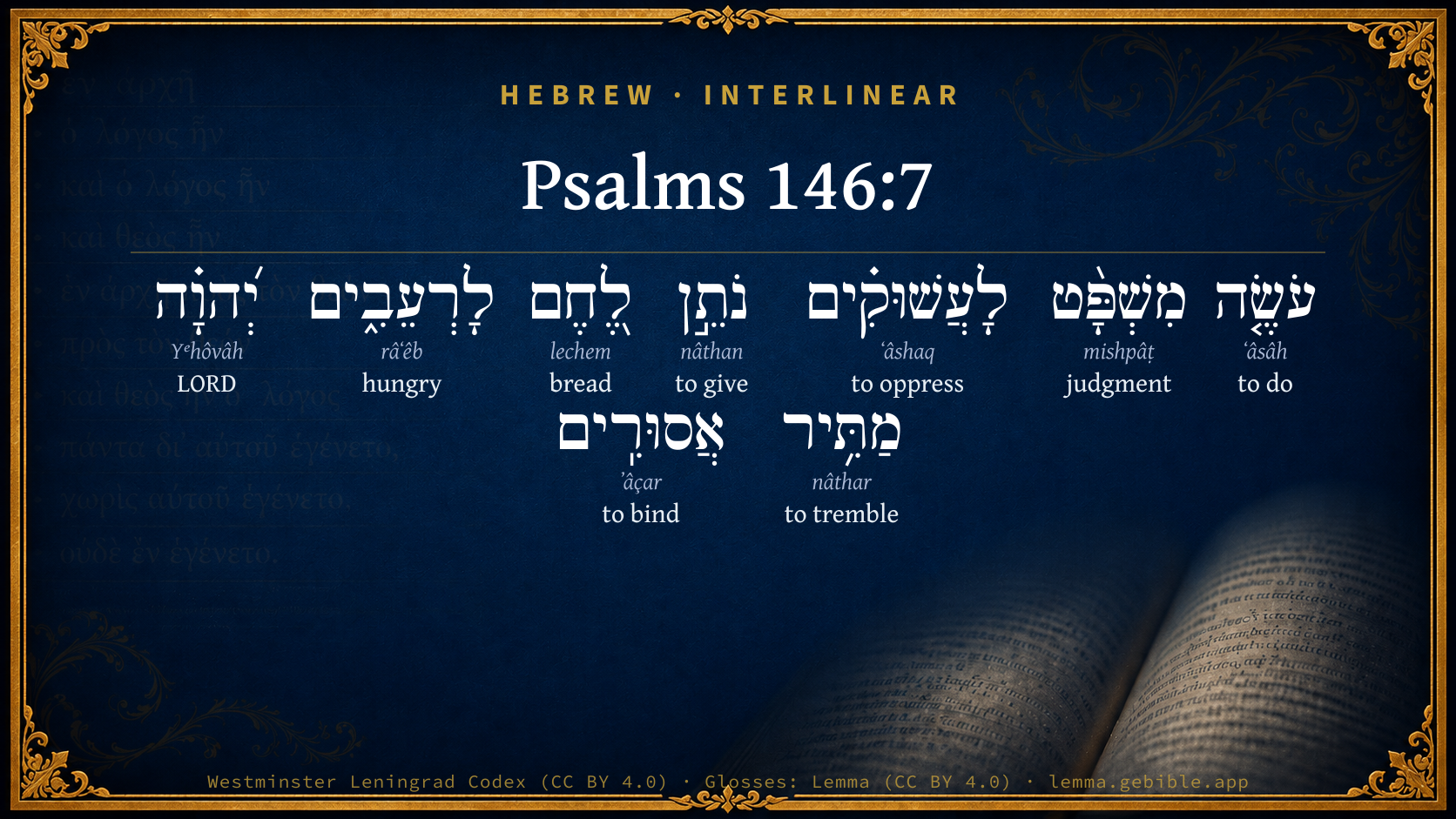
Hebrew (Westminster Leningrad Codex) Psalms 146:7 appears in the Hebrew Old Testament. The text above is from the Westminster Leningrad Codex. Each word links to its Strong’s number, a concise gloss, and parsing drawn from the Open Scriptures Hebrew Bible morphology. Click any word for its full Brown-Driver-Briggs (BDB) entry.
Download image
Cite this verse

Psalms 146:7 (World English Bible). Public Domain. Lemma interlinear Bible study tool, https://lemma.gebible.app/v/psalms/146/7.

Show BibTeX & RIS
BibTeX
RIS
English Translation
Who executes justice for the oppressed; Who gives food to the hungry. Yahweh frees the prisoners.
World English Bible · Public Domain
Download a study sheet

One document with this verse’s original text, its word-by-word gloss line, the meaning frame, cross-references with their text, attributed commentary, and full source and license credits — printable, and it pastes into notes with its structure intact.

This verse Autodidact and up

Study sheet (.html) Plain text (.txt)

A passage Seminary Student

Up to 50 verses in one chapter. A passage sheet keeps up to 6 commentary sources and 12 cross-references per verse, in the order this page ranks them, and says so on the sheet whenever that leaves anything out. Ask for a single verse and you get the Autodidact verse sheet above.

Everything on this page stays free to read, with no account — the sheet is a download of what is already on screen, not access to it.

Want to remove ads? Support Godless Engineer
Compare translations 3

The same verse in 3 English versions, stacked beneath the original-language interlinear above. Click any original word for its lexicon entry.

Each is an independent rendering of the whole verse — the interlinear is not word-aligned to these translations.

Highlighted words mark where these versions differ — a whole-verse word diff, not a word-by-word alignment.

  • World English Bible Public Domain
    Who executes justice for the oppressed; Who gives food to the hungry. Yahweh frees the prisoners.
  • King James Version Public Domain
    Which executeth judgment for the oppressed: which giveth food to the hungry. The LORD looseth the prisoners:
  • unfoldingWord Literal Text CC BY-SA 4.0
    doing justice for the oppressed, giving bread to the hungry. Yahweh is releasing the bound ones.

unfoldingWord Literal Text — © unfoldingWord, licensed CC BY-SA 4.0. Word-aligned USFM3 via Door43 (git.door43.org/unfoldingWord/en_ult).

Versions to compare (up to 4)

3 of 4 selected

Show all 18 translations

Every available English version of this verse, each an independent rendering of the whole verse.

  • World English Bible Public Domain
    Who executes justice for the oppressed; Who gives food to the hungry. Yahweh frees the prisoners.
  • Berean Standard Bible Public Domain
    He executes justice for the oppressed and gives food to the hungry. The LORD sets the prisoners free,
  • Majority Standard Bible Public Domain
    He executes justice for the oppressed and gives food to the hungry. The LORD sets the prisoners free,
  • King James Version Public Domain
    Which executeth judgment for the oppressed: which giveth food to the hungry. The LORD looseth the prisoners:
  • American Standard Version (1901) Public Domain
    Who executeth justice for the oppressed; Who giveth food to the hungry. Jehovah looseth the prisoners;
  • Revised Version (1885) Public Domain
    Which executeth judgment for the oppressed; which giveth food to the hungry: the LORD looseth the prisoners;
  • Geneva Bible (1599) Public Domain
    Which executeth iustice for the oppressed: which giueth bread to the hungry: the Lord loseth the prisoners.
  • Douay-Rheims (1899) Public Domain
    They shall publish the memory of the abundance of thy sweetness: and shall rejoice in thy justice.
  • Young's Literal Translation Public Domain
    Doing judgment for the oppressed, Giving bread to the hungry.
  • Literal Standard Version CC BY-SA 4.0
    Doing judgment for the oppressed, || Giving bread to the hungry.
  • Unlocked Literal Bible CC BY-SA 4.0
    He executes justice for the oppressed and gives food to the hungry. Yahweh frees the prisoners;
  • unfoldingWord Literal Text CC BY-SA 4.0
    doing justice for the oppressed, giving bread to the hungry. Yahweh is releasing the bound ones.
  • Darby Bible Public Domain
    Who executeth judgment for the oppressed, who giveth bread to the hungry. Jehovah looseth the prisoners;
  • World Messianic Bible Public Domain
    who executes justice for the oppressed; who gives food to the hungry. The LORD frees the prisoners.
  • Webster's Bible Public Domain
    Who executeth judgment for the oppressed: who giveth food to the hungry. The LORD looseth the prisoners:
  • Free Bible Version CC BY-SA 4.0
    He makes sure the oppressed receive justice. He gives food to the hungry. The Lord sets the prisoners free.
  • Bible in Basic English Public Domain
    Who gives their rights to those who are crushed down; and gives food to those who are in need of it: the Lord makes the prisoners free;
  • JPS Tanakh (1917) Public Domain
    Who executeth justice for the oppressed; who giveth bread to the hungry. The LORD looseth the prisoners;

Literal Standard Version (2020), Covenant Press — licensed CC BY-SA 4.0. Text via the HelloAO Bible API (eBible.org). Unlocked Literal Bible (unfoldingWord) — licensed CC BY-SA 4.0. Text via the HelloAO Bible API (eBible.org). unfoldingWord Literal Text — © unfoldingWord, licensed CC BY-SA 4.0. Word-aligned USFM3 via Door43 (git.door43.org/unfoldingWord/en_ult). Free Bible Version, Dr. Jonathan Gallagher — licensed CC BY-SA 4.0. Text via the HelloAO Bible API (eBible.org).

Word by word

More ways to search: Search by grammar → Find every occurrence → Compare this word →

Practice this passage: Drill this verse → Learn its vocabulary →

מַתִּ֥יר
nâthar
H5425
“trembling”
Verb, Hiphil, Participle Active, Masculine, Singular, Absolute
Part of Speech
Verb
Stem
Hiphil
Form
Participle Active
Gender
Masculine
Number
Singular
State
Absolute
Full BDB Definition

Origin: a primitive root

TWOT: 1448 , 1449

to start up, tremble, shake, spring up - (Qal) to start up - (Piel) to leap - (Hiphil) to cause to start up - to loose, let loose, undo, be free, be loose - (Hiphil) - to unfasten, loosen - to set free, unbind
  1. עֹשֶׂ֤ה ʻâsâh H6213 “doing” Verb, Qal, Participle Active, Masculine, Singular, Absolute
  2. מִשְׁפָּ֨ט mishpâṭ H4941 “judgment” Noun, Common, Masculine, Singular, Absolute
  3. לָעֲשׁוּקִ֗ים ʻâshaq H6231 “to/for the · oppressed” Preposition, Determined + Verb, Qal, Participle Passive, Masculine, Plural, Absolute
  4. נֹתֵ֣ן nâthan H5414 “giving” Verb, Qal, Participle Active, Masculine, Singular, Absolute
  5. לֶ֭חֶם lechem H3899 “bread” Noun, Common, Both, Singular, Absolute
  6. לָרְעֵבִ֑ים râʻêb H7457 “to/for the · hungry” Preposition, Determined + Adjective, Adjective, Masculine, Plural, Absolute
  7. יְ֝הוָ֗ה Yᵉhôvâh H3068 “LORD” Noun, Proper
  8. אֲסוּרִֽים ʼâçar H631 “bound” Verb, Qal, Participle Passive, Masculine, Plural, Absolute

About this verse

These counts appear in no published source. They are computed here, from the morphology-tagged text and Lemma’s own curated glosses. What Lemma adds →

9
words
9
distinct lemmas
Wisdom
section

Notable vocabulary

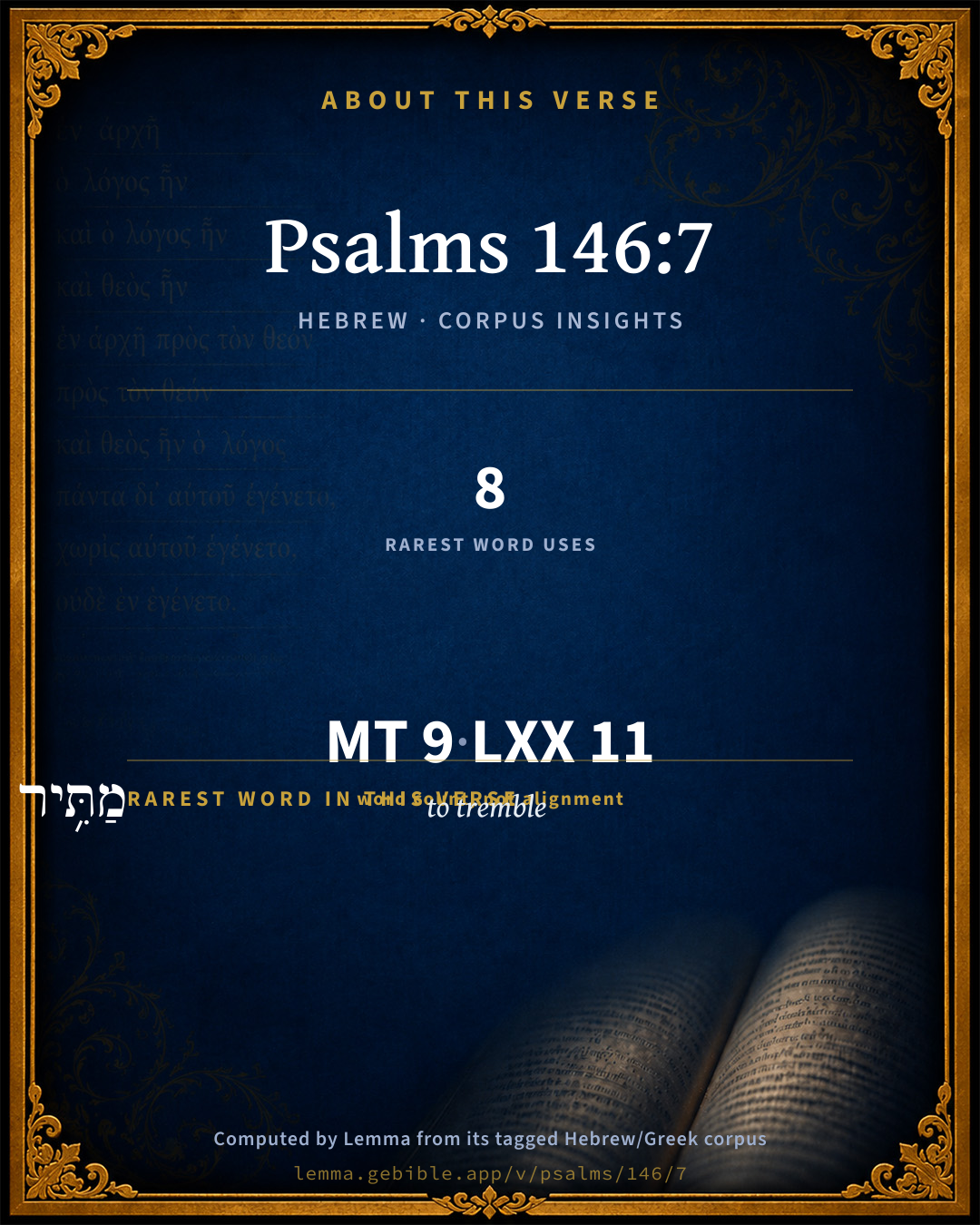
The rarest word here is מַתִּ֥יר to tremble H5425 — appearing just 8 times in the whole Hebrew Bible.

Shared distinctive vocabulary

מַתִּ֥יר to tremble H5425 occurs in 8 verses of the Hebrew Bible. Also found in:

Grammatical profile

  • 5 verbs
  • 3 nouns
  • 1 adjective

Verb forms

  • עֹשֶׂ֤ה Qal · Participle Active
  • לָעֲשׁוּקִ֗ים Qal · Participle Passive
  • נֹתֵ֣ן Qal · Participle Active
  • מַתִּ֥יר Hiphil · Participle Active
  • אֲסוּרִֽים Qal · Participle Passive

Hebrew & Septuagint length

In English translation the verse runs 16 words from the Hebrew and 18 from the Septuagint (LXX English) — closely comparable.

A rough comparison of the two English renderings, which tokenize alike — not a word-level alignment.

Word counts can differ between the Hebrew and the Greek without any difference in meaning — e.g. the Hebrew direct-object marker אֵת has no separate Greek word, and Greek often adds the article ὁ.

In the original languages it is 9 Hebrew tokens and 11 Greek tokens — but the two are counted differently (Hebrew bundles its prefixes and suffixes into one token; the Greek is in lemma form), so that isn’t a like-for-like length.

Cross-references

25

Topical passages linked to Psalms 146:7 in the Treasury of Scripture Knowledge — connected by theme and wording, ordered by reader-vote popularity; previews shown in the World English Bible.

  • Psalms 103:6 Yahweh executes righteous acts, And justice for all who are oppressed.
  • Psalms 68:6 God sets the lonely in families. He brings out the prisoners with singing, But the rebellious dwell in a sun-scorched land.
  • Isaiah 61:1 The Spirit of the Lord Yahweh is on me; because Yahweh has anointed me to preach good news to the humble; he has sent me to bind up the broken-hearted, to proclaim liberty to the captives, and the opening [of the prison] to those who are bound;
  • Proverbs 22:22–23 Don't exploit the poor, because he is poor; And don't crush the needy in court;
  • Zechariah 9:11–12 As for you also, Because of the blood of your covenant, I have set free your prisoners from the pit in which is no water.
  • Luke 4:18 "The Spirit of the Lord is on me, Because he has anointed me to preach good news to the poor. He has sent me to heal the brokenhearted, To proclaim release to the captives, Recovering of sight to the blind, To deliver those who are crushed,
  • Psalms 10:18 To judge the fatherless and the oppressed, That man who is of the earth may terrify no more.
  • Psalms 142:7 Bring my soul out of prison, That I may give thanks to your name. The righteous will surround me, For you will be good to me.
  • Psalms 107:9–10 For he satisfies the longing soul. He fills the hungry soul with good.
  • Psalms 9:16 Yahweh has made himself known. He has executed judgment. The wicked is snared by the work of his own hands. Meditation. Selah.
  • Psalms 10:14–15 But you do see trouble and grief; You consider it to take it into your hand. You help the victim and the fatherless.
  • Psalms 12:5 "Because of the oppression of the weak and because of the groaning of the needy, I will now arise," says Yahweh; "I will set him in safety from those who malign him."
  • Psalms 72:4 He will judge the poor of the people. He will save the children of the needy, And will break the oppressor in pieces.
  • Psalms 105:17–20 He sent a man before them. Joseph was sold for a slave.
  • Psalms 107:14–16 He brought them out of darkness and the shadow of death, And broke their bonds in sunder.
  • Psalms 136:25 Who gives food to every creature; For his loving kindness endures forever.
  • Psalms 145:15–16 The eyes of all wait for you. You give them their food in due season.
  • Proverbs 23:10–11 Don't move the ancient boundary stone. Don't encroach on the fields of the fatherless:
  • Isaiah 9:4 For the yoke of his burden, and the staff of his shoulder, the rod of his oppressor, you have broken as in the day of Midian.
  • Jeremiah 31:14 I will satiate the soul of the priests with fatness, and my people shall be satisfied with my goodness, says Yahweh.
  • Malachi 3:5 I will come near to you to judgment; and I will be a swift witness against the sorcerers, and against the adulterers, and against the perjurers, and against those who oppress the hireling in his wages, the widow, and the fatherless, and who deprive the foreigner of justice, and don't fear me," says Yahweh of Hosts.
  • Luke 1:53 He has filled the hungry with good things. He has sent the rich away empty.
  • Luke 9:17 They ate, and were all filled. They gathered up twelve baskets of broken pieces that were left over.
  • Acts 5:19 But an angel of the Lord opened the prison doors by night, and brought them out, and said,
  • Acts 16:26 Suddenly there was a great earthquake, so that the foundations of the prison were shaken; and immediately all the doors were opened, and everyone's bonds were loosened.

Cross-references courtesy of OpenBible.info (CC BY 4.0).

Hebrew and Greek witnesses Masoretic Hebrew ↔ Greek Septuagint

The same verse in the two great witnesses to the Old Testament, shown verse-for-verse.

You’re reading Greek Psalm 145 (Hebrew Psalm 146). The Septuagint counts the superscription, so verse numbers can differ from the Hebrew — chapter-level alignment, not verse-by-verse. Numbering follows Rahlfs.

These are two independent witnesses, not word-aligned to each other, and the Septuagint is shown in lemma (dictionary) form.

Hebrew Psalms 146:7 Masoretic · Westminster Leningrad Codex

עֹשֶׂ֤ה מִשְׁפָּ֨ט לָעֲשׁוּקִ֗ים נֹתֵ֣ן לֶ֭חֶם לָרְעֵבִ֑ים יְ֝הוָ֗ה מַתִּ֥יר אֲסוּרִֽים

Who executes justice for the oppressed; Who gives food to the hungry. Yahweh frees the prisoners.

World English Bible · Public Domain

Greek LXX Greek Psalm 145:7 Septuagint · lemma form

ποιέω κρίμα ὁ ἀδικέω δίδωμι τροφή ὁ πεινάω κύριος λύω πεδάω

who executes judgment for the wronged: who gives food to the hungry. The Lord looses the fettered ones:

LXX2012 (modern English Septuagint) · Public Domain

Hebrew: Westminster Leningrad Codex (CC BY 4.0). Greek: Septuagint (public domain); English from LXX2012 (modern English Septuagint) (Public Domain). How the Septuagint differs from the Hebrew →

Commentary

Notes on Psalms 146:7 from classic Christian and Jewish commentators (each source and its license shown beneath its notes). The classic Christian expositions comment on the surrounding passage and are grouped to its opening verse, so a note may address several verses; the Jewish commentaries on the Tanakh (Rashi and others) are per-verse, so they appear only where the commentator wrote on this verse.

Lemma curates 59 commentaries, every one of them public domain or Creative Commons licensed, each selected and text-cleaned for this edition rather than reprinted as found. About our sources →

Trapp's Complete Commentary

John Trapp

Psa 146:7 Which executeth judgment for the oppressed: which giveth food to the hungry. The LORD looseth the prisoners:

Ver. 7. Which executeth judgment] Vindicat violatos. This should draw custom and company about him; as all that were in distress fled to David, and he became their captain.

Which giveth food to the hungry] As he did to Elijah, by the ravens; to Hunniades, by his shepherd, with whom he supped on coarse fare, and found it sweet; to the town of Rochel, by a shoal of fish extraordinarily cast up into it by the tide, when they were straitly besieged and distressed.

The Lord looseth the prisoners] As he did Peter, Act 12:7-11, and still he knoweth how to deliver his, saith the same Peter, who could speak it by good experience, 2Pe 2:9.

John Trapp, A Commentary or Exposition upon All the Books of the Old and New Testament (1647–1656) — public domain. Text from a community e-Sword module.

The Biblical Illustrator

Joseph S. Exell

Psa_146:7-9

The Lord looseth the prisoners.

The Lords famous titles

There are five famous titles of God here.

I. Emancipator. He looseth those in mental, moral, and spiritual bondage.

II. Illuminator. The Lord has opened the eyes of many a man who could not see himself, and so proved how blind he was; and could not see the Lord, and so showed still more how blind he was. The Lord has given the inner sight to many a man who was without spiritual understanding, to whom the Gospel seemed a great mystery, of which he could make neither head nor tail.

III. Comforter. He raiseth them that are bowed down with--

1. Bereavement.

2. The burdens of life.

3. Inward distress.

4. A sense of sin.

IV. Rewarder. He loveth the righteous--with a love of complacency, communion, favour, and honour.

V. Preserver.

1. He preserveth the strangers. Father is dead, mother is dead, friends are all gone, and even in the very village where you were born you are a stranger; come along, your God is not dead, your Saviour liveth: The Lord preserveth the stangers.

2. He relieveth the fatherless and widow. If you turn to the first books of the Bible, you will see there Gods great care of the fatherless and the widow. Who had the tithes? Well, the Levites; but also the poor, and the stranger, and the fatherless, and the widow (Deu_14:28; Deu_26:12). Now, then, you who feel like widows, you who have lost your joy and earthly comfort, you who feel like the fatherless, and cry, No man careth for my soul, oh, may the sweet Spirit of the Lord entice you to come to Him. (C. H. Spurgeon.)

Jesus--the Liberator

Liberty--a free country! Those are words dear to us all. We love and honour the memory of those who in the old days fought for Englands freedom, We read with pride of the Swiss hero who flung himself upon the Austrian spears and made a way for liberty. But what shall we say of Jesus, who gives us the truest liberty, whose service is perfect freedom, who loosest men out of prison? There are few words which have been more misused than that word liberty. Well might the French woman, victim of the Revolution, point to the Statue of Freedom, as she came to die upon the scaffold, and say, O Liberty, how many crimes have been committed in thy name! Truly, says one of our great preachers, there are two freedoms--the false, where a man is free to do what he likes; the true, where a man is free to do what he ought. The Lord looseth men out of prison. He looseth out of the hard prison of the ancient law, and setteth our feet in the large room of grace, and bringeth us into a wealthy place. He looseth out of the prison of sin and death, the prison of the curse. He who went down into Hades, and preached to the spirits of the fathers in prison, hath broken for us the gates of brass, and smitten the bars of iron in sunder. Are there none of us who are prisoners--captives and slaves to our own bad passions, our own undisciplined will, evil habits of our own making? If so, and if we have the will to be free, Jesus, the Liberator, will loose us, even though we be in the innermost prison of sin, and our feet made fast in the stocks of evil habits. But we shall never be free till we know that we are in prison, till we feel the chain. The young man following his own lusts and pleasures, walking in his own way, talks to us of his freedom; he knows not that he is a prisoner, and so he will not cry to the Lord to set him free. (H. J. Wilmot Buxton, M. A.)

The Biblical Illustrator, edited by Joseph S. Exell (c. 1880s–1900s) — public domain. Text from a community e-Sword module.

Joseph Benson's Commentary

Psa 146:7-9. Which executeth judgment for the oppressed — Who doth not slight nor forget the cries of his grieved subjects; but in due time asserts the right of those who are oppressed, and can find no relief in other courts of judgment. Which giveth food to the hungry — Who supplies the needs of the poor that are ready to perish for want; and is so gracious as to set them at liberty, who, by unjust or merciless men, are held in a miserable captivity. The Lord openeth the eyes of the blind — “Illuminates their minds; or even restores their natural sight when it is defective and weak; or when perfectly gone, and there are no hopes of a human cure.” This part of the Psalm was most exactly and literally fulfilled in our Lord Jesus Christ during the time of his public ministry: see the margin. The Lord raiseth them that are bowed down — By supporting and comforting them in their distresses, and in due time removing their burdens. This also was literally performed by Christ in the days of his flesh: see Luk 13:12. And he still performs similar spiritual cures by his grace, giving rest to those that are weary and heavy laden, and raising up, with his comforts, those that are humbled and cast down under a sense of the guilt and power of sin. The Lord loveth the righteous — He has a peculiar favour for all the truly pious, who may, with the more confidence, depend upon his power when they are assured of his love. The Lord preserveth the strangers — Who are generally friendless, and exposed to many injuries from men, but are protected and preserved by God when they commit themselves to his care. Fatherless children, and destitute widows, also find support and relief from him against the injustice and violence of their wicked oppressors. But the way of the wicked he turneth upside down — Hebrew, יעות, he subverteth, or overthroweth it. He not only frustrates their plots and enterprises, but turneth them against themselves. Or, he perplexes and puzzles their steps, and causes them to stumble and fall. This, and all the foregoing sentences, are so many arguments to encourage pious men to trust in God in all their straits and difficulties.

Joseph Benson's Commentary on the Old and New Testaments (1811–1818) — public domain. Text from a community e-Sword module.

Whedon's Commentary on the Bible

Daniel D. Whedon

7. The five lines beginning with The Lord, etc., Psa_146:7, are, in Hebrew, of three words each, forming a beautiful and peculiar strain, which may be read as one verse. Thus:—

Jehovah looseth [the] prisoners,

Jehovah openeth [the eyes of the] blind,

Jehovah raiseth [the] depressed,

Jehovah loveth [the] righteous,

Jehovah keepeth strangers.

The words in brackets are not in the original, but are implied.

Daniel D. Whedon (gen. ed.), Commentary on the Old and New Testaments (1874–1909) — public domain. Text from a community e-Sword module.

J. A. Alexander on Psalms

Joseph Addison Alexander

7. (Psa 146:7) Doing justice to the oppressed—giving bread to the hungry—Jehovah, freeing (or the liberator of) the bound. He is not only able but accustomed to relieve those in distress, of whom several distinct classes are here specified as samples. Compare Psa 37:19; Psa 68:5-6; Psa 107:5; Psa 107:9-10; Psa 145:14. Hunger and captivity are both familiar figures for spiritual evils, as well as literal designations of external ones, both which may here be considered as included.

Joseph Addison Alexander, The Psalms Translated and Explained (1850) — public domain. Text from a community e-Sword module.

Geneva Bible (1599)

Geneva Bible translators

Whose faith and patience for a while he trieth, but at length he punisheth the adversaries, that he may be known to be judge of the world.

Geneva Bible (1599) marginal notes — public domain. Text via Bolls.life.

Adam Clarke's Commentary

Verse 7. Which executeth judgment for the oppressed] For those who suffer by violence or calumny. This may refer to the Israelites, who suffered much by oppression from the Babylonians, and by calumny from the Samaritans, &c., who had prejudiced the king of Persia against them.

Giving food to the hungry.] No doubt he fed the poor captives by many displays of his peculiar providence.

The Lord looseth the prisoners] And as he has sustained you so long under your captivity, so will he bring you out of it.

Adam Clarke's Commentary on the Bible (1810–1826) — public domain. Text from a community e-Sword/MySword module.

John Calvin's Commentaries

7. Rendering right, etc. He instances other kinds both of the power and goodness of God, which are just so many reasons why we should hope in him. All of them bear upon the point, that the help of God will be ready and forthcoming to those who are in the lowest circumstances, that accordingly our miseries will be no barrier in the way of his helping us; nay, that such is his nature, that he is disposed to assist all in proportion to their necessity. He says first, that God renders justice to the oppressed, to remind us that although in the judgment of sense God connives at the injuries done to us, he will not neglect the duty which properly belongs to him of forcing the wicked to give an account of their violence. As God, in short, would have the patience of his people tried, he here expressly calls upon the afflicted not to faint under their troubles, but composedly wait for deliverance from one who is slow in interposing, only that he may appear eventually as the righteous judge of the world. It follows, that he gives bread to the hungry. We learn from this that he is not always so indulgent to his own as to load them with abundance, but occasionally withdraws his blessing, that he may succor them when reduced to hunger. Had the Psalmist said that God fed his people with abundance, and pampered them, would not any of those under want or in famine have immediately desponded? The goodness of God is therefore properly extended farther to the feeding of the hungry. What is added is to the same purpose — that he looses them that are bound, and enlightens the blind. As it is the fate of his people to be straitened by anxiety, or pressed down by human tyranny, or reduced to extremity, in a manner equivalent to being shut up in the worst of dungeons, it was necessary to announce, by way of comfort, that God can easily find an outgate for us when brought into such straits. To enlighten the blind is the same with giving light in the midst of darkness. When at any time we know not what to do — are in perplexity, and lie confounded and dismayed, as if the darkness of death had fallen upon us — let us learn to ascribe this title to God, that he may dissipate the gloom and open our eyes. So when he is said to raise up the bowed down, we are taught to take courage when weary and groaning under any burden. Nor is it merely that God would here have his praises celebrated; he in a manner stretches out his hand to the blind, the captives, and the afflicted, that they may cast their grief’s and cares upon him. There is a reason for repeating the name Jehovah three times. In this way he stimulates and excites men to seek him who will often rather chafe and pine away in their miseries, than betake themselves to this sure asylum. “Qui saepe frenum rodendo, malunt putrescere in suis miseriis, quam ad certum hoe asylum se conferre.” — Lat.

John Calvin's Commentaries (1540-1563) — public domain. Text from the Calvin Translation Society English edition (1840s-50s) via the Christian Classics Ethereal Library (ccel.org). Calvin's coverage is partial (roughly two-thirds of the Bible); uncommented books and verses are honest gaps, never fabricated. The 19th-century editor's footnotes and remarks are omitted so the notes are faithfully Calvin's own voice.

Ellicott's Commentary for English Readers

(7) Comp. Psa_103:6; Psa_104:27; Psa_107:9; Psa_136:25; Isa_55:1.

Here follow five lines, each beginning with the Divine name, and each consisting of three words, the rhythm prominent in the book of Job.

A Bible Commentary for English Readers, edited by Charles John Ellicott (1878–1897) — public domain. Text from a community e-Sword module.

The Cambridge Bible for Schools and Colleges

gen. ed. J. J. S. Perowne

7. Illustrations of Jehovah’s beneficent action, not without allusion to the circumstances of Israel. Observe how these Divine works were literally manifested in Christ’s miracles. 7 a is abbreviated from Psa_103:6; with 7 b cp. Psa_107:9.

the Lord &c.] Five times the name of Jehovah stands emphatically at the beginning of the line, to shew that it is He and no other Who does all these things. Prison may be a figure for exile, or for suffering generally (cp. Psa_107:10; Psa_107:14). Releasing from prison and giving sight to the blind are coupled together in Isa_42:7; Isa_61:1, “to prisoners opening of eyes.”

The Cambridge Bible for Schools and Colleges (gen. ed. J. J. S. Perowne; Cambridge University Press, 1878–1918) — public domain. Text from a community e-Sword module.

John Gill's Exposition

Which executeth judgment for the oppressed,.... All judgment being committed to Christ as Mediator, he executes it on the behalf of his oppressed ones, and breaks in pieces their oppressors; being oppressed with sin, and lying under the power of it, he condemned it in his flesh, wrought out a righteousness to justify from it, and redeemed them from all their iniquities; being oppressed by Satan, and led captive by him, he took them as a prey from the mighty, and led captivity captive; and, when oppressed by the world, he is on their side and takes their part, and thoroughly pleads their cause, and suffers no weapon formed against them to prosper; and will before long destroy antichrist and his followers, and bring down his judgments on them, so that men of the earth shall no more oppress; and especially at the last judgment, he, the righteous Judge, will render tribulation to them that have troubled his people, and set the crown of righteousness on their heads; see Psa 10:18;

which giveth food to the hungry: in a literal sense he gave manna and quails to the hungry Israelites in the wilderness, fed five thousand with five loaves and two small fishes, and four thousand with seven loaves and a few fishes, when here on earth; and in a spiritual sense, to such as are in a starving and famishing condition, and hunger and thirst after righteousness, he gives himself, the bread of life, and his grace, the water of life; he gives them to eat of the hidden manna, and of the tree of life; he gives them his word, his Gospel, which is milk for babes and meat for strong men; he gives them his ordinances, which are a feast of fat things, and so he tills and satisfies their hungry souls;

the Lord looseth the prisoners: such as were bound by diseases and infirmities of body, he loosed in the days of his flesh here; and some that were held with the cords of death he raised from the dead, Luk 13:11; and his people, who are in a spiritual sense prisoners of sin, Satan, and the law, being shut up and held under by them, he proclaims liberty to them, and the opening the prison to them that are bound; he opens the prison doors, and says to the prisoners, Go forth; he delivers them from the power of sin, the slavery of Satan, and the bondage of the law, and brings them into a state of liberty, Isa 61:1; yea, all the prisoners in the grave he will loose at the last day; he has the key of hell and death, and will open those prisons and set them free; they shall come forth, some to the resurrection of life, and others to the resurrection of damnation.

John Gill's Exposition of the Whole Bible (1746–1763) — public domain (CC PDM 1.0). Text via the HelloAO Bible API.

Albert Barnes' Notes on the Bible

Which executeth judgment for the oppressed - This is the third reason why the lot of those is a happy one who trust in God. It is because he has power to pronounce and execute a right judgment or sentence in regard to the oppressed and the wronged, and because it is characteristic of his nature that he does thus execute judgment. See the notes at Psa 103:6 : “The Lord executeth right. eousness and judgment for all that are oppressed.”

Which giveth food to the hungry - See the notes at Psa 107:9 : “For he satisfieth the longing soul, and filleth the hungry soul with goodness.” This is the fourth reason why they who confide in God are happy. Compare Luk 1:53 : “He hath filled the hungry with good things.”

The Lord looseth the prisoners - This is the fifth reason why they who trust in the Lord are “happy.” Compare the notes at Psa 68:6 : “He bringeth out those which are bound with chains.” See also the notes at Psa 107:10 : “Being bound in affliction and iron.” Compare Job 36:8-9.

Albert Barnes' Notes on the Bible (1834–1885) — public domain. Text from a community e-Sword/MySword module.

The Treasury of David

Charles H. Spurgeon

Ver. 7. Which executeth judgment for the oppressed. He is a swift and impartial administrator of justice. Our King surpasses all earthly princes because he pays no deference to rank or wealth, and is never the respecter of persons. He is the friend of the down trodden, the avenger of the persecuted, the champion of the helpless. Safely may we trust our cause with such a Judge if it be a just one: happy are we to be under such a Ruler. Are we "evil entreated"? Are our rights denied us? Are we slandered? Let this console us, that he who occupies the throne will not only think upon our case, but bestir himself to execute judgment on our behalf.

Which giveth food to the hungry. Glorious King art thou; O Jehovah! Thou dost not only mete out justice but thou dost dispense bounty! All food comes from God; but when we are reduced to hunger, and providence supplies our necessity, we are peculiarly struck with the fact. Let every hungry man lay hold on this statement, and plead it before the mercy seat, whether he suffer bodily hunger, or heart hunger. See how our God finds his special clients among the lowest of mankind: the oppressed and the starving find help in the God of Jacob.

The LORD looseth the prisoners. Thus he completes the triple blessing: justice, bread, and liberty. Jehovah loves not to see men pining in dungeons, or fretting in fetters: he brought up Joseph from the round house, and Israel from the house of bondage. Jesus is the Emancipator, spiritually, providentially, and nationally. Thy chains, O Africa! were broken by his hand. As faith in Jehovah shall become common among men freedom will advance in every form, especially will mental, moral, and spiritual bonds be loosed, and the slaves of error, sin, and death shall be set free. Well might the Psalmist praise Jehovah, who is so kind to men in bonds! Well may the loosened ones be loudest in the song!

Ver. 7. Giveth food to the hungry. We learn from this that he is not always so indulgent to his own as to load them with abundance, but occasionally withdraws his blessing, that he may succour them when reduced to hunger. Had the Psalmist said that God fed his people with abundance and pampered them, would not any of those under want, or in famine have immediately desponded? The goodness of God is therefore properly extended farther to the feeding of the hungry. John Calvin.

Ver. 7. Giveth food to the hungry. Now, that Jesus was that Lord of whom the Psalmist in this place, and in Ps 145:16, speaketh, was fully testified by the miracles which he wrought, in feeding many thousands with some few loaves and two small fishes, and in filling so many baskets with the fragments or relics of that small provision wherewith he bad filled thousands. From these miracles, the people which had seen him do them and tasted of his bounty, did rightly infer that he was the prophet which was to come into the world, as you may read, Joh 6:14; and being supposed to be the prophet, they consequently presumed that he was likewise to be the King of Israel; and out of this concert or presumption they would have enforced him to be their king, Joh 6:15. Thomas Jackson, 1579-1640.

Ver. 7. The Lord looseth the prisoners. As in that place of Isa 61:1 the phrase of "opening the prison to them that are bound", is by the learned thought to be a prophetic elegance, to signify the cure of those that are deaf and dumb, whose souls consequently were shut up from being able to express themselves, as language enables others to do; so here also it may be used poetically, and then it will be directly parallel to that part of Christ's answer, "the deaf hear" (Mt 11:5). At the curing of such, Christ's form of speech was, Ephphatha, "be opened", as to the door of a prison, when those which were under restraint therein were to be let loose out of it, their fetters being shaken off from them. But then, 'tis further manifest, that those that were under any sore disease or lameness, etc., are said to be "bound by Satan" (Lu 13:16), and be "loosed" by Christ, when they were cured by him. So saith Christ (Lu 13:12), "Woman, thou art loosed from thine infirmity: and immediately she was made straight." Her being "made straight" was her being loosed out of her restraint, or bonds, or prison. And in this latitude of the poetic or prophetic expression, the Lord's loosing the prisoners here will comprehend the walking of the lame, the lepers being cleansed, the hearing of the deaf, yea, and the raising up of the dead; for those of all others are fastest bound, and so when they were raised, the style is as proper as to Lazarus in respect of the graveclothes, "loose them, and let him go." Henry Hammond.

Ver. 7-8. It ought not to pass without remark that the name Jehovah is repeated here five times in five lines, to intimate that it is an almighty power, that of Jehovah, that is engaged and exerted for the relief of the oppressed; and that it is as much to the glory of God to succour them that are in misery, as it is to ride on the heavens by his name JAH, Ps 68:4. Matthew Henry.

Ver. 7. (last clause). See "Spurgeon's Sermons", No. 484: "The Lordthe Liberator."

Ver. 7. The People's Rights.

1. Three rights of humanity. Justice, Bread, Freedom.

2. God's interventions in their behalf. Revolutions, Reforms, Regenerations. Christ's war with Satan.

3. The magnificent supply of the three blessings in Christ's kingdom.

4. The men who are fashioned and trained under this regime. W.B.H.

Psalms 146:8*

Charles H. Spurgeon's The Treasury of David (1869–1885) — public domain. Psalms only. Text from a community e-Sword/MySword module.

The Pulpit Commentary

Which executeth judgment for the oppressed. (comp. Psa_103:6, "The Lord executeth righteousness and judgment for all that are oppressed Israel"s history was an ample comment on this text. Which giveth food to the hungry. (comp. Psa_145:15, Psa_145:16, and the comment ad loc.) The Lord looseth the prisoners. Either captive nations, as Israel; or individuals, as Jeremiah from his dungeon, (Jer_37:16, Jer_37:17) Daniel from the lions" den, (Dan_6:23) Peter from his prison-house, (Act_12:7-10) and the like. Deliverance from the bands of sin may also be intended.

The Pulpit Commentary (1880–1919), ed. H.D.M. Spence-Jones & Joseph S. Exell — public domain. Text from a community e-Sword module.

Keil & Delitzsch

C. F. Keil & F. Delitzsch

The five lines beginning with Jahve belong together. Each consists of three words, which in the main is also the favourite measure of the lines in the Book of Job. The expression is as brief as possible. התּיר is transferred from the yoke and chains to the person himself who is bound, and פּקח is transferred from the eyes of the blind to the person himself. The five lines celebrate the God of the five-divisioned Tra, which furnishes abundant examples for these celebrations, and is directed with most considerate tenderness towards the strangers, orphans, and widows in particular. The orphan and the widow, says the sixth line, doth He recover, strengthen (with reference to עודד see Psa 20:9; Psa 31:12). Valde gratus mihi est hic Psalmus, Bakius observes, ob Trifolium illud Dei: Advenas, Pupillos, et Viduas, versu uno luculentissime depictum, id quod in toto Psalterio nullibi fit. Whilst Jahve, however, makes the manifold sorrows of His saints to have a blessed issue, He bends (יאוּת) the way of the wicked, so that it leads into error and ends in the abyss (Psa 1:6). This judicial manifestation of Jahve has only one line devoted to it. For He rules in love and in wrath, but delights most of all to rule in love. Jahve is, however, the God of Zion. The eternal duration of His kingdom is also the guarantee for its future glorious completion, for the victory of love. Hallelujah!

Keil & Delitzsch — Biblical Commentary on the Old Testament (1861–1891) — public domain (CC PDM 1.0). Text via the HelloAO Bible API. (Old Testament only.)

unfoldingWord translationNotes

Door43 World Missions Community

He executes justice

"He decides matters fairly"

for the oppressed

This nominal adjective can be stated as adjectives. AT: "for oppressed people" or "for those whom other people oppress" (See: Nominal Adjectives)

to the hungry

This nominal adjective can be stated as adjectives. AT: "to hungry people" or "to those who are hungry" (See: Nominal Adjectives)

opens the eyes of the blind

Causing a blind person to see is spoken of as if Yahweh were opening the person's eyes. AT: "causes the blind to see" (See: Metaphor)

the blind

This nominal adjective can be stated as adjectives. AT: "blind people" or "those who are blind" (See: Nominal Adjectives)

Yahweh raises up those who are bowed down

Yahweh helping someone is spoken of as if he were physically helping someone to stand up. AT: "Yahweh helps those who are discouraged" or "Yahweh helps those who are weak" (See: Metaphor)

who are bowed down

This action is a sign of distress or mourning. (See: Symbolic Action)

translationWords

just

oppress

free

prison

raise

bow

love

righteous

people group

unfoldingWord translationNotes — © Distant Shores Media and the Door43 World Missions Community, licensed CC BY-SA 4.0. Source: git.door43.org/Door43/en_tn.

Lesson kit

Teaching starters — assembled from the data on this page, not authored interpretation. Every prompt links to the verse data it draws on. Edit before teaching.

Psalms, in the Wisdom, opens this verse with 9 words (9 distinct Hebrew lemmas). Its most distinctive word is nâthar (“to tremble”). A historical commentator’s framing appears above. Read the whole chapter for the surrounding context.

Discussion questions

  1. What does “to tremble” (nâthar) contribute to the verse as a whole?
  2. Leviticus 11:21 shares the word «to tremble» with this verse. How do the two illuminate each other?
  3. The translations on this page render this verse differently — a whole-verse word diff, not a word-by-word alignment. What might account for the different wordings?
  4. The verb «עֹשֶׂ֤ה» is Qal Participle Active. How does its form color the action?
  5. Reading how Trapp's Complete Commentary and The Biblical Illustrator read this verse, where do the two commentators agree and where do they part?

Things to notice

Reading settings

Reading text

Shown beneath each verse's original-language words.

Old Testament
Old Testament edition

Read the OT as the Masoretic Hebrew (MT) or the Greek Septuagint (LXX).

English shown for the Greek Septuagint (in the Hebrew ↔ Greek comparison).

Comparing translations? Open the Compare panel on any verse page to stack up to four side by side.