
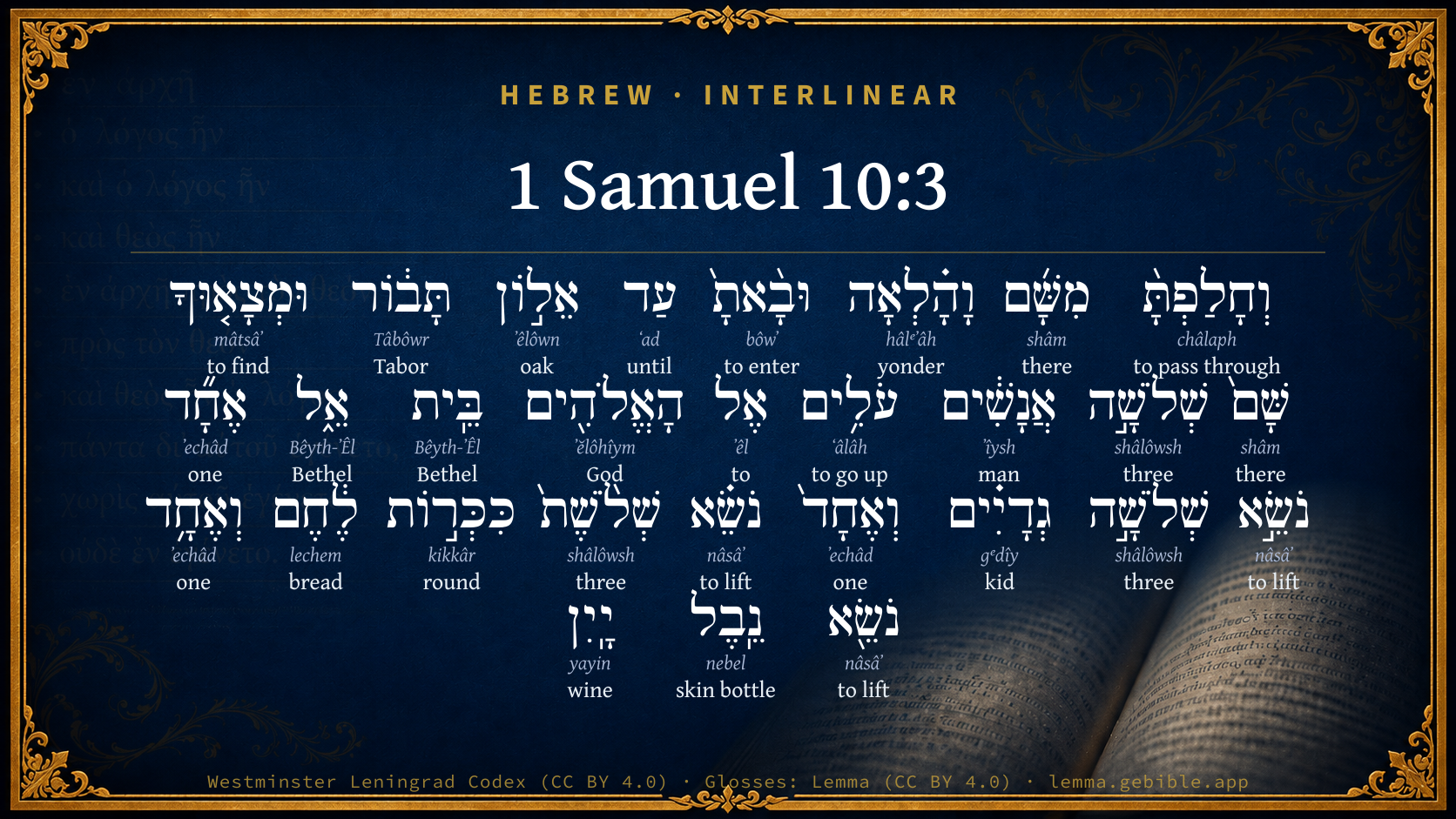
1 Samuel 10:3

Hebrew (Westminster Leningrad Codex) 1 Samuel 10:3 appears in the Hebrew Old Testament. The text above is from the Westminster Leningrad Codex. Each word links to its Strong’s number, a concise gloss, and parsing drawn from the Open Scriptures Hebrew Bible morphology. Click any word for its full Brown-Driver-Briggs (BDB) entry.
Download image
Cite this verse

1 Samuel 10:3 (World English Bible). Public Domain. Lemma interlinear Bible study tool, https://lemma.gebible.app/v/1-samuel/10/3.

Show BibTeX & RIS
BibTeX
RIS
English Translation
Then shall you go on forward from there, and you shall come to the oak of Tabor; and there shall meet you there three men going up to God to Bethel, one carrying three kids, and another carrying three loaves of bread, and another carrying a bottle of wine:
World English Bible · Public Domain
Download a study sheet

One document with this verse’s original text, its word-by-word gloss line, the meaning frame, cross-references with their text, attributed commentary, and full source and license credits — printable, and it pastes into notes with its structure intact.

This verse Autodidact and up

Study sheet (.html) Plain text (.txt)

A passage Seminary Student

Up to 50 verses in one chapter. A passage sheet keeps up to 6 commentary sources and 12 cross-references per verse, in the order this page ranks them, and says so on the sheet whenever that leaves anything out. Ask for a single verse and you get the Autodidact verse sheet above.

Everything on this page stays free to read, with no account — the sheet is a download of what is already on screen, not access to it.

Want to remove ads? Support Godless Engineer
Compare translations 3

The same verse in 3 English versions, stacked beneath the original-language interlinear above. Click any original word for its lexicon entry.

Each is an independent rendering of the whole verse — the interlinear is not word-aligned to these translations.

Highlighted words mark where these versions differ — a whole-verse word diff, not a word-by-word alignment.

  • World English Bible Public Domain
    Then shall you go on forward from there, and you shall come to the oak of Tabor; and there shall meet you there three men going up to God to Bethel, one carrying three kids, and another carrying three loaves of bread, and another carrying a bottle of wine:
  • King James Version Public Domain
    Then shalt thou go on forward from thence, and thou shalt come to the plain of Tabor, and there shall meet thee three men going up to God to Bethel, one carrying three kids, and another carrying three loaves of bread, and another carrying a bottle of wine:
  • unfoldingWord Literal Text CC BY-SA 4.0
    And you will go on from there and farther, and you will come to the oak of Tabor. And three men going up to God Bethel will find you there, one carrying three young goats and one carrying three loaves of bread and one carrying a skin of wine.

unfoldingWord Literal Text — © unfoldingWord, licensed CC BY-SA 4.0. Word-aligned USFM3 via Door43 (git.door43.org/unfoldingWord/en_ult).

Versions to compare (up to 4)

3 of 4 selected

Show all 18 translations

Every available English version of this verse, each an independent rendering of the whole verse.

  • World English Bible Public Domain
    Then shall you go on forward from there, and you shall come to the oak of Tabor; and there shall meet you there three men going up to God to Bethel, one carrying three kids, and another carrying three loaves of bread, and another carrying a bottle of wine:
  • Berean Standard Bible Public Domain
    Then you will go on from there until you come to the Oak of Tabor. Three men going up to God at Bethel will meet you there, one carrying three young goats, another carrying three loaves of bread, and another carrying a skin of wine.
  • Majority Standard Bible Public Domain
    Then you will go on from there until you come to the Oak of Tabor. Three men going up to God at Bethel will meet you there, one carrying three young goats, another carrying three loaves of bread, and another carrying a skin of wine.
  • King James Version Public Domain
    Then shalt thou go on forward from thence, and thou shalt come to the plain of Tabor, and there shall meet thee three men going up to God to Bethel, one carrying three kids, and another carrying three loaves of bread, and another carrying a bottle of wine:
  • American Standard Version (1901) Public Domain
    Then shalt thou go on forward from thence, and thou shalt come to the oak of Tabor; and there shall meet thee there three men going up to God to Beth-el, one carrying three kids, and another carrying three loaves of bread, and another carrying a bottle of wine:
  • Revised Version (1885) Public Domain
    Then shalt thou go on forward from thence, and thou shalt come to the oak of Tabor, and there shall meet thee there three men going up to God to Beth-el, one carrying three kids, and another carrying three loaves of bread, and another carrying a bottle of wine:
  • Geneva Bible (1599) Public Domain
    Then shalt thou go forth from thence and shalt come to the plaine of Tabor, and there shall meete thee three men going vp to God to Bethel: one carying three kiddes, and an other carying three loaues of bread, and another carying a bottle of wine:
  • Douay-Rheims (1899) Public Domain
    And when thou shalt depart from thence, and go farther on, and shalt come to the oak of Thabor, there shall meet thee three men going up to God to Bethel, one carrying three kids, and another three loaves of bread, and another carrying a bottle of wine.
  • Young's Literal Translation Public Domain
    `And thou hast passed on thence, and beyond, and hast come in unto the oak of Tabor, and found thee there have three men going up unto God to Beth-El, one bearing three kids, and one bearing three cakes of bread, and one bearing a bottle of wine,
  • Literal Standard Version CC BY-SA 4.0
    And you have passed on there, and beyond, and have come to the oak of Tabor, and three men going up to God to Beth-El have found you there, one carrying three kids, and one carrying three cakes of bread, and one carrying a bottle of wine,
  • Unlocked Literal Bible CC BY-SA 4.0
    Then you will go on further from there, and you will come to the oak of Tabor. Three men going to God at Bethel will meet you there, one carrying three young goats, another carrying three loaves of bread, and another carrying a skin of wine.
  • unfoldingWord Literal Text CC BY-SA 4.0
    And you will go on from there and farther, and you will come to the oak of Tabor. And three men going up to God Bethel will find you there, one carrying three young goats and one carrying three loaves of bread and one carrying a skin of wine.
  • Darby Bible Public Domain
    And thou shalt go on forward from thence, and shalt come to the oak of Tabor, and there shall meet thee three men going up to God, to Bethel, one carrying three kids, and another carrying three cakes of bread, and another carrying a flask of wine.
  • World Messianic Bible Public Domain
    “Then you will go on forward from there, and you will come to the oak of Tabor. Three men will meet you there going up to God to Bethel: one carrying three young goats, and another carrying three loaves of bread, and another carrying a container of wine.
  • Webster's Bible Public Domain
    Then shalt thou go on forward from thence, and thou shalt come to the plain of Tabor, and there shall meet thee three men going up to God to Beth-el, one carrying three kids, and another carrying three loaves of bread, and another carrying a bottle of wine:
  • Free Bible Version CC BY-SA 4.0
    You will leave there and go on to the oak at Tabor where you will meet three men on their way to worship God at Bethel. One will be carrying three young goats, one will be carrying three loaves of bread, and one will be carrying a skin of wine.
  • Bible in Basic English Public Domain
    Then you are to go on from there, and when you come to the oak-tree of Tabor, you will see three men going up to God to Beth-el, one having with him three young goats and another three cakes of bread and another a skin full of wine:
  • JPS Tanakh (1917) Public Domain
    Then shalt thou go on forward from thence, and thou shalt come to the terebinth of Tabor, and there shall meet thee there three men going up to God to Beth-el, one carrying three kids, and another carrying three loaves of bread, and another carrying a bottle of wine.

Literal Standard Version (2020), Covenant Press — licensed CC BY-SA 4.0. Text via the HelloAO Bible API (eBible.org). Unlocked Literal Bible (unfoldingWord) — licensed CC BY-SA 4.0. Text via the HelloAO Bible API (eBible.org). unfoldingWord Literal Text — © unfoldingWord, licensed CC BY-SA 4.0. Word-aligned USFM3 via Door43 (git.door43.org/unfoldingWord/en_ult). Free Bible Version, Dr. Jonathan Gallagher — licensed CC BY-SA 4.0. Text via the HelloAO Bible API (eBible.org).

Word by word

More ways to search: Search by grammar → Find every occurrence → Compare this word →

Practice this passage: Drill this verse → Learn its vocabulary →

אֵל֣וֹן
ʼêlôwn
H436
“oak of”
Noun, Common, Masculine, Singular, Construct
Part of Speech
Noun
Type
Common
Gender
Masculine
Number
Singular
State
Construct
Full BDB Definition

Origin: prolonged from H352

TWOT: 45i

tree, great tree, terebinth - plain
  1. וְחָלַפְתָּ֨ châlaph H2498 “and · to pass through” Conjunction + Verb, Qal, Sequential Perfect, 2nd Person, Masculine, Singular
  2. מִשָּׁ֜ם shâm H8033 “from · there” Preposition + Adverb
  3. וָהָ֗לְאָה hâlᵉʼâh H1973 “and · yonder” Conjunction + Adverb
  4. וּבָ֨אתָ֙ bôwʼ H935 “and · to enter” Conjunction + Verb, Qal, Sequential Perfect, 2nd Person, Masculine, Singular
  5. עַד ʻad H5704 “until” Preposition
  6. תָּב֔וֹר Tâbôwr H8396 “Tabor” Noun, Proper
  7. וּמְצָא֤וּךָ mâtsâʼ H4672 “and · to find · you” Conjunction + Verb, Qal, Sequential Perfect, 3rd Person, Common, Plural + Suffix, Personal, 2nd Person, Masculine, Singular
  8. שָּׁם֙ shâm H8033 “there” Adverb
  9. שְׁלֹשָׁ֣ה shâlôwsh H7969 “three” Adjective, Cardinal number, Masculine, Singular, Absolute
  10. אֲנָשִׁ֔ים ʼîysh H376 “men” Noun, Common, Masculine, Plural, Absolute
  11. עֹלִ֥ים ʻâlâh H5927 “going up” Verb, Qal, Participle Active, Masculine, Plural, Absolute
  12. אֶל ʼêl H413 “to” Preposition
  13. הָאֱלֹהִ֖ים ʼĕlôhîym H430 “the · God(s)” Particle, Definite Article + Noun, Common, Masculine, Plural, Absolute
  14. בֵּֽית Bêyth-ʼÊl H1008 “Bethel” Noun, Proper
  15. אֵ֑ל Bêyth-ʼÊl H1008 “Bethel” Noun, Proper
  16. אֶחָ֞ד ʼechâd H259 “one” Adjective, Cardinal number, Masculine, Singular, Absolute
  17. נֹשֵׂ֣א nâsâʼ H5375 “lifting” Verb, Qal, Participle Active, Masculine, Singular, Absolute
  18. שְׁלֹשָׁ֣ה shâlôwsh H7969 “three” Adjective, Cardinal number, Masculine, Singular, Absolute
  19. גְדָיִ֗ים gᵉdîy H1423 “kids” Noun, Common, Masculine, Plural, Absolute
  20. וְאֶחָד֙ ʼechâd H259 “and · one” Conjunction + Adjective, Cardinal number, Masculine, Singular, Absolute
  21. נֹשֵׂ֗א nâsâʼ H5375 “lifting” Verb, Qal, Participle Active, Masculine, Singular, Absolute
  22. שְׁלֹ֨שֶׁת֙ shâlôwsh H7969 “three” Adjective, Cardinal number, Masculine, Singular, Construct
  23. כִּכְּר֣וֹת kikkâr H3603 “talents of” Noun, Common, Both, Plural, Construct
  24. לֶ֔חֶם lechem H3899 “bread” Noun, Common, Both, Singular, Absolute
  25. וְאֶחָ֥ד ʼechâd H259 “and · one” Conjunction + Adjective, Cardinal number, Masculine, Singular, Absolute
  26. נֹשֵׂ֖א nâsâʼ H5375 “lifting” Verb, Qal, Participle Active, Masculine, Singular, Absolute
  27. נֵֽבֶל nebel H5035 “skin bottle of” Noun, Common, Masculine, Singular, Construct
  28. יָֽיִן yayin H3196 “wine” Noun, Common, Masculine, Singular, Absolute

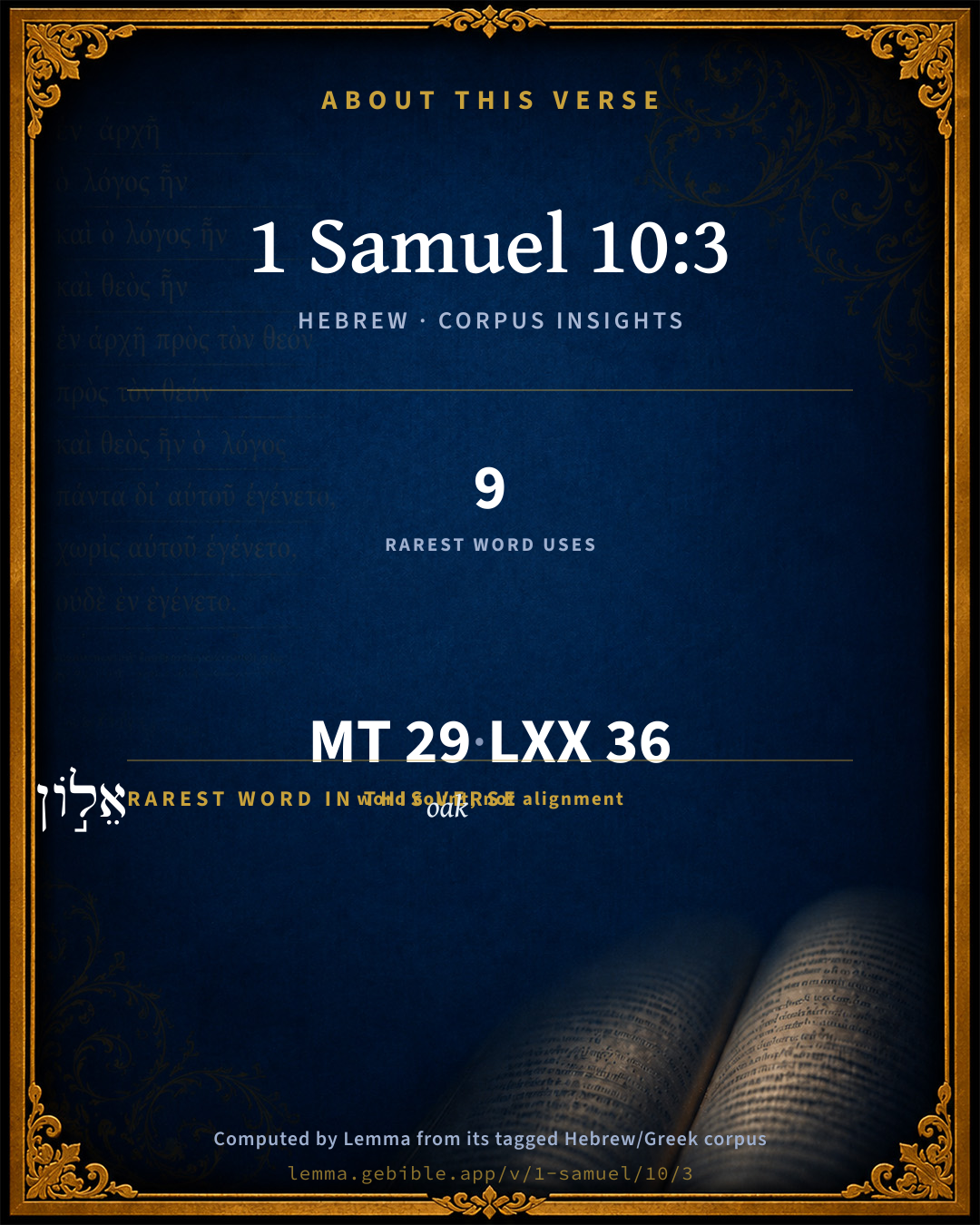
About this verse

These counts appear in no published source. They are computed here, from the morphology-tagged text and Lemma’s own curated glosses. What Lemma adds →

29
words
21
distinct lemmas
Historical
section

Notable vocabulary

The rarest word here is אֵל֣וֹן oak H436 — appearing just 9 times in the whole Hebrew Bible.

Shared distinctive vocabulary

אֵל֣וֹן oak H436 occurs in 9 verses of the Hebrew Bible. Also found in:

Grammatical profile

  • 7 verbs
  • 11 nouns
  • 6 adjectives
  • 2 prepositions
  • 3 adverbs

Verb forms

  • וְחָלַפְתָּ֨ Qal · Sequential Perfect
  • וּבָ֨אתָ֙ Qal · Sequential Perfect
  • וּמְצָא֤וּךָ Qal · Sequential Perfect
  • עֹלִ֥ים Qal · Participle Active
  • נֹשֵׂ֣א Qal · Participle Active
  • נֹשֵׂ֗א Qal · Participle Active
  • נֹשֵׂ֖א Qal · Participle Active

Repetition

Words recur within this verse — often emphatic in Hebrew:

  • שְׁלֹשָׁ֣ה three H7969 ×3
  • אֶחָ֞ד one H259 ×3
  • נֹשֵׂ֣א to lift H5375 ×3
  • מִשָּׁ֜ם there H8033 ×2
  • בֵּֽית Bethel H1008 ×2

Hebrew & Septuagint length

In English translation the verse runs 49 words from the Hebrew and 48 from the Septuagint (LXX English) — closely comparable.

A rough comparison of the two English renderings, which tokenize alike — not a word-level alignment.

Word counts can differ between the Hebrew and the Greek without any difference in meaning — e.g. the Hebrew direct-object marker אֵת has no separate Greek word, and Greek often adds the article ὁ.

In the original languages it is 29 Hebrew tokens and 36 Greek tokens — but the two are counted differently (Hebrew bundles its prefixes and suffixes into one token; the Greek is in lemma form), so that isn’t a like-for-like length.

Cross-references

17

Topical passages linked to 1 Samuel 10:3 in the Treasury of Scripture Knowledge — connected by theme and wording, ordered by reader-vote popularity; previews shown in the World English Bible.

  • Genesis 28:22 then this stone, which I have set up for a pillar, will be God's house. Of all that you will give me I will surely give the tenth to you."
  • Genesis 35:1 God said to Jacob, "Arise, go up to Bethel, and live there. Make there an altar to God, who appeared to you when you fled from the face of Esau your brother."
  • Genesis 35:3 Let us arise, and go up to Bethel. I will make there an altar to God, who answered me in the day of my distress, and was with me in the way which I went."
  • Genesis 28:19 He called the name of that place Bethel, but the name of the city was Luz at the first.
  • Genesis 35:6–8 So Jacob came to Luz, which is in the land of Canaan (the same is Bethel), he and all the people who were with him.
  • Leviticus 1:10 "'If his offering is from the flock, from the sheep, or from the goats, for a burnt offering, he shall offer a male without blemish.
  • Leviticus 3:6 "'If his offering for a sacrifice of peace offerings to Yahweh is from the flock; male or female, he shall offer it without blemish.
  • Leviticus 3:12 "'If his offering is a goat, then he shall offer it before Yahweh:
  • Leviticus 7:13 With cakes of leavened bread he shall offer his offering with the sacrifice of his peace offerings for thanksgiving.
  • Leviticus 23:13 The meal offering with it shall be two tenth parts of an ephah of fine flour mingled with oil, an offering made by fire to Yahweh for a sweet savor; and the drink offering with it shall be of wine, the fourth part of a hin.
  • Numbers 15:5–12 and wine for the drink-offering, the fourth part of a hin, shall you prepare with the burnt offering, or for the sacrifice, for each lamb.
  • Joshua 19:12 and it turned from Sarid eastward toward the sunrise to the border of Chisloth Tabor; and it went out to Daberath, and went up to Japhia;
  • Joshua 19:22 and the border reached to Tabor, and Shahazumah, and Beth-shemesh; and the goings out of their border were at the Jordan: sixteen cities with their villages.
  • Judges 4:6 She sent and called Barak the son of Abinoam out of Kedesh-naphtali, and said to him, Hasn't Yahweh, the God of Israel, commanded, [saying], Go and draw to Mount Tabor, and take with you ten thousand men of the children of Naphtali and of the children of Zebulun?
  • Judges 4:12 They told Sisera that Barak the son of Abinoam was gone up to Mount Tabor.
  • Judges 8:18 Then said he to Zebah and Zalmunna, What manner of men were they whom you killed at Tabor? They answered, As you are, so were they; each one resembled the children of a king.
  • Psalms 89:12 The north and the south, you have created them. Tabor and Hermon rejoice in your name.

Cross-references courtesy of OpenBible.info (CC BY 4.0).

Hebrew and Greek witnesses Masoretic Hebrew ↔ Greek Septuagint

The same verse in the two great witnesses to the Old Testament, shown verse-for-verse.

These are two independent witnesses, not word-aligned to each other, and the Septuagint is shown in lemma (dictionary) form.

Hebrew 1 Samuel 10:3 Masoretic · Westminster Leningrad Codex

וְחָלַפְתָּ֨ מִשָּׁ֜ם וָהָ֗לְאָה וּבָ֨אתָ֙ עַד אֵל֣וֹן תָּב֔וֹר וּמְצָא֤וּךָ שָּׁם֙ שְׁלֹשָׁ֣ה אֲנָשִׁ֔ים עֹלִ֥ים אֶל הָאֱלֹהִ֖ים בֵּֽית אֵ֑ל אֶחָ֞ד נֹשֵׂ֣א שְׁלֹשָׁ֣ה גְדָיִ֗ים וְאֶחָד֙ נֹשֵׂ֗א שְׁלֹ֨שֶׁת֙ כִּכְּר֣וֹת לֶ֔חֶם וְאֶחָ֥ד נֹשֵׂ֖א נֵֽבֶל יָֽיִן

Then shall you go on forward from there, and you shall come to the oak of Tabor; and there shall meet you there three men going up to God to Bethel, one carrying three kids, and another carrying three loaves of bread, and another carrying a bottle of wine:

World English Bible · Public Domain

Greek LXX 1 Samuel 10:3 Septuagint · lemma form

καί ἀποἔρχομαι ἐκεῖθεν καί ἐπέκεινα ἥκω ἕως ὁ δρῦς θαβωρ καί εὑρίσκω ἐκεῖ τρεῖς ἀνήρ ἀναβαίνω πρός ὁ θεός εἰς βαιθηλ εἷς αἴρω τρεῖς αἰγίδιον καί εἷς αἴρω τρεῖς ἀγγεῖον ἄρτος καί εἷς αἴρω ἀσκός οἶνος

And you shall depart thence, and shall go beyond that as far as the oak of Thabor, and you shall find there three men going up to God to Baethel, one bearing three kids, and another bearing three vessels of bread, and another bearing a bottle of wine.

LXX2012 (modern English Septuagint) · Public Domain

Hebrew: Westminster Leningrad Codex (CC BY 4.0). Greek: Septuagint (public domain); English from LXX2012 (modern English Septuagint) (Public Domain). How the Septuagint differs from the Hebrew →

Targum (Aramaic paraphrase)

1

The Targum is the ancient Jewish Aramaic paraphrase of the Hebrew Scriptures — an interpretive translation, not the Hebrew text itself. Onkelos (literal) and Pseudo-Jonathan (expansive) render the Torah, and Jonathan the Prophets. Coverage is partial: where no permissively-licensed English translation exists for a verse, only the Aramaic is shown. This is verse-level text, not a word-by-word alignment to the Hebrew.

  1. Targum Jonathan Prophets (Joshua–Malachi)
    וּתְהַךְ מִתַּמָן וּלְהָלָא וְתֵיתֵי עַד מֵישַׁר תָּבוֹר וְיִשְׁכְּחוּנָךְ תַּמָן תְּלָתָא גוּבְרִין דְסַלְקִין לְמִסְגַד קֳדָם יְיָ בְּבֵית אֵל חַד נָטִיל תְּלָתָא גַדְיָן וְחַד נָטִיל תְּלַת פִּתִּין דִלְחַם וְחַד נָטִיל גַרְבָא דַחֲמָר:

    (no public-domain English translation for this verse)

    Targum Jonathan — Aramaic: “Mikraot Gedolot” (public domain). English: “Sefaria Community Translation” (CC0 1.0 (public-domain dedication)); “London "Chaldee Paraphrase," 1871” (public domain). Text via Sefaria.

Commentary

Notes on 1 Samuel 10:3 from classic Christian and Jewish commentators (each source and its license shown beneath its notes). The classic Christian expositions comment on the surrounding passage and are grouped to its opening verse, so a note may address several verses; the Jewish commentaries on the Tanakh (Rashi and others) are per-verse, so they appear only where the commentator wrote on this verse.

Lemma curates 59 commentaries, every one of them public domain or Creative Commons licensed, each selected and text-cleaned for this edition rather than reprinted as found. About our sources →

Trapp's Complete Commentary

John Trapp

1Sa 10:3 Then shalt thou go on forward from thence, and thou shalt come to the plain of Tabor, and there shall meet thee three men going up to God to Bethel, one carrying three kids, and another carrying three loaves of bread, and another carrying a bottle of wine:

Ver. 3. Going up to God,] i.e., To ask counsel of God; before whom they might not come empty handed, but were to bring the best of the best.

John Trapp, A Commentary or Exposition upon All the Books of the Old and New Testament (1647–1656) — public domain. Text from a community e-Sword module.

Joseph Benson's Commentary

1Sa 10:3. Thou shalt come to the plain — Not that at the foot of mount Tabor, which was far from these parts; but another, belonging to some other place. Beth-el — Properly so called, which was in Ephraim, where there was a noted high place, famous for Jacob’s vision there, (Gen 28:19,) and where it is probable they offered sacrifices, in this confused state of things, when the ark was in one place, and the tabernacle in another.

Joseph Benson's Commentary on the Old and New Testaments (1811–1818) — public domain. Text from a community e-Sword module.

Tyndale Open Study Notes

Tyndale Open Resources

10:3 oak of Tabor: This location, somewhere in Benjamin, is not to be confused with the village of the same name in Zebulun (1 Chr 6:77). • Bethel: See study note on 1 Sam 7:16.

Tyndale Open Study Notes — © Tyndale Open Resources, licensed CC BY-SA 4.0. Text via the HelloAO Bible API.

Geneva Bible (1599)

Geneva Bible translators

Or, oaks.

Geneva Bible (1599) marginal notes — public domain. Text via Bolls.life.

Jamieson, Fausset & Brown

Robert Jamieson, A. R. Fausset & David Brown

the plain--or, "the oak of Tabor," not the celebrated mount, for that was far distant.

three men going up to God to Beth-el--apparently to offer sacrifices there at a time when the ark and the tabernacle were not in a settled abode, and God had not yet declared the permanent place which He should choose. The kids were for sacrifice, the loaves for the offering, and the wine for the libations.

Jamieson, Fausset & Brown — Commentary Critical and Explanatory on the Whole Bible (1871) — public domain (CC PDM 1.0). Text via the HelloAO Bible API.

Adam Clarke's Commentary

Verse 3. Three men going up to God to Bethel] Jacob's altar was probably there still, Ge 28:19. However this might be, it was still considered, as its name implies, the house of God; and to it they were now going, to offer sacrifice.

The three kids were for sacrifice; the three loaves of bread to be offered probably as a thank-offering; and the bottle or skin full of wine, for a libation. When the blood was poured out before the Lord, then they feasted on the flesh and on the bread; and probably had a sufficiency of the wine left for their own drinking.

Adam Clarke's Commentary on the Bible (1810–1826) — public domain. Text from a community e-Sword/MySword module.

Ellicott's Commentary for English Readers

(3) Thou shalt come to the plain of Tabor.—The accurate translation of the Hebrew is “to the terebinth or oak of Tabor.” There was evidently a history, now lost, connected with the “terebinth of Tabor.” Ewald suggests that “Tabor” is a different form for Deborah, and that this historic tree was the oak beneath which Deborah, the nurse of Rachel, was buried (Gen_35:8).

Going up to God to Beth-el.—This since the old patriarchal days had been a sacred spot. Samuel used to visit it as judge, and hold his court there annually, no doubt on account of the number of pilgrims who were in the habit of visiting it. These men were evidently on a pilgrimage to the old famous shrine.

A Bible Commentary for English Readers, edited by Charles John Ellicott (1878–1897) — public domain. Text from a community e-Sword module.

The Cambridge Bible for Schools and Colleges

gen. ed. J. J. S. Perowne

3. the plain of Tabor] Rather, the oak of Tabor. It has been ingeniously conjectured that this is to be identified with the oak under which Rebekah’s nurse Deborah was buried “under Bethel” (Gen_35:8), and the palm tree between Ramah and Bethel under which Deborah judged Israel (Jdg_4:5), Tabor being either a corruption or dialectic variation for Deborah; but nothing certain is known about the place.

going up to God to Bethel] On the sanctuary at Bethel see note on 1Sa_7:16. As yet the presence of God was only connected with holy places, or the Ark, and the Omnipresence of God scarcely realised. See Gen_28:16 and 1Sa_14:36.

a bottle of wine] i.e. a skin bottle: Sept. ἀσκός. Cp. 1Sa_1:24.

The Cambridge Bible for Schools and Colleges (gen. ed. J. J. S. Perowne; Cambridge University Press, 1878–1918) — public domain. Text from a community e-Sword module.

John Gill's Exposition

Then shall thou go on forward from thence,.... From Zelzah and Rachel's sepulchre there:

and thou shall come to the plain of Tabor; not that which lay at the bottom of the famous and well known mountain Tabor; for that was in the tribe of Zebulun, at a great distance from hence: but a plain, so called perhaps from the name of the owner of it:

and there shall meet thee three men going up to God to Bethel: the same with Luz, where Jacob built an altar, and called upon God; and so Elohimbethel here is the same with Elbethel, Gen 35:6. Here was an high place as at Ramah, whither in those times, when there was no fixed place for worship, the tabernacle at one place, and the ark at another, the people went up to worship; and they might the rather choose this, because it was a place devoted to the worship and service of God by their father Jacob; so the Targum paraphrases it,"going up to worship God in Bethel;''so Josephus (c), they were going thither to pray, and, as it seems by what follows, to sacrifice: one carrying three kids; which were used in sacrifice, and were a pretty heavy load if carried far; though, according to Josephus (d), it was but one kid:

and another carrying three loaves of bread; for the minchah, the meat offering, or rather bread offering, Lev 2:4.

and another carrying a bottle of wine; for the drink offering, the fourth part of an hin of wine being required for each kid, Num 15:5. This bottle, Ben Melech says, was a bottle made of skin, a leathern bottle or bag, or a potter's vessel or pitcher; the Targum renders it, a flagon of wine.

(c) Antiqu. l. 6. c. 4. sect. 2. (d) lbid.

John Gill's Exposition of the Whole Bible (1746–1763) — public domain (CC PDM 1.0). Text via the HelloAO Bible API.

Albert Barnes' Notes on the Bible

The plain of Tabor - It should be “the oak or terebinth”” of Tabor” (Jdg 4:11 note). It has been ingeniously conjectured that “Tabor” is either a different form of “Deborah,” or a corruption of it, and that the “oak,” or “terebinth of Tabor,” is the same as “Allon-bachuth,” the oak under which Deborah was buried, and which lay “beneath Bethel” Gen 35:8. The terebinth, where the three men came upon Saul, must have been at some point previous to that where the road leading northward from Jerusalem branches; when they reached that point they would go on with their offerings to Bethel, he would pursue his journey to Gibeah.

Albert Barnes' Notes on the Bible (1834–1885) — public domain. Text from a community e-Sword/MySword module.

Haydock's Catholic Bible Commentary

Thabor, very distant from the famous mountain (Calmet) in Zabulon. (Menochius) --- Bethel. Where there was at that time an altar of God; it being one of the places where Samuel judged Israel, (Challoner) and which had always been considered as a place of devotion, since Jacob had his vision, Genesis xxviii. 19. It lay to the east of Gabaa, so that Saul might easily meet these pilgrims. (Calmet) --- Wine, for libations, as the other things were for a sacrifice and feast, as well as for presents to the officiating priests.

George Leo Haydock (1774–1849), Haydock's Catholic Family Bible and Commentary, 1859 edition — public domain. Excludes Psalms (Douay-Rheims chapter numbering differs from Protestant) and Deuterocanonical books (Catholic canon only).

Matthew Poole's English Annotations

To the plain of Tabor; not that at the foot of Mount Tabor, which was far from these parts; but another belonging to some other place, or man, called Tabor. Beth-el; properly so called, which was in Ephraim, where there was a noted high place, famous for Jacob’s vision there, Gen 28:19, where it is probable they offered sacrifices in this confused state of things, when the ark was in one place, and the tabernacle, if not destroyed, in another. Or, to the house of God, i.e. to Kirjath-jearim, where the ark, the habitation of God, now was, 1Sa 7:1,2,16.

Loaves of bread might be offered, either by themselves, as Lev 2:4, or with other sacrifices.

A bottle of wine; which was poured forth in drink-offerings. See Lev 23:13; Num 15:5.

Matthew Poole's English Annotations on the Holy Bible (1683–1685) — public domain. Text from a community e-Sword/MySword module.

Whedon's Commentary on the Bible

Daniel D. Whedon

3. The plain of Tabor — Rather, the oak of Tabor, a spot apparently well known to Saul and Samuel, but now lost from our knowledge. Thenius’s conjecture that the oak of Deborah (Gen_35:8) is meant cannot be correct, for that was at Beth-el, far to the north of Saul’s home.

Three men going up to God to Beth-el — That is, going up to worship and sacrifice unto God at Beth-el. This “shows that there was still a place of sacrifice consecrated to the Lord at Beth-el, where Abraham and Jacob had erected altars to the Lord, who had appeared to them there, (Gen_12:8; Gen_13:3-4; Gen_28:18-19; Gen_35:7;) for the kids and loaves and wine were sacrificial gifts which they were about to offer.” — Keil. Beth-el was one of the places regularly visited by Samuel in his yearly circuit, (1Sa_7:16,) and here were doubtless priests, and at this time, when the tabernacle was desolate, (see note on 1Sa_9:12,) these three devoted men knew no more appropriate place to sacrifice unto God. Perhaps, too, the tabernacle was at Beth-el at this time, for after the desolation of Shiloh it seems to have become again a movable sanctuary, and appears in later history at Nob and Gibeon. 1Sa_21:1-6; 1Ch_16:39; comp. Jdg_20:27.

Daniel D. Whedon (gen. ed.), Commentary on the Old and New Testaments (1874–1909) — public domain. Text from a community e-Sword module.

The Pulpit Commentary

The second sign was to be the presenting of an offering to him out of their sacrificial gifts by three men going on a pilgrimage to Bethel. He would meet them not in the plain of Tabor, but at the oak, elon, of Tabor. Many attempt to connect this elon-Tabor with the allon, or oak, under which Deborah, Rachel"s nurse, was buried, (Gen_35:8) and suppose that Tabor is a corruption of the name Deborah. This is scarcely possible, and it is better to acknowledge that we know nothing of the site of this tree, except that it was on the road to Bethel. This was one of the places which Samuel used to visit as judge; (1Sa_7:16) but these men were on a pilgrimage thither because since the days of Jacob it had been a sacred spot, and a chief seat of the old patriarchal worship, for which see 1Sa_9:12.

The Pulpit Commentary (1880–1919), ed. H.D.M. Spence-Jones & Joseph S. Exell — public domain. Text from a community e-Sword module.

John Wesley's Explanatory Notes

Plain - Not that at the foot of mount Tabor, which was far from these parts; but another belonging to some other place. Bethel - Properly so called, which was in Ephraim, where there was a noted high-place, famous for Jacob's vision there, Gen. xxviii, 19, where it is probable they offered sacrifices, in this confused state of things, when the ark was in one place, and the tabernacle in another.

John Wesley, Explanatory Notes Upon the Whole Bible (1754–1765) — public domain. Text via the GEBible commentary corpus.

unfoldingWord translationNotes

Door43 World Missions Community

Tabor

This is the name of a place. (See: How to Translate Names)

take from their hands

The hands are a synecdoche for the person. "take from them" or "accept" (See: Synecdoche)

translationWords

oak

God

Bethel

goat

bread

wine

unfoldingWord translationNotes — © Distant Shores Media and the Door43 World Missions Community, licensed CC BY-SA 4.0. Source: git.door43.org/Door43/en_tn.

Rashi

Rabbi Shlomo Yitzchaki (Rashi)

Eilon Tavor. The plain of Tavor.

Rashi on the Tanakh — English translations: “The Judaica Press complete Tanach with Rashi, translated by A. J. Rosenberg” (CC BY 4.0); “Pentateuch with Rashi's commentary by M. Rosenbaum and A.M. Silbermann, 1929-1934” (public domain); “The Metsudah Tanach series, Lakewood, N.J” (CC BY 4.0); and “The Book of Joshua, Metsudah Publications, 1997” (CC BY 4.0). Text via Sefaria.

Lesson kit

Teaching starters — assembled from the data on this page, not authored interpretation. Every prompt links to the verse data it draws on. Edit before teaching.

1 Samuel, in the Historical, opens this verse with 29 words (21 distinct Hebrew lemmas). Its most distinctive word is ʼêlôwn (“oak”). A historical commentator’s framing appears above. Read the whole chapter for the surrounding context.

Discussion questions

  1. How does “oak” (ʼêlôwn) shape what this verse is saying?
  2. Genesis 12:6 shares the word «oak» with this verse. How do the two illuminate each other?
  3. “three” occurs 3× in this one verse. What is the effect of the repetition?
  4. These translations render this verse differently. What is at stake in choosing one wording over another?
  5. The verb «וְחָלַפְתָּ֨» is Qal Sequential Perfect. How does its form color the action?
  6. Reading how Trapp's Complete Commentary and Joseph Benson's Commentary read this verse, where do the two commentators agree and where do they part?

Things to notice

Reading settings

Reading text

Shown beneath each verse's original-language words.

Old Testament
Old Testament edition

Read the OT as the Masoretic Hebrew (MT) or the Greek Septuagint (LXX).

English shown for the Greek Septuagint (in the Hebrew ↔ Greek comparison).

Comparing translations? Open the Compare panel on any verse page to stack up to four side by side.