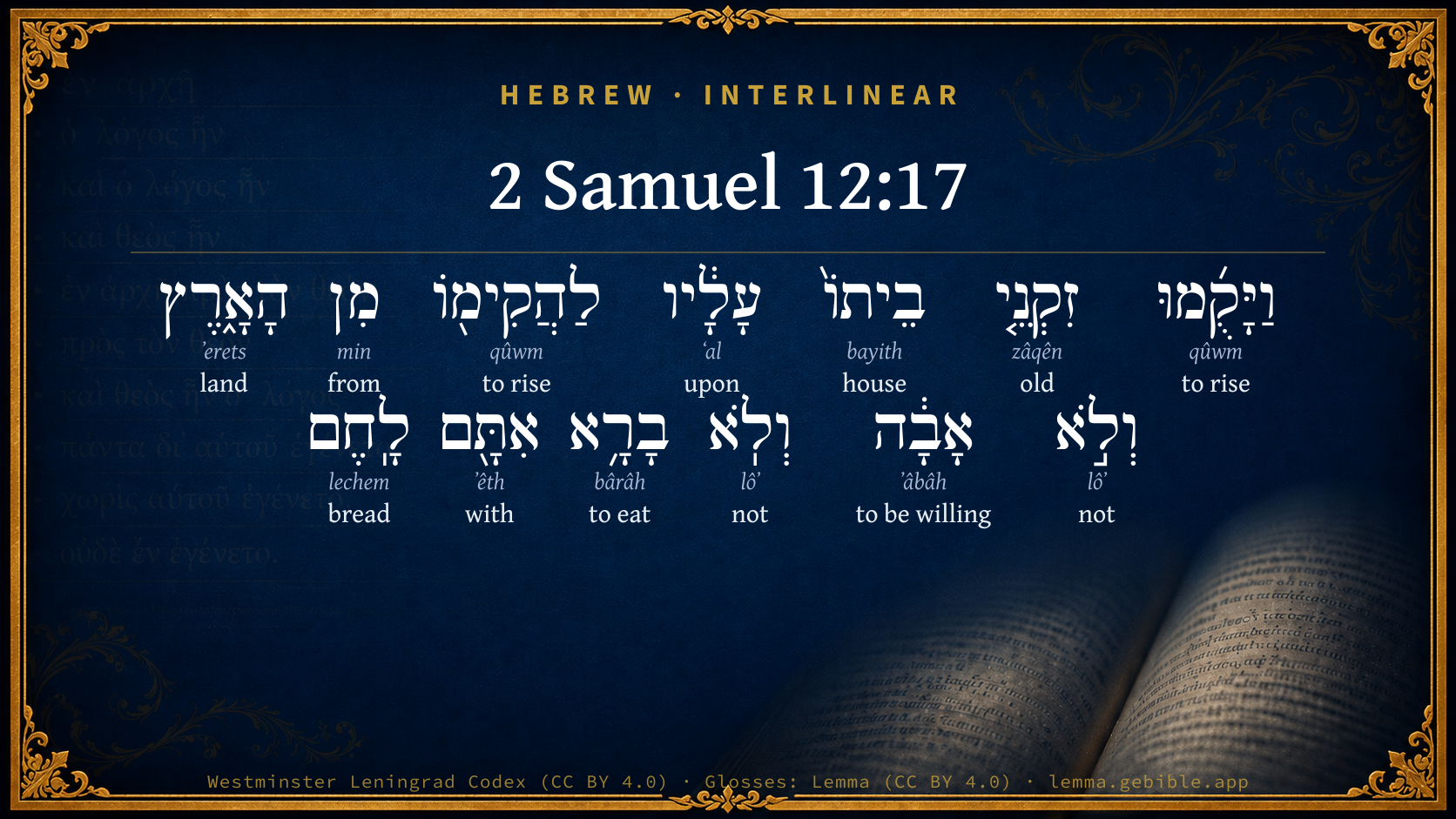
2 Samuel 12:17

Hebrew (Westminster Leningrad Codex) 2 Samuel 12:17 appears in the Hebrew Old Testament. The text above is from the Westminster Leningrad Codex. Each word links to its Strong’s number, a concise gloss, and parsing drawn from the Open Scriptures Hebrew Bible morphology. Click any word for its full Brown-Driver-Briggs (BDB) entry.
Download image
Cite this verse

2 Samuel 12:17 (World English Bible). Public Domain. Lemma interlinear Bible study tool, https://lemma.gebible.app/v/2-samuel/12/17.

Show BibTeX & RIS
BibTeX
RIS
English Translation
The elders of his house arose, [and stood] beside him, to raise him up from the earth: but he would not, neither did he eat bread with them.
World English Bible · Public Domain
Download a study sheet

One document with this verse’s original text, its word-by-word gloss line, the meaning frame, cross-references with their text, attributed commentary, and full source and license credits — printable, and it pastes into notes with its structure intact.

This verse Autodidact and up

Study sheet (.html) Plain text (.txt)

A passage Seminary Student

Up to 50 verses in one chapter. A passage sheet keeps up to 6 commentary sources and 12 cross-references per verse, in the order this page ranks them, and says so on the sheet whenever that leaves anything out. Ask for a single verse and you get the Autodidact verse sheet above.

Everything on this page stays free to read, with no account — the sheet is a download of what is already on screen, not access to it.

Want to remove ads? Support Godless Engineer
Compare translations 3

The same verse in 3 English versions, stacked beneath the original-language interlinear above. Click any original word for its lexicon entry.

Each is an independent rendering of the whole verse — the interlinear is not word-aligned to these translations.

Highlighted words mark where these versions differ — a whole-verse word diff, not a word-by-word alignment.

  • World English Bible Public Domain
    The elders of his house arose, [and stood] beside him, to raise him up from the earth: but he would not, neither did he eat bread with them.
  • King James Version Public Domain
    And the elders of his house arose, and went to him, to raise him up from the earth: but he would not, neither did he eat bread with them.
  • unfoldingWord Literal Text CC BY-SA 4.0
    And the elders of his house arose upon him to make him arise from the ground, but he was not willing, and he would not eat bread with them.

unfoldingWord Literal Text — © unfoldingWord, licensed CC BY-SA 4.0. Word-aligned USFM3 via Door43 (git.door43.org/unfoldingWord/en_ult).

Versions to compare (up to 4)

3 of 4 selected

Show all 18 translations

Every available English version of this verse, each an independent rendering of the whole verse.

  • World English Bible Public Domain
    The elders of his house arose, [and stood] beside him, to raise him up from the earth: but he would not, neither did he eat bread with them.
  • Berean Standard Bible Public Domain
    The elders of his household stood beside him to help him up from the ground, but he was unwilling and would not eat anything with them.
  • Majority Standard Bible Public Domain
    The elders of his household stood beside him to help him up from the ground, but he was unwilling and would not eat anything with them.
  • King James Version Public Domain
    And the elders of his house arose, and went to him, to raise him up from the earth: but he would not, neither did he eat bread with them.
  • American Standard Version (1901) Public Domain
    And the elders of his house arose, `and stood' beside him, to raise him up from the earth: but he would not, neither did he eat bread with them.
  • Revised Version (1885) Public Domain
    And the elders of his house arose, and stood beside him, to raise him up from the earth: but he would not, neither did he eat bread with them.
  • Geneva Bible (1599) Public Domain
    Then the Elders of his house arose to come vnto him, and to cause him to rise from the groud: but he would not, neither did he eate meate with them.
  • Douay-Rheims (1899) Public Domain
    And the ancients of his house came, to make him rise from the ground: but he would not, neither did he eat meat with them.
  • Young's Literal Translation Public Domain
    And the elders of his house rise against him, to raise him up from the earth, and he hath not been willing, nor hath he eaten with them bread;
  • Literal Standard Version CC BY-SA 4.0
    And [the] elderly of his house rise against him, to raise him up from the earth, and he has not been willing, nor has he eaten bread with them;
  • Unlocked Literal Bible CC BY-SA 4.0
    The elders of his house arose and stood beside him, to raise him up from the floor, but he would not get up, and he would not eat with them.
  • unfoldingWord Literal Text CC BY-SA 4.0
    And the elders of his house arose upon him to make him arise from the ground, but he was not willing, and he would not eat bread with them.
  • Darby Bible Public Domain
    And the elders of his house arose, [and went] to him, to raise him up from the earth; but he would not, and he ate no bread with them.
  • World Messianic Bible Public Domain
    The elders of his house arose beside him, to raise him up from the earth; but he would not, and he didn’t eat bread with them.
  • Webster's Bible Public Domain
    And the elders of his house arose, and went to him, to raise him from the earth: but he would not, neither did he eat bread with them.
  • Free Bible Version CC BY-SA 4.0
    His senior officials approached him and tried to help him up from the ground, but he didn't want to, and he refused their appeals to eat.
  • Bible in Basic English Public Domain
    And the chief men of his house got up and went to his side to make him get up from the earth, but he would not; and he would not take food with them.
  • JPS Tanakh (1917) Public Domain
    And the elders of his house arose, and stood beside him, to raise him up from the earth; but he would not, neither did he eat bread with them.

Literal Standard Version (2020), Covenant Press — licensed CC BY-SA 4.0. Text via the HelloAO Bible API (eBible.org). Unlocked Literal Bible (unfoldingWord) — licensed CC BY-SA 4.0. Text via the HelloAO Bible API (eBible.org). unfoldingWord Literal Text — © unfoldingWord, licensed CC BY-SA 4.0. Word-aligned USFM3 via Door43 (git.door43.org/unfoldingWord/en_ult). Free Bible Version, Dr. Jonathan Gallagher — licensed CC BY-SA 4.0. Text via the HelloAO Bible API (eBible.org).

Word by word

More ways to search: Search by grammar → Find every occurrence → Compare this word →

Practice this passage: Drill this verse → Learn its vocabulary →

בָרָ֥א
bârâh
H1262
“to eat”
Verb, Qal, Perfect, 3rd Person, Masculine, Singular
Part of Speech
Verb
Stem
Qal
Form
Perfect
Person
3rd Person
Gender
Masculine
Number
Singular
Full BDB Definition

Origin: a primitive root

TWOT: 281

to eat, consume - (Qal) to eat - (Piel) for eating, devouring - (Hiphil) to cause to eat
  1. וַיָּקֻ֜מוּ qûwm H6965 “and · to rise” Conjunction + Verb, Qal, Sequential Imperfect, 3rd Person, Masculine, Plural
  2. זִקְנֵ֤י zâqên H2205 “old of” Adjective, Adjective, Masculine, Plural, Construct
  3. בֵיתוֹ֙ bayith H1004 “house · his” Noun, Common, Masculine, Singular, Construct + Suffix, Personal, 3rd Person, Masculine, Singular
  4. עָלָ֔יו ʻal H5921 “upon · him” Preposition + Suffix, Personal, 3rd Person, Masculine, Singular
  5. לַהֲקִימ֖וֹ qûwm H6965 “to rise · him” Preposition + Verb, Hiphil, Infinitive Construct + Suffix, Personal, 3rd Person, Masculine, Singular
  6. מִן min H4480 “from” Preposition
  7. הָאָ֑רֶץ ʼerets H776 “the · land” Particle, Definite Article + Noun, Common, Both, Singular, Absolute
  8. וְלֹ֣א lôʼ H3808 “and · not” Conjunction + Particle, Negative
  9. אָבָ֔ה ʼâbâh H14 “to be willing” Verb, Qal, Perfect, 3rd Person, Masculine, Singular
  10. וְלֹֽא lôʼ H3808 “and · not” Conjunction + Particle, Negative
  11. אִתָּ֖ם ʼêth H854 “with · them” Preposition + Suffix, Personal, 3rd Person, Masculine, Plural
  12. לָֽחֶם lechem H3899 “bread” Noun, Common, Both, Singular, Absolute

About this verse

These counts appear in no published source. They are computed here, from the morphology-tagged text and Lemma’s own curated glosses. What Lemma adds →

13
words
11
distinct lemmas
Historical
section

Notable vocabulary

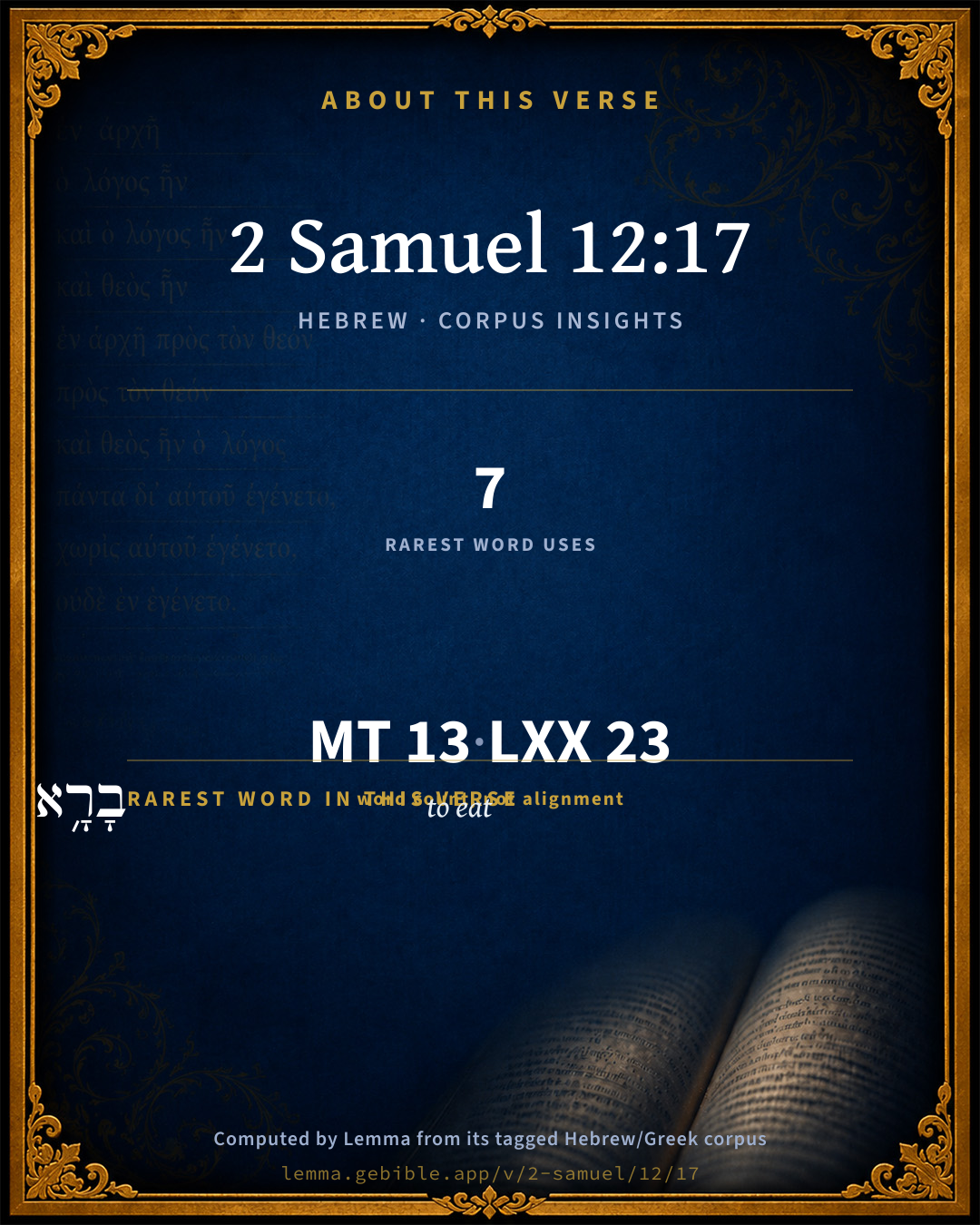
The rarest word here is בָרָ֥א to eat H1262 — appearing just 7 times in the whole Hebrew Bible.

Shared distinctive vocabulary

בָרָ֥א to eat H1262 occurs in 7 verses of the Hebrew Bible. Also found in:

Grammatical profile

  • 4 verbs
  • 3 nouns
  • 1 adjective
  • 3 prepositions
  • 2 particles

Verb forms

  • וַיָּקֻ֜מוּ Qal · Sequential Imperfect
  • לַהֲקִימ֖וֹ Hiphil · Infinitive Construct
  • אָבָ֔ה Qal · Perfect
  • בָרָ֥א Qal · Perfect

Repetition

Words recur within this verse — often emphatic in Hebrew:

  • וַיָּקֻ֜מוּ to rise H6965 ×2
  • וְלֹ֣א not H3808 ×2

Hebrew & Septuagint length

In English translation the verse runs 28 words from the Hebrew and 30 from the Septuagint (LXX English) — closely comparable.

A rough comparison of the two English renderings, which tokenize alike — not a word-level alignment.

Word counts can differ between the Hebrew and the Greek without any difference in meaning — e.g. the Hebrew direct-object marker אֵת has no separate Greek word, and Greek often adds the article ὁ.

In the original languages it is 13 Hebrew tokens and 23 Greek tokens — but the two are counted differently (Hebrew bundles its prefixes and suffixes into one token; the Greek is in lemma form), so that isn’t a like-for-like length.

Cross-references

2

Topical passages linked to 2 Samuel 12:17 in the Treasury of Scripture Knowledge — connected by theme and wording, ordered by reader-vote popularity; previews shown in the World English Bible.

  • 2 Samuel 3:35 All the people came to cause David to eat bread while it was yet day; but David swore, saying, God do so to me, and more also, if I taste bread, or anything else, until the sun be down.
  • 1 Samuel 28:23 But he refused, and said, I will not eat. But his servants, together with the woman, constrained him; and he listened to their voice. So he arose from the earth, and sat on the bed.

Cross-references courtesy of OpenBible.info (CC BY 4.0).

Hebrew and Greek witnesses Masoretic Hebrew ↔ Greek Septuagint

The same verse in the two great witnesses to the Old Testament, shown verse-for-verse.

These are two independent witnesses, not word-aligned to each other, and the Septuagint is shown in lemma (dictionary) form.

Hebrew 2 Samuel 12:17 Masoretic · Westminster Leningrad Codex

וַיָּקֻ֜מוּ זִקְנֵ֤י בֵיתוֹ֙ עָלָ֔יו לַהֲקִימ֖וֹ מִן הָאָ֑רֶץ וְלֹ֣א אָבָ֔ה וְלֹֽא בָרָ֥א אִתָּ֖ם לָֽחֶם

The elders of his house arose, [and stood] beside him, to raise him up from the earth: but he would not, neither did he eat bread with them.

World English Bible · Public Domain

Greek LXX 2 Samuel 12:17 Septuagint · lemma form

καί ἀναἵστημι ἐπί αὐτός ὁ πρεσβύτερος ὁ οἶκος αὐτός ὁ ἐγείρω αὐτός ἀπό ὁ γῆ καί οὐ θέλω καί οὐ συνἐσθίω αὐτός ἄρτος

And the elders of his house arose and went to him to raise him up from the ground, but he would not rise, nor did he eat bread with them.

LXX2012 (modern English Septuagint) · Public Domain

Hebrew: Westminster Leningrad Codex (CC BY 4.0). Greek: Septuagint (public domain); English from LXX2012 (modern English Septuagint) (Public Domain). How the Septuagint differs from the Hebrew →

Targum (Aramaic paraphrase)

1

The Targum is the ancient Jewish Aramaic paraphrase of the Hebrew Scriptures — an interpretive translation, not the Hebrew text itself. Onkelos (literal) and Pseudo-Jonathan (expansive) render the Torah, and Jonathan the Prophets. Coverage is partial: where no permissively-licensed English translation exists for a verse, only the Aramaic is shown. This is verse-level text, not a word-by-word alignment to the Hebrew.

  1. Targum Jonathan Prophets (Joshua–Malachi)
    וְקָמוּ סָבֵי בֵיתֵיהּ עֲלוֹהִי לַאֲקָמוּתֵיהּ מִן אַרְעָא וְלָא אֲבָא וְלָא אֲכָל עִמְהוֹן לַחְמָא:

    (no public-domain English translation for this verse)

    Targum Jonathan — Aramaic: “Mikraot Gedolot” (public domain). English: “Sefaria Community Translation” (CC0 1.0 (public-domain dedication)); “London "Chaldee Paraphrase," 1871” (public domain). Text via Sefaria.

Commentary

Notes on 2 Samuel 12:17 from classic Christian and Jewish commentators (each source and its license shown beneath its notes). The classic Christian expositions comment on the surrounding passage and are grouped to its opening verse, so a note may address several verses; the Jewish commentaries on the Tanakh (Rashi and others) are per-verse, so they appear only where the commentator wrote on this verse.

Lemma curates 59 commentaries, every one of them public domain or Creative Commons licensed, each selected and text-cleaned for this edition rather than reprinted as found. About our sources →

Trapp's Complete Commentary

John Trapp

2Sa 12:17 And the elders of his house arose, [and went] to him, to raise him up from the earth: but he would not, neither did he eat bread with them.

Ver. 17. But he would not, neither did he eat bread with them.] It is easy to observe that good man, David, too passionately attached to his children: and that these strong affections brought strong afflictions.

John Trapp, A Commentary or Exposition upon All the Books of the Old and New Testament (1647–1656) — public domain. Text from a community e-Sword module.

Joseph Benson's Commentary

2Sa 12:17. The elders of his house — The chief officers of his kingdom and household. He would not — This excessive mourning did not proceed simply from the fear of the loss of the child, but from a deep sense of his sin, and the divine displeasure manifested herein.

Joseph Benson's Commentary on the Old and New Testaments (1811–1818) — public domain. Text from a community e-Sword module.

Geneva Bible (1599)

Geneva Bible translators

Thinking by his instant prayer that God would have restored his child, but God hath otherwise determined.

Geneva Bible (1599) marginal notes — public domain. Text via Bolls.life.

The Cambridge Bible for Schools and Colleges

gen. ed. J. J. S. Perowne

17. the elders of his house] His oldest and most confidential servants. Cp. Gen_24:2; Gen_50:7.

The Cambridge Bible for Schools and Colleges (gen. ed. J. J. S. Perowne; Cambridge University Press, 1878–1918) — public domain. Text from a community e-Sword module.

John Gill's Exposition

And it came to pass on the seventh day, that the child died,.... Not the seventh day from its being taken ill, but from its birth; for it cannot be thought that David should fast seven days:

and the servants of David feared to tell him that the child was dead; lest he should be overwhelmed with too much sorrow:

for they said, behold, while the child was yet alive, we spake unto him; to rise from the ground, and eat food:

and he would not hearken unto our voice; we could not prevail upon him to do the one nor the other:

how will he then vex himself if we tell him that the child is dead? or should we acquaint him with it, "he will do mischief" (w) to himself, to his body; he will tear his flesh to pieces, and cut and kill himself; this they were afraid of, observing the distress and agony he was in while it was living, and therefore they concluded these would increase upon hearing of its death.

(w) , Sept. "faciat malum", Pagninus, Montanus; "malum sibi inferet", Syr. Ar.

John Gill's Exposition of the Whole Bible (1746–1763) — public domain (CC PDM 1.0). Text via the HelloAO Bible API.

Matthew Poole's English Annotations

The elders of his house; the chief officers of his kingdom and household who were there present.

This excessive mourning did not proceed simply from the fear of the loss of the child; but from a deep sense of his sin, and from the Divine displeasure manifested herein; and particularly from a just apprehension of the injury which he had done to the child by his sin, which justice obliged him to do his utmost to repair by prayer or other means.

Matthew Poole's English Annotations on the Holy Bible (1683–1685) — public domain. Text from a community e-Sword/MySword module.

Whedon's Commentary on the Bible

Daniel D. Whedon

17. The elders of his house — The oldest, most experienced, and confidential of his servants.

Daniel D. Whedon (gen. ed.), Commentary on the Old and New Testaments (1874–1909) — public domain. Text from a community e-Sword module.

John Wesley's Explanatory Notes

Elders - The chief officers of his kingdom and household. He would not - This excessive mourning did not proceed simply from the fear of the loss of the child; but from a deep sense of his sin, and the divine displeasure manifested herein.

John Wesley, Explanatory Notes Upon the Whole Bible (1754–1765) — public domain. Text via the GEBible commentary corpus.

Rashi

Rabbi Shlomo Yitzchaki (Rashi)

And he did not eat. [A word] denoting eating like [we find], "I will eat from her hand."

Rashi on the Tanakh — English translations: “The Judaica Press complete Tanach with Rashi, translated by A. J. Rosenberg” (CC BY 4.0); “Pentateuch with Rashi's commentary by M. Rosenbaum and A.M. Silbermann, 1929-1934” (public domain); “The Metsudah Tanach series, Lakewood, N.J” (CC BY 4.0); and “The Book of Joshua, Metsudah Publications, 1997” (CC BY 4.0). Text via Sefaria.

Lesson kit

Teaching starters — assembled from the data on this page, not authored interpretation. Every prompt links to the verse data it draws on. Edit before teaching.

2 Samuel, in the Historical, opens this verse with 13 words (11 distinct Hebrew lemmas). Its most distinctive word is bârâh (“to eat”). A historical commentator’s framing appears above. Read the whole chapter for the surrounding context.

Discussion questions

  1. The word bârâh carries the sense “to eat.” How does it shape the verse?
  2. 1 Samuel 17:8 shares the word «to eat» with this verse. How do the two illuminate each other?
  3. “to rise” occurs 2× in this one verse. What is the effect of the repetition?
  4. These translations render this verse differently. What is at stake in choosing one wording over another?
  5. The verb «וַיָּקֻ֜מוּ» is Qal Sequential Imperfect. How does its form color the action?
  6. Reading how Trapp's Complete Commentary and Joseph Benson's Commentary read this verse, where do the two commentators agree and where do they part?

Things to notice

Reading settings

Reading text

Shown beneath each verse's original-language words.

Old Testament
Old Testament edition

Read the OT as the Masoretic Hebrew (MT) or the Greek Septuagint (LXX).

English shown for the Greek Septuagint (in the Hebrew ↔ Greek comparison).

Comparing translations? Open the Compare panel on any verse page to stack up to four side by side.