Leviticus 22:7

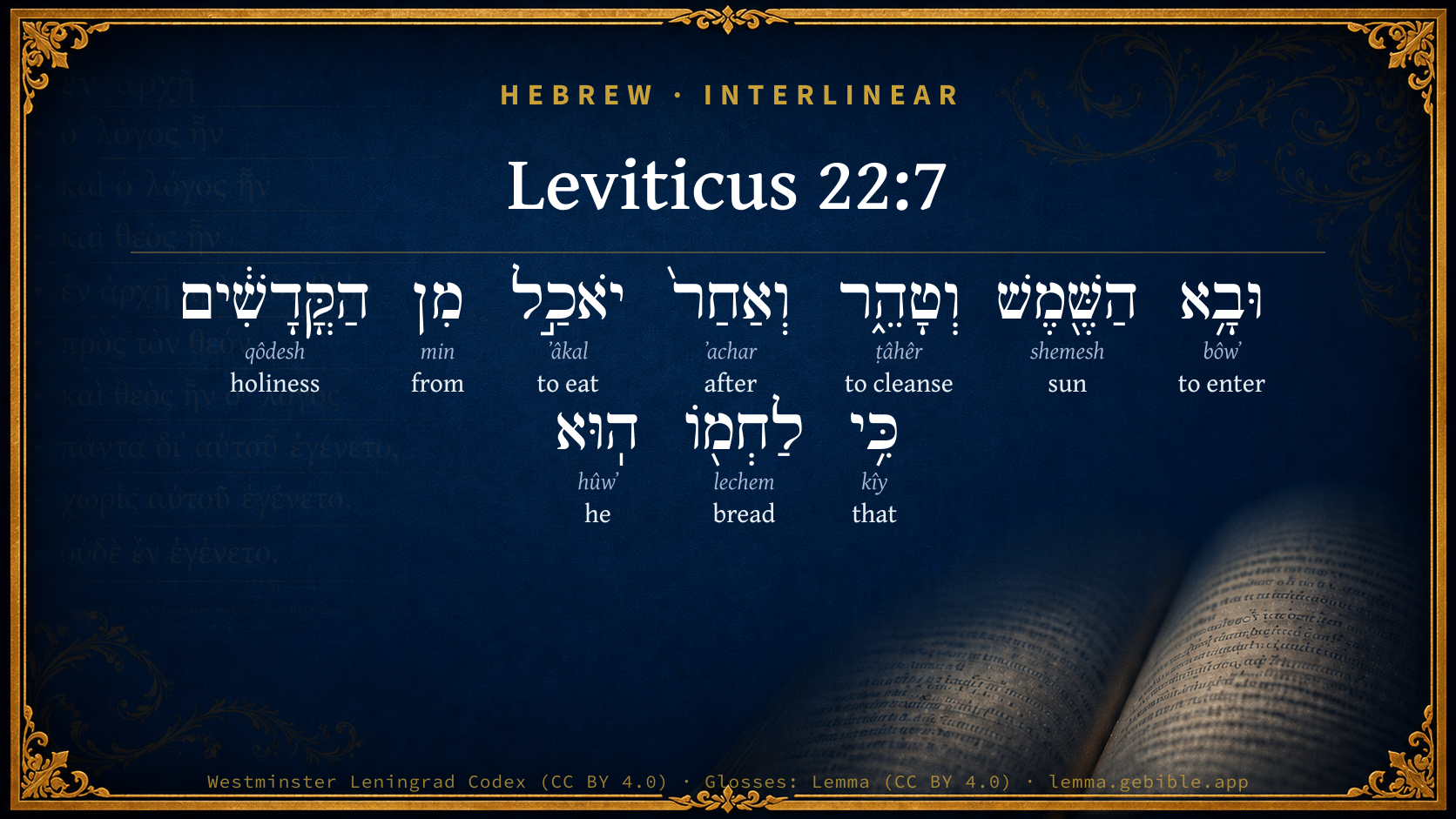
Hebrew (Westminster Leningrad Codex) Leviticus 22:7 appears in the Hebrew Old Testament. The text above is from the Westminster Leningrad Codex. Each word links to its Strong’s number, a concise gloss, and parsing drawn from the Open Scriptures Hebrew Bible morphology. Click any word for its full Brown-Driver-Briggs (BDB) entry.
Download image
Cite this verse

Leviticus 22:7 (World English Bible). Public Domain. Lemma interlinear Bible study tool, https://lemma.gebible.app/v/leviticus/22/7.

Show BibTeX & RIS
BibTeX
RIS
English Translation
When the sun is down, he shall be clean; and afterward he shall eat of the holy things, because it is his bread.
World English Bible · Public Domain
Download a study sheet

One document with this verse’s original text, its word-by-word gloss line, the meaning frame, cross-references with their text, attributed commentary, and full source and license credits — printable, and it pastes into notes with its structure intact.

This verse Autodidact and up

Study sheet (.html) Plain text (.txt)

A passage Seminary Student

Up to 50 verses in one chapter. A passage sheet keeps up to 6 commentary sources and 12 cross-references per verse, in the order this page ranks them, and says so on the sheet whenever that leaves anything out. Ask for a single verse and you get the Autodidact verse sheet above.

Everything on this page stays free to read, with no account — the sheet is a download of what is already on screen, not access to it.

Want to remove ads? Support Godless Engineer
Compare translations 3

The same verse in 3 English versions, stacked beneath the original-language interlinear above. Click any original word for its lexicon entry.

Each is an independent rendering of the whole verse — the interlinear is not word-aligned to these translations.

Highlighted words mark where these versions differ — a whole-verse word diff, not a word-by-word alignment.

  • World English Bible Public Domain
    When the sun is down, he shall be clean; and afterward he shall eat of the holy things, because it is his bread.
  • King James Version Public Domain
    And when the sun is down, he shall be clean, and shall afterward eat of the holy things; because it is his food.
  • unfoldingWord Literal Text CC BY-SA 4.0
    And the sun will go, and he will be clean. And afterward, he may eat from the holy things, because it his bread.

unfoldingWord Literal Text — © unfoldingWord, licensed CC BY-SA 4.0. Word-aligned USFM3 via Door43 (git.door43.org/unfoldingWord/en_ult).

Versions to compare (up to 4)

3 of 4 selected

Show all 18 translations

Every available English version of this verse, each an independent rendering of the whole verse.

  • World English Bible Public Domain
    When the sun is down, he shall be clean; and afterward he shall eat of the holy things, because it is his bread.
  • Berean Standard Bible Public Domain
    When the sun has set, he will become clean, and then he may eat from the sacred offerings, for they are his food.
  • Majority Standard Bible Public Domain
    When the sun has set, he will become clean, and then he may eat from the sacred offerings, for they are his food.
  • King James Version Public Domain
    And when the sun is down, he shall be clean, and shall afterward eat of the holy things; because it is his food.
  • American Standard Version (1901) Public Domain
    And when the sun is down, he shall be clean; and afterward he shall eat of the holy things, because it is his bread.
  • Revised Version (1885) Public Domain
    And when the sun is down, he shall be clean; and afterward he shall eat of the holy things, because it is his bread.
  • Geneva Bible (1599) Public Domain
    But when the Sunne is downe, hee shalbe cleane, and shall afterward eate of the holy things: for it is his foode.
  • Douay-Rheims (1899) Public Domain
    And the sun is down, then being purified, he shall eat of the sanctified things, because it is his meat.
  • Young's Literal Translation Public Domain
    and the sun hath gone in, and he hath been clean, and afterwards he doth eat of the holy things, for it `is' his food;
  • Literal Standard Version CC BY-SA 4.0
    and the sun has gone in, and he has been clean, and afterward he eats of the holy things, for it [is] his food;
  • Unlocked Literal Bible CC BY-SA 4.0
    When the sun has set, he will then be clean. After sunset he may eat from the holy things, because they are his food.
  • unfoldingWord Literal Text CC BY-SA 4.0
    And the sun will go, and he will be clean. And afterward, he may eat from the holy things, because it his bread.
  • Darby Bible Public Domain
    and when the sun goeth down, he shall be clean, and may afterwards eat of the holy things; for it is his food.
  • World Messianic Bible Public Domain
    When the sun is down, he shall be clean; and afterward he shall eat of the holy things, because it is his bread.
  • Webster's Bible Public Domain
    And when the sun is set, he shall be clean, and shall afterward eat of the holy things, because it is his food.
  • Free Bible Version CC BY-SA 4.0
    At sunset he will become clean, and then he is allowed to eat from the holy offerings because they provide his food.
  • Bible in Basic English Public Domain
    And when the sun has gone down he will be clean; and after that he may take part in the holy food, because it is his bread.
  • JPS Tanakh (1917) Public Domain
    And when the sun is down, he shall be clean; and afterward he may eat of the holy things, because it is his bread.

Literal Standard Version (2020), Covenant Press — licensed CC BY-SA 4.0. Text via the HelloAO Bible API (eBible.org). Unlocked Literal Bible (unfoldingWord) — licensed CC BY-SA 4.0. Text via the HelloAO Bible API (eBible.org). unfoldingWord Literal Text — © unfoldingWord, licensed CC BY-SA 4.0. Word-aligned USFM3 via Door43 (git.door43.org/unfoldingWord/en_ult). Free Bible Version, Dr. Jonathan Gallagher — licensed CC BY-SA 4.0. Text via the HelloAO Bible API (eBible.org).

Word by word

More ways to search: Search by grammar → Find every occurrence → Compare this word →

Practice this passage: Drill this verse → Learn its vocabulary →

וְטָהֵ֑ר
ṭâhêr
H2891
“and · to cleanse”
Conjunction + Verb, Qal, Sequential Perfect, 3rd Person, Masculine, Singular
Part of Speech
Conjunction + Verb
Stem
Qal
Form
Sequential Perfect
Person
3rd Person
Gender
Masculine
Number
Singular
Full BDB Definition

Origin: a primitive root

TWOT: 792

to be clean, be pure - (Qal) - to be clean (physically - of disease) - to be clean ceremonially - to purify, be clean morally, made clean - (Piel) - to cleanse, purify - physically - ceremonially - morally - to pronounce clean - to perform the ceremony of cleansing - (Pual) to be cleansed, be pronounced clean - (Hithpael) - to purify oneself - ceremonially - morally - to present oneself for purification
  1. וּבָ֥א bôwʼ H935 “and · to enter” Conjunction + Verb, Qal, Sequential Perfect, 3rd Person, Masculine, Singular
  2. הַשֶּׁ֖מֶשׁ shemesh H8121 “the · sun” Particle, Definite Article + Noun, Common, Both, Singular, Absolute
  3. וְאַחַר֙ ʼachar H310 “and · after” Conjunction + Adverb
  4. יֹאכַ֣ל ʼâkal H398 “to eat” Verb, Qal, Imperfect, 3rd Person, Masculine, Singular
  5. מִן min H4480 “from” Preposition
  6. הַקֳּדָשִׁ֔ים qôdesh H6944 “the · holy things” Particle, Definite Article + Noun, Common, Masculine, Plural, Absolute
  7. כִּ֥י kîy H3588 “that” Conjunction
  8. לַחְמ֖וֹ lechem H3899 “bread · his” Noun, Common, Both, Singular, Construct + Suffix, Personal, 3rd Person, Masculine, Singular
  9. הֽוּא hûwʼ H1931 “he” Pronoun, Personal, 3rd Person, Masculine, Singular

About this verse

These counts appear in no published source. They are computed here, from the morphology-tagged text and Lemma’s own curated glosses. What Lemma adds →

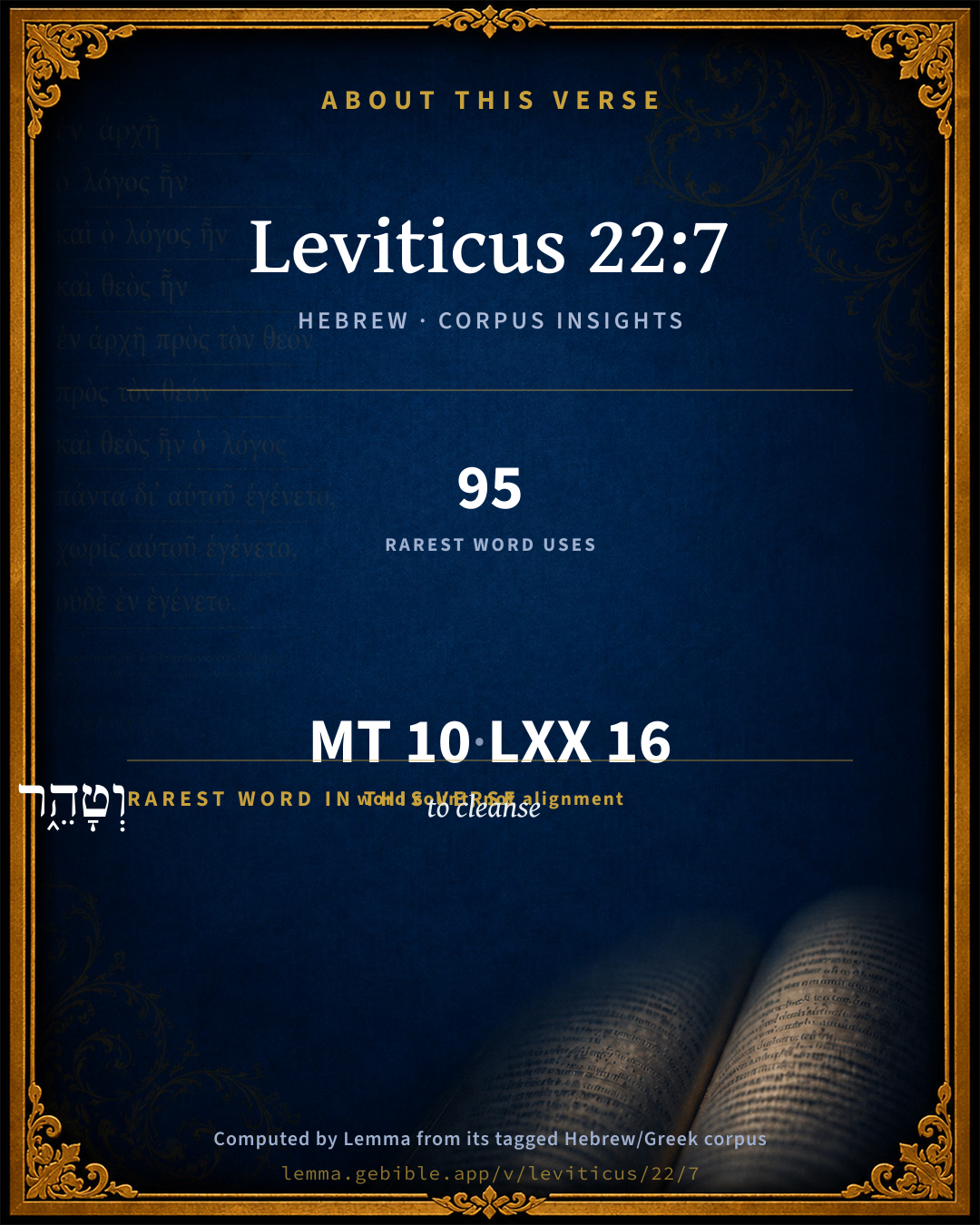
10
words
10
distinct lemmas
Pentateuch
section

Grammatical profile

  • 3 verbs
  • 3 nouns
  • 1 pronoun
  • 1 preposition
  • 1 conjunction
  • 1 adverb

Verb forms

  • וּבָ֥א Qal · Sequential Perfect
  • וְטָהֵ֑ר Qal · Sequential Perfect
  • יֹאכַ֣ל Qal · Imperfect

Hebrew & Septuagint length

In English translation the verse runs 23 words from the Hebrew and 26 from the Septuagint (LXX English) — closely comparable.

A rough comparison of the two English renderings, which tokenize alike — not a word-level alignment.

Word counts can differ between the Hebrew and the Greek without any difference in meaning — e.g. the Hebrew direct-object marker אֵת has no separate Greek word, and Greek often adds the article ὁ.

In the original languages it is 10 Hebrew tokens and 16 Greek tokens — but the two are counted differently (Hebrew bundles its prefixes and suffixes into one token; the Greek is in lemma form), so that isn’t a like-for-like length.

Cross-references

5

Topical passages linked to Leviticus 22:7 in the Treasury of Scripture Knowledge — connected by theme and wording, ordered by reader-vote popularity; previews shown in the World English Bible.

  • Leviticus 21:22 He shall eat the bread of his God, both of the most holy, and of the holy.
  • Numbers 18:11–19 This is your: the heave-offering of their gift, even all the wave-offerings of the children of Israel; I have given them to you, and to your sons and to your daughters with you, as a portion forever; everyone who is clean in your house shall eat of it.
  • Deuteronomy 18:3–4 This shall be the priests' due from the people, from those who offer a sacrifice, whether it be ox or sheep, that they shall give to the priest the shoulder, and the two cheeks, and the maw.
  • 1 Corinthians 9:4 Have we no right to eat and to drink?
  • 1 Corinthians 9:13–14 Don't you know that those who serve around sacred things eat from the things of the temple, and those who wait on the altar have their portion with the altar?

Cross-references courtesy of OpenBible.info (CC BY 4.0).

Hebrew and Greek witnesses Masoretic Hebrew ↔ Greek Septuagint

The same verse in the two great witnesses to the Old Testament, shown verse-for-verse.

These are two independent witnesses, not word-aligned to each other, and the Septuagint is shown in lemma (dictionary) form.

Hebrew Leviticus 22:7 Masoretic · Westminster Leningrad Codex

וּבָ֥א הַשֶּׁ֖מֶשׁ וְטָהֵ֑ר וְאַחַר֙ יֹאכַ֣ל מִן הַקֳּדָשִׁ֔ים כִּ֥י לַחְמ֖וֹ הֽוּא

When the sun is down, he shall be clean; and afterward he shall eat of the holy things, because it is his bread.

World English Bible · Public Domain

Greek LXX Leviticus 22:7 Septuagint · lemma form

καί δύω ὁ ἥλιος καί καθαρός εἰμί καί τότε ἐσθίω ὁ ἅγιος ὅτι ἄρτος εἰμί αὐτός

and the sun go down, and then he shall be clean; and then shall he eat of all the holy things, for they are his bread.

LXX2012 (modern English Septuagint) · Public Domain

Hebrew: Westminster Leningrad Codex (CC BY 4.0). Greek: Septuagint (public domain); English from LXX2012 (modern English Septuagint) (Public Domain). How the Septuagint differs from the Hebrew →

Targum (Aramaic paraphrase)

2

The Targum is the ancient Jewish Aramaic paraphrase of the Hebrew Scriptures — an interpretive translation, not the Hebrew text itself. Onkelos (literal) and Pseudo-Jonathan (expansive) render the Torah, and Jonathan the Prophets. Coverage is partial: where no permissively-licensed English translation exists for a verse, only the Aramaic is shown. This is verse-level text, not a word-by-word alignment to the Hebrew.

  1. Targum Onkelos Torah (Genesis–Deuteronomy)
    וּבְמֵעַל שִׁמְשָׁא וְיִדְכֵּי וּבָתַר כֵּן יֵיכוּל מִן קוּדְשַׁיָא אֲרֵי לַחְמֵהּ הוּא

    (no public-domain English translation for this verse)

    Targum Onkelos — Aramaic: “Onkelos Genesis” (public domain); “Onkelos Exodus” (public domain); “Onkelos Leviticus” (public domain); “Onkelos Numbers” (public domain); “Onkelos Deuteronomy” (public domain). English: “Sefaria Community Translation” (CC0 1.0 (public-domain dedication)); “J.W. Etheridge. The Targums of Onkelos and Jonathan Ben Uzziel on the Pentateuch. London: Longmans, Green, 1862” (public domain). Text via Sefaria.

  2. Targum Pseudo-Jonathan Torah (Genesis–Deuteronomy)
    וְיִטְמוֹעַ שִׁמְשָׁא וְיִתְכַּשֵׁר וּבָתַר כְּדֵין יֵיכוּל מִן קוּדְשַׁיָא אֲרוּם מְזוֹנֵיהּ הוּא

    And when the sun hath set and he be fit, he may afterward eat of the holy things; for they are his food.

    Targum Pseudo-Jonathan — Aramaic: “Targum Jonathan on Genesis” (public domain); “Targum Jonathan on Exodus” (public domain); “Targum Jonathan on Leviticus” (public domain); “Targum Jonathan on Numbers” (public domain); “Targum Jonathan on Deuteronomy” (public domain). English: “The Targum of Jonathan ben Uzziel, trans. J. W. Etheridge, London, 1862” (public domain). Text via Sefaria.

Commentary

Notes on Leviticus 22:7 from classic Christian and Jewish commentators (each source and its license shown beneath its notes). The classic Christian expositions comment on the surrounding passage and are grouped to its opening verse, so a note may address several verses; the Jewish commentaries on the Tanakh (Rashi and others) are per-verse, so they appear only where the commentator wrote on this verse.

Lemma curates 59 commentaries, every one of them public domain or Creative Commons licensed, each selected and text-cleaned for this edition rather than reprinted as found. About our sources →

Trapp's Complete Commentary

John Trapp

Lev 22:7 And when the sun is down, he shall be clean, and shall afterward eat of the holy things; because it [is] his food.

Ver. 7. ; Because it is his food.] Animantis cuiusque vita in fuga est, and must be preserved by food.

John Trapp, A Commentary or Exposition upon All the Books of the Old and New Testament (1647–1656) — public domain. Text from a community e-Sword module.

Joseph Benson's Commentary

Lev 22:7. His food — His portion, the means of his subsistence. This may be added, to signify why there was no greater nor longer a penalty put upon the priests than upon the people in the same case, because his necessity craved some mitigation: though otherwise the priests, being more sacred persons, deserved a greater punishment.

Joseph Benson's Commentary on the Old and New Testaments (1811–1818) — public domain. Text from a community e-Sword module.

Geneva Bible (1599)

Geneva Bible translators

Or, bread.

Geneva Bible (1599) marginal notes — public domain. Text via Bolls.life.

Ellicott's Commentary for English Readers

(7) And shall afterward eat . . . because it is his food.—As the sacrifices which were the perquisites of the officiating priests were the only things he had to live upon, the priest who had contracted defilement had virtually to go without food till sundown, when he purified himself by the prescribed lustrations.

That which dieth of itself.—That is, clean animals or birds which have not been properly slaughtered, but have met with an accident. These have already been forbidden to every ordinary Israelite. (See Lev_17:15.) In the case of a priest eating the proscribed meat the consequences would be more serious, inasmuch as he would be debarred from his sacerdotal duties.

Keep my ordinance.—That is, one laid down in the preceding verse with reference to animals which died a natural death, &c.

And die therefore, if they profane it.—The death here threatened for the transgression of the ordinance is one not to be inflicted by an earthly tribunal, but, as it was explained during the second Temple, “by the hand of heaven.” Hence the Chaldee version of Jonathan renders it, “lest they be killed for it by a flaming fire” like Nadab and Abihu.

A Bible Commentary for English Readers, edited by Charles John Ellicott (1878–1897) — public domain. Text from a community e-Sword module.

John Gill's Exposition

And when the sun is down he shall be clean,.... Having washed himself in water, otherwise not, though the sun may be set:

and shall afterwards eat of the holy things; the families of the priests lived upon:

because it is his food: his common food, his ordinary diet, that by which he subsists, having nothing else to live upon; this being the ordination of God, that he which ministered about holy things should live on them; and these being his only substance, in compassion to him they were detained from him no longer than the evening; and this was done, to make him careful how he defiled himself, since thereby he was debarred of his ordinary meals.

John Gill's Exposition of the Whole Bible (1746–1763) — public domain (CC PDM 1.0). Text via the HelloAO Bible API.

Matthew Poole's English Annotations

i.e. His portion, the means of his subsistence. This may be added to signify why there was no greater nor longer a penalty put upon the priests than upon the people in the same case, Le 11; Le 15, because his necessity craved some mitigation; though otherwise the priests being more sacred persons, and obliged to greater care and exemplariness, deserved a greater punishment.

Matthew Poole's English Annotations on the Holy Bible (1683–1685) — public domain. Text from a community e-Sword/MySword module.

Whedon's Commentary on the Bible

Daniel D. Whedon

7. When the sun is down — The divine mercy is seen in the narrow period during which the priest is disqualified from eating the holy and the most holy things. Since these were his prescribed food, a long uncleanness would be a long fasting.

Daniel D. Whedon (gen. ed.), Commentary on the Old and New Testaments (1874–1909) — public domain. Text from a community e-Sword module.

John Wesley's Explanatory Notes

His food - His portion, the means of his subsistence. This may be added, to signify why there was no greater nor longer a penalty put upon the priests than upon the people in the same case, because his necessity craved some mitigation: tho' otherwise the priests being more sacred persons, deserved a greater punishment.

John Wesley, Explanatory Notes Upon the Whole Bible (1754–1765) — public domain. Text via the GEBible commentary corpus.

unfoldingWord translationNotes

Door43 World Missions Community

he will then be clean

"the priest will then be considered clean." A person who is acceptable for God's purposes is spoken of as if the person were physically clean. (See: Metaphor)

found dead or killed by wild animals

This can be stated in active form. AT: "that someone found dead or that a wild animal has killed" (See: Active or Passive)

translationWords

clean

holy

defile

Yahweh

guilt

sin

profane

holy

unfoldingWord translationNotes — © Distant Shores Media and the Door43 World Missions Community, licensed CC BY-SA 4.0. Source: git.door43.org/Door43/en_tn.

Rashi

Rabbi Shlomo Yitzchaki (Rashi)

ואחר יאכל מן הקדשים [AND WHEN THE SUN IS DOWN HE SHALL BE CLEAN] AND MAY AFTERWARDS EAT OF HOLY THINGS — This is interpreted in Treatise Jebamoth (74b) to have reference to the heave-offering (not to holy things of every description): that he (a priest who was unclean and has bathed) is permitted to eat it as soon as the sun has set.

מן הקדשים accordingly means: some OF THE HOLY THINGS, but not all holy things (the word מן having a partitive meaning: “some of”).

Rashi on the Tanakh — English translations: “The Judaica Press complete Tanach with Rashi, translated by A. J. Rosenberg” (CC BY 4.0); “Pentateuch with Rashi's commentary by M. Rosenbaum and A.M. Silbermann, 1929-1934” (public domain); “The Metsudah Tanach series, Lakewood, N.J” (CC BY 4.0); and “The Book of Joshua, Metsudah Publications, 1997” (CC BY 4.0). Text via Sefaria.

Sforno

Rabbi Ovadia Sforno

For it is his bread. He is not required to wait for his atonement before eating his bread, as it says previously — at sunset he may eat terumah.

Sforno on the Tanakh — English translation: “Yalkut, Sifsei Chachomim Chumash, Metsudah Publications, 2009” (CC BY 4.0). Text via Sefaria.

Lesson kit

Teaching starters — assembled from the data on this page, not authored interpretation. Every prompt links to the verse data it draws on. Edit before teaching.

Leviticus, in the Pentateuch, opens this verse with 10 words (10 distinct Hebrew lemmas). Its most distinctive word is ṭâhêr (“to cleanse”). A historical commentator’s framing appears above. Read the whole chapter for the surrounding context.

Discussion questions

  1. How does “to cleanse” (ṭâhêr) shape what this verse is saying?
  2. How does Leviticus 21:22, which shares this passage’s theme, read alongside this verse?
  3. The translations on this page render this verse differently — a whole-verse word diff, not a word-by-word alignment. What might account for the different wordings?
  4. «וּבָ֥א» is a Qal Sequential Perfect verb. How does that grammatical form shape the action described?
  5. Compare how Trapp's Complete Commentary and Joseph Benson's Commentary read this verse. Where do they agree or differ?

Things to notice

Reading settings

Reading text

Shown beneath each verse's original-language words.

Old Testament
Old Testament edition

Read the OT as the Masoretic Hebrew (MT) or the Greek Septuagint (LXX).

English shown for the Greek Septuagint (in the Hebrew ↔ Greek comparison).

Comparing translations? Open the Compare panel on any verse page to stack up to four side by side.