
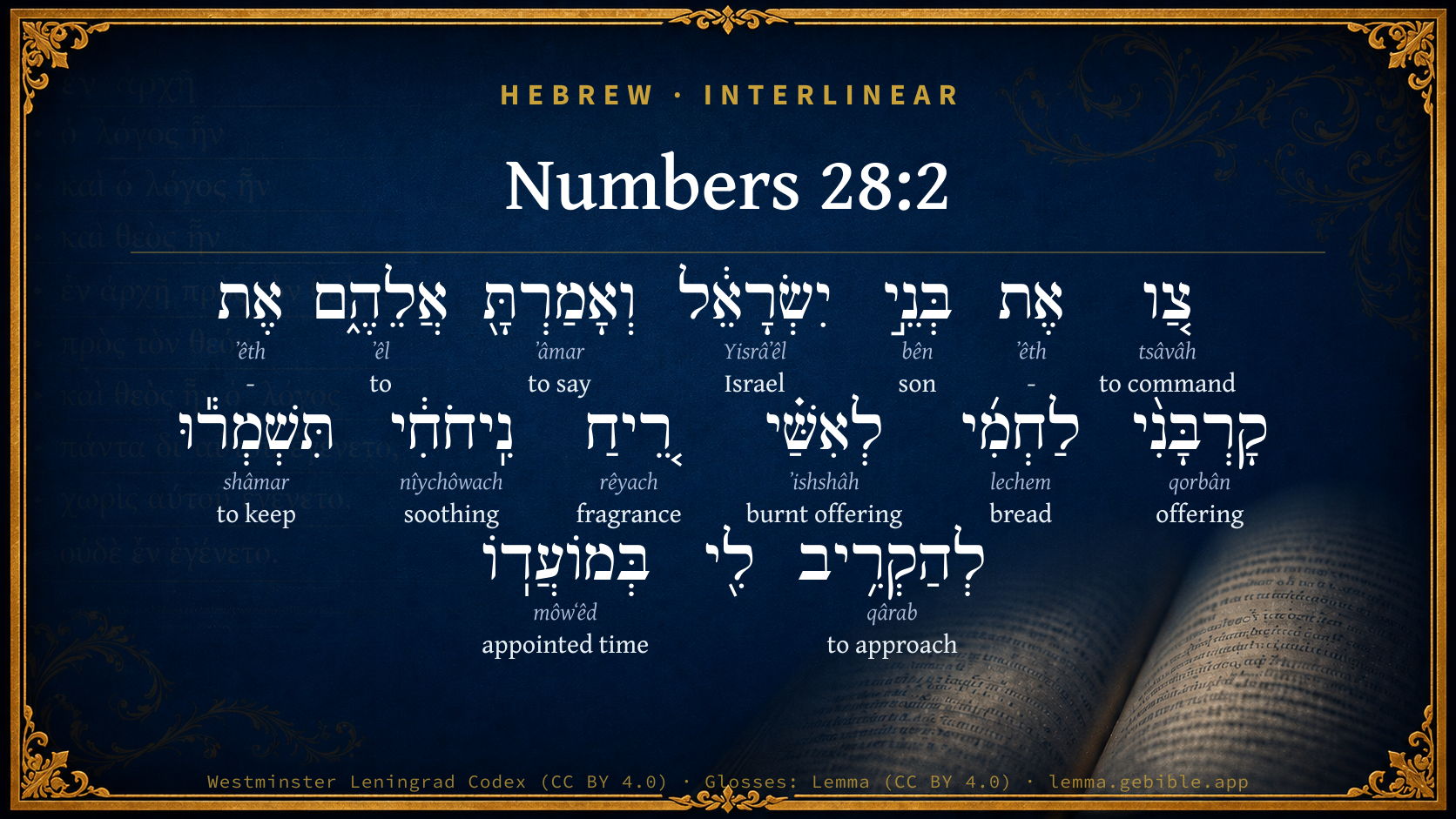
Numbers 28:2

Hebrew (Westminster Leningrad Codex) Numbers 28:2 appears in the Hebrew Old Testament. The text above is from the Westminster Leningrad Codex. Each word links to its Strong’s number, a concise gloss, and parsing drawn from the Open Scriptures Hebrew Bible morphology. Click any word for its full Brown-Driver-Briggs (BDB) entry.
Download image
Cite this verse

Numbers 28:2 (World English Bible). Public Domain. Lemma interlinear Bible study tool, https://lemma.gebible.app/v/numbers/28/2.

Show BibTeX & RIS
BibTeX
RIS
English Translation
Command the children of Israel, and tell them, My offering, my food for my offerings made by fire, of a sweet savor to me, shall you observe to offer to me in their due season.
World English Bible · Public Domain
Download a study sheet

One document with this verse’s original text, its word-by-word gloss line, the meaning frame, cross-references with their text, attributed commentary, and full source and license credits — printable, and it pastes into notes with its structure intact.

This verse Autodidact and up

Study sheet (.html) Plain text (.txt)

A passage Seminary Student

Up to 50 verses in one chapter. A passage sheet keeps up to 6 commentary sources and 12 cross-references per verse, in the order this page ranks them, and says so on the sheet whenever that leaves anything out. Ask for a single verse and you get the Autodidact verse sheet above.

Everything on this page stays free to read, with no account — the sheet is a download of what is already on screen, not access to it.

Want to remove ads? Support Godless Engineer
Compare translations 3

The same verse in 3 English versions, stacked beneath the original-language interlinear above. Click any original word for its lexicon entry.

Each is an independent rendering of the whole verse — the interlinear is not word-aligned to these translations.

Highlighted words mark where these versions differ — a whole-verse word diff, not a word-by-word alignment.

  • World English Bible Public Domain
    Command the children of Israel, and tell them, My offering, my food for my offerings made by fire, of a sweet savor to me, shall you observe to offer to me in their due season.
  • King James Version Public Domain
    Command the children of Israel, and say unto them, My offering, and my bread for my sacrifices made by fire, for a sweet savor unto me, shall ye observe to offer unto me in their due season.
  • unfoldingWord Literal Text CC BY-SA 4.0
    “Command the sons of Israel and say to them, ‘You shall be careful to offer to me at its appointed time my offering, my food for my offerings made by fire, an aroma of my soothing.’

unfoldingWord Literal Text — © unfoldingWord, licensed CC BY-SA 4.0. Word-aligned USFM3 via Door43 (git.door43.org/unfoldingWord/en_ult).

Versions to compare (up to 4)

3 of 4 selected

Show all 18 translations

Every available English version of this verse, each an independent rendering of the whole verse.

  • World English Bible Public Domain
    Command the children of Israel, and tell them, My offering, my food for my offerings made by fire, of a sweet savor to me, shall you observe to offer to me in their due season.
  • Berean Standard Bible Public Domain
    “Command the Israelites and say to them: See that you present to Me at its appointed time the food for My offerings by fire, as a pleasing aroma to Me.
  • Majority Standard Bible Public Domain
    “Command the Israelites and say to them: See that you present to Me at its appointed time the food for My food offerings, as a pleasing aroma to Me.
  • King James Version Public Domain
    Command the children of Israel, and say unto them, My offering, and my bread for my sacrifices made by fire, for a sweet savor unto me, shall ye observe to offer unto me in their due season.
  • American Standard Version (1901) Public Domain
    Command the children of Israel, and say unto them, My oblation, my food for my offerings made by fire, of a sweet savor unto me, shall ye observe to offer unto me in their due season.
  • Revised Version (1885) Public Domain
    Command the children of Israel, and say unto them, My oblation, my food for my offerings made by fire, of a sweet savour unto me, shall ye observe to offer unto me in their due season.
  • Geneva Bible (1599) Public Domain
    Command the children of Israel, and say vnto them, Ye shall obserue to offer vnto me in their due season mine offering, and my bread, for my sacrifices made by fire for a sweete sauour vnto me.
  • Douay-Rheims (1899) Public Domain
    Command the children of Israel, and thou shalt say to them: Offer ye my oblation and my bread, and burnt sacrifice of most sweet odour, in their due seasons.
  • Young's Literal Translation Public Domain
    `Command the sons of Israel, and thou hast said unto them, My offering, My bread for My fire-offerings, My sweet fragrance, ye take heed to bring near to Me in its appointed season.
  • Literal Standard Version CC BY-SA 4.0
    “Command the sons of Israel, and you have said to them: My offering, My bread for My fire-offerings, My refreshing fragrance, you take heed to bring near to Me in its appointed time.
  • Unlocked Literal Bible CC BY-SA 4.0
    “Command the people of Israel and say to them, 'You must offer sacrifices to me at the appointed times, the food of my offerings made by fire to produce a sweet aroma for me.'
  • unfoldingWord Literal Text CC BY-SA 4.0
    “Command the sons of Israel and say to them, ‘You shall be careful to offer to me at its appointed time my offering, my food for my offerings made by fire, an aroma of my soothing.’
  • Darby Bible Public Domain
    Command the children of Israel, and say unto them, My offering, my bread for my offerings by fire of sweet odour to me, shall ye take heed to present to me at their set time.
  • World Messianic Bible Public Domain
    “Command the children of Israel, and tell them, ‘See that you present my offering, my food for my offerings made by fire, as a pleasant aroma to me, in their due season.’
  • Webster's Bible Public Domain
    Command the children of Israel, and say to them, My offering, and my bread for my sacrifices made by fire, for a sweet savor to me, shall ye observe to offer to me in their due season.
  • Free Bible Version CC BY-SA 4.0
    “Give the following regulations to the Israelites: You are to present to me at the appropriate times my food offerings for me to accept.
  • Bible in Basic English Public Domain
    Give orders to the children of Israel and say to them, Let it be your care to give me my offerings at their regular times, the food of the offerings made by fire to me for a sweet smell.
  • JPS Tanakh (1917) Public Domain
    Command the children of Israel, and say unto them: My food which is presented unto Me for offerings made by fire, of a sweet savour unto Me, shall ye observe to offer unto Me in its due season.

Literal Standard Version (2020), Covenant Press — licensed CC BY-SA 4.0. Text via the HelloAO Bible API (eBible.org). Unlocked Literal Bible (unfoldingWord) — licensed CC BY-SA 4.0. Text via the HelloAO Bible API (eBible.org). unfoldingWord Literal Text — © unfoldingWord, licensed CC BY-SA 4.0. Word-aligned USFM3 via Door43 (git.door43.org/unfoldingWord/en_ult). Free Bible Version, Dr. Jonathan Gallagher — licensed CC BY-SA 4.0. Text via the HelloAO Bible API (eBible.org).

Word by word

More ways to search: Search by grammar → Find every occurrence → Compare this word →

Practice this passage: Drill this verse → Learn its vocabulary →

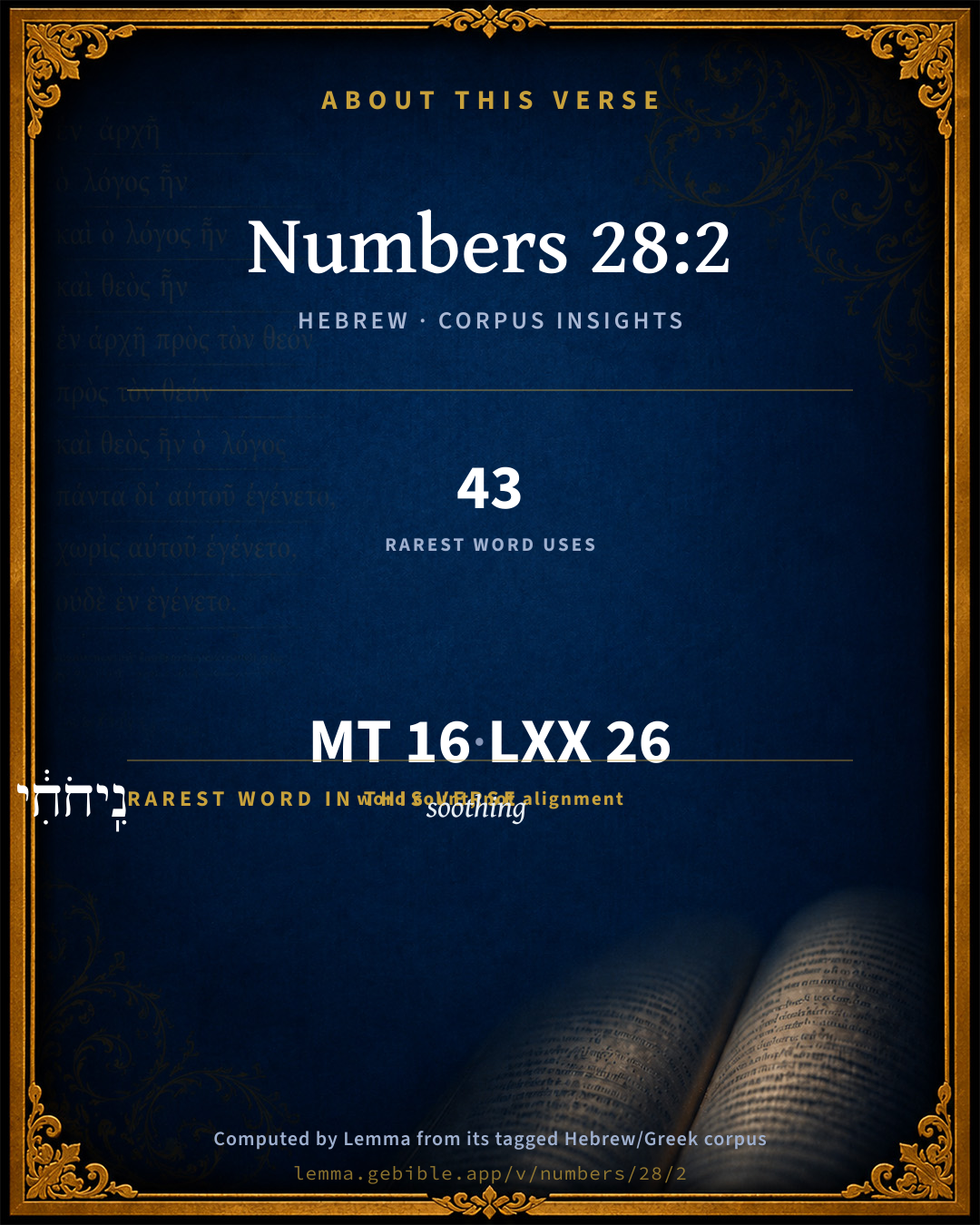
נִֽיחֹחִ֔י
nîychôwach
H5207
“soothing · my”
Noun, Common, Masculine, Singular, Construct + Suffix, Personal, 1st Person, Common, Singular
Part of Speech
Noun
Type
Common
Gender
Masculine
Number
Singular
State
Construct
Full BDB Definition

Origin: from H5117

TWOT: 1323c

soothing, quieting, tranquillising
  1. צַ֚ו tsâvâh H6680 “command” Verb, Piel, Imperative, 2nd Person, Masculine, Singular
  2. אֶת ʼêth H853 “-” Particle, Direct Object
  3. בְּנֵ֣י bên H1121 “sons of” Noun, Common, Masculine, Plural, Construct
  4. יִשְׂרָאֵ֔ל Yisrâʼêl H3478 “Israel” Noun, Proper
  5. וְאָמַרְתָּ֖ ʼâmar H559 “and · to say” Conjunction + Verb, Qal, Sequential Perfect, 2nd Person, Masculine, Singular
  6. אֲלֵהֶ֑ם ʼêl H413 “to · them” Preposition + Suffix, Personal, 3rd Person, Masculine, Plural
  7. אֶת ʼêth H853 “-” Particle, Direct Object
  8. קָרְבָּנִ֨י qorbân H7133 “offering · my” Noun, Common, Masculine, Singular, Construct + Suffix, Personal, 1st Person, Common, Singular
  9. לַחְמִ֜י lechem H3899 “bread · my” Noun, Common, Both, Singular, Construct + Suffix, Personal, 1st Person, Common, Singular
  10. לְאִשַּׁ֗י ʼishshâh H801 “to/for · burnt offerings · my” Preposition + Noun, Common, Masculine, Plural, Construct + Suffix, Personal, 1st Person, Common, Singular
  11. רֵ֚יחַ rêyach H7381 “fragrance of” Noun, Common, Masculine, Singular, Construct
  12. תִּשְׁמְר֕וּ shâmar H8104 “to keep” Verb, Qal, Imperfect, 2nd Person, Masculine, Plural
  13. לְהַקְרִ֥יב qârab H7126 “to approach” Preposition + Verb, Hiphil, Infinitive Construct
  14. בְּמוֹעֲדֽוֹ môwʻêd H4150 “in/at · appointed time · his” Preposition + Noun, Common, Masculine, Singular, Construct + Suffix, Personal, 3rd Person, Masculine, Singular

About this verse

These counts appear in no published source. They are computed here, from the morphology-tagged text and Lemma’s own curated glosses. What Lemma adds →

16
words
14
distinct lemmas
Pentateuch
section

Shared distinctive vocabulary

נִֽיחֹחִ֔י soothing H5207 occurs in 43 verses of the Hebrew Bible. Also found in:

Grammatical profile

  • 4 verbs
  • 8 nouns
  • 2 prepositions
  • 2 particles

Verb forms

  • צַ֚ו Piel · Imperative
  • וְאָמַרְתָּ֖ Qal · Sequential Perfect
  • תִּשְׁמְר֕וּ Qal · Imperfect
  • לְהַקְרִ֥יב Hiphil · Infinitive Construct

Hebrew & Septuagint length

In English translation the verse runs 35 words from the Hebrew and 34 from the Septuagint (LXX English) — closely comparable.

A rough comparison of the two English renderings, which tokenize alike — not a word-level alignment.

Word counts can differ between the Hebrew and the Greek without any difference in meaning — e.g. the Hebrew direct-object marker אֵת has no separate Greek word, and Greek often adds the article ὁ.

In the original languages it is 16 Hebrew tokens and 26 Greek tokens — but the two are counted differently (Hebrew bundles its prefixes and suffixes into one token; the Greek is in lemma form), so that isn’t a like-for-like length.

Cross-references

23

Topical passages linked to Numbers 28:2 in the Treasury of Scripture Knowledge — connected by theme and wording, ordered by reader-vote popularity; previews shown in the World English Bible.

  • Leviticus 3:11 The priest shall burn it on the altar: it is the food of the offering made by fire to Yahweh.
  • Genesis 8:21 Yahweh smelled the sweet savor. Yahweh said in his heart, "I will not again curse the ground any more for man's sake, because the imagination of man's heart is evil from his youth; neither will I ever again strike everything living, as I have done.
  • Exodus 23:15 You shall observe the feast of unleavened bread. Seven days you shall eat unleavened bread, as I commanded you, at the time appointed in the month Abib (for in it you came out from Egypt), and no one shall appear before me empty.
  • Exodus 29:18 You shall burn the whole ram on the altar: it is a burnt offering to Yahweh; it is a sweet savor, an offering made by fire to Yahweh.
  • Leviticus 1:9 but its innards and its legs he shall wash with water. The priest shall burn the whole on the altar, for a burnt offering, an offering made by fire, of a sweet savor to Yahweh.
  • Leviticus 1:13 but the innards and the legs he shall wash with water. The priest shall offer the whole, and burn it on the altar. It is a burnt offering, an offering made by fire, of a sweet savor to Yahweh.
  • Leviticus 1:17 He shall tear it by its wings, but shall not divide it apart. The priest shall burn it on the altar, on the wood that is on the fire. It is a burnt offering, an offering made by fire, of a sweet savor to Yahweh.
  • Leviticus 21:6 They shall be holy to their God, and not profane the name of their God; for they offer the offerings of Yahweh made by fire, the bread of their God; therefore they shall be holy.
  • Leviticus 21:8 You shall sanctify him therefore; for he offers the bread of your God: he shall be holy to you: for I Yahweh, who sanctify you, am holy.
  • Numbers 9:2–3 "Moreover let the children of Israel keep the Passover in its appointed season.
  • Numbers 9:7 Those men said to him, "We are unclean because of the dead body of a man. Why are we kept back, that we may not offer the offering of Yahweh in its appointed season among the children of Israel?"
  • Numbers 9:13 But the man who is clean, and is not on a journey, and fails to keep the Passover, that soul shall be cut off from his people. Because he didn't offer the offering of Yahweh in its appointed season, that man shall bear his sin.
  • Numbers 15:3 and will make an offering by fire to Yahweh, a burnt offering, or a sacrifice, to accomplish a vow, or as a freewill-offering, or in your set feasts, to make a sweet savor to Yahweh, of the herd, or of the flock;
  • Numbers 15:7 and for the drink-offering you shall offer the third part of a hin of wine, of a sweet savor to Yahweh.
  • Numbers 15:24 then it shall be, if it be done unwittingly, without the knowledge of the congregation, that all the congregation shall offer one young bull for a burnt offering, for a sweet savor to Yahweh, with the meal-offering of it, and the drink-offering of it, according to the ordinance, and one male goat for a sin-offering.
  • Psalms 81:3 Blow the trumpet at the New Moon, At the full moon, on our feast day.
  • Ezekiel 16:19 My bread also which I gave you, fine flour, and oil, and honey, with which I fed you, you did even set it before them for a sweet savor; and [thus] it was, says the Lord Yahweh.
  • Ezekiel 20:41 As a sweet savor will I accept you, when I bring you out from the peoples, and gather you out of the countries in which you have been scattered; and I will be sanctified in you in the sight of the nations.
  • Malachi 1:7 You offer polluted bread on my altar. You say, 'How have we polluted you?' In that you say, 'Yahweh's table contemptible.'
  • Malachi 1:12 "But you profane it, in that you say, 'Yahweh's table is polluted, and its fruit, even its food, is contemptible.'
  • 2 Corinthians 2:15 For we are a sweet aroma of Christ to God, in those who are saved, and in those who perish;
  • Ephesians 5:2 Walk in love, even as Christ also loved you, and gave himself up for us, an offering and a sacrifice to God for a sweet-smelling fragrance.
  • Philippians 4:18 But I have all things, and abound. I am filled, having received from Epaphroditus the things that came from you, a sweet-smelling fragrance, an acceptable and well-pleasing sacrifice to God.

Cross-references courtesy of OpenBible.info (CC BY 4.0).

Hebrew and Greek witnesses Masoretic Hebrew ↔ Greek Septuagint

The same verse in the two great witnesses to the Old Testament, shown verse-for-verse.

These are two independent witnesses, not word-aligned to each other, and the Septuagint is shown in lemma (dictionary) form.

Hebrew Numbers 28:2 Masoretic · Westminster Leningrad Codex

צַ֚ו אֶת בְּנֵ֣י יִשְׂרָאֵ֔ל וְאָמַרְתָּ֖ אֲלֵהֶ֑ם אֶת קָרְבָּנִ֨י לַחְמִ֜י לְאִשַּׁ֗י רֵ֚יחַ נִֽיחֹחִ֔י תִּשְׁמְר֕וּ לְהַקְרִ֥יב לִ֖י בְּמוֹעֲדֽוֹ

Command the children of Israel, and tell them, My offering, my food for my offerings made by fire, of a sweet savor to me, shall you observe to offer to me in their due season.

World English Bible · Public Domain

Greek LXX Numbers 28:2 Septuagint · lemma form

ἐντέλλομαι ὁ υἱός ἰσραήλ καί εἶπον πρός αὐτός λέγω ὁ δῶρον ἐγώ δόμα ἐγώ κάρπωμα ἐγώ εἰς ὀσμή εὐωδία διατηρέω προςφέρω ἐγώ ἐν ὁ ἑορτή ἐγώ

Charge the children of Israel, and you shall speak to them, saying, You⌃ shall observe to offer to me in my feasts my gifts, my presents, my burnt offerings for a sweet smelling savor.

LXX2012 (modern English Septuagint) · Public Domain

On this verse, The Pulpit Commentary discusses the Septuagint’s reading. Read the note in Commentary ↓

Hebrew: Westminster Leningrad Codex (CC BY 4.0). Greek: Septuagint (public domain); English from LXX2012 (modern English Septuagint) (Public Domain). How the Septuagint differs from the Hebrew →

Targum (Aramaic paraphrase)

2

The Targum is the ancient Jewish Aramaic paraphrase of the Hebrew Scriptures — an interpretive translation, not the Hebrew text itself. Onkelos (literal) and Pseudo-Jonathan (expansive) render the Torah, and Jonathan the Prophets. Coverage is partial: where no permissively-licensed English translation exists for a verse, only the Aramaic is shown. This is verse-level text, not a word-by-word alignment to the Hebrew.

  1. Targum Onkelos Torah (Genesis–Deuteronomy)
    פַקֵיד יָת בְּנֵי יִשְׂרָאֵל וְתֵימַר לְהוֹן יָת קוּרְבָּנִי לְחֵם סִדוּר לְקוּרְבָּנַי לְאִתְקַבָּלָא בְּרַעֲוָא תִּטְרוּן לְקָרָבָא קֳדָמַי בְּזִמְנֵיהּ

    (no public-domain English translation for this verse)

    Targum Onkelos — Aramaic: “Onkelos Genesis” (public domain); “Onkelos Exodus” (public domain); “Onkelos Leviticus” (public domain); “Onkelos Numbers” (public domain); “Onkelos Deuteronomy” (public domain). English: “Sefaria Community Translation” (CC0 1.0 (public-domain dedication)); “J.W. Etheridge. The Targums of Onkelos and Jonathan Ben Uzziel on the Pentateuch. London: Longmans, Green, 1862” (public domain). Text via Sefaria.

  2. Targum Pseudo-Jonathan Torah (Genesis–Deuteronomy)
    פַּקֵיד יַת בְּנֵי יִשְרָאֵל וְתֵימַר לְהוֹן יַת קוּרְבָּנִי לְחֵים סִדוּר פָּתוֹרֵי יֵיכְלוּן כַּהֲנַיָא וּמַה דְאַתּוּן מְקַרְבִין עַל גַב מַדְבְּחָא לֵית רְשׁוּ לִגְבַר דְיֵיכוּל מִנֵיהּ הֲלָא אֵישָׁתָא הִיא דְאַכְלָא יָתֵיהּ וְהוּא מִתְקַבֵּל קֳדָמֵי לְרֵיחַ רַעֲוָא. עַמִי בְּנֵי יִשְרָאֵל הֲווֹ זְהִירִין לִמְקַרְבָא יָתֵיהּ מֵאַפְרָשׁוּת לִשְׁכְּתָא קָרְבַּן קֳדָמַי בְּזִמְנֵיהּ

    Instruct the children of Israel, and say to them: The priests may eat of My oblation the bread of the order of My table; but that which you offer upon My altar may no man eat. Is there not a fire that will consume it? And it shall be accepted before Me as a pleasant smell. Sons of Israel, My people, be admonished to offer it from the firstlings on the Sabbath, an oblation before Me in its time.

    Targum Pseudo-Jonathan — Aramaic: “Targum Jonathan on Genesis” (public domain); “Targum Jonathan on Exodus” (public domain); “Targum Jonathan on Leviticus” (public domain); “Targum Jonathan on Numbers” (public domain); “Targum Jonathan on Deuteronomy” (public domain). English: “The Targum of Jonathan ben Uzziel, trans. J. W. Etheridge, London, 1862” (public domain). Text via Sefaria.

Commentary

Notes on Numbers 28:2 from classic Christian and Jewish commentators (each source and its license shown beneath its notes). The classic Christian expositions comment on the surrounding passage and are grouped to its opening verse, so a note may address several verses; the Jewish commentaries on the Tanakh (Rashi and others) are per-verse, so they appear only where the commentator wrote on this verse.

Lemma curates 59 commentaries, every one of them public domain or Creative Commons licensed, each selected and text-cleaned for this edition rather than reprinted as found. About our sources →

Trapp's Complete Commentary

John Trapp

Num 28:2 Command the children of Israel, and say unto them, My offering, [and] my bread for my sacrifices made by fire, [for] a sweet savour unto me, shall ye observe to offer unto me in their due season.

Ver. 2. My offering.] He is owner of all; and of his own we give him. Tα σα εκ των σων, said that great emperor.

And my bread.] Called their bread for their souls; that is, the bread for their natural sustenance, common bread, when not rightly offered. So Jer 7:21. God in scorn calls their sacrifice flesh, ordinary flesh, such as is sold in the shambles. So at the Lord’s Supper impenitent communicants receive no more than the bare elements; panem Domini, but not panem Dominum. {a}

In their due season.] Which for eight and thirty years they had intermitted. Get a settlement, or Sabbath of spirit, or else God shall be but ill, if at all, served.

{a} August.

John Trapp, A Commentary or Exposition upon All the Books of the Old and New Testament (1647–1656) — public domain. Text from a community e-Sword module.

Joseph Benson's Commentary

Num 28:2. Command the children of Israel — God here repeats some of the former laws about sacrifices, not without great reason; 1st, Because they had been generally discontinued for thirty-eight years together. 2d, Because the generation to which the former laws had been given about these things was wholly dead, and it was fit the new generation should be instructed about them, as their parents were. 3d, To renew the testimonies of God’s grace and mercy, notwithstanding their frequent forfeitures thereof by their rebellion. And, 4th, and principally, Because they were now ready to enter into that land, in which they were obliged to put these things in practice. It is observable that God commands Moses to repeat them in the following order of daily, weekly, monthly, and anniversary sacrifices.

Joseph Benson's Commentary on the Old and New Testaments (1811–1818) — public domain. Text from a community e-Sword module.

Keil & Delitzsch

C. F. Keil & F. Delitzsch

Num 28:2 contains the general instruction to offer to the Lord His sacrificial gift "at the time appointed by Him." On corban, see at Lev 1:2; on "the bread of Jehovah," at Lev 3:11; on the "sacrifice made by fire," and "a sweet savour," at Lev 1:9; and on "moed," at Lev 23:2, Lev 23:4.

Keil & Delitzsch — Biblical Commentary on the Old Testament (1861–1891) — public domain (CC PDM 1.0). Text via the HelloAO Bible API. (Old Testament only.)

Tyndale Open Study Notes

Tyndale Open Resources

28:2 they are my food: See study notes on Exod 29:18; Deut 8:2.

Tyndale Open Study Notes — © Tyndale Open Resources, licensed CC BY-SA 4.0. Text via the HelloAO Bible API.

Geneva Bible (1599)

Geneva Bible translators

By bread he meaneth all manner of sacrifice.

Geneva Bible (1599) marginal notes — public domain. Text via Bolls.life.

Adam Clarke's Commentary

Verse 2. Command the children of Israel, c.] It is not easy to account for the reason of the introduction of these precepts here, which had been so circumstantially delivered before in different parts of the books of Exodus and Leviticus. It is possible that the daily, weekly, monthly, and yearly services had been considerably interrupted for several years, owing to the unsettled state of the people in the wilderness, and that it was necessary to repeat these laws for two reasons:

1. Because they were now about to enter into the promised land, where these services must be established and constant.

2. Because the former generations being all dead, multitudes of the present might be ignorant of these ordinances.

In their due season] Moses divides these offerings into: -

1. DAILY. The morning and evening sacrifices: a lamb each time, Nu 28:3-4.

2. WEEKLY. The Sabbath offerings, two lambs of a year old, Nu 28:9, c.

3. MONTHLY. At the beginning of each month two young bullocks, one ram, and seven lambs of a year old, and a kid for a sin-offering, Nu 28:11, &c.

4. ANNUAL. 1. The passover to last seven days the offerings, two young bullocks, one ram, seven lambs of a year old, and a he-goat for a sin-offering, Nu 28:16, &c. 2. The day of FIRST-FRUITS. The sacrifices, the same as on the beginning of the month, Nu 28:26, &c.

With these sacrifices were offered libations, or drink-offerings of strong wine, Nu 28:7, Nu 28:14, and minchahs, or meat-offerings, composed of fine flour mingled with oil, Nu 28:8, Nu 28:12, &c. For an ample account of all these offerings, See Clarke on Le 7:38 and Ex 12:1-51.

Adam Clarke's Commentary on the Bible (1810–1826) — public domain. Text from a community e-Sword/MySword module.

Ellicott's Commentary for English Readers

(2) My offering, and my bread . . . —Better, My oblation (even) my bread, &c. The offering, though presented by the hands of men, was God’s, not theirs. “The silver is mine, and the gold is mine, saith the Lord of hosts” (Hag_2:8). “Every beast of the forest is mine, and the cattle upon a thousand hills” (Ps. 1.10). The word korban is a general term for an oblation. It may denote in this place the minchah, or meal offering, or the shew-bread, offerings which were directly connected with a settled life in Canaan rather than with a nomadic life in the wilderness. Or the word lehem (bread) may be used to denote food generally, the sacrificial offerings being symbolically regarded as the Lord’s food. (Comp. Lev_3:11; Lev_3:16, where the same word is rendered food, and where the reference is to a portion of the flesh of the lamb and of the goat of the peace offering. See also Mal_3:7.)

A Bible Commentary for English Readers, edited by Charles John Ellicott (1878–1897) — public domain. Text from a community e-Sword module.

John Gill's Exposition

Command the children of Israel, and say unto them,.... For what follows concerned them all; namely, the offering of their daily, weekly, monthly, and anniversary sacrifices, which were not for private persons, but for the whole congregation; and these might be considered by them not merely as commands and duties to be observed, but as tokens of the divine favour to them, that notwithstanding all their rebellions and provocations in the wilderness, sacrifices for sin were ordered, continued, and accepted of by the Lord; and his acceptance of them, and well pleasedness in them, may easily be observed in the expressions used concerning them:

my offering, and my bread; by "offering" may be meant in general all sacrifices which were offered to the Lord, and by his command; and more especially the burnt offering, which was wholly and peculiarly his, and is after explained by sacrifices made by fire, and it is chiefly of burnt offerings this chapter treats; and by "bread" may be meant either the shewbread, which was set upon a table before the Lord continually, as his bread; so the Targum of Jonathan,"my oblation, the bread of the order of my table, shall the priests eat, but what ye offer on the altar no man has power to eat;''or else the meat offering, or rather, as it may be called, the bread offering, which always went along with burnt offerings; though the copulative "and", which is not in the text, may be omitted, and both may signify the same, "my offering", that is, "my bread"; for the sacrifices were the food of God, the provisions of his house, of which there were all sorts in the sacrifices, flesh, bread, and wine; particularly the daily sacrifice was his food every day, and the fat of sacrifices burnt is called the food of the offering made by fire, Lev 3:16, so Jarchi interprets it, "my offering", this is the blood; "my bread", the "amurim", or fat that covereth the inward parts, which were burnt on the altar:

for my sacrifices made by fire for a sweet savour unto me; which respects burnt offerings, wholly consumed by fire, and were entirely the Lord's, and which he smelled a sweet savour in, or were acceptable to him: these the children of Israel were

to observe to offer unto him in their due season; the daily sacrifice, morning and evening; not before morning, nor after evening, as Aben Ezra observes; and so all the rest at the proper time fixed, whether weekly, monthly, or yearly. The Jews, from this phrase, "observe to offer unto me", conclude the necessity of fixing stations, or stationary men, as Jarchi notes; so the tradition is,"these are the stations, as it is said, "command the children of Israel, &c." but how can the offering of a man be offered, and he not stand by it? wherefore the former prophets appointed twenty four courses, and to every course there was a station at Jerusalem of priests, Levites, and Israelites; and when the time of each course came to go up, the priests and Levites went up to Jerusalem, and the Israelites who belonged to that course went into their cities, and read the history of the creation (d):''now these stations, or stationary men, were substitutes for, or representatives of all Israel, and stood by the sacrifices when they were offered, in which all Israel were concerned, as particularly in the daily sacrifice, which is here first taken notice of.

(d) Taanith, c. 4. sect. 2.

John Gill's Exposition of the Whole Bible (1746–1763) — public domain (CC PDM 1.0). Text via the HelloAO Bible API.

Albert Barnes' Notes on the Bible

My offering, and my bread ... - Or, my offering, even my bread, etc. Offering is here קרבן qorbân (compare Lev 1:2; Mar 7:11), a term in itself of quite general import, but often especially applied, as apparently in this instance, to the meat-offering which accompanied the sacrifices. This meat-offering connected itself, from its very nature, with the life of the Israelites in Canaan, not with their life in the wilderness; and it was annexed to the animal sacrifices as a token that the people must dedicate to God their property and the fruits of their labor as well as their own persons. See Num 15:2 note and Lev 21:6.

Albert Barnes' Notes on the Bible (1834–1885) — public domain. Text from a community e-Sword/MySword module.

Haydock's Catholic Bible Commentary

Seasons. These precepts had often been repeated already: but perhaps they had not been exactly observed in the desert, so that Moses indicates them once more, as if to remind the people that they will now have no excuse, if they neglect these sacrifices in the promised land. (Calmet) --- These frequent repetitions may also remind us, with what attention we ought to worship God. (Du Hamel)

George Leo Haydock (1774–1849), Haydock's Catholic Family Bible and Commentary, 1859 edition — public domain. Excludes Psalms (Douay-Rheims chapter numbering differs from Protestant) and Deuterocanonical books (Catholic canon only).

Matthew Poole's English Annotations

God here repeats some of the former laws about sacrifices, not without great reason, partly, because they had been generally discontinued for thirty-eight years together; partly, because the generation to which the former laws had been given about these things was wholly dead, and it was fit the new generation should be instructed about them, as their parents were; partly, to renew the testimonies of God’s grace and mercy, notwithstanding their frequent forfeitures thereof by their horrid apostacies and rebellions; and principally, because they were now ready to enter into that land, in which they were obliged to put these things in practice, Deu 12:8, &c.

Made by fire. According to this translation the sense is, My offering, i.e. my offering or sacrifices, and my bread, i.e. either my shew-bread, or rather my meat-offering made of bread or meal, for my sacrifices made by fire, i.e. which is to accompany my burnt-offerings. Or thus, My offering, to wit, my bread, i. e. my meat-offering, which was made of bread or meal, which is oft expressed by this very name of corban or offering, as Lev 2:1; 6:20; but because corban signifies not only a meatoffering, but other offerings also, as Lev 7:37,38, therefore he limits that general word by adding my bread with (so the Hebrew lamed is oft used, as Gen 46:26; Ezr 1:5; 2:63, &c.) my sacrifices made by fire, which may be understood either,

1. Generally for all the sacrifices, as that phrase is sometimes taken, as 1Sa 2:28, where it must needs be so meant, because the burntofferings properly so called were not given to the priest, but reserved to God himself, and the priest’s portion lay in the other sacrifices only; or,

2. Specially and properly for burnt-offerings; and so under them, as the most eminent kind, are contained all other sacrifices; as under the meat-offering here is contained the drink-offering. And according to this translation and explication these words contain a full and general rule, comprehending all the particulars following in this chapter, as in reason they ought to do, and which otherwise they do not.

Matthew Poole's English Annotations on the Holy Bible (1683–1685) — public domain. Text from a community e-Sword/MySword module.

Whedon's Commentary on the Bible

Daniel D. Whedon

SACRIFICES REQUIRED BY JEHOVAH, Num_28:1-2.

2. My offering — Korban. Lev_1:2, note.

My bread — Lev_3:11, note.

By fire… sweet savour — Lev_1:9, note.

Due season — The festal times of Jehovah, (Lev_23:2,) appointed by him as days or times which were to be sanctified to his service, include the sabbath, new moon, the yearly feasts, and the daily sacrifices.

Daniel D. Whedon (gen. ed.), Commentary on the Old and New Testaments (1874–1909) — public domain. Text from a community e-Sword module.

The Pulpit Commentary

My offering, and my bread. Literally, "my korban, my bread." The general term korban (anything offered to God; cf. Num_7:3 Mar_7:11) is here restricted by the words which follow to the meat offering. "Bread" ( is translated "food" in Lev_3:11, 16 (see the note there). Sweet savour. jyre. Septuagint, eiv osmhav . (see on Gen_8:21 Lev_3:16 Eph_5:2)

The Pulpit Commentary (1880–1919), ed. H.D.M. Spence-Jones & Joseph S. Exell — public domain. Text from a community e-Sword module.

John Wesley's Explanatory Notes

Command the children of Israel - God here repeats some of the former laws about sacrifices, not without great reason, partly because they had been generally discontinued for thirty eight years together; partly because the generation to which the former laws had been given about these things was wholly dead, and it was fit the new generation should be instructed about them, as their parents were; partly to renew their testimonies of God's grace and mercy, notwithstanding their frequent forfeitures thereof by their rebellion: and principally because they were now ready to enter into that land, in which they were obliged to put these things in practice.

John Wesley, Explanatory Notes Upon the Whole Bible (1754–1765) — public domain. Text via the GEBible commentary corpus.

Scofield Reference Notes

C. I. Scofield

sweet savour

Or, savour of satisfaction. (See Scofield "Lev 1:9").

The Scofield Reference Bible (1917 edition), notes by C. I. Scofield — public domain. Text from a community e-Sword module.

Rashi

Rabbi Shlomo Yitzchaki (Rashi)

צו את בני ישראל COMMAND THE CHILDREN OF ISRAEL — What is said above? Moses said, “Let the Lord set [a man over the congregation]” (Numbers 27:16). The Holy One, blessed be He, said to him, “Instead of giving Me a command regarding My children, command My children regarding Me!” A parable! It may be compared to the case of a princess who was departing this world and gave her husband charge concerning her children, etc., as it is related in Sifrei Bamidbar 142:1.

קרבני MY OFFERING — this refers to the blood.

לחמי MY FOOD — this refers to the fat-portions, and so it states, (Leviticus 3:16) “And the priest shall burn them (the fat-portions) on the altar, it is the food of the fire-offerings” (Sifrei Bamidbar 142:2).

לאשי [MY FOOD] FOR MY FIRE OFFERING — i.e., the fat-portions that are assigned for the fire offerings of My altar (Sifrei Bamidbar 142:2).

תשמרו YE (the children of Israel) SHALL WATCH [TO OFFER TO ME] — This implies that priests, Levites and ordinary Israelites shall stand by watching when the sacrifices are offered (Sifrei Bamidbar 142:2). From this command they (the Rabbis) derived the law of, and instituted the Maamadot (representatives of the people who were present when the sacrificial service was performed) (Taanit 27a).

במועדו [YE SHALL OFFER TO ME] IN ITS APPOINTED SEASON — Every day is the “appointed season” for the continual offerings.

Rashi on the Tanakh — English translations: “The Judaica Press complete Tanach with Rashi, translated by A. J. Rosenberg” (CC BY 4.0); “Pentateuch with Rashi's commentary by M. Rosenbaum and A.M. Silbermann, 1929-1934” (public domain); “The Metsudah Tanach series, Lakewood, N.J” (CC BY 4.0); and “The Book of Joshua, Metsudah Publications, 1997” (CC BY 4.0). Text via Sefaria.

Ramban (Nachmanides)

Rabbi Moshe ben Nachman (Ramban / Nachmanides)

COMMAND THE CHILDREN OF ISRAEL, AND SAY UNTO THEM: MY OFFERING, MY BREAD FOR MY FIRE-OFFERINGS. The reason [for stating this command here] is that after He had said, Unto these the Land shall be divided, He completed the commands relating to the laws of the offerings which they are to observe in the Land, since they did not bring any Additional Offerings [of Sabbaths and festivals] in the desert, as I have mentioned in Seder Emor El Hakohanim. Likewise they were not obliged to bring drink-offerings in the wilderness, as I have explained in Seder Shelach Lecha. But now He charged those who were to come into the Land with the duty of bringing all [these offerings] there — the Daily Whole-offerings, the Additional Offerings, and their meal-offerings and their drink-offerings. And although He did not say expressly here: “when you come into the Land,” He has already mentioned it in the section of drink-offerings, and He hinted at it in the first section dealing with the festivals. Now He started here with the [laws of the] Daily Whole-offering, [for] although it has already been mentioned in the section of V’atah Tetzaveh, He repeated it in order that it should all be arranged in one section. And Rashi wrote [in Verse 4]; “That one [i.e., the section in V’atah Tetzaveh] was an instruction [only] for the days of the installation [of the priests], and here He [repeated it] as a commandment for [all future] generations.” But this is not correct, since there it says, It shall be a continual burnt-offering ‘throughout your generations.’, 29:42. Hence the commandment to offer this in future generations has already been stated there.And according to the interpretation [of the Rabbis] 142. many new teachings are added here [in this repetition of the section of V’atah Tetzaveh; namely]: “My offering — this is the blood. My bread — this refers to [those parts of the offering] that are to be burnt on the altar. My fire offerings — these are the handfuls [of flour] and the frankincense [of the meal-offering]. For a pleasing odor unto Me — these are the [two] bowls [of frankincense that were brought as a memorial] with the showbread. Ye shall observe — that it should only be brought from [animals which have been] kept [for a number of days, and examined so that no blemish occurs to them]. Ye shall observe — that one may only bring [the offering] from that [money] which was donated to the treasury [of the Sanctuary]. Ye shall observe — that priests, Levites and Israelites should stand over it. Ye shall observe — Scripture uses here the term shmirah [‘keeping,’ or ‘observing’], and elsewhere it [also] uses the term shmirah; (in your keeping) until the fourteenth day of the same month (Exodus 12:6). Since the lamb had to be bought on the tenth of that month (ibid., Verse 3), the verse implies that it has to be carefully examined for a blemish for four days before it is slaughtered. Since here, in speaking of the Daily Whole-offering, Scripture likewise uses the term shmirah [— ‘tishmeru’ (ye shall keep)], we deduce that it also has to be examined for four days before it is slaughtered just as there the offering requires observation [so that no blemish should be found in it] for [a period of] four days before it is slaughtered, so here too etc.” [See] the whole interpretation, as it is stated in the Sifre. 142.By way of the Truth, [the mystic teachings of the Cabala], the verse also hints to the following: It states My offering, My bread ‘l’ishai’ — of ‘ishai’ (My Divine powers) — ye shall keep and be careful to offer unto Me to My Name, in its due season. And thou shalt say unto them further, This is the fire-offering which ye shall offer unto the Eternal, “so that the offering should bring about [the desired unity and harmony on high].” on Ricanti. Now there is no sin-offering amongst the Additional Offerings of the Sabbath, as there is in all the other Additional Offerings [i.e., those brought on the New Moon and the festivals], because the congregation of Israel is its partner [that of the Sabbath], and all is [therefore] peace [and harmony]. The student [learned in the teachings of the Cabala] will understand. Similarly He mentioned [here for the purpose of arranging all offerings in one section] And in the first month, on the fourteenth day of the month, is the Eternal’s Passover, meaning that they should offer the Paschal-offering, in order to command them about it together with the other [additional] offerings of the Festival of Unleavened Bread. And He dealt with it [the Paschal-offering] briefly, referring to it only by its name, since He had already explained [all] its laws, according to all the statutes of it, and according to all the ordinances thereof.

Ramban (Nachmanides) on the Tanakh — English translation: “Commentary on the Torah by Ramban (Nachmanides). Translated and annotated by Charles B. Chavel. New York, Shilo Pub. House, 1971-1976” (CC BY 4.0). Text via Sefaria.

Lesson kit

Teaching starters — assembled from the data on this page, not authored interpretation. Every prompt links to the verse data it draws on. Edit before teaching.

Numbers, in the Pentateuch, opens this verse with 16 words (14 distinct Hebrew lemmas). Its most distinctive word is nîychôwach (“soothing”). A historical commentator’s framing appears above. Read the whole chapter for the surrounding context.

Discussion questions

  1. How does “soothing” (nîychôwach) shape what this verse is saying?
  2. Genesis 8:21 shares the word «soothing» with this verse. How do the two illuminate each other?
  3. These translations render this verse differently; the difference is in the English rendering, not the original. What questions does that raise?
  4. The verb «צַ֚ו» is Piel Imperative. How does its form color the action?
  5. Reading how Trapp's Complete Commentary and Joseph Benson's Commentary read this verse, where do the two commentators agree and where do they part?

Things to notice

Reading settings

Reading text

Shown beneath each verse's original-language words.

Old Testament
Old Testament edition

Read the OT as the Masoretic Hebrew (MT) or the Greek Septuagint (LXX).

English shown for the Greek Septuagint (in the Hebrew ↔ Greek comparison).

Comparing translations? Open the Compare panel on any verse page to stack up to four side by side.