Leviticus 24:7

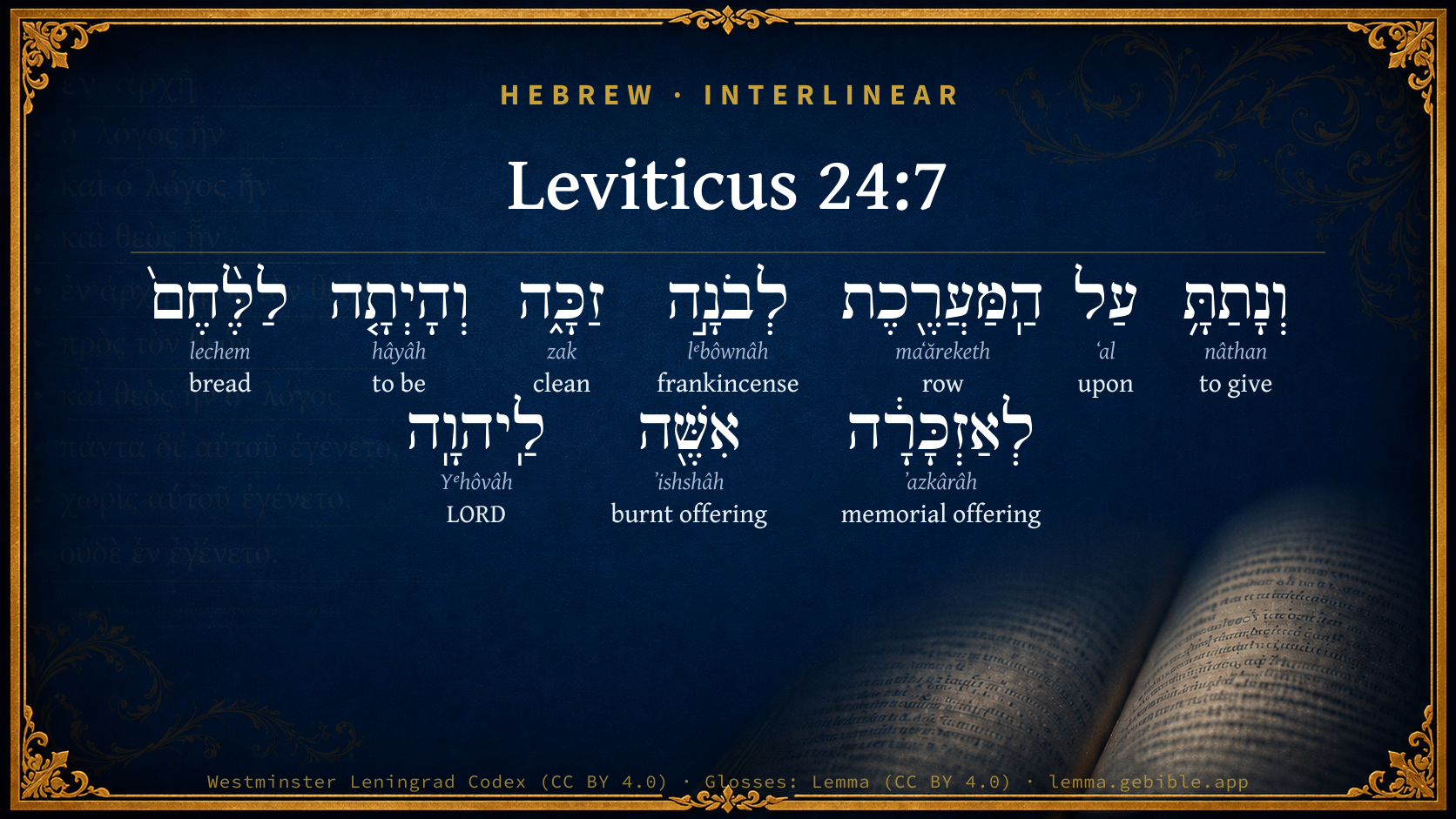
Hebrew (Westminster Leningrad Codex) Leviticus 24:7 appears in the Hebrew Old Testament. The text above is from the Westminster Leningrad Codex. Each word links to its Strong’s number, a concise gloss, and parsing drawn from the Open Scriptures Hebrew Bible morphology. Click any word for its full Brown-Driver-Briggs (BDB) entry.
Download image
Cite this verse

Leviticus 24:7 (World English Bible). Public Domain. Lemma interlinear Bible study tool, https://lemma.gebible.app/v/leviticus/24/7.

Show BibTeX & RIS
BibTeX
RIS
English Translation
You shall put pure frankincense on each row, that it may be to the bread for a memorial, even an offering made by fire to Yahweh.
World English Bible · Public Domain
Download a study sheet

One document with this verse’s original text, its word-by-word gloss line, the meaning frame, cross-references with their text, attributed commentary, and full source and license credits — printable, and it pastes into notes with its structure intact.

This verse Autodidact and up

Study sheet (.html) Plain text (.txt)

A passage Seminary Student

Up to 50 verses in one chapter. A passage sheet keeps up to 6 commentary sources and 12 cross-references per verse, in the order this page ranks them, and says so on the sheet whenever that leaves anything out. Ask for a single verse and you get the Autodidact verse sheet above.

Everything on this page stays free to read, with no account — the sheet is a download of what is already on screen, not access to it.

Want to remove ads? Support Godless Engineer
Compare translations 3

The same verse in 3 English versions, stacked beneath the original-language interlinear above. Click any original word for its lexicon entry.

Each is an independent rendering of the whole verse — the interlinear is not word-aligned to these translations.

Highlighted words mark where these versions differ — a whole-verse word diff, not a word-by-word alignment.

  • World English Bible Public Domain
    You shall put pure frankincense on each row, that it may be to the bread for a memorial, even an offering made by fire to Yahweh.
  • King James Version Public Domain
    And thou shalt put pure frankincense upon each row, that it may be on the bread for a memorial, even an offering made by fire unto the LORD.
  • unfoldingWord Literal Text CC BY-SA 4.0
    And you shall put on the row pure frankincense, and it shall be for the bread as a memorial portion, a gift to Yahweh.

unfoldingWord Literal Text — © unfoldingWord, licensed CC BY-SA 4.0. Word-aligned USFM3 via Door43 (git.door43.org/unfoldingWord/en_ult).

Versions to compare (up to 4)

3 of 4 selected

Show all 18 translations

Every available English version of this verse, each an independent rendering of the whole verse.

  • World English Bible Public Domain
    You shall put pure frankincense on each row, that it may be to the bread for a memorial, even an offering made by fire to Yahweh.
  • Berean Standard Bible Public Domain
    And you are to place pure frankincense near each row, so that it may serve as a memorial portion for the bread, an offering made by fire to the LORD.
  • Majority Standard Bible Public Domain
    And you are to place pure frankincense near each row, so that it may serve as a memorial portion for the bread, a food offering to the LORD.
  • King James Version Public Domain
    And thou shalt put pure frankincense upon each row, that it may be on the bread for a memorial, even an offering made by fire unto the LORD.
  • American Standard Version (1901) Public Domain
    And thou shalt put pure frankincense upon each row, that it may be to the bread for a memorial, even an offering made by fire unto Jehovah.
  • Revised Version (1885) Public Domain
    And thou shalt put pure frankincense upon each row, that it may be to the bread for a memorial, even an offering made by fire unto the LORD.
  • Geneva Bible (1599) Public Domain
    Thou shalt also put pure incense vpon the rowes, that in steade of the bread it may bee for a remembrance, and an offering made by fire to the Lord.
  • Douay-Rheims (1899) Public Domain
    And thou shalt put upon them the dearest frankincense, that the bread may be for a memorial of the oblation of the Lord.
  • Young's Literal Translation Public Domain
    and thou hast put on the rank pure frankincense, and it hath been to the bread for a memorial, a fire-offering to Jehovah.
  • Literal Standard Version CC BY-SA 4.0
    and you have put pure frankincense on the row, and it has been with the bread for a memorial, a fire-offering to YHWH.
  • Unlocked Literal Bible CC BY-SA 4.0
    You must put pure incense along each row of loaves as a representative offering. This incense will be burnt for Yahweh.
  • unfoldingWord Literal Text CC BY-SA 4.0
    And you shall put on the row pure frankincense, and it shall be for the bread as a memorial portion, a gift to Yahweh.
  • Darby Bible Public Domain
    And thou shalt put pure frankincense upon each row; and it shall be a bread of remembrance, an offering by fire to Jehovah.
  • World Messianic Bible Public Domain
    You shall put pure frankincense on each row, that it may be to the bread for a memorial, even an offering made by fire to the LORD.
  • Webster's Bible Public Domain
    And thou shalt put pure frankincense upon each row, that it may be on the bread for a memorial, even an offering made by fire to the LORD.
  • Free Bible Version CC BY-SA 4.0
    Place pure frankincense beside each pile to go with the bread to act as the ‘reminder part,’ a food offering to the Lord.
  • Bible in Basic English Public Domain
    And on the lines of cakes put clean sweet-smelling spices, for a sign on the bread, an offering made by fire to the Lord.
  • JPS Tanakh (1917) Public Domain
    And thou shalt put pure frankincense with each row, that it may be to the bread for a memorial-part, even an offering made by fire unto the LORD.

Literal Standard Version (2020), Covenant Press — licensed CC BY-SA 4.0. Text via the HelloAO Bible API (eBible.org). Unlocked Literal Bible (unfoldingWord) — licensed CC BY-SA 4.0. Text via the HelloAO Bible API (eBible.org). unfoldingWord Literal Text — © unfoldingWord, licensed CC BY-SA 4.0. Word-aligned USFM3 via Door43 (git.door43.org/unfoldingWord/en_ult). Free Bible Version, Dr. Jonathan Gallagher — licensed CC BY-SA 4.0. Text via the HelloAO Bible API (eBible.org).

Word by word

More ways to search: Search by grammar → Find every occurrence → Compare this word →

Practice this passage: Drill this verse → Learn its vocabulary →

לְאַזְכָּרָ֔ה
ʼazkârâh
H234
“to/for · memorial offering”
Preposition + Noun, Common, Feminine, Singular, Absolute
Part of Speech
Preposition + Noun
Type
Common
Gender
Feminine
Number
Singular
State
Absolute
Full BDB Definition

Origin: from H2142

TWOT: 551d

memorial-offering, the portion of the meal (food) offering which is burned
  1. וְנָתַתָּ֥ nâthan H5414 “and · to give” Conjunction + Verb, Qal, Sequential Perfect, 2nd Person, Masculine, Singular
  2. עַל ʻal H5921 “upon” Preposition
  3. הַֽמַּעֲרֶ֖כֶת maʻăreketh H4635 “the · row” Particle, Definite Article + Noun, Common, Feminine, Singular, Absolute
  4. לְבֹנָ֣ה lᵉbôwnâh H3828 “frankincense” Noun, Common, Feminine, Singular, Absolute
  5. זַכָּ֑ה zak H2134 “clean” Adjective, Adjective, Feminine, Singular, Absolute
  6. וְהָיְתָ֤ה hâyâh H1961 “and · to be” Conjunction + Verb, Qal, Sequential Perfect, 3rd Person, Feminine, Singular
  7. לַלֶּ֨חֶם֙ lechem H3899 “to/for the · bread” Preposition, Determined + Noun, Common, Both, Singular, Absolute
  8. אִשֶּׁ֖ה ʼishshâh H801 “burnt offering” Noun, Common, Masculine, Singular, Absolute
  9. לַֽיהוָֽה Yᵉhôvâh H3068 “to/for · LORD” Preposition + Noun, Proper

About this verse

These counts appear in no published source. They are computed here, from the morphology-tagged text and Lemma’s own curated glosses. What Lemma adds →

10
words
10
distinct lemmas
Pentateuch
section

Notable vocabulary

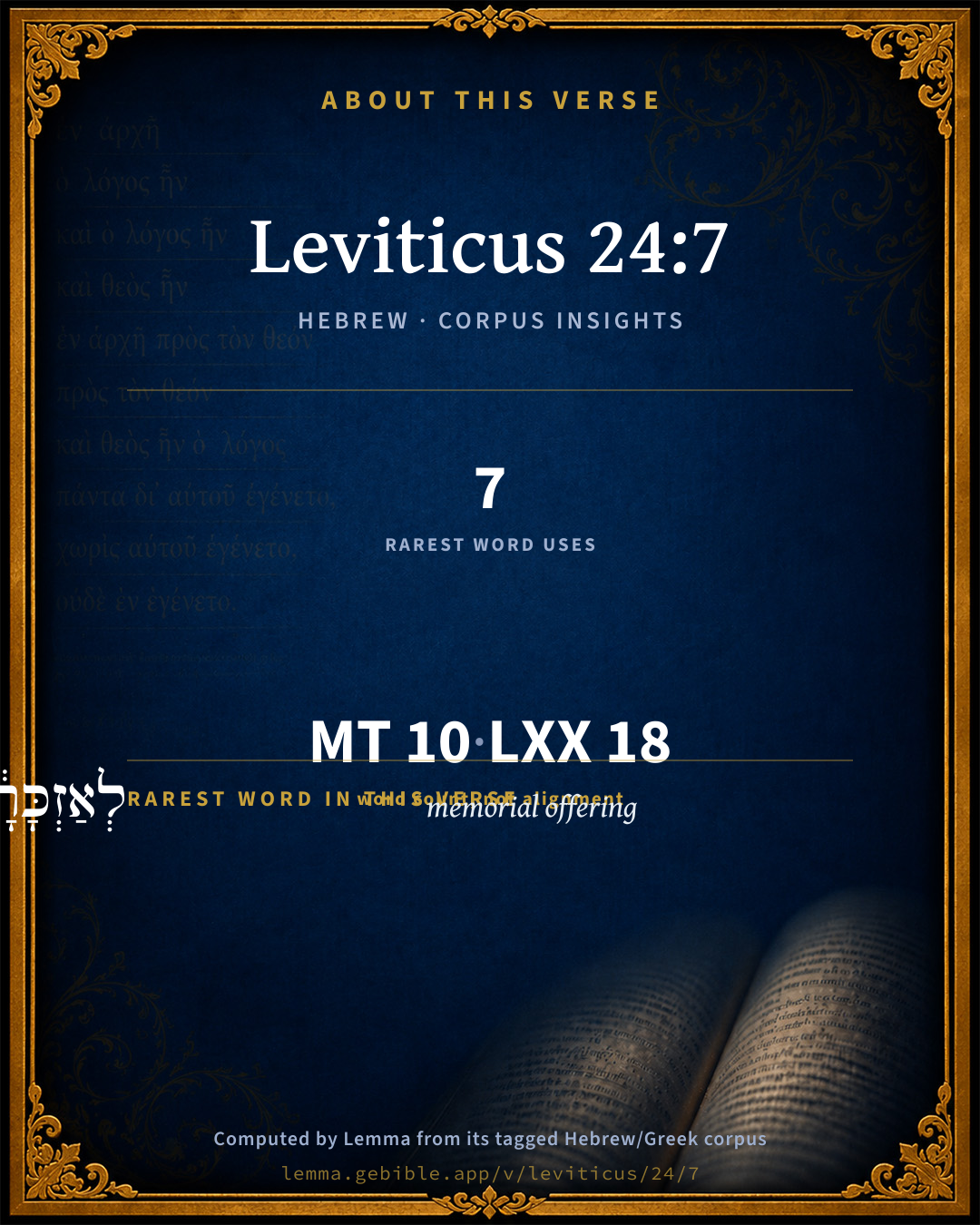
The rarest word here is לְאַזְכָּרָ֔ה memorial offering H234 — appearing just 7 times in the whole Hebrew Bible.

Shared distinctive vocabulary

לְאַזְכָּרָ֔ה memorial offering H234 occurs in 7 verses of the Hebrew Bible. Also found in:

Grammatical profile

  • 2 verbs
  • 6 nouns
  • 1 adjective
  • 1 preposition

Verb forms

  • וְנָתַתָּ֥ Qal · Sequential Perfect
  • וְהָיְתָ֤ה Qal · Sequential Perfect

Hebrew & Septuagint length

In English translation the verse runs 26 words from the Hebrew and 26 from the Septuagint (LXX English) — the same length.

A rough comparison of the two English renderings, which tokenize alike — not a word-level alignment.

Word counts can differ between the Hebrew and the Greek without any difference in meaning — e.g. the Hebrew direct-object marker אֵת has no separate Greek word, and Greek often adds the article ὁ.

In the original languages it is 10 Hebrew tokens and 18 Greek tokens — but the two are counted differently (Hebrew bundles its prefixes and suffixes into one token; the Greek is in lemma form), so that isn’t a like-for-like length.

Cross-references

13

Topical passages linked to Leviticus 24:7 in the Treasury of Scripture Knowledge — connected by theme and wording, ordered by reader-vote popularity; previews shown in the World English Bible.

  • Leviticus 2:2 He shall bring it to Aaron's sons the priests; and he shall take his handful of its fine flour, and of its oil, with all its frankincense; and the priest shall burn the memorial of it on the altar, an offering made by fire, of a sweet savor to Yahweh.
  • Revelation 8:3–4 Another angel came and stood over the altar, having a golden censer. Much incense was given to him, that he should add it to the prayers of all the saints on the golden altar which was before the throne.
  • Genesis 9:16 The rainbow will be in the cloud. I will look at it, that I may remember the everlasting covenant between God and every living creature of all flesh that is on the earth."
  • Exodus 12:14 This day shall be to you for a memorial, and you shall keep it a feast to Yahweh: throughout your generations you shall keep it a feast by an ordinance forever.
  • Exodus 13:9 It shall be for a sign to you on your hand, and for a memorial between your eyes, that the law of Yahweh may be in your mouth; for with a strong hand Yahweh has brought you out of Egypt.
  • Exodus 17:14 Yahweh said to Moses, "Write this for a memorial in a book, and rehearse it in the ears of Joshua: that I will utterly blot out the memory of Amalek from under the sky."
  • John 6:35 Jesus said to them, "I am the bread of life. He who comes to me will not be hungry, and he who believes in me will never be thirsty.
  • John 6:51 I am the living bread which came down out of heaven. If anyone eats of this bread, he will live forever. Yes, the bread which I will give for the life of the world is my flesh."
  • Acts 10:4 He, fastening his eyes on him, and being frightened, said, "What is it, Lord?" He said to him, "Your prayers and your gifts to the needy have gone up for a memorial before God.
  • Acts 10:31 and said, 'Cornelius, your prayer is heard, and your gifts to the needy are remembered in the sight of God.
  • 1 Corinthians 11:23–25 For I received from the Lord that which also I delivered to you, that the Lord Jesus on the night in which he was betrayed took bread.
  • Ephesians 1:6 to the praise of the glory of his grace, by which he freely bestowed favor on us in the Beloved,
  • Hebrews 7:25 Therefore he is also able to save to the uttermost those who draw near to God through him, seeing he ever lives to make intercession for them.

Cross-references courtesy of OpenBible.info (CC BY 4.0).

Hebrew and Greek witnesses Masoretic Hebrew ↔ Greek Septuagint

The same verse in the two great witnesses to the Old Testament, shown verse-for-verse.

These are two independent witnesses, not word-aligned to each other, and the Septuagint is shown in lemma (dictionary) form.

Hebrew Leviticus 24:7 Masoretic · Westminster Leningrad Codex

וְנָתַתָּ֥ עַל הַֽמַּעֲרֶ֖כֶת לְבֹנָ֣ה זַכָּ֑ה וְהָיְתָ֤ה לַלֶּ֨חֶם֙ לְאַזְכָּרָ֔ה אִשֶּׁ֖ה לַֽיהוָֽה

You shall put pure frankincense on each row, that it may be to the bread for a memorial, even an offering made by fire to Yahweh.

World English Bible · Public Domain

Greek LXX Leviticus 24:7 Septuagint · lemma form

καί ἐπιτίθημι ἐπί ὁ θέμα λίβανος καθαρός καί ἅλς καί εἰμί εἰς ἄρτος εἰς ἀνάμνησις προκεῖμαι ὁ κύριος

And you⌃ shall put on each row pure frankincense and salt; and these things shall be for loaves for a memorial, set forth before the Lord.

LXX2012 (modern English Septuagint) · Public Domain

On this verse, The Cambridge Bible for Schools and Colleges discusses the Septuagint’s reading. Read the note in Commentary ↓

Hebrew: Westminster Leningrad Codex (CC BY 4.0). Greek: Septuagint (public domain); English from LXX2012 (modern English Septuagint) (Public Domain). How the Septuagint differs from the Hebrew →

Targum (Aramaic paraphrase)

2

The Targum is the ancient Jewish Aramaic paraphrase of the Hebrew Scriptures — an interpretive translation, not the Hebrew text itself. Onkelos (literal) and Pseudo-Jonathan (expansive) render the Torah, and Jonathan the Prophets. Coverage is partial: where no permissively-licensed English translation exists for a verse, only the Aramaic is shown. This is verse-level text, not a word-by-word alignment to the Hebrew.

  1. Targum Onkelos Torah (Genesis–Deuteronomy)
    וְתִתֵּן עַל סִדְרָא לְבֹנְתָּא דָכִיתָא וּתְהֵי לִלְחֵם לְאִדְכַּרְתָּא קֻרְבָּנָא קָדָם יְיָ

    (no public-domain English translation for this verse)

    Targum Onkelos — Aramaic: “Onkelos Genesis” (public domain); “Onkelos Exodus” (public domain); “Onkelos Leviticus” (public domain); “Onkelos Numbers” (public domain); “Onkelos Deuteronomy” (public domain). English: “Sefaria Community Translation” (CC0 1.0 (public-domain dedication)); “J.W. Etheridge. The Targums of Onkelos and Jonathan Ben Uzziel on the Pentateuch. London: Longmans, Green, 1862” (public domain). Text via Sefaria.

  2. Targum Pseudo-Jonathan Torah (Genesis–Deuteronomy)
    וְתִתֵּן עַל סִידוּרַיָא צְרִיד לְבוֹנְתָּא בְּרִירְתָּא וּתְהֵי לְלַחֲמָא לְאַדְכָּרָא קוּרְבָּנָא קֳדָם יְיָ

    And thou shalt put upon the orders pure frankincense, that it may be an oblation of memorial bread before the Lord.

    Targum Pseudo-Jonathan — Aramaic: “Targum Jonathan on Genesis” (public domain); “Targum Jonathan on Exodus” (public domain); “Targum Jonathan on Leviticus” (public domain); “Targum Jonathan on Numbers” (public domain); “Targum Jonathan on Deuteronomy” (public domain). English: “The Targum of Jonathan ben Uzziel, trans. J. W. Etheridge, London, 1862” (public domain). Text via Sefaria.

Commentary

Notes on Leviticus 24:7 from classic Christian and Jewish commentators (each source and its license shown beneath its notes). The classic Christian expositions comment on the surrounding passage and are grouped to its opening verse, so a note may address several verses; the Jewish commentaries on the Tanakh (Rashi and others) are per-verse, so they appear only where the commentator wrote on this verse.

Lemma curates 59 commentaries, every one of them public domain or Creative Commons licensed, each selected and text-cleaned for this edition rather than reprinted as found. About our sources →

Trapp's Complete Commentary

John Trapp

Lev 24:7 And thou shalt put pure frankincense upon [each] row, that it may be on the bread for a memorial, [even] an offering made by fire unto the LORD.

Ver. 7. On the bread.] Or, Instead of the bread.

John Trapp, A Commentary or Exposition upon All the Books of the Old and New Testament (1647–1656) — public domain. Text from a community e-Sword module.

Tyndale Open Study Notes

Tyndale Open Resources

24:7 Since a portion of this bread was to be burned as a representative offering (see 2:2), it would have been made without yeast (that is, unleavened; see 2:11).

Tyndale Open Study Notes — © Tyndale Open Resources, licensed CC BY-SA 4.0. Text via the HelloAO Bible API.

Geneva Bible (1599)

Geneva Bible translators

For it was burnt every Sabbath, when the bread was taken away.

Geneva Bible (1599) marginal notes — public domain. Text via Bolls.life.

Ellicott's Commentary for English Readers

(7) Shalt put pure frankincense upon each row.—Better, shalt place pure frankincense by each pile. As the two piles of six cakes each measured together ten handbreadths in width, and as the length of the table was twelve handbreadths, there was a vacant space of two handbreadths left on the table for the two bowls with frankincense. The vacant place in question may, therefore, (1) have been divided between the two ends of the table, and a bowl with incense been put at each end on either side of the two piles; or (2) the disposable vacant space may have been left at one end of the table only, and the bowls put together on this end by one side of the two piles; or (3) each of the two piles of the cakes may have been put more or less closely to the other end of the table, thus leaving a vacant space between the two piles, into which the two bowls with the frankincense were placed. The last was the practice during the second Temple.

That it may be on the bread for a memorial.—Better, that it may be for the bread as a memorial, that is, that the frankincense may be offered up upon the altar, as God’s portion, instead of the bread which was given to the priests. By this means the prayers of the children of Israel will be brought into grateful remembrance before the Lord. (See Lev_2:2.)

A Bible Commentary for English Readers, edited by Charles John Ellicott (1878–1897) — public domain. Text from a community e-Sword module.

The Cambridge Bible for Schools and Colleges

gen. ed. J. J. S. Perowne

7. frankincense] The LXX. add ‘and salt,’ apparently in view of the rule in Lev_2:13. According to a tradition preserved by Josephus (Ant. iii. 10. 7) the frankincense was not poured on the bread, but placed beside it in two golden bowls.

an offering made by fire] The frankincense was burnt on the altar of Burnt-Offering. See Jos. Ant. l.c.

The Cambridge Bible for Schools and Colleges (gen. ed. J. J. S. Perowne; Cambridge University Press, 1878–1918) — public domain. Text from a community e-Sword module.

John Gill's Exposition

And thou shalt put pure frankincense upon each row,.... Two cups of frankincense, in each of which was an handful of it, and which were set by each row of the cakes, as Jarchi observes:

that it may be on the bread for a memorial; or "for the bread", instead of it, for a memorial of it; that being to be eaten by the priests, and this to be burned on the altar to the Lord, as follows:

even an offering made by fire unto the Lord; not the bread that was after a time taken away, and eaten by the priests, but the frankincense.

John Gill's Exposition of the Whole Bible (1746–1763) — public domain (CC PDM 1.0). Text via the HelloAO Bible API.

Matthew Poole's English Annotations

Pure frankincense, unmixed and uncorrupted, or of the best sort.

That it may be on the bread, or to the bread, or for the bread, to wit, to be burnt before the Lord instead of the bread, which could not conveniently be offered to God in that manner. And this was done every time that the bread was changed.

For a memorial; for that part which properly belonged to God, whereas the rest belonged to the priest. See Poole "Lev 2:2".

Matthew Poole's English Annotations on the Holy Bible (1683–1685) — public domain. Text from a community e-Sword/MySword module.

Whedon's Commentary on the Bible

Daniel D. Whedon

7. Frankincense — See Lev_2:1, note. The frankincense used by the Jews in the temple service must not be confounded with the common frankincense of commerce, which is a product of the Abies excelsa. The true frankincense is a product of the Boswellia thurifera. It is the symbol of intercession, (Rev_8:3,) and it doubtless was to be burnt on the appointed altar.

A memorial — See Lev_2:2, note.

Made by fire — The incense was properly a fire-made offering, but the show-bread was improperly so called, since it was only fire-baked.

Daniel D. Whedon (gen. ed.), Commentary on the Old and New Testaments (1874–1909) — public domain. Text from a community e-Sword module.

John Wesley's Explanatory Notes

Pure frankincense - Unmixed and uncorrupted, or of the best sort, to be burnt before the Lord. On the bread - And this was done every time that the bread was changed. For a memorial - For that part which properly belonged to God, whereas the rest belonged to the priests.

John Wesley, Explanatory Notes Upon the Whole Bible (1754–1765) — public domain. Text via the GEBible commentary corpus.

unfoldingWord translationNotes

Door43 World Missions Community

Connecting Statement:

God continues giving Moses instructions about the things in the tent of meeting.

You must put pure incense along each row of loaves

The incense was probably next to the loaves, rather than directly on the loaves. AT: "You must put pure incense next to the loaves in each row" (See: Assumed Knowledge and Implicit Information)

as a representative offering

What the incense would represent can be stated clearly. AT: "to represent the loaves as an offering" or "to be an offering that represents the loaves" (See: Assumed Knowledge and Implicit Information)

This incense will be burnt for Yahweh

This can be stated in active form. AT: "You will burn the incense for Yahweh" (See: Active or Passive)

This offering

"This bread that is offered"

for it is a portion from the offerings

"for they took it from the offerings"

the offerings to Yahweh made by fire

"the burnt offerings to Yahweh" or "the offerings that you burn to Yahweh"

translationWords

incense

Sabbath

bread

sign

eternity

covenant

sacrifice

holy

burnt offering

unfoldingWord translationNotes — © Distant Shores Media and the Door43 World Missions Community, licensed CC BY-SA 4.0. Source: git.door43.org/Door43/en_tn.

Rashi

Rabbi Shlomo Yitzchaki (Rashi)

ונתת על המערכת AND THOU SHALT PUT UPON THE ROW — i. e. upon each of the two rows [PURE FRANKINCENSE]; there were two bowls for this frankincense, each filled with a handful of it.

והיתה THAT IT — this frankincense — MAY BE

ללחם לאזכרה ON THE BREAD FOR A MEMORIAL — because of the bread itself nothing was offered to the Lord, but the frankincense was burnt when the former was removed from the golden table every Sabbath. It (the frankincense) thus served as a memorial for the bread, because through it, it (the bread) was recalled to memory Above (the bread itself was not offered) just as the “handful” of flour and of oil (Leviticus 2:2) was “the memorial portion” of the meal offering being the only part offered, while the remainder was eaten by the priests just as this bread was.

Rashi on the Tanakh — English translations: “The Judaica Press complete Tanach with Rashi, translated by A. J. Rosenberg” (CC BY 4.0); “Pentateuch with Rashi's commentary by M. Rosenbaum and A.M. Silbermann, 1929-1934” (public domain); “The Metsudah Tanach series, Lakewood, N.J” (CC BY 4.0); and “The Book of Joshua, Metsudah Publications, 1997” (CC BY 4.0). Text via Sefaria.

Ibn Ezra

Rabbi Abraham ibn Ezra

The frankincense that was with the bread was a fire offering to Hashem, and the bread was for the kohein. It could be that it mentions this parshah [in this place] because Israel has an obligation to give the festival burnt-offerings, oil, and the constant bread.

Ibn Ezra on the Tanakh — English translations: “Sefaria Community Translation” (CC0 1.0 (public-domain dedication)); “Yalkut, Sifsei Chachomim Chumash, Metsudah Publications, 2009” (CC BY 4.0); and “Commentary of Ibn Ezra on Isaiah - trans. by M. Friedlander, 1873” (public domain). Text via Sefaria.

Lesson kit

Teaching starters — assembled from the data on this page, not authored interpretation. Every prompt links to the verse data it draws on. Edit before teaching.

Leviticus, in the Pentateuch, opens this verse with 10 words (10 distinct Hebrew lemmas). Its most distinctive word is ʼazkârâh (“memorial offering”). A historical commentator’s framing appears above. Read the whole chapter for the surrounding context.

Discussion questions

  1. The word ʼazkârâh carries the sense “memorial offering.” How does it shape the verse?
  2. How does Leviticus 2:2, which shares the word «memorial offering», read alongside this verse?
  3. These translations render this verse differently; the difference is in the English rendering, not the original. What questions does that raise?
  4. «וְנָתַתָּ֥» is a Qal Sequential Perfect verb. How does that grammatical form shape the action described?
  5. Compare how Trapp's Complete Commentary and Tyndale Open Study Notes read this verse. Where do they agree or differ?

Things to notice

Reading settings

Reading text

Shown beneath each verse's original-language words.

Old Testament
Old Testament edition

Read the OT as the Masoretic Hebrew (MT) or the Greek Septuagint (LXX).

English shown for the Greek Septuagint (in the Hebrew ↔ Greek comparison).

Comparing translations? Open the Compare panel on any verse page to stack up to four side by side.