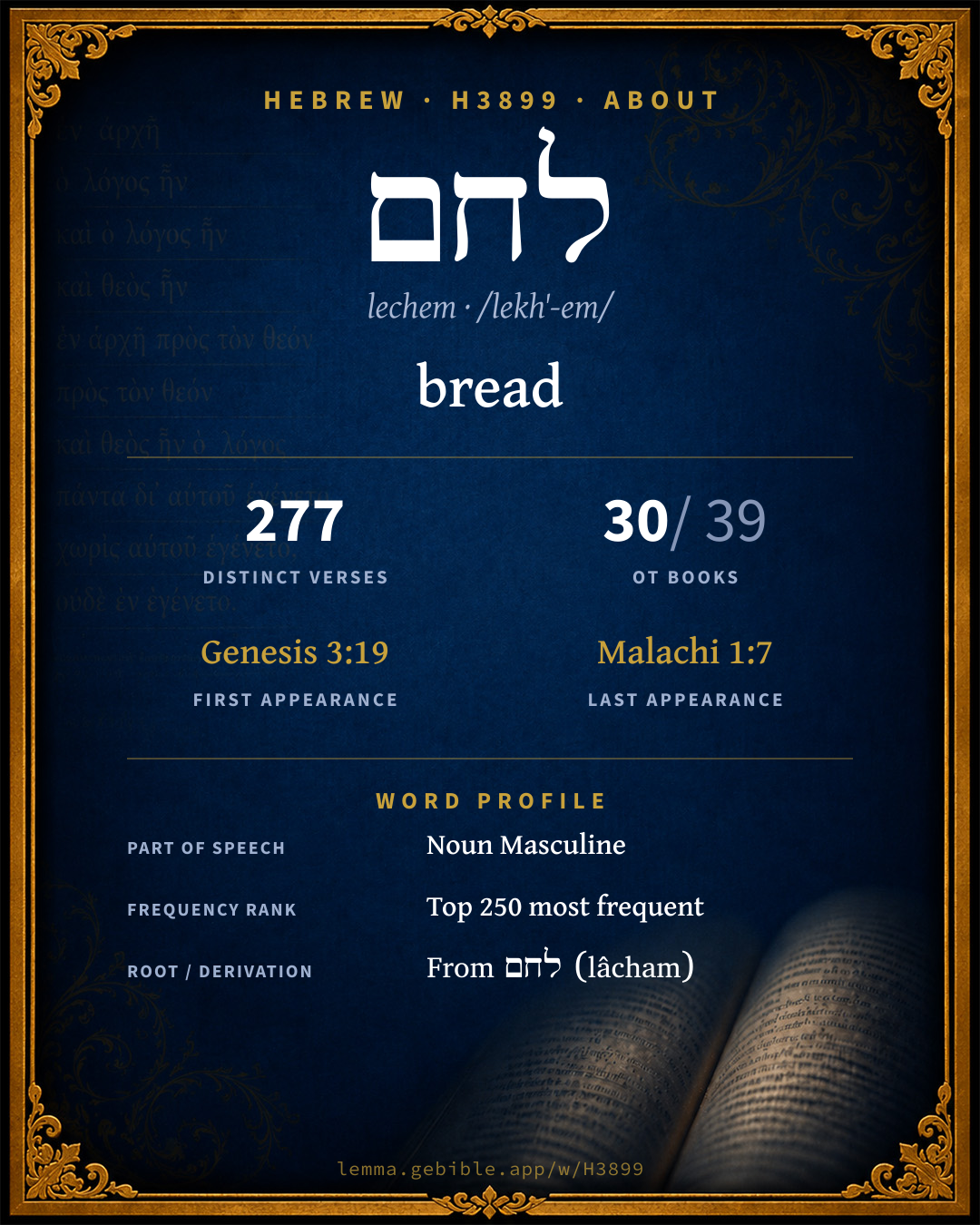
לֶ֫חֶם
bread
also: food, grain fuller range ↓
Full lexicon entry — Brown-Driver-Briggs (BDB)
From Brown-Driver-Briggs (BDB)
Where this word appears
See every Absolute-state word in the Hebrew Bible →
Grammar key — what these labels mean
Part of speech
- Noun
- A naming word — a person, place, thing, or idea.
Noun type
- Common
- A common noun — a general class of person, place, or thing (“king,” “city,” “water”), not a specific name.
Stem
- Qal
- The basic, simple active stem — the plain form of the verb (“he wrote”).
Form
- Infinitive Construct
- A bound verbal noun, frequently with prepositions (“to write / in writing”).
State
- Absolute
- The independent form of a noun, not bound to a following word.
- Construct
- A noun bound to a following noun in a possessive / “of” relationship (the construct chain).
Gender
- Both
- Attested as both masculine and feminine.
Number
- Singular
- One.
Every verse where H3899 appears in the Book of Exodus — 20 distinct verses. Click any verse to open its interlinear word-by-word view. Verse text shown in the World English Bible for context — . Each verse’s Hebrew form is shown with its reference; the English is not keyword-highlighted, since the data carries no word-level English alignment. Use “Compare translations” on any verse to read it across multiple English versions. This concordance covers the Hebrew Bible; Septuagint (Greek Old Testament) occurrences are not indexed here.
Exodus
- Exodus 2:20 לָֽחֶם n c bs He said to his daughters, "Where is he? Why is it that you have left the man? Call him, that he may eat bread."
- Exodus 16:3 לֶ֖חֶם n c bs and the children of Israel said to them, "We wish that we had died by the hand of Yahweh in the land of Egypt, when we sat by the flesh-pots, when we ate our fill of bread, for you have brought us out into this wilderness, to kill this whole assembly with hunger."
- Exodus 16:4 לֶ֖חֶם n c bs Then said Yahweh to Moses, "Behold, I will rain bread from the sky for you, and the people shall go out and gather a day's portion every day, that I may test them, whether they will walk in my law, or not.
- Exodus 16:8 וְ/לֶ֤חֶם conj + n c bs Moses said, "Now Yahweh shall give you meat to eat in the evening, and in the morning bread to satisfy you; because Yahweh hears your murmurings which you murmur against him. And who are we? Your murmurings are not against us, but against Yahweh."
- Exodus 16:12 לָ֑חֶם n c bs "I have heard the murmurings of the children of Israel. Speak to them, saying, 'At evening you shall eat meat, and in the morning you shall be filled with bread: and you shall know that I am Yahweh your God.'"
- Exodus 16:15 הַ/לֶּ֔חֶם ptcl def.art + n c bs When the children of Israel saw it, they said one to another, "What is it?" For they didn't know what it was. Moses said to them, "It is the bread which Yahweh has given you to eat."
- Exodus 16:22 לֶ֨חֶם֙ n c bs cs It happened that on the sixth day they gathered twice as much bread, two omers for each one, and all the rulers of the congregation came and told Moses.
- Exodus 16:29 לֶ֣חֶם n c bs cs Behold, because Yahweh has given you the Sabbath, therefore he gives you on the sixth day the bread of two days. Everyone stay in his place. Let no one go out of his place on the seventh day."
- Exodus 16:32 הַ/לֶּ֗חֶם ptcl def.art + n c bs Moses said, "This is the thing which Yahweh has commanded, 'Let an omer-full of it be kept throughout your generations, that they may see the bread with which I fed you in the wilderness, when I brought you forth from the land of Egypt."
- Exodus 18:12 לֶ֛חֶם n c bs Jethro, Moses' father-in-law, took a burnt offering and sacrifices for God. Aaron came with all of the elders of Israel, to eat bread with Moses' father-in-law before God.
- Exodus 23:25 לַחְמְ/ךָ֖ n c bs cs + sfx pers 2ms You shall serve Yahweh your God, and he will bless your bread and your water, and I will take sickness away from your midst.
- Exodus 25:30 לֶ֥חֶם n c bs cs You shall set bread of the presence on the table before me always.
- Exodus 29:2 וְ/לֶ֣חֶם conj + n c bs cs unleavened bread, unleavened cakes mixed with oil, and unleavened wafers anointed with oil: you shall make them of fine wheat flour.
- Exodus 29:23 לֶ֜חֶם לֶ֥חֶם n c bs n c bs cs and one loaf of bread, one cake of oiled bread, and one wafer out of the basket of unleavened bread that is before Yahweh.
- Exodus 29:32 הַ/לֶּ֖חֶם ptcl def.art + n c bs Aaron and his sons shall eat the flesh of the ram, and the bread that is in the basket, at the door of the tent of meeting.
- Exodus 29:34 הַ/לֶּ֖חֶם ptcl def.art + n c bs If anything of the flesh of the consecration, or of the bread, remains to the morning, then you shall burn the remainder with fire: it shall not be eaten, because it is holy.
- Exodus 34:28 לֶ֚חֶם n c bs He was there with Yahweh forty days and forty nights; he neither ate bread, nor drank water. He wrote on the tablets the words of the covenant, the ten commandments.
- Exodus 35:13 לֶ֥חֶם n c bs cs the table with its poles and all its vessels, and the show bread;
- Exodus 39:36 לֶ֥חֶם n c bs cs the table, all its vessels, the show bread,
- Exodus 40:23 לֶ֖חֶם n c bs He set the bread in order on it before Yahweh, as Yahweh commanded Moses.
About this entry
At a glance — auto-summarized from this page’s data, not written by a person. Every figure links to its source below. This summary describes the numbers; it doesn’t interpret them.
לחם (lechem) is a Hebrew noun most often rendered “bread.” Scripture first uses it in Genesis 3:19. Spanning 277 verses in 30 books, it ranks among the common words of the Hebrew Bible. Beyond its headline sense, its full sense range takes in “food” and “grain”. Sharing its root, it stands alongside לחם, לחום and לחם. For the data behind this summary, explore the sense tree and the renderings breakdown below.
Gloss history
Strong's 1890 vs modern scholarship
About this word
Strong's H3899 catalogs a Hebrew word from the Hebrew Old Testament.
These counts are not copied from any lexicon or concordance. They are computed here, from the morphology-tagged Hebrew Old Testament. What Lemma adds →
- 277
- distinct verses
- The word appears in 277 distinct verses.
- 30 / 39
- OT books
- The word appears in 30 of 39 Old Testament books.
- #165
- by frequency
- Top 250 most frequent Hebrew words (rank 165 of 8,640 Hebrew words by occurrence).
View all 277 occurrences in the concordance →
By section of the Old Testament
By traditional corpus
Conventional, traditional groupings — biblical authorship is debated, so this is a traditional corpus grouping, not an authorship claim. Each share is this word’s portion of its verses in that division of the Hebrew canon. Each figure is a share of the word’s 277 distinct verses.
- Prophets (Nevi'im) 122 verses · 44%
- Torah (Pentateuch) 78 verses · 28%
- Writings (Ketuvim) 77 verses · 28%
How translations render this word
Counts come from each version’s own published word-to-Strong’s tagging or interlinear alignment — an approximate guide to how each version renders this word, not a word-level alignment the data otherwise carries. Because each total is that version’s own tagged count, the per-version totals vary from one another and need not match the appearance or distinct-verse counts above. These counts may also differ from a printed concordance because Lemma counts each distinctly tagged rendering and does not collapse phrase taggings into a single head-word total. This is a fixed set of word-tagged versions (KJV, ASV, BSB, ULT) and does not change with the reading translation you choose elsewhere. Each version’s license is shown beside its name below (and on Sources).
- King James Version: Bread 202×, Meat 17×, Food 11×
- American Standard Version: Bread 184×, Food 18×, Loaves of bread 4×
- Berean Standard Bible: Bread 142×, Food 89×, Meal 6×
- unfoldingWord Literal Text: Bread 215×, Bread of 37×, Food 18×
King James Version Public Domain
Renders H3899 across 294 tagged occurrences — most commonly:
Plus 43 renderings that appear only once — usually multi-word phrases or single function words the recovered tagging swept in, not distinct renderings. Not rendered by a distinct English word in 3 further occurrences.
American Standard Version Public Domain
Renders H3899 across 291 tagged occurrences — most commonly:
Plus 66 renderings that appear only once — usually multi-word phrases or single function words the recovered tagging swept in, not distinct renderings.
Berean Standard Bible Public Domain
Renders H3899 across 276 tagged occurrences — most commonly:
Plus 25 renderings that appear only once — usually multi-word phrases or single function words the recovered tagging swept in, not distinct renderings. Not rendered by a distinct English word in 22 further occurrences.
unfoldingWord Literal Text CC BY-SA 4.0
Renders H3899 across 300 tagged occurrences — most commonly:
Plus 22 renderings that appear only once — usually multi-word phrases or single function words the recovered tagging swept in, not distinct renderings.
9 senses and sub-senses in the full BDB
What do BDB’s symbols mean?
BDB uses these scholarly abbreviations:
| Symbol | Meaning |
|---|---|
| 𝔊 | the Septuagint (the ancient Greek translation, LXX) |
| 𝔙 | the Vulgate (the Latin translation) |
| 𝔖 | the Syriac version (the Peshitta) |
| 𝔗 | the Targum (the Aramaic translation) |
| ψ | the Psalms |
| √ | root (the underlying root or stem) |
| ‖ | parallel passage (a synonymous or contrasted parallel) |
| † | the dagger: every passage where the word occurs is cited |
The 9 senses and sub-senses the full Brown-Driver-Briggs lexicon distinguishes for this word, in lexicon order (not ranked by frequency), with BDB’s own verbatim wording and sub-sense lettering. Shown in Hebrew script with BDB’s own scholarly abbreviations. The condensed entry is in the Lexicon Entry tab. See also the Forms in the corpus table below.
- 1.
- a. bread, the ordinary food of early Hebrews (BenzArch. 84 ff. NowArch. i. 109 ff.) Ex 21:14 (E), Nu 21:5 Jos 9:5, 12 (JE), Dt 8:3; 23:5 Ex 16:3 (P) +; כִּכַּר־ל׳ loaf of bread 1 S 2:36 + (vid. כִּכָּר sub כרר), and without ככר (always c. num.) †1 S 10:4; 16:20 (v. Dr), 17:17; 21:4; 25:18 2 S 16:1 1 K 14:3 2 K 4:42†; חַלַּת ל׳ cake of bread 2 S 6:19 Ex 29:23 + (v. חַלָּה sub I. חלל); made from barley (שְׂעֹרִים) Ju 7:13 2 K 4:42 (v. also לָחֶם supr.); from wheat-flour (סֹלֶת חִטִּים) Ex 29:2 (P); cf. the mixture Ez 4:9; made by baking (אפה) Is 44:15, 19 Lv 26:26 (H; cf. Je 37:21); †פַּת־ל׳ a bit of bread 1 S 2:36 1 K 17:11 Pr 28:21, cf. Ez 13:19, as modest term for a hospitable meal Gn 18:5 (J), Ju 19:5 1 S 28:22†; disting. from meat (flesh), Gn 27:17 (J), 1 S 25:11 1 K 17:6(×2) Ex 16:8, 12 (also v 3 supr.), 29:32, 34 Lv 8:31 (all P), 23:18 (H), 1 Ch 12:40 ψ 78:20 Dn 10:3; = a meal 1 S 20:27, אָכַל ל׳ = take a meal Gn 31:54(×2); 37:25; 43:25, 32 +; אכל לַחְמִי ψ 41:10 eat my bread, establishing an obligation, cf. Ob 7 (read אֹכְלֵי ל׳ according to MartiKauAT; del. ל׳ 𝔊 Hi We, cf. VB) עשׂה ל׳ = make a feast Ec 10:19; מַטֵּה ל׳ staff of bread (as support of life), only late †Ez 4:16; 5:16; 14:13 Lv 26:26 (H), ψ 105:16; cf. מִשְׁעַן ל׳ Is 3:1 (gloss)†; leavened bread is ל׳ חָמֵץ Lv 7:13; unleavened bread is ל׳ מַצּוֹת Ex 29:2 (both P); †ל׳ (הַ)פָּנִים bread of the face (of י׳; i. e. in his presence, Di Lv 24:9 Dr 1 S 21:7): in the sanctuary 1 S 21:7 1 K 7:48 = 2 Ch 4:19, Ex 25:30; 35:13; 39:36, without פ׳ 40:23 (all P); = ל׳ הַתָּמִיד Nu 4:7 (P), ל׳ קֹדֶשׁ 1 S 21:5; in Chr ל׳ הַמַּעֲרָ֑כֶת 1 Ch 9:32 cf. 23:29 Ne 10:34, מ׳ ל׳ 2 Ch 13:11; opp. ל׳ חֹל 1 S 21:5†; ל׳ תְּנוּפָה Lv 23:17 wave-loaf; ל׳ (הַ)בִּכֻּרִים v 20 2 K 4:42 bread of first-fruits. e.g. Exodus 21:14
- b. = bread-corn, the material from which bread is made, i.e. wheat, barley, etc.: Gn 41:54, 55 (E), 47:13, 15, 17(×2), 19 (J), 49:20 (poem in J), Is 28:28; 30:23; 55:10 Je 5:17 Ez 48:18 Jb 28:5 Pr 28:3 ψ 104:14; ל׳ הָאָרֶץ Nu 15:19 (P), ארץ ל׳ 2 K 18:32 = Is 36:17†. e.g. Genesis 41:54
- 2. food in general:
- a. of man Ju 13:16 (kid, v 15), 1 S 14:24(×2), 28 (honey), 28:20; 30:12 Pr 27:27(×2) (goat’s milk) +; נֹתֵן ל׳ לְכָל־בָּשָׂר ψ 136:25 Pr 22:9. e.g. Judges 13:16
- b. of animals, Pr 6:8; 30:25 Is 65:25 Jb 24:5 ψ 147:9†. e.g. Proverbs 6:8
- c. of God (in sacrifices): †ל׳ אֱלהֵיהֶם (cf. RSSem i. 207, 2nd ed., 224) Lv 21:6 cf. v 8, 17, 21, 22, 22:13, 25 (all H), Nu 28:2 (P), Ez 16:19; 44:7, and ל׳ מְגֹאָל Mal 1:7; also ל׳ אִשֶּׁה (לי׳) Lv 3:11, 16 Nu 28:24 (all P)†. e.g. Leviticus 21:6
- 3. other phrases and fig. uses are:
- a. ל׳ רֶשַׁע Pr 4:17 (acc. cogn. c. לָחַם), prob. = food gained by wickedness (‖ יֵין חֲמָסִים), cf. ל׳ שָׁ֑קֶר 20:17, ל׳ כְּזָבִים 23:3; ל׳ עַצְלוּת 31:27 = bread of idleness, i. e. unearned; ל׳ חֻקִּי Pr 30:8 (opp. to riches and poverty, v. חֹק); ל׳ לַחַץ 1 K 22:27 = 2 Ch 18:26, vid. לַחַץ infr.; ל׳ הָעֲצָבִים ψ 127:2, vid. ii. עֶצֶב; ל׳ אוֹנִים Ho 9:4, vid. אָוֶן, p. 20a; ל׳ אֲנָשִׁים Ez 24:17, 22 of food offered to mourners, cf. Je 16:7 (where ins. ל׳ 𝔊 Gf Gie); שַׁלַּח לחמך על־פני המים Ec 11:1 usually interpr. of benevolent giving (cf. Now); De al. of sea-commerce in bread stuffs, cf. Pr 31:14. e.g. Proverbs 4:17
- b. fig. לַחְמֵנוּ הֵם Nu 14:9 (JE) our food are they, i. e. we will devour, destroy, them (cf. Dt 7:16); דִּמְעָתִי ל׳ ψ 42:4 cf. 80:6 (vid. אכל, p. 37b supr.); ל׳ of evil deeds of wicked Jb 20:14; עֵץ בְּלַחְמוֹ Je 11:19 appar. fig. of destroying the prophet and his house, but read prob. בְּלֵחוֹ in its freshness (i. e. untimely), so Hi Gf Che Gie (vid. לֵחַ = sub לחח supra). e.g. Numbers 14:9
Senses from the full Brown-Driver-Briggs lexicon (Brown, Driver, Briggs; Oxford 1906 — public domain), digitized via Sefaria, supplemented by the OpenScriptures HebrewLexicon (CC BY 4.0). Full attribution on Sources.
Word origin
n.m. 1 S 9:7 and (rarely) f. Gn 49:20 (vid. infr., and Dr 1 S 10:4) bread, food (Ph. לחם bread; NH לֶחֶם; Aramaic לַחְמָא, ܠܰܚܡܳܐ, as Heb.; Arabic لَحْمٌ flesh, meat (cf. Frä30));—abs. ל׳ Gn 3:19 +; לָ֑חֶם Gn 31:54 +; לֶ֑חֶם ψ 14:4 + 2 times; cstr. לֶחֶם Ho 9:4 +; sf. לַחְמִי Jb 3:24 +, לַחְמְךָ Ob 7 +, לַחְמָם Ho 9:4b, + v 4a (for MT לָהֶם), We GASm Now, + etc.;—
— Brown-Driver-Briggs (Oxford 1906, public domain), digitized via Sefaria, supplemented by the OpenScriptures HebrewLexicon (CC BY 4.0). See Sources.
Derived from לחם (lâcham) (H3898) — to fight.
Jastrow Dictionary
A second Hebrew/Aramaic lexicon for comparison, covering Aramaic and post-biblical (Talmudic, Targumic, Midrashic) usage that the biblical-Hebrew BDB does not. Matched by lemma rather than by Strong’s number, so a lemma may carry more than one Jastrow headword (shown separately below), and the entries cover usage well beyond the Bible.
לָחַם I
- (cmp. לוּחַ), to join, or to be joined, be inserted.
- to fit, insert; to tenon. Y. Sabb. XII, 13ᶜ המַלְחִים את וכ׳ he who inserts the shutters (of a shop); Y. Bets. I, 60ᶜ המלחם (corr. acc.). Cant. R. to V, 12; ib. to IV, 15, v. לְחִי. Lev. R. s. 3 (ref. to the harmonious parallelism of Is. LV, 7) כאדם שהוא מלחים שני נסרים ומדביקן זה לזה as one fits (with tenon and mortise) two boards and glues them to one another; כאדם שהוא מ׳ שתי כרעי המטה (leave out ומדביקן זה לזה, v. Ar. s. v. מלח) as one inserts two legs of a bedstead. e.g. Isaiah 55:7
לָחַם II
- v. preced.) to join.
- (cmp. use of זָוַג Nithpa.) to come in (hostile) contact, to battle; with ל of person, to assist, battle for. Mekh. B’shall. 2 (ref. to Ex. XIV, 14) לא … יִלָּחֵם לכם אלא לעולם ילחם כנגדן וכ׳ not only this time will he assist you, but he will always battle against your enemies. Tanḥ. Masé 6 כשהלך להִלָּחֵם בישראל when he (Sisera) went to war against &c. Ib. Vayera 7 (ref. בלחומו, Job XX, 23) על המלחמות שהיו נִלְחָמִים עם וכ׳ for the battles which they fought against the Lord; a. fr. e.g. Exodus 14:14
- to contest, dispute. Y. M. Kat. III, 81ᵈ top אם חברים מִתְלַחֲמִים וכ׳ if scholars are at variance with one another, what concern is it to you? (B. Mets. 59ᵇ מנצחים זה את זה וכ׳).
לֶחֶם
- fr. לחח to chew, v. Ges. H. Dict.10 s. v. לוע) food, bread; [Arab. meat]. Ber. V, 1 the benediction over bread (פת) reads: המוציא ל׳ וכ׳ who makest food grow out of the earth; ib. 37ᵇ. Men. XI, 1 שתי הל׳ (sub. ככרות) the two loaves of bread (Lev. XXIII, 17). Ib. ל׳ הפנים the show-bread (on the table of the Sanctuary); a. fr.—Trnsf. tribute, tax, salary (cmp. annona). Ruth R. to II, 14 זו לַחְמָהּ של מלכות that is (thou shalt partake of) the royal maintenance. Zeb. 85ᵃ; Meïl. 7ᵇ לַחְמוֹ של מזבח the tribute belonging to the altar (cmp. Lev. XXI, 6; 8; Neh. V, 14).—Pl. לְחָמִים. Y. Ḥag. III, end, 79ᵈ שני ל׳ two sets of show-bread, opp. to לחם אחד. e.g. Leviticus 23:17
לְחֵם
- 1. same. Targ. Gen. XIV, 18. Ib. XLIII, 31; a. fr.—Snh. 100ᵇ (from Ben Sira) אמר במאי איכול ל׳ ל׳ סב מיניה if a man says, ‘wherewith shall I eat bread (to season it)?’, take the bread from him. Ab. Zar. 35ᵇ ל׳ דארמאי (Ms. M. נהמא) bread baked by gentiles, v. פַּת. Ber. 42ᵇ ניזיל וניכול ל׳ וכ׳ (Ms. M. נהמא) let us go and dine at a certain place; a. fr.
- 2. meat, flesh. Ex. R. s. 42 (ref. to לחמם, Zeph. I, 17) בערביא קורין לבשרא ל׳ in Arabia they call meat laḥma e.g. Zephaniah 1:17
A Dictionary of the Targumim, the Talmud Babli and Yerushalmi, and the Midrashic Literature (Marcus Jastrow; London, Luzac, 1903) — Public Domain. Digitized via Sefaria. Digitized via Sefaria. Full attribution on Sources.
Forms in the corpus
The 97 distinct written forms H3899 takes in the Hebrew Bible, most frequent first — each parse links to that state’s occurrences in the concordance. Hebrew forms include their vowel points and cantillation, so a single lemma takes many written forms.
The 60 most common forms are shown; 37 rarer forms follow in the full concordance.
Same root — word family
Other BDB entries built from the same root as H3899, grouped by Strong’s listed origin. These share a root / origin per the lexicon — not necessarily a shared meaning. Each links to that word’s own entry.
Derives from
Shares the same root
Derived from this word
Proper names from this root
People and places named from this root — a name, not an additional meaning of the word.
Compare all same-root words → Showing 4 of 7 — not the complete family. 1 of the same-root words is a proper name (a person or place). They share a root, not necessarily a meaning.
Septuagint verse parallels
This word appears in 264 verses that also exist in the Greek Old Testament (Septuagint), out of the 277 Hebrew verses it occurs in. You can read those verses in Greek by switching the Old Testament edition to the Septuagint.
Read these verses in the Septuagint
- Genesis 3:19
- Exodus 2:20
- Leviticus 3:11
- Numbers 4:7
- Deuteronomy 8:3
- Joshua 9:5
- Judges 7:13
- Ruth 1:6
- 1 Samuel 2:5
- 2 Samuel 3:29
- 1 Kings 5:9
- 2 Kings 4:8
This is a verse-level parallel only — the same verses exist in both the Hebrew and Greek Old Testaments. No word-level Hebrew↔Greek correspondence is claimed: the data carries no such alignment, so no Greek word is shown as this Hebrew word’s translation. Coverage is not total — the Septuagint omits the deuterocanon and renumbers the Psalms, so some Hebrew verses have no direct Greek parallel.