
Leviticus 23:14

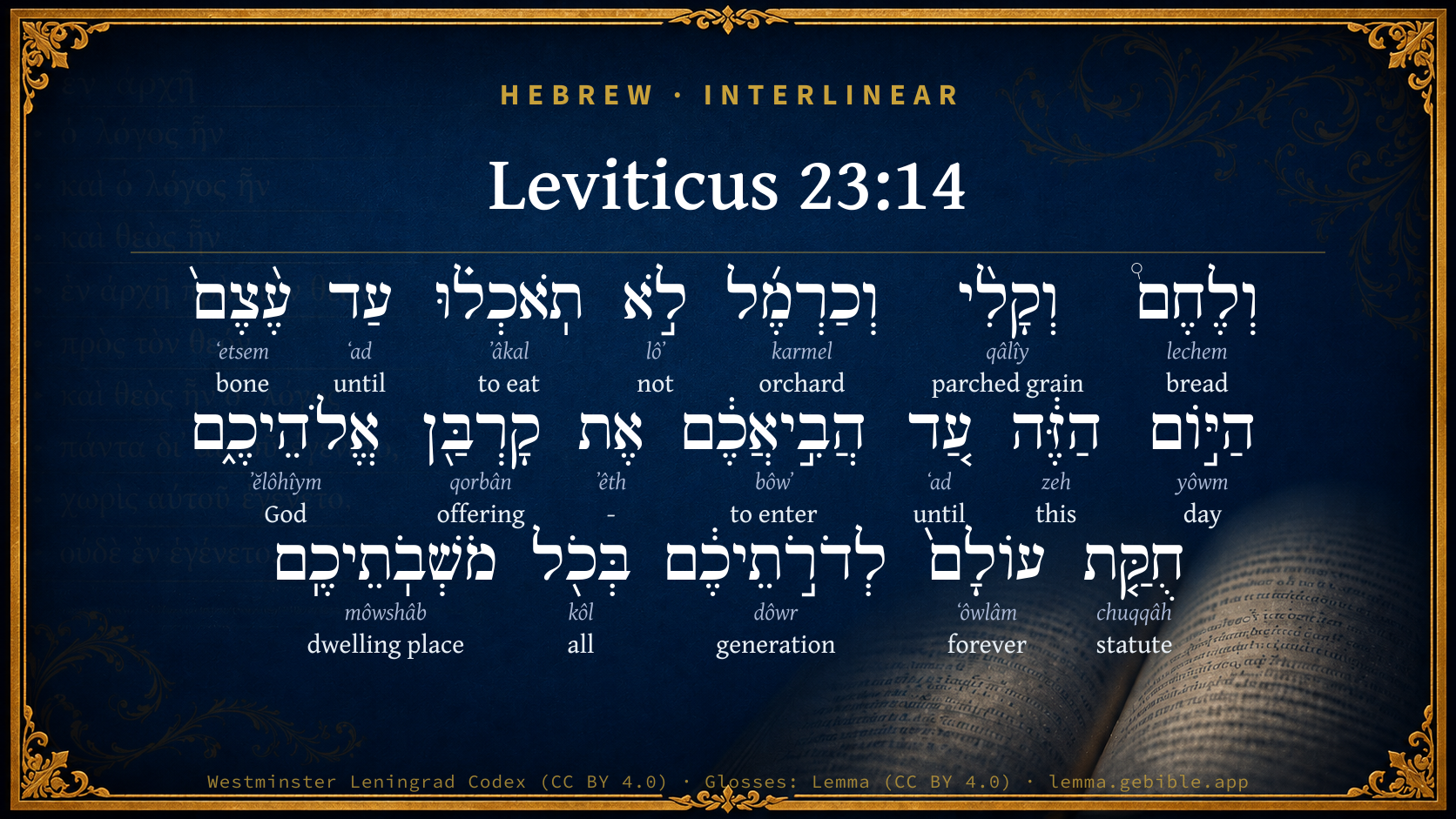
Hebrew (Westminster Leningrad Codex) Leviticus 23:14 appears in the Hebrew Old Testament. The text above is from the Westminster Leningrad Codex. Each word links to its Strong’s number, a concise gloss, and parsing drawn from the Open Scriptures Hebrew Bible morphology. Click any word for its full Brown-Driver-Briggs (BDB) entry.
Download image
Cite this verse

Leviticus 23:14 (World English Bible). Public Domain. Lemma interlinear Bible study tool, https://lemma.gebible.app/v/leviticus/23/14.

Show BibTeX & RIS
BibTeX
RIS
English Translation
You shall eat neither bread, nor roasted grain, nor fresh grain, until this same day, until you have brought the offering of your God. This is a statute forever throughout your generations in all your dwellings.
World English Bible · Public Domain
Highlights
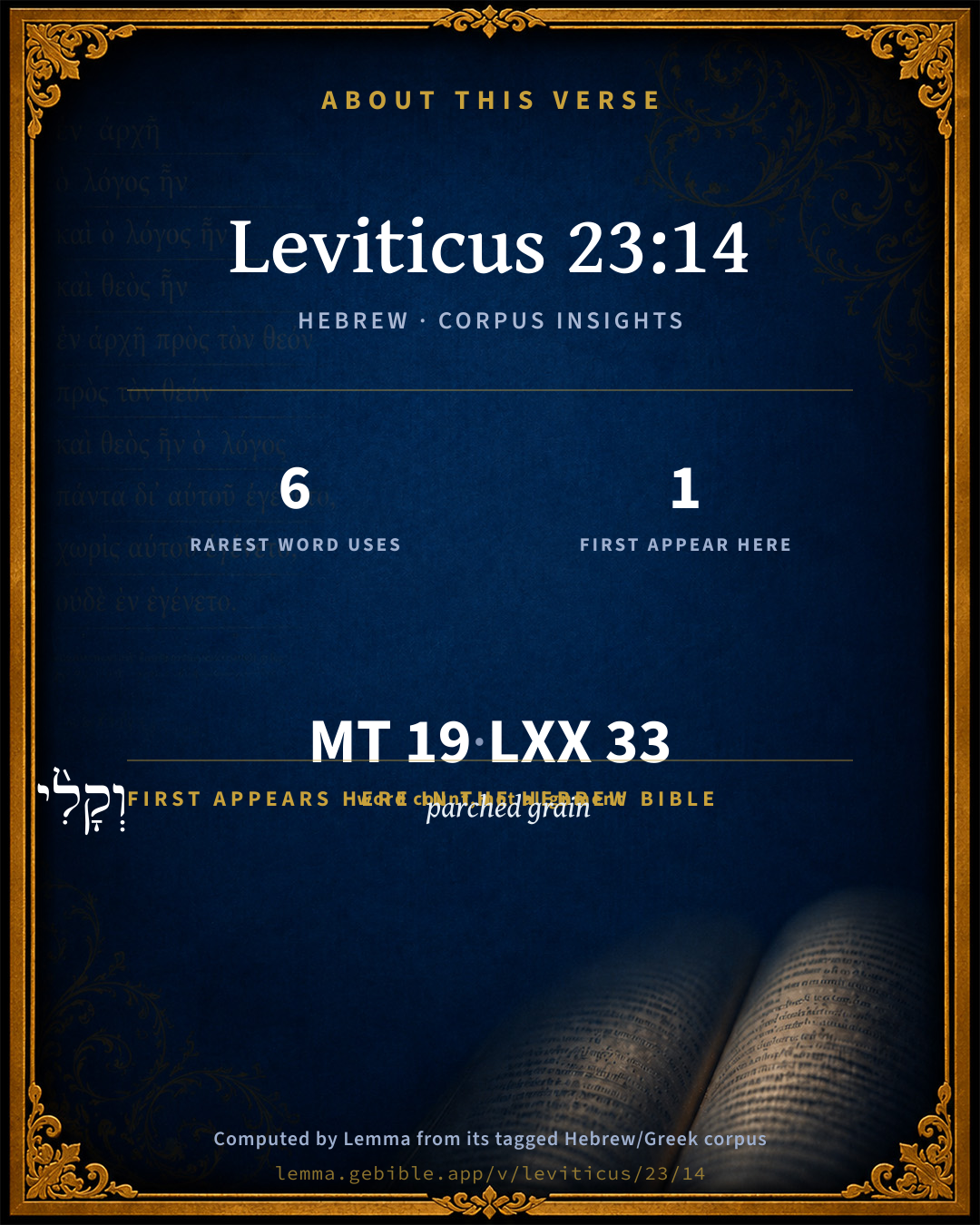
  • 1 first appearance in the Hebrew Bible
Full analysis ↓
Download a study sheet

One document with this verse’s original text, its word-by-word gloss line, the meaning frame, cross-references with their text, attributed commentary, and full source and license credits — printable, and it pastes into notes with its structure intact.

This verse Autodidact and up

Study sheet (.html) Plain text (.txt)

A passage Seminary Student

Up to 50 verses in one chapter. A passage sheet keeps up to 6 commentary sources and 12 cross-references per verse, in the order this page ranks them, and says so on the sheet whenever that leaves anything out. Ask for a single verse and you get the Autodidact verse sheet above.

Everything on this page stays free to read, with no account — the sheet is a download of what is already on screen, not access to it.

Want to remove ads? Support Godless Engineer
Compare translations 3

The same verse in 3 English versions, stacked beneath the original-language interlinear above. Click any original word for its lexicon entry.

Each is an independent rendering of the whole verse — the interlinear is not word-aligned to these translations.

Highlighted words mark where these versions differ — a whole-verse word diff, not a word-by-word alignment.

  • World English Bible Public Domain
    You shall eat neither bread, nor roasted grain, nor fresh grain, until this same day, until you have brought the offering of your God. This is a statute forever throughout your generations in all your dwellings.
  • King James Version Public Domain
    And ye shall eat neither bread, nor parched corn, nor green ears, until the selfsame day that ye have brought an offering unto your God: it shall be a statute for ever throughout your generations in all your dwellings.
  • unfoldingWord Literal Text CC BY-SA 4.0
    And bread and roasted grain and fresh grain you shall not eat until this same day, until you bring the offering of your God. a statute of eternity for your generations in all your dwellings.

unfoldingWord Literal Text — © unfoldingWord, licensed CC BY-SA 4.0. Word-aligned USFM3 via Door43 (git.door43.org/unfoldingWord/en_ult).

Versions to compare (up to 4)

3 of 4 selected

Show all 18 translations

Every available English version of this verse, each an independent rendering of the whole verse.

  • World English Bible Public Domain
    You shall eat neither bread, nor roasted grain, nor fresh grain, until this same day, until you have brought the offering of your God. This is a statute forever throughout your generations in all your dwellings.
  • Berean Standard Bible Public Domain
    You must not eat any bread or roasted or new grain until the very day you have brought this offering to your God. This is to be a permanent statute for the generations to come, wherever you live.
  • Majority Standard Bible Public Domain
    You must not eat any bread or roasted or new grain until the very day you have brought this offering to your God. This is to be a permanent statute for the generations to come, wherever you live.
  • King James Version Public Domain
    And ye shall eat neither bread, nor parched corn, nor green ears, until the selfsame day that ye have brought an offering unto your God: it shall be a statute for ever throughout your generations in all your dwellings.
  • American Standard Version (1901) Public Domain
    And ye shall eat neither bread, nor parched grain, nor fresh ears, until this selfsame day, until ye have brought the oblation of your God: it is a statute for ever throughout your generations in all your dwellings.
  • Revised Version (1885) Public Domain
    And ye shall eat neither bread, nor parched corn, nor fresh ears, until this selfsame day, until ye have brought the oblation of your God: it is a statute for ever throughout your generations in all your dwellings.
  • Geneva Bible (1599) Public Domain
    And ye shall eat neither bread nor parched corne, nor greene eares vntill the selfe same day that ye haue brought an offring vnto your God: this shalbe a lawe for euer in your generations and in all your dwellings.
  • Douay-Rheims (1899) Public Domain
    You shall not eat either bread, or parched corn, or frumenty of the harvest, until the day that you shall offer thereof to your God. It is a precept for ever throughout your generations, and all your dwellings.
  • Young's Literal Translation Public Domain
    `And bread and roasted corn and full ears ye do not eat until this self-same day, until your bringing in the offering of your God -- a statute age-during to your generations, in all your dwellings.
  • Literal Standard Version CC BY-SA 4.0
    And you do not eat bread and roasted grain and full ears until this very day, until your bringing in the offering of your God—a continuous statute throughout your generations, in all your dwellings.
  • Unlocked Literal Bible CC BY-SA 4.0
    You must eat no bread, nor roasted or fresh grain, until the same day you have brought this offering to your God. This will be a permanent statute throughout your people's generations, in every place that you live.
  • unfoldingWord Literal Text CC BY-SA 4.0
    And bread and roasted grain and fresh grain you shall not eat until this same day, until you bring the offering of your God. a statute of eternity for your generations in all your dwellings.
  • Darby Bible Public Domain
    And ye shall not eat bread, or roast corn, or green ears, until the same day that ye have brought the offering of your God: [it is] an everlasting statute throughout your generations in all your dwellings.
  • World Messianic Bible Public Domain
    You must not eat bread, or roasted grain, or fresh grain, until this same day, until you have brought the offering of your God. This is a statute forever throughout your generations in all your dwellings.
  • Webster's Bible Public Domain
    And ye shall eat neither bread, nor parched corn, nor green ears, until the same day that ye have brought an offering to your God: It shall be a statute for ever throughout your generations in all your dwellings.
  • Free Bible Version CC BY-SA 4.0
    Don't eat any bread, roasted grain, or new grain until the time you bring this offering to your God. This regulation is for all time and for future generations everywhere you live.
  • Bible in Basic English Public Domain
    And you may take no bread or dry grain or new grain for food till the very day on which you have given the offering for your God: this is a rule for ever through all your generations wherever you are living.
  • JPS Tanakh (1917) Public Domain
    And ye shall eat neither bread, nor parched corn, nor fresh ears, until this selfsame day, until ye have brought the offering of your God; it is a statute for ever throughout your generations in all your dwellings.

Literal Standard Version (2020), Covenant Press — licensed CC BY-SA 4.0. Text via the HelloAO Bible API (eBible.org). Unlocked Literal Bible (unfoldingWord) — licensed CC BY-SA 4.0. Text via the HelloAO Bible API (eBible.org). unfoldingWord Literal Text — © unfoldingWord, licensed CC BY-SA 4.0. Word-aligned USFM3 via Door43 (git.door43.org/unfoldingWord/en_ult). Free Bible Version, Dr. Jonathan Gallagher — licensed CC BY-SA 4.0. Text via the HelloAO Bible API (eBible.org).

Word by word

More ways to search: Search by grammar → Find every occurrence → Compare this word →

Practice this passage: Drill this verse → Learn its vocabulary →

וְקָלִ֨י
qâlîy
H7039
“and · parched grain”
Conjunction + Noun, Common, Masculine, Singular, Absolute
Part of Speech
Conjunction + Noun
Type
Common
Gender
Masculine
Number
Singular
State
Absolute
Full BDB Definition

Origin: from H7033

TWOT: 2023a

parched grain, roasted grain - a common food
  1. וְלֶחֶם֩ lechem H3899 “and · bread” Conjunction + Noun, Common, Both, Singular, Absolute
  2. וְכַרְמֶ֜ל karmel H3759 “and · orchard” Conjunction + Noun, Common, Masculine, Singular, Absolute
  3. לֹ֣א lôʼ H3808 “not” Particle, Negative
  4. תֹֽאכְל֗וּ ʼâkal H398 “to eat” Verb, Qal, Imperfect, 2nd Person, Masculine, Plural
  5. עַד ʻad H5704 “until” Preposition
  6. עֶ֨צֶם֙ ʻetsem H6106 “bone of” Noun, Common, Feminine, Singular, Construct
  7. הַיּ֣וֹם yôwm H3117 “the · day” Particle, Definite Article + Noun, Common, Masculine, Singular, Absolute
  8. הַזֶּ֔ה zeh H2088 “the · this” Particle, Definite Article + Pronoun, Demonstrative, Masculine, Singular
  9. עַ֚ד ʻad H5704 “until” Preposition
  10. הֲבִ֣יאֲכֶ֔ם bôwʼ H935 “to enter · you” Verb, Hiphil, Infinitive Construct + Suffix, Personal, 2nd Person, Masculine, Plural
  11. אֶת ʼêth H853 “-” Particle, Direct Object
  12. קָרְבַּ֖ן qorbân H7133 “offering of” Noun, Common, Masculine, Singular, Construct
  13. אֱלֹהֵיכֶ֑ם ʼĕlôhîym H430 “God(s) · your” Noun, Common, Masculine, Plural, Construct + Suffix, Personal, 2nd Person, Masculine, Plural
  14. חֻקַּ֤ת chuqqâh H2708 “statute of” Noun, Common, Both, Singular, Construct
  15. עוֹלָם֙ ʻôwlâm H5769 “forever” Noun, Common, Masculine, Singular, Absolute
  16. לְדֹרֹ֣תֵיכֶ֔ם dôwr H1755 “to/for · generations · your” Preposition + Noun, Common, Masculine, Plural, Construct + Suffix, Personal, 2nd Person, Masculine, Plural
  17. בְּכֹ֖ל kôl H3605 “in/at · all of” Preposition + Noun, Common, Masculine, Singular, Construct
  18. מֹשְׁבֹֽתֵיכֶֽם môwshâb H4186 “dwelling places · your” Noun, Common, Masculine, Plural, Construct + Suffix, Personal, 2nd Person, Masculine, Plural

About this verse

These counts appear in no published source. They are computed here, from the morphology-tagged text and Lemma’s own curated glosses. What Lemma adds →

19
words
18
distinct lemmas
Pentateuch
section

Notable vocabulary

The rarest word here is וְקָלִ֨י parched grain H7039 — appearing just 6 times in the whole Hebrew Bible.

First appearance in Scripture

This word makes its first canonical appearance in the Hebrew Bible here:

  • וְקָלִ֨י parched grain H7039

Shared distinctive vocabulary

וְקָלִ֨י parched grain H7039 occurs in 5 verses of the Hebrew Bible. Also found in:

Grammatical profile

  • 2 verbs
  • 12 nouns
  • 1 pronoun
  • 2 prepositions
  • 2 particles

Verb forms

  • תֹֽאכְל֗וּ Qal · Imperfect
  • הֲבִ֣יאֲכֶ֔ם Hiphil · Infinitive Construct

Repetition

A word recurs within this verse — often emphatic in Hebrew:

Hebrew & Septuagint length

In English translation the verse runs 36 words from the Hebrew and 35 from the Septuagint (LXX English) — closely comparable.

A rough comparison of the two English renderings, which tokenize alike — not a word-level alignment.

Word counts can differ between the Hebrew and the Greek without any difference in meaning — e.g. the Hebrew direct-object marker אֵת has no separate Greek word, and Greek often adds the article ὁ.

In the original languages it is 19 Hebrew tokens and 33 Greek tokens — but the two are counted differently (Hebrew bundles its prefixes and suffixes into one token; the Greek is in lemma form), so that isn’t a like-for-like length.

Cross-references

11

Topical passages linked to Leviticus 23:14 in the Treasury of Scripture Knowledge — connected by theme and wording, ordered by reader-vote popularity; previews shown in the World English Bible.

  • Exodus 34:26 You shall bring the first of the first fruits of your ground to the house of Yahweh your God. You shall not boil a young goat in its mother's milk."
  • Genesis 4:4–5 Abel also brought some of the firstborn of his flock and of the fat of it. Yahweh respected Abel and his offering,
  • Leviticus 3:17 "'It shall be a perpetual statute throughout your generations in all your dwellings, that you shall eat neither fat nor blood.'"
  • Leviticus 10:11 and that you are to teach the children of Israel all the statutes which Yahweh has spoken to them by Moses."
  • Leviticus 19:23–25 "'When you come into the land, and have planted all kinds of trees for food, then you shall count their fruit as forbidden. Three years shall they be forbidden to you. It shall not be eaten.
  • Leviticus 25:2–3 "Speak to the children of Israel, and tell them, 'When you come into the land which I give you, then the land shall keep a Sabbath to Yahweh.
  • Numbers 15:20–21 Of the first of your dough you shall offer up a cake for a heave-offering: as the heave-offering of the threshing floor, so shall you heave it.
  • Deuteronomy 16:12 You shall remember that you were a bondservant in Egypt: and you shall observe and do these statutes.
  • Joshua 5:11–12 They ate of the produce of the land on the next day after the Passover, unleavened cakes and parched grain, in the same day.
  • Nehemiah 9:14 and made known to them your holy Sabbath, and commanded them commandments, and statutes, and a law, by Moses your servant,
  • Psalms 19:8 Yahweh's precepts are right, rejoicing the heart. Yahweh's commandment is pure, enlightening the eyes.

Cross-references courtesy of OpenBible.info (CC BY 4.0).

Hebrew and Greek witnesses Masoretic Hebrew ↔ Greek Septuagint

The same verse in the two great witnesses to the Old Testament, shown verse-for-verse.

These are two independent witnesses, not word-aligned to each other, and the Septuagint is shown in lemma (dictionary) form.

Hebrew Leviticus 23:14 Masoretic · Westminster Leningrad Codex

וְלֶחֶם֩ וְקָלִ֨י וְכַרְמֶ֜ל לֹ֣א תֹֽאכְל֗וּ עַד עֶ֨צֶם֙ הַיּ֣וֹם הַזֶּ֔ה עַ֚ד הֲבִ֣יאֲכֶ֔ם אֶת קָרְבַּ֖ן אֱלֹהֵיכֶ֑ם חֻקַּ֤ת עוֹלָם֙ לְדֹרֹ֣תֵיכֶ֔ם בְּכֹ֖ל מֹשְׁבֹֽתֵיכֶֽם

You shall eat neither bread, nor roasted grain, nor fresh grain, until this same day, until you have brought the offering of your God. This is a statute forever throughout your generations in all your dwellings.

World English Bible · Public Domain

Greek LXX Leviticus 23:14 Septuagint · lemma form

καί ἄρτος καί φρύγω χίδρον νέος οὐ ἐσθίω ἕως εἰς αὐτός ὁ ἡμέρα οὗτος ἕως ἄν προςφέρω σύ ὁ δῶρον ὁ θεός σύ νόμιμος αἰώνιος εἰς ὁ γενεά σύ ἐν πᾶς κατοικία σύ

And you⌃ shall not eat bread, or the new parched corn, until this same day, until you⌃ offer the sacrifices to your God: it is a perpetual statute throughout your generations in all your dwellings.

LXX2012 (modern English Septuagint) · Public Domain

Hebrew: Westminster Leningrad Codex (CC BY 4.0). Greek: Septuagint (public domain); English from LXX2012 (modern English Septuagint) (Public Domain). How the Septuagint differs from the Hebrew →

Targum (Aramaic paraphrase)

2

The Targum is the ancient Jewish Aramaic paraphrase of the Hebrew Scriptures — an interpretive translation, not the Hebrew text itself. Onkelos (literal) and Pseudo-Jonathan (expansive) render the Torah, and Jonathan the Prophets. Coverage is partial: where no permissively-licensed English translation exists for a verse, only the Aramaic is shown. This is verse-level text, not a word-by-word alignment to the Hebrew.

  1. Targum Onkelos Torah (Genesis–Deuteronomy)
    וּלְחֵם וּקְלִי וּפֵרוּכָן לָא תֵיכְלוּן עַד כְּרַן יוֹמָא הָדֵין עַד אַיְתוֹאֵיכוֹן יָת קֻרְבָּן אֱלָהָכוֹן קְיַם עָלָם לְדָרֵיכוֹן בְּכֹל מוֹתְבָנֵיכוֹן

    (no public-domain English translation for this verse)

    Targum Onkelos — Aramaic: “Onkelos Genesis” (public domain); “Onkelos Exodus” (public domain); “Onkelos Leviticus” (public domain); “Onkelos Numbers” (public domain); “Onkelos Deuteronomy” (public domain). English: “Sefaria Community Translation” (CC0 1.0 (public-domain dedication)); “J.W. Etheridge. The Targums of Onkelos and Jonathan Ben Uzziel on the Pentateuch. London: Longmans, Green, 1862” (public domain). Text via Sefaria.

  2. Targum Pseudo-Jonathan Torah (Genesis–Deuteronomy)
    וּלְחֵם וּקְלִי וּפֵירוּכִין חַדְתִּין לָא תֵיכְלוּן עַד בִּכְרַן יוֹמָא הָדֵין עַד זְמַן אִיתוֹיֵיכוֹן יַת קָרְבַּן אֱלָהָכוֹן קְיַם עֲלָם לְדָרֵיכוֹן בְּכָל מוֹתְבָנֵיכוֹן

    But neither bread nor parched corn (of the ripe harvest) nor new ears may you eat until this day, until the time of your bringing the oblation of your God: an everlasting statute unto your generations in all your dwellings.

    Targum Pseudo-Jonathan — Aramaic: “Targum Jonathan on Genesis” (public domain); “Targum Jonathan on Exodus” (public domain); “Targum Jonathan on Leviticus” (public domain); “Targum Jonathan on Numbers” (public domain); “Targum Jonathan on Deuteronomy” (public domain). English: “The Targum of Jonathan ben Uzziel, trans. J. W. Etheridge, London, 1862” (public domain). Text via Sefaria.

Commentary

Notes on Leviticus 23:14 from classic Christian and Jewish commentators (each source and its license shown beneath its notes). The classic Christian expositions comment on the surrounding passage and are grouped to its opening verse, so a note may address several verses; the Jewish commentaries on the Tanakh (Rashi and others) are per-verse, so they appear only where the commentator wrote on this verse.

Lemma curates 59 commentaries, every one of them public domain or Creative Commons licensed, each selected and text-cleaned for this edition rather than reprinted as found. About our sources →

Trapp's Complete Commentary

John Trapp

Lev 23:14 And ye shall eat neither bread, nor parched corn, nor green ears, until the selfsame day that ye have brought an offering unto your God: [it shall be] a statute for ever throughout your generations in all your dwellings.

Ver. 14. And ye shall eat neither bread.] It was fit that God the giver should have the first.

John Trapp, A Commentary or Exposition upon All the Books of the Old and New Testament (1647–1656) — public domain. Text from a community e-Sword module.

Joseph Benson's Commentary

Lev 23:14. Ye shall eat neither bread nor corn — Of this year’s growth. This was a most reasonable testimony of their respect for God, to give him the first place, and pay their tribute of gratitude to the donor before they used his gifts. They who lived at a distance from the tabernacle, or temple, were allowed to eat new corn on this day after mid-day, because the offering to God was always presented before that time.

Joseph Benson's Commentary on the Old and New Testaments (1811–1818) — public domain. Text from a community e-Sword module.

Tyndale Open Study Notes

Tyndale Open Resources

23:14 Israelites could not eat food from the harvest on that day until they acknowledged God’s provision by presenting him with the appropriate offering.

Tyndale Open Study Notes — © Tyndale Open Resources, licensed CC BY-SA 4.0. Text via the HelloAO Bible API.

Geneva Bible (1599)

Geneva Bible translators

Or, full ears.

Geneva Bible (1599) marginal notes — public domain. Text via Bolls.life.

Adam Clarke's Commentary

Verse 14. Ye shall eat neither bread, nor parched corn, nor green ears] It is right that God, the dispenser of every blessing, should be acknowledged as such, and the first-fruits of the field, &c., dedicated to him. Concerning the dedication of the first-fruits, See Clarke on Ex 22:29. Parched ears of corn and green ears, fried, still constitute a part, and not a disagreeable one, of the food of the Arabs now resident in the Holy Land. See Hasselquist.

Adam Clarke's Commentary on the Bible (1810–1826) — public domain. Text from a community e-Sword/MySword module.

Ellicott's Commentary for English Readers

(14) And ye shall eat neither bread.—In acknowledgment of the bountiful Giver of the new harvest, it was ordained that the Israelites were not to taste any of it till they had dedicated the first- fruit to the Lord. By bread is meant the unleavened bread which they were now enjoined to eat. The unleavened bread for the first and the second days of Passover was prepared from the last year’s harvest, but the bread for the following days could only be made from the new harvest after the normal dedication of it to the Lord.

Parched corn.—See Lev_2:14.

Green ears.—The expression carmel, which the Authorised version renders “full ears” in Lev. 214, the authorities during the second Temple took to denote the five kinds of the new grain, viz., wheat, rye, oats, and two kinds of barley, which were forbidden to be used in any form whatsoever prior to this public dedication of the harvest to the Lord. The same custom of dedicating the first-fruits of the harvest to the divine beings also obtained amongst the Egyptians, Greeks, Romans, and other nations of antiquity.

A statute for ever . . . —See Lev_3:17; Lev_7:23-25.

A Bible Commentary for English Readers, edited by Charles John Ellicott (1878–1897) — public domain. Text from a community e-Sword module.

The Cambridge Bible for Schools and Colleges

gen. ed. J. J. S. Perowne

14. For ‘parched corn’ and ‘fresh ears,’ see on Lev_2:14-16.

The Cambridge Bible for Schools and Colleges (gen. ed. J. J. S. Perowne; Cambridge University Press, 1878–1918) — public domain. Text from a community e-Sword module.

John Gill's Exposition

And ye shall eat neither bread, nor parched corn, nor green ears,.... That is, they were not allowed to make bread of the new corn, as Aben Ezra and Gersom explain it; for they were obliged to eat unleavened bread at this time: but it might not be made of the new corn, until the above offering was made; nay, they were not allowed to parch any of the grains of corn, and eat them; yea, even they might not pluck and eat the green ears, though of ever so small a quantity. The Jews say (q), if it was the quantity of an olive of either of these, a man was to be beaten for it:

until the selfsame day that ye have brought an offering unto your God; which includes all the offerings on this account, the offering of the firstfruits, the offering of the he lamb, and the meat offering and the drink offering; until these were offered up, the new corn might not be eaten in any form:

it shall be a statute for ever throughout your generations; until the Messiah came, who is the substance of these shadows:

in all your dwellings; not at Jerusalem only, but in the several parts of the land of Canaan; yea, as Ben Gersom says, whether in the land, or without the land; a later writer says, it is forbidden to eat of the new corn at this time, whether bread, parched corn, or green ears, until the beginning of the night of the eighteenth of Nisan, and in the land of Israel, until the beginning of the night of the seventeenth of Nisan (r).

(q) Maimon. Hilchot Maacolot Asurot, c. 10. sect. 2, 3. (r) Schulchan Aruch, par. 1. c. 489. sect. 10. so Lebush, c. 489. sect. 10.

John Gill's Exposition of the Whole Bible (1746–1763) — public domain (CC PDM 1.0). Text via the HelloAO Bible API.

Haydock's Catholic Bible Commentary

Corn (polentam). Some translate bruised corn, or a sort of cake. See chap. ii. 4. --- Dwellings, even out of the holy land, which was peculiar to this law. (Grotius)

George Leo Haydock (1774–1849), Haydock's Catholic Family Bible and Commentary, 1859 edition — public domain. Excludes Psalms (Douay-Rheims chapter numbering differs from Protestant) and Deuterocanonical books (Catholic canon only).

Matthew Poole's English Annotations

Bread, made of new wheat, as the nature and reason of the law showeth.

Nor green ears, which were usual, not only for offerings to God, as Lev 2:14, but also for man’s food. See Jos 5:11; Rth 2:14; 1Sa 17:17; Mat 12:1.

Until the selfsame day: good reason God should be first served and owned as the supreme Landlord.

Matthew Poole's English Annotations on the Holy Bible (1683–1685) — public domain. Text from a community e-Sword/MySword module.

Whedon's Commentary on the Bible

Daniel D. Whedon

14. Parched corn… green ears — These, being fried, are still eaten with relish by the Arabs now dwelling in Palestine. See note on Rth_2:14. Abstinence from the fruits of the earth till thanks have been rendered to the bountiful Giver in the form of an offering of firstfruits was a practice quite prevalent among the pagan nations. Pliny says of the ancient Romans, “They did not so much as taste of their corn and wine till the priests had offered the firstfruits.” A statute for ever. See note on Lev_3:17.

Daniel D. Whedon (gen. ed.), Commentary on the Old and New Testaments (1874–1909) — public domain. Text from a community e-Sword module.

John Wesley's Explanatory Notes

Bread - Made of new wheat. Nor green ears - Which were usual, not only for offerings to God, but also for man's food.

John Wesley, Explanatory Notes Upon the Whole Bible (1754–1765) — public domain. Text via the GEBible commentary corpus.

Rashi

Rabbi Shlomo Yitzchaki (Rashi)

וקלי means flour made out of tender ears (כרמל); this is called קלוי because they dry them in the oven and so become scorched.

וכרמל — these are ears themselves which are called grenailles in old French (Menachot 66a, b).

בכל משבתיכם IN ALL YOUR HABITATIONS — The Sages differ in their opinions regarding this (the meaning of these words). Some learn from here (taking the words בכל משבתיכם in the sense "wherever you may live") that the law concerning the new crop applies also outside the Land of Israel; others, hold that it (the phrase) denotes “in all your settlements” and is only intended to teach that they did not become subject to the command concerning the new crop until after the land had become their inheritance and place of settlement (ישיבה) i. e. after they had subjugated the land and had parcelled it out amongst the tribes (Kiddushin 37a).

Rashi on the Tanakh — English translations: “The Judaica Press complete Tanach with Rashi, translated by A. J. Rosenberg” (CC BY 4.0); “Pentateuch with Rashi's commentary by M. Rosenbaum and A.M. Silbermann, 1929-1934” (public domain); “The Metsudah Tanach series, Lakewood, N.J” (CC BY 4.0); and “The Book of Joshua, Metsudah Publications, 1997” (CC BY 4.0). Text via Sefaria.

Lesson kit

Teaching starters — assembled from the data on this page, not authored interpretation. Every prompt links to the verse data it draws on. Edit before teaching.

Leviticus, in the Pentateuch, opens this verse with 19 words (18 distinct Hebrew lemmas). Its most distinctive word is qâlîy (“parched grain”). A historical commentator’s framing appears above. Read the whole chapter for the surrounding context.

Discussion questions

  1. The word qâlîy carries the sense “parched grain.” How does it shape the verse?
  2. The word “parched grain” first appears here in Scripture. What is being introduced at this debut?
  3. Ruth 2:14 shares the word «parched grain» with this verse. How do the two illuminate each other?
  4. “until” occurs 2× in this one verse. What is the effect of the repetition?
  5. These translations render this verse differently; the difference is in the English rendering, not the original. What questions does that raise?
  6. The verb «תֹֽאכְל֗וּ» is Qal Imperfect. How does its form color the action?
  7. Reading how Trapp's Complete Commentary and Joseph Benson's Commentary read this verse, where do the two commentators agree and where do they part?

Things to notice

Reading settings

Reading text

Shown beneath each verse's original-language words.

Old Testament
Old Testament edition

Read the OT as the Masoretic Hebrew (MT) or the Greek Septuagint (LXX).

English shown for the Greek Septuagint (in the Hebrew ↔ Greek comparison).

Comparing translations? Open the Compare panel on any verse page to stack up to four side by side.