Exodus 29:2

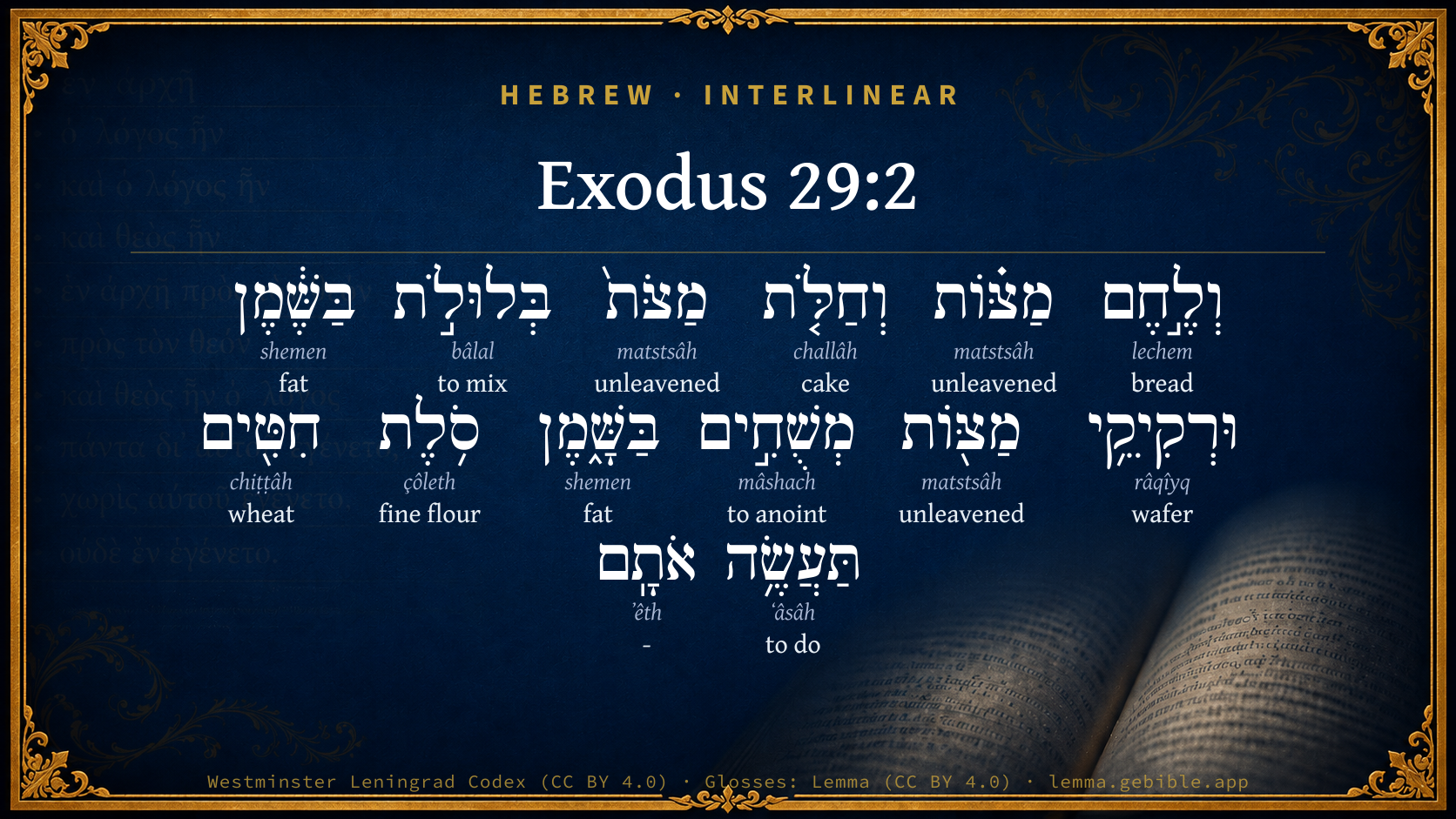
Hebrew (Westminster Leningrad Codex) Exodus 29:2 appears in the Hebrew Old Testament. The text above is from the Westminster Leningrad Codex. Each word links to its Strong’s number, a concise gloss, and parsing drawn from the Open Scriptures Hebrew Bible morphology. Click any word for its full Brown-Driver-Briggs (BDB) entry.
Download image
Cite this verse

Exodus 29:2 (World English Bible). Public Domain. Lemma interlinear Bible study tool, https://lemma.gebible.app/v/exodus/29/2.

Show BibTeX & RIS
BibTeX
RIS
English Translation
unleavened bread, unleavened cakes mixed with oil, and unleavened wafers anointed with oil: you shall make them of fine wheat flour.
World English Bible · Public Domain
Highlights
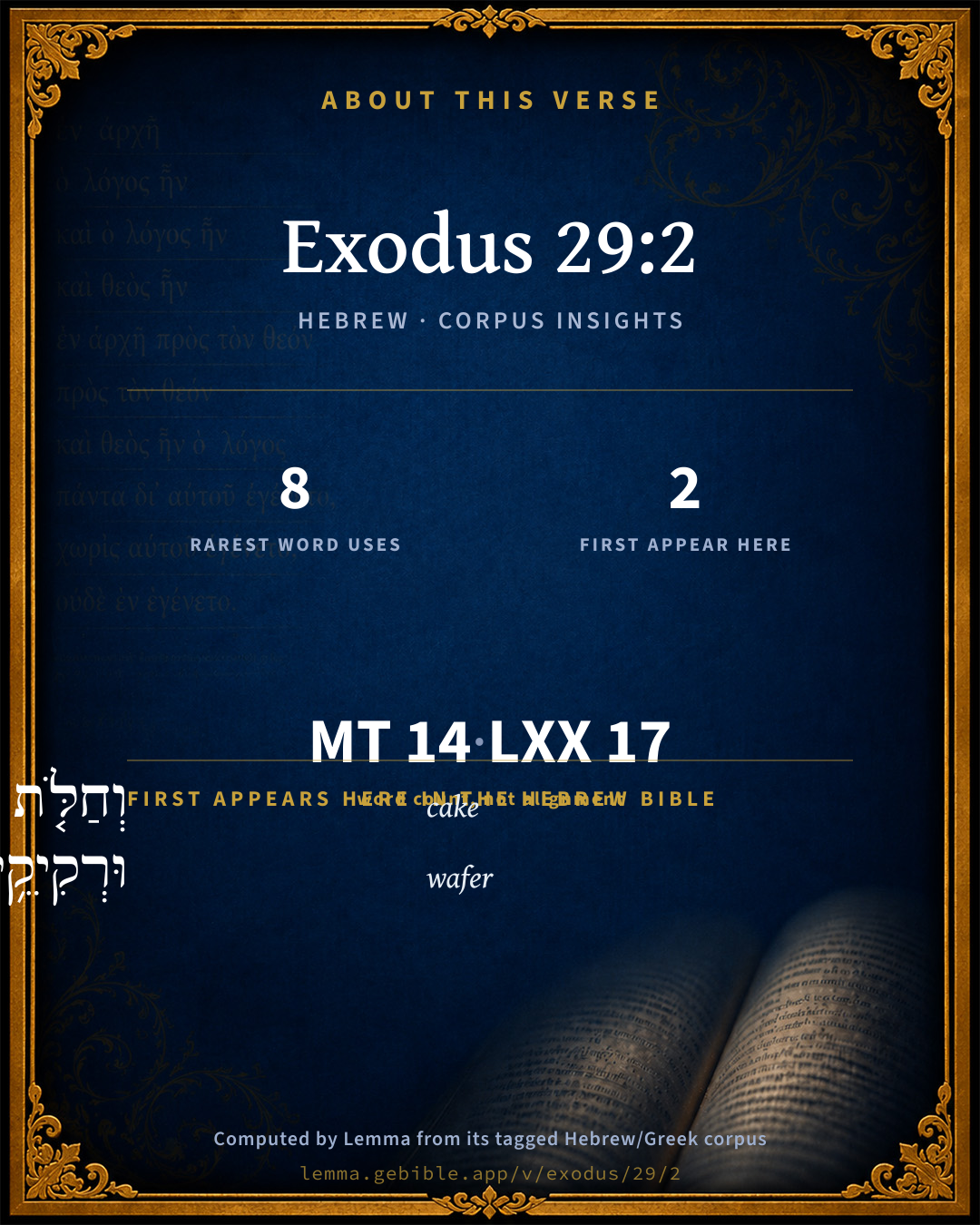
  • 2 first appearances in the Hebrew Bible
Full analysis ↓
Download a study sheet

One document with this verse’s original text, its word-by-word gloss line, the meaning frame, cross-references with their text, attributed commentary, and full source and license credits — printable, and it pastes into notes with its structure intact.

This verse Autodidact and up

Study sheet (.html) Plain text (.txt)

A passage Seminary Student

Up to 50 verses in one chapter. A passage sheet keeps up to 6 commentary sources and 12 cross-references per verse, in the order this page ranks them, and says so on the sheet whenever that leaves anything out. Ask for a single verse and you get the Autodidact verse sheet above.

Everything on this page stays free to read, with no account — the sheet is a download of what is already on screen, not access to it.

Want to remove ads? Support Godless Engineer
Compare translations 3

The same verse in 3 English versions, stacked beneath the original-language interlinear above. Click any original word for its lexicon entry.

Each is an independent rendering of the whole verse — the interlinear is not word-aligned to these translations.

Highlighted words mark where these versions differ — a whole-verse word diff, not a word-by-word alignment.

  • World English Bible Public Domain
    unleavened bread, unleavened cakes mixed with oil, and unleavened wafers anointed with oil: you shall make them of fine wheat flour.
  • King James Version Public Domain
    And unleavened bread, and cakes unleavened tempered with oil, and wafers unleavened anointed with oil: of wheaten flour shalt thou make them.
  • unfoldingWord Literal Text CC BY-SA 4.0
    and unleavened bread and unleavened cakes mixed with oil and unleavened wafers rubbed with oil. Make them with fine flour of wheat.

unfoldingWord Literal Text — © unfoldingWord, licensed CC BY-SA 4.0. Word-aligned USFM3 via Door43 (git.door43.org/unfoldingWord/en_ult).

Versions to compare (up to 4)

3 of 4 selected

Show all 18 translations

Every available English version of this verse, each an independent rendering of the whole verse.

  • World English Bible Public Domain
    unleavened bread, unleavened cakes mixed with oil, and unleavened wafers anointed with oil: you shall make them of fine wheat flour.
  • Berean Standard Bible Public Domain
    along with unleavened bread, unleavened cakes mixed with oil, and unleavened wafers anointed with oil. Make them out of fine wheat flour,
  • Majority Standard Bible Public Domain
    along with unleavened bread, unleavened cakes mixed with oil, and unleavened wafers anointed with oil. Make them out of fine wheat flour,
  • King James Version Public Domain
    And unleavened bread, and cakes unleavened tempered with oil, and wafers unleavened anointed with oil: of wheaten flour shalt thou make them.
  • American Standard Version (1901) Public Domain
    and unleavened bread, and cakes unleavened mingled with oil, and wafers unleavened anointed with oil: of fine wheaten flour shalt thou make them.
  • Revised Version (1885) Public Domain
    and unleavened bread, and cakes unleavened mingled with oil, and wafers unleavened anointed with oil: of fine wheaten flour shalt thou make them.
  • Geneva Bible (1599) Public Domain
    And vnleauened bread and cakes vnleauened tempered with oyle, and wafers vnleauened anoynted with oyle: (of fine wheate flowre shalt thou make them)
  • Douay-Rheims (1899) Public Domain
    And unleavened bread, and a cake without leaven, tempered with oil, wafers also unleavened anointed with oil: thou shalt make them all of wheaten flour.
  • Young's Literal Translation Public Domain
    and bread unleavened, and cakes unleavened anointed with oil, of fine wheaten flour thou dost make them,
  • Literal Standard Version CC BY-SA 4.0
    and unleavened bread, and unleavened cakes anointed with oil; you make them of fine wheat flour,
  • Unlocked Literal Bible CC BY-SA 4.0
    bread without yeast, and cakes without yeast mixed with oil. Also take wafers without yeast rubbed with oil. Make the wafers using fine wheat flour.
  • unfoldingWord Literal Text CC BY-SA 4.0
    and unleavened bread and unleavened cakes mixed with oil and unleavened wafers rubbed with oil. Make them with fine flour of wheat.
  • Darby Bible Public Domain
    and unleavened bread, and unleavened cakes mingled with oil, and unleavened wafers anointed with oil -- of wheaten flour shalt thou make them.
  • World Messianic Bible Public Domain
    unleavened bread, unleavened cakes mixed with oil, and unleavened wafers anointed with oil. You shall make them of fine wheat flour.
  • Webster's Bible Public Domain
    And unleavened bread, and cakes unleavened tempered with oil, and wafers unleavened anointed with oil; of wheat flour shalt thou make them.
  • Free Bible Version CC BY-SA 4.0
    Then using the best wheat flour, make the following without yeast: bread, cakes mixed with olive oil, and wafers sprinkled with olive oil.
  • Bible in Basic English Public Domain
    And unleavened bread, and unleavened cakes mixed with oil, and thin unleavened cakes on which oil has been put, made of the best bread-meal;
  • JPS Tanakh (1917) Public Domain
    and unleavened bread, and cakes unleavened mingled with oil, and wafers unleavened spread with oil; of fine wheaten flour shalt thou make them.

Literal Standard Version (2020), Covenant Press — licensed CC BY-SA 4.0. Text via the HelloAO Bible API (eBible.org). Unlocked Literal Bible (unfoldingWord) — licensed CC BY-SA 4.0. Text via the HelloAO Bible API (eBible.org). unfoldingWord Literal Text — © unfoldingWord, licensed CC BY-SA 4.0. Word-aligned USFM3 via Door43 (git.door43.org/unfoldingWord/en_ult). Free Bible Version, Dr. Jonathan Gallagher — licensed CC BY-SA 4.0. Text via the HelloAO Bible API (eBible.org).

Word by word

More ways to search: Search by grammar → Find every occurrence → Compare this word →

Practice this passage: Drill this verse → Learn its vocabulary →

וּרְקִיקֵ֥י
râqîyq
H7550
“and · wafers of”
Conjunction + Noun, Common, Masculine, Plural, Construct
Part of Speech
Conjunction + Noun
Type
Common
Gender
Masculine
Number
Plural
State
Construct
Full BDB Definition

Origin: from H7556 in its original sense

TWOT: 2218b

thin cake, wafer
  1. וְלֶ֣חֶם lechem H3899 “and · bread of” Conjunction + Noun, Common, Both, Singular, Construct
  2. מַצּ֗וֹת matstsâh H4682 “unleavened bread” Noun, Common, Feminine, Plural, Absolute
  3. וְחַלֹּ֤ת challâh H2471 “and · cake of” Conjunction + Noun, Common, Feminine, Singular, Construct
  4. מַצֹּת֙ matstsâh H4682 “unleavened bread” Noun, Common, Feminine, Plural, Absolute
  5. בְּלוּלֹ֣ת bâlal H1101 “mixed” Verb, Qal, Participle Passive, Feminine, Plural, Absolute
  6. בַּשֶּׁ֔מֶן shemen H8081 “in/at the · fat” Preposition, Determined + Noun, Common, Masculine, Singular, Absolute
  7. מַצּ֖וֹת matstsâh H4682 “unleavened bread” Noun, Common, Feminine, Plural, Absolute
  8. מְשֻׁחִ֣ים mâshach H4886 “anointed” Verb, Qal, Participle Passive, Masculine, Plural, Absolute
  9. בַּשָּׁ֑מֶן shemen H8081 “in/at the · fat” Preposition, Determined + Noun, Common, Masculine, Singular, Absolute
  10. סֹ֥לֶת çôleth H5560 “fine flour of” Noun, Common, Feminine, Singular, Construct
  11. חִטִּ֖ים chiṭṭâh H2406 “wheat” Noun, Common, Feminine, Plural, Absolute
  12. תַּעֲשֶׂ֥ה ʻâsâh H6213 “to do” Verb, Qal, Imperfect, 2nd Person, Masculine, Singular
  13. אֹתָֽם ʼêth H853 “- · them” Particle, Direct Object + Suffix, Personal, 3rd Person, Masculine, Plural

About this verse

These counts appear in no published source. They are computed here, from the morphology-tagged text and Lemma’s own curated glosses. What Lemma adds →

14
words
11
distinct lemmas
Pentateuch
section

Notable vocabulary

The rarest word here is וּרְקִיקֵ֥י wafer H7550 — appearing just 8 times in the whole Hebrew Bible.

First appearance in Scripture

These words make their first canonical appearance in the Hebrew Bible here:

  • וְחַלֹּ֤ת cake H2471
  • וּרְקִיקֵ֥י wafer H7550

Shared distinctive vocabulary

וּרְקִיקֵ֥י wafer H7550 occurs in 8 verses of the Hebrew Bible. Also found in:

Grammatical profile

  • 3 verbs
  • 10 nouns
  • 1 particle

Verb forms

  • בְּלוּלֹ֣ת Qal · Participle Passive
  • מְשֻׁחִ֣ים Qal · Participle Passive
  • תַּעֲשֶׂ֥ה Qal · Imperfect

Repetition

Words recur within this verse — often emphatic in Hebrew:

  • מַצּ֗וֹת unleavened H4682 ×3
  • בַּשֶּׁ֔מֶן fat H8081 ×2

Hebrew & Septuagint length

In English translation the verse runs 21 words from the Hebrew and 21 from the Septuagint (LXX English) — the same length.

A rough comparison of the two English renderings, which tokenize alike — not a word-level alignment.

Word counts can differ between the Hebrew and the Greek without any difference in meaning — e.g. the Hebrew direct-object marker אֵת has no separate Greek word, and Greek often adds the article ὁ.

In the original languages it is 14 Hebrew tokens and 17 Greek tokens — but the two are counted differently (Hebrew bundles its prefixes and suffixes into one token; the Greek is in lemma form), so that isn’t a like-for-like length.

Cross-references

12

Topical passages linked to Exodus 29:2 in the Treasury of Scripture Knowledge — connected by theme and wording, ordered by reader-vote popularity; previews shown in the World English Bible.

  • Numbers 6:15 and a basket of unleavened bread, cakes of fine flour mixed with oil, and unleavened wafers anointed with oil, and their meal offering, and their drink offerings.
  • Exodus 12:8 They shall eat the flesh in that night, roasted with fire, and unleavened bread. They shall eat it with bitter herbs.
  • Exodus 29:23 and one loaf of bread, one cake of oiled bread, and one wafer out of the basket of unleavened bread that is before Yahweh.
  • Leviticus 2:4–5 "'When you offer an offering of a meal offering baked in the oven, it shall be unleavened cakes of fine flour mixed with oil, or unleavened wafers anointed with oil.
  • Leviticus 2:15 You shall put oil on it, and lay frankincense on it: it is a meal offering.
  • Leviticus 6:19–23 Yahweh spoke to Moses, saying,
  • Leviticus 7:10 Every meal offering, mixed with oil or dry, belongs to all the sons of Aaron, one as well as another.
  • Leviticus 7:12 If he offers it for a thanksgiving, then he shall offer with the sacrifice of thanksgiving unleavened cakes mixed with oil, and unleavened wafers anointed with oil, and cakes mixed with oil.
  • Leviticus 8:2 "Take Aaron and his sons with him, and the garments, and the anointing oil, and the bull of the sin offering, and the two rams, and the basket of unleavened bread;
  • Leviticus 8:26 and out of the basket of unleavened bread, that was before Yahweh, he took one unleavened cake, and one cake of oiled bread, and one wafer, and placed them on the fat, and on the right thigh.
  • Numbers 6:19 The priest shall take the boiled shoulder of the ram, and one unleavened cake out of the basket, and one unleavened wafer, and shall put them on the hands of the Nazirite, after he has shaved the head of his separation;
  • 1 Corinthians 5:7 Purge out the old yeast, that you may be a new lump, even as you are unleavened. For indeed Christ, our Passover, has been sacrificed in our place.

Cross-references courtesy of OpenBible.info (CC BY 4.0).

Hebrew and Greek witnesses Masoretic Hebrew ↔ Greek Septuagint

The same verse in the two great witnesses to the Old Testament, shown verse-for-verse.

These are two independent witnesses, not word-aligned to each other, and the Septuagint is shown in lemma (dictionary) form.

Hebrew Exodus 29:2 Masoretic · Westminster Leningrad Codex

וְלֶ֣חֶם מַצּ֗וֹת וְחַלֹּ֤ת מַצֹּת֙ בְּלוּלֹ֣ת בַּשֶּׁ֔מֶן וּרְקִיקֵ֥י מַצּ֖וֹת מְשֻׁחִ֣ים בַּשָּׁ֑מֶן סֹ֥לֶת חִטִּ֖ים תַּעֲשֶׂ֥ה אֹתָֽם

unleavened bread, unleavened cakes mixed with oil, and unleavened wafers anointed with oil: you shall make them of fine wheat flour.

World English Bible · Public Domain

Greek LXX Exodus 29:2 Septuagint · lemma form

καί ἄρτος ἄζυμος φυράω ἐν ἔλαιον καί λάγανον ἄζυμος χρίω ἐν ἔλαιον σεμίδαλις ἐκ πυρός ποιέω αὐτός

and unleavened loaves kneaded with oil, and unleavened cakes anointed with oil: you shall make them of fine flour of wheat.

LXX2012 (modern English Septuagint) · Public Domain

Hebrew: Westminster Leningrad Codex (CC BY 4.0). Greek: Septuagint (public domain); English from LXX2012 (modern English Septuagint) (Public Domain). How the Septuagint differs from the Hebrew →

Targum (Aramaic paraphrase)

2

The Targum is the ancient Jewish Aramaic paraphrase of the Hebrew Scriptures — an interpretive translation, not the Hebrew text itself. Onkelos (literal) and Pseudo-Jonathan (expansive) render the Torah, and Jonathan the Prophets. Coverage is partial: where no permissively-licensed English translation exists for a verse, only the Aramaic is shown. This is verse-level text, not a word-by-word alignment to the Hebrew.

  1. Targum Onkelos Torah (Genesis–Deuteronomy)
    וּלְחֵם פַּטִיר וּגְרִיצִין פַּטִּירִין דְפִילָן בִּמְשַׁח וְאֶסְפּוֹגִין פַּטִּירִין דִמְשִׁיחִין בִּמְשָׁח סֻלְתָּא חִטִין תַּעְבֵּד יָתְהוֹן:

    (no public-domain English translation for this verse)

    Targum Onkelos — Aramaic: “Onkelos Genesis” (public domain); “Onkelos Exodus” (public domain); “Onkelos Leviticus” (public domain); “Onkelos Numbers” (public domain); “Onkelos Deuteronomy” (public domain). English: “Sefaria Community Translation” (CC0 1.0 (public-domain dedication)); “J.W. Etheridge. The Targums of Onkelos and Jonathan Ben Uzziel on the Pentateuch. London: Longmans, Green, 1862” (public domain). Text via Sefaria.

  2. Targum Pseudo-Jonathan Torah (Genesis–Deuteronomy)
    וּלְחֵים פַּטִּיר וּגְרִיצַן פַּטִּירִין דִּפְּתִיכִין בִּמְשַׁח זֵיתָא וְעֵירוּבִין דִּלְחֵם פַּטִּיר דִּמְשִׁיחִין בִּמְשַׁח זֵיתָא סְמִידָא דְחִינְטִין תַּעֲבֵיד יַתְהוֹן

    and unleavened bread, and unleavened cakes, mingled with olive oil; and wafers of unleavened bread anointed with olive oil, and with flour of wheat shalt thou make them.

    Targum Pseudo-Jonathan — Aramaic: “Targum Jonathan on Genesis” (public domain); “Targum Jonathan on Exodus” (public domain); “Targum Jonathan on Leviticus” (public domain); “Targum Jonathan on Numbers” (public domain); “Targum Jonathan on Deuteronomy” (public domain). English: “The Targum of Jonathan ben Uzziel, trans. J. W. Etheridge, London, 1862” (public domain). Text via Sefaria.

Commentary

Notes on Exodus 29:2 from classic Christian and Jewish commentators (each source and its license shown beneath its notes). The classic Christian expositions comment on the surrounding passage and are grouped to its opening verse, so a note may address several verses; the Jewish commentaries on the Tanakh (Rashi and others) are per-verse, so they appear only where the commentator wrote on this verse.

Lemma curates 59 commentaries, every one of them public domain or Creative Commons licensed, each selected and text-cleaned for this edition rather than reprinted as found. About our sources →

Trapp's Complete Commentary

John Trapp

Exo 29:2 And unleavened bread, and cakes unleavened tempered with oil, and wafers unleavened anointed with oil: [of] wheaten flour shalt thou make them.

Ver. 2. And unlevened bread.] See 1Co 5:7-8. {See Trapp on "1Co 5:7"} {See Trapp on "1Co 5:8"]

John Trapp, A Commentary or Exposition upon All the Books of the Old and New Testament (1647–1656) — public domain. Text from a community e-Sword module.

Joseph Benson's Commentary

Exo 29:2. Unleavened bread — To signify that both themselves and their services must be sincere, and free from all hypocrisy and wickedness. Cakes tempered with oil — Denoting that all their oblations and services must be under the influence of divine grace. Wheaten flour — The best part of the principal grain, to show that God must be served with the best.

Joseph Benson's Commentary on the Old and New Testaments (1811–1818) — public domain. Text from a community e-Sword module.

Adam Clarke's Commentary

Verse 2. Unleavened bread] Three kinds of bread as to its form are mentioned here, but all unleavened:

1. מצות matstsoth, unleavened bread, no matter in what shape. See Ex 12:8.

2. חלת challoth, cakes, pricked or perforated, as the root implies.

3. רקיקי rekikey, an exceeding thin cake, from רק rak, to be attenuated, properly enough translated wafer. The manner in which these were prepared is sufficiently plain from the text, and probably these were the principal forms in which flour was prepared for household use during their stay in the wilderness.

These were all waved before the Lord, Ex 29:24, as an acknowledgment that the bread that sustains the body, as well as the mercy which saves the soul, comes from God alone.

Adam Clarke's Commentary on the Bible (1810–1826) — public domain. Text from a community e-Sword/MySword module.

Ellicott's Commentary for English Readers

(2) Unleavened bread.—Unleavened bread seems to have been required as purer than leavened, since fermentation was viewed as a species of corruption.

Cakes . . . tempered with oil.—Rather, cakes that have had oil poured over them. A tolerably thick cake is intended.

Wafers.—These were cakes, or biscuits, extremely thin and unsubstantial, as is implied by the etymology of the term used. Oil is commonly eaten with cakes of both kinds by the Orientals.

A Bible Commentary for English Readers, edited by Charles John Ellicott (1878–1897) — public domain. Text from a community e-Sword module.

The Cambridge Bible for Schools and Colleges

gen. ed. J. J. S. Perowne

2. Three kinds of biscuit, for the minḥâh, or meal-offering (see on Leviticus 2.), accompanying the installation-offering: viz. (1) bread of unleavened cakes, see on Exo_12:15; (2) perforated cakes (EB. i. 460) unleavened, mingled with oil, see on Lev_2:4; and (3) wafers (large, circular, very thin cakes: see EB. i. 605; L. and B. iii. 219 f.), unleavened, anointed with oil, see also on Lev_2:4.

The Cambridge Bible for Schools and Colleges (gen. ed. J. J. S. Perowne; Cambridge University Press, 1878–1918) — public domain. Text from a community e-Sword module.

John Gill's Exposition

And unleavened bread,.... Such as used to be eaten at the time of the passover, and this being distinguished from cakes and wafers, after mentioned, shows that this was bread of a larger size, a loaf or loaves of bread, see Exo 29:3.

and cakes unleavened, tempered with oil; these were made of flour mixed with oil, but without leaven, and were a lesser and thinner sort of bread than the former:

and wafers unleavened, anointed with oil; with oil olive, the best of oil, as the Targum of Jonathan, and so Aben Ezra; these were a thinner sort of bread still, somewhat like our pancakes; and they were anointed with oil after the baking of them, and in the form of the Greek "chi", as Jarchi says, or of a St. Andrew's or Burgundian cross:

of wheaten flour shall thou make them; of the finest of the wheat, for these were to be the food of Aaron and his sons, who were now to be invested with an high and honourable office, and were to live according to the dignity of it; and these being all unleavened, may denote that sincerity, simplicity, and integrity that ought to be found in them, in the discharge of their office, and which were in Christ in full perfection; as well as soundness in doctrine, life, and manners, being free from all leaven of false doctrine, hypocrisy, and malice; and likewise what is expected of the same kind in all the saints, who, under the Gospel dispensation, are all of them priests unto God, and whose food is the finest of the wheat, Christ the bread of life.

John Gill's Exposition of the Whole Bible (1746–1763) — public domain (CC PDM 1.0). Text via the HelloAO Bible API.

Haydock's Catholic Bible Commentary

Wafers, (lagana.). They knead them with water, and afterwards fry or bake them with oil. (St. Isidore) Such wafers are very common in Italy. (Calmet)

George Leo Haydock (1774–1849), Haydock's Catholic Family Bible and Commentary, 1859 edition — public domain. Excludes Psalms (Douay-Rheims chapter numbering differs from Protestant) and Deuterocanonical books (Catholic canon only).

Matthew Poole's English Annotations

The unleavened bread was to show that the priests should be, and that Christ really was, free from all malice and hypocrisy, both which are compared to leaven, Luk 12:1; 1Co 5:8, and that all the services offered to God by the priests were to be pure and unmixed.

Matthew Poole's English Annotations on the Holy Bible (1683–1685) — public domain. Text from a community e-Sword/MySword module.

Whedon's Commentary on the Bible

Daniel D. Whedon

2. Bread… cakes… oil — The manner of preparing the vegetable offering is described in Leviticus ii, where see notes. The distinction between the cakes and the wafers was in the thinness of the latter, the unleavened bread being made up in two different forms.

Daniel D. Whedon (gen. ed.), Commentary on the Old and New Testaments (1874–1909) — public domain. Text from a community e-Sword module.

The Pulpit Commentary

Unleavened bread was regarded as purer than leavened, since fermentation is a sort of corruption. See the comment on Exo_12:15. Cakes tempered with oil. Literally, "mixed with oil," i.e. , having oil as one of their ingredients, in contrast with the wafers, which had oil poured over them.

The Pulpit Commentary (1880–1919), ed. H.D.M. Spence-Jones & Joseph S. Exell — public domain. Text from a community e-Sword module.

Scofield Reference Notes

C. I. Scofield

cakes

(See Scofield "Exo 25:30") See Scofield "Lev 2:1".

The Scofield Reference Bible (1917 edition), notes by C. I. Scofield — public domain. Text from a community e-Sword module.

Rashi

Rabbi Shlomo Yitzchaki (Rashi)

ולחם מצות וחלת מצת... ורקיקי מצות AND UNLEAVENED BREAD, AND PIERCED CAKES UNLEAVENED … AND WAFERS UNLEAVENED — Here you have these three kinds: “satured” with scalding water, and pierced cakes, and wafers. The לחם מצות, “unleavened bread” mentioned here is that which is termed further on in this section (v. 23) חלת לחם שמן, “pierced cake of oiled bread”, being so termed because they put unto the saturated dough as much oil as they put into the pieced cakes and wafers together (Menachot 89a). Of each of these kinds there were brought ten cakes (Menachot 76a).

בלולת בשמן [CAKES] MINGLED WITH OIL — whilst they were still meal they poured oil into them and mixed them up (Menachot 75a).

משחים בשמן ANOINTED WITH OIL — after they were baked they anointed them in the form of a Greek Chi (X), which is formed like our נ (Menachot 74b and Rashi thereon; Menachot 75a).

Rashi on the Tanakh — English translations: “The Judaica Press complete Tanach with Rashi, translated by A. J. Rosenberg” (CC BY 4.0); “Pentateuch with Rashi's commentary by M. Rosenbaum and A.M. Silbermann, 1929-1934” (public domain); “The Metsudah Tanach series, Lakewood, N.J” (CC BY 4.0); and “The Book of Joshua, Metsudah Publications, 1997” (CC BY 4.0). Text via Sefaria.

Lesson kit

Teaching starters — assembled from the data on this page, not authored interpretation. Every prompt links to the verse data it draws on. Edit before teaching.

Exodus, in the Pentateuch, opens this verse with 14 words (11 distinct Hebrew lemmas). Its most distinctive word is râqîyq (“wafer”). A historical commentator’s framing appears above. Read the whole chapter for the surrounding context.

Discussion questions

  1. What does “wafer” (râqîyq) contribute to the verse as a whole?
  2. 2 words make their first appearance in Scripture here. What does this debut establish?
  3. How does Exodus 29:23, which shares the word «wafer», read alongside this verse?
  4. What does the repetition of “unleavened” (3× in this one verse) do in this verse?
  5. These translations render this verse differently; the difference is in the English rendering, not the original. What questions does that raise?
  6. «בְּלוּלֹ֣ת» is a Qal Participle Passive verb. How does that grammatical form shape the action described?
  7. Compare how Trapp's Complete Commentary and Joseph Benson's Commentary read this verse. Where do they agree or differ?

Things to notice

Reading settings

Reading text

Shown beneath each verse's original-language words.

Old Testament
Old Testament edition

Read the OT as the Masoretic Hebrew (MT) or the Greek Septuagint (LXX).

English shown for the Greek Septuagint (in the Hebrew ↔ Greek comparison).

Comparing translations? Open the Compare panel on any verse page to stack up to four side by side.