

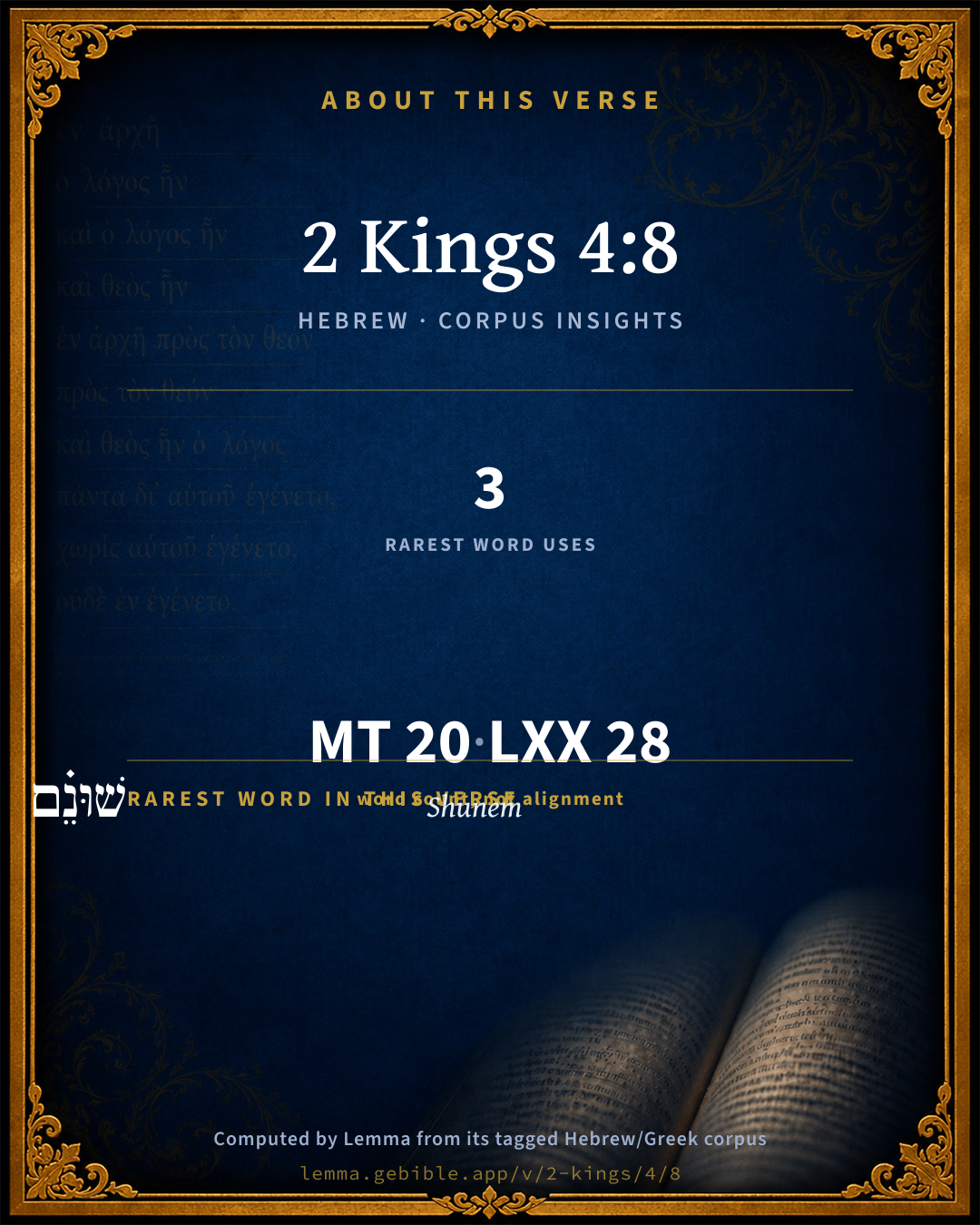
2 Kings 4:8

Hebrew (Westminster Leningrad Codex) 2 Kings 4:8 appears in the Hebrew Old Testament. The text above is from the Westminster Leningrad Codex. Each word links to its Strong’s number, a concise gloss, and parsing drawn from the Open Scriptures Hebrew Bible morphology. Click any word for its full Brown-Driver-Briggs (BDB) entry.
Download image
Cite this verse

2 Kings 4:8 (World English Bible). Public Domain. Lemma interlinear Bible study tool, https://lemma.gebible.app/v/2-kings/4/8.

Show BibTeX & RIS
BibTeX
RIS
English Translation
It fell on a day, that Elisha passed to Shunem, where was a great woman; and she constrained him to eat bread. So it was, that as often as he passed by, he turned in there to eat bread.
World English Bible · Public Domain
Download a study sheet

One document with this verse’s original text, its word-by-word gloss line, the meaning frame, cross-references with their text, attributed commentary, and full source and license credits — printable, and it pastes into notes with its structure intact.

This verse Autodidact and up

Study sheet (.html) Plain text (.txt)

A passage Seminary Student

Up to 50 verses in one chapter. A passage sheet keeps up to 6 commentary sources and 12 cross-references per verse, in the order this page ranks them, and says so on the sheet whenever that leaves anything out. Ask for a single verse and you get the Autodidact verse sheet above.

Everything on this page stays free to read, with no account — the sheet is a download of what is already on screen, not access to it.

Want to remove ads? Support Godless Engineer
Compare translations 3

The same verse in 3 English versions, stacked beneath the original-language interlinear above. Click any original word for its lexicon entry.

Each is an independent rendering of the whole verse — the interlinear is not word-aligned to these translations.

Highlighted words mark where these versions differ — a whole-verse word diff, not a word-by-word alignment.

  • World English Bible Public Domain
    It fell on a day, that Elisha passed to Shunem, where was a great woman; and she constrained him to eat bread. So it was, that as often as he passed by, he turned in there to eat bread.
  • King James Version Public Domain
    And it fell on a day, that Elisha passed to Shunem, where was a great woman; and she constrained him to eat bread. And so it was, that as oft as he passed by, he turned in thither to eat bread.
  • unfoldingWord Literal Text CC BY-SA 4.0
    And it was the day, and Elisha went over to Shunem, and a great woman there, and she constrained him to eat bread. And it happened that as often as he passed by, he turned aside to there to eat bread.

unfoldingWord Literal Text — © unfoldingWord, licensed CC BY-SA 4.0. Word-aligned USFM3 via Door43 (git.door43.org/unfoldingWord/en_ult).

Versions to compare (up to 4)

3 of 4 selected

Show all 18 translations

Every available English version of this verse, each an independent rendering of the whole verse.

  • World English Bible Public Domain
    It fell on a day, that Elisha passed to Shunem, where was a great woman; and she constrained him to eat bread. So it was, that as often as he passed by, he turned in there to eat bread.
  • Berean Standard Bible Public Domain
    One day Elisha went to Shunem, and a prominent woman who lived there persuaded him to have a meal. So whenever he would pass by, he would stop there to eat.
  • Majority Standard Bible Public Domain
    One day Elisha went to Shunem, and a prominent woman who lived there persuaded him to have a meal. So whenever he would pass by, he would stop there to eat.
  • King James Version Public Domain
    And it fell on a day, that Elisha passed to Shunem, where was a great woman; and she constrained him to eat bread. And so it was, that as oft as he passed by, he turned in thither to eat bread.
  • American Standard Version (1901) Public Domain
    And it fell on a day, that Elisha passed to Shunem, where was a great woman; and she constrained him to eat bread. And so it was, that as oft as he passed by, he turned in thither to eat bread.
  • Revised Version (1885) Public Domain
    And it fell on a day, that Elisha passed to Shunem, where was a great woman; and she constrained him to eat bread. And so it was, that as oft as he passed by, he turned in thither to eat bread.
  • Geneva Bible (1599) Public Domain
    And on a time Elisha came to Shunem, and there a woman of great estimation constrained him to eate bread: and as he passed by, he turned in thither to eate bread.
  • Douay-Rheims (1899) Public Domain
    And there was a day when Eliseus passed by Sunam: now there was a great woman there, who detained him to eat bread; and as he passed often that way, he turned into her house to eat bread.
  • Young's Literal Translation Public Domain
    And the day cometh that Elisha passeth over unto Shunem, and there `is' a great woman, and she layeth hold on him to eat bread, and it cometh to pass, at the time of his passing over, he turneth aside thither to eat bread,
  • Literal Standard Version CC BY-SA 4.0
    And the day comes that Elisha passes over to Shunem, and there [is] a great woman, and she lays hold on him to eat bread, and it comes to pass, at the time of his passing over, he turns aside there to eat bread,
  • Unlocked Literal Bible CC BY-SA 4.0
    One day Elisha walked to Shunem where an important woman lived; she urged him to eat food with her. So as often as Elisha passed by, he would stop there to eat.
  • unfoldingWord Literal Text CC BY-SA 4.0
    And it was the day, and Elisha went over to Shunem, and a great woman there, and she constrained him to eat bread. And it happened that as often as he passed by, he turned aside to there to eat bread.
  • Darby Bible Public Domain
    And it came to pass on a day, that Elisha passed to Shunem, where was a wealthy woman; and she constrained him to eat bread. And so it was, [that] as oft as he passed by, he turned in thither to eat bread.
  • World Messianic Bible Public Domain
    One day Elisha went to Shunem, where there was a prominent woman; and she persuaded him to eat bread. So it was, that as often as he passed by, he turned in there to eat bread.
  • Webster's Bible Public Domain
    And it fell on a day, that Elisha passed to Shunem, where was a distinguished woman; and she constrained him to eat bread. And so it was, that as oft as he passed by, he turned in thither to eat bread.
  • Free Bible Version CC BY-SA 4.0
    One day as Elisha was passing through Shunem, a wealthy woman who lived there convinced him to have a meal. After that, whenever he was passing by he would stop there to eat.
  • Bible in Basic English Public Domain
    Now there came a day when Elisha went to Shunem, and there was a woman of high position living there, who made him come in and have a meal with her. And after that, every time he went by, he went into her house for a meal.
  • JPS Tanakh (1917) Public Domain
    And it fell on a day, that Elisha passed to Shunem, where was a great woman; and she constrained him to eat bread. And so it was, that as oft as he passed by, he turned in thither to eat bread.

Literal Standard Version (2020), Covenant Press — licensed CC BY-SA 4.0. Text via the HelloAO Bible API (eBible.org). Unlocked Literal Bible (unfoldingWord) — licensed CC BY-SA 4.0. Text via the HelloAO Bible API (eBible.org). unfoldingWord Literal Text — © unfoldingWord, licensed CC BY-SA 4.0. Word-aligned USFM3 via Door43 (git.door43.org/unfoldingWord/en_ult). Free Bible Version, Dr. Jonathan Gallagher — licensed CC BY-SA 4.0. Text via the HelloAO Bible API (eBible.org).

Word by word

More ways to search: Search by grammar → Find every occurrence → Compare this word →

Practice this passage: Drill this verse → Learn its vocabulary →

שׁוּנֵ֗ם
Shûwnêm
H7766
“Shunem”
Noun, Proper
Part of Speech
Noun
Type
Proper
Full BDB Definition

Origin: probably from the same as H7764

TWOT: None

Shunem = "double resting place" - a city in Issachar, located 5 miles (8 kilometers) south of Mount Tabor
  1. וַיְהִ֨י hâyâh H1961 “and · to be” Conjunction + Verb, Qal, Sequential Imperfect, 3rd Person, Masculine, Singular
  2. הַיּ֜וֹם yôwm H3117 “the · day” Particle, Definite Article + Noun, Common, Masculine, Singular, Absolute
  3. וַיַּעֲבֹ֧ר ʻâbar H5674 “and · to pass over” Conjunction + Verb, Qal, Sequential Imperfect, 3rd Person, Masculine, Singular
  4. אֱלִישָׁ֣ע ʼĔlîyshâʻ H477 “Elisha” Noun, Proper
  5. אֶל ʼêl H413 “to” Preposition
  6. וְשָׁם֙ shâm H8033 “and · there” Conjunction + Adverb
  7. אִשָּׁ֣ה ʼishshâh H802 “woman” Noun, Common, Feminine, Singular, Absolute
  8. גְדוֹלָ֔ה gâdôwl H1419 “great” Adjective, Adjective, Feminine, Singular, Absolute
  9. וַתַּחֲזֶק châzaq H2388 “and · to strengthen” Conjunction + Verb, Hiphil, Sequential Imperfect, 3rd Person, Feminine, Singular
  10. לֶאֱכָל ʼâkal H398 “to eat” Preposition + Verb, Qal, Infinitive Construct
  11. לָ֑חֶם lechem H3899 “bread” Noun, Common, Both, Singular, Absolute
  12. וַֽיְהִי֙ hâyâh H1961 “and · to be” Conjunction + Verb, Qal, Sequential Imperfect, 3rd Person, Masculine, Singular
  13. מִדֵּ֣י day H1767 “from · enough of” Preposition + Noun, Common, Masculine, Singular, Construct
  14. עָבְר֔וֹ ʻâbar H5674 “to pass over · him” Verb, Qal, Infinitive Construct + Suffix, Personal, 3rd Person, Masculine, Singular
  15. יָסֻ֥ר çûwr H5493 “to turn aside” Verb, Qal, Imperfect, 3rd Person, Masculine, Singular
  16. שָׁ֖מָּה shâm H8033 “there · toward” Adverb + Suffix, Demonstrative
  17. לֶאֱכָל ʼâkal H398 “to eat” Preposition + Verb, Qal, Infinitive Construct
  18. לָֽחֶם lechem H3899 “bread” Noun, Common, Both, Singular, Absolute

About this verse

These counts appear in no published source. They are computed here, from the morphology-tagged text and Lemma’s own curated glosses. What Lemma adds →

20
words
14
distinct lemmas
Historical
section

Notable vocabulary

The rarest word here is שׁוּנֵ֗ם Shunem H7766 — appearing just 3 times in the whole Hebrew Bible.

Shared distinctive vocabulary

שׁוּנֵ֗ם Shunem H7766 occurs in 3 verses of the Hebrew Bible. Also found in:

Grammatical profile

  • 8 verbs
  • 7 nouns
  • 1 adjective
  • 2 prepositions
  • 2 adverbs

Verb forms

  • וַיְהִ֨י Qal · Sequential Imperfect
  • וַיַּעֲבֹ֧ר Qal · Sequential Imperfect
  • וַתַּחֲזֶק Hiphil · Sequential Imperfect
  • לֶאֱכָל Qal · Infinitive Construct
  • וַֽיְהִי֙ Qal · Sequential Imperfect
  • עָבְר֔וֹ Qal · Infinitive Construct
  • יָסֻ֥ר Qal · Imperfect
  • לֶאֱכָל Qal · Infinitive Construct

Repetition

Words recur within this verse — often emphatic in Hebrew:

  • וַיְהִ֨י to be H1961 ×2
  • וַיַּעֲבֹ֧ר to pass over H5674 ×2
  • וְשָׁם֙ there H8033 ×2
  • לֶאֱכָל to eat H398 ×2
  • לָ֑חֶם bread H3899 ×2

Hebrew & Septuagint length

In English translation the verse runs 39 words from the Hebrew and 44 from the Septuagint (LXX English) — closely comparable.

A rough comparison of the two English renderings, which tokenize alike — not a word-level alignment.

Word counts can differ between the Hebrew and the Greek without any difference in meaning — e.g. the Hebrew direct-object marker אֵת has no separate Greek word, and Greek often adds the article ὁ.

In the original languages it is 20 Hebrew tokens and 28 Greek tokens — but the two are counted differently (Hebrew bundles its prefixes and suffixes into one token; the Greek is in lemma form), so that isn’t a like-for-like length.

Cross-references

14

Topical passages linked to 2 Kings 4:8 in the Treasury of Scripture Knowledge — connected by theme and wording, ordered by reader-vote popularity; previews shown in the World English Bible.

  • Joshua 19:18 Their border was to Jezreel, and Chesulloth, and Shunem,
  • Genesis 19:3 He urged them greatly, and they came in with him, and entered into his house. He made them a feast, and baked unleavened bread, and they ate.
  • 1 Kings 1:3 So they sought for a beautiful young lady throughout all the borders of Israel, and found Abishag the Shunammite, and brought her to the king.
  • 2 Kings 4:11–12 It fell on a day, that he came there, and he turned into the chamber and lay there.
  • Job 1:3 His possessions also were seven thousand sheep, three thousand camels, five hundred yoke of oxen, five hundred she-donkeys, and a very great household; so that this man was the greatest of all the children of the east.
  • Job 32:9 It is not the great who are wise, Nor the aged who understand justice.
  • Luke 24:29 They urged him, saying, "Stay with us, for it is almost evening, and the day is almost over." He went in to stay with them.
  • Judges 19:20 The old man said, Peace be to you; howsoever let all your wants lie on me; only don't lodge in the street.
  • 2 Samuel 19:32 Now Barzillai was a very aged man, even eighty years old: and he had provided the king with sustenance while he lay at Mahanaim; for he was a very great man.
  • Proverbs 7:21 With persuasive words, she led him astray. With the flattering of her lips, she seduced him.
  • Luke 1:15 For he will be great in the sight of the Lord, and he will drink no wine nor strong drink. He will be filled with the Holy Spirit, even from his mother's womb.
  • Acts 16:15 When she and her household were baptized, she begged us, saying, "If you have judged me to be faithful to the Lord, come into my house, and stay." So she persuaded us.
  • 1 Samuel 28:4 The Philistines gathered themselves together, and came and encamped in Shunem: and Saul gathered all Israel together, and they encamped in Gilboa.
  • 2 Kings 4:18 When the child was grown, it fell on a day, that he went out to his father to the reapers.

Cross-references courtesy of OpenBible.info (CC BY 4.0).

Hebrew and Greek witnesses Masoretic Hebrew ↔ Greek Septuagint

The same verse in the two great witnesses to the Old Testament, shown verse-for-verse.

These are two independent witnesses, not word-aligned to each other, and the Septuagint is shown in lemma (dictionary) form.

Hebrew 2 Kings 4:8 Masoretic · Westminster Leningrad Codex

וַיְהִ֨י הַיּ֜וֹם וַיַּעֲבֹ֧ר אֱלִישָׁ֣ע אֶל שׁוּנֵ֗ם וְשָׁם֙ אִשָּׁ֣ה גְדוֹלָ֔ה וַתַּחֲזֶק בּ֖וֹ לֶאֱכָל לָ֑חֶם וַֽיְהִי֙ מִדֵּ֣י עָבְר֔וֹ יָסֻ֥ר שָׁ֖מָּה לֶאֱכָל לָֽחֶם

It fell on a day, that Elisha passed to Shunem, where was a great woman; and she constrained him to eat bread. So it was, that as often as he passed by, he turned in there to eat bread.

World English Bible · Public Domain

Greek LXX 2 Kings 4:8 Septuagint · lemma form

καί γίγνομαι ἡμέρα καί διαβαίνω ελισαιε εἰς σουμαν καί ἐκεῖ γυνή μέγας καί κρατέω αὐτός ἐσθίω ἄρτος καί γίγνομαι ἀπό ἱκανός ὁ εἰςπορεύομαι αὐτός ἐκκλίνω ὁ ἐκεῖ ἐσθίω

And a day came, when Elisaie passed over to Soman, and there was a great lady there, and she constrained him to eat bread: and it came to pass as often as he went into the city, that he turned aside to eat there.

LXX2012 (modern English Septuagint) · Public Domain

Hebrew: Westminster Leningrad Codex (CC BY 4.0). Greek: Septuagint (public domain); English from LXX2012 (modern English Septuagint) (Public Domain). How the Septuagint differs from the Hebrew →

Targum (Aramaic paraphrase)

1

The Targum is the ancient Jewish Aramaic paraphrase of the Hebrew Scriptures — an interpretive translation, not the Hebrew text itself. Onkelos (literal) and Pseudo-Jonathan (expansive) render the Torah, and Jonathan the Prophets. Coverage is partial: where no permissively-licensed English translation exists for a verse, only the Aramaic is shown. This is verse-level text, not a word-by-word alignment to the Hebrew.

  1. Targum Jonathan Prophets (Joshua–Malachi)
    וַהֲוָה יוֹמָא וַעֲבַר אֱלִישָׁע לְשׁוּנֵם וְתַמָן אִתְּתָא דַחֲלַת חֶטְאִין וְאַתְקִיפַת בֵּיהּ לְמֵיכַל לַחְמָא וַהֲוָה בִּזְמַן מְעִידוֹהִי מִתְפְּנֵי לְתַמָן לְמֵיכַל לַחְמָא:

    (no public-domain English translation for this verse)

    Targum Jonathan — Aramaic: “Mikraot Gedolot” (public domain). English: “Sefaria Community Translation” (CC0 1.0 (public-domain dedication)); “London "Chaldee Paraphrase," 1871” (public domain). Text via Sefaria.

Commentary

Notes on 2 Kings 4:8 from classic Christian and Jewish commentators (each source and its license shown beneath its notes). The classic Christian expositions comment on the surrounding passage and are grouped to its opening verse, so a note may address several verses; the Jewish commentaries on the Tanakh (Rashi and others) are per-verse, so they appear only where the commentator wrote on this verse.

Lemma curates 59 commentaries, every one of them public domain or Creative Commons licensed, each selected and text-cleaned for this edition rather than reprinted as found. About our sources →

Matthew Henry's Commentary

The giving of a son to such as were old, and had been long childless, was an ancient instance of the divine power and favour, in the case of Abraham, and Isaac, and Manoah, and Elkanah; we find it here among the wonders wrought by Elisha. This was wrought in recompence for the kind entertainment which a good woman gave him, as the promise of a son was given to Abraham when he entertained angels. Observe here,

I. The kindness of the Shunammite woman to Elisha. Things are bad enough in Israel, yet not so bad but that God's prophet finds friends, wherever he goes. Shunem was a city in the tribe of Issachar, that lay in the road between Samaria and Carmel, a road that Elisha often travelled, as we find Kg2 2:25. There lived a great woman, who kept a good house, and was very hospitable, her husband having a good estate, and his heart safely trusting in her, and in her discreet management, Pro 31:11. So famous a man as Elisha could not pass and repass unobserved. Probably he had been accustomed to take some private obscure lodgings in the town; but this pious matron, having notice once of his being there, pressed him with great importunity, and, with much difficulty, constrained him to dine with her, Kg2 4:8. He was modest and loth to be troublesome, humble and affected not to associate with those of the first rank; so that it was not without some difficulty that he was first drawn into an acquaintance there; but afterwards, whenever he went that way in his circuit, he constantly called there. So well pleased was she with her guest, and so desirous of his company, that she would not only bid him welcome to her table, but provide a lodging-room for him in her house, that he might make the longer stay, not doubting but her house would be blessed for his sake, and all under her roof edified by his pious instructions and example - a good design, yet she would not do it without acquainting her husband, would neither lay out his money nor invite strangers to his house without his consent asked and obtained, Kg2 4:9, Kg2 4:10. She suggests to him, 1. That the stranger she would invite was a holy man of God, who therefore would do good to their family, and God would recompense the kindness done to him; perhaps she had heard how well paid the widow of Sarepta was for entertaining Elijah. 2. That the kindness she intended him would be no great charge to them; she would build him only a little chamber. Perhaps she had no spare room in the house, or none private and retired enough for him, who spent much of his time in contemplation, and cared not for being disturbed with the noise of the family. The furniture shall be very plain; no costly hangings, no stands, no couches, no looking-glasses, but a bed, and a table, a stool, and a candlestick, all that was needful for his convenience, not only for his repose, but for his study, his reading and writing. Elisha seemed highly pleased with these accommodations, for he turned in and lay there (Kg2 4:11), and, as it should seem, his man in the same chamber, for he was far from taking state.

II. Elisha's gratitude for this kindness. Being exceedingly pleased with the quietness of his apartment, and the friendliness of his entertainment, he began to consider with himself what recompence he should make her. Those that receive courtesies should study to return them; it ill becomes men of God to be ungrateful, or to sponge upon those that are generous. 1. He offered to use his interest for her in the king's court (Kg2 4:13): Thou hast been careful for us with all this care (thus did he magnify the kindness he received, as those that are humble are accustomed to do, though in the purse of one so rich, and in the breast of one so free, it was as nothing); now what shall be done for thee? As the liberal devise liberal things, so the grateful devise grateful things. "Wouldst thou be spoken for to the king, or the captain of the host, for an office for thy husband, civil or military? Hast thou any complaint to make, any petition to present, any suit at law depending, that needs the countenance of the high powers? Wherein can I serve thee?" It seems Elisha had got such an interest by his late services that, though he chose not to prefer himself by it, yet he was capable of preferring his friends. A good man can take as much pleasure in serving others as in raising himself. But she needs not any good offices of this kind to be done for her: I dwell (says she) among my own people, that is, "We are well off as we are, and do not aim at preferment." It is a happiness to dwell among our own people, that love and respect us, and to whom we are in a capacity of doing good; and a greater happiness to be content to do so, to be easy, and to know when we are well off. Why should those that live comfortably among their own people covet to live delicately in kings' palaces? It would be well with many if they did but know when they were well off. Some years after this we find this Shunammite had occasion to be spoken for to the king, though now she needed it not, Kg2 8:3, Kg2 8:4. Those that dwell among their own people must not think their mountain stands so strong as that it cannot be moved; they may be driven, as this good woman was, to sojourn among strangers. Our continuing city is above. 2. He did use his interest for her in the court of heaven, which was far better. Elisha consulted with his servant what kindness he should do for her, to such a freedom did this great prophet admit even his servant. Gehazi reminded him that she was childless, had a great estate, but no son to leave it to, and was past hopes of having any, her husband being old. If Elisha could obtain this favour from God for her, it would be the removal of that which at present was her only grievance. Those are the most welcome kindnesses which are most suited to our necessities. He sent for her immediately. She very humbly and respectfully stood in the door (Kg2 4:15), according to her accustomed modesty, and then he assured her that within a year she should bring forth a son, Kg2 4:16. She had received this prophet in the name of a prophet, and now she had not a courtier's reward, in being spoken for to the king, but a prophet's reward, a signal mercy given by prophets and in answer to prayer: the promise was a surprise to her, and she begged that she might not be flattered by it: "Nay, my lord, thou are a man of God, and therefore I hope speakest seriously, and doth not jest with me, nor lie unto thy handmaid." The event, within the time limited, confirmed the truth of the promise: She bore a son at the season that Elisha spoke of, Kg2 4:17. God built up her house, in reward to her kindness in building the prophet a chamber. We may well imagine what joy this brought to the family. Sing, O barren! thou that didst not bear.

Matthew Henry's Commentary on the Whole Bible (1708–1710) — public domain (CC PDM 1.0). Text via the HelloAO Bible API.

Jamieson, Fausset & Brown

Robert Jamieson, A. R. Fausset & David Brown

PROMISES A SON TO THE SHUNAMMITE. (Kg2 4:8-17)

Elisha passed to Shunem--now Sulam, in the plain of Esdraelon, at the southwestern base of Little Hermon. The prophet, in his journey, was often entertained here by one of its pious and opulent inhabitants.

Jamieson, Fausset & Brown — Commentary Critical and Explanatory on the Whole Bible (1871) — public domain (CC PDM 1.0). Text via the HelloAO Bible API.

Trapp's Complete Commentary

John Trapp

2Ki 4:8 And it fell on a day, that Elisha passed to Shunem, where [was] a great woman; and she constrained him to eat bread. And [so] it was, [that] as oft as he passed by, he turned in thither to eat bread.

Ver. 8. That Elisha passed to Shunem.] Abishag’s country. {1Ki 1:3} See Jos 19:18. And the Rabbins say that this good Shunammite was Abishag’s sister’s daughter.

Where was a great woman.] Great in wealth, and great also in virtue, as the Chaldee understandeth it. {a}

{a} Cavens sibi a peccato. - Chald. Paraph.

John Trapp, A Commentary or Exposition upon All the Books of the Old and New Testament (1647–1656) — public domain. Text from a community e-Sword module.

The Biblical Illustrator

Joseph S. Exell

2Ki_4:8-17

And it fell on a day that Elisha passed to Shunem.

Hospitality

In these verses there are two very interesting subjects, and of a practical character.

I. Hospitality rightfully employed. The object of the hospitality was Elisha the prophet, and the author of it is called here a great woman. Observe,

1. The hospitality was very hearty. She constrained him to eat bread.

2. The hospitality was shown to a poor but a godly man. Genuine hospitality looks out for the poor and deserving, and constrains them to enter and be fed.

3. The hospitality involved considerable trouble and expense.

II. Hospitality nobly rewarded. Elisha, instead of being insensible to the great generosity of his hostess, glowed with gratitude that prompted a strong desire to make some return. His offer,

1. Implies his consciousness of great power with man. Elishas offer,

2. Implies his consciousness of his power with God. (Homilist.)

A great woman.

A great woman

The monotony of a womans life is, perhaps, its greatest trial. Such a round of daily trivialities occupy her attention that, even though heart and conscience may be right, the body and nerves not unfrequently suffer. The strain and over-pressure from which her husband often suffers are not supposed in any way to affect her: his life is in the rush, but hers in the calm; he is mixing with men, and taking part in all the movements of the day, while she is in the nursery and the home-place, with her easy duties and sheltered position. Yet while we have the story of the lady of Shunem before us, we cannot but see how possible it is for the life of a woman to be great even in the midst of very contracted interests. This woman lived at home with her husband, and Was occupied with household cares; but she never lost her own individuality, never allowed her little duties to make her little also; she stands before us as a great woman, indeed--greater in character than any circumstances or position could possibly have made her.

1. As we read the narrative several points reveal her true greatness, and stand out as examples to us all; and the first is her kindness. She cared for others. In our modern speech this expression means a great deal. Do you care for him? is a question full of significance; for when a woman loves she does care very much indeed. And this woman had a kind heart, whose sympathies centred at home, but reached out to all who needed her care; and this heart, which royally ruled her whole being, had servants in eyes that were quick to see and hands that were swift to bless.

2. The lady of Shunem exhibited, also, that quality of greatness which is submission. Much nonsense is talked about the equality of the sexes; but no one can read this history without suspecting that, in this case--a rare one, no doubt--the woman was more than the equal of the man. Had she been conscious of the fact it would have gone far to change it; but she was not.

3. The loyalty of the Shunammite was another proof of her greatness. That she had everything she wanted, and nothing to wish for, we cannot imagine. Serenely contented as she might have been, she would have been less, or more, than a woman if greater possessions and a higher position would not in themselves have been acceptable. But she counted nothing a rise in life that took her away from her own people.

4. The marvellous self-control of the Shunammite was another element in her greatness. How quiet she was during all the tests that came to her!

5. The self-control of the Shunammite was no more marked than the great force of character which in this case, as in every other, accompanied it. The strong individuality of this truly great woman shone out in all the circumstances of her life. She had that subtle power, with which only a few people are trusted, but which, in man or woman, is invariably felt by others. Her mastery of self gave her in great part the mastery over her fellows; but her natural abilities were great, and no littlenesses spoiled them. She seems always to have had her own way; but that was because her way was the best.

6. It was godliness, most of all, that made the woman of Shunem great. It is true that we are not told that she feared God; but we can see that written between the lines of everything that is said respecting her. It was because Elisha was a holy man of God that the hospitality of her home was offered to him. It was the sustaining power of religion that made her strong to declare, It is well. (Marianne Farningham.)

A great woman

The hotel of our time had no counterpart in any entertainment of olden time. The vast majority of travellers must be entertained at private abode. She was great in her hospitalities. Uncivilised and barbarous nations have this virtue. Jupiter had the surname of the Hospitable, and he was said especially to avenge the wrongs of strangers. Homer extolled it in his verse. The Arabs are punctilious on this subject) and amongst some of their tribes it is not until the ninth day of tarrying that the occupant has a right to ask his guest, Who, and whence art thou? If this virtue is so honored among barbarians, how ought it to be honoured among those of us who believe in the Bible, which commands us to use hospitality one toward another without grudging? Most beautiful is this grace of hospitality when shown in the house of God. A good man travelling in the far West, in the wilderness, was overtaken by night and storm, and he put in at a cabin. He saw firearms along the beams of the cabin, and he felt alarmed. He did not know but that he had fallen into a den of thieves. He sat there greatly perturbed. After awhile the man of the house came home with a gun on his shoulder, and set it down in a corner. The stranger was still more alarmed. After awhile the man of the house whispered with his wife, and the stranger thought his destruction was being planned. Then the man of the house came forward and said to the stranger: Stranger, we are a rough and rude people out here, and we work hard for a living. We make our living by hunting, and when we come to the nightfall we are tired and we are apt to go to bed early, and before retiring we are always in the habit of reading a chapter from the Word of God and making a prayer. If you dont like such things, if you will just step outside the door until we get through, Ill be greatly obliged to you. Of course the stranger tarried in the room, and the old hunter took hold of the horns of the altar and brought down the blessing of God upon his household and upon the stranger within their gates. Rude but glorious Christian hospitality!

II. This woman was great in her kindness toward Gods messenger. Elisha may have been a stranger in that household, but as she found out he had come on a Divine mission, he was cordially welcomed.

III. This woman was great in her behaviour under trouble. Her only son had died on her lap. A very bright light went out in that household. The sacred writer puts it very tersely when he says, He sat on her knee until noon, and then he died. Yet the writer goes on to say that she exclaimed, It is well! Great in prosperity, this woman was great in trouble. Where are the feet that have not been blistered on the hot sands of this great Sahara? Where are the shoulders that have not bent under the burden of grief? Where is the ship sailing over glassy sea that has not after awhile been caught in a cyclone? Where is the garden of earthly comfort, but trouble hath hitched up its fiery and panting team and gone through it with burning ploughshare of disaster? Under the pelting of ages of suffering the great heart of the world has burst with woe.

IV. This woman was great in her application to domestic duties. Every picture is a home picture, whether she is entertaining an Elisha, or whether she is giving careful attention to her sick boy, or whether she is appealing for the restoration of her property. Every picture in her case is a home picture. Those are not disciples of this Shunammite woman who, going out to attend to outside charities, neglect the duty of home--the duty of wife, of mother, of daughter. No faithfulness in public benefaction can ever atone for domestic negligence. There has been many a mother who, by indefatigable toll, has reared a large family of children, equipping them for the duties of life with good manners and large intelligence and Christian principle, starting them out, who has done more for the world than many a woman whose name has sounded through all the lands and through the centuries. I remember, when Kossuth was in this country, there were some ladies who got honourable reputations by presenting him very gracefully with bouquets of flowers on public occasions; but what was all that compared with the work of the plain Hungarian mother who gave to truth, and civilisation, and the cause of universal liberty, a Kossuth? Yes; this woman of my text was great in her domesticity. When this prophet wanted to reward her for her hospitality by asking some preferment from the king, what did she say? She declined it. She said, I dwell among my own people--as much as to say, I am satisfied with my lot; all I want is my family and my friends around me--I dwell among my own people. Oh, what a rebuke to the strife for precedence in all ages!

V. This woman was great in her piety. She had faith in God, and she was not ashamed to talk about it before idolators. Ah! woman will never appreciate what she owes to Christianity until she knows and sees the degradation of her sex under Paganism and Mohammedanism. Her very birth considered a misfortune. Sold like cattle on the shambles. Slave of all work, and, at last, her body fuel for the funeral pyre of her husband. Above the shriek of the fire worshippers in India, and above the rumbling of the Juggernauts, I hear the million-voiced groan of wronged, insulted, broken-hearted, down-trodden woman. Her tears have fallen in the Nile and Tigris, the La Plata, and on the steppes of Tartary. She has been dishonoured in Turkish garden and Persian palace and Spanish Alhambra. Her little ones have been sacrificed in the Indus and the Ganges. There is not a groan, or a dungeon, or an island, or a mountain, or a river, or a lake, or a sea, but could tell a story of the outrages heaped upon her. But thanks to God this glorious Christianity comes forth, and all the chains of this vassalage are snapped, and she rises from ignominy to exalted sphere and becomes the affectionate daughter, the gentle wife, the honoured mother, the useful Christian. Oh, if Christianity has done so much for woman, surely woman will become its most ardent advocate and its sublimest exemplification! (T. De Witt Talmage, D. D.)

The Biblical Illustrator, edited by Joseph S. Exell (c. 1880s–1900s) — public domain. Text from a community e-Sword module.

Joseph Benson's Commentary

2Ki 4:8. Elisha passed to Shunem, where was a great woman — Great for estate, or birth and quality. And she constrained him to eat bread — Pressed him with great importunity, and at length, with great difficulty, prevailed with him to dine with her. As oft as he passed by he turned in thither — She made him so welcome, that he did not scruple, when he had occasion to go that way, to step in there and refresh himself; which she probably invited him to do.

Joseph Benson's Commentary on the Old and New Testaments (1811–1818) — public domain. Text from a community e-Sword module.

Whedon's Commentary on the Bible

Daniel D. Whedon

ELISHA AND THE SHUNAMMITE WOMAN, 2Ki_4:8-37.

8. Shunem — The modern Solam, on the southwestern slope of the Little Hermon, and in full view of Mount Carmel, and in the midst of the finest cornfields of Palestine. Compare Jos_19:18.

A great woman — That is, a woman of great wealth. Compare the expression in 1Sa_25:2. Some have thought that this woman was a relative of the fair Abishag. 1Ki_1:3.

Constrained him to eat bread — Persistently urged him, in accordance with the hearty manner of Oriental hospitality.

Daniel D. Whedon (gen. ed.), Commentary on the Old and New Testaments (1874–1909) — public domain. Text from a community e-Sword module.

The Preacher's Complete Homiletical Commentary

Joseph S. Exell (gen. ed.)

CRITICAL AND EXPLANATORY NOTES.—

2Ki_4:8. Shunem, in the plain of Esdraelon, at the base of Little Hermon, now Sulam.

2Ki_4:10. Chamber on the wall—Probably, as in 2Sa_18:33, a chamber in the oleah, or porch, usually appropriated to strangers; secluded and suitable for quiet retirement.

2Ki_4:13. I dwell among mine own people—i.e., I do not need court notice, for my life is serenely simple, and I am satisfied with the esteem of my neighbours.

2Ki_4:16. Thou shalt embrace a son—Thus experiencing the same proof of Divine favour as was given to Sarah in her old age (Gen_18:10-15).

HOMILETICS OF 2Ki_4:8-17

GENUINE KINDNESS IS NEVER UNREWARDED

I. It is in the power of all classes to show kindness (2Ki_4:8). Elisha was hospitably entertained by a “great woman”—great in moral goodness as well as in wealth. It is in the power of the rich to do much good with their riches. All honour to those who of their abundance take pleasure in ministering to the wants of the needy. It is in their power greatly to augment the happiness of the world. But alas! how many there are who, with ample means to do good to others, have not the disposition. The lack of the disposition is more sad, and, unfortunately, more common, than the lack of the ability. It is not, however, the exclusive privilege of the rich to show kindness to others. The poor may, and do, help the poor. There are many who, like the poor widow of Zarephath, are ready to share their last crust and their last cruse of oil. There are arts of kindness more precious than money. These it is in the power of all classes to show—rich or poor, great or insignificant. A generous spirit is governed more by the actual necessity of the case than by the expense. Great acts of kindness are not accomplished without cost (1Ch_21:24).

II. It is a special privilege to show kindness to a true servant of God (2Ki_4:9-10). There was something about the mien and spirit of Elisha which impressed the women of Shunem that he was “an holy man of God.” He was so different from the prophets of Baal, or from many who pretended to a character of sanctity to which they had no claim. In a time of such widespread degeneracy, a good man was too rare not to be easily distinguished. In showing kindness to Elisha, she paid deference to the God whom he worshipped and whose truth he taught. The love of kindness should spring from the love of goodness. “Those that are truly pious and devout think their houses and their hands cannot be too open to the messengers of God, and are most glad to exchange their earthly commodities for the others spiritual. Superfluity should not fall within the care of a prophet, necessity must. He that could provide oil for the widow, could have provided all needful helps for himself. What room had there been for the charity and beneficence of others, if the prophet should have always maintained himself out of power?” A judicious use of kindness to the truly good is more fruitful of blessing than the most lavish generosity towards the undeserving. Indiscriminate charity does more to pauperise than to really help.

III. A grateful heart knows how to appreciate genuine kindness (2Ki_4:11; 2Ki_4:13). The prophet was not unmindful of the thoughtfulness and liberality with which he was treated, and was anxious to bestow some substantial proof of his appreciation and gratitude. Kindness begets kindness. It is the curse of a selfish and covetous spirit to receive all and give nothing in return. The heart that cannot respond to repeated acts of kindness is past all feeling—it is petrified into stony hopelessness. Gratitude will manifest itself; it is restless to show its appreciation of kindness. “An ingenuous disposition cannot receive favours without thoughts of return. A wise debtor is desirous to retribute in such kind as may be most acceptable to his obligers. Without this discretion, we may offer such requitals as may seem goodly to us—to our friends, worthless.”

IV. The reward of genuine kindness often comes in a form least expected (2Ki_4:14-17). The kind hostess of the prophet did not look for any recompense. She had no difficulty in which Elisha’s influence with the king or the captain of the host would be of any service to her. She was not conscious of needing anything. The recompense came in a way wholly unexpected—all human probabilites seemed against her being thus honoured—she received the promise of a son. To an Israelitish wife childlessness was a reproach and disgrace (Gen_30:23; Luk_1:25). In some way unexpected, but in a way that will bring much satisfaction and joy, kindness will meet with its reward. There is a special blessing connected with what we do for the servants of God (Mat_10:40-42).

LESSONS:—

1. The love of moral goodness begets a true generosity.

2. A generous spirit never lacks opportunity for its exercise.

3. Kindness shown to the servants of God is never lost.

GERM NOTES ON THE VERSES

2Ki_4:8. There are always, among those whose lot it is to have wealth, some who do not attach their hearts to it, and do not trust in uncertain riches, but in the living God; who have not become satiated and indifferent in their hearts, but hunger and thirst alter righteousness, and have an earnest desire for the bread of life. The servants of the Word ought not to withdraw themselves from these, but advance to meet them in every way. God always gives to His children pious hearts, so that they open their houses and shelter strangers. Though the Gadarenes beg him to depart (Luk_8:37), though there are Samaritans who will not receive Christ (Luk_9:52), yet there is always a good soul which is glad to take the Lord Jesus and receive Him to itself. He who, like the Shunammite, honours and loves the Lord, and is anxious to lead a life in God, honours and loves also the servants of the Lord, and seeks their society. He does not seek them, however, as pleasant companions, or merely in order to claim their help in bodily need, but he seeks them as shepherds, as soul-physicians, as guardians of God’s mysteries, and as messengers in Christ’s stead.—Lange.

2Ki_4:9-11. A true servant of God. I. Distinguished by purity of life and character. “A holy man is like a crystal glass with a clear lamp in the midst of it.” II. Exerts a beneficial influence on all with whom he comes in contact. III. Inspires generous purposes in the hearts of all lovers of goodness. IV. Sincerely appreciates acts of kindness done for his own or his Master’s sake.

2Ki_4:12-17. The conversation of Elisha with the Shunammite.

1. The question of Elisha. A question inspired by gratitude, although the woman had far more reason to thank him than he her. A noble heart does not like to receive a favour and make no return, but recognizes its obligation to return it. It is also a test-question, to see if the Shunammite had received him in the name of a prophet, and not for the sake of a reward, or for any temporal gain. The question as to thy wishes is a question as to the disposition of thy heart.

2. The answer of the Shunammite. She seeks no recompense for the good she has done; she wishes to have nothing to do with the court of the king, and of the great ones of this world; she has no desire for high things—a sign of great humility and modesty. Although she lacked that which was essential to the honour and happiness of an Israelitish wife—a son—yet she was contented, and no word of complaint passed her lips—a sign of great contentment. The Lord, according to His grace and truth, remembers even the wishes that we cherish in silence and do not express before men, and He often gives to those who yield to His holy will without murmurs or complaints just that which they no longer dared to hope for. It makes a great difference whether we doubt of the Divine promises from unbelief, or from humility, or want of confidence in ourselves, because we consider the promises too great and glorious, and ourselves unworthy of them.—Lange.

2Ki_4:13. It is good hearing that an Elisha is in such grace at the court that he can promise himself access to the king in a friend’s suit. It was not ever thus. The time was when his master heard, “Hast thou found me, O mine enemy?” Now the late miracle which Elisha wrought in gratifying the three kings with water and victory hath endeared him to the king of Israel. Bad as Jehoram was, yet he honoured the man of God. Not to his own advancement doth Elisha desire to improve the king’s favour, but to the behoof, to the relief of others. There cannot be a better office, nor more beseeming a prophet, than to speak in the cause of the dumb, to befriend the oppressed, to win greatness unto the protection of innocence.—Bp. Hall.

—“I dwell among mine own people.” A spirit of contentment. I. Finds its happiness in its immediate surroundings. II. Is not allured by offers of greater worldly distinction. III. Is not involved in troubles requiring the interference of the great and powerful. IV. Does not show kindness to others with the design of securing any advantage, or receiving anything in return.

—The good matron needs no shelter of the great. “I dwell among mine own people.” As if she said: The courtesy is not small in itself, but not useful to me. I live here quietly, in a contented obscurity, out of the reach either of the glories or cares of a court; free from wrongs, and free from envies. Not so high as to provoke an evil eye, not so low as to be trodden on. I have neither fears nor ambitions. My neighbours are my friends, my friends are my protectors; and, if I should be so unhappy as to be the subject of main injuries, would not stick to be mine advocates. This favour is for those that either affect greatness, or groan under oppression. I do neither, for “I live among my own people.” O Shunammite! thou shalt not escape envy. Who can hear of thy happy condition, and not say, why am I not thus? If the world afford any perfect contentment, it is in a middle estate, equally distant from penury, from excess. It is in a calm freedom, a secure tranquillity, a sweet fruition of ourselves, of ours.

2Ki_4:16. How liberal is God by His prophet in giving beyond her requests. Not seldom doth His bounty overreach our thoughts, and meet us with those benefits which we thought too good for us to ask. We are never sure of what we desire. We are not more hard to believe than loath to distrust beneficial events. She well knew the prophet’s holinesscould not stand with wilful falsehood. Perhaps she might think it spoken by way of trial, not of serious affirmation—Bp. Hall.

The Preacher's Complete Homiletical Commentary (gen. ed. Joseph S. Exell; Funk & Wagnalls, c. 1892) — public domain (pre-1929). A full-Bible homiletical/sermon-outline anthology covering 65 of 66 books (2 John is absent from the source module). Text from a community e-Sword module.

Keil & Delitzsch

C. F. Keil & F. Delitzsch

The Shunammite and her Son. - Kg2 4:8. When Elisha was going one day (lit., the day, i.e., at that time, then) to Shunem (Solam, at the south-western foot of the Lesser Hermon; see at Kg1 1:3), a wealthy woman (גּדולה as in Sa1 25:2, etc.) constrained him to eat at her house; whereupon, as often as he passed by that place in his subsequent journeys from Carmel to Jezreel and back, he was accustomed to call upon her (סוּר as in Gen 19:2).

Kg2 4:9-10

The woman then asked her husband to build a small upper chamber for this holy man of God, and to furnish it with the necessary articles of furniture (viz., bed, table, seat, and lamp), that he might always turn in at their house. עליּת־קיר is either a walled upper chamber, i.e., one built with brick and not with wooden walls (Cler., Then.), or an upper chamber built upon the wall of the house (Ges.).

Kg2 4:11-13

After some time, when Elisha had spent the night in the chamber provided for him, he wanted to make some acknowledgment to his hostess for the love which she had shown him, and told his servant Gehazi to call her, and say to her: "Thou hast taken all this care for us, what shall I do to thee? Hast thou (anything) to say to the king or the chief captain?" i.e., hast thou any wish that I could convey to them, and intercede for thee? There is something striking here in the fact that Elisha did not address the woman himself, as she was standing before him, but told her servant to announce to her his willingness to make some return for what she had done. This was, probably, simply from a regard to the great awe which she had of the "holy man of God" (Kg2 4:9), and to inspire her with courage to give expression to the wishes of her heart.

(Note: The conjecture that Elisha would not speak to her directly for the sake of maintaining his dignity, or that the historian looked upon such conversation with women as unbecoming in a teacher of the law (Thenius), is already proved to be untenable by Kg2 4:15, Kg2 4:16, where Elisha does speak to her directly.)

She answered: "I dwell among my people," i.e., not, I merely belong to the people (Thenius), but, I live quietly and peaceably among my countrymen, so that I have no need for any intercession with the king and great men of the kingdom. Ἀπραγμοσύνῃ χαίρω καὶ εἰρηνικῶς διάγω καὶ πρός τινα ἀμφισβήτησιν ούκ ἀνέχομαι (Theodoret).

Kg2 4:14-16

When Elisha conversed with Gehazi still further on the matter, the latter said: "But she has no son, and her husband is old." Elisha then had her called again, and told her when she had entered the door: "At this time a year hence (חיּה כּעת, lit., at the time when it revives again; see at Gen 18:10) thou wilt embrace a son." The same favour was to be granted to the Shunammite as that which Sarah had received in her old age, that she might learn that the God of Abraham still ruled in and for Israel. She replied: "No, my lord, thou man of God," אל־תּכזּב, I do not excite in thy servant any deceptive hopes.

Kg2 4:17

But however incredible this promise might appear to her, as it had formerly done to Sarah (Gen 18:12-13), it was fulfilled at the appointed time (cf. Gen 21:2).

Kg2 4:18-20

But even the faith of the pious woman was soon to be put to the test, and to be confirmed by a still more glorious revelation of the omnipotence of the Lord, who works through the medium of His prophets. When the child presented to her by God had grown up into a lad, he complained one day to the reapers of the field of a violent headache, saying to his father, "My head, my head!" He was then taken home to his mother, and died at noon upon her knees, no doubt from inflammation of the brain produced by a sunstroke.

Kg2 4:21-23

The mother took the dead child at once up to the chamber built for Elisha, laid it upon the bed of the man of God, and shut the door behind her; she then asked her husband, without telling him of the death of the boy, to send a young man with a she-ass, that she might ride as quickly as possible to the man of God; and when her husband asked her, "Wherefore wilt thou go to him to-day, since it is neither new moon nor Sabbath?"

(Note: From these words, Theod., Kimchi, C. a Lap., Vatabl., and others have drawn the correct conclusion, that the pious in Israel were accustomed to meet together at the prophets' houses for worship and edification, on those days which were appointed in the law (Lev 23:3; Num 28:11.) for the worship of God; and from this Hertz and Hengstenberg have still further inferred, that in the kingdom of the ten tribes not only were the Sabbath and new moons kept, as is evident from Amo 8:5 also, but the prophets supplied the pious in that kingdom with a substitute for the missing Levitical priesthood.)

she replied, shalom; i.e., either "it is all well," or "never mind." For this word, which is used in reply to a question after one's health (see Kg2 4:26), is apparently also used, as Clericus has correctly observed, when the object is to avoid giving a definite answer to any one, and yet at the same time to satisfy him.

Kg2 4:24-25

She then rode without stopping, upon the animal driven by the young man, to Elisha at mount Carmel. לרכּב אל־תּעצר־לי, literally, do not hinder me from riding.

Kg2 4:25-27

When the prophet saw her מנּגד (from the opposite), that is to say, saw her coming in the distance, and recognised her as the Shunammite, he sent Gehazi to meet her, to ask her about her own health and that of her husband and child. She answered, shalom, i.e., well, that she might not be detained by any further discussion, and came to the prophet and embraced his feet, to pray for the help of the "holy man of God." Gehazi wanted to thrust her away, "because it seemed to him an immodest importunity to wish to urge the prophet in such a way as this, and as it were to compel him" (Seb. Schm.); but the prophet said, "Let her alone, for her soul is troubled, and Jehovah has hidden it from me and has not told me."

(Note: All that we can infer from these last words with regard to the nature of prophecy, is that the donum propheticum did not involve a supernatural revelation of every event.)

Kg2 4:28

The pious woman then uttered this complaint to the prophet: "Did I ask a son of the Lord? Did I not say, Do not deceive me?" What had happened to her she did not say, - a fact which may easily be explained on psychological grounds from her deep sorrow, - but Elisha could not fail to discover it from what she said.

Kg2 4:29

He therefore directed his servant Gehazi: "Gird thy loins and take thy staff in thy hand and go: if thou meet any one, thou wilt not salute him; and if any one salute thee, thou wilt not answer him; and lay my staff upon the face of the boy." The object of this command neither to salute nor to return salutations by the way, was not merely to ensure the greatest haste (Thenius and many others), inasmuch as the people of the East lose a great deal of time in prolonged salutations (Niebuhr, Beschr. v. Arab. p. 48),

(Note: Or, as C. a Lap. supposes: "that Gehazi might avoid all distraction of either eyes or ears, and prepare himself entirely by prayers for the accomplishment of so great a miracle." Theodoret explains it in a similar manner: "He knew that he was vainglorious and fond of praise, and that he would be sure to tell the reason of his journey to those who should meet him by the way. And vainglory is a hindrance to thaumaturgy.")

but the prophet wished thereby to preclude at the very outset the possibility of attributing the failure of Gehazi's attempt to awaken the child to any external or accidental circumstance of this kind. For since it is inconceivable that the prophet should have adopted a wrong method, that is to say, should have sent Gehazi with the hope that he would restore the dead boy to life, his only intention in sending the servant must have been to give to the Shunammite and her family, and possibly also to Gehazi himself, a practical proof that the power to work miracles was not connected in any magical way with his person or his staff, but that miracles as works of divine omnipotence could only be wrought through faith and prayer; not indeed with the secondary intention of showing that he alone could work miracles, and so of increasing his own importance (Kster), but to purify the faith of the godly from erroneous ideas, and elevate them from superstitious reliance upon his own human person to true reliance upon the Lord God.

Kg2 4:30

The mother of the boy does not appear, indeed, to have anticipated any result from the measures adopted by Elisha; for she swears most solemnly that she will not leave him. But the question arises, whether this urging of the prophet to come himself and help arose from doubt as to the result of Gehazi's mission, or whether it was not rather an involuntary utterance of her excessive grief, and of the warmest wish of her maternal heart to see her beloved child recalled to life. We may probably infer the latter from the fulfilment of her request by Elisha.

Kg2 4:31

Gehazi did as he was commanded, but the dead child did not come to life again; the prophet's staff worked no miracle. "There was no sound and no attention," i.e., the dead one gave no sign of life. This is the meaning of קשׁב ואין קול אין both here and Kg1 18:29, where it is used of dead idols. The attempt of Gehazi to awaken the child was unsuccessful, not propter fidem ipsi a muliere non adhibitam (Seb. Schm.), nor because of the vainglory of Gehazi himself, but simply to promote in the godly of Israel true faith in the Lord.

Kg2 4:32-35

Elisha then entered the house, where the boy was lying dead upon his bed, and shut the door behind them both (i.e., himself and the dead child), and prayed to the Lord. He then lay down upon the boy, so that his mouth, his eyes, and his hands lay upon the mouth, eyes, and hands of the child, bowing down over him (גּהר; see at Kg1 18:42); and the flesh (the body) of the child became warm. He then turned round, i.e., turned away from the boy, went once up and down in the room, and bowed himself over him again; whereupon the boy sneezed seven times, and then opened his eyes. This raising of the dead boy to life does indeed resemble the raising of the dead by Elijah (Kg1 17:20.); but it differs so obviously in the manner in which it was effected, that we may see at once from this that Elisha did not possess the double measure of the spirit of Elijah. It is true that Elijah stretched himself three times upon the dead child, but at his prayer the dead returned immediately to life, whereas in the case of Elisha the restoration to life was a gradual thing.

(Note: The raising of the dead by Elijah and Elisha, especially by the latter, has been explained by many persons as being merely a revivification by magnetic manipulations or by the force of animal magnetism (even Passavant and Ennemoser adopt this view). But no dead person was ever raised to life by animal magnetism; and the assumption that the two boys were only apparently dead is at variance with the distinct words of the text, in addition to which, both Elisha and Elijah accomplished the miracle through their prayer, as is stated as clearly as possible both here (Kg2 4:33) and also at Kg1 17:21-22.)

And they both differ essentially from the raising of the dead by Christ, who recalled the dead to life by one word of His omnipotence (Mar 5:39-42; Luk 7:13-15; Joh 11:43-44), a sign that He was the only-begotten Son of God, to whom the Father gave to have life in Himself, even as the Father has life in Himself (Joh 5:25.), in whose name the Apostle Peter also was able through prayer to recall the dead Tabitha to life, whereas Elisha and Elijah had only to prophesy by word and deed of the future revelation of the glory of God.

Kg2 4:36-37

After the restoration of the boy to life, Elisha had his mother called and gave her back her son, for which she fell at his feet with thanksgiving.

Keil & Delitzsch — Biblical Commentary on the Old Testament (1861–1891) — public domain (CC PDM 1.0). Text via the HelloAO Bible API. (Old Testament only.)

Tyndale Open Study Notes

Tyndale Open Resources

4:8-37 Elisha’s dealings with the woman from Shunem are presented in two parallel sections (4:8-20, 21-37). Shunem was a border town in the tribal allotment to Issachar (Josh 19:18).

Tyndale Open Study Notes — © Tyndale Open Resources, licensed CC BY-SA 4.0. Text via the HelloAO Bible API.

Adam Clarke's Commentary

Verse 8. Elisha passed to Shunem] This city was in the tribe of Issachar, to the south of the brook Kishon, and at the foot of Mount Tabor.

Where was a great woman] In Pirkey Rab. Eliezer, this woman is said to have been the sister of Abishag, the Shunammite, well known in the history of David.

Instead of great woman, the Chaldee has, a woman fearing sin; the Arabic, a woman eminent for piety before God. This made her truly great.

Adam Clarke's Commentary on the Bible (1810–1826) — public domain. Text from a community e-Sword/MySword module.

Ellicott's Commentary for English Readers

(8) And it fell on a day.—Rather, And it came to pass at that time. Literally, during that day, referring to the period of the miracle just related. Perhaps, too, the contrast of the poor and rich woman is intentional.

Passed.—Crossed over—scil., the plain of Jezreel, which he would have to do, whether he went from Samaria, or from Carmel to Shunem, which lay on the slope of Little Hermon, about midway between the two.

A great woman—i.e., of high rank, or rich (1Sa_25:2; 2Sa_19:33). Rabbinic tradition identifies her with Abishag the Shunammite of 1Ki_1:3 (!). In that case she must have been at this time more than 200 years old.

So it was.—It came to pass.

Passed by.—Crossed over, as above.

He turned in.—He would turn aside (frequentative). For the phrase, see Gen_19:2.

A Bible Commentary for English Readers, edited by Charles John Ellicott (1878–1897) — public domain. Text from a community e-Sword module.

The Cambridge Bible for Schools and Colleges

gen. ed. J. J. S. Perowne

8–17. Elisha promises a son to the hospitable Shunammite (Not in Chronicles)

8. And it fell on a day] From its use elsewhere the Hebrew noun, as here, with the article signifies ‘on that day’, ‘at that time’, and indicates a closer connexion with the preceding narrative than would be gathered from the A.V. But see below, verses 11 and 18.

Elisha passed to Shunem] In Jos_19:18, Shunem is among the places allotted to the tribe of Issachar. It is also mentioned as the place where the Philistines encamped before the battle of Gilboa (1Sa_28:4). It has been identified with Solam, a village situate on the little Hermon about 3 miles north of Jezreel. When Elisha was travelling either from Samaria or Jezreel to Carmel, Shunem lay on his road. The place is mentioned as being the home of Abishag (1Ki_1:3) and from that is derived the Jewish tradition which makes the Shunammite woman of the present narrative to have been the sister of Abishag.

a great woman] The adjective is used to signify wealthy in 1Sa_25:2, of Nabal, and 2Sa_19:32 of Barzillai, who is described as ‘a very great man’. As the Shunammite woman had a husband still alive, it would be more natural to speak of him as ‘great’ in the sense of ‘rich’, and perhaps here the meaning is rather ‘influential’. She was clearly a person of independent character, and one who could act when the occasion demanded it.

she constrained him to eat bread] The journeys of Elisha to and fro had somehow become known to her and she offered him hospitality. This was the usual way in the East, where houses for public entertainment were uncommon.

as oft as he passed by] Apparently the allusion is to such rounds as the chief of the prophetic colleges would make to the different centres at which they were gathered. That Elisha’s visits were frequent is clear from the next verse.

The Cambridge Bible for Schools and Colleges (gen. ed. J. J. S. Perowne; Cambridge University Press, 1878–1918) — public domain. Text from a community e-Sword module.

John Gill's Exposition

And it fell on a day,.... Or so it was at a certain time:

that Elisha passed to Shunem; a city in the tribe of Issachar; of which see Jos 19:18,

where was a great woman; of great wealth and riches, of great benevolence and hospitality, and of great grace and piety; that feared sin, as the Targum paraphrases it; a woman of great credit and reputation on all accounts. The Jews say (u) she was the sister of Abishag the Shunammite, and the mother of Iddo the prophet:

and she constrained him to eat bread; she had observed him at all times pass that way, and guessed by his habit and deportment that he was a religious man, and therefore took an opportunity to invite him into her house, and take a dinner with her; but he being modest and shy, she was obliged to use some pressing language, and be importunate with him, that he would accept of her invitation, which he did:

and so it was, that, as oft as he passed by, he turned in thither to eat bread; being made very welcome, and encouraged by the free and kind entertainment he met with, as often as he had occasion to come that way, he called and took a meal with her; and this it seems was pretty often, for Shunem was not far from Carmel, which he frequented, and lay in the way to Samaria, Bethel, and Jericho, places he often visited, the schools of the prophets being there.

(u) T. Bab. Bava Bathra, fol. 57. 2.

John Gill's Exposition of the Whole Bible (1746–1763) — public domain (CC PDM 1.0). Text via the HelloAO Bible API.

Albert Barnes' Notes on the Bible

And it fell on a day - The original of the expression here used, which occurs three times in the present narrative 2Ki 4:11, 2Ki 4:18, is also found in Job 1:6, Job 1:13; Job 2:1. The character of the expression perhaps supports the view that the author of Kings has collected from various sources his account of the miracles of Elisha, and has kept in each case the words of the original writer.

A great woman - That is, “a rich woman.” Compare 1Sa 25:2; 2Sa 19:32.

Albert Barnes' Notes on the Bible (1834–1885) — public domain. Text from a community e-Sword/MySword module.

Haydock's Catholic Bible Commentary

Sunam, the birth-place of the beautiful virgin Abisag, (3 Kings i. 3.) at the foot of Thabor, (Calmet) and not above a mile from Carmel, ver. 23. (Tirinus) --- Great woman, "renowned for piety" (Arabic) and riches, ver. 13. (Tirinus) (Menochius) --- "Fearing sins." (Chaldean) This was true greatness! (Haydock) --- Eliseus often passed by her house, when he went to visit the colleges [of prophets] at Bethel, Jericho, &c. (Menochius)

George Leo Haydock (1774–1849), Haydock's Catholic Family Bible and Commentary, 1859 edition — public domain. Excludes Psalms (Douay-Rheims chapter numbering differs from Protestant) and Deuterocanonical books (Catholic canon only).

Matthew Poole's English Annotations

To Shunnam a city in Issachar, near Mount Carmel, Jos 19:17,18, whither the prophet frequently went.

Was a great woman; for estate, or birth and quality. See Gen 24:35; 1Sa 25:2.

She constrained him, by her importunate desire.

To eat bread; to take his repast there.

Matthew Poole's English Annotations on the Holy Bible (1683–1685) — public domain. Text from a community e-Sword/MySword module.

The Pulpit Commentary

Vers. 8-37. 2. The promise of a child to the Shunammite woman, and the restoration of the child to life.

And it fall on a day, that. The expression seems to be archaic. It occurs only hero and in. the opening chapters of the Book of Job (i. 6, 13; 2:1). The most literal rendering would be, and the day came when. Elisha passed to Shunem. Shunem was a village of Galilee, situated in the territory assigned to Issachar. (Jos_19:18) It is reasonably identified with the modern Solam, at the south-eastern foot of the Gebel Duhy, or "Little Hermon," a "flourishing village encompassed by gardens" (Porter), and "in the midst of the finest corn-fields in the world" (Grove), on the edge of the Plain of Esdraelon. Elisha, in his progression to different parts of the northern kingdom, happened to come on one occasion to Shunem. Where was a great woman. Houbigant strangely translates, "a tan woman," maintaining that a woman would not be called "great" in the sense of "wealthy" during her husband"s lifetime; but no other commentator has accepted his view. The meaning seems to be that she was a woman of substance, one well-to-do, perhaps one that had brought her husband the bulk of his wealth. And she constrained him to eat broad; i.e. she invited him in as he passed her house, and would take no denial. Compare Lot"s pressing hospitality, as related in Gen_19:1-3. And so it was, that as oft as he passed by, he turned in thither to eat bread.

Elisha, it appears, had frequent occasion to pass through Shunem on his way from Carmel to visit the cities of Galilee, or versa. It became his habit, on these journeys, to eat his meals at the house of the rich Shunammite. Hence arose a kindly feeling on both sides and a close intimacy.

Vers. 8-37.

Godliness has, to a large extent, the promise of this life, as well as of the life to come.

The "good Shunammite" and her husband are examples of the union, which is more common than men are apt to allow, between piety and prosperity. They have nothing heroic about them, nothing out of the common. They are substantial middle-class people, dwelling in a quiet country-side, farming on a moderate scale, with a comfortable house of their own, dwelling contentedly amid their laborers and their country neighbors. But they are not rendered selfish or worldly minded by their prosperity. They feel and admit the claims of religion upon them. In Elisha they recognize a "man of God;" first, it would seem, officially. As the official representative to them of the Most High, they regard him as entitled to kindness and hospitality. They press upon him their good offices, insist on his taking his meals with them, "constrain him to eat bread" (ver. 8). When by degrees they have become acquainted with his character, they recognize in him something more they "perceive that he is a holy man of God" (ver. 9). Like is perceived by like. It takes some holiness to perceive and recognize holiness. And the perception raises a desire for greater intimacy. Like desires like. It will be a blessed thing if they can persuade the prophet, not merely to take an occasional meal in their house, but to be an occasional inmate to rest there, to sleep there. So the woman proposes to her husband to build the prophet a sleeping-chamber; and he readily consents, apparently without a murmur (ver. 10). He is neither jealous, nor stingy, nor ill-natured. The woman has her way, and her kindly nature is gratified by the frequent presence of the godly man, whose ministrations she attends on sabbaths and holy days (ver. 23). And now her piety, which has been wholly disinterested, receives an earthly reward. The disgrace of barrenness is, at the prophet"s intercession, removed from her, and she obtains the blessing of offspring. Nay, more. Though death removes her offspring, he is restored to her, rendered doubly precious by having seemed to be forever lost. The well-deserved prosperity of herself and husband culminates in this happy restoration, which puts the finishing touch to the earthly bliss that had lacked only this crowning joy. And so it is in life generally. Not only the proud and ungodly, but the godly also, are "rewarded after their deserving". (Psa_94:2) Many virtues, e.g. honesty, sobriety, industry, prudence, have a natural tendency to draw to their possessor a considerable share of this world"s goods, as the opposite vices, dishonesty, drunkenness, idleness, imprudence, have a natural tendency to disperse such goods when possessed and prevent their accumulation. Goodness, on the whole, secures the respect and esteem of other men; and the respect and. esteem of our fellows tends in various ways to our worldly advantage. Men place more trust in the godly than in the ungodly, and situations of trust are, for the most part, situations of profit. Nor must we omit the consideration of the Divine blessing, which always rests upon the godly, in fact, and is sometimes openly manifested. "The eyes of the Lord are upon the righteous, and his ears are open unto their cry: but the face of the Lord is against them that do evil"; (Psa_34:15, Psa_34:16) "No good thing will God withhold from them that walk uprightly". (Psa_84:11)

And the entire result is that, upon the whole, even in this life, right conduct, goodness, piety, have the advantage over their opposites, and that happiness and misery are distributed, even here, very much "according to men"s deserving not, of course, without exceptions, even numerous exceptions but still predominantly, so that the law holds good as a general one, that "godliness hath the promise of this life." Our blessed Lord went so far as to say, "There is no man that hath left house, or brethren, or sisters, or father, or mother, or wife, or children, or lands, for my sake, and the gospel"s, but he shall receive an hundredfold now in this time, houses, and brethren, and sisters, and mothers, and children, and lands, with persecutions; and in the world to come eternal life". (Mar_10:29, 30)

Vers. 8-17.

Kindness requited.

I GOOD MEN CARRY THEIR GOODNESS WHEREVER THEY GO. The Shunammite"s words are a testimony to the character of Elisha. "I perceive that this is a holy man of God, which passeth by us continually." Elisha"s conduct and conversation showed him to be a holy man of God. It was evident that God was with him, and that he lived near to God. He did not leave his religion behind him at home. Wherever he was, he took his religion with him. A lesson for modern Christians. There is not much reality in our religion if we do not confess it amongst strangers just as much as where we are known. The inward character is shown by the outward acts. "Coelum, non animum, mutant, qui trans mare currunt." It is evident that Elisha was a man of studious habits. The furniture which the Shunammite placed in his room shows this. The stool or chair and the table were intended to afford him facilities for study. He who will teach others must store his own mind with knowledge. Paul exhorted Timothy to give attention to reading. The minister and the Sunday-school teacher need constant study to equip themselves for their important work.

II GOOD MEN CARRY A BLESSING EVERYWHERE. Their goodness benefits others as well as themselves. "The holy seed shall be the substance thereof." Some there are who bring evil wherever they go. One bad man, one wicked woman, may corrupt a whole community. Some are the perpetual occasions of strife, discord, unpleasantness, unhappiness. What an unenviable character! Oh to be like him who "went about every day doing good!

III KINDNESS TO GOOD MEN IS NEVER LOST. This Shunammite treated Elisha kindly because he was a servant of God, and the God whom he served rewarded her for her kindness to his servant. "Give, and it shall be given unto you" She lost nothing, but gained much, by her generosity and hospitality, by the trouble she took to provide a resting-place for the prophet. He that receiveth a prophet in the name of a prophet shall receive a prophet"s reward; and he that receiveth a righteous man in the name of a righteous man shall receive a righteous man"s reward. C.H.I.

Vers. 8-17.

Hospitality.

it fell on a day, that Elisha passed to Shunem," etc. In these verses there are two very interesting subjects of a practical character.

I HOSPITALITY RIGHTFULLY EMPLOYED. The object of the hospitality was Elisha the prophet, and the author of it is called here "a great woman." 1 The account given is very clear and sententious. "And it fell on a day, that Elisha passed to Shunem, where was a great woman; and she constrained him to eat bread. And so it was, that as oft as he passed by, he turned in thither to eat bread." Observe:

1. The hospitality was very hearty. "She constrained him to eat bread." She did not give Elisha a mere formal invitation, nor was she urged to it by pleadings on his behalf, either by himself or others. It was spontaneous and hearty, worthy of "a great woman." It was so hearty that Elisha felt authorized, "as oft as he passed by," to enter and "eat bread." On his prophetic mission he would be constantly journeying, and often passing the house, and as often as he did so he felt there was a hearty welcome for him inside, and entered.

2. The hospitality was shown to a poor but godly man. The woman "said unto her husband, Behold now, I perceive that this is a holy man of God, which passeth by us continually," Conventional hospitality welcomes to its table the respectable only, and the more respectable in a worldly sense the more welcome. But genuine hospitality, as in the case before us, looks out for the poor and deserving, and constrains them to enter and be fed. "When thou makest a feast, call not thy brethren, nor thy kinsmen, nor thy rich neighbors; lest they also bid thee again, and a recompense be made thee. But when thou makest a feast, call the poor, the maimed, the lame, and the blind.

3. The hospitality involved considerable trouble and expense. This "great woman" said to her husband, "Let us make a little chamber, I pray thee, on the wall; and let us set for him there a bed, and a table, and a stool, and a candlestick." She did not say to her husband, "Entertaining him will put us to no inconvenience or expense, therefore let us invite him. No, she calculated upon some inconvenience and cost; a little chamber would have to be built, quiet and suitable for a man of spiritual thoughtfulness and devotion. And then some furniture, too, would have to be procured- " a bed, and a table, and a stool, and a candlestick." The hospitality that involves no outlay is common, but is a counterfeit, nay, a misnomer. The accommodation this woman offered to Elisha, it must be borne in mind, included that of his servant Gehazi he shared the provisions and the apartments of his master.

II HOSPITALITY NOBLY REWARDED. Elisha, instead of being insensible to the great generosity of his hostess, glowed with gratitude that prompted a strong desire to make some return, and "said to Gehazi his servant, Call this Shunammite And he said unto him, Say now unto her, Behold, thou hast been careful for us with all this care; what is to be done for thee?" His offer:

1. Implies his consciousness of great power with man. "Wouldest thou be spoken for to the king, or to the captain of the host?" Though poor himself, he had influence with the rich; and though too independent in soul to ask of them a favor for himself, he could do it for others. Her answer to his generous offer is expressive of the calm self-respect, unmercenariness, and dignity of a "great woman." She answered, I dwell among mine own people." As if she had said, "We are provided for; we neither aim at nor need preferment

2. Implies his See Homilist, vol. 38, p. 289. Consciousness of his power with God. He finds out, through his servant Gehazi, that the one great thing on earth that they desired most, and would most appreciate, was a family; a child would brighten their hearth and gladden their hearts. This, through his wonderful power with Heaven, Elisha obtains for them. Thus the Almighty himself acknowledged the hospitality which this woman had shown to his faithful prophet. "Be not forgetful to entertain strangers: for thereby some have entertained angels unawares.

CONCLUSION. Dinings out and social banquets are common enough amongst us, but hospitality of the true sort is, it may be feared, somewhat rare the hospitality described by Washington Irving, which "breaks through the chill of ceremonies, and throws every heart into a glow." There is an emanation from the heart in genuine hospitality that cannot be described. D.T.

Vers. 8-17.

The lady of Shunem: 1. A son given.

The scene of this exquisite story is the town of Shunem, on the slope of Little Hermon, one of the eminences looking down on the rich and extensive plain of Jezreel.

I RECEIVING A PROPHET IN THE NAME OF A PROPHET. In this town dwelt a wealthy lady, wife of a man who had large possessions in land the Boaz of that district. The first part of the story is a beautiful instance of the consecrated use of wealth.

1. Elisha observed. Shunem lay in Elisha"s route in passing to and fro, probably on Iris visits to the schools of the prophets. The lady of Shunem did not at first know him, but his appearance, as he passed and repassed, attracted her attention. She saw, from the gravity, benevolence, and distinction of his aspect, that he was "a holy man of God." She felt an interest in him, first as a wayfarer, then as a man of piety. It is well when even our outward deportment is such that others are compelled to take knowledge of us that we have been with Jesus. (Act_4:13)

2. Elisha welcomed. The immediate impulse of the pious lady was to show hospitality to the traveler.

(1) This illustrates her own piety. It was because she feared God that she was moved to show this kindness to his servant. Piety often lingers in rural districts when wickedness is rampant in the cities. One marked manifestation of piety is reverence for, and hospitable treatment of, God"s saints. (Mat_10:40-42 Mat_25:34-46) Elisha was received "in the name of a prophet". (Mat_10:41)

(2) It illustrates also her natural benevolence of heart. Had this lady not been naturally of a benevolent disposition, accustomed to act hospitably and generously, she would not so readily have thought of constraining Elisha "to eat bread." St. Paul notes it as the mark of a godly woman, "if she have lodged strangers". (1Ti_5:10)

3. Elisa a customary guest. When once Elisha had found his way to this good lady"s house, it would be alike a pleasure to him and a satisfaction to his hostess "to turn in thither" every time he passed through Shunem. The more the Shunammite saw of the prophet, the more she reverenced and desired to serve him. With the inventiveness of a mind that "deviseth liberal things", (Isa_32:8) it soon occurred to her to make permanent arrangements for his comfortable reception. Her husband, to whom she proposed her plans, entered heartily into them. Unlike the churlish Nabal, (1Sa 25) he was willing to give of his wealth for a prophet"s entertainment. A chamber, accordingly, was fitted up on the wall for Elisha"s private use, and there he abode, and could feel at home, whenever he passed that way. How beautiful the large and unstinted generosity, the wise forethought, the warm consideration for another"s comfort, displayed in this incident! This wise and unselfish use of wealth is the true secret of obtaining enjoyment out of it.

II A PROPHET"S REWARD. We are called to notice:

1. The prophets gratitude. It was not with hope of reward that the Shunammite had done her acts of kindness, but Elisha was none the less anxious to show his sense of her generosity by doing her some service in return. He bade Gehazi his servant call her, and say to her, "Thou hast been careful for us with all this care; what is to be done for thee?" A grateful spirit well becomes a servant of God. (2Ti_1:16-18) There is none whose gratitude we should so much desire to have as that of "righteous men." They may not, like Elisha, have interest with kings and courts, but they have interest with Heaven. God rewards for their sake. Their prayers and intercessions are worth more than silver and gold.

2. The Shunammites humility.

(1) Elisha"s first proposal was, "Wouldst thou be spoken for to the king, or to the captain of the host?" His influence at court, since the victory over the Moabites, was probably very great. It is not clear what exactly he supposed the king could do for her that the Shunammite was likely to desire; for it could not be thought, least of all by Elisha, that life in Samaria, and a position in Jehoram"s court, even though attended by wealth and honor, was an advantageous exchange for her present rural felicity. A case did arise, however, later on, in which it was of benefit to her to "be spoken for to the king". (2Ki_8:1-6) To many minds such a proposal as Elisha"s would have had supreme attractions. To be "presented at court" is, in many circles of fashion, the acme of ambition to gain titles, honors, royal recognitions, the summum bonum of existence.

(2) It was different with this Shunammite. Her wise and beautiful and unambitious answer was," I dwell among mine own people." She had no desire to exchange her simple country life at Shunem, surrounded by those who knew and loved her, for any grander station king or captain could give her. In this she judged rightly. The elements of happiness are probably found in their greatest perfection in such a quiet country existence, with the means of doing good to others, as this lady enjoyed. They are emphatically not to be found in the sphere of court-favor and court-patronage too often the sphere of sycophancy, intrigue, faction, backstairs influence, miserable jealousies and spites, which reduce life to the emptiest, vainest show.

3. The prophets reward. What, then, was to be done for the Shunammite?

(1) Gehazi, with the shrewdness of a man of the world, struck on the right idea. "Verily she hath no child, and her husband is old." Perhaps he had ere this heard the lady lament her want of offspring. It was the one cross of her otherwise contented and happy life. Her husband, like Elkanah, might console her with the words," Am not I better to thee than ten sons?" but her warm, motherly heart, overflowing as it was with kindness to others, yearned for a child of her own on whom to lavish its riches. Without this boon, however she might feel the duty of resignation, existence remained incomplete. It is rare but that some cross, if it be but one, is mingled with our blessings, if only to teach us that existence here is not the be-all and end-all.

(2) Elisha saw at once the propriety of Gehazi"s suggestion, and confident in the Divine readiness to give effect to his word, he called the Shunammite, and announced to her the joyful fact that, with the revolving months, she should embrace a son. The intimation astounded her, as well it might. It so entirely transcended her hopes and expectations, that she could hardly believe in its realization. "Nay thou man of God," she said, "do not lie unto thine handmaid;" as if she was afraid he was trifling with her, trying some experiment upon her feelings, or otherwise deluding her. Her words were not really those of unbelief, but of faith asking for greater assurance. When her mind had time to take in the full extent of Elisha"s promise, inexpressible joy would chase the last trace of doubt from her soul.

(3) The event happened as predicted, and a son was born. We learn that those who show kindness to God"s people shall not go without their reward. (Mat_10:41, Mat_10:42) The reward may not come in the form they anticipate, but it will come in the way that is best for them, and will generally be above all that they ask or think. (Eph_3:20) God"s power, "which calleth those things which be not as though they were", (Rom_4:17) will do marvels for us, if only we have faith to receive his promise. J.O.

The Pulpit Commentary (1880–1919), ed. H.D.M. Spence-Jones & Joseph S. Exell — public domain. Text from a community e-Sword module.

John Wesley's Explanatory Notes

Great - For estate, or birth and quality.

John Wesley, Explanatory Notes Upon the Whole Bible (1754–1765) — public domain. Text via the GEBible commentary corpus.

Kretzmann's Popular Commentary

Paul E. Kretzmann

Elisha and the Shunammite

v. 8. And it fell on a day, just about that time, that Elisha passed to Shunem, a city in the northern part of the Plain of Jezreel, on the slope of the Little Hermon, where was a great woman, one of considerable local prominence; and she constrained him to eat bread, to partake of her hospitality. And so it was that as oft as he passed by, probably on his way to and from Mount Carmel, he turned in thither to eat bread.

v. 9. And she, after this had happened a number of times, said unto her husband, Behold, now, I perceive that this Is an holy man of God, not a fraud, a wandering false prophet, such as may have infested the roads, just as they do today, which passeth by us continually.

v. 10. Let us make a little chamber, I pray thee, on the wall, and let us set for him there a bed, and a table, and a stool, and a candlestick; and it shall be, when he cometh to us, that he shall turn in thither. What she suggested was a walled upper chamber, one built upon the fiat roof of the house, which could be reached by an outside stairway, with walls which would be a protection against every kind of weather.

v. 11. And it fell on a day, it happened at another time, that he came in thither, and he turned into the chamber, and lay there, resting from his long journey.

v. 12. And he said to Gehazi, his servant, of whom nothing else is known, Call this Shunammite. And when he had called her, she stood before him, that is, Gehazi, who thereupon communicated to her the rest of Elisha’s words.

v. 13. And he said unto him, before he went down, Say now unto her, Behold, thou hast been careful for us with all this care, she had shown them all possible careful consideration, the most painstaking hospitality; what is to be done for thee? What would she ask in return? Wouldest thou be spoken for to the king or to the captain of the host? Elisha had great influence with the most important men in the country and might easily have gotten favors for the woman. And she answered, I dwell among mine own people. She was well content with her position among the lowly and did not long for life at court.

v. 14. And he said, What, then, is to be done for her? In what way could he show his appreciation of the kindness shown? And Gehazi answered, making a conjecture which was based upon the general opinion in the nation, Ver ily, she hath no child, a fact which was considered a disgrace, if not a curse of God, in Israel, and her husband is old. Where seemed to be little hope for the Shunammite to enjoy the blessing of a child.

v. 15. And he said, desiring to communicate with her directly, Call her. And when he had called her, she stood in the door, her modesty and respect not permitting her to advance into the room.

v. 16. And he said, About this season, according to the time of life, in the natural course of events, thou shalt embrace a son. And she, almost overwhelmed by the prospect which exceeded her fondest hopes, said, Nay, my lord, thou man of God, do not lie unto thine handmaid. She feared the disappointment following unfulfilled hopes.

v. 17. And the woman conceived and bare a son at that season that Elisha had said unto her, according to the time of life. In this way did the Lord reward the woman for her kindness to His servant. It is He who also today gives children, the fruit of the womb, to believing parents, as His reward, and they will appreciate them accordingly.

Paul E. Kretzmann, Popular Commentary of the Bible (1921–1924) — public domain. Text from a community e-Sword module.

unfoldingWord translationNotes

Door43 World Missions Community

Shunem

This is the name of a city. (See: How to Translate Names)

she urged him to eat food with her

This means that she asked him to stop and have a meal at her house. AT: "she asked him to come to her house to have a meal" (See: Assumed Knowledge and Implicit Information)

passed by

"traveled through Shunem"

See, now I realize

"Now I understand"

who is always passing by

"who travels by regularly"

translationWords

holy

unfoldingWord translationNotes — © Distant Shores Media and the Door43 World Missions Community, licensed CC BY-SA 4.0. Source: git.door43.org/Door43/en_tn.

Rashi

Rabbi Shlomo Yitzchaki (Rashi)

There [lived] a prominent woman. [I.e.,] an important [woman]. And I saw in Pirkei of Rabbi Eliezer, that she was the sister of Avishag the Shunamis.

Thereafter, whenever he passed through. In that city, he would stop at her house to eat a meal.

He would go. [יור is] the present tense, [i.e.,] he would go there.

Rashi on the Tanakh — English translations: “The Judaica Press complete Tanach with Rashi, translated by A. J. Rosenberg” (CC BY 4.0); “Pentateuch with Rashi's commentary by M. Rosenbaum and A.M. Silbermann, 1929-1934” (public domain); “The Metsudah Tanach series, Lakewood, N.J” (CC BY 4.0); and “The Book of Joshua, Metsudah Publications, 1997” (CC BY 4.0). Text via Sefaria.

Lesson kit

Teaching starters — assembled from the data on this page, not authored interpretation. Every prompt links to the verse data it draws on. Edit before teaching.

2 Kings, in the Historical, opens this verse with 20 words (14 distinct Hebrew lemmas). Its most distinctive word is Shûwnêm (“Shunem”). A historical commentator’s framing appears above. Read the whole chapter for the surrounding context.

Discussion questions

  1. How does “Shunem” (Shûwnêm) shape what this verse is saying?
  2. Joshua 19:18 shares the word «Shunem» with this verse. How do the two illuminate each other?
  3. “to be” occurs 2× in this one verse. What is the effect of the repetition?
  4. These translations render this verse differently; the difference is in the English rendering, not the original. What questions does that raise?
  5. The verb «וַיְהִ֨י» is Qal Sequential Imperfect. How does its form color the action?
  6. Reading how Matthew Henry's Commentary and Jamieson, Fausset & Brown read this verse, where do the two commentators agree and where do they part?

Things to notice

Reading settings

Reading text

Shown beneath each verse's original-language words.

Old Testament
Old Testament edition

Read the OT as the Masoretic Hebrew (MT) or the Greek Septuagint (LXX).

English shown for the Greek Septuagint (in the Hebrew ↔ Greek comparison).

Comparing translations? Open the Compare panel on any verse page to stack up to four side by side.