Psalms 53:4

Hebrew (Westminster Leningrad Codex) Psalms 53:4 appears in the Hebrew Old Testament. The text above is from the Westminster Leningrad Codex. Each word links to its Strong’s number, a concise gloss, and parsing drawn from the Open Scriptures Hebrew Bible morphology. Click any word for its full Brown-Driver-Briggs (BDB) entry.
Download image
Cite this verse

Psalms 53:4 (World English Bible). Public Domain. Lemma interlinear Bible study tool, https://lemma.gebible.app/v/psalms/53/4.

Show BibTeX & RIS
BibTeX
RIS
English Translation
Have the workers of iniquity no knowledge, Who eat up my people as they eat bread, And don't call on God?
World English Bible · Public Domain
Download a study sheet

One document with this verse’s original text, its word-by-word gloss line, the meaning frame, cross-references with their text, attributed commentary, and full source and license credits — printable, and it pastes into notes with its structure intact.

This verse Autodidact and up

Study sheet (.html) Plain text (.txt)

A passage Seminary Student

Up to 50 verses in one chapter. A passage sheet keeps up to 6 commentary sources and 12 cross-references per verse, in the order this page ranks them, and says so on the sheet whenever that leaves anything out. Ask for a single verse and you get the Autodidact verse sheet above.

Everything on this page stays free to read, with no account — the sheet is a download of what is already on screen, not access to it.

Want to remove ads? Support Godless Engineer
Compare translations 3

The same verse in 3 English versions, stacked beneath the original-language interlinear above. Click any original word for its lexicon entry.

Each is an independent rendering of the whole verse — the interlinear is not word-aligned to these translations.

Highlighted words mark where these versions differ — a whole-verse word diff, not a word-by-word alignment.

  • World English Bible Public Domain
    Have the workers of iniquity no knowledge, Who eat up my people as they eat bread, And don't call on God?
  • King James Version Public Domain
    Have the workers of iniquity no knowledge? who eat up my people as they eat bread: they have not called upon God.
  • unfoldingWord Literal Text CC BY-SA 4.0
    Do they not know, the doers of iniquity, the ones eating my people they eat bread? They do not call God.

unfoldingWord Literal Text — © unfoldingWord, licensed CC BY-SA 4.0. Word-aligned USFM3 via Door43 (git.door43.org/unfoldingWord/en_ult).

Versions to compare (up to 4)

3 of 4 selected

Show all 18 translations

Every available English version of this verse, each an independent rendering of the whole verse.

  • World English Bible Public Domain
    Have the workers of iniquity no knowledge, Who eat up my people as they eat bread, And don't call on God?
  • Berean Standard Bible Public Domain
    Will the workers of iniquity never learn? They devour my people like bread; they refuse to call upon God.
  • Majority Standard Bible Public Domain
    Will the workers of iniquity never learn? They devour my people like bread; they refuse to call upon God.
  • King James Version Public Domain
    Have the workers of iniquity no knowledge? who eat up my people as they eat bread: they have not called upon God.
  • American Standard Version (1901) Public Domain
    Have the workers of iniquity no knowledge, Who eat up my people `as' they eat bread, And call not upon God?
  • Revised Version (1885) Public Domain
    Have the workers of iniquity no knowledge? who eat up my people as they eat bread, and call not upon God.
  • Geneva Bible (1599) Public Domain
    Doe not the workers of iniquitie knowe that they eate vp my people as they eate bread? they call not vpon God.
  • Douay-Rheims (1899) Public Domain
    All have gone aside, they are become unprofitable together, there is none that doth good, no not one.
  • Young's Literal Translation Public Domain
    Have not workers of iniquity known, Those eating my people have eaten bread, God they have not called.
  • Literal Standard Version CC BY-SA 4.0
    Workers of iniquity have not known, || Those eating my people have eaten bread, || They have not called God.
  • Unlocked Literal Bible CC BY-SA 4.0
    Do those who commit iniquity have no understanding— those who devour my people as if they were eating bread and they do not call on God?
  • unfoldingWord Literal Text CC BY-SA 4.0
    Do they not know, the doers of iniquity, the ones eating my people they eat bread? They do not call God.
  • Darby Bible Public Domain
    Have the workers of iniquity no knowledge, eating up my people [as] they eat bread? they call not upon God.
  • World Messianic Bible Public Domain
    Have the workers of iniquity no knowledge, who eat up my people as they eat bread, and don’t call on God?
  • Webster's Bible Public Domain
    \\53:3\\Every one of them is gone back: they are altogether become filthy; there is none that doeth good, no, not one.
  • Free Bible Version CC BY-SA 4.0
    “Won't these people who do evil ever learn? They consume my people as if they were eating bread, and refuse to pray to me.”
  • Bible in Basic English Public Domain
    Have the workers of evil no knowledge? they take my people for food, as they would take bread; they make no prayer to God.
  • JPS Tanakh (1917) Public Domain
    (53-5) 'Shall not the workers of iniquity know it, who eat up My people as they eat bread, and call not upon God?'

Literal Standard Version (2020), Covenant Press — licensed CC BY-SA 4.0. Text via the HelloAO Bible API (eBible.org). Unlocked Literal Bible (unfoldingWord) — licensed CC BY-SA 4.0. Text via the HelloAO Bible API (eBible.org). unfoldingWord Literal Text — © unfoldingWord, licensed CC BY-SA 4.0. Word-aligned USFM3 via Door43 (git.door43.org/unfoldingWord/en_ult). Free Bible Version, Dr. Jonathan Gallagher — licensed CC BY-SA 4.0. Text via the HelloAO Bible API (eBible.org).

Word by word

More ways to search: Search by grammar → Find every occurrence → Compare this word →

Practice this passage: Drill this verse → Learn its vocabulary →

פֹּ֤עֲלֵ֫י
pâʻal
H6466
“doing”
Verb, Qal, Participle Active, Masculine, Plural, Construct
Part of Speech
Verb
Stem
Qal
Form
Participle Active
Gender
Masculine
Number
Plural
State
Construct
Full BDB Definition

Origin: a primitive root

TWOT: 1792

to do, make - (Qal) - to do - to make
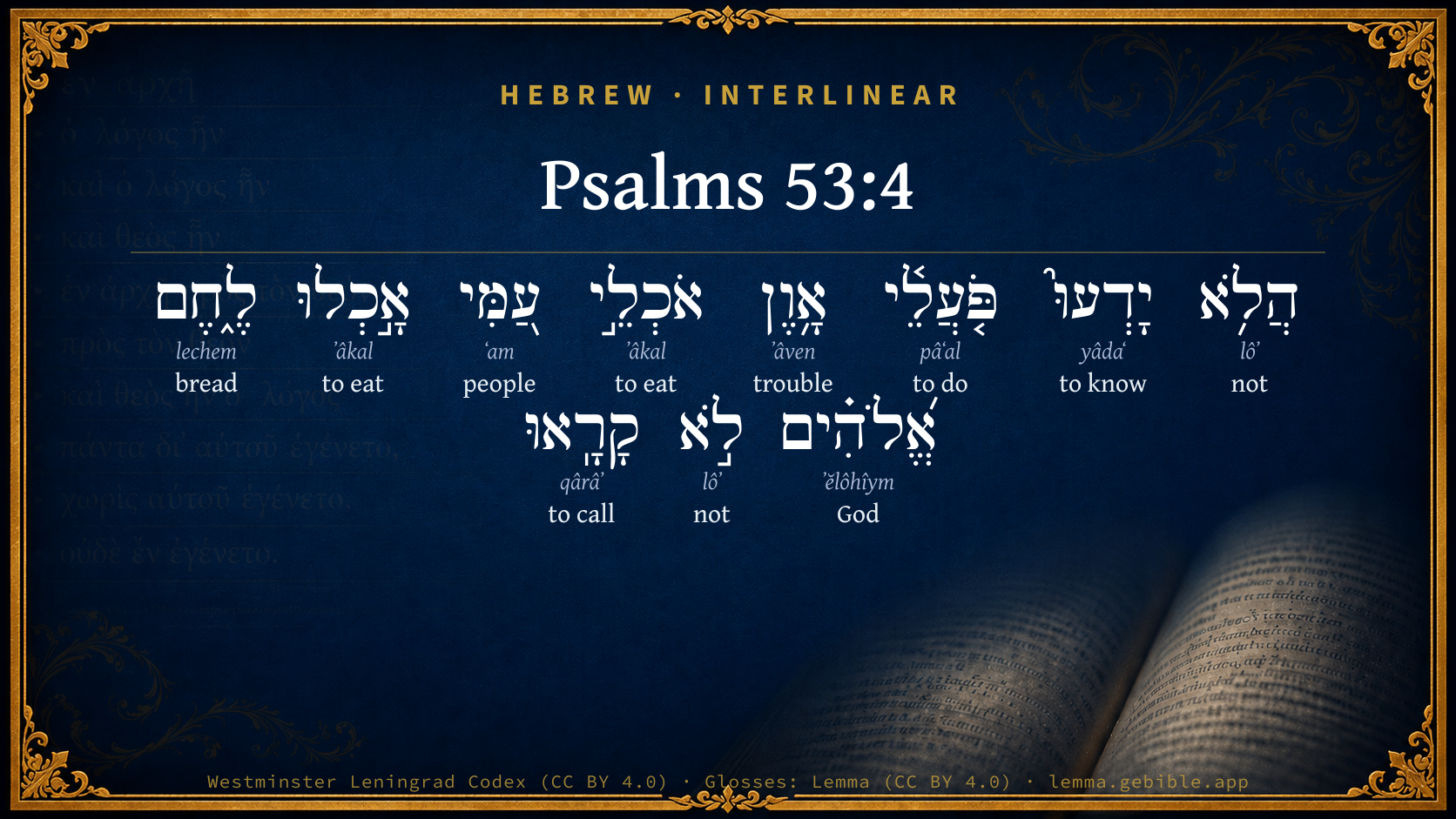
  1. הֲלֹ֥א lôʼ H3808 “not” Particle, Interrogative + Particle, Negative
  2. יָדְעוּ֮ yâdaʻ H3045 “to know” Verb, Qal, Perfect, 3rd Person, Common, Plural
  3. אָ֥וֶן ʼâven H205 “trouble” Noun, Common, Masculine, Singular, Absolute
  4. אֹכְלֵ֣י ʼâkal H398 “eating” Verb, Qal, Participle Active, Masculine, Plural, Construct
  5. עַ֭מִּי ʻam H5971 “people · my” Noun, Common, Masculine, Singular, Construct + Suffix, Personal, 1st Person, Common, Singular
  6. אָ֣כְלוּ ʼâkal H398 “to eat” Verb, Qal, Perfect, 3rd Person, Common, Plural
  7. לֶ֑חֶם lechem H3899 “bread” Noun, Common, Both, Singular, Absolute
  8. אֱ֝לֹהִ֗ים ʼĕlôhîym H430 “God(s)” Noun, Common, Masculine, Plural, Absolute
  9. לֹ֣א lôʼ H3808 “not” Particle, Negative
  10. קָרָֽאוּ qârâʼ H7121 “to call” Verb, Qal, Perfect, 3rd Person, Common, Plural

About this verse

These counts appear in no published source. They are computed here, from the morphology-tagged text and Lemma’s own curated glosses. What Lemma adds →

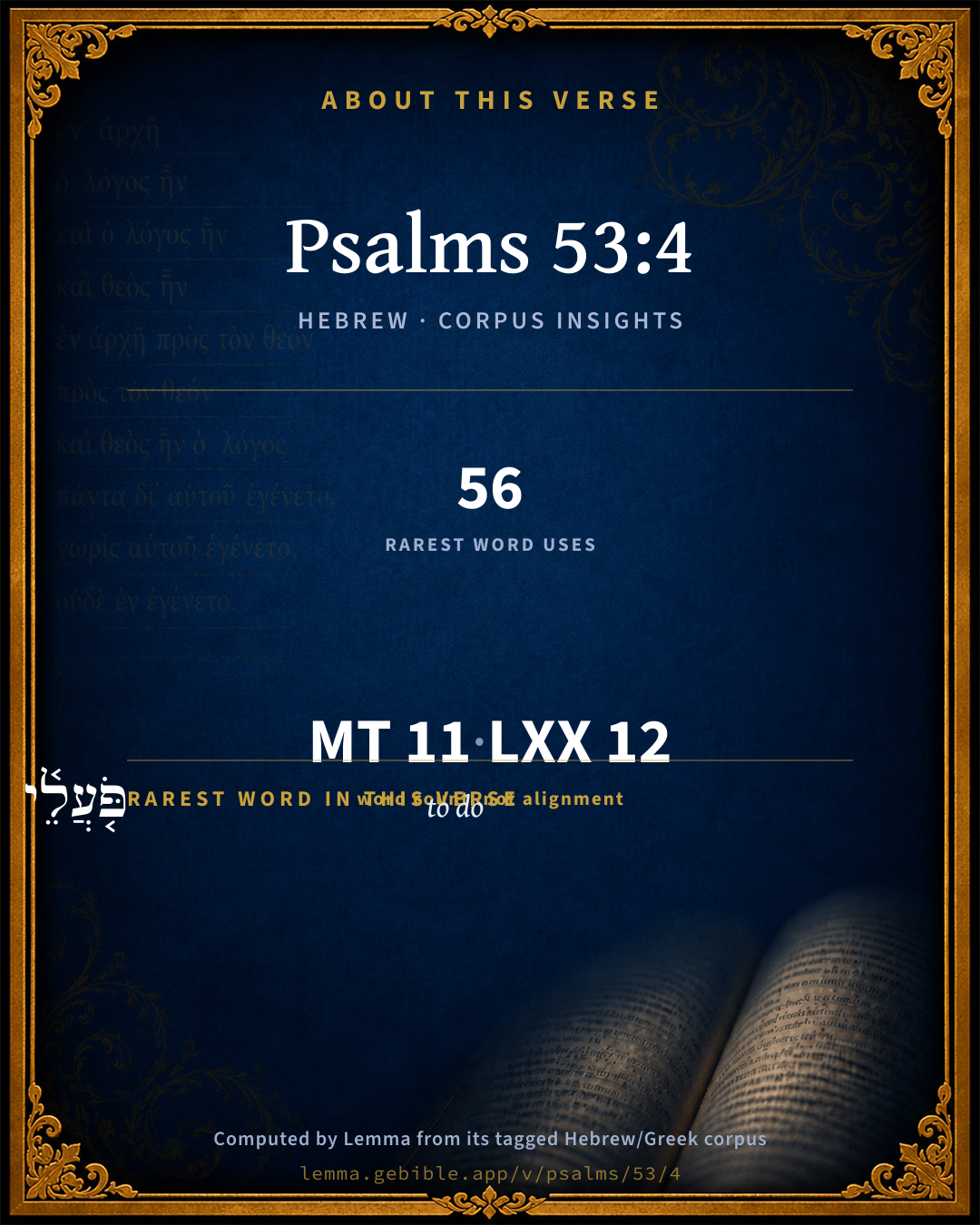
11
words
9
distinct lemmas
Wisdom
section

Shared distinctive vocabulary

פֹּ֤עֲלֵ֫י to do H6466 occurs in 55 verses of the Hebrew Bible. Also found in:

Grammatical profile

  • 5 verbs
  • 4 nouns
  • 2 particles

Verb forms

  • יָדְעוּ֮ Qal · Perfect
  • פֹּ֤עֲלֵ֫י Qal · Participle Active
  • אֹכְלֵ֣י Qal · Participle Active
  • אָ֣כְלוּ Qal · Perfect
  • קָרָֽאוּ Qal · Perfect

Repetition

Words recur within this verse — often emphatic in Hebrew:

  • אֹכְלֵ֣י to eat H398 ×2
  • הֲלֹ֥א not H3808 ×2

Hebrew & Septuagint length

In English translation the verse runs 21 words from the Hebrew and 33 from the Septuagint (LXX English) — closely comparable.

A rough comparison of the two English renderings, which tokenize alike — not a word-level alignment.

Word counts can differ between the Hebrew and the Greek without any difference in meaning — e.g. the Hebrew direct-object marker אֵת has no separate Greek word, and Greek often adds the article ὁ.

In the original languages it is 11 Hebrew tokens and 12 Greek tokens — but the two are counted differently (Hebrew bundles its prefixes and suffixes into one token; the Greek is in lemma form), so that isn’t a like-for-like length.

Cross-references

7

Topical passages linked to Psalms 53:4 in the Treasury of Scripture Knowledge — connected by theme and wording, ordered by reader-vote popularity; previews shown in the World English Bible.

  • Jeremiah 4:22 For my people are foolish, they don't know me; they are foolish children, and they have no understanding; they are wise to do evil, but to do good they have no knowledge.
  • Jeremiah 10:25 Pour out your wrath on the nations that don't know you, and on the families that don't call on your name: for they have devoured Jacob, yes, they have devoured him and consumed him, and have laid waste his habitation.
  • Psalms 27:2 When evil-doers came at me to eat up my flesh, Even my adversaries and my foes, they stumbled and fell.
  • Psalms 94:8 Consider, you senseless among the people; You fools, when will you be wise?
  • Isaiah 27:11 When the boughs of it are withered, they shall be broken off; the women shall come, and set them on fire; for it is a people of no understanding: therefore he who made them will not have compassion on them, and he who formed them will show them no favor.
  • Matthew 23:17–39 You blind fools! For which is greater, the gold, or the temple that sanctifies the gold?
  • Revelation 17:16 The ten horns which you saw, and the beast, these will hate the prostitute, and will make her desolate, and will make her naked, and will eat her flesh, and will burn her utterly with fire.

Cross-references courtesy of OpenBible.info (CC BY 4.0).

Hebrew and Greek witnesses Masoretic Hebrew ↔ Greek Septuagint

The same verse in the two great witnesses to the Old Testament, shown verse-for-verse.

You’re reading Greek Psalm 52 (Hebrew Psalm 53). The Septuagint counts the superscription, so verse numbers can differ from the Hebrew — chapter-level alignment, not verse-by-verse. Numbering follows Rahlfs.

These are two independent witnesses, not word-aligned to each other, and the Septuagint is shown in lemma (dictionary) form.

Hebrew Psalms 53:4 Masoretic · Westminster Leningrad Codex

הֲלֹ֥א יָדְעוּ֮ פֹּ֤עֲלֵ֫י אָ֥וֶן אֹכְלֵ֣י עַ֭מִּי אָ֣כְלוּ לֶ֑חֶם אֱ֝לֹהִ֗ים לֹ֣א קָרָֽאוּ

Have the workers of iniquity no knowledge, Who eat up my people as they eat bread, And don't call on God?

World English Bible · Public Domain

Greek LXX Greek Psalm 52:4 Septuagint · lemma form

πᾶς ἐκκλίνω ἅμα ἀχρειόω οὐ εἰμί ποιέω ἀγαθός οὐ εἰμί ἕως εἷς

Will none of the workers of iniquity know, who devour my people as they would eat bread? they have not called upon God. There were they greatly afraid, where there was no fear:

LXX2012 (modern English Septuagint) · Public Domain

On this verse, Adam Clarke's Commentary discusses the Septuagint’s reading. Read the note in Commentary ↓

Hebrew: Westminster Leningrad Codex (CC BY 4.0). Greek: Septuagint (public domain); English from LXX2012 (modern English Septuagint) (Public Domain). How the Septuagint differs from the Hebrew →

Commentary

Notes on Psalms 53:4 from classic Christian and Jewish commentators (each source and its license shown beneath its notes). The classic Christian expositions comment on the surrounding passage and are grouped to its opening verse, so a note may address several verses; the Jewish commentaries on the Tanakh (Rashi and others) are per-verse, so they appear only where the commentator wrote on this verse.

Lemma curates 59 commentaries, every one of them public domain or Creative Commons licensed, each selected and text-cleaned for this edition rather than reprinted as found. About our sources →

Trapp's Complete Commentary

John Trapp

Psa 53:4 Have the workers of iniquity no knowledge? who eat up my people [as] they eat bread: they have not called upon God.

Ver. 4. Have the workers of iniquity no knowledge?] Etiam scient in fine, et dolebunt, saith one, Know they shall, to their sorrow, in the end, that they have eaten that on earth which they must digest in hell.

John Trapp, A Commentary or Exposition upon All the Books of the Old and New Testament (1647–1656) — public domain. Text from a community e-Sword module.

J. A. Alexander on Psalms

Joseph Addison Alexander

5. (Psa 53:4). Do they not know—(these) workers of iniquity—eating my people (as) they eat bread—(and on) God call not? See above, on Psa 14:4. The only variation here, besides the change of the divine name which has been already mentioned, is the omission of the all before workers of iniquity. This has been noted by some critics as the only case in which the language of the fourteenth psalm is stronger than the parallel expression of the fifty-third.

Joseph Addison Alexander, The Psalms Translated and Explained (1850) — public domain. Text from a community e-Sword module.

Geneva Bible (1599)

Geneva Bible translators

David pronounceth God’s vengeance against cruel governors, who having charge to defend and preserve God’s people, do most cruelly devour them.

Geneva Bible (1599) marginal notes — public domain. Text via Bolls.life.

Adam Clarke's Commentary

Verse 4. Have the workers of iniquity] For פעלי, poaley, workers seventy-two of Kennicott's and De Rossi's MSS., with several ancient editions, the Chaldee, though not noticed in the Latin translation in the London Polyglot, the Syriac, Vulgate, Septuagint, AEthiopic, and the Arabic, with the Anglo-Saxon, add the word כל col, all, - ALL the workers of iniquity; which is the reading in the parallel place in Ps 14:3-4. It may be necessary to observe, that the Chaldee, in the Antwerp and Paris Polyglots, and in that of Justinianus, has not the word כל col, ALL.

Have not called upon God] אלהים Elohim; but many MSS. have יהוה Jehovah, LORD.

Adam Clarke's Commentary on the Bible (1810–1826) — public domain. Text from a community e-Sword/MySword module.

Ellicott's Commentary for English Readers

(4) Notice the omission of the expressive “all” found in Psalms 14

A Bible Commentary for English Readers, edited by Charles John Ellicott (1878–1897) — public domain. Text from a community e-Sword module.

The Cambridge Bible for Schools and Colleges

gen. ed. J. J. S. Perowne

4. God is the speaker. The first clause may be taken as in A.V., ‘Have the workers of iniquity no knowledge?’ Are they so ignorant that they cannot distinguish between right and wrong? Cp. Psa_53:2, and Psa_82:5. But a much better connexion with Psa_53:5 is gained by rendering, Have not the workers of iniquity been made to know? i.e. taught by sharp experience to recognise their error. Then Psa_53:5 follows as an answer to the question, pointing to the plain white with the bones of Jerusalem’s besiegers. For this pregnant sense of know cp. Hos_9:7; Jdg_8:16 (taught, lit. made to know).

who eat up &c.] The A.V. follows the Ancient Versions in understanding this to mean, ‘they devour my people as naturally as they take their daily food.’ And this they do without regard to God (in Psalms 14, Jehovah). Cp. for the phrase, Num_14:9, “the people of the land are bread for us”; Num_24:8; and for the fact, Isa_1:7; Jer_10:25; Jer_30:16; Hab_3:14; Psa_79:7. The reference to national deliverance in the following verse excludes (at any rate in this recension of the Ps.) the explanation of ‘my people’ as the godly few in Israel (Mic_2:9; Mic_3:3; Mic_3:5, and often in the prophets), and of ‘the workers of iniquity’ as the nobles who impoverished them by unjust extortions (Mic_3:1 ff; Isa_3:14 f; Pro_30:14).

4, 5. The corruption of mankind exemplified in their treatment of God’s people; and His Providence demonstrated in the deliverance of them.

The Cambridge Bible for Schools and Colleges (gen. ed. J. J. S. Perowne; Cambridge University Press, 1878–1918) — public domain. Text from a community e-Sword module.

John Gill's Exposition

Have the workers of iniquity no knowledge?.... In Psa 14:4, it is, "have all the workers", &c. There are none of them but what have, unless given up to judicial blindness, and hardness of heart, to believe a lie, as antichrist and his followers, Th2 2:10; See Gill on Psa 14:4;

who eat up my people, as they eat bread; and drink their blood, and are drunken with it, Rev 17:6;

they have not called upon God; but upon their idols, upon the Virgin Mary, and saints departed. In Psa 14:4, it is, "upon the Lord".

John Gill's Exposition of the Whole Bible (1746–1763) — public domain (CC PDM 1.0). Text via the HelloAO Bible API.

Albert Barnes' Notes on the Bible

Have the workers of iniquity no knowledge? - See the notes at Psa 14:4. The only change in this verse is in the omission of the word “all.” This word, as it occurs in Psa 14:1-7 (“all the workers of iniquity”), makes the sentence stronger and more emphatic. It is designed to affirm in the most absolute and unqualified manner that none of these workers of iniquity had any true knowledge of God. This has been noticed by critics as the only instance in which the expression in Psa 14:1-7 is stronger than in the revised form of the psalm before us.

Albert Barnes' Notes on the Bible (1834–1885) — public domain. Text from a community e-Sword/MySword module.

The Treasury of David

Charles H. Spurgeon

Ver. 4. Have the workers of iniquity no knowledge? They have no wisdom, certainly, but even so common a thing as knowledge might have restrained them. Can they not see that there is a God? that sin is an evil thing? that persecution recoils upon a man's own head? Are they such utter fools as not to know that they are their own enemies, and are ruining themselves?

Who eat up my people as they eat bread. Do they not see that such food will be hard to digest, and will bring on them a horrible vomit when God deals with them in justice? Can they imagine that the Lord will allow them to devour his people with impunity? They must be insane indeed.

They have not called upon God. They carry on their cruel enterprises against the saints, and use every means but that which is essential to success in every case, namely, the invocation of God. In this respect persecutors are rather more consistent than Pharisees who devoured widow's houses, and prayed too. The natural man, like Ishmael, loves not the spiritual seed, is very jealous of it, and would fain destroy it, because it is beloved of God; yet the natural man does not seek after the like favour from God. The carnal mind envies those who obtain mercy, and yet it will not seek mercy itself. It plays the dog in the manger. Sinners will out of a malicious jealousy devour those who pray, but yet they will not pray themselves.

Ver. 4. Have the workers of iniquity no knowledge? Conscience is a means to curb and restrain, control and rebuke corrupt nature, and the swelling forms of it. It is not there as a native inhabitant, but as a garrison planted in a rebellious town by the great Governor of the world, to keep the rebellion of the inhabitants within compass, who else would break forth into present confusion. David, speaking of the corruption of man by nature, after this question, Whether there be not some knowledge to discover their evil doings to them? yes, says he, Have they no knowledge, who eat up my people as bread Yes; and therefore (Ps 53:5) They are often in fear, God having placed this there to overcome them with fear; and by that to restrain them from many outrages against God's people, whom in their desires, and sometimes practice, they eat up as bread Therefore this knowledge is put in as a bridle to corrupt nature, as a hook was put into Sennacherib's nostrils (Isa 37:29) to rule and tame men, and overcome them with fear. If they had no knowledge they would eat up one another, and the church, as bread; but there is their fear, says he, that is, thence it comes to pass they are kept in awe Thomas Goodwin, 1600-1679.

Ver. 4. Who eat up my people as they eat bread C'est, n'en font non plus de conscience, que de manger un morceau de pain. (That is, they have no more scruple in doing this than in eating a morsel of bread.) French Margin.

Ver. 4. My people. David may call the serious his people, because of his regard for them, and because they were his supporters and friends. They adhered to him in all his afflictions. ("Thy people shall be my people, and thy God my God, " Ru 1:16.) Benjamin Boothroyd, 1836.

Ver. 4. How far knowledge is and is not a restraint upon ungodliness.

Ver. 4. It is a sin not to call upon God.

I. What is it to call upon God? Three things required

in it.

1. A drawing near to him.

2. A speaking to him. 1Sa 1:12-13.

3. A praying to him. II. How should we call upon God?

1. Reverently, considering (1) God's holiness and greatness; (2) our own sin and weakness. Ge 18:27.

2. Understandingly. 1Co 14:15. (1) Of what we ask. (2) Of whom we ask it.

3. Submissively.

4. Believingly. Mr 11:24 Jas 1:6.

5. Sincerely. Jas 4:3.

6. Constantly. (1) So as to be always in a praying frame. (2) So as to take all occasions of pouring forth our souls in prayer to God. (3) So as to let no day slip without prayer. III. How it appears to be a sin not to call upon God.

1. He hath commanded it. Isa 55:6 1Ti 2:8.

2. Because praying is one of the principal parts of worship we owe to God. I. Who are guilty of this sin?

1. All who pray to any one else but God.

2. All who neglect either public, private, or family prayer.

3. All who pray, but not aright. William Beveridge (1636-1708), in "Thesaurus Theologicus."

Psalms 53:5*

Charles H. Spurgeon's The Treasury of David (1869–1885) — public domain. Psalms only. Text from a community e-Sword/MySword module.

The Pulpit Commentary

For "the workers of iniquity" in this verse, Psa 14: "For God is in the generation of the righteous a very considerable change, which must certainly have been intentional. On the second occasion whereto the psalm was made applicable, there must have been a very great catastrophe some vast slaughter of an enemy who had been at open war with Israel. Sennacherib is suggested (Canon Cook). Thou hast put them to shams, because God hath despised them. The clause in Psalm 14 which this replaces runs as follows: "Ye have shamed the counsel of the poor, because the Lord is his Refuge." Here again, both the phrases used, and the whole tenor of the thought in either case, are different.

The Pulpit Commentary (1880–1919), ed. H.D.M. Spence-Jones & Joseph S. Exell — public domain. Text from a community e-Sword module.

Keil & Delitzsch

C. F. Keil & F. Delitzsch

Here in the first line the word כּל־, which, as in Psa 5:6; Psa 6:9, is in its right place, is wanting. In Psa 14:1-7 there then follow, instead of two tristichs, two distichs, which are perhaps each mutilated by the loss of a line. The writer who has retouched the Psalm has restored the tristichic symmetry that had been lost sight of, but he has adopted rather violent means: inasmuch as he has fused down the two distichs into a single tristich, which is as closely as possible adapted to the sound of their letters.

Keil & Delitzsch — Biblical Commentary on the Old Testament (1861–1891) — public domain (CC PDM 1.0). Text via the HelloAO Bible API. (Old Testament only.)

unfoldingWord translationNotes

Door43 World Missions Community

Do those who commit iniquity have no understanding—those ... God?

This question is used to show the shock that the writer feels because the people are so sinful. It can be written as two statements. "Those who commit iniquity act as though they do not know anything. They devour my people as if they were eating bread, and they do not call on God!" (See: Rhetorical Question)

those who devour my people as if they were eating bread

Destroying people is spoken of as devouring them. Doing it as if they were eating bread implies that they did it very easily or without feeling guilty about it. AT: "those who destroy my people as freely as if they were eating bread" (See: Metaphor and Simile)

God will scatter the bones of whoever will camp against you

Scattering people's bones represents killing them and allowing their bones to remain wherever they have died and not be buried properly. "God will completely destroy whoever will camp against you, and their bones will lie scattered on the ground" (See: Metonymy)

whoever will camp against you

Camping against people represents attacking them. Enemy armies would travel and set up camps to live in temporarily near the people they wanted to attack. AT: "whoever will attack you" (See: Metonymy)

translationWords

iniquity

bread

call

fear

shame

reject

unfoldingWord translationNotes — © Distant Shores Media and the Door43 World Missions Community, licensed CC BY-SA 4.0. Source: git.door43.org/Door43/en_tn.

Rashi

Rabbi Shlomo Yitzchaki (Rashi)

dross Heb. סג, an expression of סיגים, dross.

not even one of all his armies will protest against his deeds.

Rashi on the Tanakh — English translations: “The Judaica Press complete Tanach with Rashi, translated by A. J. Rosenberg” (CC BY 4.0); “Pentateuch with Rashi's commentary by M. Rosenbaum and A.M. Silbermann, 1929-1934” (public domain); “The Metsudah Tanach series, Lakewood, N.J” (CC BY 4.0); and “The Book of Joshua, Metsudah Publications, 1997” (CC BY 4.0). Text via Sefaria.

Lesson kit

Teaching starters — assembled from the data on this page, not authored interpretation. Every prompt links to the verse data it draws on. Edit before teaching.

Psalms, in the Wisdom, opens this verse with 11 words (9 distinct Hebrew lemmas). Its most distinctive word is pâʻal (“to do”). A historical commentator’s framing appears above. Read the whole chapter for the surrounding context.

Discussion questions

  1. The word pâʻal carries the sense “to do.” How does it shape the verse?
  2. Exodus 15:17 shares the word «to do» with this verse. How do the two illuminate each other?
  3. “to eat” occurs 2× in this one verse. What is the effect of the repetition?
  4. These translations render this verse differently; the difference is in the English rendering, not the original. What questions does that raise?
  5. The verb «יָדְעוּ֮» is Qal Perfect. How does its form color the action?
  6. Reading how Trapp's Complete Commentary and J. A. Alexander on Psalms read this verse, where do the two commentators agree and where do they part?

Things to notice

Reading settings

Reading text

Shown beneath each verse's original-language words.

Old Testament
Old Testament edition

Read the OT as the Masoretic Hebrew (MT) or the Greek Septuagint (LXX).

English shown for the Greek Septuagint (in the Hebrew ↔ Greek comparison).

Comparing translations? Open the Compare panel on any verse page to stack up to four side by side.