
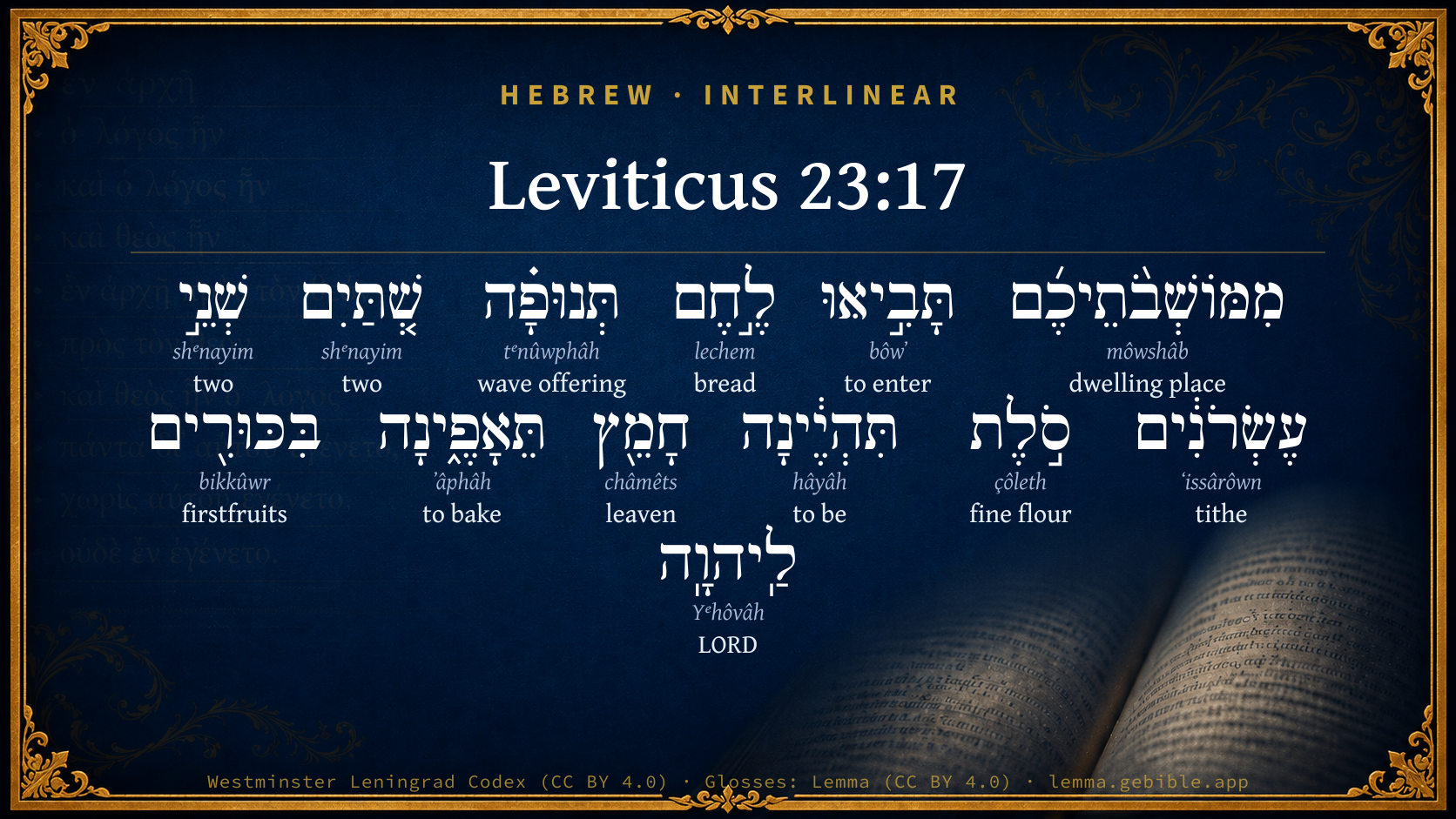
Leviticus 23:17

Hebrew (Westminster Leningrad Codex) Leviticus 23:17 appears in the Hebrew Old Testament. The text above is from the Westminster Leningrad Codex. Each word links to its Strong’s number, a concise gloss, and parsing drawn from the Open Scriptures Hebrew Bible morphology. Click any word for its full Brown-Driver-Briggs (BDB) entry.
Download image
Cite this verse

Leviticus 23:17 (World English Bible). Public Domain. Lemma interlinear Bible study tool, https://lemma.gebible.app/v/leviticus/23/17.

Show BibTeX & RIS
BibTeX
RIS
English Translation
You shall bring out of your habitations two wave-loaves of two tenth parts of an ephah: they shall be of fine flour, they shall be baked with yeast, for first fruits to Yahweh.
World English Bible · Public Domain
Download a study sheet

One document with this verse’s original text, its word-by-word gloss line, the meaning frame, cross-references with their text, attributed commentary, and full source and license credits — printable, and it pastes into notes with its structure intact.

This verse Autodidact and up

Study sheet (.html) Plain text (.txt)

A passage Seminary Student

Up to 50 verses in one chapter. A passage sheet keeps up to 6 commentary sources and 12 cross-references per verse, in the order this page ranks them, and says so on the sheet whenever that leaves anything out. Ask for a single verse and you get the Autodidact verse sheet above.

Everything on this page stays free to read, with no account — the sheet is a download of what is already on screen, not access to it.

Want to remove ads? Support Godless Engineer
Compare translations 3

The same verse in 3 English versions, stacked beneath the original-language interlinear above. Click any original word for its lexicon entry.

Each is an independent rendering of the whole verse — the interlinear is not word-aligned to these translations.

Highlighted words mark where these versions differ — a whole-verse word diff, not a word-by-word alignment.

  • World English Bible Public Domain
    You shall bring out of your habitations two wave-loaves of two tenth parts of an ephah: they shall be of fine flour, they shall be baked with yeast, for first fruits to Yahweh.
  • King James Version Public Domain
    Ye shall bring out of your habitations two wave loaves of two tenth deals; they shall be of fine flour; they shall be baked with leaven; they are the firstfruits unto the LORD.
  • unfoldingWord Literal Text CC BY-SA 4.0
    From your dwellings you shall bring bread of raising, two of two-tenths. They shall be flour. They shall be baked leaven, first fruits to Yahweh.

unfoldingWord Literal Text — © unfoldingWord, licensed CC BY-SA 4.0. Word-aligned USFM3 via Door43 (git.door43.org/unfoldingWord/en_ult).

Versions to compare (up to 4)

3 of 4 selected

Show all 18 translations

Every available English version of this verse, each an independent rendering of the whole verse.

  • World English Bible Public Domain
    You shall bring out of your habitations two wave-loaves of two tenth parts of an ephah: they shall be of fine flour, they shall be baked with yeast, for first fruits to Yahweh.
  • Berean Standard Bible Public Domain
    Bring two loaves of bread from your dwellings as a wave offering, each made from two-tenths of an ephah of fine flour, baked with leaven, as the firstfruits to the LORD.
  • Majority Standard Bible Public Domain
    Bring two loaves of bread from your dwellings as a wave offering, each made from two-tenths of an ephah of fine flour, baked with leaven, as the firstfruits to the LORD.
  • King James Version Public Domain
    Ye shall bring out of your habitations two wave loaves of two tenth deals; they shall be of fine flour; they shall be baked with leaven; they are the firstfruits unto the LORD.
  • American Standard Version (1901) Public Domain
    Ye shall bring out of your habitations two wave-loaves of two tenth parts `of an ephah': they shall be of fine flour, they shall be baken with leaven, for first-fruits unto Jehovah.
  • Revised Version (1885) Public Domain
    Ye shall bring out of your habitations two wave loaves of two tenth parts of an ephah: they shall be of fine flour, they shall be baken with leaven, for firstfruits unto the LORD.
  • Geneva Bible (1599) Public Domain
    Ye shall bring out of your habitations bread for the shake offring: they shalbe two loaues of two tenth deales of fine floure, which shalbe baken with leauen for first fruites vnto the Lord.
  • Douay-Rheims (1899) Public Domain
    Out of all your dwellings, two leaves of the firstfruits, of two tenths of flour leavened, which you shall bake for the firstfruits of the Lord.
  • Young's Literal Translation Public Domain
    out of your dwellings ye bring in bread of a wave-offering, two `loaves', of two tenth deals of flour they are, `with' yeast they are baken, first-`fruits' to Jehovah.
  • Literal Standard Version CC BY-SA 4.0
    you bring in two [loaves] of bread out of your dwellings [for] a wave-offering; they are of two-tenth parts of flour; they are baked [with] yeast—first-[fruits] to YHWH.
  • Unlocked Literal Bible CC BY-SA 4.0
    You must bring out of your houses two loaves made from two-tenths of an ephah. They must be made from fine flour and baked with yeast; they will be a wave offering of the firstfruits to Yahweh.
  • unfoldingWord Literal Text CC BY-SA 4.0
    From your dwellings you shall bring bread of raising, two of two-tenths. They shall be flour. They shall be baked leaven, first fruits to Yahweh.
  • Darby Bible Public Domain
    Out of your dwellings shall ye bring two wave-loaves, of two tenths of fine flour; with leaven shall they be baken; [as] first-fruits to Jehovah.
  • World Messianic Bible Public Domain
    You shall bring out of your habitations two loaves of bread for a wave offering made of two tenths of an efah of fine flour. They shall be baked with yeast, for first fruits to the LORD.
  • Webster's Bible Public Domain
    Ye shall bring out of your habitations two wave-loaves of two tenth-parts: they shall be of fine flour, they shall be baked with leaven, they are the first-fruits to the LORD.
  • Free Bible Version CC BY-SA 4.0
    Bring two loaves of bread from your homes as a wave offering. Make them from two-tenths of an ephah of the best flour, baked with yeast, as the firstfruits to the Lord.
  • Bible in Basic English Public Domain
    Take from your houses two cakes of bread, made of a fifth part of an ephah of the best meal, cooked with leaven, to be waved for first-fruits to the Lord.
  • JPS Tanakh (1917) Public Domain
    Ye shall bring out of your dwellings two wave-loaves of two tenth parts of an ephah; they shall be of fine flour, they shall be baked with leaven, for first-fruits unto the LORD.

Literal Standard Version (2020), Covenant Press — licensed CC BY-SA 4.0. Text via the HelloAO Bible API (eBible.org). Unlocked Literal Bible (unfoldingWord) — licensed CC BY-SA 4.0. Text via the HelloAO Bible API (eBible.org). unfoldingWord Literal Text — © unfoldingWord, licensed CC BY-SA 4.0. Word-aligned USFM3 via Door43 (git.door43.org/unfoldingWord/en_ult). Free Bible Version, Dr. Jonathan Gallagher — licensed CC BY-SA 4.0. Text via the HelloAO Bible API (eBible.org).

Word by word

More ways to search: Search by grammar → Find every occurrence → Compare this word →

Practice this passage: Drill this verse → Learn its vocabulary →

חָמֵ֖ץ
châmêts
H2557
“leaven”
Noun, Common, Masculine, Singular, Absolute
Part of Speech
Noun
Type
Common
Gender
Masculine
Number
Singular
State
Absolute
Full BDB Definition

Origin: from H2556

TWOT: TWOT- 679a

the thing leavened, leaven
  1. מִמּוֹשְׁבֹ֨תֵיכֶ֜ם môwshâb H4186 “from · dwelling places · your” Preposition + Noun, Common, Masculine, Plural, Construct + Suffix, Personal, 2nd Person, Masculine, Plural
  2. תָּבִ֣יאּוּ bôwʼ H935 “to enter” Verb, Hiphil, Imperfect, 2nd Person, Masculine, Plural
  3. לֶ֣חֶם lechem H3899 “bread of” Noun, Common, Both, Singular, Construct
  4. תְּנוּפָ֗ה tᵉnûwphâh H8573 “wave offering” Noun, Common, Feminine, Singular, Absolute
  5. שְׁ֚תַּיִם shᵉnayim H8147 “two” Adjective, Cardinal number, Feminine, Dual, Absolute
  6. שְׁנֵ֣י shᵉnayim H8147 “two” Adjective, Cardinal number, Masculine, Dual, Construct
  7. עֶשְׂרֹנִ֔ים ʻissârôwn H6241 “tithes” Noun, Common, Masculine, Plural, Absolute
  8. סֹ֣לֶת çôleth H5560 “fine flour” Noun, Common, Feminine, Singular, Absolute
  9. תִּהְיֶ֔ינָה hâyâh H1961 “to be” Verb, Qal, Imperfect, 3rd Person, Feminine, Plural
  10. תֵּאָפֶ֑ינָה ʼâphâh H644 “to bake” Verb, Niphal, Imperfect, 3rd Person, Feminine, Plural
  11. בִּכּוּרִ֖ים bikkûwr H1061 “firstfruits” Noun, Common, Both, Plural, Absolute
  12. לַֽיהוָֽה Yᵉhôvâh H3068 “to/for · LORD” Preposition + Noun, Proper

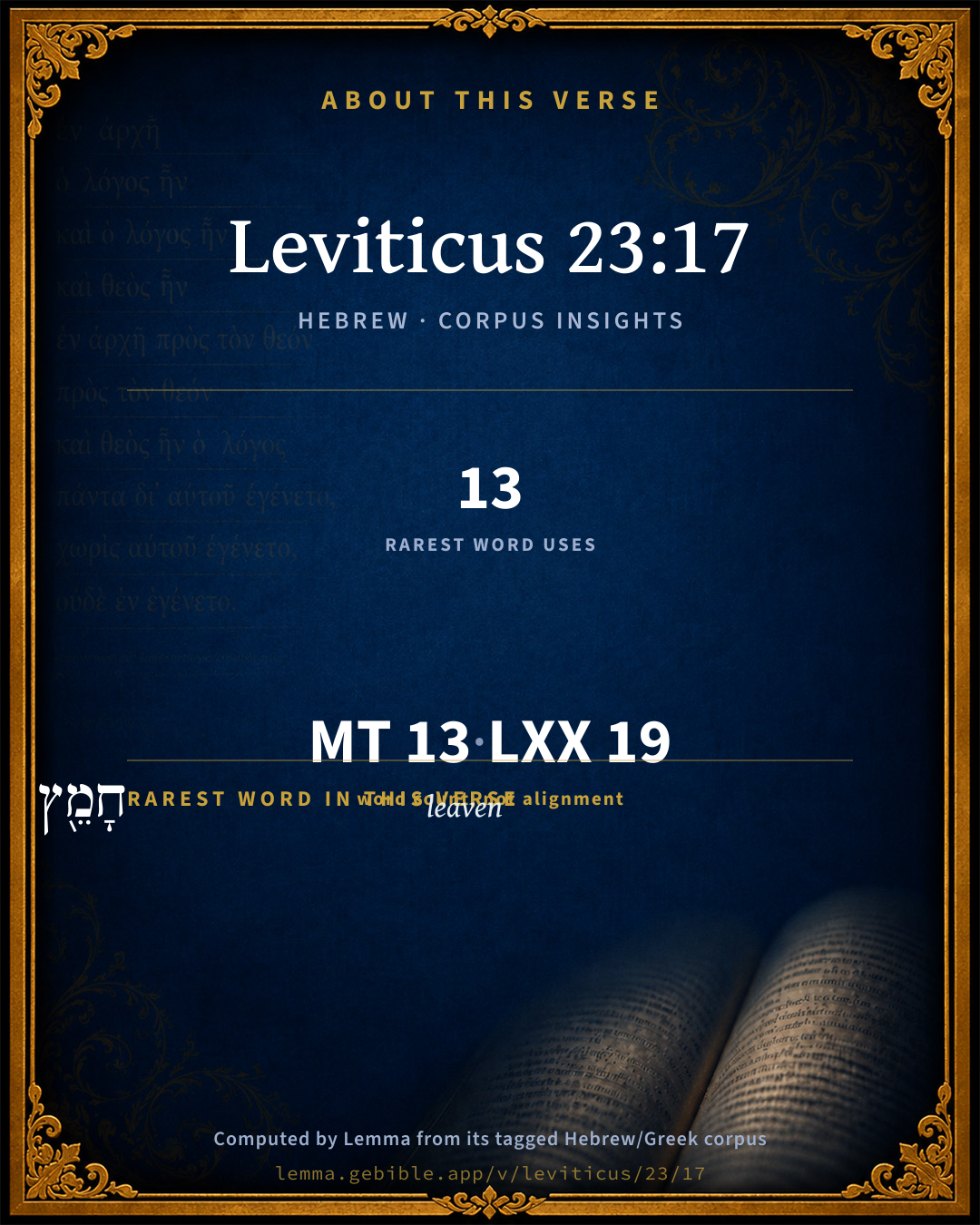
About this verse

These counts appear in no published source. They are computed here, from the morphology-tagged text and Lemma’s own curated glosses. What Lemma adds →

13
words
12
distinct lemmas
Pentateuch
section

Notable vocabulary

The rarest word here is חָמֵ֖ץ leaven H2557 — appearing just 13 times in the whole Hebrew Bible.

Shared distinctive vocabulary

חָמֵ֖ץ leaven H2557 occurs in 13 verses of the Hebrew Bible. Also found in:

Grammatical profile

  • 3 verbs
  • 8 nouns
  • 2 adjectives

Verb forms

  • תָּבִ֣יאּוּ Hiphil · Imperfect
  • תִּהְיֶ֔ינָה Qal · Imperfect
  • תֵּאָפֶ֑ינָה Niphal · Imperfect

Repetition

A word recurs within this verse — often emphatic in Hebrew:

  • שְׁ֚תַּיִם two H8147 ×2

Hebrew & Septuagint length

In English translation the verse runs 33 words from the Hebrew and 35 from the Septuagint (LXX English) — closely comparable.

A rough comparison of the two English renderings, which tokenize alike — not a word-level alignment.

Word counts can differ between the Hebrew and the Greek without any difference in meaning — e.g. the Hebrew direct-object marker אֵת has no separate Greek word, and Greek often adds the article ὁ.

In the original languages it is 13 Hebrew tokens and 19 Greek tokens — but the two are counted differently (Hebrew bundles its prefixes and suffixes into one token; the Greek is in lemma form), so that isn’t a like-for-like length.

Cross-references

18

Topical passages linked to Leviticus 23:17 in the Treasury of Scripture Knowledge — connected by theme and wording, ordered by reader-vote popularity; previews shown in the World English Bible.

  • Leviticus 23:10 "Speak to the children of Israel, and tell them, 'When you have come into the land which I give to you, and shall reap its the harvest, then you shall bring the sheaf of the first fruits of your harvest to the priest:
  • Exodus 23:19 The first of the first fruits of your ground you shall bring into the house of Yahweh your God. "You shall not boil a kid in its mother's milk.
  • Exodus 34:22 You shall observe the feast of weeks with the first fruits of wheat harvest, and the feast of harvest at the year's end.
  • Exodus 34:26 You shall bring the first of the first fruits of your ground to the house of Yahweh your God. You shall not boil a young goat in its mother's milk."
  • Leviticus 7:13 With cakes of leavened bread he shall offer his offering with the sacrifice of his peace offerings for thanksgiving.
  • Numbers 28:26 Also in the day of the first fruits, when you offer a new meal-offering to Yahweh in your [feast of] weeks, you shall have a holy convocation; you shall do no servile work;
  • Exodus 22:29 "You shall not delay to offer from your harvest and from the outflow of your presses. "You shall give the firstborn of your sons to me.
  • Exodus 23:16 And the feast of harvest, the first fruits of your labors, which you sow in the field: and the feast of harvest, at the end of the year, when you gather in your labors out of the field.
  • Leviticus 2:12 As an offering of firstfruits you shall offer them to Yahweh: but they shall not come up for a sweet savor on the altar.
  • Numbers 15:17 Yahweh spoke to Moses, saying,
  • Numbers 15:19–21 then it shall be that when you eat of the bread of the land, you shall offer up a heave-offering to Yahweh.
  • Deuteronomy 26:1–2 It shall be, when you are come in to the land which Yahweh your God gives you for an inheritance, and possess it, and dwell therein,
  • Proverbs 3:9–10 Honor Yahweh with your substance, With the first fruits of all your increase:
  • Matthew 13:33 He spoke another parable to them. "The Kingdom of Heaven is like yeast, which a woman took, and hid in three measures of meal, until it was all leavened."
  • Romans 8:23 Not only so, but ourselves also, who have the first fruits of the Spirit, even we ourselves groan within ourselves, waiting for adoption, the redemption of our body.
  • 1 Corinthians 15:20 But now Christ has been raised from the dead. He became the first fruits of those who are asleep.
  • James 1:18 Of his own will he brought us forth by the word of truth, that we should be a kind of first fruits of his creatures.
  • Revelation 14:4 These are those who were not defiled with women, for they are virgins. These are those who follow the Lamb wherever he goes. These were redeemed by Jesus from among men, the first fruits to God and to the Lamb.

Cross-references courtesy of OpenBible.info (CC BY 4.0).

Hebrew and Greek witnesses Masoretic Hebrew ↔ Greek Septuagint

The same verse in the two great witnesses to the Old Testament, shown verse-for-verse.

These are two independent witnesses, not word-aligned to each other, and the Septuagint is shown in lemma (dictionary) form.

Hebrew Leviticus 23:17 Masoretic · Westminster Leningrad Codex

מִמּוֹשְׁבֹ֨תֵיכֶ֜ם תָּבִ֣יאּוּ לֶ֣חֶם תְּנוּפָ֗ה שְׁ֚תַּיִם שְׁנֵ֣י עֶשְׂרֹנִ֔ים סֹ֣לֶת תִּהְיֶ֔ינָה חָמֵ֖ץ תֵּאָפֶ֑ינָה בִּכּוּרִ֖ים לַֽיהוָֽה

You shall bring out of your habitations two wave-loaves of two tenth parts of an ephah: they shall be of fine flour, they shall be baked with yeast, for first fruits to Yahweh.

World English Bible · Public Domain

Greek LXX Leviticus 23:17 Septuagint · lemma form

ἀπό ὁ κατοικία σύ προςφέρω ἄρτος ἐπίθεμα δύο ἄρτος ἐκ δύο δέκατος σεμίδαλις εἰμί ζύμομαι πέπτω πρωτογένημα ὁ κύριος

You⌃ shall bring from your dwelling loaves, as a heave-offering, two loaves: they shall be of two tenth portions of fine flour, they shall be baked with leaven of the first fruits to the Lord.

LXX2012 (modern English Septuagint) · Public Domain

Hebrew: Westminster Leningrad Codex (CC BY 4.0). Greek: Septuagint (public domain); English from LXX2012 (modern English Septuagint) (Public Domain). How the Septuagint differs from the Hebrew →

Targum (Aramaic paraphrase)

2

The Targum is the ancient Jewish Aramaic paraphrase of the Hebrew Scriptures — an interpretive translation, not the Hebrew text itself. Onkelos (literal) and Pseudo-Jonathan (expansive) render the Torah, and Jonathan the Prophets. Coverage is partial: where no permissively-licensed English translation exists for a verse, only the Aramaic is shown. This is verse-level text, not a word-by-word alignment to the Hebrew.

  1. Targum Onkelos Torah (Genesis–Deuteronomy)
    מִמוֹתְבָנֵיכוֹן תַּיְתוּן לְחֵם אֲרָמוּתָא תַּרְתֵּין (גְרִיצַן) תְּרֵין עֶשְׂרוֹנִין סֻלְתָּא יְהֶוְיָן חֲמִיעַ יִתְאַפְיָן בִּכּוּרִין קֳדָם יְיָ

    (no public-domain English translation for this verse)

    Targum Onkelos — Aramaic: “Onkelos Genesis” (public domain); “Onkelos Exodus” (public domain); “Onkelos Leviticus” (public domain); “Onkelos Numbers” (public domain); “Onkelos Deuteronomy” (public domain). English: “Sefaria Community Translation” (CC0 1.0 (public-domain dedication)); “J.W. Etheridge. The Targums of Onkelos and Jonathan Ben Uzziel on the Pentateuch. London: Longmans, Green, 1862” (public domain). Text via Sefaria.

  2. Targum Pseudo-Jonathan Torah (Genesis–Deuteronomy)
    מֵאֲתַר מוֹתְבָנֵיכוֹן תַּיְיתוּן לְחֵם אֲרָמוּתָא תַּרְתֵּין גְרִיצִין תְּרֵין עֶשְרוֹנִין סְמִידָא יְהַוְויָין חָמִיעַ יִתְאַפְיָן בִּיכּוּרִין לִשְׁמָא דַיְיָ

    From the place of your dwellings you are to bring the bread for the elevation; two cakes of two-tenths of flour, which must be baked with leaven, as first fruits unto the Name of the Lord.

    Targum Pseudo-Jonathan — Aramaic: “Targum Jonathan on Genesis” (public domain); “Targum Jonathan on Exodus” (public domain); “Targum Jonathan on Leviticus” (public domain); “Targum Jonathan on Numbers” (public domain); “Targum Jonathan on Deuteronomy” (public domain). English: “The Targum of Jonathan ben Uzziel, trans. J. W. Etheridge, London, 1862” (public domain). Text via Sefaria.

Commentary

Notes on Leviticus 23:17 from classic Christian and Jewish commentators (each source and its license shown beneath its notes). The classic Christian expositions comment on the surrounding passage and are grouped to its opening verse, so a note may address several verses; the Jewish commentaries on the Tanakh (Rashi and others) are per-verse, so they appear only where the commentator wrote on this verse.

Lemma curates 59 commentaries, every one of them public domain or Creative Commons licensed, each selected and text-cleaned for this edition rather than reprinted as found. About our sources →

Trapp's Complete Commentary

John Trapp

Lev 23:17 Ye shall bring out of your habitations two wave loaves of two tenth deals: they shall be of fine flour; they shall be baken with leaven; [they are] the firstfruits unto the LORD.

Ver. 17. Out of your habitations.] That is, Out of the new corn (growing of the same land which God gave them to inherit) not foreign.

The firstfruits,] viz., Of their wheat harvest, as the shake sheaf {Lev 23:10} was of their barley harvest. Thus were they to express their thankfulness to God for those precious fruits of the earth. {Jas 5:7}

John Trapp, A Commentary or Exposition upon All the Books of the Old and New Testament (1647–1656) — public domain. Text from a community e-Sword module.

Joseph Benson's Commentary

Lev 23:17. Two wave loaves of two tenth-deals — There was one tenth-deal in each loaf. They were called wave-loaves, because they were presented to God by waving them toward heaven. Baken with leaven — Contrary to the established law in other bread or flower offerings, Lev 2:11-12. The reason may be, that these first-fruits were a symbol of the leavened bread which the Israelites commonly used.

Joseph Benson's Commentary on the Old and New Testaments (1811–1818) — public domain. Text from a community e-Sword module.

Geneva Bible (1599)

Geneva Bible translators

Because the Priest should eat them, as Lev. 7:13, and they should not be offered to the Lord upon the altar.

Geneva Bible (1599) marginal notes — public domain. Text via Bolls.life.

Jamieson, Fausset & Brown

Robert Jamieson, A. R. Fausset & David Brown

Ye shall bring out of your habitations two wave loaves of two tenth deals, &c.--These loaves were made of "fine" or wheaten flour, the quantity contained in them being somewhat more than ten pounds in weight. As the wave-sheaf gave the signal for the commencement, the two loaves solemnized the termination of the harvest season. They were the first-fruits of that season, being offered unto the Lord by the priest in name of the whole nation. (See Exo 34:22). The loaves used at the Passover were unleavened; those presented at Pentecost were leavened--a difference which is thus accounted for, that the one was a memorial of the bread hastily prepared at their departure, while the other was a tribute of gratitude to God for their daily food, which was leavened.

Jamieson, Fausset & Brown — Commentary Critical and Explanatory on the Whole Bible (1871) — public domain (CC PDM 1.0). Text via the HelloAO Bible API.

Ellicott's Commentary for English Readers

(17) Ye shall bring out of your habitations.—During the second Temple this clause was taken to be elliptical, and to denote ye shall bring out of, or from, the land of your habitations, that is, from Palestine (Num_15:2).

Two wave loaves of two tenth deals.—These two loaves were prepared in the following manner. Three seahs of new wheat were brought into the court of the Temple, were beaten and trodden and ground into flour. Two omers of the flour were respectively obtained from a seah and a half, and after having been sieved in the twelve different sieves, were kneaded separately with leaven into two loaves outside the Temple, but were baked inside the sanctuary on the day preceding the festival. Each loaf was seven hand-breadths long, four hand-breadths broad, and five fingers high. These were offered to the Lord as firstlings (Exo_34:17), whence this festival is also called “the day of first-fruits” (Num_28:26).

A Bible Commentary for English Readers, edited by Charles John Ellicott (1878–1897) — public domain. Text from a community e-Sword module.

The Cambridge Bible for Schools and Colleges

gen. ed. J. J. S. Perowne

17. wave loaves] See Appendix IV, pp. 183 ff.

tenth parts] A.V. ‘tenth deals,’ and so in Lev_23:13. With the exception of these vv. the expression is peculiar to P, denoting the measure of fine flour used in a Meal-Offering. For the word ‘deals’ see on Lev_14:10.

The Cambridge Bible for Schools and Colleges (gen. ed. J. J. S. Perowne; Cambridge University Press, 1878–1918) — public domain. Text from a community e-Sword module.

John Gill's Exposition

And ye shall bring out of your habitations two wave loaves of two tenth deals,.... Out of their habitations in the land of Canaan; and not out of those without the land, as Jarchi observes; and not out of all of them, as Ben Gersom remarks; though the Vulgate Latin version has it, out of "all" of our habitations, but wrongly; and indeed out of no one particular habitation, because it was at the public expense; but they were brought from some part of the country or another, even the quantity of two tenth parts of an ephah, or two omers of wheat flour made into two loaves, which were to be, and were waved before the Lord, and hence so called; and are the same with the new meat offering, or rather bread offering, made of the new corn, in the preceding verse, so Jarchi:

they shall be of fine flour; of wheat flour, the finest of it, of which all meat or bread offerings were made; and this was particularly on account of the wheat harvest, and therefore it was proper that the finest of the wheat should be used on this occasion; See Gill on Lev 2:1; each loaf or cake, according to Maimonides (w), was seven hands' breadths long, four hands' breadths broad, and four fingers high:

they shall be baked with leaven; the common meat offering was unleavened, part of which was burnt on the altar, where no leaven might be burnt, Lev 2:4; and from hence it may be concluded that no part of these loaves was to be burnt, but the whole of them fell to the share of the priests:

they are the firstfruits unto the Lord; which he claimed as his, and gave unto his priests; and it was but right and just he should have them, as an acknowledgment of all coming from his hands, and as expressive of gratitude for them, and for the sanctification of the rest; hence this is called the feast of the firstfruits of wheat harvest, Exo 34:22.

(w) Hilchot Tamidin, &c. c. 8. sect. 10.

John Gill's Exposition of the Whole Bible (1746–1763) — public domain (CC PDM 1.0). Text via the HelloAO Bible API.

Haydock's Catholic Bible Commentary

Loaves. The Protestants supply wave loaves, (Haydock) though their Hebrew text has nothing. The Samaritan is more correct. (Houbigant)

George Leo Haydock (1774–1849), Haydock's Catholic Family Bible and Commentary, 1859 edition — public domain. Excludes Psalms (Douay-Rheims chapter numbering differs from Protestant) and Deuterocanonical books (Catholic canon only).

Matthew Poole's English Annotations

Out of your habitations, i.e. out of the corn of your own land, for which and for the fruits of it you are now to offer praises unto God. And this also, as well as the former sacrifice, was brought out of the common charge, and in the name of the whole nation, whence it is said to be brought out of their habitations in the plural number. Some conceive two several loaves were brought from every family, or, as others, from every city or town. But this is easily confuted from Lev 23:18, where we read that with the bread, to wit, the two loaves, were to be offered seven lambs, one bullock, &c., which doubtless was a common oblation, and in the name of all.

Two wave loaves; in double proportion, as before, Lev 23:13.

Baken with leaven; because these were not offered to God, but wholly given to the priest for food. See on Lev 2:11; 7:13.

Matthew Poole's English Annotations on the Holy Bible (1683–1685) — public domain. Text from a community e-Sword/MySword module.

Whedon's Commentary on the Bible

Daniel D. Whedon

17. Ye shall bring out… two wave loaves — The words out of your habitations do not imply that the offering is individual. Two wave loaves were required of the whole nation, and not of each family. The size of these loaves may be inferred from the fact that they consisted of six quarts of flour, and were leavened. Three ordinary loaves were required for a meal for one person. Luk_11:5. For the manner and significance of waving, see note on Lev_7:30.

Fine flour — See note on Lev_2:1.

With leaven — Leaven was prohibited only in fire offerings, (Lev_2:11,) and in the bread to be eaten during the passover week. Exo_12:15. It was required in the peace offering. See note on Lev_7:13. Hence Amos, in his mention of leaven, does not ironically reproach the character of the sacrifices, but the senseless idols to which they were offered. Amo_4:5.

Daniel D. Whedon (gen. ed.), Commentary on the Old and New Testaments (1874–1909) — public domain. Text from a community e-Sword module.

Scofield Reference Notes

C. I. Scofield

wave-loaves

The wave-loaves were offered fifty days after the wave-sheaf. This is precisely the period between the resurrection of Christ and the formation of the church at Pentecost by the baptism of the Holy Spirit Act 2:1-4; 1Co 12:12; 1Co 12:13. See "Church"; Mat 16:18; Heb 12:22; Heb 12:23. With the wave-sheaf no leaven was offered, for there was no evil in Christ; but the wave-loaves, typifying the church, are "baken with leaven," for in the church there is still evil.

The Scofield Reference Bible (1917 edition), notes by C. I. Scofield — public domain. Text from a community e-Sword module.

unfoldingWord translationNotes

Door43 World Missions Community

General Information:

Yahweh continues telling Moses what the people must do.

made from two-tenths of an ephah. They must be made from fine flour and baked with yeast

This can be stated in active form. AT: "that you have made from two-tenths of an ephah of flour and then baked with yeast" (See: Active or Passive)

two-tenths of an ephah

This is approximately 4.5 liters. AT: "four and a half liters" (See: Biblical Volume)

producing a sweet aroma for Yahweh

The Lord's pleasure with the aroma represents his pleasure with the person who burns the offering. AT: "Yahweh will be pleased with you" or "that pleases the Yahweh" (See: Metaphor)

translationWords

yeast

firstfruits

cow

ewe

grain offering

unfoldingWord translationNotes — © Distant Shores Media and the Door43 World Missions Community, licensed CC BY-SA 4.0. Source: git.door43.org/Door43/en_tn.

Rashi

Rabbi Shlomo Yitzchaki (Rashi)

מושבתיכם [YE SHALL BRING] OUT OF YOUR HABITATIONS [TWO WAVE LOAVES] — but not from outside the Land of Canaan (Sifra, Emor, Chapter 13 1; Menachot 83b).

לחם תנופה WAVE LOAVES — i. e. heave loaves that have been heaved in honour of the Lord. It is these which constitute the “new meal-offering” mentioned above (v. 16).

בכורים [THEY ARE] THE FIRSTLINGS — the first of all meal-offerings offered, the first even in relation to the “meal-offering of jealousy” (cf. Numbers 5:15) which was brought of barley; even that must not be offered of the new crop previous to the two loaves, although a barley offering had already been brought, viz., the Omer which was offered on Passover (Menachot 84b).

Rashi on the Tanakh — English translations: “The Judaica Press complete Tanach with Rashi, translated by A. J. Rosenberg” (CC BY 4.0); “Pentateuch with Rashi's commentary by M. Rosenbaum and A.M. Silbermann, 1929-1934” (public domain); “The Metsudah Tanach series, Lakewood, N.J” (CC BY 4.0); and “The Book of Joshua, Metsudah Publications, 1997” (CC BY 4.0). Text via Sefaria.

Ramban (Nachmanides)

Rabbi Moshe ben Nachman (Ramban / Nachmanides)

THEY SHALL BE BAKED WITH LEAVEN. Scripture commanded that these two loaves be leavened, because they are a thanks-offering to G-d for having kept for us the appointed time of the harvest, and a thanks-offering comes with cakes of leavened bread. Perhaps the [usual] prohibition of bringing leavened things as an offering, 2:11. is because leaven alludes to the attribute of justice, for it is called chametz (leaven), just as wine which sours is called ‘chometz yayin v’chometz sheichar’ (vinegar of wine or vinegar of strong drink), the word [chametz] being derived from the expression: the unrighteous ‘v’chomeitz’ (and ruthless man), for [vinegar of wine and vinegar of strong drink] are drinks whose original taste has been “robbed” from them, and they are therefore not suitable for [normal] drinking. Similarly, for my heart yithchameitz’, 73:21. means that it was “in a ferment, and it lost its composure.” Now since the offerings are brought to be acceptable before the Glorious Name, they are therefore not to be brought from objects which possess a strong power to change natural properties of other things [such as leaven], and similarly they are not to be brought from things which are completely sweet ). such as honey. [Instead, they are to come] only from things which are blended of different qualities, just as the Rabbis have said with reference to the creation of the world “He combined the attribute of mercy with the attribute of justice, and created the world.” Now on the Festival of Weeks which is the day of the Giving of the Torah [on Mount Sinai], the offering [i.e., the two leavened loaves and the various burnt-offerings, together with their meal-offering which is of unleavened bread, as stated in Verse 18] comes in accordance with the law of the thanks-offering [which was brought with ten leavened cakes and thirty unleavened cakes], for it is the day of the solemn assembly. The student learned in the mysteries of the Cabala will understand. And this is the secret of which our Rabbis have said: “All offerings are destined to cease [in the World to Come], but the thanks-offering will never cease etc.,” for in it are both unleavened and leavened [cakes], comparable to the World to Come [in which the Divine attributes of justice and mercy will forever be in perfect harmony].

Ramban (Nachmanides) on the Tanakh — English translation: “Commentary on the Torah by Ramban (Nachmanides). Translated and annotated by Charles B. Chavel. New York, Shilo Pub. House, 1971-1976” (CC BY 4.0). Text via Sefaria.

Lesson kit

Teaching starters — assembled from the data on this page, not authored interpretation. Every prompt links to the verse data it draws on. Edit before teaching.

Leviticus, in the Pentateuch, opens this verse with 13 words (12 distinct Hebrew lemmas). Its most distinctive word is châmêts (“leaven”). A historical commentator’s framing appears above. Read the whole chapter for the surrounding context.

Discussion questions

  1. How does “leaven” (châmêts) shape what this verse is saying?
  2. How does Exodus 12:15, which shares the word «leaven», read alongside this verse?
  3. What does the repetition of “two” (2× in this one verse) do in this verse?
  4. These translations render this verse differently; the difference is in the English rendering, not the original. What questions does that raise?
  5. «תָּבִ֣יאּוּ» is a Hiphil Imperfect verb. How does that grammatical form shape the action described?
  6. Compare how Trapp's Complete Commentary and Joseph Benson's Commentary read this verse. Where do they agree or differ?

Things to notice

Reading settings

Reading text

Shown beneath each verse's original-language words.

Old Testament
Old Testament edition

Read the OT as the Masoretic Hebrew (MT) or the Greek Septuagint (LXX).

English shown for the Greek Septuagint (in the Hebrew ↔ Greek comparison).

Comparing translations? Open the Compare panel on any verse page to stack up to four side by side.