
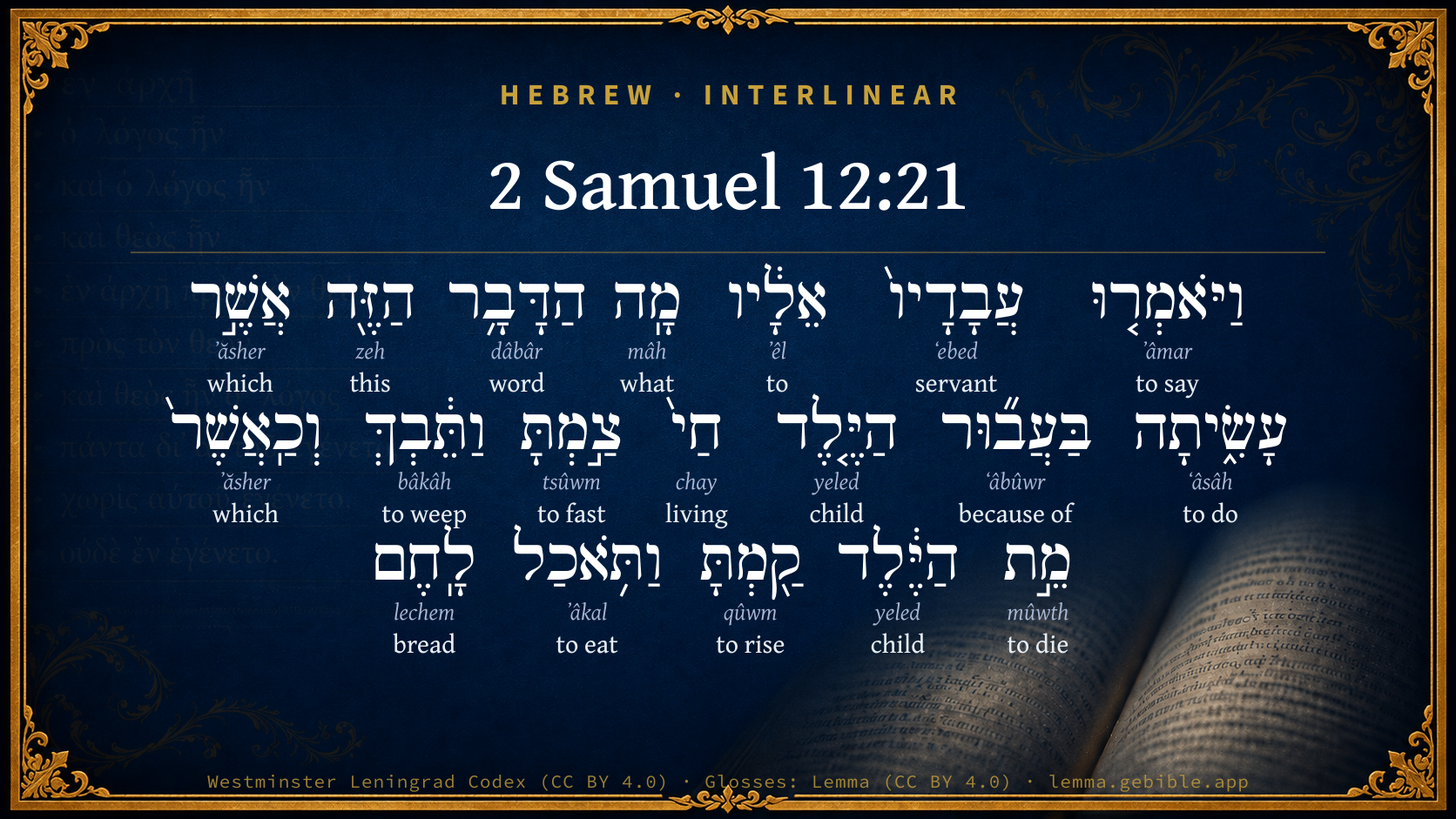
2 Samuel 12:21

Hebrew (Westminster Leningrad Codex) 2 Samuel 12:21 appears in the Hebrew Old Testament. The text above is from the Westminster Leningrad Codex. Each word links to its Strong’s number, a concise gloss, and parsing drawn from the Open Scriptures Hebrew Bible morphology. Click any word for its full Brown-Driver-Briggs (BDB) entry.
Download image
Cite this verse

2 Samuel 12:21 (World English Bible). Public Domain. Lemma interlinear Bible study tool, https://lemma.gebible.app/v/2-samuel/12/21.

Show BibTeX & RIS
BibTeX
RIS
English Translation
Then said his servants to him, What thing is this that you have done? you did fast and weep for the child, while it was alive; but when the child was dead, you did rise and eat bread.
World English Bible · Public Domain
Download a study sheet

One document with this verse’s original text, its word-by-word gloss line, the meaning frame, cross-references with their text, attributed commentary, and full source and license credits — printable, and it pastes into notes with its structure intact.

This verse Autodidact and up

Study sheet (.html) Plain text (.txt)

A passage Seminary Student

Up to 50 verses in one chapter. A passage sheet keeps up to 6 commentary sources and 12 cross-references per verse, in the order this page ranks them, and says so on the sheet whenever that leaves anything out. Ask for a single verse and you get the Autodidact verse sheet above.

Everything on this page stays free to read, with no account — the sheet is a download of what is already on screen, not access to it.

Want to remove ads? Support Godless Engineer
Compare translations 3

The same verse in 3 English versions, stacked beneath the original-language interlinear above. Click any original word for its lexicon entry.

Each is an independent rendering of the whole verse — the interlinear is not word-aligned to these translations.

Highlighted words mark where these versions differ — a whole-verse word diff, not a word-by-word alignment.

  • World English Bible Public Domain
    Then said his servants to him, What thing is this that you have done? you did fast and weep for the child, while it was alive; but when the child was dead, you did rise and eat bread.
  • King James Version Public Domain
    Then said his servants unto him, What thing is this that thou hast done? thou didst fast and weep for the child, while it was alive; but when the child was dead, thou didst rise and eat bread.
  • unfoldingWord Literal Text CC BY-SA 4.0
    And his servants said to him, “What this thing that you have done? For the sake of the living child you fasted and wept, but when the child died, you arose and ate bread.”

unfoldingWord Literal Text — © unfoldingWord, licensed CC BY-SA 4.0. Word-aligned USFM3 via Door43 (git.door43.org/unfoldingWord/en_ult).

Versions to compare (up to 4)

3 of 4 selected

Show all 18 translations

Every available English version of this verse, each an independent rendering of the whole verse.

  • World English Bible Public Domain
    Then said his servants to him, What thing is this that you have done? you did fast and weep for the child, while it was alive; but when the child was dead, you did rise and eat bread.
  • Berean Standard Bible Public Domain
    “What is this you have done?” his servants asked. “While the child was alive, you fasted and wept, but when he died, you got up and ate.”
  • Majority Standard Bible Public Domain
    “What is this you have done?” his servants asked. “While the child was alive, you fasted and wept, but when he died, you got up and ate.”
  • King James Version Public Domain
    Then said his servants unto him, What thing is this that thou hast done? thou didst fast and weep for the child, while it was alive; but when the child was dead, thou didst rise and eat bread.
  • American Standard Version (1901) Public Domain
    Then said his servants unto him, What thing is this that thou hast done? thou didst fast and weep for the child, while it was alive; but when the child was dead, thou didst rise and eat bread.
  • Revised Version (1885) Public Domain
    Then said his servants unto him, What thing is this that thou hast done? thou didst fast and weep for the child, while it was alive; but when the child was dead, thou didst rise and eat bread.
  • Geneva Bible (1599) Public Domain
    Then saide his seruants vnto him, What thing is this, that thou hast done? thou diddest fast and weepe for the childe while it was aliue, but when the childe was dead, thou diddest rise vp, and eate meate.
  • Douay-Rheims (1899) Public Domain
    And his servants said to him: What thing is this that thou hast done? thou didst fast and weep for the child, while it was alive, but when the child was dead, thou didst rise up, and eat bread.
  • Young's Literal Translation Public Domain
    And his servants say unto him, `What `is' this thing thou hast done? because of the living lad thou hast fasted and dost weep, and when the lad is dead thou hast risen and dost eat bread.'
  • Literal Standard Version CC BY-SA 4.0
    And his servants say to him, “What [is] this thing you have done? Because of the living boy you have fasted and you weep, and when the boy is dead you have risen and eat bread.”
  • Unlocked Literal Bible CC BY-SA 4.0
    Then his servants said to him, “Why have you done this? You fasted and wept for the child while he was alive, but when the child died, you got up and ate.”
  • unfoldingWord Literal Text CC BY-SA 4.0
    And his servants said to him, “What this thing that you have done? For the sake of the living child you fasted and wept, but when the child died, you arose and ate bread.”
  • Darby Bible Public Domain
    And his servants said to him, What thing is this which thou hast done? thou didst fast and weep for the child alive; but as soon as the child is dead, thou dost rise and eat bread.
  • World Messianic Bible Public Domain
    Then his servants said to him, “What is this that you have done? You fasted and wept for the child while he was alive, but when the child was dead, you rose up and ate bread.”
  • Webster's Bible Public Domain
    Then said his servants to him, What thing is this that thou hast done? thou didst fast and weep for the child, while it was alive; but after the child was dead, thou didst rise and eat bread.
  • Free Bible Version CC BY-SA 4.0
    “Why are you acting like this?” his officials asked him. “While the child was still alive, you fasted and cried aloud, but now that he's dead, you get up and eat.”
  • Bible in Basic English Public Domain
    Then his servants said to him, Why have you been acting in this way? you were weeping and going without food while the child was still living; but when the child was dead, you got up and had a meal.
  • JPS Tanakh (1917) Public Domain
    Then said his servants unto him: 'What thing is this that thou hast done? thou didst fast and weep for the child, while it was alive; but when the child was dead, thou didst rise and eat bread.'

Literal Standard Version (2020), Covenant Press — licensed CC BY-SA 4.0. Text via the HelloAO Bible API (eBible.org). Unlocked Literal Bible (unfoldingWord) — licensed CC BY-SA 4.0. Text via the HelloAO Bible API (eBible.org). unfoldingWord Literal Text — © unfoldingWord, licensed CC BY-SA 4.0. Word-aligned USFM3 via Door43 (git.door43.org/unfoldingWord/en_ult). Free Bible Version, Dr. Jonathan Gallagher — licensed CC BY-SA 4.0. Text via the HelloAO Bible API (eBible.org).

Word by word

More ways to search: Search by grammar → Find every occurrence → Compare this word →

Practice this passage: Drill this verse → Learn its vocabulary →

צַ֣מְתָּ
tsûwm
H6684
“to fast”
Verb, Qal, Perfect, 2nd Person, Masculine, Singular
Part of Speech
Verb
Stem
Qal
Form
Perfect
Person
2nd Person
Gender
Masculine
Number
Singular
Full BDB Definition

Origin: a primitive root

TWOT: 1890

(Qal) to abstain from food, fast
  1. וַיֹּאמְר֤וּ ʼâmar H559 “and · to say” Conjunction + Verb, Qal, Sequential Imperfect, 3rd Person, Masculine, Plural
  2. עֲבָדָיו֙ ʻebed H5650 “servants · his” Noun, Common, Masculine, Plural, Construct + Suffix, Personal, 3rd Person, Masculine, Singular
  3. אֵלָ֔יו ʼêl H413 “to · him” Preposition + Suffix, Personal, 3rd Person, Masculine, Singular
  4. מָֽה mâh H4100 “what” Particle, Interrogative
  5. הַדָּבָ֥ר dâbâr H1697 “the · word” Particle, Definite Article + Noun, Common, Masculine, Singular, Absolute
  6. הַזֶּ֖ה zeh H2088 “the · this” Particle, Definite Article + Pronoun, Demonstrative, Masculine, Singular
  7. אֲשֶׁ֣ר ʼăsher H834 “which” Particle, Relative
  8. עָשִׂ֑יתָה ʻâsâh H6213 “to do” Verb, Qal, Perfect, 2nd Person, Masculine, Singular
  9. בַּעֲב֞וּר ʻâbûwr H5668 “in/at · because of of” Preposition + Noun, Common, Masculine, Singular, Construct
  10. הַיֶּ֤לֶד yeled H3206 “the · child” Particle, Definite Article + Noun, Common, Masculine, Singular, Absolute
  11. חַי֙ chay H2416 “living” Adjective, Adjective, Masculine, Singular, Absolute
  12. וַתֵּ֔בְךְּ bâkâh H1058 “and · to weep” Conjunction + Verb, Qal, Sequential Imperfect, 2nd Person, Masculine, Singular
  13. וְכַֽאֲשֶׁר֙ ʼăsher H834 “and · like/as · which” Conjunction + Preposition + Particle, Relative
  14. מֵ֣ת mûwth H4191 “to die” Verb, Qal, Perfect, 3rd Person, Masculine, Singular
  15. הַיֶּ֔לֶד yeled H3206 “the · child” Particle, Definite Article + Noun, Common, Masculine, Singular, Absolute
  16. קַ֖מְתָּ qûwm H6965 “to rise” Verb, Qal, Perfect, 2nd Person, Masculine, Singular
  17. וַתֹּ֥אכַל ʼâkal H398 “and · to eat” Conjunction + Verb, Qal, Sequential Imperfect, 2nd Person, Masculine, Singular
  18. לָֽחֶם lechem H3899 “bread” Noun, Common, Both, Singular, Absolute

About this verse

These counts appear in no published source. They are computed here, from the morphology-tagged text and Lemma’s own curated glosses. What Lemma adds →

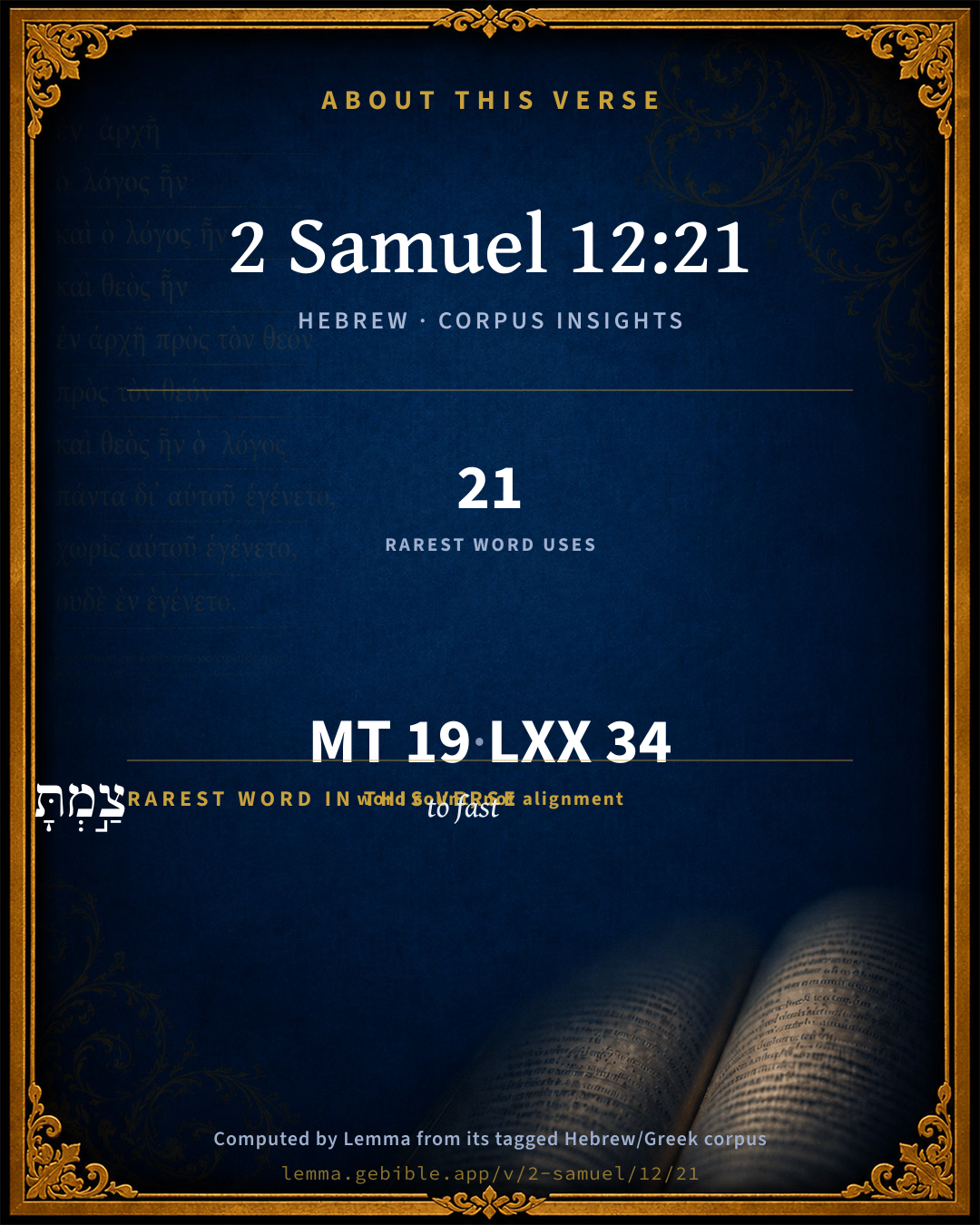
19
words
17
distinct lemmas
Historical
section

Notable vocabulary

The rarest word here is צַ֣מְתָּ to fast H6684 — appearing just 21 times in the whole Hebrew Bible.

Shared distinctive vocabulary

צַ֣מְתָּ to fast H6684 occurs in 17 verses of the Hebrew Bible. Also found in:

Grammatical profile

  • 7 verbs
  • 6 nouns
  • 1 adjective
  • 1 pronoun
  • 1 preposition
  • 3 particles

Verb forms

  • וַיֹּאמְר֤וּ Qal · Sequential Imperfect
  • עָשִׂ֑יתָה Qal · Perfect
  • צַ֣מְתָּ Qal · Perfect
  • וַתֵּ֔בְךְּ Qal · Sequential Imperfect
  • מֵ֣ת Qal · Perfect
  • קַ֖מְתָּ Qal · Perfect
  • וַתֹּ֥אכַל Qal · Sequential Imperfect

Repetition

Words recur within this verse — often emphatic in Hebrew:

  • הַיֶּ֤לֶד child H3206 ×2
  • אֲשֶׁ֣ר which H834 ×2

Hebrew & Septuagint length

In English translation the verse runs 38 words from the Hebrew and 45 from the Septuagint (LXX English) — closely comparable.

A rough comparison of the two English renderings, which tokenize alike — not a word-level alignment.

Word counts can differ between the Hebrew and the Greek without any difference in meaning — e.g. the Hebrew direct-object marker אֵת has no separate Greek word, and Greek often adds the article ὁ.

In the original languages it is 19 Hebrew tokens and 34 Greek tokens — but the two are counted differently (Hebrew bundles its prefixes and suffixes into one token; the Greek is in lemma form), so that isn’t a like-for-like length.

Cross-references

1

Topical passages linked to 2 Samuel 12:21 in the Treasury of Scripture Knowledge — connected by theme and wording, ordered by reader-vote popularity; previews shown in the World English Bible.

  • 1 Corinthians 2:15 But he who is spiritual discerns all things, and he himself is judged by no one.

Cross-references courtesy of OpenBible.info (CC BY 4.0).

Hebrew and Greek witnesses Masoretic Hebrew ↔ Greek Septuagint

The same verse in the two great witnesses to the Old Testament, shown verse-for-verse.

These are two independent witnesses, not word-aligned to each other, and the Septuagint is shown in lemma (dictionary) form.

Hebrew 2 Samuel 12:21 Masoretic · Westminster Leningrad Codex

וַיֹּאמְר֤וּ עֲבָדָיו֙ אֵלָ֔יו מָֽה הַדָּבָ֥ר הַזֶּ֖ה אֲשֶׁ֣ר עָשִׂ֑יתָה בַּעֲב֞וּר הַיֶּ֤לֶד חַי֙ צַ֣מְתָּ וַתֵּ֔בְךְּ וְכַֽאֲשֶׁר֙ מֵ֣ת הַיֶּ֔לֶד קַ֖מְתָּ וַתֹּ֥אכַל לָֽחֶם

Then said his servants to him, What thing is this that you have done? you did fast and weep for the child, while it was alive; but when the child was dead, you did rise and eat bread.

World English Bible · Public Domain

Greek LXX 2 Samuel 12:21 Septuagint · lemma form

καί εἶπον ὁ παῖς αὐτός πρός αὐτός τίς ὁ ῥῆμα οὗτος ὅς ποιέω ἕνεκα ὁ παιδάριον ἔτι ζάω νηστεύω καί κλαίω καί ἀγρυπνέω καί ἡνίκα ἀποθνήσκω ὁ παιδάριον ἀναἵστημι καί ἐσθίω ἄρτος καί πίνω

And his servants said to him, What is this thing that you have done concerning the child? while it was yet living you did fast, and weep, and watch: and when the child was dead you did rise up, and did eat bread, and drink.

LXX2012 (modern English Septuagint) · Public Domain

Hebrew: Westminster Leningrad Codex (CC BY 4.0). Greek: Septuagint (public domain); English from LXX2012 (modern English Septuagint) (Public Domain). How the Septuagint differs from the Hebrew →

Targum (Aramaic paraphrase)

1

The Targum is the ancient Jewish Aramaic paraphrase of the Hebrew Scriptures — an interpretive translation, not the Hebrew text itself. Onkelos (literal) and Pseudo-Jonathan (expansive) render the Torah, and Jonathan the Prophets. Coverage is partial: where no permissively-licensed English translation exists for a verse, only the Aramaic is shown. This is verse-level text, not a word-by-word alignment to the Hebrew.

  1. Targum Jonathan Prophets (Joshua–Malachi)
    וַאֲמַרוּ עַבְדוֹהִי לֵיהּ מַה פִתְגָמָא הָדֵין דַעֲבַדְתָּא עַד דְרַבְיָא קַיָם צַמְתָּא וּבְכֵית וְכַד מִית רַבְיָא קַמְתָּא וַאֲכַלְתְּ לַחְמָא:

    (no public-domain English translation for this verse)

    Targum Jonathan — Aramaic: “Mikraot Gedolot” (public domain). English: “Sefaria Community Translation” (CC0 1.0 (public-domain dedication)); “London "Chaldee Paraphrase," 1871” (public domain). Text via Sefaria.

Commentary

Notes on 2 Samuel 12:21 from classic Christian and Jewish commentators (each source and its license shown beneath its notes). The classic Christian expositions comment on the surrounding passage and are grouped to its opening verse, so a note may address several verses; the Jewish commentaries on the Tanakh (Rashi and others) are per-verse, so they appear only where the commentator wrote on this verse.

Lemma curates 59 commentaries, every one of them public domain or Creative Commons licensed, each selected and text-cleaned for this edition rather than reprinted as found. About our sources →

Trapp's Complete Commentary

John Trapp

2Sa 12:21 Then said his servants unto him, What thing [is] this that thou hast done? thou didst fast and weep for the child, [while it was] alive; but when the child was dead, thou didst rise and eat bread.

Ver. 21. What thing is this that thou hast done?] Quam absurda et insolens? The saints are "for signs and for wonders in Israel"; {Isa 8:18} their rations also - because they keep a constant counter notion to the corrupt customs of others - seem strange and unreasonable, {1Pe 4:4} though they need not.

John Trapp, A Commentary or Exposition upon All the Books of the Old and New Testament (1647–1656) — public domain. Text from a community e-Sword module.

Tyndale Open Study Notes

Tyndale Open Resources

12:21-23 David grieved before his son’s death, hoping to ward off punishment.

Tyndale Open Study Notes — © Tyndale Open Resources, licensed CC BY-SA 4.0. Text via the HelloAO Bible API.

Geneva Bible (1599)

Geneva Bible translators

As they which considered not that God granteth many things to the sobs and tears of the faithful.

Geneva Bible (1599) marginal notes — public domain. Text via Bolls.life.

John Gill's Exposition

And he said, while the child was yet alive,.... And so there was hope it might be continued:

I fasted and wept; or sought the Lord by prayer, and fasting, and weeping, that the threatening might not take place, that the child's life might be spared:

for I said; within himself, thus he reasoned in his own mind:

who can tell whether God will be gracious to me, that the child may live? and in hope of this he kept praying, fasting, and weeping; he could not tell but God might repent of the evil he had threatened, as in some cases he has done; see Joe 2:13. Abarbinel thinks that David fasted and wept to hide this matter from his wife, and his servants, and did not let them know that this was in his punishment, that the child should die.

John Gill's Exposition of the Whole Bible (1746–1763) — public domain (CC PDM 1.0). Text via the HelloAO Bible API.

Whedon's Commentary on the Bible

Daniel D. Whedon

21. What thing is this that thou hast done — The bereaved are accustomed to fast and weep after the death of their relative; but David does his mourning before the death of the child, and feasts immediately after. “The practice of the East is, to leave a relation of the deceased person to weep and mourn, till, on the third or fourth day at furthest, the relations and friends go to see him, cause him to eat, lead him to a bath, and cause him to put on new vestments, he having before thrown himself on the ground. The extremity of David’s sorrow for the child’s illness, and his not observing the common forms of grief afterwards, was what surprised his servants.” — Harmer’s Observations.

Daniel D. Whedon (gen. ed.), Commentary on the Old and New Testaments (1874–1909) — public domain. Text from a community e-Sword module.

unfoldingWord translationNotes

Door43 World Missions Community

General Information:

These verses contain rhetorical questions that emphasize that David realizes that Yahweh has allowed this to happen.

Who knows whether or not Yahweh will be gracious to me, that the child may live?

David asked this rhetorical question to empathize that no one knew if Yahweh would let the child live. This rhetorical question can be translated as a statement. AT: "No one knows whether or not Yahweh will be gracious to me so that the child may live." (See: Rhetorical Question)

But now he is dead, so why should I fast?

David asks this rhetorical question to empathize that he no longer has a reason to fast. This can be written as a statement. AT: "Now that he is dead it would be of no use to fast any longer." (See: Rhetorical Question)

Can I bring him back again?

David asks this rhetorical question to empathize that the boy cannot come back to life. This can be written as a statement. AT: "I cannot bring him back to life." (See: Rhetorical Question)

I will go to him

David implies that he will go to where his child is when he dies. AT: "When I die I will go to where he is" (See: Assumed Knowledge and Implicit Information)

translationWords

fast

Yahweh

grace

unfoldingWord translationNotes — © Distant Shores Media and the Door43 World Missions Community, licensed CC BY-SA 4.0. Source: git.door43.org/Door43/en_tn.

Lesson kit

Teaching starters — assembled from the data on this page, not authored interpretation. Every prompt links to the verse data it draws on. Edit before teaching.

2 Samuel, in the Historical, opens this verse with 19 words (17 distinct Hebrew lemmas). Its most distinctive word is tsûwm (“to fast”). A historical commentator’s framing appears above. Read the whole chapter for the surrounding context.

Discussion questions

  1. The word tsûwm carries the sense “to fast.” How does it shape the verse?
  2. How does Judges 20:26, which shares the word «to fast», read alongside this verse?
  3. What does the repetition of “child” (2× in this one verse) do in this verse?
  4. The translations on this page render this verse differently — a whole-verse word diff, not a word-by-word alignment. What might account for the different wordings?
  5. «וַיֹּאמְר֤וּ» is a Qal Sequential Imperfect verb. How does that grammatical form shape the action described?
  6. Compare how Trapp's Complete Commentary and Tyndale Open Study Notes read this verse. Where do they agree or differ?

Things to notice

Reading settings

Reading text

Shown beneath each verse's original-language words.

Old Testament
Old Testament edition

Read the OT as the Masoretic Hebrew (MT) or the Greek Septuagint (LXX).

English shown for the Greek Septuagint (in the Hebrew ↔ Greek comparison).

Comparing translations? Open the Compare panel on any verse page to stack up to four side by side.