Judges 8:6

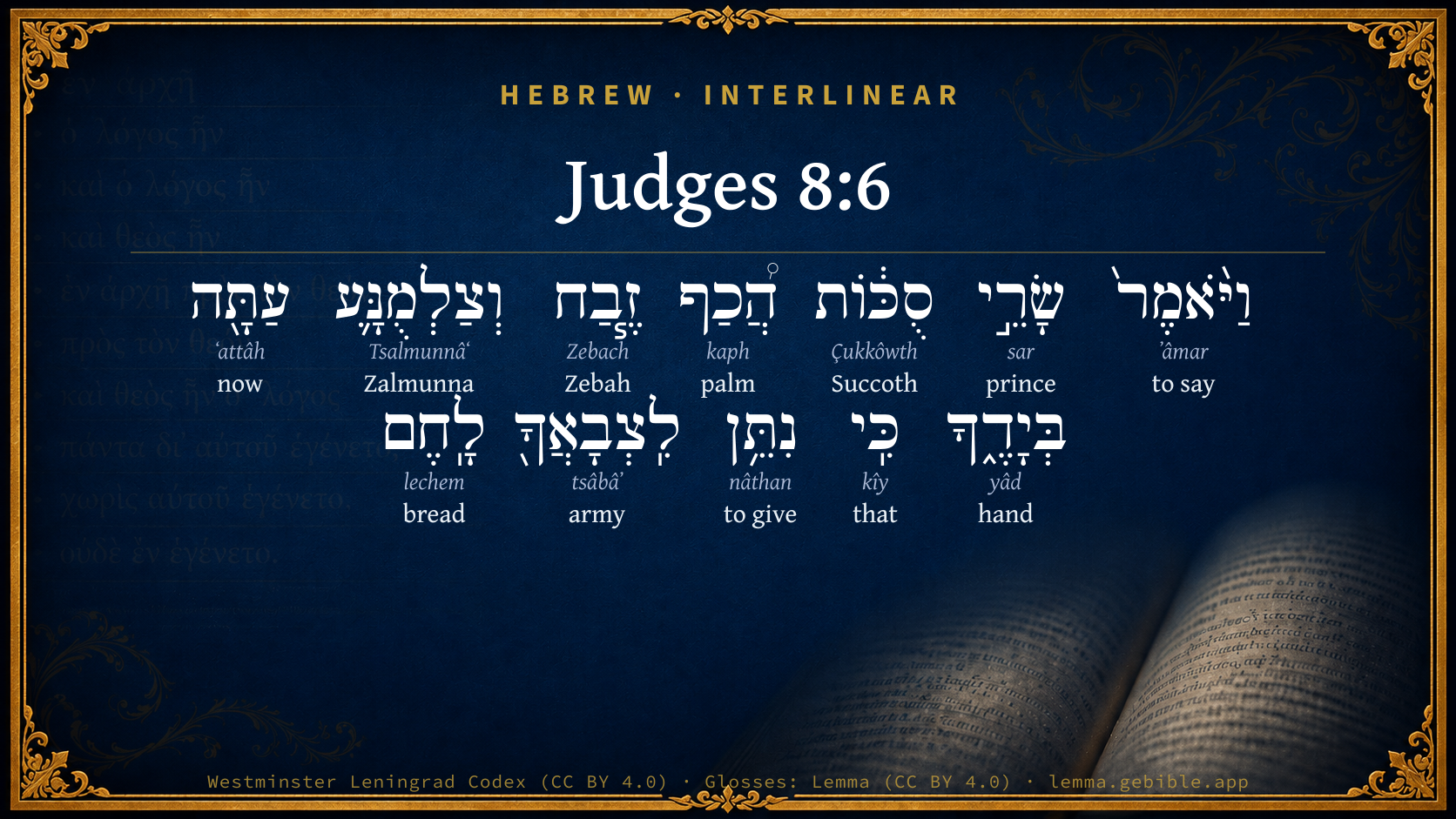
Hebrew (Westminster Leningrad Codex) Judges 8:6 appears in the Hebrew Old Testament. The text above is from the Westminster Leningrad Codex. Each word links to its Strong’s number, a concise gloss, and parsing drawn from the Open Scriptures Hebrew Bible morphology. Click any word for its full Brown-Driver-Briggs (BDB) entry.
Download image
Cite this verse

Judges 8:6 (World English Bible). Public Domain. Lemma interlinear Bible study tool, https://lemma.gebible.app/v/judges/8/6.

Show BibTeX & RIS
BibTeX
RIS
English Translation
The princes of Succoth said, Are the hands of Zebah and Zalmunna now in your hand, that we should give bread to your army?
World English Bible · Public Domain
Download a study sheet

One document with this verse’s original text, its word-by-word gloss line, the meaning frame, cross-references with their text, attributed commentary, and full source and license credits — printable, and it pastes into notes with its structure intact.

This verse Autodidact and up

Study sheet (.html) Plain text (.txt)

A passage Seminary Student

Up to 50 verses in one chapter. A passage sheet keeps up to 6 commentary sources and 12 cross-references per verse, in the order this page ranks them, and says so on the sheet whenever that leaves anything out. Ask for a single verse and you get the Autodidact verse sheet above.

Everything on this page stays free to read, with no account — the sheet is a download of what is already on screen, not access to it.

Want to remove ads? Support Godless Engineer
Compare translations 3

The same verse in 3 English versions, stacked beneath the original-language interlinear above. Click any original word for its lexicon entry.

Each is an independent rendering of the whole verse — the interlinear is not word-aligned to these translations.

Highlighted words mark where these versions differ — a whole-verse word diff, not a word-by-word alignment.

  • World English Bible Public Domain
    The princes of Succoth said, Are the hands of Zebah and Zalmunna now in your hand, that we should give bread to your army?
  • King James Version Public Domain
    And the princes of Succoth said, Are the hands of Zebah and Zalmunna now in thine hand, that we should give bread unto thine army?
  • unfoldingWord Literal Text CC BY-SA 4.0
    But the leaders of Succoth said, “ the palm of Zebah and Zalmunna now in your hand, that giving bread to your army?”

unfoldingWord Literal Text — © unfoldingWord, licensed CC BY-SA 4.0. Word-aligned USFM3 via Door43 (git.door43.org/unfoldingWord/en_ult).

Versions to compare (up to 4)

3 of 4 selected

Show all 18 translations

Every available English version of this verse, each an independent rendering of the whole verse.

  • World English Bible Public Domain
    The princes of Succoth said, Are the hands of Zebah and Zalmunna now in your hand, that we should give bread to your army?
  • Berean Standard Bible Public Domain
    But the leaders of Succoth asked, “Are the hands of Zebah and Zalmunna already in your possession, that we should give bread to your army?”
  • Majority Standard Bible Public Domain
    But the leaders of Succoth asked, “Are the hands of Zebah and Zalmunna already in your possession, that we should give bread to your army?”
  • King James Version Public Domain
    And the princes of Succoth said, Are the hands of Zebah and Zalmunna now in thine hand, that we should give bread unto thine army?
  • American Standard Version (1901) Public Domain
    And the princes of Succoth said, Are the hands of Zebah and Zalmunna now in thy hand, that we should give bread unto thine army?
  • Revised Version (1885) Public Domain
    And the princes of Succoth said, Are the hands of Zebah and Zalmunna now in thine hand, that we should give bread unto thine army?
  • Geneva Bible (1599) Public Domain
    And the princes of Succoth sayde, Are the handes of Zebah and Zalmunna nowe in thine hads, that we should giue bread vnto thine army?
  • Douay-Rheims (1899) Public Domain
    The princes of Soccoth answered: Peradventure the palms of the hands of Zebee and Salmana are in thy hand, and therefore thou demandest that we should give bread to thy army.
  • Young's Literal Translation Public Domain
    And the heads of Succoth say, `Is the hand of Zebah and Zalmunna now in thy hand, that we give to thy host bread?'
  • Literal Standard Version CC BY-SA 4.0
    And the heads of Succoth say, “Is the hand of Zebah and Zalmunna now in your hand, that we give bread to your host?”
  • Unlocked Literal Bible CC BY-SA 4.0
    Then the officials said, “Are the hands of Zebah and Zalmunna now in your hand? Why should we give bread to your army?”
  • unfoldingWord Literal Text CC BY-SA 4.0
    But the leaders of Succoth said, “ the palm of Zebah and Zalmunna now in your hand, that giving bread to your army?”
  • Darby Bible Public Domain
    And the officials of Succoth said, "Are Zebah and Zalmun'na already in your hand, that we should give bread to your army?"
  • World Messianic Bible Public Domain
    The princes of Succoth said, “Are the hands of Zebah and Zalmunna now in your hand, that we should give bread to your army?”
  • Webster's Bible Public Domain
    And the princes of Succoth said, Are the hands of Zebah and Zalmunna now in thy hand, that we should give bread to thy army?
  • Free Bible Version CC BY-SA 4.0
    But the Succoth town leaders replied, “Why should we give your army bread when you haven't even captured Zebah and Zalmunna yet?”
  • Bible in Basic English Public Domain
    But the chiefs of Succoth said, Are the hands of Zebah and Zalmunna even now in your hand that we are to give bread to your army?
  • JPS Tanakh (1917) Public Domain
    And the princes of Succoth said: 'Are the hands of Zebah and Zalmunna now in thy power, that we should give bread unto thine army?'

Literal Standard Version (2020), Covenant Press — licensed CC BY-SA 4.0. Text via the HelloAO Bible API (eBible.org). Unlocked Literal Bible (unfoldingWord) — licensed CC BY-SA 4.0. Text via the HelloAO Bible API (eBible.org). unfoldingWord Literal Text — © unfoldingWord, licensed CC BY-SA 4.0. Word-aligned USFM3 via Door43 (git.door43.org/unfoldingWord/en_ult). Free Bible Version, Dr. Jonathan Gallagher — licensed CC BY-SA 4.0. Text via the HelloAO Bible API (eBible.org).

Word by word

More ways to search: Search by grammar → Find every occurrence → Compare this word →

Practice this passage: Drill this verse → Learn its vocabulary →

זֶ֧בַח
Zebach
H2078
“Zebah”
Noun, Proper
Part of Speech
Noun
Type
Proper
Full BDB Definition

Origin: the same as H2077

TWOT: None

Zebah = "deprived of protection" - one of the two kings of Midian who commanded the great invasion of Palestine and finally were defeated by Gideon
  1. וַיֹּ֨אמֶר֙ ʼâmar H559 “and · to say” Conjunction + Verb, Qal, Sequential Imperfect, 3rd Person, Masculine, Singular
  2. שָׂרֵ֣י sar H8269 “princes of” Noun, Common, Masculine, Plural, Construct
  3. סֻכּ֔וֹת Çukkôwth H5523 “Succoth” Noun, Proper
  4. הֲ֠כַף kaph H3709 “palm of” Particle, Interrogative + Noun, Common, Feminine, Singular, Construct
  5. וְצַלְמֻנָּ֛ע Tsalmunnâʻ H6759 “and · Zalmunna” Conjunction + Noun, Proper
  6. עַתָּ֖ה ʻattâh H6258 “now” Adverb
  7. בְּיָדֶ֑ךָ yâd H3027 “in/at · hand · your” Preposition + Noun, Common, Both, Singular, Construct + Suffix, Personal, 2nd Person, Masculine, Singular
  8. כִּֽי kîy H3588 “that” Conjunction
  9. נִתֵּ֥ן nâthan H5414 “to give” Verb, Qal, Imperfect, 1st Person, Common, Plural
  10. לִֽצְבָאֲךָ֖ tsâbâʼ H6635 “to/for · army · your” Preposition + Noun, Common, Both, Singular, Construct + Suffix, Personal, 2nd Person, Masculine, Singular
  11. לָֽחֶם lechem H3899 “bread” Noun, Common, Both, Singular, Absolute

About this verse

These counts appear in no published source. They are computed here, from the morphology-tagged text and Lemma’s own curated glosses. What Lemma adds →

12
words
12
distinct lemmas
Historical
section

Notable vocabulary

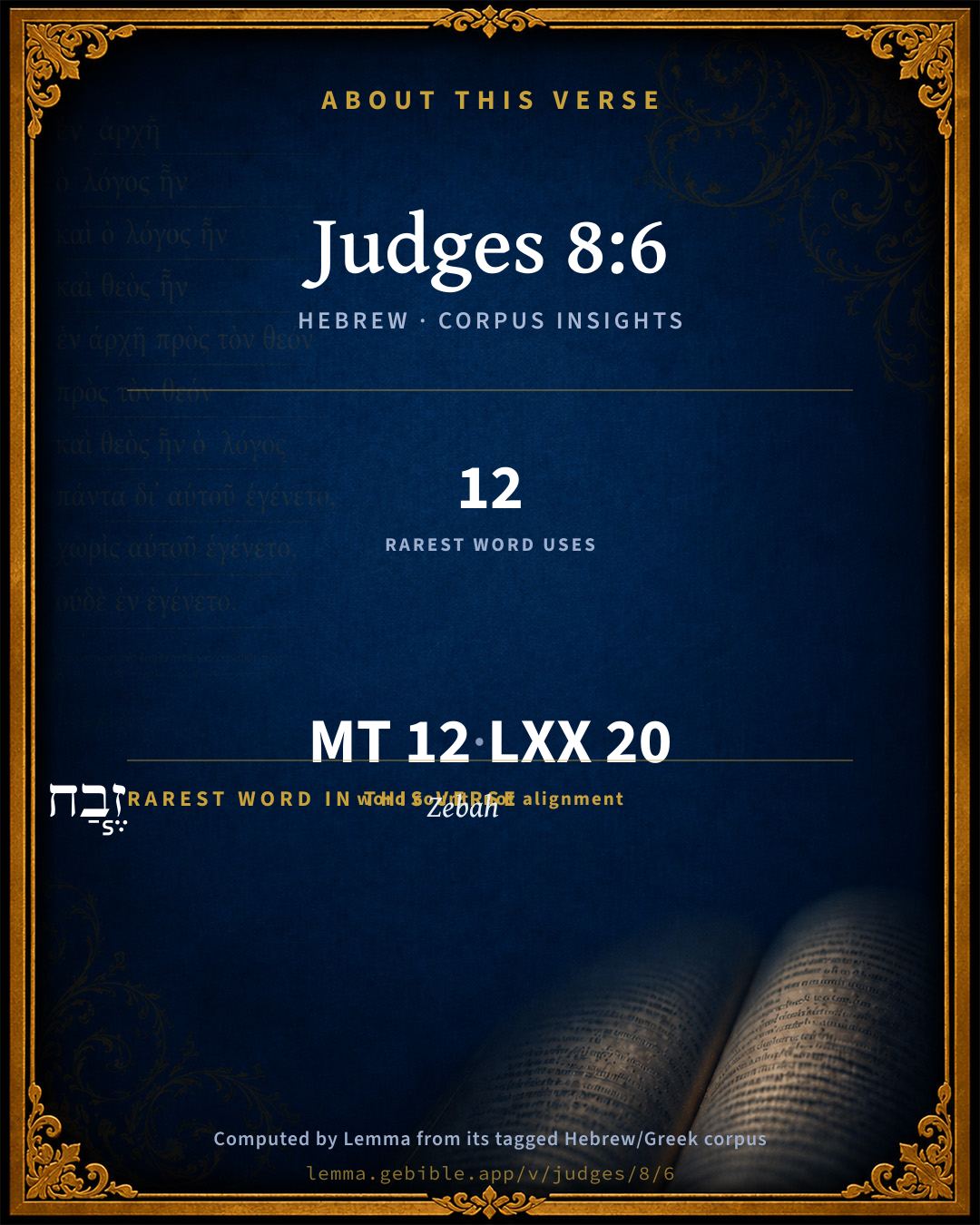
The rarest word here is זֶ֧בַח Zebah H2078 — appearing just 12 times in the whole Hebrew Bible.

Shared distinctive vocabulary

זֶ֧בַח Zebah H2078 occurs in 9 verses of the Hebrew Bible. Also found in:

Grammatical profile

  • 2 verbs
  • 8 nouns
  • 1 conjunction
  • 1 adverb

Verb forms

  • וַיֹּ֨אמֶר֙ Qal · Sequential Imperfect
  • נִתֵּ֥ן Qal · Imperfect

Hebrew & Septuagint length

In English translation the verse runs 24 words from the Hebrew and 25 from the Septuagint (LXX English) — closely comparable.

A rough comparison of the two English renderings, which tokenize alike — not a word-level alignment.

Word counts can differ between the Hebrew and the Greek without any difference in meaning — e.g. the Hebrew direct-object marker אֵת has no separate Greek word, and Greek often adds the article ὁ.

In the original languages it is 12 Hebrew tokens and 20 Greek tokens — but the two are counted differently (Hebrew bundles its prefixes and suffixes into one token; the Greek is in lemma form), so that isn’t a like-for-like length.

Cross-references

10

Topical passages linked to Judges 8:6 in the Treasury of Scripture Knowledge — connected by theme and wording, ordered by reader-vote popularity; previews shown in the World English Bible.

  • 1 Kings 20:11 The king of Israel answered, Tell him, Don't let him who girds on [his armor] boast himself as he who puts it off.
  • Philippians 2:21 For they all seek their own, not the things of Jesus Christ.
  • Genesis 25:13 These are the names of the sons of Ishmael, by their names, according to the order of their birth: the firstborn of Ishmael, Nebaioth, then Kedar, Adbeel, Mibsam,
  • Genesis 37:25 They sat down to eat bread, and they lifted up their eyes and looked, and saw a caravan of Ishmaelites was coming from Gilead, with their camels bearing spices and balm and myrrh, going to carry it down to Egypt.
  • Genesis 37:28 Midianites who were merchants passed by, and they drew and lifted up Joseph out of the pit, and sold Joseph to the Ishmaelites for twenty pieces of silver. They brought Joseph into Egypt.
  • Judges 5:23 Curse you Meroz, said the angel of Yahweh. Curse you bitterly the inhabitants of it, Because they didn't come to the help of Yahweh, To the help of Yahweh against the mighty.
  • Judges 8:15 He came to the men of Succoth, and said, See Zebah and Zalmunna, concerning whom you did taunt me, saying, Are the hands of Zebah and Zalmunna now in your hand, that we should give bread to your men who are weary?
  • 1 Samuel 25:10–11 Nabal answered David's servants, and said, Who is David? and who is the son of Jesse? there are many servants now-a-days who break away every man from his master.
  • 2 Kings 14:9 Jehoash the king of Israel sent to Amaziah king of Judah, saying, The thistle that was in Lebanon sent to the cedar that was in Lebanon, saying, Give your daughter to my son as wife: and there passed by a wild animal that was in Lebanon, and trod down the thistle.
  • Proverbs 18:23 The poor plead for mercy, But the rich answer harshly.

Cross-references courtesy of OpenBible.info (CC BY 4.0).

Hebrew and Greek witnesses Masoretic Hebrew ↔ Greek Septuagint

The same verse in the two great witnesses to the Old Testament, shown verse-for-verse.

These are two independent witnesses, not word-aligned to each other, and the Septuagint is shown in lemma (dictionary) form.

Hebrew Judges 8:6 Masoretic · Westminster Leningrad Codex

וַיֹּ֨אמֶר֙ שָׂרֵ֣י סֻכּ֔וֹת הֲ֠כַף זֶ֧בַח וְצַלְמֻנָּ֛ע עַתָּ֖ה בְּיָדֶ֑ךָ כִּֽי נִתֵּ֥ן לִֽצְבָאֲךָ֖ לָֽחֶם

The princes of Succoth said, Are the hands of Zebah and Zalmunna now in your hand, that we should give bread to your army?

World English Bible · Public Domain

Greek LXX Judges 8:6 Septuagint · lemma form

καί εἶπον ὁ ἄρχων σοκχωθ μή χείρ ζεβεε καί σελμανα νῦν ἐν χείρ σύ οὐ δίδωμι ὁ δύναμις σύ ἄρτος

And the princes of Socchoth said, Are the hands of Zebee and Salmana now in your hand, that we should give bread to your host?

LXX2012 (modern English Septuagint) · Public Domain

Hebrew: Westminster Leningrad Codex (CC BY 4.0). Greek: Septuagint (public domain); English from LXX2012 (modern English Septuagint) (Public Domain). How the Septuagint differs from the Hebrew →

Targum (Aramaic paraphrase)

1

The Targum is the ancient Jewish Aramaic paraphrase of the Hebrew Scriptures — an interpretive translation, not the Hebrew text itself. Onkelos (literal) and Pseudo-Jonathan (expansive) render the Torah, and Jonathan the Prophets. Coverage is partial: where no permissively-licensed English translation exists for a verse, only the Aramaic is shown. This is verse-level text, not a word-by-word alignment to the Hebrew.

  1. Targum Jonathan Prophets (Joshua–Malachi)
    וַאֲמַר רַבְרְבֵי סֻכּוֹת הָא כְּאִלּוּ זֶבַח וְצַלְמֻנָע כְעַן מְסִירִין בִּידָךְ אֲרֵי נִתַּן לְחֵילָךְ לַחֲמָא:

    (no public-domain English translation for this verse)

    Targum Jonathan — Aramaic: “Mikraot Gedolot” (public domain). English: “Sefaria Community Translation” (CC0 1.0 (public-domain dedication)); “London "Chaldee Paraphrase," 1871” (public domain). Text via Sefaria.

Commentary

Notes on Judges 8:6 from classic Christian and Jewish commentators (each source and its license shown beneath its notes). The classic Christian expositions comment on the surrounding passage and are grouped to its opening verse, so a note may address several verses; the Jewish commentaries on the Tanakh (Rashi and others) are per-verse, so they appear only where the commentator wrote on this verse.

Lemma curates 59 commentaries, every one of them public domain or Creative Commons licensed, each selected and text-cleaned for this edition rather than reprinted as found. About our sources →

Trapp's Complete Commentary

John Trapp

Jdg 8:6 And the princes of Succoth said, [Are] the hands of Zebah and Zalmunna now in thine hand, that we should give bread unto thine army?

Ver. 6. And the princes of Succoth said.] They not only deny him so reasonable a request, but deride and scornfully treat him, in like sort as afterwards Nabal the churl did David; which vexed him not a little.

John Trapp, A Commentary or Exposition upon All the Books of the Old and New Testament (1647–1656) — public domain. Text from a community e-Sword module.

The Biblical Illustrator

Joseph S. Exell

Jdg_8:6-17

The princes of Succoth . . . The men of Penuel.

Patience under provocation

Instead of being supported, as they had good right to expect they would have been, by those who profess to be the Lords people, instances are by no means rare of men of Gideons stamp being met on their part by scoffs and insinuations, and positive refusals along with cold prudential admonitions to attend to their own business, and allow matters just to take their course. Nor is this all. There are some who go even farther still--men who, while professing to be the friends of truth, are found actually, out of deliberate malice, envy, or jealousy, refusing to lend a lending hand and casting obstacles in the way of accomplishing the reformation on which their generous hearts are set. Now of all this we are furnished with a striking illustration in what is here recorded as having passed between Gideon and the men of Succoth and Penuel. Yet mark how nobly he continued to restrain the impulse of his resentment--an example which naturally reminds us of that of one greater far than Gideon, when He met with treatment similar, yet worse still, at the hands of those whom He had come to seek and to save from a servitude more deplorable by far. Oh, how amazing was His long-suffering forbearance! How analogous also to the conduct of Gideon, while infinitely more worthy of our admiration, was the patient perseverance with which He went on His way, still carrying forward the work which His Father had given Him to do, and for the sake of those very people who thus shamefully requited His love and service and self-denial, exposed Himself to still greater privations and still severer sufferings than any He had yet borne! Oh, if we wonder at the behaviour of the Ephraimites and the men of Succoth and Penuel toward Gideon son of Joash under provocation so aggravated, what ought we to think of Jesus the Son of God in bearing with us as He does! Yet, from what afterwards took place, let us beware how we presume on the long-suffering to which we owe so much. If the promises of Christ are yea and amen, so also are His threatenings; let us never for one moment lose sight of that! Gideon contented himself meanwhile with simply threatening the men of Succoth and Penuel, the former that he would tear their flesh with thorns (Jdg_8:7), the latter that he would break down their tower (Jdg_8:8) But afterwards, when he returned from taking vengeance on his countrys enemies at Karkor, thereby crowning his enterprise with complete success, then he fulfilled these threatenings to the very letter. And even so it shall be with all the enemies of Jesus, with all who decline to come to the help of the Lord against the mighty, at that day when He shall come again, to be admired of all them that love Him, and to take vengeance on all besides. Sooner or later the judgment He has threatened shall descend upon them. (W. W. Duncan, M. A.)

Punishment of the selfish and mean-spirited

These men were blind to the glory of the common cause--selfish, poor-spirited creatures, that shut themselves up in their fenced cities, and were satisfied to let Gods soldiers starve, and Gods work come to an end for want of support, so long only as they had bread enough to satisfy their own hunger. This was a state of mind not to be corrected by a mere civil speech or explanation. Gideon taught them, not by expostulation, but by the sword and with the briers of the wilderness. Can we say that there are none now who merit the same punishment? none who resist every appeal to assist those who are faint by pursuing Gods work? There are still men who have no eye for spiritual importance, but measure all things by their outward appearance and by their relation to their own comfort; men who fortify themselves in their ungenerous selfishness by asking, as these men of Succoth did, What have you made of this pursuit in which you want us to assist you? what great good have you done, that we should help you? Are Zebah and Zalmunna already in your hands, that we should acknowledge you as useful men, and give you what you ask to help you on in your pursuit? For such persons, who despise the day of small things, who cannot recognise God if He takes on Him the form of a little child, nor His Church when it exists as a grain of mustard-seed, there remains the doom of seeing the whole work of God in the world finished without their aid, and of hearing the voice of God Himself in rebuke, Behold, ye despisers, and wonder and perish! (Marcus Dods, D.D.)

The Biblical Illustrator, edited by Joseph S. Exell (c. 1880s–1900s) — public domain. Text from a community e-Sword module.

Joseph Benson's Commentary

Jdg 8:6. Are the hands of Zeba and Zalmunna now in thy hand? — Art thou so foolish as to think with thy three hundred faint and weary soldiers to conquer and destroy fifteen thousand men? Thus they make light of the advantage he had gained, and tauntingly tell him, that he had not yet got these kings into his hands, that they should run the danger of giving him and his men food, and so afterward have those kings to fall upon them. Thus they show the most dastardly and ungenerous spirit, and shut up the bowels of their compassion against their brethren, who, with extreme toil, and at the hazard of their lives, were endeavouring to deliver them and the rest of their country from a cruel slavery. Were these Israelites! Surely they were worshippers of Baal, or in the interest of Midian.

Joseph Benson's Commentary on the Old and New Testaments (1811–1818) — public domain. Text from a community e-Sword module.

Geneva Bible (1599)

Geneva Bible translators

Because thou hast overcome an handful, thinkest thou to have overcome the whole?

Geneva Bible (1599) marginal notes — public domain. Text via Bolls.life.

Jamieson, Fausset & Brown

Robert Jamieson, A. R. Fausset & David Brown

the princes of Succoth said, Are the hands of Zebah and Zalmunna now in thine hand--an insolent as well as a time-serving reply. It was insolent because it implied a bitter taunt that Gideon was counting with confidence on a victory which they believed he would not gain; and it was time-serving, because living in the near neighborhood of the Midianite sheiks, they dreaded the future vengeance of those roving chiefs. This contumelious manner of acting was heartless and disgraceful in people who were of Israelitish blood.

Jamieson, Fausset & Brown — Commentary Critical and Explanatory on the Whole Bible (1871) — public domain (CC PDM 1.0). Text via the HelloAO Bible API.

Adam Clarke's Commentary

Verse 6. Are the hands of Zebah and Zalmunna now in thine hand] They feared to help Gideon, lest, if he should be overpowered, the Midianites would revenge it upon them; and they dared not trust God.

Adam Clarke's Commentary on the Bible (1810–1826) — public domain. Text from a community e-Sword/MySword module.

Ellicott's Commentary for English Readers

(6) Are the hands of Zebah and Zalmunna now in thine hand?—Literally, Is the fist (caph) of Zebah and Zalmunna now in thy hand (yad)? The general meaning, of course, is clear: “Are you so completely victor as to secure us from the vengeance of these kings?” (Comp. 1Ki_20:11.) But what the exact shade of meaning is in this proverbial expression we do not know. Perhaps it is an allusion to the chained hands of captives. Nor do we know whether the tone of the elders of Succoth was one of derision or only of cowardice. In any case, they were guilty of inhumanity, want of faith, want of courage, and want of patriotism.

That we should give bread unto thine army.—They use the exaggerated term “army,” as though to magnify the sacrifice required of them. Gideon had only said “my followers.”

A Bible Commentary for English Readers, edited by Charles John Ellicott (1878–1897) — public domain. Text from a community e-Sword module.

The Cambridge Bible for Schools and Colleges

gen. ed. J. J. S. Perowne

6. the princes of Succoth] i.e. the executive officials of the community, responsible for its government, e.g. Jdg_9:30 (‘ruler,’ lit. ‘prince’), or for the conduct of its wars, e.g. Jdg_7:25, Jdg_8:3. See further on Jdg_8:14.

The Cambridge Bible for Schools and Colleges (gen. ed. J. J. S. Perowne; Cambridge University Press, 1878–1918) — public domain. Text from a community e-Sword module.

John Gill's Exposition

And the princes of Succoth said,.... The chief magistrates of the place made answer, one in the name of the rest; for the word said is in the singular number:

are the hands of Zebah and Zalmunna now in thine hands; that is, are they taken prisoners, and handcuffed, or their hands bound behind them, and put into the hands of Gideon, to do with them as he pleased? no, they were not; and they suggest they never would, deriding him and his small number of men as not a match for these kings, whom, perhaps a little before, they had seen pass by with 15,000 men; with whom his little army would not be able to encounter, should they turn and fall upon them, which they supposed would be the case; and therefore, say they, when these are in thine hands, which they thought would never be, it will be time enough

that we should give bread to thine army? for they feared, should they do that, these kings would hear of it, and they should suffer for it, and their bondage be harder than it was before; so selfish and diffident in themselves, so cruel and uncompassionate to their brethren, and so ungrateful to their deliverers, which stirred up the spirit of this humble and good man to great resentment.

John Gill's Exposition of the Whole Bible (1746–1763) — public domain (CC PDM 1.0). Text via the HelloAO Bible API.

Albert Barnes' Notes on the Bible

The number of the followers of Zebah and Zalmunna was still so formidable, and Gideon’s enterprise still so doubtful, that the men of Succoth (being on the same side of the Jordan) would not risk the vengeance of the Midianites by giving supplies to Gideon’s men.

Albert Barnes' Notes on the Bible (1834–1885) — public domain. Text from a community e-Sword/MySword module.

Haydock's Catholic Bible Commentary

Hand. Perhaps thou makest sure of taking these kings. (Haydock) We apprehend that they will return with greater forces, and punish our compliance. (Menochius)

George Leo Haydock (1774–1849), Haydock's Catholic Family Bible and Commentary, 1859 edition — public domain. Excludes Psalms (Douay-Rheims chapter numbering differs from Protestant) and Deuterocanonical books (Catholic canon only).

Matthew Poole's English Annotations

Art thou so foolish to think, with thy three hundred faint and weary soldiers, to conquer and destroy a host of fifteen thousand men?

Matthew Poole's English Annotations on the Holy Bible (1683–1685) — public domain. Text from a community e-Sword/MySword module.

The Pulpit Commentary

And the princes of Succoth, etc. Nothing could be more selfish, cowardly, and unpatriotic, than the conduct of the chief men of Succoth. Instead of aiding Gideon in his gallant enterprise for the deliverance of his country, they refused even food to his weary followers, for fear of the possibility of incurring the anger of the Midianites in ease Gideon should fail. Their conduct and that of the men of Penuel is perhaps one among many indications how little real union there was between the tribes on the opposite sides of the Jordan. (see Jud_1:5:16, 17)

The Pulpit Commentary (1880–1919), ed. H.D.M. Spence-Jones & Joseph S. Exell — public domain. Text from a community e-Sword module.

unfoldingWord translationNotes

Door43 World Missions Community

Are the hands of Zebah and Zalmunna now in your hand?

The leaders use a question to emphasize that the Israelites have not yet captured Zebah and Zalumnna. AT: "You have not captured Zebah and Zalmunna yet." (See: Rhetorical Question)

Are the hands of Zebah and Zalmunna

Here "hands" refer to the whole body. (See: Synecdoche)

now in your hand

Here "hand" represents power or control. (See: Metonymy)

Why should we give bread to your army?

The leaders use a question to emphasize that they have no reason to give bread to the Israelites. AT: "We see no reason to give bread to your army." (See: Rhetorical Question and Assumed Knowledge and Implicit Information)

I will tear your skin with the desert thorns and briers

The full meaning of this statement can be made explicit. AT: "I will make whips out of desert thorns and briers and use them to beat you and cut you" (See: Assumed Knowledge and Implicit Information)

thorns and briers

sharp, pointed pieces on vines or tree limbs that stick out and can cut people and animals

translationWords

bread

Gideon

Yahweh

flesh

desert

thorn

unfoldingWord translationNotes — © Distant Shores Media and the Door43 World Missions Community, licensed CC BY-SA 4.0. Source: git.door43.org/Door43/en_tn.

Rashi

Rabbi Shlomo Yitzchaki (Rashi)

Are the palms of Zevach and Tzalmuna in your hands that you pride yourself in having rescued us from the hand of Midyon.

Rashi on the Tanakh — English translations: “The Judaica Press complete Tanach with Rashi, translated by A. J. Rosenberg” (CC BY 4.0); “Pentateuch with Rashi's commentary by M. Rosenbaum and A.M. Silbermann, 1929-1934” (public domain); “The Metsudah Tanach series, Lakewood, N.J” (CC BY 4.0); and “The Book of Joshua, Metsudah Publications, 1997” (CC BY 4.0). Text via Sefaria.

Lesson kit

Teaching starters — assembled from the data on this page, not authored interpretation. Every prompt links to the verse data it draws on. Edit before teaching.

Judges, in the Historical, opens this verse with 12 words (12 distinct Hebrew lemmas). Its most distinctive word is Zebach (“Zebah”). A historical commentator’s framing appears above. Read the whole chapter for the surrounding context.

Discussion questions

  1. How does “Zebah” (Zebach) shape what this verse is saying?
  2. Judges 8:5 shares the word «Zebah» with this verse. How do the two illuminate each other?
  3. These translations render this verse differently. What is at stake in choosing one wording over another?
  4. The verb «וַיֹּ֨אמֶר֙» is Qal Sequential Imperfect. How does its form color the action?
  5. Reading how Trapp's Complete Commentary and The Biblical Illustrator read this verse, where do the two commentators agree and where do they part?

Things to notice

Reading settings

Reading text

Shown beneath each verse's original-language words.

Old Testament
Old Testament edition

Read the OT as the Masoretic Hebrew (MT) or the Greek Septuagint (LXX).

English shown for the Greek Septuagint (in the Hebrew ↔ Greek comparison).

Comparing translations? Open the Compare panel on any verse page to stack up to four side by side.