
Proverbs 6:26

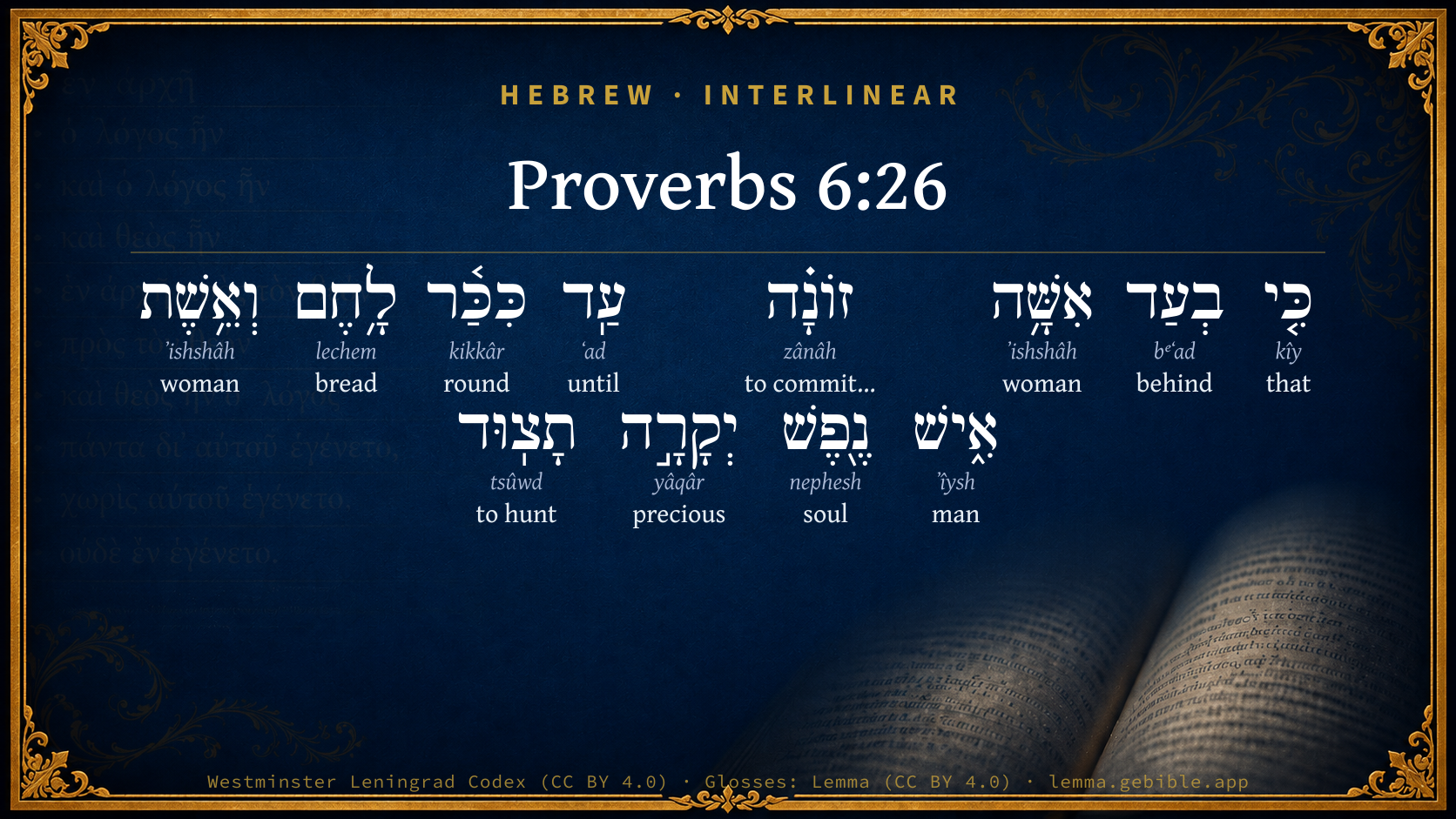
Hebrew (Westminster Leningrad Codex) Proverbs 6:26 appears in the Hebrew Old Testament. The text above is from the Westminster Leningrad Codex. Each word links to its Strong’s number, a concise gloss, and parsing drawn from the Open Scriptures Hebrew Bible morphology. Click any word for its full Brown-Driver-Briggs (BDB) entry.
Download image
Cite this verse

Proverbs 6:26 (World English Bible). Public Domain. Lemma interlinear Bible study tool, https://lemma.gebible.app/v/proverbs/6/26.

Show BibTeX & RIS
BibTeX
RIS
English Translation
For a prostitute reduces you to a piece of bread. The adulteress hunts for your precious life.
World English Bible · Public Domain
Download a study sheet

One document with this verse’s original text, its word-by-word gloss line, the meaning frame, cross-references with their text, attributed commentary, and full source and license credits — printable, and it pastes into notes with its structure intact.

This verse Autodidact and up

Study sheet (.html) Plain text (.txt)

A passage Seminary Student

Up to 50 verses in one chapter. A passage sheet keeps up to 6 commentary sources and 12 cross-references per verse, in the order this page ranks them, and says so on the sheet whenever that leaves anything out. Ask for a single verse and you get the Autodidact verse sheet above.

Everything on this page stays free to read, with no account — the sheet is a download of what is already on screen, not access to it.

Want to remove ads? Support Godless Engineer
Compare translations 3

The same verse in 3 English versions, stacked beneath the original-language interlinear above. Click any original word for its lexicon entry.

Each is an independent rendering of the whole verse — the interlinear is not word-aligned to these translations.

Highlighted words mark where these versions differ — a whole-verse word diff, not a word-by-word alignment.

  • World English Bible Public Domain
    For a prostitute reduces you to a piece of bread. The adulteress hunts for your precious life.
  • King James Version Public Domain
    For by means of a whorish woman a man is brought to a piece of bread: and the adultress will hunt for the precious life.
  • unfoldingWord Literal Text CC BY-SA 4.0
    For the price of a prostitute woman as a loaf of bread, but the wife of a man hunts a precious life.

unfoldingWord Literal Text — © unfoldingWord, licensed CC BY-SA 4.0. Word-aligned USFM3 via Door43 (git.door43.org/unfoldingWord/en_ult).

Versions to compare (up to 4)

3 of 4 selected

Show all 18 translations

Every available English version of this verse, each an independent rendering of the whole verse.

  • World English Bible Public Domain
    For a prostitute reduces you to a piece of bread. The adulteress hunts for your precious life.
  • Berean Standard Bible Public Domain
    For the levy of the prostitute is poverty, and the adulteress preys upon your very life.
  • Majority Standard Bible Public Domain
    For the levy of the prostitute is poverty, and the adulteress preys upon your very life.
  • King James Version Public Domain
    For by means of a whorish woman a man is brought to a piece of bread: and the adultress will hunt for the precious life.
  • American Standard Version (1901) Public Domain
    For on account of a harlot `a man is brought' to a piece of bread; And the adulteress hunteth for the precious life.
  • Revised Version (1885) Public Domain
    For on account of a whorish woman a man is brought to a piece of bread: and the adulteress hunteth for the precious life.
  • Geneva Bible (1599) Public Domain
    For because of the whorish woman a man is brought to a morsell of bread, and a woman wil hunt for the precious life of a man.
  • Douay-Rheims (1899) Public Domain
    For the price of a harlot is scarce one loaf: but the woman catcheth the precious soul of a man.
  • Young's Literal Translation Public Domain
    For a harlot consumeth unto a cake of bread, And an adulteress the precious soul hunteth.
  • Literal Standard Version CC BY-SA 4.0
    For a harlot consumes to a cake of bread, || And an adulteress hunts the precious soul.
  • Unlocked Literal Bible CC BY-SA 4.0
    Sleeping with a prostitute can cost the price of a loaf of bread, but the wife of another may cost you your very life.
  • unfoldingWord Literal Text CC BY-SA 4.0
    For the price of a prostitute woman as a loaf of bread, but the wife of a man hunts a precious life.
  • Darby Bible Public Domain
    for by means of a whorish woman [a man is brought] to a loaf of bread, and another's wife doth hunt for the precious soul.
  • World Messianic Bible Public Domain
    For a prostitute reduces you to a piece of bread. The adulteress hunts for your precious life.
  • Webster's Bible Public Domain
    For by means of a lewd woman a man is brought to a piece of bread: and the adulteress will hunt for the precious life.
  • Free Bible Version CC BY-SA 4.0
    You can buy a prostitute for the price of a loaf of bread, but adultery with another man's wife can cost you your life.
  • Bible in Basic English Public Domain
    For a loose woman is looking for a cake of bread, but another man's wife goes after one's very life.
  • JPS Tanakh (1917) Public Domain
    For on account of a harlot a man is brought to a loaf of bread, but the adulteress hunteth for the precious life.

Literal Standard Version (2020), Covenant Press — licensed CC BY-SA 4.0. Text via the HelloAO Bible API (eBible.org). Unlocked Literal Bible (unfoldingWord) — licensed CC BY-SA 4.0. Text via the HelloAO Bible API (eBible.org). unfoldingWord Literal Text — © unfoldingWord, licensed CC BY-SA 4.0. Word-aligned USFM3 via Door43 (git.door43.org/unfoldingWord/en_ult). Free Bible Version, Dr. Jonathan Gallagher — licensed CC BY-SA 4.0. Text via the HelloAO Bible API (eBible.org).

Word by word

More ways to search: Search by grammar → Find every occurrence → Compare this word →

Practice this passage: Drill this verse → Learn its vocabulary →

תָצֽוּד
tsûwd
H6679
“to hunt”
Verb, Qal, Imperfect, 3rd Person, Feminine, Singular
Part of Speech
Verb
Stem
Qal
Form
Imperfect
Person
3rd Person
Gender
Feminine
Number
Singular
Full BDB Definition

Origin: a primitive root

TWOT: 1885

to hunt - (Qal) to hunt - (Poel) to hunt, hunt eagerly or keenly - (Hithpael) take provision
  1. כִּ֤י kîy H3588 “that” Conjunction
  2. בְעַד bᵉʻad H1157 “behind” Preposition
  3. אִשָּׁ֥ה ʼishshâh H802 “woman” Noun, Common, Feminine, Singular, Absolute
  4. זוֹנָ֗ה zânâh H2181 “committing fornication” Verb, Qal, Participle Active, Feminine, Singular, Absolute
  5. עַֽד ʻad H5704 “until” Preposition
  6. כִּכַּ֫ר kikkâr H3603 “round of” Noun, Common, Both, Singular, Construct
  7. לָ֥חֶם lechem H3899 “bread” Noun, Common, Both, Singular, Absolute
  8. וְאֵ֥שֶׁת ʼishshâh H802 “and · woman of” Conjunction + Noun, Common, Feminine, Singular, Construct
  9. אִ֑ישׁ ʼîysh H376 “man” Noun, Common, Masculine, Singular, Absolute
  10. נֶ֖פֶשׁ nephesh H5315 “soul” Noun, Common, Both, Singular, Absolute
  11. יְקָרָ֣ה yâqâr H3368 “precious” Adjective, Adjective, Feminine, Singular, Absolute

About this verse

These counts appear in no published source. They are computed here, from the morphology-tagged text and Lemma’s own curated glosses. What Lemma adds →

12
words
11
distinct lemmas
Wisdom
section

Notable vocabulary

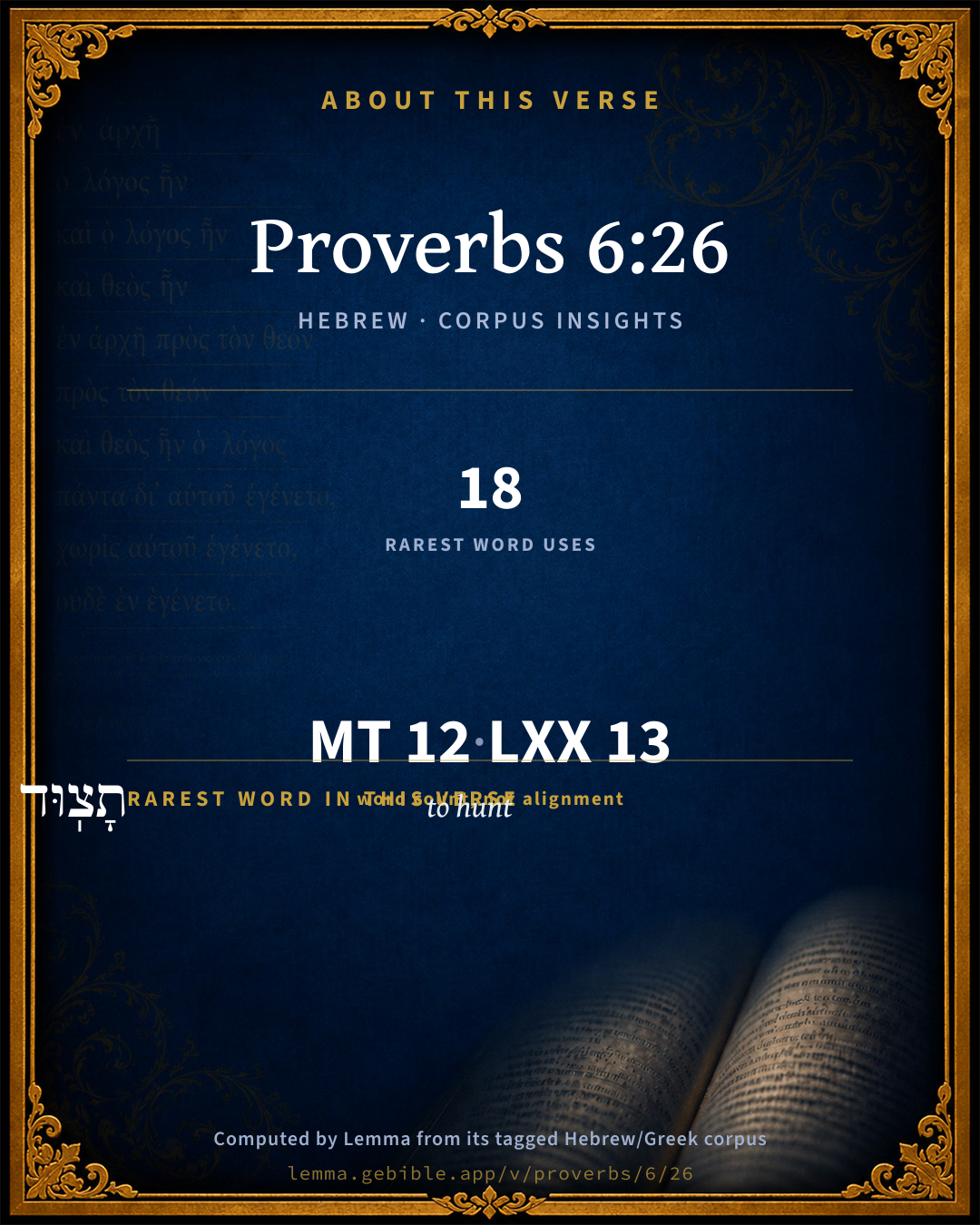
The rarest word here is תָצֽוּד to hunt H6679 — appearing just 18 times in the whole Hebrew Bible.

Shared distinctive vocabulary

תָצֽוּד to hunt H6679 occurs in 15 verses of the Hebrew Bible. Also found in:

Grammatical profile

  • 2 verbs
  • 6 nouns
  • 1 adjective
  • 2 prepositions
  • 1 conjunction

Verb forms

  • זוֹנָ֗ה Qal · Participle Active
  • תָצֽוּד Qal · Imperfect

Repetition

A word recurs within this verse — often emphatic in Hebrew:

  • אִשָּׁ֥ה woman H802 ×2

Hebrew & Septuagint length

In English translation the verse runs 17 words from the Hebrew and 23 from the Septuagint (LXX English) — closely comparable.

A rough comparison of the two English renderings, which tokenize alike — not a word-level alignment.

Word counts can differ between the Hebrew and the Greek without any difference in meaning — e.g. the Hebrew direct-object marker אֵת has no separate Greek word, and Greek often adds the article ὁ.

In the original languages it is 12 Hebrew tokens and 13 Greek tokens — but the two are counted differently (Hebrew bundles its prefixes and suffixes into one token; the Greek is in lemma form), so that isn’t a like-for-like length.

Cross-references

10

Topical passages linked to Proverbs 6:26 in the Treasury of Scripture Knowledge — connected by theme and wording, ordered by reader-vote popularity; previews shown in the World English Bible.

  • Luke 15:30 But when this, your son, came, who has devoured your living with prostitutes, you killed the fattened calf for him.'
  • Proverbs 29:3 Whoever loves wisdom brings joy to his father; But a companion of prostitutes squanders his wealth.
  • Genesis 39:14 that she called to the men of her house, and spoke to them, saying, "Behold, he has brought in a Hebrew to us to mock us. He came in to me to lie with me, and I cried with a loud voice.
  • 1 Samuel 2:36 It shall happen, that everyone who is left in your house shall come and bow down to him for a piece of silver and a loaf of bread, and shall say, Please put me into one of the priests' offices, that I may eat a morsel of bread.
  • Proverbs 5:10 Lest strangers feast on your wealth, And your labors enrich another man's house.
  • Proverbs 7:23 Until an arrow strikes through his liver, As a bird hurries to the snare, And doesn't know that it will cost his life.
  • Proverbs 29:8 Mockers stir up a city, But wise men turn away anger.
  • Ezekiel 13:8 Therefore thus says the Lord Yahweh: Because you have spoken falsehood, and seen lies, therefore, behold, I am against you, says the Lord Yahweh.
  • Ezekiel 13:18 and say, Thus says the Lord Yahweh: Woe to the women who sew pillows on all elbows, and make kerchiefs for the head of [persons of] every stature to hunt souls! Will you hunt the souls of my people, and save souls alive for yourselves?
  • Luke 15:13–15 Not many days after, the younger son gathered all of this together and traveled into a far country. There he wasted his property with riotous living.

Cross-references courtesy of OpenBible.info (CC BY 4.0).

Hebrew and Greek witnesses Masoretic Hebrew ↔ Greek Septuagint

The same verse in the two great witnesses to the Old Testament, shown verse-for-verse.

These are two independent witnesses, not word-aligned to each other, and the Septuagint is shown in lemma (dictionary) form.

Hebrew Proverbs 6:26 Masoretic · Westminster Leningrad Codex

כִּ֤י בְעַד אִשָּׁ֥ה זוֹנָ֗ה עַֽד כִּכַּ֫ר לָ֥חֶם וְאֵ֥שֶׁת אִ֑ישׁ נֶ֖פֶשׁ יְקָרָ֣ה תָצֽוּד

For a prostitute reduces you to a piece of bread. The adulteress hunts for your precious life.

World English Bible · Public Domain

Greek LXX Proverbs 6:26 Septuagint · lemma form

τιμή γάρ πόρνη ὅσος καί εἷς ἄρτος γυνή δέ ἀνήρ τίμιος ψυχή ἀγρεύω

For the value of a harlot is as much as of one loaf; and a woman hunts for the precious souls of men.

LXX2012 (modern English Septuagint) · Public Domain

On this verse, Adam Clarke's Commentary discusses the Septuagint’s reading. Read the note in Commentary ↓

Hebrew: Westminster Leningrad Codex (CC BY 4.0). Greek: Septuagint (public domain); English from LXX2012 (modern English Septuagint) (Public Domain). How the Septuagint differs from the Hebrew →

Commentary

Notes on Proverbs 6:26 from classic Christian and Jewish commentators (each source and its license shown beneath its notes). The classic Christian expositions comment on the surrounding passage and are grouped to its opening verse, so a note may address several verses; the Jewish commentaries on the Tanakh (Rashi and others) are per-verse, so they appear only where the commentator wrote on this verse.

Lemma curates 59 commentaries, every one of them public domain or Creative Commons licensed, each selected and text-cleaned for this edition rather than reprinted as found. About our sources →

Trapp's Complete Commentary

John Trapp

Pro 6:26 For by means of a whorish woman [a man is brought] to a piece of bread: and the adulteress will hunt for the precious life.

Ver. 26. For by means of a whorish woman.] {See Trapp on "Pro 5:10"} These creatures know no other language but that of the horse leech’s daughter, Give, give, and may fitly be compared to the ravens of Arabia, that, fully gorged, have a tunable, sweet record, but empty, screech horribly; or to carrion crows, that flock to a dead carcase, not to defend it, but to devour it; and no sooner have they bared the bones but they are gone. Thus dame Alice Peirce, King Edward III’s concubine, served him while he lived; all was here as she would; and when this king lay dying, she packed away what she could snatch, even to the rings on his fingers, and so left him. {a}

“ Corpus, opes, animum, famam, vim, lumina, scortum

Debilitat, perdit, necat, aufert, cripit, orbat."

Will hunt for the precious life.] As Potiphar’s wife did for Joseph’s. {Gen 39:14} And surely it was a great providence of God that, upon her false accusation, he had not been presently put to death. Into prison he was thrown, and so laden with fetters, that "the iron entered into his soul" Psa 105:18 - i.e., ate into his flesh, and all by means of this whorish woman, whose lust turned into hatred. Aut te ardenter amat, aut te capitaliter odit. {b} {See Trapp on "Pro 5:11"}

{a} Daniel’s Chronicle.

{b} Mantuan.

John Trapp, A Commentary or Exposition upon All the Books of the Old and New Testament (1647–1656) — public domain. Text from a community e-Sword module.

Tyndale Open Study Notes

Tyndale Open Resources

6:26 Sleeping with a prostitute has consequences, and sleeping with another man’s wife can cost you your life. Her husband will seek revenge (6:34-35), and God is watching in judgment.

Tyndale Open Study Notes — © Tyndale Open Resources, licensed CC BY-SA 4.0. Text via the HelloAO Bible API.

Jamieson, Fausset & Brown

Robert Jamieson, A. R. Fausset & David Brown

The supplied words give a better sense than the old version: "The price of a whore is a piece of bread."

adulteress--(Compare Margin), which the parallel and context (Pro 6:29-35) sustain. Of similar results of this sin, compare Pro 5:9-12.

will hunt--alluding to the snares spread by harlots (compare Pro 7:6-8).

precious life--more valuable than all else.

Jamieson, Fausset & Brown — Commentary Critical and Explanatory on the Whole Bible (1871) — public domain (CC PDM 1.0). Text via the HelloAO Bible API.

Adam Clarke's Commentary

Verse 26. By means of a whorish woman] In following lewd women, a man is soon reduced to poverty and disease. The Septuagint gives this a strange turn: τιμη γαρ πορνης, οση και ενος αρτου. "For the price or hire of a whore is about one loaf." So many were they in the land, that they hired themselves out for a bare subsistence. The Vulgate, Syriac, and Arabic, give the same sense. The old MS. Bible has it thus: The price forsothe of a strumpet is unneth oon lof: the woman forsothe taketh the precious liif of a man. The sense of which is, and probably the sense of the Hebrew too, While the man hires the whore for a single loaf of bread; the woman thus hired taketh his precious life. She extracts his energy, and poisons his constitution. In the first clause אשה זונה ishshah zonah is plainly a prostitute; but should we render אשת esheth, in the second clause, an adulteress? I think not. The versions in general join אשת איש esheth ish, together, which, thus connected, signify no more than the wife of a man; and out of this we have made adulteress, and Coverdale a married woman. I do not think that the Old MS. Bible gives a good sense; and it requires a good deal of paraphrase to extract the common meaning from the text. Though the following verses seem to countenance the common interpretation, yet they may contain a complete sense of themselves; but, taken in either way, the sense is good, though the construction is a little violent.

Adam Clarke's Commentary on the Bible (1810–1826) — public domain. Text from a community e-Sword/MySword module.

The Cambridge Bible for Schools and Colleges

gen. ed. J. J. S. Perowne

26. the adulteress] Lit. a man’s wife. It is the same woman who is contemplated in both clauses of the verse, a married woman, who has become a “whorish woman.”

will hunt] Rather, hunteth, R.V. Not only substance (Pro_6:31) but life itself (Pro_6:34-35) may be the forfeit, and a more precious substance than bodily life also. “Every sin is the precursor of spiritual bankruptcy; it is setting one’s hand to a bill, which when it comes in must break the wealthiest signatory.” Horton, p. 75.

The Cambridge Bible for Schools and Colleges (gen. ed. J. J. S. Perowne; Cambridge University Press, 1878–1918) — public domain. Text from a community e-Sword module.

John Gill's Exposition

Can a man take fire in his bosom,.... A whore is compared to fire, and is so called by the poets (o); and it is a saying of Pythagoras,

"it is a like thing to fall into fire and into a woman (p);''

the Hebrew words "esh", "fire", and "ishah", "a woman", have some affinity in sound; and the phrase of taking it "into the bosom" fitly expresses the impure embraces of a harlot;

and his clothes not be burned? he cannot, it is impossible; and equally vain is it to think that a man can commit whoredom and it not be known, or he not hurt by it in his name and substance, or in his body, soul, and life.

(o) Plauti Bacehides, Act. 4. Sc. 9. v. 15. "Accede ad ignem hunc", Terent. Eunuehus, Act. 1. Sc. 2. v. 5. (p) , apud Maximum, Eclog. c. 39.

John Gill's Exposition of the Whole Bible (1746–1763) — public domain (CC PDM 1.0). Text via the HelloAO Bible API.

Albert Barnes' Notes on the Bible

The two forms of evil bring, each of them, their own penalty. By the one a man is brought to such poverty as to beg for “a piece of bread” (compare 1Sa 2:36): by the other and more deadly sin he incurs a peril which may affect his life. The second clause is very abrupt and emphatic in the original; “but as for a man’s wife; she hunts for the precious life.”

Albert Barnes' Notes on the Bible (1834–1885) — public domain. Text from a community e-Sword/MySword module.

Haydock's Catholic Bible Commentary

Woman. Who is married, exposes her lover to the danger of death. She chooses the most accomplished men, while the harlot receives the first comer. (Calmet)

George Leo Haydock (1774–1849), Haydock's Catholic Family Bible and Commentary, 1859 edition — public domain. Excludes Psalms (Douay-Rheims chapter numbering differs from Protestant) and Deuterocanonical books (Catholic canon only).

Matthew Poole's English Annotations

To a piece of bread; to extreme poverty, so as to want and be forced to beg his bread. Hunt for the precious life; to take away a man’s life; either by consuming his body and spirits, and so shortening his days; or more directly and strictly, when she hath any great provocation to it, or any prospect of considerable advantage by it. Or, for the precious soul, which she corrupteth and destroyeth. But I prefer the former sense.

Matthew Poole's English Annotations on the Holy Bible (1683–1685) — public domain. Text from a community e-Sword/MySword module.

Whedon's Commentary on the Bible

Daniel D. Whedon

26. This verse is difficult because of the supposed ellipsis, and is variously rendered by the versions and critics. The ellipsis indicated by the italics renders the meaning doubtful. The meaning most approved is, that licentiousness leads to starvation, even to a last morsel of bread. There is no verb in the first member of the verse, and one must be supposed, it is possible that תצוד, tatsudh, in the latter clause, rendered will hunt, (better, lies in wait, or, lays snares,) or some verb of similar meaning, is implied in the first clause. The sense thus might be, that while the harlot lies in wait for bread she also lays snares for the precious life. Some eminent authorities refer the terms to two different classes of evil women — the harlot and the adulteress. By the one the man is brought to poverty, by the other into peril of his life.

Adulteress — The Hebrew denotes, the woman of a man, and is hence rendered adulteress. But this meaning is not certain. The Septuagint has γυνη ανδρων, meaning, a woman of men, that is, of more than one man — a common woman. The Hebrew ish, like our word man, is often used in the plural sense, each one, every one, or any one. If this be the sense of the words they would only be another term for ishshah zonah, a harlot, in the preceding clause, and both predicates, the hunting for bread and the hunting for the life, would apply to the same kind of vile person, namely, a lewd woman, married or single. But Miller renders thus: “For after a woman selling herself as low as for a loaf of bread, and she a man’s wife, a precious soul will hunt.” Conant, however, thus: “For a harlot is but a round (loaf) of bread, but the married woman hunts for the precious life.” Round or loaf means her hire. The law punished adultery with death. Lev_20:10; Deu_22:22; Eze_16:40; Joh_8:5.

Daniel D. Whedon (gen. ed.), Commentary on the Old and New Testaments (1874–1909) — public domain. Text from a community e-Sword module.

The Pulpit Commentary

For by means of a whorish woman a man is brought to a piece of bread. From this verse onwards to the end of the chapter the discourse consists of a series of arguments, each calculated to deter youth from the sins of fornication and adultery, by exhibiting the evil consequences of such indulgence. The first is the poverty and extreme beggary to which a man is brought. For by means of; Hebrew, ki v"ad. Lee gives the preposition vaad the force of "after," i.e. after associating with. The radical idea of the preposition is that of nearness, by, near, and easily passes to that of "because" (Gesenius) or "by means of," as in the Authorized Version. It is here used for per, "through," as in Jos_2:15 2Sa_20:23, and so indicates the transit through the way of fornication to extreme beggary (Gejerus). A whorish woman; Hebrew, ishshah zonah; Vulgate, scortum; LXX, pornh ; "a harlot," here corresponding to "the adulteress" (esheth ish), since the root zonah, "to commit fornication," is attributed both to married and unmarried women. (Gen_38:24 Lev_19:29 Hos_3:3) The word zonah is sometimes written alone, as in Gen_38:15 and Deu_23:19. The fuller expression, as here, occurs in Lev_21:7 Jos_2:1 Jud_1:11:1. To a piece of bread; Hebrew, adkikkar lakhem. It will be noticed that there is an ellipsis in the Hebrew, which, however, may be easily supplied, as in the Authorized Version. Delitzsch supplies "one cometh down to;" so Zockler. "A piece of bread" is properly "a circle of bread, a small round piece of bread, such as is still baked in Italy (pagnotta) and in the East (Arabic kurs), here an expression for the smallest piece" (Fleischer). The term occurs in Exo_29:23 1Sa_2:36, in the latter of which passages it expresses the extreme destitution to which the members of the house of Eli were to be reduced. As illustrating the term, see also Exo_38:21 and Eze_13:19. The LXX and Vulgate singularly render, "For the price of a harlot is scarcely that of a bit of bread," which may mean, as Castalio, that she is of so little value; but the context is opposed to this rendering, where the Point brought out is not the vile character of the harlot as the ruin she inflicts or is the cause of. Besides, the Hebrew ad does not mean ever "scarcely," or "hardly," which the Vulgate vix gives to it. And the adulteress will hunt for the precious life. The adulteress is isheth ish, literally, "the woman of a man," or "a man"s wife," as in the margin as, therefore, strictly an adulteress here. (cf. Lev_20:10) Will hunt; Hebrew, thatsud; LXX, agreuei ; Vulgate, capit. The Hebrew verb tsud, "to lie in wait for," "to hunt," also signifies "to take, or capture," like the Vulgate capere, The verb in its metaphorical use also occurs in Lam_3:52 Mic_7:2 Psa_140:12, and refers to those beguilements resorted to by the adulteress to seduce youth. In Eze_13:18 it carries with it the idea of death, and if understood in this sense here it may have reference to the death penalty inflicted on adulterer and adulteress by the Mosaic Law, (Lev_20:10) and introduces what is said more fully in vers. 32, 34, 35. The precious life; Hebrew, nephesh y"karah The epithet y"karah is appropriately added to nephesh, as indicating the high value of the life. All is implied in the nephesh, "the life," moral dignity of character, the soul of man. It is the ever-existing part of the man, and therefore is precious nothing can exceed it in value. Our Lord says, (Mat_16:26) "What shall a man give in exchange for his soul?" and the psalmist, (Psa_49:8) "For the redemption of their life is precious." But it is for this life, or soul, that the adulteress hunts, and which she destroys. Lives of fornication and adultery, therefore, carry with them the severest penalties, the loss of temporal possessions, for the enjoyment of a transient passion, and far beyond this the loss of life both temporal and eternal. We cannot imagine a more deterrent warning.

The Pulpit Commentary (1880–1919), ed. H.D.M. Spence-Jones & Joseph S. Exell — public domain. Text from a community e-Sword module.

unfoldingWord translationNotes

Door43 World Missions Community

the price of a loaf of bread

This is talking about the material cost, not the spiritual cost or the moral cost. AT: "a little bit"

may cost you your very life

Possible meanings are 1) the wife of another man will destroy your life because she always wants more or 2) the husband of the other woman will hunt you down and kill you.

Can a man carry a fire against his chest without burning his clothes?

This action would be very dangerous and would cause harm. The implied answer to the question is "no." AT: "Every man who carries a fire in his chest will burn his clothes." (See: Rhetorical Question)

without burning

"without destroying" or "and not destroy"

his clothes

His clothes stand for him as a whole person. (See: Metonymy)

translationWords

prostitute

life

unfoldingWord translationNotes — © Distant Shores Media and the Door43 World Missions Community, licensed CC BY-SA 4.0. Source: git.door43.org/Door43/en_tn.

Rashi

Rabbi Shlomo Yitzchaki (Rashi)

Because a man is brought to a loaf of bread for a harlot He is reduced to poverty and the lack of all good things.

Rashi on the Tanakh — English translations: “The Judaica Press complete Tanach with Rashi, translated by A. J. Rosenberg” (CC BY 4.0); “Pentateuch with Rashi's commentary by M. Rosenbaum and A.M. Silbermann, 1929-1934” (public domain); “The Metsudah Tanach series, Lakewood, N.J” (CC BY 4.0); and “The Book of Joshua, Metsudah Publications, 1997” (CC BY 4.0). Text via Sefaria.

Lesson kit

Teaching starters — assembled from the data on this page, not authored interpretation. Every prompt links to the verse data it draws on. Edit before teaching.

Proverbs, in the Wisdom, opens this verse with 12 words (11 distinct Hebrew lemmas). Its most distinctive word is tsûwd (“to hunt”). A historical commentator’s framing appears above. Read the whole chapter for the surrounding context.

Discussion questions

  1. What does “to hunt” (tsûwd) contribute to the verse as a whole?
  2. How does Genesis 27:3, which shares the word «to hunt», read alongside this verse?
  3. What does the repetition of “woman” (2× in this one verse) do in this verse?
  4. The translations on this page render this verse differently — a whole-verse word diff, not a word-by-word alignment. What might account for the different wordings?
  5. «זוֹנָ֗ה» is a Qal Participle Active verb. How does that grammatical form shape the action described?
  6. Compare how Trapp's Complete Commentary and Tyndale Open Study Notes read this verse. Where do they agree or differ?

Things to notice

Reading settings

Reading text

Shown beneath each verse's original-language words.

Old Testament
Old Testament edition

Read the OT as the Masoretic Hebrew (MT) or the Greek Septuagint (LXX).

English shown for the Greek Septuagint (in the Hebrew ↔ Greek comparison).

Comparing translations? Open the Compare panel on any verse page to stack up to four side by side.