
Jeremiah 38:9

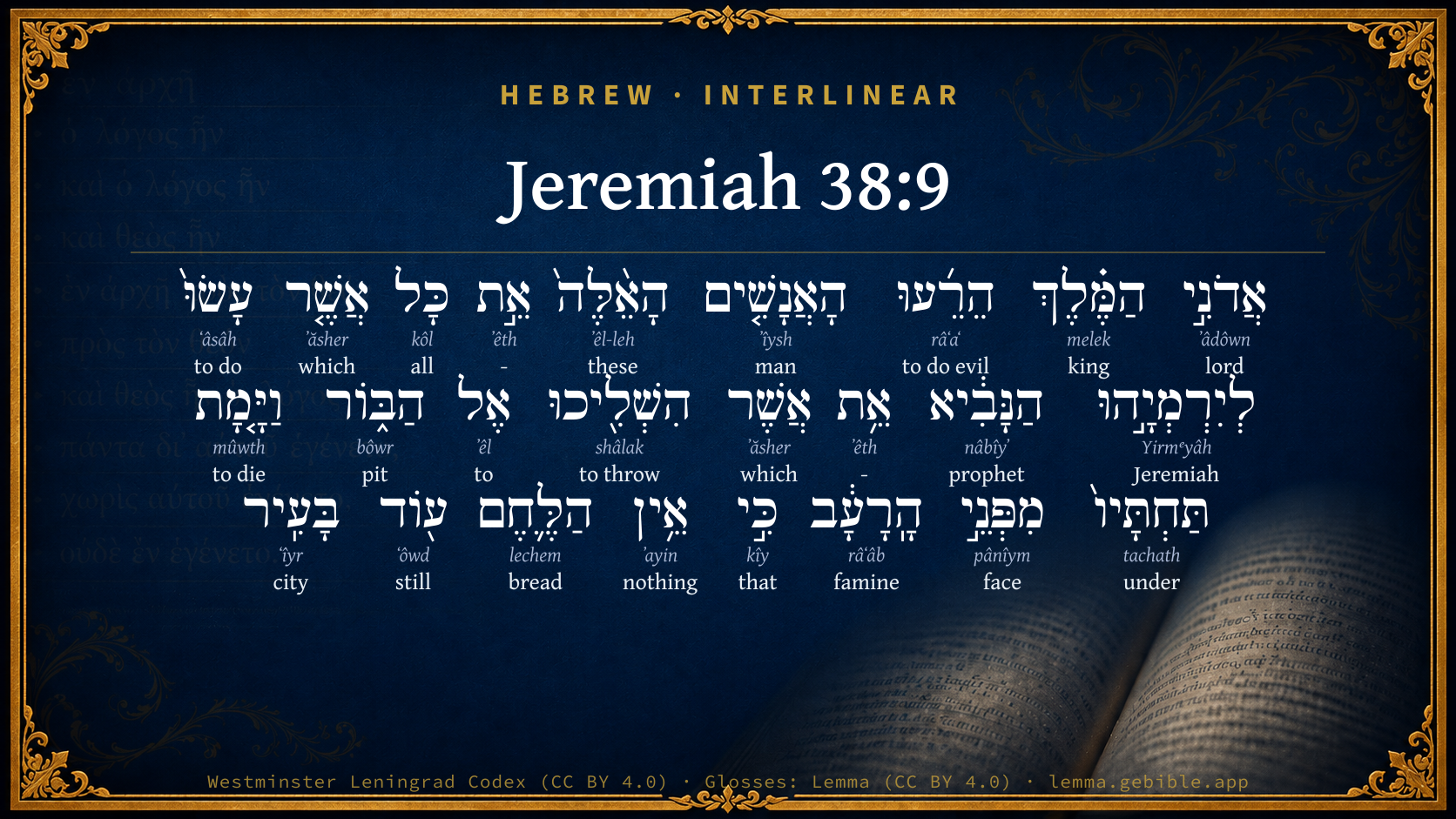
Hebrew (Westminster Leningrad Codex) Jeremiah 38:9 appears in the Hebrew Old Testament. The text above is from the Westminster Leningrad Codex. Each word links to its Strong’s number, a concise gloss, and parsing drawn from the Open Scriptures Hebrew Bible morphology. Click any word for its full Brown-Driver-Briggs (BDB) entry.
Download image
Cite this verse

Jeremiah 38:9 (World English Bible). Public Domain. Lemma interlinear Bible study tool, https://lemma.gebible.app/v/jeremiah/38/9.

Show BibTeX & RIS
BibTeX
RIS
English Translation
My lord the king, these men have done evil in all that they have done to Jeremiah the prophet, whom they have cast into the dungeon; and he is likely to die in the place where he is, because of the famine; for there is no more bread in the city.
World English Bible · Public Domain
Download a study sheet

One document with this verse’s original text, its word-by-word gloss line, the meaning frame, cross-references with their text, attributed commentary, and full source and license credits — printable, and it pastes into notes with its structure intact.

This verse Autodidact and up

Study sheet (.html) Plain text (.txt)

A passage Seminary Student

Up to 50 verses in one chapter. A passage sheet keeps up to 6 commentary sources and 12 cross-references per verse, in the order this page ranks them, and says so on the sheet whenever that leaves anything out. Ask for a single verse and you get the Autodidact verse sheet above.

Everything on this page stays free to read, with no account — the sheet is a download of what is already on screen, not access to it.

Want to remove ads? Support Godless Engineer
Compare translations 3

The same verse in 3 English versions, stacked beneath the original-language interlinear above. Click any original word for its lexicon entry.

Each is an independent rendering of the whole verse — the interlinear is not word-aligned to these translations.

Highlighted words mark where these versions differ — a whole-verse word diff, not a word-by-word alignment.

  • World English Bible Public Domain
    My lord the king, these men have done evil in all that they have done to Jeremiah the prophet, whom they have cast into the dungeon; and he is likely to die in the place where he is, because of the famine; for there is no more bread in the city.
  • King James Version Public Domain
    My lord the king, these men have done evil in all that they have done to Jeremiah the prophet, whom they have cast into the dungeon; and he is like to die for hunger in the place where he is: for there is no more bread in the city.
  • unfoldingWord Literal Text CC BY-SA 4.0
    “My master the king, these men have done evil with the way they have treated Jeremiah the prophet. They threw him into a cistern for him to die in it from hunger, since there is no more food in the city.”

unfoldingWord Literal Text — © unfoldingWord, licensed CC BY-SA 4.0. Word-aligned USFM3 via Door43 (git.door43.org/unfoldingWord/en_ult).

Versions to compare (up to 4)

3 of 4 selected

Show all 18 translations

Every available English version of this verse, each an independent rendering of the whole verse.

  • World English Bible Public Domain
    My lord the king, these men have done evil in all that they have done to Jeremiah the prophet, whom they have cast into the dungeon; and he is likely to die in the place where he is, because of the famine; for there is no more bread in the city.
  • Berean Standard Bible Public Domain
    “My lord the king, these men have acted wickedly in all that they have done to Jeremiah the prophet. They have dropped him into the cistern, where he will starve to death, for there is no more bread in the city.”
  • Majority Standard Bible Public Domain
    “My lord the king, these men have acted wickedly in all that they have done to Jeremiah the prophet. They have dropped him into the cistern, where he will starve to death, for there is no more bread in the city.”
  • King James Version Public Domain
    My lord the king, these men have done evil in all that they have done to Jeremiah the prophet, whom they have cast into the dungeon; and he is like to die for hunger in the place where he is: for there is no more bread in the city.
  • American Standard Version (1901) Public Domain
    My lord the king, these men have done evil in all that they have done to Jeremiah the prophet, whom they have cast into the dungeon; and he is like to die in the place where he is, because of the famine; for there is no more bread in the city.
  • Revised Version (1885) Public Domain
    My lord the king, these men have done evil in all that they have done to Jeremiah the prophet, whom they have cast into the dungeon; and he is like to die in the place where he is because of the famine: for there is no more bread in the city.
  • Geneva Bible (1599) Public Domain
    My lorde the King, these men haue done euill in all that they haue done to Ieremiah the Prophet, whom they haue cast into the dungeon, and he dyeth for hunger in the place where he is: for there is no more bread in the citie.
  • Douay-Rheims (1899) Public Domain
    My lord the king, these men have done evil in all that they have done against Jeremias the prophet, casting him into the dungeon to die there with hunger, for there is no more bread in the city.
  • Young's Literal Translation Public Domain
    `My lord, O king, these men have done evil `in' all that they have done to Jeremiah the prophet, whom they have cast into the pit, and he dieth in his place because of the famine, for there is no more bread in the city.'
  • Literal Standard Version CC BY-SA 4.0
    “My lord, O king, these men have done evil [in] all that they have done to Jeremiah the prophet, whom they have cast into the pit, and he dies in his place because of the famine, for there is no more bread in the city.”
  • Unlocked Literal Bible CC BY-SA 4.0
    “My master the king, these men have done evil with the way they have treated Jeremiah the prophet. They threw him into a cistern for him to die in it from hunger, since there is no more food in the city.”
  • unfoldingWord Literal Text CC BY-SA 4.0
    “My master the king, these men have done evil with the way they have treated Jeremiah the prophet. They threw him into a cistern for him to die in it from hunger, since there is no more food in the city.”
  • Darby Bible Public Domain
    My lord, O king, these men have done evil in all that they have done to the prophet Jeremiah, whom they have cast into the dungeon; and he will die by reason of the famine in the place where he is; for there is no more bread in the city.
  • World Messianic Bible Public Domain
    “My lord the king, these men have done evil in all that they have done to Jeremiah the prophet, whom they have cast into the dungeon. He is likely to die in the place where he is, because of the famine; for there is no more bread in the city.”
  • Webster's Bible Public Domain
    My lord the king, these men have done evil in all that they have done to Jeremiah the prophet, whom they have cast into the dungeon; and he is like to die by hunger in the place where he is: for there is no more bread in the city.
  • Free Bible Version CC BY-SA 4.0
    “My lord the king, all these terrible things these men have done to Jeremiah the prophet are evil. They've put him in the cistern, and he'll starve to death there because there's no more bread left in the city.”
  • Bible in Basic English Public Domain
    My lord the king, these men have done evil in all they have done to Jeremiah the prophet, whom they have put into the water-hole; and he will come to his death in the place where he is through need of food: for there is no more bread in the town.
  • JPS Tanakh (1917) Public Domain
    'My lord the king, these men have done evil in all that they have done to Jeremiah the prophet, whom they have cast into the pit; and he is like to die in the place where he is because of the famine; for there is no more bread in the city.'

Literal Standard Version (2020), Covenant Press — licensed CC BY-SA 4.0. Text via the HelloAO Bible API (eBible.org). Unlocked Literal Bible (unfoldingWord) — licensed CC BY-SA 4.0. Text via the HelloAO Bible API (eBible.org). unfoldingWord Literal Text — © unfoldingWord, licensed CC BY-SA 4.0. Word-aligned USFM3 via Door43 (git.door43.org/unfoldingWord/en_ult). Free Bible Version, Dr. Jonathan Gallagher — licensed CC BY-SA 4.0. Text via the HelloAO Bible API (eBible.org).

Word by word

More ways to search: Search by grammar → Find every occurrence → Compare this word →

Practice this passage: Drill this verse → Learn its vocabulary →

הַבּ֑וֹר
bôwr
H953
“the · pit”
Particle, Definite Article + Noun, Common, Masculine, Singular, Absolute
Part of Speech
Particle + Noun
Type
Common
Gender
Masculine
Number
Singular
State
Absolute
Full BDB Definition

Origin: from H952 (in the sense of H877 )

TWOT: 194e

pit, well, cistern
  1. אֲדֹנִ֣י ʼâdôwn H113 “lord · my” Noun, Common, Masculine, Singular, Construct + Suffix, Personal, 1st Person, Common, Singular
  2. הַמֶּ֗לֶךְ melek H4428 “the · king” Particle, Definite Article + Noun, Common, Masculine, Singular, Absolute
  3. הֵרֵ֜עוּ râʻaʻ H7489 “to do evil” Verb, Hiphil, Perfect, 3rd Person, Common, Plural
  4. הָאֲנָשִׁ֤ים ʼîysh H376 “the · men” Particle, Definite Article + Noun, Common, Masculine, Plural, Absolute
  5. הָאֵ֨לֶּה֙ ʼêl-leh H428 “the · these” Particle, Definite Article + Pronoun, Demonstrative, Common, Plural
  6. אֵ֣ת ʼêth H853 “-” Particle, Direct Object
  7. כָּל kôl H3605 “all of” Noun, Common, Masculine, Singular, Construct
  8. אֲשֶׁ֤ר ʼăsher H834 “which” Particle, Relative
  9. עָשׂוּ֙ ʻâsâh H6213 “to do” Verb, Qal, Perfect, 3rd Person, Common, Plural
  10. לְיִרְמְיָ֣הוּ Yirmᵉyâh H3414 “to/for · Jeremiah” Preposition + Noun, Proper
  11. הַנָּבִ֔יא nâbîyʼ H5030 “the · prophet” Particle, Definite Article + Noun, Common, Masculine, Singular, Absolute
  12. אֵ֥ת ʼêth H853 “-” Particle, Direct Object
  13. אֲשֶׁר ʼăsher H834 “which” Particle, Relative
  14. הִשְׁלִ֖יכוּ shâlak H7993 “to throw” Verb, Hiphil, Perfect, 3rd Person, Common, Plural
  15. אֶל ʼêl H413 “to” Preposition
  16. וַיָּ֤מָת mûwth H4191 “and · to die” Conjunction + Verb, Qal, Sequential Imperfect, 3rd Person, Masculine, Singular
  17. תַּחְתָּיו֙ tachath H8478 “under · him” Preposition + Suffix, Personal, 3rd Person, Masculine, Singular
  18. מִפְּנֵ֣י pânîym H6440 “from · face(s) of” Preposition + Noun, Common, Both, Plural, Construct
  19. הָֽרָעָ֔ב râʻâb H7458 “the · famine” Particle, Definite Article + Noun, Common, Masculine, Singular, Absolute
  20. כִּ֣י kîy H3588 “that” Conjunction
  21. אֵ֥ין ʼayin H369 “nothing” Particle, Negative
  22. הַלֶּ֛חֶם lechem H3899 “the · bread” Particle, Definite Article + Noun, Common, Both, Singular, Absolute
  23. ע֖וֹד ʻôwd H5750 “still” Adverb
  24. בָּעִֽיר ʻîyr H5892 “in/at the · city” Preposition, Determined + Noun, Common, Feminine, Singular, Absolute

About this verse

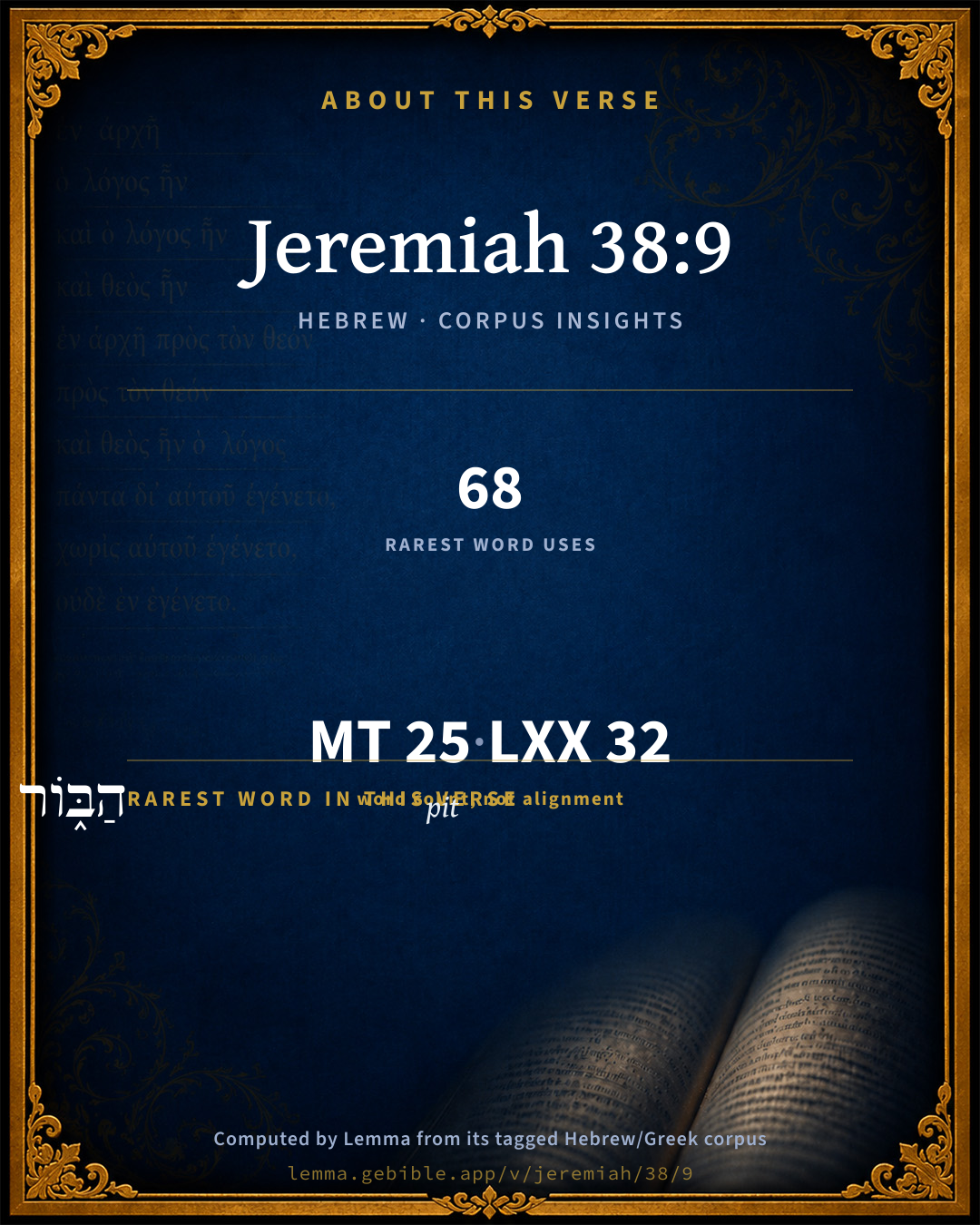
These counts appear in no published source. They are computed here, from the morphology-tagged text and Lemma’s own curated glosses. What Lemma adds →

25
words
23
distinct lemmas
Prophets
section

Grammatical profile

  • 4 verbs
  • 11 nouns
  • 1 pronoun
  • 2 prepositions
  • 1 conjunction
  • 1 adverb
  • 5 particles

Verb forms

  • הֵרֵ֜עוּ Hiphil · Perfect
  • עָשׂוּ֙ Qal · Perfect
  • הִשְׁלִ֖יכוּ Hiphil · Perfect
  • וַיָּ֤מָת Qal · Sequential Imperfect

Repetition

A word recurs within this verse — often emphatic in Hebrew:

  • אֲשֶׁ֤ר which H834 ×2

Hebrew & Septuagint length

In the original languages it is 25 Hebrew tokens and 32 Greek tokens — but the two are counted differently (Hebrew bundles its prefixes and suffixes into one token; the Greek is in lemma form), so that isn’t a like-for-like length.

Cross-references

6

Topical passages linked to Jeremiah 38:9 in the Treasury of Scripture Knowledge — connected by theme and wording, ordered by reader-vote popularity; previews shown in the World English Bible.

  • Jeremiah 37:21–38:6 Then Zedekiah the king commanded, and they committed Jeremiah into the court of the guard; and they gave him daily a loaf of bread out of the bakers' street, until all the bread in the city was spent. Thus Jeremiah remained in the court of the guard.
  • Esther 7:4–6 for we are sold, I and my people, to be destroyed, to be slain, and to perish. But if we had been sold for bondservants and bondmaids, I had held my peace, although the adversary could not have compensated for the king's damage.
  • Job 31:34 Because I feared the great multitude, And the contempt of families terrified me, So that I kept silence, and didn't go out of the door--
  • Proverbs 24:11–12 Rescue those who are being led away to death! Indeed, hold back those who are staggering to the slaughter!
  • Proverbs 31:8–9 Open your mouth for the mute, In the cause of all who are left desolate.
  • Jeremiah 52:6 In the fourth month, in the ninth day of the month, the famine was sore in the city, so that there was no bread for the people of the land.

Cross-references courtesy of OpenBible.info (CC BY 4.0).

Hebrew and Greek witnesses Masoretic Hebrew ↔ Greek Septuagint

The same verse in the two great witnesses to the Old Testament, shown verse-for-verse.

These are two independent witnesses, not word-aligned to each other, and the Septuagint is shown in lemma (dictionary) form.

Hebrew Jeremiah 38:9 Masoretic · Westminster Leningrad Codex

אֲדֹנִ֣י הַמֶּ֗לֶךְ הֵרֵ֜עוּ הָאֲנָשִׁ֤ים הָאֵ֨לֶּה֙ אֵ֣ת כָּל אֲשֶׁ֤ר עָשׂוּ֙ לְיִרְמְיָ֣הוּ הַנָּבִ֔יא אֵ֥ת אֲשֶׁר הִשְׁלִ֖יכוּ אֶל הַבּ֑וֹר וַיָּ֤מָת תַּחְתָּיו֙ מִפְּנֵ֣י הָֽרָעָ֔ב כִּ֣י אֵ֥ין הַלֶּ֛חֶם ע֖וֹד בָּעִֽיר

My lord the king, these men have done evil in all that they have done to Jeremiah the prophet, whom they have cast into the dungeon; and he is likely to die in the place where he is, because of the famine; for there is no more bread in the city.

World English Bible · Public Domain

Greek LXX Structure differs

In the Septuagint, Jeremiah is about an eighth shorter than the Hebrew and arranges its material differently — the Oracles Against the Nations (Hebrew chapters 46–51) appear in the middle of the Greek book, after 25:13. Because the chapter and verse boundaries do not line up, a verse-for-verse comparison with the Hebrew is not shown.

A verse-for-verse comparison isn’t shown here because the chapters and verses don’t line up. Switch to the LXX edition with the MT / LXX toggle above to read the Greek directly.

On this verse, Ellicott's Commentary for English Readers discusses the Septuagint’s reading. Read the note in Commentary ↓

Hebrew: Westminster Leningrad Codex (CC BY 4.0). Greek: Septuagint (public domain); English from a public-domain English Septuagint. How the Septuagint differs from the Hebrew →

Targum (Aramaic paraphrase)

1

The Targum is the ancient Jewish Aramaic paraphrase of the Hebrew Scriptures — an interpretive translation, not the Hebrew text itself. Onkelos (literal) and Pseudo-Jonathan (expansive) render the Torah, and Jonathan the Prophets. Coverage is partial: where no permissively-licensed English translation exists for a verse, only the Aramaic is shown. This is verse-level text, not a word-by-word alignment to the Hebrew.

  1. Targum Jonathan Prophets (Joshua–Malachi)
    רִבּוֹנִי מַלְכָּא אַבְאִישׁוּ גַבְרַיָא הָאִלֵין יַת כָּל דַעֲבַדוּ לְיִרְמְיָה נְבִיָא יַת דִרְמוֹהִי לְגוּבָא כְּבַר מִית בְּאַתְרֵיהּ מִן קֳדָם כַּפְנָא אֲרֵי לֵית לַחְמָא עוֹד בְּקַרְתָּא:

    (no public-domain English translation for this verse)

    Targum Jonathan — Aramaic: “Mikraot Gedolot” (public domain). English: “Sefaria Community Translation” (CC0 1.0 (public-domain dedication)); “London "Chaldee Paraphrase," 1871” (public domain). Text via Sefaria.

Commentary

Notes on Jeremiah 38:9 from classic Christian and Jewish commentators (each source and its license shown beneath its notes). The classic Christian expositions comment on the surrounding passage and are grouped to its opening verse, so a note may address several verses; the Jewish commentaries on the Tanakh (Rashi and others) are per-verse, so they appear only where the commentator wrote on this verse.

Lemma curates 59 commentaries, every one of them public domain or Creative Commons licensed, each selected and text-cleaned for this edition rather than reprinted as found. About our sources →

Trapp's Complete Commentary

John Trapp

Jer 38:9 My lord the king, these men have done evil in all that they have done to Jeremiah the prophet, whom they have cast into the dungeon; and he is like to die for hunger in the place where he is: for [there is] no more bread in the city.

Ver. 9. My lord the king, these men have done evil.] What a brave man was this, to oppose so many princes, and so potent that the king himself dared not displease them! It was God’s holy Spirit that put this mettle into him, and gave him the freedom of speech. {Psa 119:46}

And he is like to die for hunger in the place where he is.] Or, Who would have died for hunger in the place where he was.

For there is no more bread in the city.] Cum panum annona sit pauca et parca. What need he to be doubly murdered?

John Trapp, A Commentary or Exposition upon All the Books of the Old and New Testament (1647–1656) — public domain. Text from a community e-Sword module.

Geneva Bible (1599)

Geneva Bible translators

Hereby is declared that the Prophet found more favor at this stranger’s hands, than he did by all them of his country, which was to their great condemnation.

Geneva Bible (1599) marginal notes — public domain. Text via Bolls.life.

Jamieson, Fausset & Brown

Robert Jamieson, A. R. Fausset & David Brown

die for hunger in the place where he is; for . . . no . . . bread in . . . city--(Compare Jer 37:21). He had heretofore got a piece of bread supplied to him. "Seeing that there is the utmost want of bread in the city, so that even if he were at large, there could no more be regularly supplied to him, much less now in a place where none remember or pity him, so that he is likely to die for hunger." "No more bread," that is, no more left of the public store in the city (Jer 37:21); or, all but no bread left anywhere [MAURER].

Jamieson, Fausset & Brown — Commentary Critical and Explanatory on the Whole Bible (1871) — public domain (CC PDM 1.0). Text via the HelloAO Bible API.

Adam Clarke's Commentary

Verse 9. My lord the king, these men have done evil] He must have been much in the king's confidence, and a humane and noble spirited man, thus to have raised his voice against the powerful cabal already mentioned.

There is no more bread in the city.] They had defended it to the last extremity; and it appears that bread had been afforded to the prophet according to the king's commandment, as long as there was any remaining. See Jer 37:21.

Adam Clarke's Commentary on the Bible (1810–1826) — public domain. Text from a community e-Sword/MySword module.

John Calvin's Commentaries

He then said, that the king’s counselors had done wickedly in all the things which they had done against Jeremiah the Prophet, because they had cast him into the well: and he added, There he will die under himself, or as some render it, and rightly, “in his own place.” But the expression is striking, but cannot be fully expressed in our language: for Ebedmelech meant that Jeremiah would die, though no one molested him, though no evil or harm were done to him by another. He will, then, die in his own place, that is, he will die, if left where he is; because he lay, as it has appeared, sunk in mire. And then he said, He will die through famine; for he had been cast into the pit as into a grave. And as scarcity prevailed among the whole people, Jeremiah could not have hoped for any aid; and bread, as we shall hereafter see, could not have been thrown to him. Then Ebedmelech says here first, that Jeremiah had been unworthily treated, because he was God’s Prophet; for he honors him with this title, that he might expose the impiety of the princes; and secondly, he shews how miserably he lay in the pit, because no one could supply him with food, and there was no more bread in the city. It now follows —

John Calvin's Commentaries (1540-1563) — public domain. Text from the Calvin Translation Society English edition (1840s-50s) via the Christian Classics Ethereal Library (ccel.org). Calvin's coverage is partial (roughly two-thirds of the Bible); uncommented books and verses are honest gaps, never fabricated. The 19th-century editor's footnotes and remarks are omitted so the notes are faithfully Calvin's own voice.

Ellicott's Commentary for English Readers

(9) These men have done evil. . . .—It is noticeable that some MSS. of the LXX., following apparently a different text, represent the Eunuch as assuming that the king himself had given the order, “Thou hast done evil in all that thou hast done.”

He is like to die for hunger.—Literally, and he dies . . . painting vividly what would be the certain issue if no help were sent. It lies in the nature of the case that those who had thrown the prophet into the pit were not likely to continue the supply of his daily rations (Jer_37:21), and the scarcity that prevailed in the besieged city made it all but impossible that his friends, even if they could gain access to him, should help him out of their own resources. Ebed-melech had obviously no power to help him without the king’s sanction.

A Bible Commentary for English Readers, edited by Charles John Ellicott (1878–1897) — public domain. Text from a community e-Sword module.

The Cambridge Bible for Schools and Colleges

gen. ed. J. J. S. Perowne

9. he is like to die (mg. Heb. he is dead) in the place where he is because of the famine] is dead of hunger on the spot. Jeremiah was at death’s door already, as suffering at once from hunger and from confinement in so dismal a dungeon. If food was almost exhausted, prisoners would naturally be the first to suffer.

for there is no more bread in the city] This again is an exaggeration shewing the eagerness of the speaker. If it had been absolutely true, there could have been no object in freeing Jeremiah. The obvious sense is that there was so scanty a supply of provision that there was little or no chance of any reaching Jeremiah in the place where he was then confined.

The Cambridge Bible for Schools and Colleges (gen. ed. J. J. S. Perowne; Cambridge University Press, 1878–1918) — public domain. Text from a community e-Sword module.

John Gill's Exposition

My lord the king,.... He addresses him as a courtier, with great reverence and submission, and yet with great boldness:

these men have done evil in all that they have done to Jeremiah the prophet; meaning the princes, who might be present, and whom he pointed at, and mentioned by name; which showed great courage and faithfulness, as well as great zeal for, and attachment to, the prophet; to charge after this manner persons of such great authority so publicly, and to the king, whom the king himself stood in fear of: he first brings a general charge against them, that they had done wrong in everything they had done to the prophet; in their angry words to him; in smiting him, and putting him in prison in Jonathan's house; and particularly in their last instance of ill will to him:

whom they have cast into the dungeon; he does not say where, or describe the dungeon, because well known to the king, and what a miserable place it was; and tacitly suggests the cruelty and inhumanity of the princes:

and he is like to die for hunger in the place where he is, for there is no more bread in the city; or very little; there was none to be had but with great difficulty, as Kimchi observes; and therefore though the king had ordered a piece of bread to be given him daily, as long as there was any in the city; yet it being almost all consumed, and the prophet being out or sight, and so out of mind, and altogether disregarded, must be in perishing circumstances, and near death; and must inevitably perish, unless some immediate care be taken of him. It may be rendered, "he will die" (t), &c. or the sense is, bread being exceeding scarce in the city, notwithstanding the king's order, very little was given to Jeremiah, while he was in the court of the prison; so that he was half starved, and was a mere skeleton then, and would have died for hunger there; wherefore it was barbarous in the princes to cast such a man into a dungeon. It may be rendered, "he would have died for hunger in the place where he was, seeing there was no more bread in the city" (u); wherefore, if the princes had let him alone where he was, he would have died through famine; and therefore acted a very wicked part in hastening his death, by throwing him into a dungeon; this is Jarchi's sense, with which Abarbinel agrees.

(t) "morietur enim", Schmidt. (u) "Qui moriturus fuerat in loco suo propter famem", Junius & Tremellius, Piscator.

John Gill's Exposition of the Whole Bible (1746–1763) — public domain (CC PDM 1.0). Text via the HelloAO Bible API.

Haydock's Catholic Bible Commentary

City. It was useless, therefore, to add the torment of the dungeon, since he must soon have perished. (Calmet)

George Leo Haydock (1774–1849), Haydock's Catholic Family Bible and Commentary, 1859 edition — public domain. Excludes Psalms (Douay-Rheims chapter numbering differs from Protestant) and Deuterocanonical books (Catholic canon only).

Matthew Poole's English Annotations

The courage of this good eunuch was very remarkable; he did not stay till the king came in, but went to the king, as he was sitting in the gate of Benjamin, administering justice, or receiving and answering petitions, where doubtless he was not alone, and probably was attended there by some of those princes who had thrown Jeremiah into this miserable place. Ebed-melech was not afraid of them, but openly complains of their cruelty to the king, and tells him that Jeremiah would be starved to death: those who were alive in the city could not long subsist, for the stores were almost all spent, and though the king had appointed the prophet an allowance, yet being in such a hole, and there being so little bread left in the city, it was not likely there would be much care taken of him.

Matthew Poole's English Annotations on the Holy Bible (1683–1685) — public domain. Text from a community e-Sword/MySword module.

Whedon's Commentary on the Bible

Daniel D. Whedon

9. Is like to die — Literally, he is dead upon the spot for hunger. This is the language of intensity and alarm. It is hence the language of the feelings, and not merely of the intellect.

Daniel D. Whedon (gen. ed.), Commentary on the Old and New Testaments (1874–1909) — public domain. Text from a community e-Sword module.

The Pulpit Commentary

For there is no more bread in the city. It would almost seem as if the little remaining bread had been brought together by command of the magistrates, and that it was given out in rations by them. (comp. Jer_37:21)

The Pulpit Commentary (1880–1919), ed. H.D.M. Spence-Jones & Joseph S. Exell — public domain. Text from a community e-Sword module.

Rashi

Rabbi Shlomo Yitzchaki (Rashi)

He would have died in his place, etc. If they had left him in his place, he would have died by himself in the famine, but they have done harm to bring his death closer.

Rashi on the Tanakh — English translations: “The Judaica Press complete Tanach with Rashi, translated by A. J. Rosenberg” (CC BY 4.0); “Pentateuch with Rashi's commentary by M. Rosenbaum and A.M. Silbermann, 1929-1934” (public domain); “The Metsudah Tanach series, Lakewood, N.J” (CC BY 4.0); and “The Book of Joshua, Metsudah Publications, 1997” (CC BY 4.0). Text via Sefaria.

Lesson kit

Teaching starters — assembled from the data on this page, not authored interpretation. Every prompt links to the verse data it draws on. Edit before teaching.

Jeremiah, in the Prophets, opens this verse with 25 words (23 distinct Hebrew lemmas). Its most distinctive word is bôwr (“pit”). A historical commentator’s framing appears above. Read the whole chapter for the surrounding context.

Discussion questions

  1. What does “pit” (bôwr) contribute to the verse as a whole?
  2. How does Jeremiah 37:21–38:6, which shares this passage’s theme, read alongside this verse?
  3. What does the repetition of “which” (2× in this one verse) do in this verse?
  4. The translations on this page render this verse differently — a whole-verse word diff, not a word-by-word alignment. What might account for the different wordings?
  5. «הֵרֵ֜עוּ» is a Hiphil Perfect verb. How does that grammatical form shape the action described?
  6. Compare how Trapp's Complete Commentary and Geneva Bible (1599) read this verse. Where do they agree or differ?

Things to notice

Reading settings

Reading text

Shown beneath each verse's original-language words.

Old Testament
Old Testament edition

Read the OT as the Masoretic Hebrew (MT) or the Greek Septuagint (LXX).

English shown for the Greek Septuagint (in the Hebrew ↔ Greek comparison).

Comparing translations? Open the Compare panel on any verse page to stack up to four side by side.