
1 Chronicles 12:40

Hebrew (Westminster Leningrad Codex) 1 Chronicles 12:40 appears in the Hebrew Old Testament. The text above is from the Westminster Leningrad Codex. Each word links to its Strong’s number, a concise gloss, and parsing drawn from the Open Scriptures Hebrew Bible morphology. Click any word for its full Brown-Driver-Briggs (BDB) entry.
Download image
Cite this verse

1 Chronicles 12:40 (World English Bible). Public Domain. Lemma interlinear Bible study tool, https://lemma.gebible.app/v/1-chronicles/12/40.

Show BibTeX & RIS
BibTeX
RIS
English Translation
Moreover those who were near to them, [even] as far as Issachar and Zebulun and Naphtali, brought bread on donkeys, and on camels, and on mules, and on oxen, food of meal, cakes of figs, and clusters of raisins, and wine, and oil, and oxen, and sheep in abundance: for there was joy in Israel.
World English Bible · Public Domain
Download a study sheet

One document with this verse’s original text, its word-by-word gloss line, the meaning frame, cross-references with their text, attributed commentary, and full source and license credits — printable, and it pastes into notes with its structure intact.

This verse Autodidact and up

Study sheet (.html) Plain text (.txt)

A passage Seminary Student

Up to 50 verses in one chapter. A passage sheet keeps up to 6 commentary sources and 12 cross-references per verse, in the order this page ranks them, and says so on the sheet whenever that leaves anything out. Ask for a single verse and you get the Autodidact verse sheet above.

Everything on this page stays free to read, with no account — the sheet is a download of what is already on screen, not access to it.

Want to remove ads? Support Godless Engineer
Compare translations 3

The same verse in 3 English versions, stacked beneath the original-language interlinear above. Click any original word for its lexicon entry.

Each is an independent rendering of the whole verse — the interlinear is not word-aligned to these translations.

Highlighted words mark where these versions differ — a whole-verse word diff, not a word-by-word alignment.

  • World English Bible Public Domain
    Moreover those who were near to them, [even] as far as Issachar and Zebulun and Naphtali, brought bread on donkeys, and on camels, and on mules, and on oxen, food of meal, cakes of figs, and clusters of raisins, and wine, and oil, and oxen, and sheep in abundance: for there was joy in Israel.
  • King James Version Public Domain
    Moreover they that were nigh them, even unto Issachar and Zebulun and Naphtali, brought bread on asses, and on camels, and on mules, and on oxen, and meat, meal, cakes of figs, and bunches of raisins, and wine, and oil, and oxen, and sheep abundantly: for there was joy in Israel.
  • unfoldingWord Literal Text CC BY-SA 4.0
    And also the ones near to them, unto Issachar and Zebulun and Naphtali, were bringing bread on donkeys and on camels and on mules and on oxen: food flour, fig cakes and raisins cakes and wine and oil and oxen and sheep in abundance, for joy in Israel.

unfoldingWord Literal Text — © unfoldingWord, licensed CC BY-SA 4.0. Word-aligned USFM3 via Door43 (git.door43.org/unfoldingWord/en_ult).

Versions to compare (up to 4)

3 of 4 selected

Show all 18 translations

Every available English version of this verse, each an independent rendering of the whole verse.

  • World English Bible Public Domain
    Moreover those who were near to them, [even] as far as Issachar and Zebulun and Naphtali, brought bread on donkeys, and on camels, and on mules, and on oxen, food of meal, cakes of figs, and clusters of raisins, and wine, and oil, and oxen, and sheep in abundance: for there was joy in Israel.
  • Berean Standard Bible Public Domain
    And their neighbors from as far away as Issachar, Zebulun, and Naphtali came bringing food on donkeys, camels, mules, and oxen—abundant supplies of flour, fig cakes and raisin cakes, wine and oil, oxen and sheep. Indeed, there was joy in Israel.
  • Majority Standard Bible Public Domain
    And their neighbors from as far away as Issachar, Zebulun, and Naphtali came bringing food on donkeys, camels, mules, and oxen—abundant supplies of flour, fig cakes and raisin cakes, wine and oil, oxen and sheep. Indeed, there was joy in Israel.
  • King James Version Public Domain
    Moreover they that were nigh them, even unto Issachar and Zebulun and Naphtali, brought bread on asses, and on camels, and on mules, and on oxen, and meat, meal, cakes of figs, and bunches of raisins, and wine, and oil, and oxen, and sheep abundantly: for there was joy in Israel.
  • American Standard Version (1901) Public Domain
    Moreover they that were nigh unto them, `even' as far as Issachar and Zebulun and Naphtali, brought bread on asses, and on camels, and on mules, and on oxen, victuals of meal, cakes of figs, and clusters of raisins, and wine, and oil, and oxen, and sheep in abundance: for there was joy in Israel.
  • Revised Version (1885) Public Domain
    Moreover they that were nigh unto them, even as far as Issachar and Zebulun and Naphtali, brought bread on asses, and on camels, and on mules, and on oxen, victual of meal, cakes of figs, and clusters of raisins, and wine, and oil, and oxen, and sheep in abundance: for there was joy in Israel:
  • Geneva Bible (1599) Public Domain
    Moreouer they that were neere them vntill Issachar, and Zebulun, and Naphtali brought bread vpon asses, and on camels, and on mules, and on oxen, euen meate, floure, figges, and reisins, and wine and oyle, and beeues and sheepe abundantly: for there was ioy in Israel.
  • Douay-Rheims (1899) Public Domain
    Moreover they that were near them even as far as Issachar, and Zabulon, and Nephtali, brought leaves on asses, and on camels, and on mules, and on oxen, to eat: meal, figs, raisins, wine, oil, and oxen, and sheep in abundance, for there was joy in Israel.
  • Young's Literal Translation Public Domain
    And also those near unto them, unto Issachar, and Zebulun, and Naphtali, are bringing in bread on asses, and on camels, and on mules, and on oxen -- food of fine flour, fig-cakes and grape-cakes, and wine, and oil, and oxen, and sheep, in abundance, for joy `is' in Israel.
  • Literal Standard Version CC BY-SA 4.0
    And also those near to them—to Issachar, and Zebulun, and Naphtali—are bringing in bread on donkeys, and on camels, and on mules, and on oxen—food of fine flour, fig-cakes and grape-cakes, and wine, and oil, and oxen, and sheep, in abundance, for joy [is] in Israel.
  • Unlocked Literal Bible CC BY-SA 4.0
    In addition, those who were near to them, as far as Issachar and Zebulun and Naphtali, brought bread on donkeys, camels, mules, and oxen, and cakes of figs, clusters of raisins, wine, oil, oxen, and sheep, for Israel was celebrating.
  • unfoldingWord Literal Text CC BY-SA 4.0
    And also the ones near to them, unto Issachar and Zebulun and Naphtali, were bringing bread on donkeys and on camels and on mules and on oxen: food flour, fig cakes and raisins cakes and wine and oil and oxen and sheep in abundance, for joy in Israel.
  • Darby Bible Public Domain
    and those too that were near them, as far as Issachar and Zebulun and Naphtali, brought food on asses, and on camels, and on mules, and on oxen; provisions of meal, fig-cakes and raisin-cakes, and wine and oil, and oxen and sheep, abundantly; for there was joy in Israel.
  • World Messianic Bible Public Domain
    Moreover those who were near to them, as far as Issachar, Zebulun, and Naphtali, brought bread on donkeys, on camels, on mules, and on oxen: supplies of flour, cakes of figs, clusters of raisins, wine, oil, cattle, and sheep in abundance; for there was joy in Israel.
  • Webster's Bible Public Domain
    Moreover, they that were nigh them, even to Issachar, and Zebulun, and Naphtali, brought bread on asses, and on camels, and on mules, and on oxen, and provision, meal, cakes of figs, and bunches of raisins, and wine, and oil, and oxen, and sheep abundantly: for there was joy in Israel.
  • Free Bible Version CC BY-SA 4.0
    Their neighbors, even as far away as Issachar, Zebulun, and Naphtali, arrived bringing food on donkeys, camels, mules, and oxen. They had plenty of flour, fig cakes, bunches of raisins, wine, olive oil, cattle, and sheep, for Israel was so happy.
  • Bible in Basic English Public Domain
    And those who were near, as far as Issachar and Zebulun and Naphtali, came with food on asses and camels and mules and oxen, with meal for food and cakes of figs and masses of grapes, and wine and oil and oxen and sheep in great numbers, for there was joy in Israel.
  • JPS Tanakh (1917) Public Domain
    (12-41) Moreover they that were nigh unto them, even as far as Issachar and Zebulun and Naphtali, brought bread on asses, and on camels, and on mules, and on oxen, victual of meal, cakes of figs, and clusters of raisins, and wine, and oil, and oxen, and sheep in abundance; for there was joy in Israel.

Literal Standard Version (2020), Covenant Press — licensed CC BY-SA 4.0. Text via the HelloAO Bible API (eBible.org). Unlocked Literal Bible (unfoldingWord) — licensed CC BY-SA 4.0. Text via the HelloAO Bible API (eBible.org). unfoldingWord Literal Text — © unfoldingWord, licensed CC BY-SA 4.0. Word-aligned USFM3 via Door43 (git.door43.org/unfoldingWord/en_ult). Free Bible Version, Dr. Jonathan Gallagher — licensed CC BY-SA 4.0. Text via the HelloAO Bible API (eBible.org).

Word by word

More ways to search: Search by grammar → Find every occurrence → Compare this word →

Practice this passage: Drill this verse → Learn its vocabulary →

וְצִמּוּקִ֧ים
tsammûwq
H6778
“and · bunches of raisins”
Conjunction + Noun, Common, Masculine, Plural, Absolute
Part of Speech
Conjunction + Noun
Type
Common
Gender
Masculine
Number
Plural
State
Absolute
Full BDB Definition

Origin: from H6784

TWOT: 1930a

bunch of raisins, raisin-bunch
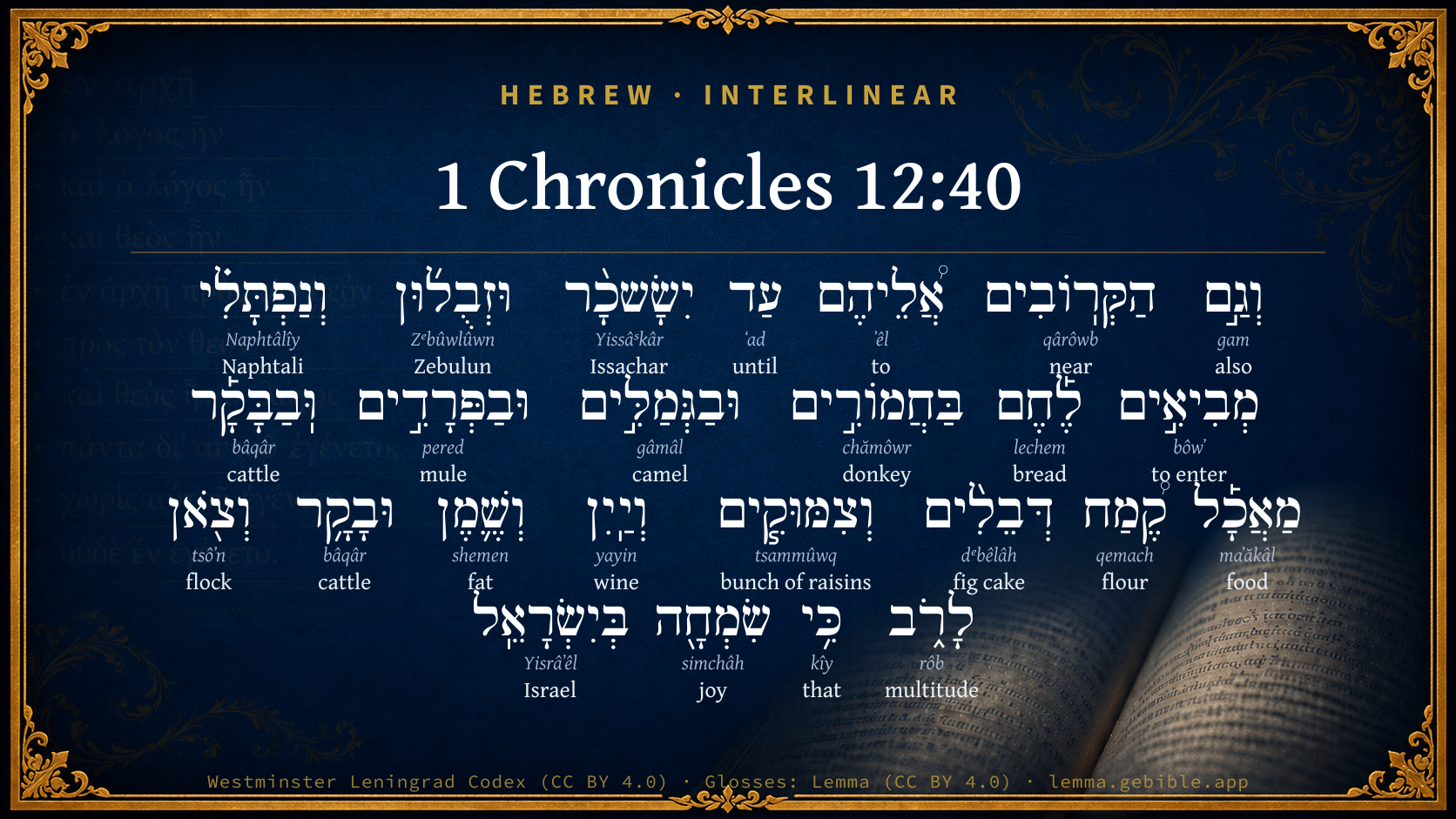
  1. וְגַ֣ם gam H1571 “and · also” Conjunction + Particle, Accusative
  2. הַקְּרֽוֹבִים qârôwb H7138 “the · near” Particle, Definite Article + Adjective, Adjective, Masculine, Plural, Absolute
  3. אֲ֠לֵיהֶם ʼêl H413 “to · them” Preposition + Suffix, Personal, 3rd Person, Masculine, Plural
  4. עַד ʻad H5704 “until” Preposition
  5. יִשָׂשכָ֨ר Yissâˢkâr H3485 “Issachar” Noun, Proper
  6. וּזְבֻל֜וּן Zᵉbûwlûwn H2074 “and · Zebulun” Conjunction + Noun, Proper
  7. וְנַפְתָּלִ֗י Naphtâlîy H5321 “and · Naphtali” Conjunction + Noun, Proper
  8. מְבִיאִ֣ים bôwʼ H935 “entering” Verb, Hiphil, Participle Active, Masculine, Plural, Absolute
  9. לֶ֡חֶם lechem H3899 “bread” Noun, Common, Both, Singular, Absolute
  10. בַּחֲמוֹרִ֣ים chămôwr H2543 “in/at the · donkeys” Preposition, Determined + Noun, Common, Both, Plural, Absolute
  11. וּבַגְּמַלִּ֣ים gâmâl H1581 “and · in/at the · camels” Conjunction + Preposition, Determined + Noun, Common, Masculine, Plural, Absolute
  12. וּבַפְּרָדִ֣ים pered H6505 “and · in/at the · mules” Conjunction + Preposition, Determined + Noun, Common, Masculine, Plural, Absolute
  13. וּֽבַבָּקָ֡ר bâqâr H1241 “and · in/at the · cattle” Conjunction + Preposition, Determined + Noun, Common, Both, Singular, Absolute
  14. מַאֲכָ֡ל maʼăkâl H3978 “food” Noun, Common, Masculine, Singular, Absolute
  15. קֶ֠מַח qemach H7058 “flour” Noun, Common, Masculine, Singular, Absolute
  16. דְּבֵלִ֨ים dᵉbêlâh H1690 “fig cakes” Noun, Common, Feminine, Plural, Absolute
  17. וְיַֽיִן yayin H3196 “and · wine” Conjunction + Noun, Common, Masculine, Singular, Absolute
  18. וְשֶׁ֛מֶן shemen H8081 “and · fat” Conjunction + Noun, Common, Masculine, Singular, Absolute
  19. וּבָקָ֥ר bâqâr H1241 “and · cattle” Conjunction + Noun, Common, Both, Singular, Absolute
  20. וְצֹ֖אן tsôʼn H6629 “and · flock” Conjunction + Noun, Common, Both, Singular, Absolute
  21. לָרֹ֑ב rôb H7230 “to/for · multitude” Preposition + Noun, Common, Both, Singular, Absolute
  22. כִּ֥י kîy H3588 “that” Conjunction
  23. שִׂמְחָ֖ה simchâh H8057 “joy” Noun, Common, Feminine, Singular, Absolute
  24. בְּיִשְׂרָאֵֽל Yisrâʼêl H3478 “in/at · Israel” Preposition + Noun, Proper

About this verse

These counts appear in no published source. They are computed here, from the morphology-tagged text and Lemma’s own curated glosses. What Lemma adds →

25
words
24
distinct lemmas
Historical
section

Notable vocabulary

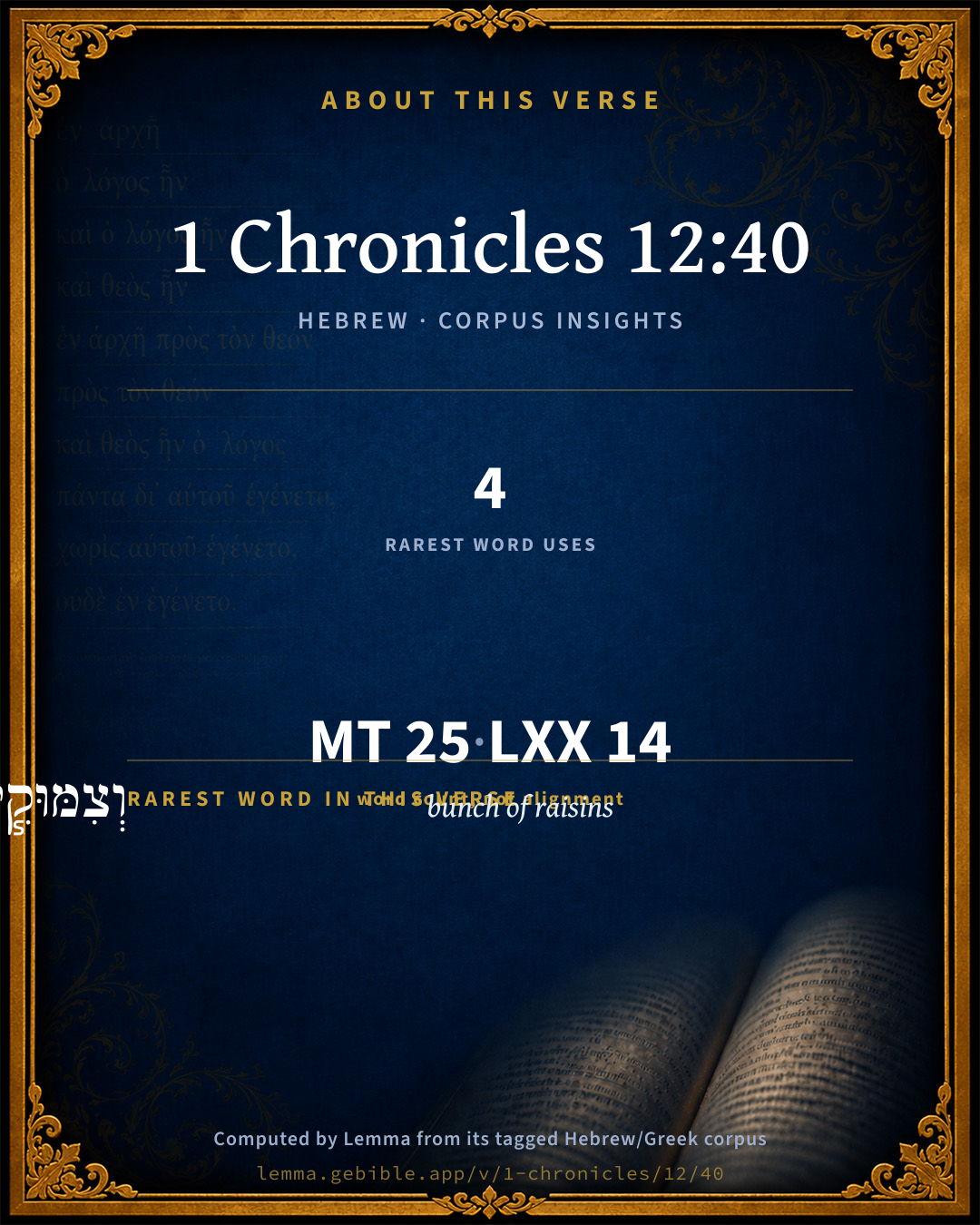
The rarest word here is וְצִמּוּקִ֧ים bunch of raisins H6778 — appearing just 4 times in the whole Hebrew Bible.

Shared distinctive vocabulary

וְצִמּוּקִ֧ים bunch of raisins H6778 occurs in 4 verses of the Hebrew Bible. Also found in:

Grammatical profile

  • 1 verb
  • 19 nouns
  • 1 adjective
  • 2 prepositions
  • 1 conjunction
  • 1 particle

Verb forms

  • מְבִיאִ֣ים Hiphil · Participle Active

Repetition

A word recurs within this verse — often emphatic in Hebrew:

  • וּֽבַבָּקָ֡ר cattle H1241 ×2

Hebrew & Septuagint length

In English translation the verse runs 55 words from the Hebrew and 42 from the Septuagint (LXX English) — closely comparable.

A rough comparison of the two English renderings, which tokenize alike — not a word-level alignment.

Word counts can differ between the Hebrew and the Greek without any difference in meaning — e.g. the Hebrew direct-object marker אֵת has no separate Greek word, and Greek often adds the article ὁ.

In the original languages it is 25 Hebrew tokens and 14 Greek tokens — but the two are counted differently (Hebrew bundles its prefixes and suffixes into one token; the Greek is in lemma form), so that isn’t a like-for-like length.

Cross-references

10

Topical passages linked to 1 Chronicles 12:40 in the Treasury of Scripture Knowledge — connected by theme and wording, ordered by reader-vote popularity; previews shown in the World English Bible.

  • 1 Samuel 25:18 Then Abigail made haste, and took two hundred loaves, and two bottles of wine, and five sheep ready dressed, and five measures of parched grain, and one hundred clusters of raisins, and two hundred cakes of figs, and laid them on donkeys.
  • 2 Samuel 16:1 When David was a little past the top [of the ascent], behold, Ziba the servant of Mephibosheth met him, with a couple of donkeys saddled, and on them two hundred loaves of bread, and one hundred clusters of raisins, and one hundred summer fruits, and a bottle of wine.
  • Proverbs 11:10 When it goes well with the righteous, the city rejoices. When the wicked perish, there is shouting.
  • Proverbs 29:2 When the righteous thrive, the people rejoice; But when the wicked rule, the people groan.
  • 2 Samuel 17:27–29 It happened, when David was come to Mahanaim, that Shobi the son of Nahash of Rabbah of the children of Ammon, and Machir the son of Ammiel of Lodebar, and Barzillai the Gileadite of Rogelim,
  • 1 Kings 1:40 All the people came up after him, and the people piped with pipes, and rejoiced with great joy, so that the earth shook with the sound of them.
  • 2 Kings 11:20 So all the people of the land rejoiced, and the city was quiet. Athaliah they had slain with the sword at the king's house.
  • Jeremiah 23:5–6 Behold, the days come, says Yahweh, that I will raise to David a righteous Branch, and he shall reign as king and deal wisely, and shall execute justice and righteousness in the land.
  • Luke 19:37–38 As he was now getting near, at the descent of the Mount of Olives, the whole multitude of the disciples began to rejoice and praise God with a loud voice for all the mighty works which they had seen,
  • Revelation 19:5–7 A voice came forth from the throne, saying, "Give praise to our God, all you his servants, you who fear him, the small and the great!"

Cross-references courtesy of OpenBible.info (CC BY 4.0).

Hebrew and Greek witnesses Masoretic Hebrew ↔ Greek Septuagint

The same verse in the two great witnesses to the Old Testament, shown verse-for-verse.

These are two independent witnesses, not word-aligned to each other, and the Septuagint is shown in lemma (dictionary) form.

Hebrew 1 Chronicles 12:40 Masoretic · Westminster Leningrad Codex

וְגַ֣ם הַקְּרֽוֹבִים אֲ֠לֵיהֶם עַד יִשָׂשכָ֨ר וּזְבֻל֜וּן וְנַפְתָּלִ֗י מְבִיאִ֣ים לֶ֡חֶם בַּחֲמוֹרִ֣ים וּבַגְּמַלִּ֣ים וּבַפְּרָדִ֣ים וּֽבַבָּקָ֡ר מַאֲכָ֡ל קֶ֠מַח דְּבֵלִ֨ים וְצִמּוּקִ֧ים וְיַֽיִן וְשֶׁ֛מֶן וּבָקָ֥ר וְצֹ֖אן לָרֹ֑ב כִּ֥י שִׂמְחָ֖ה בְּיִשְׂרָאֵֽל

Moreover those who were near to them, [even] as far as Issachar and Zebulun and Naphtali, brought bread on donkeys, and on camels, and on mules, and on oxen, food of meal, cakes of figs, and clusters of raisins, and wine, and oil, and oxen, and sheep in abundance: for there was joy in Israel.

World English Bible · Public Domain

Greek LXX 1 Chronicles 12:40 Septuagint · lemma form

καί εἰμί ἐκεῖ ἡμέρα τρεῖς ἐσθίω καί πίνω ὅτι ἑτοιμάζω αὐτός ὁ ἀδελφός αὐτός

And their neighbors, as far as Issachar and Zabulon and Nephthali, brought to them upon camels, and asses, and mules, and upon calves, food, meal, cakes of figs, raisins, wine, and oil, calves and sheep abundantly: for there was joy in Israel.

LXX2012 (modern English Septuagint) · Public Domain

On this verse, Ellicott's Commentary for English Readers discusses the Septuagint’s reading. Read the note in Commentary ↓

Hebrew: Westminster Leningrad Codex (CC BY 4.0). Greek: Septuagint (public domain); English from LXX2012 (modern English Septuagint) (Public Domain). How the Septuagint differs from the Hebrew →

Commentary

Notes on 1 Chronicles 12:40 from classic Christian and Jewish commentators (each source and its license shown beneath its notes). The classic Christian expositions comment on the surrounding passage and are grouped to its opening verse, so a note may address several verses; the Jewish commentaries on the Tanakh (Rashi and others) are per-verse, so they appear only where the commentator wrote on this verse.

Lemma curates 59 commentaries, every one of them public domain or Creative Commons licensed, each selected and text-cleaned for this edition rather than reprinted as found. About our sources →

Trapp's Complete Commentary

John Trapp

1Ch 12:40 Moreover they that were nigh them, [even] unto Issachar and Zebulun and Naphtali, brought bread on asses, and on camels, and on mules, and on oxen, [and] meat, meal, cakes of figs, and bunches of raisins, and wine, and oil, and oxen, and sheep abundantly: for [there was] joy in Israel.

Ver. 40. Moreover, their brethren.] By grace and place.

For there was joy in Israel.] As great cause they had.

John Trapp, A Commentary or Exposition upon All the Books of the Old and New Testament (1647–1656) — public domain. Text from a community e-Sword module.

Joseph Benson's Commentary

1Ch 12:40. They that were nigh them — That lived not far from Hebron, the place where they now were. Unto Issachar, &c. — This is added by way of amplification and explication, to show that this was not to be understood of those Israelites only who lived in the neighbourhood of Hebron, but of those also who lived at some distance, yet were nearer to Hebron than some of the other tribes here named. And on oxen — Which, though not commonly used in this manner, nor very fit for such purposes, yet were now employed, because the quantity of provisions which they brought was very great, as the number of the people at Hebron were, and of horses they had few in Israel, and most of their asses, camels, and mules, here mentioned, were probably used to carry men, women, and children, to this great, and public, and happy solemnity. For there was joy in Israel — Partly because their civil wars were wholly ended, and they were all united under one king; and partly because they had now a king of eminent valour and piety, and therefore expected to be saved from all their enemies and calamities, as indeed they were. Such was the joy and feasting when David was made king. And when the throne of the Son of David is set up in any soul, there is great joy in that soul; and provision is made for the feasting of it, not as here, merely for two or three days, but for the whole life, nay, for eternity.

Joseph Benson's Commentary on the Old and New Testaments (1811–1818) — public domain. Text from a community e-Sword module.

Ellicott's Commentary for English Readers

(40) They that were nigh them.—The tribes bordering on Judah (LXX. οἱ ὁμοροῦντες), and even the northern tribes, contributed provisions.

Brought, were bringing.

Asses . . . camels . . . mules . . . oxen, but not horses, were the usual beasts of burden in rocky Canaan.

Meat, meal.—Rather, food of flour.

Bunches.—Rather, cakes of raisins; masses of dried figs and raisins were, and are, a staple article of’ food iύύ the East (comp. 1Sa_25:18; Amo_8:11). The simple diction of the narrative, reminding us of Homer’s feasts, is a mark of its ancient origin.

1 Chronicles 13-16 form a complete section relating to the transfer of the Ark from Kirjath-jearim to its new sanctuary at Jerusalem. The continuity of the narrative is only suspended by the short parenthetic 1 Chronicles 14. 1 Chronicles 13 is closely parallel to 2Sa_6:1-11. The introduction, however (1Ch_12:1-5), is much fuller than that of Samuel, which is condensed into one brief sentence.

A Bible Commentary for English Readers, edited by Charles John Ellicott (1878–1897) — public domain. Text from a community e-Sword module.

The Cambridge Bible for Schools and Colleges

gen. ed. J. J. S. Perowne

40. they that were nigh unto them] The relatives of the assembled warriors cared for their needs.

even unto Issachar] R.V. even as far as Issachar. Even those warriors who came from the northern districts were provisioned by their kinsfolk.

and meat, meal] R.V. victual of meal.

bunches of raisins] R.V. clusters of raisins; as 1Sa_25:18; 1Sa_30:12; cp. 2Sa_16:1.

The Cambridge Bible for Schools and Colleges (gen. ed. J. J. S. Perowne; Cambridge University Press, 1878–1918) — public domain. Text from a community e-Sword module.

Haydock's Catholic Bible Commentary

Nephthali. All, both far and near, contributed to regale the deputies. (Calmet)

George Leo Haydock (1774–1849), Haydock's Catholic Family Bible and Commentary, 1859 edition — public domain. Excludes Psalms (Douay-Rheims chapter numbering differs from Protestant) and Deuterocanonical books (Catholic canon only).

Matthew Poole's English Annotations

They that were nigh them; that lived not far from Hebron, the place where they now were.

Unto Issachar and Zebulun and Naphtali: this is added by way of amplification and explication, to show that he did not understand this of those Israelites only who lived in the neighbourhood of Hebron, but of those that lived at some distance, yet were nearer to Hebron than some of the other tribes here named.

On oxen; which though not commonly used in this manner, nor fit for such purposes, now they so used, because the quantity of provisions which they brought was very great, as the numbers of the people at Hebron were, and horses they had few in Israel, and most of their asses, and camels, and mules here mentioned probably were used to carry divers men, or women and children, to this great, and public, and happy solemnity.

There was joy in Israel; partly because their civil wars were wholly ended, and they were all united under one king; and partly because they had now a king of eminent valour, and piety, and felicity, and therefore expected to be saved from all their enemies and calamities, as they were.

Matthew Poole's English Annotations on the Holy Bible (1683–1685) — public domain. Text from a community e-Sword/MySword module.

Whedon's Commentary on the Bible

Daniel D. Whedon

40. Even unto Issachar — Not only the tribes near Hebron, but those on the far off northern frontier contributed provisions for this great national feast.

The numbers of this list amount to 340,822, including 8,322 Levites and priests. When now we remember that the nation numbered 600,000 warriors in the time of Moses, (Num_1:46,) and 800,000 (besides the 500,000 of Judah) in the last years of David’s reign, (2Sa_24:9,) it seems probable that the numbers of the present list, both in the aggregate and in detail, are substantially correct. We need not suppose that all the warriors of all the tribes went to Hebron to make David king, but that about 300,000 appeared on that occasion is every way probable. With this vast host of warriors the newly elected king of “all Israel” proceeded at once to the conquest of Jerusalem. See 1Ch_11:1-9.

Daniel D. Whedon (gen. ed.), Commentary on the Old and New Testaments (1874–1909) — public domain. Text from a community e-Sword module.

The Pulpit Commentary

Moreover, they that were nigh them. The meaning is that not only the "brethren" of Judah and of the nearer neighbourhood of Hebron joined to entertain and to show hospitality to the immense throngs of visitors, but that others did so in ever-widening circles, even as far as the remoter Issachar, Zebulun, and Naphtali. For there was joy in Israel. The joy must have been largely enhanced by the national consciousness of divided rule coming to an end, and of the cloud and frown of the Divine countenance having cleared mercifully away. All now could join to show loyalty and to feel it towards one king, of whom they had reason to believe that he was the chosen of God as of themselves.

The earnest of human joy.

When the joy of a vast number of people finds expression in unison it must needs be exceedingly impressive. Were it possible to hear at once that consentaneous volume of sound of gladness, it would be nothing less than overpowering in its effect. Or, if it were possible to see at a glance all the signs and all the manifestations of the sparkling gladness, no scene of outer nature could be supposed so dazzling, so bewildering. But in the known harmonious joy of a vast multitude of people, it is not the mere effect upon our sense of the expression of it or the manifestation of it that would invest it with its most real and in fact most solemn force. This would rather be due to the suggestions thickly, richly clustering round about it. Whence it grew, what it had intrinsically in it, and to what it was promising to grow, would assuredly be some of the first of the thought which we should thereupon think. And these deeper, less visible feeders of our own joy would prove the more lasting and the more significant account of the deep feeling wrought within us. The point of Scripture narrative at which we are now arrived reveals to us a whole nation in the crisis of its joy. There are peculiarities about that joy very possibly of a merely temporary character, but there are others that are good for study, as permanent in their nature and as having the efficacy of principles. Let us take note .

I OF SOME OF THE CAUSES OF THIS "JOY IN ISRAEL? The nearer causes are not doubtful. For:

1. The people were glad to have reached the termination of a periodharassed by suspense. For some years now they had not lived under any certain satisfactory rule. If their armies had gone out best equipped and full of courage in their cause, they were still not confident that the cause was a safe one, a right one, one that would command the presence among them of the supreme Leader of their hosts, who taught their hands to war and their fingers to fight. And if they were awhile at peace at home, they had no guarantee that the time of peace was one of growth and sound healthy prosperity. The family, the business establishment, is ever in uncertainty, and there is an absence of satisfaction if the parent or the master is all uncertain in habit, in character, in principle.

2. They were glad to have a king who was introduced to them under fardifferent and far better auspices than ever their former king had been. Some years had now elapsed since Saul took office, and though he was anointed by Divine command, yet the distinct announcement was made of a deep disapproval in one sense on the part of the only real King. Under dark omens their visible monarchy opened upon Israel. And the thoughtful and deeper-seeing of the wise and good, the "Israelites indeed" among them, will have early wakened to the process that was going on, and to that fulfilment of Divine forebodings that was transpiring in the overcast periods of Saul"s defection. But now part of their punishment had already fallen, and for a time they had reason to think that fairer things were before them. They with reason thought that the king of their own enthusiastic choice this day was also "the man after God"s own heart." They knew he was not an untried man. They knew rather how tried he had been and also bow he had been tried, and how he had borne and acquitted himself in the trial, so as to command the growing honour, esteem, and love of all the people. How tremendous the difference and the consequences of the difference between a good leader, parent, teacher, master, ruler, and a bad or indifferent one I No man is so obscure, so stripped of all surroundings, as to be absolutely bereft of influence and "to live to himself" alone, but they whose very life-place and life-business are to "lead" or "shepherd" in any way are in the very opposite extreme of such a supposition, and the consequences of just what they are, what they say, what they do, are incalculable in momentousness and in responsibility. And an unwilling people show now that they had become very fully alive to this fact.

3. All Israel were glad because all Israel were now again one and at one inthe matter of their king and leader. One tabernacle and one court, one palace, one king, one administration of justice, now again they can call theirs. They do not feel the humiliation, the disgrace, the practical disadvantage of the contrary of these. One of the keenest reproaches which the enemies of Israel must have often flung in their face was their divided state under so much of Saul"s nominal kingship and for a few years subsequently.

II OF SOME OF THE DEEPER ELEMENTS FIXING THE CHARACTER OF THIS JOY. One of these did no doubt at this time play a considerable part, though the people were largely unconscious of it. For:

1. Even the mistaken aspiration and that which was counted to them as asin, to have a visible king, did for all that mark an aspiration, and this also

2. was counted to them and counted for good so far as ever they permitted it. The very language in which they originally worded their desire was remarkable, in this respect, though somewhat less so in that they quoted as some precedent the fashion of surrounding nations no models for them. "Make us a king to judge us, that we also may be like all the nations; and that our king may judge us, and go out before us, and fight our battles". (1Sa_8:5-20) The large multitude of people in different tribes sharply outlined, and in families surprisingly registered, were feeling for something the reverse of classification the oneness of national life. And at present they found the spiritual effort by itself severe. They craved some embodiment of the ideas and feelings which were now strongly working within them. And their sin in desiring in aid hereof a visible judge, warrior, king, was in kind but like the sin of all those who do not rise to their opportunity and who do live below their time of day, their light, their revelation. God is ever, by providence and by word, pronouncing our human nature to be capable of doing better things than it does, and of rising to higher things than it consents to acknowledge by corresponding effort. However on the lower level this people may be beheld, and beheld with some sympathy, as they now yearned for a closer brotherhood, a more homogeneous development of national life, a semblance still of the perfect model, of which, however strangely, they "judged themselves unworthy." They took, or certainly seemed to themselves to take, a great step in advance in this respect when to-day they not only rejoiced around a king, one of their own choice and of God"s distinctest choice as well, but when all of them were united thus to rejoice. There were no longer two kings, one nominal, the other real, nor a people divided into two at least, and an army in two camps, but when "all Israel" felt and showed and spoke the great joy with heartfelt, spontaneous unanimity.

3. Akin to this, less acknowledged but not less potent stimulus of a unitednation"s joy, may be ranged the various life, and character, and age, and condition, all fairly represented, which swelled the bulk of it. All classes of citizen life, and the priest and the warrior; all conditions of the life of that time, and the rich and the poor; all ages of lifetime, the man laden with memories and the young man, the strong and the weak; none were shut out from this joy. And thus this multifarious composition of it helped to fix the joy.

III OF SOME OF THE LASTING SUGGESTIONS OF IT.

1. May it not justly suggest the thought of the fulness and special blissthere is about unselfish joy. Our individual joy is often tainted with selfishness, or self-regard only. Our domestic joy is not unfrequently tarnished by it. Most of the organizations of which we form parts are open to fostering in some degree the same partial fellowship of joy. But a general national joy largely escapes this snare of partial measure.

2. Does it not opportunely suggest the large reserve of capacity of joythere must be at present in human nature? We have just enough, we may be thankful to believe, to supply to us the requisite light and heat in the history of most men, but there is more cloud and darkness, more rain and cold, than there is of the real experience and outburst of joy. We have no right to be unthankful for what our inner sky is, and for the amount of peace and serenity, warming betimes into cheerfulness and into genialness, granted to us. But where the most and the best of these are true, we can never mistake them for the surrender of our powers, susceptibility, and very self to the amplitude of joy, of which they are capable even here. But least of all is it common to find the maximum of joy spread at the same time over the maximum of people.

3. And does it not betoken something of the rapture of expectant humanity humanity perfected, redeemed, sanctified? God is full of joy. We cannotdare, to form an idea of him antagonistic to such a principle. "Fallen short of his glory, as we now are, we have become almost too complacently reconciled to the forfeit paid, to the present toned-down temper of life, to its present strong admixture of sorrow, woe, darkness, and we may detect ourselves sometimes thinking this to be the essential condition instead of the severe rebuke rising gradually into the beneficial discipline of life. But no; "we look for new heavens and a new earth," in which, as surely as "righteousness shall dwell, so surely shall joy reign for ever and ever. How universal, how impartial, how perfect in all highest elements of it, will be that harmony of human joy, when the kingdoms of this world shall have all merged in the kingdom of the one great King, eternal, immortal, invisible, and he shall have become the Chosen of all nations, of every tribe and family David"s greater Son!

Joy in Israel.

After the reign of Saul, with all its caprice, violence, and irreligiousness, it was with something more than a feeling of relief that Israel welcomed the accession of his successor. The unity of the people was manifested in the large and representative assembly that gathered together at Hebron, and the cordial sympathy of the absent in the presents and tribute forwarded from all parts of the land. The feasting was prolonged for three days; for the tables were abundantly furnished by the contributions of the several tribes, even from those in the northern districts of Palestine. Let us regard the "joy in Israel" as emblematic of that which pervades Christendom in the acknowledgment of Christ"s Divine and regal authority.

I THE OCCASION of this joy. It is the sovereignty of the Messiah, "I have set my King upon my holy hill of Zion." Christ is the rightful King of humanity. He is the acknowledged and actual King of his ransomed Church. "He shall reign until he hath put every enemy under his feet." Surely a race, distracted by lawlessness and rebellion, may well rejoice when assured that a King so mighty and so wise ascends his rightful throne.

II THE SUBJECTS of this joy. "Let Israel be glad." They who own Jesus as King are the proper persons to offer the sacrifices of rejoicing. How many are the admonitions we find in Scripture to rejoice in the reign of Immanuel! "Let all the children of Judah be joyful in their king!" With shouts of acclaim and songs of welcome do Christ"s people exalt him to the throne of their loyal hearts.

III THE MANIFESTATIONS of this joy. Joy is not wont to be silent. The elders and chief captains of Israel held high festival because David accepted the crown. And Christ"s true subjects cannot do other than speak forth his praise and celebrate his exploits.

IV THE RESULTS of this joy. If we feel the gladness which Christ"s kingship is fitted to awaken, we shall find it easy to submit and to obey; we shall learn that "the joy of the Lord is our strength;" we shall have some earnest of the higher and immortal joy which shall fill the courts of heaven.

LESSONS.

1. A rebuke to gloomy Christians. Your faith, if you have any, must be feeble indeed if joy is a strange emotion to your heart.

2. An encouragement to rejoicing Christians to turn their joy into motive power, that they may aid in the culture of holiness and in the achievements of Christian service. T.

The Pulpit Commentary (1880–1919), ed. H.D.M. Spence-Jones & Joseph S. Exell — public domain. Text from a community e-Sword module.

Lesson kit

Teaching starters — assembled from the data on this page, not authored interpretation. Every prompt links to the verse data it draws on. Edit before teaching.

1 Chronicles, in the Historical, opens this verse with 25 words (24 distinct Hebrew lemmas). Its most distinctive word is tsammûwq (“bunch of raisins”). A historical commentator’s framing appears above. Read the whole chapter for the surrounding context.

Discussion questions

  1. The word tsammûwq carries the sense “bunch of raisins.” How does it shape the verse?
  2. 1 Samuel 25:18 shares the word «bunch of raisins» with this verse. How do the two illuminate each other?
  3. “cattle” occurs 2× in this one verse. What is the effect of the repetition?
  4. The translations on this page render this verse differently — a whole-verse word diff, not a word-by-word alignment. What might account for the different wordings?
  5. The verb «מְבִיאִ֣ים» is Hiphil Participle Active. How does its form color the action?
  6. Reading how Trapp's Complete Commentary and Joseph Benson's Commentary read this verse, where do the two commentators agree and where do they part?

Things to notice

Reading settings

Reading text

Shown beneath each verse's original-language words.

Old Testament
Old Testament edition

Read the OT as the Masoretic Hebrew (MT) or the Greek Septuagint (LXX).

English shown for the Greek Septuagint (in the Hebrew ↔ Greek comparison).

Comparing translations? Open the Compare panel on any verse page to stack up to four side by side.