
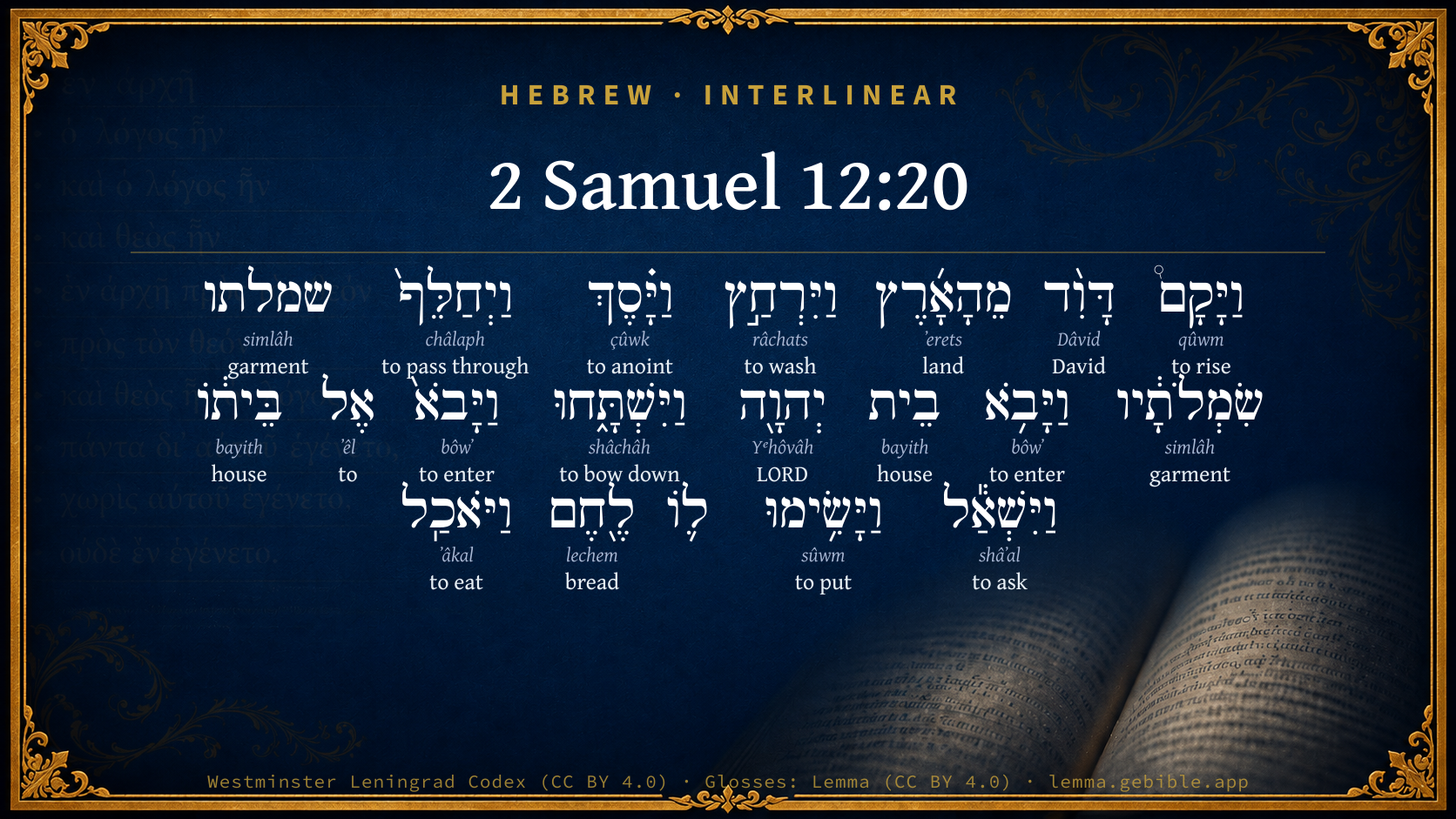
2 Samuel 12:20

Hebrew (Westminster Leningrad Codex) 2 Samuel 12:20 appears in the Hebrew Old Testament. The text above is from the Westminster Leningrad Codex. Each word links to its Strong’s number, a concise gloss, and parsing drawn from the Open Scriptures Hebrew Bible morphology. Click any word for its full Brown-Driver-Briggs (BDB) entry.
Download image
Cite this verse

2 Samuel 12:20 (World English Bible). Public Domain. Lemma interlinear Bible study tool, https://lemma.gebible.app/v/2-samuel/12/20.

Show BibTeX & RIS
BibTeX
RIS
English Translation
Then David arose from the earth, and washed, and anointed himself, and changed his clothing; and he came into the house of Yahweh, and worshiped: then he came to his own house; and when he required, they set bread before him, and he ate.
World English Bible · Public Domain
Download a study sheet

One document with this verse’s original text, its word-by-word gloss line, the meaning frame, cross-references with their text, attributed commentary, and full source and license credits — printable, and it pastes into notes with its structure intact.

This verse Autodidact and up

Study sheet (.html) Plain text (.txt)

A passage Seminary Student

Up to 50 verses in one chapter. A passage sheet keeps up to 6 commentary sources and 12 cross-references per verse, in the order this page ranks them, and says so on the sheet whenever that leaves anything out. Ask for a single verse and you get the Autodidact verse sheet above.

Everything on this page stays free to read, with no account — the sheet is a download of what is already on screen, not access to it.

Want to remove ads? Support Godless Engineer
Compare translations 3

The same verse in 3 English versions, stacked beneath the original-language interlinear above. Click any original word for its lexicon entry.

Each is an independent rendering of the whole verse — the interlinear is not word-aligned to these translations.

Highlighted words mark where these versions differ — a whole-verse word diff, not a word-by-word alignment.

  • World English Bible Public Domain
    Then David arose from the earth, and washed, and anointed himself, and changed his clothing; and he came into the house of Yahweh, and worshiped: then he came to his own house; and when he required, they set bread before him, and he ate.
  • King James Version Public Domain
    Then David arose from the earth, and washed, and anointed himself, and changed his apparel, and came into the house of the LORD, and worshipped: then he came to his own house; and when he required, they set bread before him, and he did eat.
  • unfoldingWord Literal Text CC BY-SA 4.0
    Then David arose from the ground, and he washed, and he anointed, and he changed his clothes, and he entered the house of Yahweh, and he prostrated himself. Then he went to his house, and he asked, and they set out bread for him, and he ate.

unfoldingWord Literal Text — © unfoldingWord, licensed CC BY-SA 4.0. Word-aligned USFM3 via Door43 (git.door43.org/unfoldingWord/en_ult).

Versions to compare (up to 4)

3 of 4 selected

Show all 18 translations

Every available English version of this verse, each an independent rendering of the whole verse.

  • World English Bible Public Domain
    Then David arose from the earth, and washed, and anointed himself, and changed his clothing; and he came into the house of Yahweh, and worshiped: then he came to his own house; and when he required, they set bread before him, and he ate.
  • Berean Standard Bible Public Domain
    Then David got up from the ground, washed and anointed himself, changed his clothes, and went into the house of the LORD and worshiped. Then he went to his own house, and at his request they set food before him, and he ate.
  • Majority Standard Bible Public Domain
    Then David got up from the ground, washed and anointed himself, changed his clothes, and went into the house of the LORD and worshiped. Then he went to his own house, and at his request they set food before him, and he ate.
  • King James Version Public Domain
    Then David arose from the earth, and washed, and anointed himself, and changed his apparel, and came into the house of the LORD, and worshipped: then he came to his own house; and when he required, they set bread before him, and he did eat.
  • American Standard Version (1901) Public Domain
    Then David arose from the earth, and washed, and anointed himself, and changed his apparel; and he came into the house of Jehovah, and worshipped: then he came to his own house; and when he required, they set bread before him, and he did eat.
  • Revised Version (1885) Public Domain
    Then David arose from the earth, and washed, and anointed himself, and changed his apparel; and he came into the house of the LORD, and worshipped: then he came to his own house; and when he required they set bread before him, and he did eat.
  • Geneva Bible (1599) Public Domain
    Then Dauid arose from the earth, and washed and anoynted himselfe, and changed his apparell, and came into the house of the Lord, and worshipped, and afterward came to his owne house, and bade that they should set bread before him, and he did eate.
  • Douay-Rheims (1899) Public Domain
    Then David arose from the ground, and washed and anointed himself: and when he had changed his apparel, he went into the house of the Lord: and worshipped, and then he came into his own house, and he called for bread, and ate.
  • Young's Literal Translation Public Domain
    And David riseth from the earth, and doth bathe and anoint `himself', and changeth his raiment, and cometh in to the house of Jehovah, and boweth himself, and cometh unto his house, and asketh and they place for him bread, and he eateth.
  • Literal Standard Version CC BY-SA 4.0
    And David rises from the earth, and bathes and anoints [himself], and changes his raiment, and comes into the house of YHWH, and bows himself, and comes to his house, and asks and they place bread for him, and he eats.
  • Unlocked Literal Bible CC BY-SA 4.0
    Then David arose from the floor and washed himself, anointed himself, and changed his clothes. He went to the tabernacle of Yahweh and worshiped there, and then he came back to his own palace. When he asked for it, they set food before him, and he ate.
  • unfoldingWord Literal Text CC BY-SA 4.0
    Then David arose from the ground, and he washed, and he anointed, and he changed his clothes, and he entered the house of Yahweh, and he prostrated himself. Then he went to his house, and he asked, and they set out bread for him, and he ate.
  • Darby Bible Public Domain
    Then David arose from the earth, and washed, and anointed himself, and changed his clothing, and entered into the house of Jehovah and worshipped; then he came to his own house and required them to set bread before him, and he ate.
  • World Messianic Bible Public Domain
    Then David arose from the earth, and washed and anointed himself, and changed his clothing; and he came into the LORD’s house, and worshiped. Then he came to his own house; and when he requested, they set bread before him and he ate.
  • Webster's Bible Public Domain
    Then David arose from the earth, and washed, and anointed himself, and changed his apparel, and came into the house of the LORD, and worshiped: then he came to his own house; and when he required, they set bread before him, and he ate.
  • Free Bible Version CC BY-SA 4.0
    David got up from the ground, washed and put on scented oils, and changed his clothes. Then he went to the house of the Lord and worshiped. Afterwards he went back home, and asked for some food. So they served him a meal which he ate.
  • Bible in Basic English Public Domain
    Then David got up from the earth, and after washing and rubbing himself with oil and changing his clothing, he went into the house of the Lord and gave worship: then he went back to his house, and at his order they put food before him and he had a meal.
  • JPS Tanakh (1917) Public Domain
    Then David arose from the earth, and washed, and anointed himself, and changed his apparel; and he came into the house of the LORD, and worshipped; then he came to his own house; and when he required, they set bread before him, and he did eat.

Literal Standard Version (2020), Covenant Press — licensed CC BY-SA 4.0. Text via the HelloAO Bible API (eBible.org). Unlocked Literal Bible (unfoldingWord) — licensed CC BY-SA 4.0. Text via the HelloAO Bible API (eBible.org). unfoldingWord Literal Text — © unfoldingWord, licensed CC BY-SA 4.0. Word-aligned USFM3 via Door43 (git.door43.org/unfoldingWord/en_ult). Free Bible Version, Dr. Jonathan Gallagher — licensed CC BY-SA 4.0. Text via the HelloAO Bible API (eBible.org).

Word by word

More ways to search: Search by grammar → Find every occurrence → Compare this word →

Practice this passage: Drill this verse → Learn its vocabulary →

וַיָּ֗סֶךְ
çûwk
H5480
“and · to anoint”
Conjunction + Verb, Qal, Sequential Imperfect, 3rd Person, Masculine, Singular
Part of Speech
Conjunction + Verb
Stem
Qal
Form
Sequential Imperfect
Person
3rd Person
Gender
Masculine
Number
Singular
Full BDB Definition

Origin: a primitive root

TWOT: 1474

to anoint, pour in anointing - (Qal) to anoint - to anoint oneself - to anoint (another) - to be poured - (Hiphil) to anoint
  1. וַיָּקָם֩ qûwm H6965 “and · to rise” Conjunction + Verb, Qal, Sequential Imperfect, 3rd Person, Masculine, Singular
  2. דָּוִ֨ד Dâvid H1732 “David” Noun, Proper
  3. מֵהָאָ֜רֶץ ʼerets H776 “from · the · land” Preposition + Particle, Definite Article + Noun, Common, Both, Singular, Absolute
  4. וַיִּרְחַ֣ץ râchats H7364 “and · to wash” Conjunction + Verb, Qal, Sequential Imperfect, 3rd Person, Masculine, Singular
  5. וַיְחַלֵּף֙ châlaph H2498 “and · to pass through” Conjunction + Verb, Piel, Sequential Imperfect, 3rd Person, Masculine, Singular
  6. שמלתו simlâh H8071 “garment · his” Noun, Common, Feminine, Singular, Construct + Suffix, Personal, 3rd Person, Masculine, Singular
  7. שִׂמְלֹתָ֔יו simlâh H8071 “garments · his” Noun, Common, Feminine, Plural, Construct + Suffix, Personal, 3rd Person, Masculine, Singular
  8. וַיָּבֹ֥א bôwʼ H935 “and · to enter” Conjunction + Verb, Qal, Sequential Imperfect, 3rd Person, Masculine, Singular
  9. בֵית bayith H1004 “house of” Noun, Common, Masculine, Singular, Construct
  10. יְהוָ֖ה Yᵉhôvâh H3068 “LORD” Noun, Proper
  11. וַיִּשְׁתָּ֑חוּ shâchâh H7812 “and · to bow down” Conjunction + Verb, Hithpael, Sequential Imperfect, 3rd Person, Masculine, Singular
  12. וַיָּבֹא֙ bôwʼ H935 “and · to enter” Conjunction + Verb, Qal, Sequential Imperfect, 3rd Person, Masculine, Singular
  13. אֶל ʼêl H413 “to” Preposition
  14. בֵּית֔וֹ bayith H1004 “house · his” Noun, Common, Masculine, Singular, Construct + Suffix, Personal, 3rd Person, Masculine, Singular
  15. וַיִּשְׁאַ֕ל shâʼal H7592 “and · to ask” Conjunction + Verb, Qal, Sequential Imperfect, 3rd Person, Masculine, Singular
  16. וַיָּשִׂ֥ימוּ sûwm H7760 “and · to put” Conjunction + Verb, Qal, Sequential Imperfect, 3rd Person, Masculine, Plural
  17. לֶ֖חֶם lechem H3899 “bread” Noun, Common, Both, Singular, Absolute
  18. וַיֹּאכַֽל ʼâkal H398 “and · to eat” Conjunction + Verb, Qal, Sequential Imperfect, 3rd Person, Masculine, Singular

About this verse

These counts appear in no published source. They are computed here, from the morphology-tagged text and Lemma’s own curated glosses. What Lemma adds →

20
words
16
distinct lemmas
Historical
section

Notable vocabulary

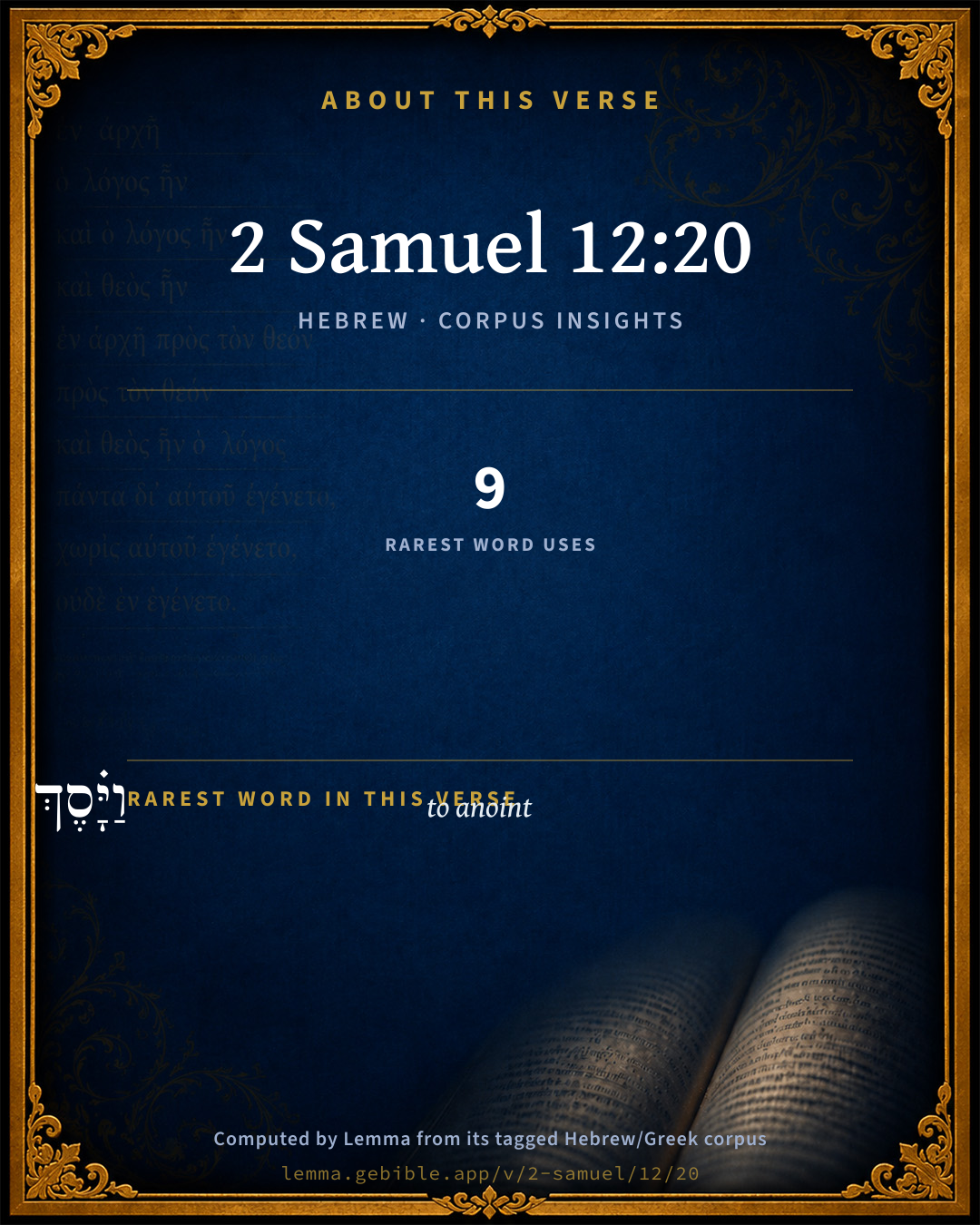
The rarest word here is וַיָּ֗סֶךְ to anoint H5480 — appearing just 9 times in the whole Hebrew Bible.

Shared distinctive vocabulary

וַיָּ֗סֶךְ to anoint H5480 occurs in 8 verses of the Hebrew Bible. Also found in:

Grammatical profile

  • 10 verbs
  • 8 nouns
  • 2 prepositions

Verb forms

  • וַיָּקָם֩ Qal · Sequential Imperfect
  • וַיִּרְחַ֣ץ Qal · Sequential Imperfect
  • וַיָּ֗סֶךְ Qal · Sequential Imperfect
  • וַיְחַלֵּף֙ Piel · Sequential Imperfect
  • וַיָּבֹ֥א Qal · Sequential Imperfect
  • וַיִּשְׁתָּ֑חוּ Hithpael · Sequential Imperfect
  • וַיָּבֹא֙ Qal · Sequential Imperfect
  • וַיִּשְׁאַ֕ל Qal · Sequential Imperfect
  • וַיָּשִׂ֥ימוּ Qal · Sequential Imperfect
  • וַיֹּאכַֽל Qal · Sequential Imperfect

Repetition

Words recur within this verse — often emphatic in Hebrew:

  • שמלתו garment H8071 ×2
  • וַיָּבֹ֥א to enter H935 ×2
  • בֵית house H1004 ×2

Hebrew & Septuagint length

In English translation the verse runs 44 words from the Hebrew and 47 from the Septuagint (LXX English) — closely comparable.

A rough comparison of the two English renderings, which tokenize alike — not a word-level alignment.

Word counts can differ between the Hebrew and the Greek without any difference in meaning — e.g. the Hebrew direct-object marker אֵת has no separate Greek word, and Greek often adds the article ὁ.

Cross-references

9

Topical passages linked to 2 Samuel 12:20 in the Treasury of Scripture Knowledge — connected by theme and wording, ordered by reader-vote popularity; previews shown in the World English Bible.

  • Job 1:20 Then Job arose, and tore his robe, and shaved his head, and fell down on the ground, and worshiped.
  • Ruth 3:3 Wash yourself therefore, and anoint you, and put your clothing on you, and get you down to the threshing floor, but don't make yourself known to the man, until he shall have done eating and drinking.
  • Lamentations 3:39–41 Why does a living man complain, a man for the punishment of his sins?
  • 2 Samuel 7:18 Then David the king went in, and sat before Yahweh; and he said, Who am I, Lord Yahweh, and what is my house, that you have brought me thus far?
  • Job 2:10 But he said to her, "You speak as one of the foolish women would speak. What? Shall we receive good at the hand of God, and shall we not receive evil?" In all this Job didn't sin with his lips.
  • Ecclesiastes 9:8 Let your garments be always white, and don't let your head lack oil.
  • Matthew 6:17 But you, when you fast, anoint your head, and wash your face;
  • 2 Samuel 6:17 They brought in the ark of Yahweh, and set it in its place, in the midst of the tent that David had pitched for it; and David offered burnt offerings and peace-offerings before Yahweh.
  • Psalms 39:9 I was mute. I didn't open my mouth, Because you did it.

Cross-references courtesy of OpenBible.info (CC BY 4.0).

Hebrew and Greek witnesses Masoretic Hebrew ↔ Greek Septuagint

The same verse in the two great witnesses to the Old Testament, shown verse-for-verse.

These are two independent witnesses, not word-aligned to each other, and the Septuagint is shown in lemma (dictionary) form.

Hebrew 2 Samuel 12:20 Masoretic · Westminster Leningrad Codex

וַיָּקָם֩ דָּוִ֨ד מֵהָאָ֜רֶץ וַיִּרְחַ֣ץ וַיָּ֗סֶךְ וַיְחַלֵּף֙ שמלתו שִׂמְלֹתָ֔יו וַיָּבֹ֥א בֵית יְהוָ֖ה וַיִּשְׁתָּ֑חוּ וַיָּבֹא֙ אֶל בֵּית֔וֹ וַיִּשְׁאַ֕ל וַיָּשִׂ֥ימוּ ל֛וֹ לֶ֖חֶם וַיֹּאכַֽל

Then David arose from the earth, and washed, and anointed himself, and changed his clothing; and he came into the house of Yahweh, and worshiped: then he came to his own house; and when he required, they set bread before him, and he ate.

World English Bible · Public Domain

Greek LXX 2 Samuel 12:20 Septuagint · lemma form

καί ἀναἵστημι δαυίδ ἐκ ὁ γῆ καί λούω καί ἀλείφω καί ἀλλάσσω ὁ ἱμάτιον αὐτός καί εἰςἔρχομαι εἰς ὁ οἶκος ὁ θεός καί προςκυνέω αὐτός καί εἰςἔρχομαι εἰς ὁ οἶκος αὐτός καί αἰτέω ἄρτος ἐσθίω καί παρατίθημι αὐτός ἄρτος καί ἐσθίω

Then David rose up from the earth, and washed, and anointed himself, and changed his raiment, and went into the house of God, and worshipped him; and went into his own house, and called for bread to eat, and they set bread before him and he ate.

LXX2012 (modern English Septuagint) · Public Domain

Hebrew: Westminster Leningrad Codex (CC BY 4.0). Greek: Septuagint (public domain); English from LXX2012 (modern English Septuagint) (Public Domain). How the Septuagint differs from the Hebrew →

Targum (Aramaic paraphrase)

1

The Targum is the ancient Jewish Aramaic paraphrase of the Hebrew Scriptures — an interpretive translation, not the Hebrew text itself. Onkelos (literal) and Pseudo-Jonathan (expansive) render the Torah, and Jonathan the Prophets. Coverage is partial: where no permissively-licensed English translation exists for a verse, only the Aramaic is shown. This is verse-level text, not a word-by-word alignment to the Hebrew.

  1. Targum Jonathan Prophets (Joshua–Malachi)
    וְקָם דָוִד מִן אַרְעָא וּמְשַׁח וְשַׁף וְשַׁנֵי כְּסוּתֵיהּ וְעַל לְבֵית מַקְדְשָׁא דַייָ וּסְגִיד וַאֲתָא לְבֵיתֵיהּ וּשְׁאֵיל וְשַׁוִיאוּ לֵיהּ לַחְמָא וַאֲכַל:

    (no public-domain English translation for this verse)

    Targum Jonathan — Aramaic: “Mikraot Gedolot” (public domain). English: “Sefaria Community Translation” (CC0 1.0 (public-domain dedication)); “London "Chaldee Paraphrase," 1871” (public domain). Text via Sefaria.

Commentary

Notes on 2 Samuel 12:20 from classic Christian and Jewish commentators (each source and its license shown beneath its notes). The classic Christian expositions comment on the surrounding passage and are grouped to its opening verse, so a note may address several verses; the Jewish commentaries on the Tanakh (Rashi and others) are per-verse, so they appear only where the commentator wrote on this verse.

Lemma curates 59 commentaries, every one of them public domain or Creative Commons licensed, each selected and text-cleaned for this edition rather than reprinted as found. About our sources →

Trapp's Complete Commentary

John Trapp

2Sa 12:20 Then David arose from the earth, and washed, and anointed [himself], and changed his apparel, and came into the house of the LORD, and worshipped: then he came to his own house; and when he required, they set bread before him, and he did eat.

Ver. 20. Then David arose from the earth.] When God hath signified his will, he patiently submitteth, and acquiesceth therein. Grief for losses that are past hope of recovery, is more sullen than useful. A godly man saith Amen to God’s Amen; and putteth his fiat and placet to God’s. {Act 21:14}

And came into the house of the Lord.] Whose service he preferred before his necessary food, as Job 23:12. {See Trapp on "Job 23:12"}

John Trapp, A Commentary or Exposition upon All the Books of the Old and New Testament (1647–1656) — public domain. Text from a community e-Sword module.

Joseph Benson's Commentary

2Sa 12:20. David arose from the earth and changed his apparel — Put off the habit of a mourner, and prepared himself to appear before God. And came into the house of the Lord — That is, to the tabernacle, to confess his sin before the Lord, to own his justice in this stroke, to deprecate his just displeasure, to acknowledge God’s rich mercy in sparing his own life, and to offer such sacrifices as were required in such cases.

Joseph Benson's Commentary on the Old and New Testaments (1811–1818) — public domain. Text from a community e-Sword module.

Tyndale Open Study Notes

Tyndale Open Resources

12:20 The series of actions described here show David resuming normal life activities. That he did so this soon after his son’s death amazed his advisers (12:21).

Tyndale Open Study Notes — © Tyndale Open Resources, licensed CC BY-SA 4.0. Text via the HelloAO Bible API.

Geneva Bible (1599)

Geneva Bible translators

Showing that our lamentations ought not to be excessive, but moderate: and that we must praise God in all his doings.

Geneva Bible (1599) marginal notes — public domain. Text via Bolls.life.

Adam Clarke's Commentary

Verse 20. David arose from the earth, and washed] Bathing, anointing the body, and changing the apparel, are the first outward signs among the Hindoos of coming out of a state of mourning or sickness.

Adam Clarke's Commentary on the Bible (1810–1826) — public domain. Text from a community e-Sword/MySword module.

The Cambridge Bible for Schools and Colleges

gen. ed. J. J. S. Perowne

20. washed, and anointed himself, and changed his apparel] He laid aside all the outward signs of mourning. Cp. Mat_6:17.

anointed himself] Anointing the head and body with oil was and still is the regular practice in Eastern countries. It was believed to contribute to health and cleanliness. Its discontinuance was a mark of mourning. Cp. ch. 2Sa_14:2; Isa_61:3.

The Cambridge Bible for Schools and Colleges (gen. ed. J. J. S. Perowne; Cambridge University Press, 1878–1918) — public domain. Text from a community e-Sword module.

John Gill's Exposition

Then said his servants unto him, what thing is this that thou hast done?.... Or what is the reason of such conduct and behaviour? they knew what was done, but they did not know the meaning of it, which is what they inquired after:

thou didst fast and weep for the child, while it was alive; prayed with fasting and weeping for it, that it might live and not die:

but when the child was dead thou didst rise and eat bread; and appeared cheerful; this seemed strange to them, when they expected his sorrow would be increased.

John Gill's Exposition of the Whole Bible (1746–1763) — public domain (CC PDM 1.0). Text via the HelloAO Bible API.

Matthew Poole's English Annotations

Into the house of the Lord, i. e. to the tabernacle, to confess his sin before the Lord, and to own his justice in this stroke and the other threatenings, and to deprecate his great and just displeasure, and to acknowledge God’s rich mercy in sparing his own life, and to offer such sacrifices as were proper and required in such cases. Nor did David transgress that law, Num 19:14, in going thither before the seven days were expired. For neither is there the same reason of a tent, and of a dwelling-house, where the several rooms of the house are as distinct as several tents; nor is it here said, that David was in the same room, or in the same house, where the child died.

Matthew Poole's English Annotations on the Holy Bible (1683–1685) — public domain. Text from a community e-Sword/MySword module.

Whedon's Commentary on the Bible

Daniel D. Whedon

20. Washed… anointed… changed his apparel — The common custom in the East after a period of mourning, for not only the apparel, but the person, becomes unclean by prostration on the ground.

Came into the house of the Lord — Went from his own house, where he had wept and fasted, to the sanctuary, where the ark abode.

Daniel D. Whedon (gen. ed.), Commentary on the Old and New Testaments (1874–1909) — public domain. Text from a community e-Sword module.

The Pulpit Commentary

Then David arose from the earth. If David"s grief had been occasioned by love for the child, then its death and the consciousness that, while his guilt had caused its sickness, his prayers had not availed to save it, would have aggravated his anguish. There was much personal regard for the child, which had been made the more precious by these very eyelets. But David"s sorrow was, as we have seen, that of penitence, and not that of natural affection. When, therefore, the threatened penalty had been paid by the death of the child, David felt it to be his duty to show his resignation, and therefore he went into the sanctuary and worshipped, in proof that he acknowledged the justice of God"s dealings, and was content to bear the punishment as his righteous desert.

The Pulpit Commentary (1880–1919), ed. H.D.M. Spence-Jones & Joseph S. Exell — public domain. Text from a community e-Sword module.

John Wesley's Explanatory Notes

And came - That is, to the tabernacle, to confess his sin before the Lord, to own his justice in this stroke, to deprecate his just displeasure, to acknowledge God's rich mercy, in sparing his own life; and to offer such sacrifices as were required in such cases.

John Wesley, Explanatory Notes Upon the Whole Bible (1754–1765) — public domain. Text via the GEBible commentary corpus.

Lesson kit

Teaching starters — assembled from the data on this page, not authored interpretation. Every prompt links to the verse data it draws on. Edit before teaching.

2 Samuel, in the Historical, opens this verse with 20 words (16 distinct Hebrew lemmas). Its most distinctive word is çûwk (“to anoint”). A historical commentator’s framing appears above. Read the whole chapter for the surrounding context.

Discussion questions

  1. How does “to anoint” (çûwk) shape what this verse is saying?
  2. Deuteronomy 28:40 shares the word «to anoint» with this verse. How do the two illuminate each other?
  3. “garment” occurs 2× in this one verse. What is the effect of the repetition?
  4. These translations render this verse differently. What is at stake in choosing one wording over another?
  5. The verb «וַיָּקָם֩» is Qal Sequential Imperfect. How does its form color the action?
  6. Reading how Trapp's Complete Commentary and Joseph Benson's Commentary read this verse, where do the two commentators agree and where do they part?

Things to notice

Reading settings

Reading text

Shown beneath each verse's original-language words.

Old Testament
Old Testament edition

Read the OT as the Masoretic Hebrew (MT) or the Greek Septuagint (LXX).

English shown for the Greek Septuagint (in the Hebrew ↔ Greek comparison).

Comparing translations? Open the Compare panel on any verse page to stack up to four side by side.