
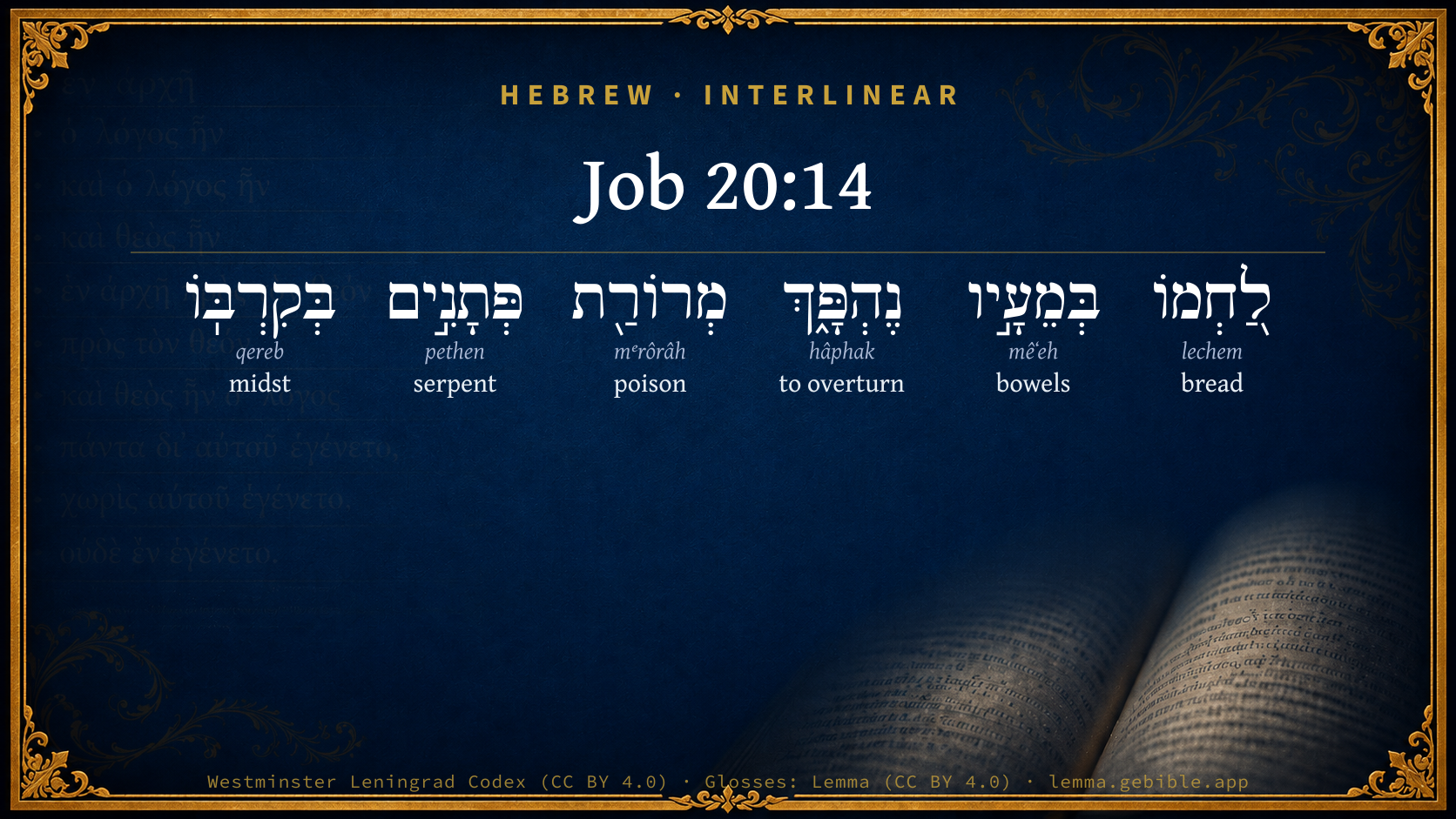
Job 20:14

Hebrew (Westminster Leningrad Codex) Job 20:14 appears in the Hebrew Old Testament. The text above is from the Westminster Leningrad Codex. Each word links to its Strong’s number, a concise gloss, and parsing drawn from the Open Scriptures Hebrew Bible morphology. Click any word for its full Brown-Driver-Briggs (BDB) entry.
Download image
Cite this verse

Job 20:14 (World English Bible). Public Domain. Lemma interlinear Bible study tool, https://lemma.gebible.app/v/job/20/14.

Show BibTeX & RIS
BibTeX
RIS
English Translation
Yet his food in his bowels is turned. It is cobra venom within him.
World English Bible · Public Domain
Download a study sheet

One document with this verse’s original text, its word-by-word gloss line, the meaning frame, cross-references with their text, attributed commentary, and full source and license credits — printable, and it pastes into notes with its structure intact.

This verse Autodidact and up

Study sheet (.html) Plain text (.txt)

A passage Seminary Student

Up to 50 verses in one chapter. A passage sheet keeps up to 6 commentary sources and 12 cross-references per verse, in the order this page ranks them, and says so on the sheet whenever that leaves anything out. Ask for a single verse and you get the Autodidact verse sheet above.

Everything on this page stays free to read, with no account — the sheet is a download of what is already on screen, not access to it.

Want to remove ads? Support Godless Engineer
Compare translations 3

The same verse in 3 English versions, stacked beneath the original-language interlinear above. Click any original word for its lexicon entry.

Each is an independent rendering of the whole verse — the interlinear is not word-aligned to these translations.

Highlighted words mark where these versions differ — a whole-verse word diff, not a word-by-word alignment.

  • World English Bible Public Domain
    Yet his food in his bowels is turned. It is cobra venom within him.
  • King James Version Public Domain
    Yet his meat in his bowels is turned, it is the gall of asps within him.
  • unfoldingWord Literal Text CC BY-SA 4.0
    his food changes in his bowels; the bitterness of asps inside him.

unfoldingWord Literal Text — © unfoldingWord, licensed CC BY-SA 4.0. Word-aligned USFM3 via Door43 (git.door43.org/unfoldingWord/en_ult).

Versions to compare (up to 4)

3 of 4 selected

Show all 18 translations

Every available English version of this verse, each an independent rendering of the whole verse.

  • World English Bible Public Domain
    Yet his food in his bowels is turned. It is cobra venom within him.
  • Berean Standard Bible Public Domain
    yet in his stomach his food sours into the venom of cobras within him.
  • Majority Standard Bible Public Domain
    yet in his stomach his food sours into the venom of cobras within him.
  • King James Version Public Domain
    Yet his meat in his bowels is turned, it is the gall of asps within him.
  • American Standard Version (1901) Public Domain
    Yet his food in his bowels is turned, It is the gall of asps within him.
  • Revised Version (1885) Public Domain
    Yet his meat in his bowels is turned, it is the gall of asps within him.
  • Geneva Bible (1599) Public Domain
    Then his meat in his bowels was turned: the gall of Aspes was in the middes of him.
  • Douay-Rheims (1899) Public Domain
    His bread in his belly shall be turned into the gall of asps within him.
  • Young's Literal Translation Public Domain
    His food in his bowels is turned, The bitterness of asps `is' in his heart.
  • Literal Standard Version CC BY-SA 4.0
    his food is turned in his bowels, the bitterness of cobras [is] in his heart.
  • Unlocked Literal Bible CC BY-SA 4.0
    the food in his intestines turns bitter; it becomes the poison of asps inside him.
  • unfoldingWord Literal Text CC BY-SA 4.0
    his food changes in his bowels; the bitterness of asps inside him.
  • Darby Bible Public Domain
    His food is turned in his bowels; it is the gall of asps within him.
  • World Messianic Bible Public Domain
    yet his food in his bowels is turned. It is cobra venom within him.
  • Webster's Bible Public Domain
    Yet his food in his bowels is turned, it is the gall of asps within him.
  • Free Bible Version CC BY-SA 4.0
    in their stomachs it turns bitter, becoming like snake venom inside them.
  • Bible in Basic English Public Domain
    His food becomes bitter in his stomach; the poison of snakes is inside him.
  • JPS Tanakh (1917) Public Domain
    Yet his food in his bowels is turned, it is the gall of asps within him.

Literal Standard Version (2020), Covenant Press — licensed CC BY-SA 4.0. Text via the HelloAO Bible API (eBible.org). Unlocked Literal Bible (unfoldingWord) — licensed CC BY-SA 4.0. Text via the HelloAO Bible API (eBible.org). unfoldingWord Literal Text — © unfoldingWord, licensed CC BY-SA 4.0. Word-aligned USFM3 via Door43 (git.door43.org/unfoldingWord/en_ult). Free Bible Version, Dr. Jonathan Gallagher — licensed CC BY-SA 4.0. Text via the HelloAO Bible API (eBible.org).

Word by word

More ways to search: Search by grammar → Find every occurrence → Compare this word →

Practice this passage: Drill this verse → Learn its vocabulary →

About this verse

These counts appear in no published source. They are computed here, from the morphology-tagged text and Lemma’s own curated glosses. What Lemma adds →

6
words
6
distinct lemmas
Wisdom
section

Notable vocabulary

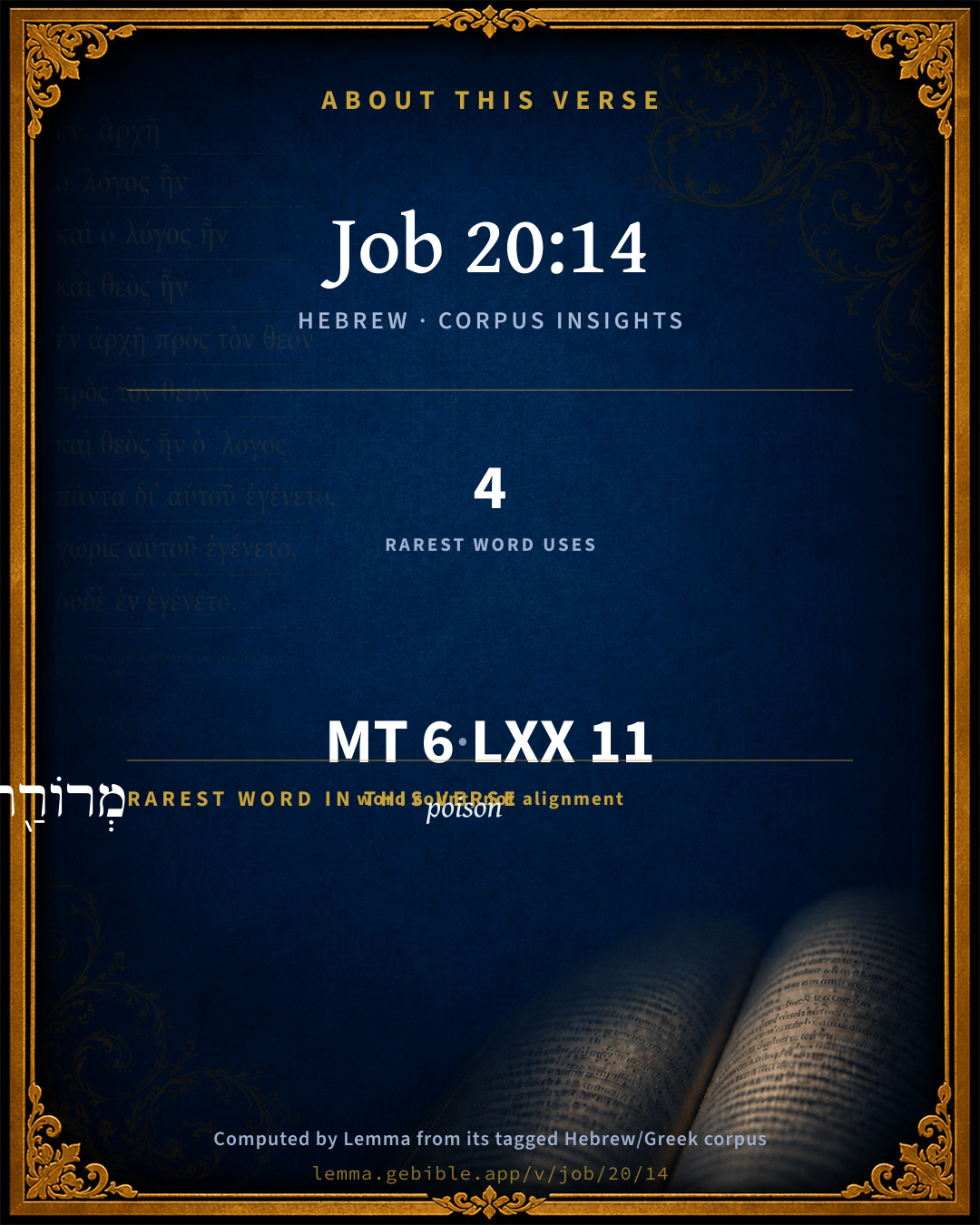
The rarest word here is מְרוֹרַ֖ת poison H4846 — appearing just 4 times in the whole Hebrew Bible.

Shared distinctive vocabulary

מְרוֹרַ֖ת poison H4846 occurs in 4 verses of the Hebrew Bible. Also found in:

Grammatical profile

  • 1 verb
  • 5 nouns

Verb forms

  • נֶהְפָּ֑ךְ Niphal · Perfect

Hebrew & Septuagint length

In English translation the verse runs 14 words from the Hebrew and 20 from the Septuagint (LXX English) — the Septuagint runs noticeably longer here. See the side-by-side →

A rough comparison of the two English renderings, which tokenize alike — not a word-level alignment.

Word counts can differ between the Hebrew and the Greek without any difference in meaning — e.g. the Hebrew direct-object marker אֵת has no separate Greek word, and Greek often adds the article ὁ.

In the original languages it is 6 Hebrew tokens and 11 Greek tokens — but the two are counted differently (Hebrew bundles its prefixes and suffixes into one token; the Greek is in lemma form), so that isn’t a like-for-like length.

Cross-references

13

Topical passages linked to Job 20:14 in the Treasury of Scripture Knowledge — connected by theme and wording, ordered by reader-vote popularity; previews shown in the World English Bible.

  • Romans 3:13 "Their throat is an open tomb. With their tongues they have used deceit." "The poison of vipers is under their lips;"
  • Deuteronomy 32:24 [They shall be] wasted with hunger, and devoured with burning heat Bitter destruction; The teeth of animals will I send on them, With the poison of crawling things of the dust.
  • 2 Samuel 11:2–5 It happened at evening, that David arose from off his bed, and walked on the roof of the king's house: and from the roof he saw a woman bathing; and the woman was very beautiful to look on.
  • 2 Samuel 12:10–11 Now therefore the sword will never depart from your house, because you have despised me, and have taken the wife of Uriah the Hittite to be your wife.'
  • Job 20:16 He shall suck cobra venom. The viper's tongue shall kill him.
  • Psalms 32:3–4 When I kept silence, my bones wasted away through my groaning all day long.
  • Psalms 38:1–8 Yahweh, don't rebuke me in your wrath, Neither chasten me in your hot displeasure.
  • Psalms 51:8–9 Let me hear joy and gladness, That the bones which you have broken may rejoice.
  • Proverbs 1:31 Therefore they will eat of the fruit of their own way, And be filled with their own schemes.
  • Proverbs 23:20–21 Don't be among ones drinking too much wine, Or those who gorge themselves on meat:
  • Proverbs 23:29–35 Who has woe? Who has sorrow? Who has strife? Who has complaints? Who has needless bruises? Who has bloodshot eyes?
  • Jeremiah 2:19 Your own wickedness shall correct you, and your backsliding shall reprove you: know therefore and see that it is an evil thing and a bitter, that you have forsaken Yahweh your God, and that my fear is not in you, says the Lord, Yahweh of Hosts.
  • Malachi 2:2 If you will not listen, and if you will not lay it to heart, to give glory to my name," says Yahweh of Hosts, "then will I send the curse on you, and I will curse your blessings. Indeed, I have cursed them already, because you do not lay it to heart.

Cross-references courtesy of OpenBible.info (CC BY 4.0).

Hebrew and Greek witnesses Masoretic Hebrew ↔ Greek Septuagint

The same verse in the two great witnesses to the Old Testament, shown verse-for-verse.

Here the Septuagint runs noticeably longer than the Hebrew — LXX2012 (modern English Septuagint) 20 words vs World English Bible 14. A rough length comparison of the two English translations, not a word-level alignment — read both below.

These are two independent witnesses, not word-aligned to each other, and the Septuagint is shown in lemma (dictionary) form.

Hebrew Job 20:14 Masoretic · Westminster Leningrad Codex

לַ֭חְמוֹ בְּמֵעָ֣יו נֶהְפָּ֑ךְ מְרוֹרַ֖ת פְּתָנִ֣ים בְּקִרְבּֽוֹ

Yet his food in his bowels is turned. It is cobra venom within him.

World English Bible · Public Domain

Greek LXX Job 20:14 Septuagint · lemma form

καί οὐ μή δύναμαι βοηθέω ἑαυτοῦ χολή ἀσπίς ἐν γαστήρ αὐτός

yet he shall not at all be able to help himself; the gall of an asp is in his belly.

LXX2012 (modern English Septuagint) · Public Domain

Hebrew: Westminster Leningrad Codex (CC BY 4.0). Greek: Septuagint (public domain); English from LXX2012 (modern English Septuagint) (Public Domain). How the Septuagint differs from the Hebrew →

Commentary

Notes on Job 20:14 from classic Christian and Jewish commentators (each source and its license shown beneath its notes). The classic Christian expositions comment on the surrounding passage and are grouped to its opening verse, so a note may address several verses; the Jewish commentaries on the Tanakh (Rashi and others) are per-verse, so they appear only where the commentator wrote on this verse.

Lemma curates 59 commentaries, every one of them public domain or Creative Commons licensed, each selected and text-cleaned for this edition rather than reprinted as found. About our sources →

Trapp's Complete Commentary

John Trapp

Job 20:14 [Yet] his meat in his bowels is turned, [it is] the gall of asps within him.

Ver. 14. Yet his meat in his bowels is turned] Sour sauce be hath at length to his sweet meats, viz. gripes and throbs of conscience, terrors and tortures inexpressible; a greedy vulture feeding upon his entrails (as the poets feigned of Prometheus), those furies or hell hags (so much mentioned by them), as haunting evildoers. In the transgression of an evil man there is a snare, Pro 29:6. There is a cord to strangle his joys with, to mar his mirth. Did not Joseph’s brethren experiment with this? and Ahab, in his house of ivory? and Belshazzar, amidst his sensualities?

Principium dulce est, sed finis amoris amarus:

Laeta venire Venus, tristis abire solet.

The sinner’s cup of honey ends in the dregs of gall, even the gall of asps. Volupia and Angerona went yoked together among the Romans. If men would forecast the sad issues of sin, they would only strive to be innocent.

It is the gall of asps within him] Gall of any sort is bitter, but that of asps is most poisonous and mortal. Pliny saith, that the poison of asps is nothing else but their gall. An asp is a kind of serpent, not known in these parts of the world. Aelian writeth, that the biting of an asp is incurable; and others say, that it killeth without remedy within four hours’ time. Unto this kind of poison is sin fitly compared; for when an asp stingeth a man, it doth first tickle him so as it maketh him laugh, then it casteth him into a sleep, till the poison gradually gets to the heart, after which it paineth him more than ever before it delighted him. So doth wickedness. It is a bitter sweet, γλυκυπικρον. Bernard compareth it to the itch, which first yieldeth pleasure, and afterwards smart. Austin saith, many devour that on earth which they must digest in hell, where they shall have punishment without pity, misery without mercy, sorrow without succour, mischief without measure, torments without end, and past imagination. When therefore thou art making a covenant with sin, say to thy soul, as Boaz said to his kinsman, Rth 4:5, What time thou buyest it, thou must have Ruth with it. So if thou wilt have the sweet of sin, thou must have the curse with it; and let thy soul answer, as he there doth, No, I may not do it, I shall mar and spoil a better inheritance.

John Trapp, A Commentary or Exposition upon All the Books of the Old and New Testament (1647–1656) — public domain. Text from a community e-Sword module.

Tyndale Open Study Notes

Tyndale Open Resources

20:14-16 poisonous venom . . . cobras . . . viper: In the end, the wicked are no longer deadly to others (Matt 3:7; Rom 3:13) but only to themselves (Prov 23:29-35).

Tyndale Open Study Notes — © Tyndale Open Resources, licensed CC BY-SA 4.0. Text via the HelloAO Bible API.

Jamieson, Fausset & Brown

Robert Jamieson, A. R. Fausset & David Brown

turned--Hebrew denotes a total change into a disagreeable contrary (Jer 2:21; compare Rev 10:9-10).

gall--in which the poison of the asp was thought to lie. It rather is contained in a sack in the mouth. Scripture uses popular language, where no moral truth is thereby endangered.

Jamieson, Fausset & Brown — Commentary Critical and Explanatory on the Whole Bible (1871) — public domain (CC PDM 1.0). Text via the HelloAO Bible API.

The Cambridge Bible for Schools and Colleges

gen. ed. J. J. S. Perowne

14. is turned] i. e. is changed,—it becomes the poison of asps in his belly.

The Cambridge Bible for Schools and Colleges (gen. ed. J. J. S. Perowne; Cambridge University Press, 1878–1918) — public domain. Text from a community e-Sword module.

John Gill's Exposition

Yet his meat in his bowels is turned,.... Or "his bread" (r), to which sin is compared, being what the sinner lives in, and lives upon; what he strengthens himself in and with, and by which he is nourished unto the day of slaughter, and by means of which he grows and proceeds to more ungodliness, though in the issue he comes into starving and famishing circumstances; for this is bread of deceit, and proves to be ashes and gravel stones; it promises pleasure, profit, liberty, and impunity, but is all the reverse; as meat turns in a man's stomach when it does not digest in him, or rather his stomach turns against that, and instead of its being pleasant and agreeable to him, it distresses him and makes him uneasy; sin being compared to meat in the bowels, denotes the finishing of in after it has been conceived in the mind, and completed in the act:

it is the gall of asps within him; which is bitter, though not poison; which yet Pliny (s) suggests, but it seems (t) it is not fact. Sin is an evil and bitter thing, and produces bitter sorrow, and makes bitter work for repentance in good men, Jer 2:19; and fills with distress inexpressible and intolerable in wicked men, as in Cain and Judas in this world, and with black despair, weeping, and gnashing of teeth, and dreadful horrors of conscience, in the world to come, to all eternity; the effect of it is eternal death, the second death, inevitable and everlasting ruin and destruction.

(r) "panis ejus", Pagninus, Montanus, Beza, Schmidt. (s) Nat. Hist. l. 11. c. 37. (t) Scheuchzer. Physic. Sacr. vol. 4. p. 711. Philosoph. Transact. abridged, vol. 2. p. 819.

John Gill's Exposition of the Whole Bible (1746–1763) — public domain (CC PDM 1.0). Text via the HelloAO Bible API.

Albert Barnes' Notes on the Bible

Yet his meat - His food.

In his bowels is turned - That is, it is as if he had taken food which was exceedingly pleasant, and had retained it in his mouth as long as possible, that he might enjoy it, but when he swallowed it, it became bitter and offensive; compare Rev 10:9-10. Sin may be pleasant when it is committed, but its consequences will be bitter.

It is the gall of asps - On the meaning of the word here rendered “asps” (פתן pethen), see the notes at Isa 11:8. There can be little doubt that the “asp,” or aspic, of antiquity, which was so celebrated, is here intended. The bite was deadly, and was regarded as incurable. The sight became immediately dim after the bite - a swelling took place, and pain was felt in the stomach, followed by stupor, convulsions, and death. It is probably the same as the “boetan” of the Arabians. It is about a foot in length, and two inches in circumference - its color being black and white. “Pict. Bib.” The word “gall” (מרורה merôrâh), means “bitterness, acridness” (compare Job 13:26); and hence, bile or gall. It is not improbable that it was formerly supposed that the poison of the serpent was contained in the gall, though it is now ascertained that it is found in a small sack in the mouth. It is used here as synonymous with the “poison” of asps - supposed to be “bitter” and “deadly.” The meaning is, that sin, however pleasant and grateful it may be when committed, will be as destructive to the soul as food would be to the body, which, as soon as it was swallowed, became the most deadly poison. This is a fair account still of the effects of sin.

Albert Barnes' Notes on the Bible (1834–1885) — public domain. Text from a community e-Sword/MySword module.

Matthew Poole's English Annotations

Turned into another nature or quality, from sweet to bitter.

The gall of asps, i.e. exceeding bitter and pernicious. Gall is most bitter; the gall of serpents is full of poison, which from thence is conveyed to their mouths by veins, as Pliny observes; and the poison of asps is most dangerous, and within a few hours kills without remedy.

Matthew Poole's English Annotations on the Holy Bible (1683–1685) — public domain. Text from a community e-Sword/MySword module.

Whedon's Commentary on the Bible

Daniel D. Whedon

14. His meat — His food, that is, the wickedness he had eaten.

Turned — Changed into poison. Canon Cook cites from an Arab poet, “crime may be enjoyed, but not digested.”

The gall of asps — It was the opinion of the ancients that “the gall constituted the venom of serpents.” — PLINY, Natural History, 11:75. The asp (pethen) is supposed by some to have been the boeten of the Arab, which is thus described by Forskal: “Spotted all over with black and white; a foot long, and about twice as thick as one’s thumb; oviparous; the bite is instantly fatal, and causes the body to swell.”

Daniel D. Whedon (gen. ed.), Commentary on the Old and New Testaments (1874–1909) — public domain. Text from a community e-Sword module.

The Pulpit Commentary

Yet his meat in his bowels is turned. Still, a time comes when the self-complacency of the wicked man is shaken. He experiences a failure of health or spirits. Then, suddenly, it is as if the meat that he has swallowed had been turned to poison in his bowels, as if the gall of asps were within him. Compare what Bishop Butler says of the sudden waking up of a man"s conscience ("Analogy," pt. 1. ch. 2. p. 52). The ancients seem to have known that the poison of serpents was a strong acid, and therefore supposed that it was secreted by the gallbladder (see Pliny, "Hist. Nat.," 11:37).

The Pulpit Commentary (1880–1919), ed. H.D.M. Spence-Jones & Joseph S. Exell — public domain. Text from a community e-Sword module.

John Wesley's Explanatory Notes

Turned - From sweet to bitter. Gall of asps - Exceeding bitter and pernicious. Gall is most bitter; the gall of serpents is full of poison; and the poison of asps is most dangerous and within a few hours kills without remedy.

John Wesley, Explanatory Notes Upon the Whole Bible (1754–1765) — public domain. Text via the GEBible commentary corpus.

Rashi

Rabbi Shlomo Yitzchaki (Rashi)

His food...within him on the day of his misfortune will turn into the venom of cobras.

Rashi on the Tanakh — English translations: “The Judaica Press complete Tanach with Rashi, translated by A. J. Rosenberg” (CC BY 4.0); “Pentateuch with Rashi's commentary by M. Rosenbaum and A.M. Silbermann, 1929-1934” (public domain); “The Metsudah Tanach series, Lakewood, N.J” (CC BY 4.0); and “The Book of Joshua, Metsudah Publications, 1997” (CC BY 4.0). Text via Sefaria.

Lesson kit

Teaching starters — assembled from the data on this page, not authored interpretation. Every prompt links to the verse data it draws on. Edit before teaching.

Job, in the Wisdom, opens this verse with 6 words (6 distinct Hebrew lemmas). Its most distinctive word is mᵉrôrâh (“poison”). The Greek Septuagint runs longer here. A historical commentator’s framing appears above. Read the whole chapter for the surrounding context.

Discussion questions

  1. The word mᵉrôrâh carries the sense “poison.” How does it shape the verse?
  2. Deuteronomy 32:32 shares the word «poison» with this verse. How do the two illuminate each other?
  3. Compared with the Hebrew, the Septuagint runs longer here. What questions does that raise?
  4. These translations render this verse differently; the difference is in the English rendering, not the original. What questions does that raise?
  5. The verb «נֶהְפָּ֑ךְ» is Niphal Perfect. How does its form color the action?
  6. Reading how Trapp's Complete Commentary and Tyndale Open Study Notes read this verse, where do the two commentators agree and where do they part?

Things to notice

Reading settings

Reading text

Shown beneath each verse's original-language words.

Old Testament
Old Testament edition

Read the OT as the Masoretic Hebrew (MT) or the Greek Septuagint (LXX).

English shown for the Greek Septuagint (in the Hebrew ↔ Greek comparison).

Comparing translations? Open the Compare panel on any verse page to stack up to four side by side.