
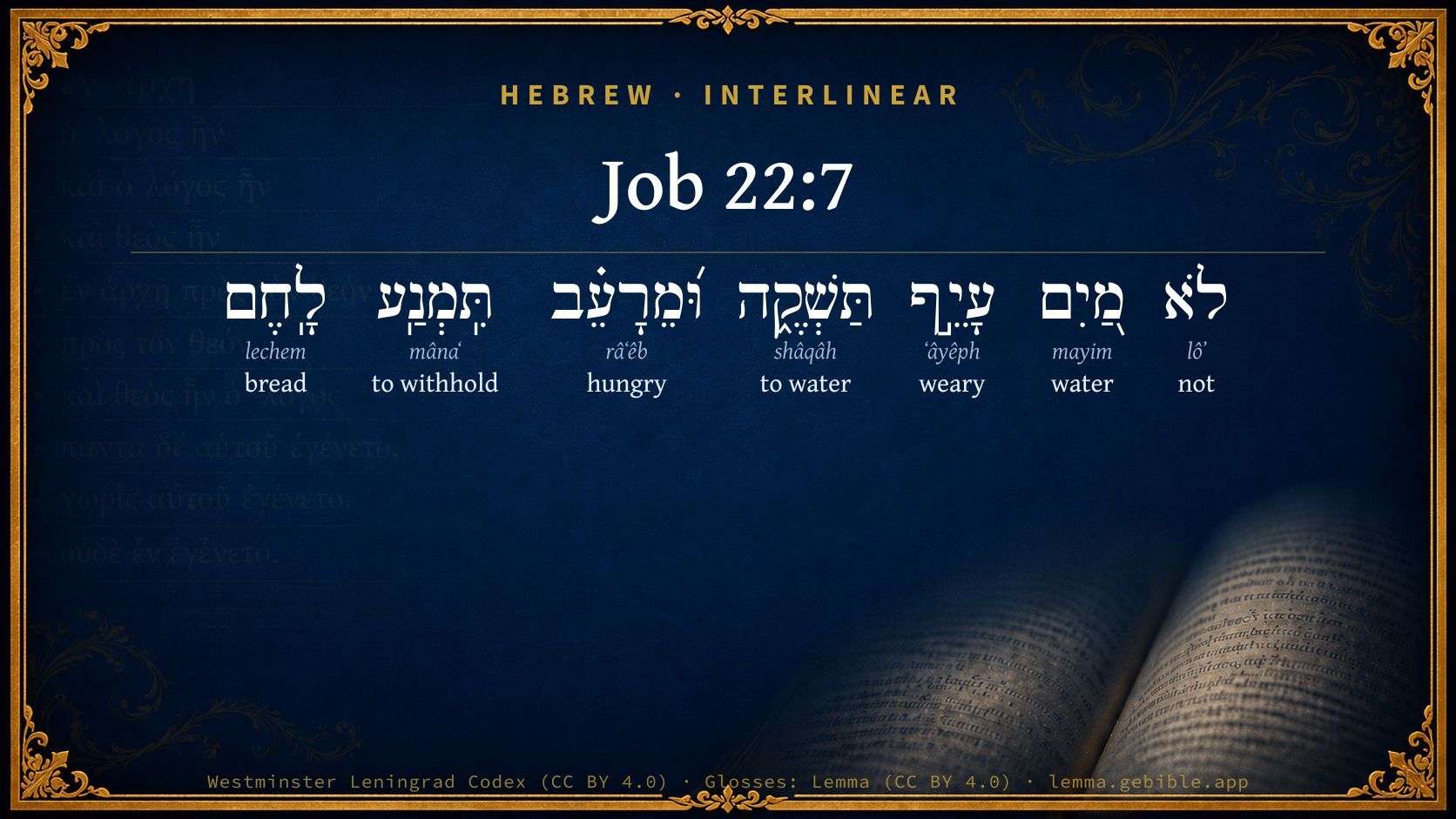
Job 22:7

Hebrew (Westminster Leningrad Codex) Job 22:7 appears in the Hebrew Old Testament. The text above is from the Westminster Leningrad Codex. Each word links to its Strong’s number, a concise gloss, and parsing drawn from the Open Scriptures Hebrew Bible morphology. Click any word for its full Brown-Driver-Briggs (BDB) entry.
Download image
Cite this verse

Job 22:7 (World English Bible). Public Domain. Lemma interlinear Bible study tool, https://lemma.gebible.app/v/job/22/7.

Show BibTeX & RIS
BibTeX
RIS
English Translation
You haven't given water to the weary to drink, And you have withheld bread from the hungry.
World English Bible · Public Domain
Download a study sheet

One document with this verse’s original text, its word-by-word gloss line, the meaning frame, cross-references with their text, attributed commentary, and full source and license credits — printable, and it pastes into notes with its structure intact.

This verse Autodidact and up

Study sheet (.html) Plain text (.txt)

A passage Seminary Student

Up to 50 verses in one chapter. A passage sheet keeps up to 6 commentary sources and 12 cross-references per verse, in the order this page ranks them, and says so on the sheet whenever that leaves anything out. Ask for a single verse and you get the Autodidact verse sheet above.

Everything on this page stays free to read, with no account — the sheet is a download of what is already on screen, not access to it.

Want to remove ads? Support Godless Engineer
Compare translations 3

The same verse in 3 English versions, stacked beneath the original-language interlinear above. Click any original word for its lexicon entry.

Each is an independent rendering of the whole verse — the interlinear is not word-aligned to these translations.

Highlighted words mark where these versions differ — a whole-verse word diff, not a word-by-word alignment.

  • World English Bible Public Domain
    You haven't given water to the weary to drink, And you have withheld bread from the hungry.
  • King James Version Public Domain
    Thou hast not given water to the weary to drink, and thou hast withholden bread from the hungry.
  • unfoldingWord Literal Text CC BY-SA 4.0
    You have not quenched the weary with water, and from the hungry you have withheld bread.

unfoldingWord Literal Text — © unfoldingWord, licensed CC BY-SA 4.0. Word-aligned USFM3 via Door43 (git.door43.org/unfoldingWord/en_ult).

Versions to compare (up to 4)

3 of 4 selected

Show all 18 translations

Every available English version of this verse, each an independent rendering of the whole verse.

  • World English Bible Public Domain
    You haven't given water to the weary to drink, And you have withheld bread from the hungry.
  • Berean Standard Bible Public Domain
    You gave no water to the weary and withheld food from the famished,
  • Majority Standard Bible Public Domain
    You gave no water to the weary and withheld food from the famished,
  • King James Version Public Domain
    Thou hast not given water to the weary to drink, and thou hast withholden bread from the hungry.
  • American Standard Version (1901) Public Domain
    Thou hast not given water to the weary to drink, And thou hast withholden bread from the hungry.
  • Revised Version (1885) Public Domain
    Thou hast not given water to the weary to drink, and thou hast withholden bread from the hungry.
  • Geneva Bible (1599) Public Domain
    To such as were wearie, thou hast not giuen water to drinke, and hast withdrawen bread from the hungrie.
  • Douay-Rheims (1899) Public Domain
    Thou hast not given water to the weary, thou hast withdrawn bread from the hungry.
  • Young's Literal Translation Public Domain
    Thou causest not the weary to drink water, And from the hungry thou withholdest bread.
  • Literal Standard Version CC BY-SA 4.0
    You do not cause the weary to drink water, || And you withhold bread from the hungry.
  • Unlocked Literal Bible CC BY-SA 4.0
    You have not given water to weary people to drink; you have withheld bread from hungry people
  • unfoldingWord Literal Text CC BY-SA 4.0
    You have not quenched the weary with water, and from the hungry you have withheld bread.
  • Darby Bible Public Domain
    Thou hast not given water to the fainting to drink, and thou hast withholden bread from the hungry.
  • World Messianic Bible Public Domain
    You haven’t given water to the weary to drink, and you have withheld bread from the hungry.
  • Webster's Bible Public Domain
    Thou hast not given water to the weary to drink, and thou hast withheld bread from the hungry.
  • Free Bible Version CC BY-SA 4.0
    You refused water to the thirsty; you denied food to the hungry.
  • Bible in Basic English Public Domain
    You do not give water to the tired traveller, and from him who has no food you keep back bread.
  • JPS Tanakh (1917) Public Domain
    Thou hast not given water to the weary to drink, and thou hast withholden bread from the hungry.

Literal Standard Version (2020), Covenant Press — licensed CC BY-SA 4.0. Text via the HelloAO Bible API (eBible.org). Unlocked Literal Bible (unfoldingWord) — licensed CC BY-SA 4.0. Text via the HelloAO Bible API (eBible.org). unfoldingWord Literal Text — © unfoldingWord, licensed CC BY-SA 4.0. Word-aligned USFM3 via Door43 (git.door43.org/unfoldingWord/en_ult). Free Bible Version, Dr. Jonathan Gallagher — licensed CC BY-SA 4.0. Text via the HelloAO Bible API (eBible.org).

Word by word

More ways to search: Search by grammar → Find every occurrence → Compare this word →

Practice this passage: Drill this verse → Learn its vocabulary →

About this verse

These counts appear in no published source. They are computed here, from the morphology-tagged text and Lemma’s own curated glosses. What Lemma adds →

7
words
7
distinct lemmas
Wisdom
section

Notable vocabulary

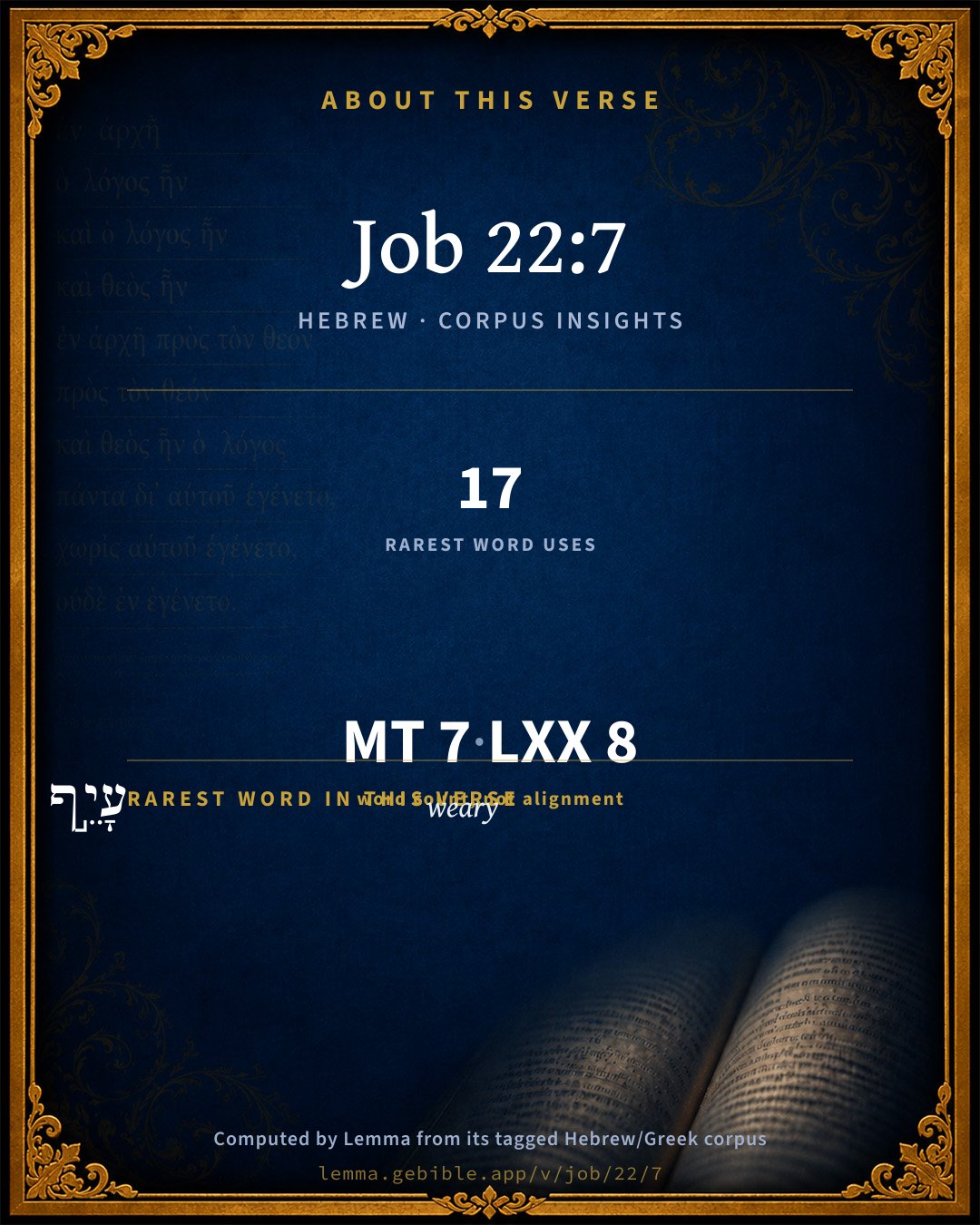
The rarest word here is עָיֵ֣ף weary H5889 — appearing just 17 times in the whole Hebrew Bible.

Shared distinctive vocabulary

עָיֵ֣ף weary H5889 occurs in 17 verses of the Hebrew Bible. Also found in:

Grammatical profile

  • 2 verbs
  • 2 nouns
  • 2 adjectives
  • 1 particle

Verb forms

  • תַּשְׁקֶ֑ה Hiphil · Imperfect
  • תִּֽמְנַֽע Qal · Imperfect

Hebrew & Septuagint length

In English translation the verse runs 17 words from the Hebrew and 19 from the Septuagint (LXX English) — closely comparable.

A rough comparison of the two English renderings, which tokenize alike — not a word-level alignment.

Word counts can differ between the Hebrew and the Greek without any difference in meaning — e.g. the Hebrew direct-object marker אֵת has no separate Greek word, and Greek often adds the article ὁ.

In the original languages it is 7 Hebrew tokens and 8 Greek tokens — but the two are counted differently (Hebrew bundles its prefixes and suffixes into one token; the Greek is in lemma form), so that isn’t a like-for-like length.

Cross-references

12

Topical passages linked to Job 22:7 in the Treasury of Scripture Knowledge — connected by theme and wording, ordered by reader-vote popularity; previews shown in the World English Bible.

  • Job 31:17 Or have eaten my morsel alone, And the fatherless has not eaten of it
  • Isaiah 58:7 Isn't it to deal your bread to the hungry, and that you bring the poor who are cast out to your house? when you see the naked, that you cover him; and that you not hide yourself from your own flesh?
  • Matthew 25:42 for I was hungry, and you didn't give me food to eat; I was thirsty, and you gave me no drink;
  • Ezekiel 18:7 and has not wronged any, but has restored to the debtor his pledge, has taken nothing by robbery, has given his bread to the hungry, and has covered the naked with a garment;
  • Ezekiel 18:16 neither has wronged any, has not taken anything to pledge, neither has taken by robbery, but has given his bread to the hungry, and has covered the naked with a garment;
  • Deuteronomy 15:7–11 If there be with you a poor man, one of your brothers, within any of your gates in your land which Yahweh your God gives you, you shall not harden your heart, nor shut your hand from your poor brother;
  • Job 31:31 If the men of my tent have not said, 'Who can find one who has not been filled with his meat?'
  • Psalms 112:9 He has dispersed, he has given to the poor. His righteousness endures forever. His horn will be exalted with honor.
  • Proverbs 11:24–25 There is one who scatters, and increases yet more. There is one who withholds more than is appropriate, but gains poverty.
  • Proverbs 19:17 He who has pity on the poor lends to Yahweh; He will reward him.
  • Isaiah 58:10 and if you draw out your soul to the hungry, and satisfy the afflicted soul: then shall your light rise in darkness, and your obscurity be as the noonday;
  • Romans 12:20 Therefore "If your enemy is hungry, feed him. If he is thirsty, give him a drink. For in doing so, you will heap coals of fire on his head."

Cross-references courtesy of OpenBible.info (CC BY 4.0).

Hebrew and Greek witnesses Masoretic Hebrew ↔ Greek Septuagint

The same verse in the two great witnesses to the Old Testament, shown verse-for-verse.

These are two independent witnesses, not word-aligned to each other, and the Septuagint is shown in lemma (dictionary) form.

Hebrew Job 22:7 Masoretic · Westminster Leningrad Codex

לֹא מַ֭יִם עָיֵ֣ף תַּשְׁקֶ֑ה וּ֝מֵרָעֵ֗ב תִּֽמְנַֽע לָֽחֶם

You haven't given water to the weary to drink, And you have withheld bread from the hungry.

World English Bible · Public Domain

Greek LXX Job 22:7 Septuagint · lemma form

οὐδέ ὕδωρ διψάω ποτίζω ἀλλά πεινάω στερέω ψωμός

Neither have you given water to the thirsty to drink, but have taken away the morsel of the hungry.

LXX2012 (modern English Septuagint) · Public Domain

Hebrew: Westminster Leningrad Codex (CC BY 4.0). Greek: Septuagint (public domain); English from LXX2012 (modern English Septuagint) (Public Domain). How the Septuagint differs from the Hebrew →

Commentary

Notes on Job 22:7 from classic Christian and Jewish commentators (each source and its license shown beneath its notes). The classic Christian expositions comment on the surrounding passage and are grouped to its opening verse, so a note may address several verses; the Jewish commentaries on the Tanakh (Rashi and others) are per-verse, so they appear only where the commentator wrote on this verse.

Lemma curates 59 commentaries, every one of them public domain or Creative Commons licensed, each selected and text-cleaned for this edition rather than reprinted as found. About our sources →

Trapp's Complete Commentary

John Trapp

Job 22:7 Thou hast not given water to the weary to drink, and thou hast withholden bread from the hungry.

Ver. 7. Thou hast not given water to the weary to drink] But hast slain him with thirst, when thou mightest have saved him with a cup of cold water. Qui non, cum potest, servat, occidit: Who when able did not serve, and died. Not to do good (when it is in the power of a man’s hand) is to do evil; and not to save a life is to destroy it, Mar 3:4. Not robbing only, but not relieving the beggar, was the rich man’s ruin, Luk 16:24, who, for a cup of cold water, duly given, might have had heaven, Mat 10:42. But what meant Eliphaz to charge innocent and munificent Job with such a cruelty? 1. The man was angry; and,

Impedit ira animum ne possit cernere verum (Horat.).

Anger hinders the soul so that it is not able to know the truth. 2. He seems not directly to charge him with these crimes, but to urge him to consider and confess, that he could not be but a grievous sinner who was so great a sufferer. Surely God would never handle thee so hardly unless thou wert deeply guilty of these or the like enormities, Necesse est, ut fatearis te aut hoc, aut illud, aut omnia commisisse, &c. (Junius).

Thou hast withholden bread from the hungry] Bread thou hadst enough and to spare; but, like a greedy-gut Pamplagus, thou wouldst part with none, though it were to save the life, not of thine enemy (which yet thou shouldest have done, Pro 25:21; Elisha feasted his persecutors, 2Ki 6:22-23; Isaac his wrong doers, Gen 26:30-31, by a noble revenge), but of thy fellow friend and brother by race, place, and grace. Thou hast hidden thine eyes from thine own flesh, when thou shouldest have dealt thy bread to the hungry, Isa 58:7; yea, drawn out thy soul (and not thy sheaf only), famelico to the hunger starved, and satisfied the afflicted soul, Job 22:10.

John Trapp, A Commentary or Exposition upon All the Books of the Old and New Testament (1647–1656) — public domain. Text from a community e-Sword module.

Jamieson, Fausset & Brown

Robert Jamieson, A. R. Fausset & David Brown

Hospitality to the weary traveller is regarded in the East as a primary duty (Isa 21:14).

Jamieson, Fausset & Brown — Commentary Critical and Explanatory on the Whole Bible (1871) — public domain (CC PDM 1.0). Text via the HelloAO Bible API.

Adam Clarke's Commentary

Verse 7. Thou hast not given water] It was esteemed a great virtue in the East to furnish thirsty travellers with water; especially in the deserts, where scarcely a stream was to be found, and where wells were very rare. Some of the Indian devotees are accustomed to stand with a girbah or skin full of water, on the public roads, to give drink to weary travellers who are parched with thirst.

Adam Clarke's Commentary on the Bible (1810–1826) — public domain. Text from a community e-Sword/MySword module.

The Cambridge Bible for Schools and Colleges

gen. ed. J. J. S. Perowne

7. Compare Job’s answer, ch. Job_31:16-17.

The Cambridge Bible for Schools and Colleges (gen. ed. J. J. S. Perowne; Cambridge University Press, 1878–1918) — public domain. Text from a community e-Sword module.

John Gill's Exposition

But as for the mighty man, he had the earth,.... A large share and portion of it, which Job could not hinder him from the enjoyment of, because mightier than he, or otherwise he would have done it; or Job was content he should have what he had, and gave him more than what of right belonged to him; for when any cause came before him as a judge, or civil magistrate, between a rich man, and a poorer man, relating to a field, or piece of land he always gave the cause to the rich and mighty and so he had the land, as is suggested:

and the honourable man dwelt in it; peaceably, quietly, and undisturbed, though he had no just title to it; or "the man accepted of face" or "countenance" (q), who was respected because of his outward circumstances, wealth and riches, power and authority; and so Job is tacitly charged with being a respecter of persons in judgment, which was not good; and in general these phrases denote partiality in him, that he was favourable to the mighty and powerful, and unkind and cruel to the poor and needy. Some (r) understand all this of Job himself, that because he was the mighty man, or "man of arms" (s), he made use of his power and might, and stretched out his arm, and grasped and got into his possession, by force and violence, the houses, and lands, and estates of others, and became the greatest man in all the east, and the earth in a manner was his alone; and because he was respected for his greatness and riches, he was confirmed therein, and dwelt securely: or rather, taking the words in this sense, they may be considered as an aggravation of Job's sins, both before and after charged upon him; as that when he was the mighty and honourable man, and though he was such, and had it in the power of his hands to do a great deal of good to the poor and needy; yet took a pledge from his indigent brother, stripped those that were almost naked of their clothing, and would not give a poor weary traveller a cup of water, nor a morsel of bread to an hungry man; yea, abused his power and authority which he had, to the oppression of the widow and fatherless, as in Job 22:9.

(q) "acceptus faciebus", Montanus; "vel facie", Vatablus, Beza, Junius & Tremellius, Drusius, Mercerus. (r) Jarchi, Ramban, Bar Tzemach, Sephorno. (s) "viro brachii", Pagninus, Montanus, Bolducius, Vatablus, Drusius, &c.

John Gill's Exposition of the Whole Bible (1746–1763) — public domain (CC PDM 1.0). Text via the HelloAO Bible API.

Albert Barnes' Notes on the Bible

Thou hast not given water to the weary - That is, thou hast withheld the rites of hospitality - one of the most grievous offences which could be charged on an Arabian; compare the notes at Isa 21:14. In all the Oriental world, hospitality was regarded, and is still, as a duty of the highest obligation.

Albert Barnes' Notes on the Bible (1834–1885) — public domain. Text from a community e-Sword/MySword module.

Haydock's Catholic Bible Commentary

Water. Job’s disposition was the reverse, chap. xxix. 15. Such inhumanity would hardly be conceived possible among us. But he Idumeans were guilty of it; (Numbers xx. 18., and Isaias xxi. 14.) and if it had not been probable, Eliphaz would not have dared to speak thus. (Calmet)

George Leo Haydock (1774–1849), Haydock's Catholic Family Bible and Commentary, 1859 edition — public domain. Excludes Psalms (Douay-Rheims chapter numbering differs from Protestant) and Deuterocanonical books (Catholic canon only).

Matthew Poole's English Annotations

Surely thou hast been so hard-hearted as to deny a cup of cold water to those that needed and desired it. Water was ofttimes scarce and precious in those hot countries, and was appropriated to particular persons, without whose leave other persons might not take it.

To the weary, i.e. to him who by reason of hard labour or travel is weary and thirsty. So this word is used Pro 25:25.

From the hungry, to whom it was due by God’s law, Pro 3:27, which also was known to Job by the light of nature. Hereby he intimates the greatness of this sin of uncharitableness, by ranking it with heinous crimes; whereas Job (as he thought) esteemed it but a small fault, if any.

Matthew Poole's English Annotations on the Holy Bible (1683–1685) — public domain. Text from a community e-Sword/MySword module.

Whedon's Commentary on the Bible

Daniel D. Whedon

7. Not given water — That which we do not do is made at the last day quite as much a test of character as what we do. Mat_25:42-43. The Egyptian Book of the Dead represents a soul before Osiris as saying. “I have given food to the hungry, drink to the thirsty, and clothes to the naked,” (ch. 125.) The same sentiment appears so frequently on stelae and tombs, that Mariette thinks that it must have been a part of a daily prayer among the ancient Egyptians.

Daniel D. Whedon (gen. ed.), Commentary on the Old and New Testaments (1874–1909) — public domain. Text from a community e-Sword module.

The Pulpit Commentary

Thou hast not given water to the weary to drink. To give water to the thirsty was regarded in the East as one of the most elementary duties of man to man. The self-justification of the dead in the Egyptian Hades contained the following passage: "I gave my bread to the hungry, and drink to him that was athirst; I clothed the naked with garments; I sheltered the wanderer" ("Ritual of the Dead," ch. CXXV The same claim appears continually on Egyptian tombs. "All men respected me," we read on one; "I gave water to the thirsty; I set the wanderer in his path; I took away the oppressor, and put a stop to violence" ("Non-Biblical Systems of Religion," p. 46). In the proverbs assigned to Solomon, "which the men of Hezekiah copied out", (Pro_25:1) the duty was declared to be one owed even to enemies. (see Pro_25:21, "If thine enemy be hungry, give him bread to eat; and if he be thirsty, give him water to drink Isaiah notices it as praiseworthy in the Temanites (Eliphaz"s people), that they brought water to him that was thirsty"and prevented with their bread him that fled". (Isa_21:14) Jael is praised for going further than this: He asked water, and she gave him milk; she brought forth butter in a lordly dish". (Jud_1:5:25) And thou hast withholden bread from the hungry. Later on Job absolutely denies this, as well as many of the other charges. "If I have withheld," he says, "the poor from their desire, or have caused the eyes of the widow to fail; or have eaten my morsel myself alone, and the fatherless hath not eaten thereof," then let mine arm fall from my shoulder-blade, and mine arm be broken from the bone". (Job_31:16-22)

Help for the needy.

I THIS IS NATURAL. God has made us mutually dependent on one another. In social order there is an interchange of service, and the general life of the community is simply maintained by people helping one another. The cases of extreme distress are those in which the reciprocity breaks down because the hungry and helpless can make no return for what they receive. Still they are part of the body, and if "one member suffer, all the members suffer with it". (1Co_12:26) The "solidarity of man" is such that the needy are naturally dependent on others for maintenance.

II THIS IS SIMPLE. Only water and bread are here referred to. These are the most necessary things; but they are also the most accessible. A poor man who cannot give the smallest coin to a beggar may yet offer a cup of cold water. Of course, true sympathy will lead us to desire to help up to the utmost of our powers. But a very great amount of distress might be alleviated without a proportionate expenditure of money; e.g. penny, halfpenny, and even farthing dinners for children give an assistance far beyond what their cost suggests.

III THIS IS UNCONDITIONAL. At least the one condition is need. We have not to consider merits when we relieve extreme distress. Water to the thirsty and bread to the starving should be given at the mere sight of extreme need, though the recipients are quite undeserving. This we admit by our poor-law. As soon as the immediate and pressing needs are supplied, other and more difficult questions must be considered. If we go further we may pauperize the objects of our charity. It is necessary, therefore, to consider character and methods of help suited to lift, not to degrade, the recipients. Here most complicated problems arise. But the primary help is simple and unconditional.

IV THIS IS CHRIST-LIKE. Our Lord took pity on the world"s sore need. He did not consider whether he could find "deserving cases." He offered his salvation to the most undeserving. Need, not merit, was the call that brought him from heaven. The most undeserving are really the most needing of help, not indeed with lavish doles of charity that will keep them in idleness, but, after the first necessaries are supplied to maintain life itself, by a kind of assistance that will raise them and better them. How to give this help is a most difficult question. We cannot do better than to follow our Lord"s example. He raises where he helps. The grace of Christ never pauperizes the soul.

V THE NEGLECT OF THIS IS A GREAT SIN. Eliphaz was unjust in accusing Job of such a sin. In the eyes of the Oriental, often dependent on casual hospitality for life itself in the desert, to refuse water and bread to the needy was a gross wrong. You may kill your enemy with the sword, but you must not deny him water to drink and bread to eat when he comes to you as a guest. Christianity widens and deepens the obligation. Though in various forms suited to the various circumstances of the world as we find it, brotherly helpfulness is always expected of Christ"s people. It is taken as a service rendered to himself. The neglect of it is a reason for rejection at the great judgment. W.F.A. (Mat_25:41-46)

The Pulpit Commentary (1880–1919), ed. H.D.M. Spence-Jones & Joseph S. Exell — public domain. Text from a community e-Sword module.

Lesson kit

Teaching starters — assembled from the data on this page, not authored interpretation. Every prompt links to the verse data it draws on. Edit before teaching.

Job, in the Wisdom, opens this verse with 7 words (7 distinct Hebrew lemmas). Its most distinctive word is ʻâyêph (“weary”). A historical commentator’s framing appears above. Read the whole chapter for the surrounding context.

Discussion questions

  1. The word ʻâyêph carries the sense “weary.” How does it shape the verse?
  2. Genesis 25:29 shares the word «weary» with this verse. How do the two illuminate each other?
  3. These translations render this verse differently. What is at stake in choosing one wording over another?
  4. The verb «תַּשְׁקֶ֑ה» is Hiphil Imperfect. How does its form color the action?
  5. Reading how Trapp's Complete Commentary and Jamieson, Fausset & Brown read this verse, where do the two commentators agree and where do they part?

Things to notice

Reading settings

Reading text

Shown beneath each verse's original-language words.

Old Testament
Old Testament edition

Read the OT as the Masoretic Hebrew (MT) or the Greek Septuagint (LXX).

English shown for the Greek Septuagint (in the Hebrew ↔ Greek comparison).

Comparing translations? Open the Compare panel on any verse page to stack up to four side by side.