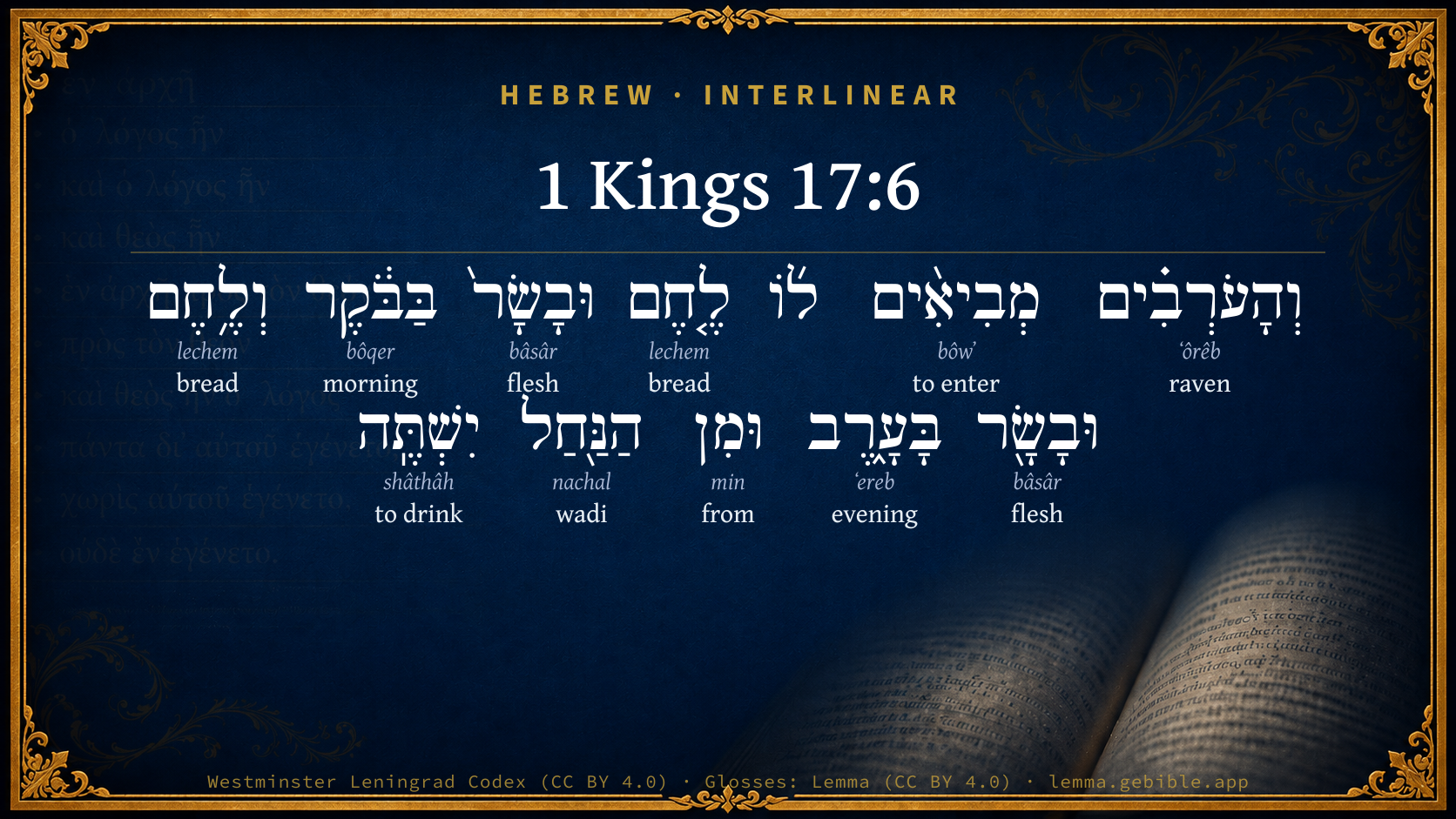
1 Kings 17:6

Hebrew (Westminster Leningrad Codex) 1 Kings 17:6 appears in the Hebrew Old Testament. The text above is from the Westminster Leningrad Codex. Each word links to its Strong’s number, a concise gloss, and parsing drawn from the Open Scriptures Hebrew Bible morphology. Click any word for its full Brown-Driver-Briggs (BDB) entry.
Download image
Cite this verse

1 Kings 17:6 (World English Bible). Public Domain. Lemma interlinear Bible study tool, https://lemma.gebible.app/v/1-kings/17/6.

Show BibTeX & RIS
BibTeX
RIS
English Translation
The ravens brought him bread and flesh in the morning, and bread and flesh in the evening; and he drank of the brook.
World English Bible · Public Domain
Download a study sheet

One document with this verse’s original text, its word-by-word gloss line, the meaning frame, cross-references with their text, attributed commentary, and full source and license credits — printable, and it pastes into notes with its structure intact.

This verse Autodidact and up

Study sheet (.html) Plain text (.txt)

A passage Seminary Student

Up to 50 verses in one chapter. A passage sheet keeps up to 6 commentary sources and 12 cross-references per verse, in the order this page ranks them, and says so on the sheet whenever that leaves anything out. Ask for a single verse and you get the Autodidact verse sheet above.

Everything on this page stays free to read, with no account — the sheet is a download of what is already on screen, not access to it.

Want to remove ads? Support Godless Engineer
Compare translations 3

The same verse in 3 English versions, stacked beneath the original-language interlinear above. Click any original word for its lexicon entry.

Each is an independent rendering of the whole verse — the interlinear is not word-aligned to these translations.

Highlighted words mark where these versions differ — a whole-verse word diff, not a word-by-word alignment.

  • World English Bible Public Domain
    The ravens brought him bread and flesh in the morning, and bread and flesh in the evening; and he drank of the brook.
  • King James Version Public Domain
    And the ravens brought him bread and flesh in the morning, and bread and flesh in the evening; and he drank of the brook.
  • unfoldingWord Literal Text CC BY-SA 4.0
    And the ravens were bringing bread and meat to him in the morning, and bread and meat in the evening. And he drank from the wadi.

unfoldingWord Literal Text — © unfoldingWord, licensed CC BY-SA 4.0. Word-aligned USFM3 via Door43 (git.door43.org/unfoldingWord/en_ult).

Versions to compare (up to 4)

3 of 4 selected

Show all 18 translations

Every available English version of this verse, each an independent rendering of the whole verse.

  • World English Bible Public Domain
    The ravens brought him bread and flesh in the morning, and bread and flesh in the evening; and he drank of the brook.
  • Berean Standard Bible Public Domain
    The ravens would bring him bread and meat in the morning and evening, and he would drink from the brook.
  • Majority Standard Bible Public Domain
    The ravens would bring him bread and meat in the morning and evening, and he would drink from the brook.
  • King James Version Public Domain
    And the ravens brought him bread and flesh in the morning, and bread and flesh in the evening; and he drank of the brook.
  • American Standard Version (1901) Public Domain
    And the ravens brought him bread and flesh in the morning, and bread and flesh in the evening; and he drank of the brook.
  • Revised Version (1885) Public Domain
    And the ravens brought him bread and flesh in the morning, and bread and flesh in the evening; and he drank of the brook.
  • Geneva Bible (1599) Public Domain
    And the rauens brought him bread and flesh in the morning, and bread and flesh in the euening, and he dranke of the riuer.
  • Douay-Rheims (1899) Public Domain
    And the ravens brought him bread and flesh in the morning, and bread and flesh in the evening, and he drank of tile torrent.
  • Young's Literal Translation Public Domain
    and the ravens are bringing to him bread and flesh in the morning, and bread and flesh in the evening, and of the brook he drinketh.
  • Literal Standard Version CC BY-SA 4.0
    and the ravens are bringing bread and flesh to him in the morning, and bread and flesh in the evening, and he drinks from the brook.
  • Unlocked Literal Bible CC BY-SA 4.0
    The ravens brought him bread and meat in the morning and bread and meat in the evening, and he drank from the brook.
  • unfoldingWord Literal Text CC BY-SA 4.0
    And the ravens were bringing bread and meat to him in the morning, and bread and meat in the evening. And he drank from the wadi.
  • Darby Bible Public Domain
    And the ravens brought him bread and flesh in the morning, and bread and flesh in the evening; and he drank of the torrent.
  • World Messianic Bible Public Domain
    The ravens brought him bread and meat in the morning, and bread and meat in the evening; and he drank from the brook.
  • Webster's Bible Public Domain
    And the ravens brought him bread and flesh in the morning, and bread and flesh in the evening; and he drank of the brook.
  • Free Bible Version CC BY-SA 4.0
    Ravens brought him bread and meat both in the morning and in the evening, and he drank from the brook.
  • Bible in Basic English Public Domain
    And the ravens took him bread in the morning and meat in the evening; and the water of the stream was his drink.
  • JPS Tanakh (1917) Public Domain
    And the ravens brought him bread and flesh in the morning, and bread and flesh in the evening; and he drank of the brook.

Literal Standard Version (2020), Covenant Press — licensed CC BY-SA 4.0. Text via the HelloAO Bible API (eBible.org). Unlocked Literal Bible (unfoldingWord) — licensed CC BY-SA 4.0. Text via the HelloAO Bible API (eBible.org). unfoldingWord Literal Text — © unfoldingWord, licensed CC BY-SA 4.0. Word-aligned USFM3 via Door43 (git.door43.org/unfoldingWord/en_ult). Free Bible Version, Dr. Jonathan Gallagher — licensed CC BY-SA 4.0. Text via the HelloAO Bible API (eBible.org).

Word by word

More ways to search: Search by grammar → Find every occurrence → Compare this word →

Practice this passage: Drill this verse → Learn its vocabulary →

וְהָעֹרְבִ֗ים
ʻôrêb
H6158
“and · the · ravens”
Conjunction + Particle, Definite Article + Noun, Common, Masculine, Plural, Absolute
Part of Speech
Conjunction + Particle + Noun
Type
Common
Gender
Masculine
Number
Plural
State
Absolute
Full BDB Definition

Origin: from H6150

TWOT: 1690a

raven
  1. מְבִיאִ֨ים bôwʼ H935 “entering” Verb, Hiphil, Participle Active, Masculine, Plural, Absolute
  2. לֶ֤חֶם lechem H3899 “bread” Noun, Common, Both, Singular, Absolute
  3. וּבָשָׂר֙ bâsâr H1320 “and · flesh” Conjunction + Noun, Common, Masculine, Singular, Absolute
  4. בַּבֹּ֔קֶר bôqer H1242 “in/at the · morning” Preposition, Determined + Noun, Common, Masculine, Singular, Absolute
  5. וְלֶ֥חֶם lechem H3899 “and · bread” Conjunction + Noun, Common, Both, Singular, Absolute
  6. וּבָשָׂ֖ר bâsâr H1320 “and · flesh” Conjunction + Noun, Common, Masculine, Singular, Absolute
  7. בָּעָ֑רֶב ʻereb H6153 “in/at the · evening” Preposition, Determined + Noun, Common, Masculine, Singular, Absolute
  8. וּמִן min H4480 “and · from” Conjunction + Preposition
  9. הַנַּ֖חַל nachal H5158 “the · wadi” Particle, Definite Article + Noun, Common, Masculine, Singular, Absolute
  10. יִשְׁתֶּֽה shâthâh H8354 “to drink” Verb, Qal, Imperfect, 3rd Person, Masculine, Singular

About this verse

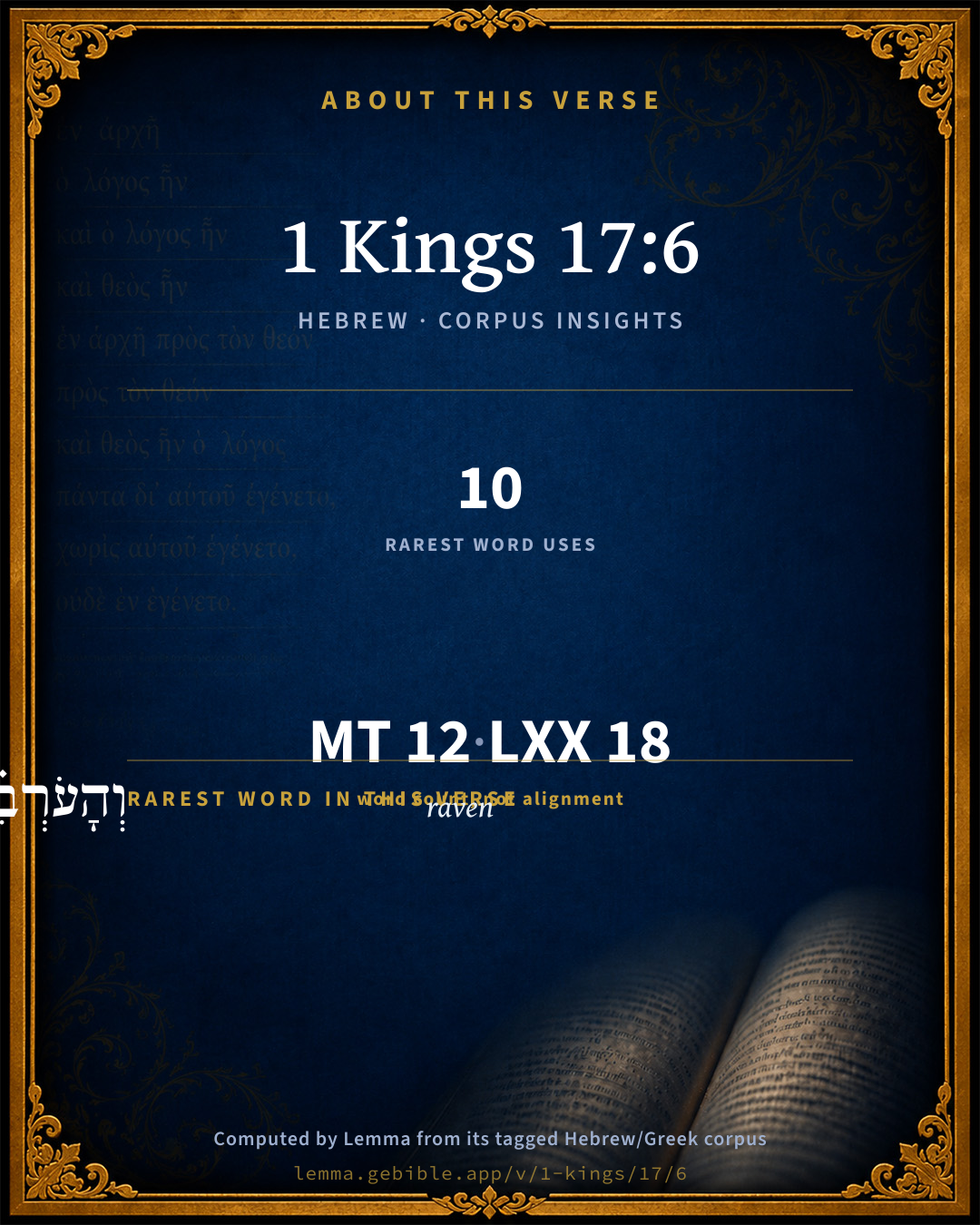
These counts appear in no published source. They are computed here, from the morphology-tagged text and Lemma’s own curated glosses. What Lemma adds →

12
words
9
distinct lemmas
Historical
section

Notable vocabulary

The rarest word here is וְהָעֹרְבִ֗ים raven H6158 — appearing just 10 times in the whole Hebrew Bible.

Shared distinctive vocabulary

וְהָעֹרְבִ֗ים raven H6158 occurs in 10 verses of the Hebrew Bible. Also found in:

Grammatical profile

  • 2 verbs
  • 8 nouns
  • 2 prepositions

Verb forms

  • מְבִיאִ֨ים Hiphil · Participle Active
  • יִשְׁתֶּֽה Qal · Imperfect

Repetition

Words recur within this verse — often emphatic in Hebrew:

  • לֶ֤חֶם bread H3899 ×2
  • וּבָשָׂר֙ flesh H1320 ×2

Hebrew & Septuagint length

In English translation the verse runs 23 words from the Hebrew and 21 from the Septuagint (LXX English) — closely comparable.

A rough comparison of the two English renderings, which tokenize alike — not a word-level alignment.

Word counts can differ between the Hebrew and the Greek without any difference in meaning — e.g. the Hebrew direct-object marker אֵת has no separate Greek word, and Greek often adds the article ὁ.

In the original languages it is 12 Hebrew tokens and 18 Greek tokens — but the two are counted differently (Hebrew bundles its prefixes and suffixes into one token; the Greek is in lemma form), so that isn’t a like-for-like length.

Cross-references

19

Topical passages linked to 1 Kings 17:6 in the Treasury of Scripture Knowledge — connected by theme and wording, ordered by reader-vote popularity; previews shown in the World English Bible.

  • Psalms 78:23–24 Yet he commanded the skies above, And opened the doors of heaven.
  • Matthew 6:31–33 "Therefore don't be anxious, saying, 'What will we eat?', 'What will we drink?' or, 'With what will we be clothed?'
  • Psalms 78:15–16 He split rocks in the wilderness, And gave them drink abundantly as out of the depths.
  • Jeremiah 37:21 Then Zedekiah the king commanded, and they committed Jeremiah into the court of the guard; and they gave him daily a loaf of bread out of the bakers' street, until all the bread in the city was spent. Thus Jeremiah remained in the court of the guard.
  • Matthew 14:19–21 He commanded the multitudes to sit down on the grass; and he took the five loaves and the two fish, and looking up to heaven, he blessed, broke and gave the loaves to the disciples, and the disciples gave to the multitudes.
  • Matthew 19:26 Looking at them, Jesus said, "With men this is impossible, but with God all things are possible."
  • Luke 22:35 He said to them, "When I sent you out without purse, and wallet, and shoes, did you lack anything?" They said, "Nothing."
  • Judges 15:18–19 He was very thirsty, and called on Yahweh, and said, You have given this great deliverance by the hand of your servant; and now shall I die for thirst, and fall into the hand of the uncircumcised.
  • Psalms 34:9–10 Oh fear Yahweh, you his saints, For there is no lack with those who fear him.
  • Psalms 37:19 They shall not be disappointed in the time of evil. In the days of famine they shall be satisfied.
  • Isaiah 33:16 He shall dwell on high; his place of defense shall be the munitions of rocks; his bread shall be given [him]; his waters shall be sure.
  • Numbers 11:23 Yahweh said to Moses, Has Yahweh's hand grown short? now shall you see whether my word shall happen to you or not.
  • Judges 14:14 He said to them, Out of the eater came forth food, Out of the strong came forth sweetness. They couldn't in three days declare the riddle.
  • Psalms 37:3 Trust in Yahweh, and do good. Dwell in the land, and enjoy safe pasture.
  • Habakkuk 3:17–18 For though the fig tree doesn't flourish, Nor fruit be in the vines; The labor of the olive fails, The fields yield no food; The flocks are cut off from the fold, And there is no herd in the stalls:
  • Hebrews 6:18 that by two immutable things, in which it is impossible for God to lie, we may have a strong encouragement, who have fled for refuge to take hold of the hope set before us.
  • Exodus 16:35 The children of Israel ate the manna forty years, until they came to an inhabited land. They ate the manna until they came to the borders of the land of Canaan.
  • Jeremiah 40:4 Now, behold, I loose you this day from the chains which are on your hand. If it seem good to you to come with me into Babylon, come, and I will look well to you; but if it seem ill to you to come with me into Babylon, forbear: behold, all the land is before you; where it seems good and right to you to go, there go.
  • Hebrews 13:5–6 Be free from the love of money, content with such things as you have, for he has said, "I will in no way leave you, neither will I in any way forsake you."

Cross-references courtesy of OpenBible.info (CC BY 4.0).

Hebrew and Greek witnesses Masoretic Hebrew ↔ Greek Septuagint

The same verse in the two great witnesses to the Old Testament, shown verse-for-verse.

These are two independent witnesses, not word-aligned to each other, and the Septuagint is shown in lemma (dictionary) form.

Hebrew 1 Kings 17:6 Masoretic · Westminster Leningrad Codex

וְהָעֹרְבִ֗ים מְבִיאִ֨ים ל֜וֹ לֶ֤חֶם וּבָשָׂר֙ בַּבֹּ֔קֶר וְלֶ֥חֶם וּבָשָׂ֖ר בָּעָ֑רֶב וּמִן הַנַּ֖חַל יִשְׁתֶּֽה

The ravens brought him bread and flesh in the morning, and bread and flesh in the evening; and he drank of the brook.

World English Bible · Public Domain

Greek LXX 1 Kings 17:6 Septuagint · lemma form

καί ὁ κόραξ φέρω αὐτός ἄρτος ὁ πρωΐ καί κρέας ὁ δείλη καί ἐκ ὁ χειμάρρους πίνω ὕδωρ

And the ravens brought him loaves in the morning, and flesh in the evening and he drank water of the brook.

LXX2012 (modern English Septuagint) · Public Domain

On this verse, Adam Clarke's Commentary discusses the Septuagint’s reading. Read the note in Commentary ↓

Hebrew: Westminster Leningrad Codex (CC BY 4.0). Greek: Septuagint (public domain); English from LXX2012 (modern English Septuagint) (Public Domain). How the Septuagint differs from the Hebrew →

Targum (Aramaic paraphrase)

1

The Targum is the ancient Jewish Aramaic paraphrase of the Hebrew Scriptures — an interpretive translation, not the Hebrew text itself. Onkelos (literal) and Pseudo-Jonathan (expansive) render the Torah, and Jonathan the Prophets. Coverage is partial: where no permissively-licensed English translation exists for a verse, only the Aramaic is shown. This is verse-level text, not a word-by-word alignment to the Hebrew.

  1. Targum Jonathan Prophets (Joshua–Malachi)
    וְעוֹרְבַיָא מַיְתָן לֵיהּ לַחְמָא וּבִסְרָא בְּצַפְרָא וְלַחְמָא וּבִסְרָא בְּרַמְשָׁא וּמִן נַחְלָא שָׁתֵי:

    (no public-domain English translation for this verse)

    Targum Jonathan — Aramaic: “Mikraot Gedolot” (public domain). English: “Sefaria Community Translation” (CC0 1.0 (public-domain dedication)); “London "Chaldee Paraphrase," 1871” (public domain). Text via Sefaria.

Commentary

Notes on 1 Kings 17:6 from classic Christian and Jewish commentators (each source and its license shown beneath its notes). The classic Christian expositions comment on the surrounding passage and are grouped to its opening verse, so a note may address several verses; the Jewish commentaries on the Tanakh (Rashi and others) are per-verse, so they appear only where the commentator wrote on this verse.

Lemma curates 59 commentaries, every one of them public domain or Creative Commons licensed, each selected and text-cleaned for this edition rather than reprinted as found. About our sources →

Trapp's Complete Commentary

John Trapp

1Ki 17:6 And the ravens brought him bread and flesh in the morning, and bread and flesh in the evening; and he drank of the brook.

Ver. 6. And the ravens brought him bread and flesh.] Which he knew could not be done but by a miracle. This was to Elijah a sensible demonstration of the divine care and providence: and therefore must every bit needs be more pleasing to him, than a whole tableful of Ahab’s best cheer. Angeli autem hos panes et carnes apparabant, saith one; the angels made ready this bread and flesh. Luther saith, that at the continual feast of a good conscience angels are cooks and butlers; and the three persons in Trinity joyful guests. Elijah was ever at this feast, over and besides his food for the day, in the day, duly brought him in by the ravens; which are naturally ravenous, unnatural, malignant, and inanspicate creatures Who hath not heard how Rochelle, in a strait siege and sore famine, was likewise miraculously relieved by God, who made the tide their purveyor to bring them in an ocean of shell-fish: the like whereof was never known before, nor since. The patrons of monkery tell us of Paul the Hermit, of St Benedict - as they call him - and some other such fed by ravens in like manner. But so did Mohammed boast, and David George - those notorious impostors - that they had communication with wild beasts and birds in all languages, and that they brought them meat for their sustenance.

John Trapp, A Commentary or Exposition upon All the Books of the Old and New Testament (1647–1656) — public domain. Text from a community e-Sword module.

The Biblical Illustrator

Joseph S. Exell

1Ki_17:6

And the ravens brought him bread and flesh in the morning.

Elijah led by ravens

I. A morally great man in great physical need. Elijah was a morally great man. Worldly greatness is but tinselled paper. He only is great who is great in thoughts and noble purposes. Elijah was such: a greater could not be found. Yet he was reduced to the greatest need.

II. The God of nature ministering to a lonely man. The Infinite Father knew His servants destitution, sympathised with it, and sent relief to him morning and evening by the ravens. Observe,

1. God makes the humblest things in nature serve His people.

2. God supplies His people as their wants return. (Homilist.)

Elijah fed by ravens

I. Irrational creatures divinely directed. All creatures, from the lowest up to the greatest, are under the Divine rule. Generally they are ruled by their own instincts. Here is an exception.

II. Lower creatures engaged in the service of man.

III. Gods attention to the affairs of the individual.

IV. Help coming from unlikely sources. (Homilist.)

The battle for bread

There is an incident in my text that baffles all the ornithological wonders of the world. The grain crop had been cut off. Famine was in the land. In a cave by the brook Cherith sat a minister of God, Elijah, waiting for something to eat. Why did he not go to the neighbours? There were no neighbours, it was a wilderness. Why did he not pick some of the berries? There were none. If there had been, they would have been dried up. Seated one morning at the mouth of his cave, the prophet looks into the dry and pitiless heavens, and he sees a flock of birds approaching.

1. Notice, in the first place, in the story of my text, that these winged creatures came to Elijah directly from God. I have commanded the ravens that they feed thee. They did not come out of some other cave. They did not just happen to alight there. God freighted them, God launched them, and God told them by what cave to swoop. That is the same God that is going to supply you. He is your Father. You would have to make an elaborate calculation before you could tell me how many pounds of food and how many yards of clothing would be necessary for you and your family; but God knows without any calculation. You have a plate at His table, and you are going to be waited on, unless you act like a naughty child, and kick, and scramble, and pound saucily the plate, and try to upset things. God has a vast family, and everything is methodised, and you are going to be served, if you will only wait your turn.

2. Notice, again, in this story, that the ravens did not allow Elijah to hoard up a surplus. They did not bring enough on Monday to last all the week. They did not bring enough one morning to last until the next morning. They came twice a day, and brought just enough for one time. You know as well as I that the great fret of the world is that we want a surplus--we want the ravens to bring enough for fifty years. You have more confidence in the Long Island Bank than you have in the royal bank of heaven. You say: All that is very poetic, but you may have the black ravens--give me the gold eagles. We had better be content with just enough. If, in the morning, your family eat up all the food there is in the house, do not sit down, and cry, and say: I dont know where the next meal is coming from. About five, or six, or seven oclock in the evening just look up, and you wilt see two black spots on the sky, and you will hear the flapping of wings, and, instead of Edgar A. Poes insane raven, alighting on the chamber-door, only this, and nothing more, you will find Elijahs two ravens, or the two ravens of the Lord, the one bringing bread and the other bringing meat--plumed butcher and baker. God is infinite in resource. When the city of Rochelle was besieged, and the inhabitants were dying of the famine, the tides washed up on the beach as never before, and as never since, enough shell-fish to feed the whole city. God is good. There is no mistake about that. History tell us that, in 1555, in England, there was a great drought. The crops failed, but in Essex, on the rocks, in a place where they had neither sown nor cultured, a great crop of peas grew, until they filled a hundred measures; and there were blossoming vines enough promising as much more.

3. Again, this story of the text impresses me that relief came to this prophet with the most unexpected, and with seemingly impossible conveyance. If it had been a robin redbreast, or a musical meadow lark, or a meek turtle-dove, or a sublime albatross that had brought the food to Elijah, it would not have been so surprising. But no. It was a bird so fierce and inauspicate that we have fashioned one of our most forceful and repulsive words out of it--ravenous. That bird has a passion for picking out the eyes of men and animals. It loves to maul the sick and the dying. It swallows, with vulturous guggle, everything it can put its beak on; and yet all the food Elijah gets for six months or a year, is from the ravens. So your supply is going to come from an unexpected source. You think some great-hearted, generous man will come along and give you his name on the back of your note, or he will go security for you in some great enterprise. No, he will not. God will open the heart of some Shylock toward you. Your relief will come from the most unexpected quarter. The providence that seemed ominous will be to you more than that which seemed auspicious. It will not be a chaffinch with breast and wing dashed with white, and brown, and chestnut, it will be a black raven. Children of God, get up out of your despondency. The Lord never had so many ravens as He has this morning. Fling your fret and worry to the winds. (T. De Witt Talmage, D. D.)

The Biblical Illustrator, edited by Joseph S. Exell (c. 1880s–1900s) — public domain. Text from a community e-Sword module.

Joseph Benson's Commentary

1Ki 17:6. The ravens brought him bread and flesh in the morning, &c. — “We need not inquire where they procured the bread and flesh, or how the food was prepared; he who commanded them to feed his servant had ten thousand ways of enabling them to fulfil his word: thus Elijah was sufficiently provided for, when numbers were starving; and the consolations of the Lord would render him contented with his solitude and sustenance.” — Scott.

Joseph Benson's Commentary on the Old and New Testaments (1811–1818) — public domain. Text from a community e-Sword module.

Jamieson, Fausset & Brown

Robert Jamieson, A. R. Fausset & David Brown

the ravens brought him bread--The idea of such unclean and voracious birds being employed to feed the prophet has appeared to many so strange that they have labored to make out the Orebim, which in our version has been rendered "ravens," to be as the word is used (in Eze 27:27) "merchants"; or Arabians (Ch2 21:16; Neh 4:7); or, the citizens of Arabah, near Beth-shan (Jos 15:6; Jos 18:18). But the common rendering is, in our opinion, preferable to these conjectures. And, if Elijah was miraculously fed by ravens, it is idle to inquire where they found the bread and the flesh, for God would direct them. After the lapse of a year, the brook dried up, and this was a new trial to Elijah's faith.

Jamieson, Fausset & Brown — Commentary Critical and Explanatory on the Whole Bible (1871) — public domain (CC PDM 1.0). Text via the HelloAO Bible API.

Adam Clarke's Commentary

Verse 6. And the ravens brought him bread and flesh] The Septuagint, in the Codex Vaticanus, and some ancient fathers, read the passage thus: - Και οἱ κορακες εφερον αυτῳ αρτους το πρωΐ, και κρεα το δειλης, And the crows brought him bread in the morning, and flesh in the evening: but all the other versions agree with the Hebrew text. This is the first account we have of flesh-meat breakfasts and flesh-meat suppers; and as this was the food appointed by the Lord for the sustenance of the prophet, we may naturally conjecture that it was the food of the people at large.

Adam Clarke's Commentary on the Bible (1810–1826) — public domain. Text from a community e-Sword/MySword module.

The Cambridge Bible for Schools and Colleges

gen. ed. J. J. S. Perowne

6. And the ravens brought, &c.] According to the LXX., the ravens brought him ‘bread in the morning, and flesh in the evening.’ Jerome in his life of Paul the hermit (§ 10) relates that a raven thus supplied the hermit’s wants, “suspiciunt alitem corvum in ramo arboris consedisse, qui inde leniter subvolabat, et integrum panem ante ora mirantium deposuit.’ Those who have watched the habits of large birds like the raven can bear witness to the large supply which they bring home under ordinary circumstances, and for Elijah’s sustenance their natural energy was quickened.

The Cambridge Bible for Schools and Colleges (gen. ed. J. J. S. Perowne; Cambridge University Press, 1878–1918) — public domain. Text from a community e-Sword module.

John Gill's Exposition

And the ravens brought him bread and flesh in the morning, and bread and flesh in the evening,.... For his breakfast and supper, the two principal meals then in use; and as there were several employed, they could bring a sufficiency in a short time for each meal; and these provisions were ready prepared, the bread made and baked, and the flesh boiled, broiled, or roasted; from whence they had it need not be inquired after; the Jews say (w) they were fetched from Ahab's table, and others from Jehoshaphat's, and others, as probable as any, from the tables of the 7000 who had not bowed the knee to Baal:

and he drank of the brook; at his meals.

(w) T. Bab. Sanhedrin, fol. 113. 1. Cholin, fol. 5. 1. Tanchuma apud Abarbinel in loc.

John Gill's Exposition of the Whole Bible (1746–1763) — public domain (CC PDM 1.0). Text via the HelloAO Bible API.

Haydock's Catholic Bible Commentary

And flesh. So the Hebrew, &c. But some copies of the Septuagint have, "bread in the morning, and flesh in the evening." (Theodoret, q. 52.) --- It is idle to inquire whence the ravens took this food. (Calmet) --- Some say from the kitchen of Achab. (Abulensis) --- The minister of angels undoubtedly intervened. (Tirinus) --- God provides his servant with what may support nature, without any wine or delicacies. (Haydock)

George Leo Haydock (1774–1849), Haydock's Catholic Family Bible and Commentary, 1859 edition — public domain. Excludes Psalms (Douay-Rheims chapter numbering differs from Protestant) and Deuterocanonical books (Catholic canon only).

Matthew Poole's English Annotations

Bread and flesh; not raw, but boiled by the ministry of some angel or man, and left in some place or places till the ravens came for it, in all which there is nothing incredible, considering the power and providence of God.

In the morning and in the evening, i.e. for dinner and supper, according to the custom. See Gen 43:25; Rth 2:14; Luk 14:12; Act 10:9,10.

Matthew Poole's English Annotations on the Holy Bible (1683–1685) — public domain. Text from a community e-Sword/MySword module.

Whedon's Commentary on the Bible

Daniel D. Whedon

6. Ravens brought him bread and flesh — Many attempts have been made to explain away the obvious import of this verse. J.D. Michaelis explains it on natural principles, supposing the brook Cherith was a place where ravens were wont to congregate, and that Elijah took from their nests, morning and evening, the young hares and other food which they brought to their young. Others have explained ערבים, orebim, to mean Arabians; others, the inhabitants of some place named Orbo, or Oreb; and some have thought the word might mean merchants, from ערב, to traffic. But these explanations have the versions and all tradition against them. The text plainly records a miracle; all the more impressive from the fact that ravens, the most voracious of birds, furnish the prophet his supplies. Since the raven is a carrion bird, and a devourer of all manner of dead flesh, some have wondered how Elijah could eat without scruple all that was brought to him; but they absurdly assume that ravens miraculously sent by Divine command would bring what was common or unclean. Alike idle is it to require whether they obtained the bread and flesh through Obadiah (compare 1Ki_18:4) or stole it from Ahab’s kitchen.

“When men disobey,” says Wordsworth, “God reproves them by the obedience of the inferior creatures. The old world disbelieved God’s warnings by Noah, would not go into the ark, and so perished in the flood; but the inferior animals went in and were fed there. Balaam was rebuked for his disobedience by the ass on which he rode. The disobedient prophet (1Ki_13:26) was slain by the lion which God sent from the forest, and which spared the ass and the carcass of the prophet. The disobedience of Ahab and Israel was rebuked by the obedience of the ravenous birds in bringing food to Elijah. Jonah fled from God, and God sent the whale to bring him back to prophesy against Nineveh. The lions spared Daniel when his colleagues would have slain him. Christ was with the wild beasts in peace, (Mar_1:13,) when he was about to be rejected by mankind.”

Daniel D. Whedon (gen. ed.), Commentary on the Old and New Testaments (1874–1909) — public domain. Text from a community e-Sword module.

The Pulpit Commentary

And the ravens brought Heb. bringing him bread and flesh in the morning, and bread and flesh in the evening the Vat. LXX has" bread in the morning and flesh in the evening." It has been objected that this verse is fatal to the view advanced above that the were not birds but men that no men would have "come regularly twice a day,., thus giving themselves needless trouble and increasing the chance of detection, when they might easily have left him a supply for several days" (Rawlinson). But if we may believe that the prophet was, if not among kinsmen or friends, yet among the pastoral, semi-nomadic people of Gilead, a people, that is to say, like the Bedawin in their instincts and customs, it is easy to understand that having taken him under their protection, they would make a point of visiting him regularly, not only to show him all possible honour, as a person endued with supernatural powers, (1Ki_18:7, 1Ki_18:13) but to afford him some measure of sympathy and companionship. And we can then see a reason for the morning and evening being mentioned. Their visits would be made in the twilight, which is really longer in the East than is generally supposed; and he drank Hebrew drinks. The Heb. future often has the force of an imperfect, and expresses continued or repeated action of the brook.

The Pulpit Commentary (1880–1919), ed. H.D.M. Spence-Jones & Joseph S. Exell — public domain. Text from a community e-Sword module.

John Wesley's Explanatory Notes

And flesh - Not raw, but boiled by the ministry of some angel or man, and left in some place 'till the ravens came for it: in all which, there is nothing incredible, considering the power and providence of God.

John Wesley, Explanatory Notes Upon the Whole Bible (1754–1765) — public domain. Text via the GEBible commentary corpus.

Lesson kit

Teaching starters — assembled from the data on this page, not authored interpretation. Every prompt links to the verse data it draws on. Edit before teaching.

1 Kings, in the Historical, opens this verse with 12 words (9 distinct Hebrew lemmas). Its most distinctive word is ʻôrêb (“raven”). A historical commentator’s framing appears above. Read the whole chapter for the surrounding context.

Discussion questions

  1. The word ʻôrêb carries the sense “raven.” How does it shape the verse?
  2. How does Genesis 8:7, which shares the word «raven», read alongside this verse?
  3. What does the repetition of “bread” (2× in this one verse) do in this verse?
  4. The translations on this page render this verse differently — a whole-verse word diff, not a word-by-word alignment. What might account for the different wordings?
  5. «מְבִיאִ֨ים» is a Hiphil Participle Active verb. How does that grammatical form shape the action described?
  6. Compare how Trapp's Complete Commentary and The Biblical Illustrator read this verse. Where do they agree or differ?

Things to notice

Reading settings

Reading text

Shown beneath each verse's original-language words.

Old Testament
Old Testament edition

Read the OT as the Masoretic Hebrew (MT) or the Greek Septuagint (LXX).

English shown for the Greek Septuagint (in the Hebrew ↔ Greek comparison).

Comparing translations? Open the Compare panel on any verse page to stack up to four side by side.