
Psalms 102:4

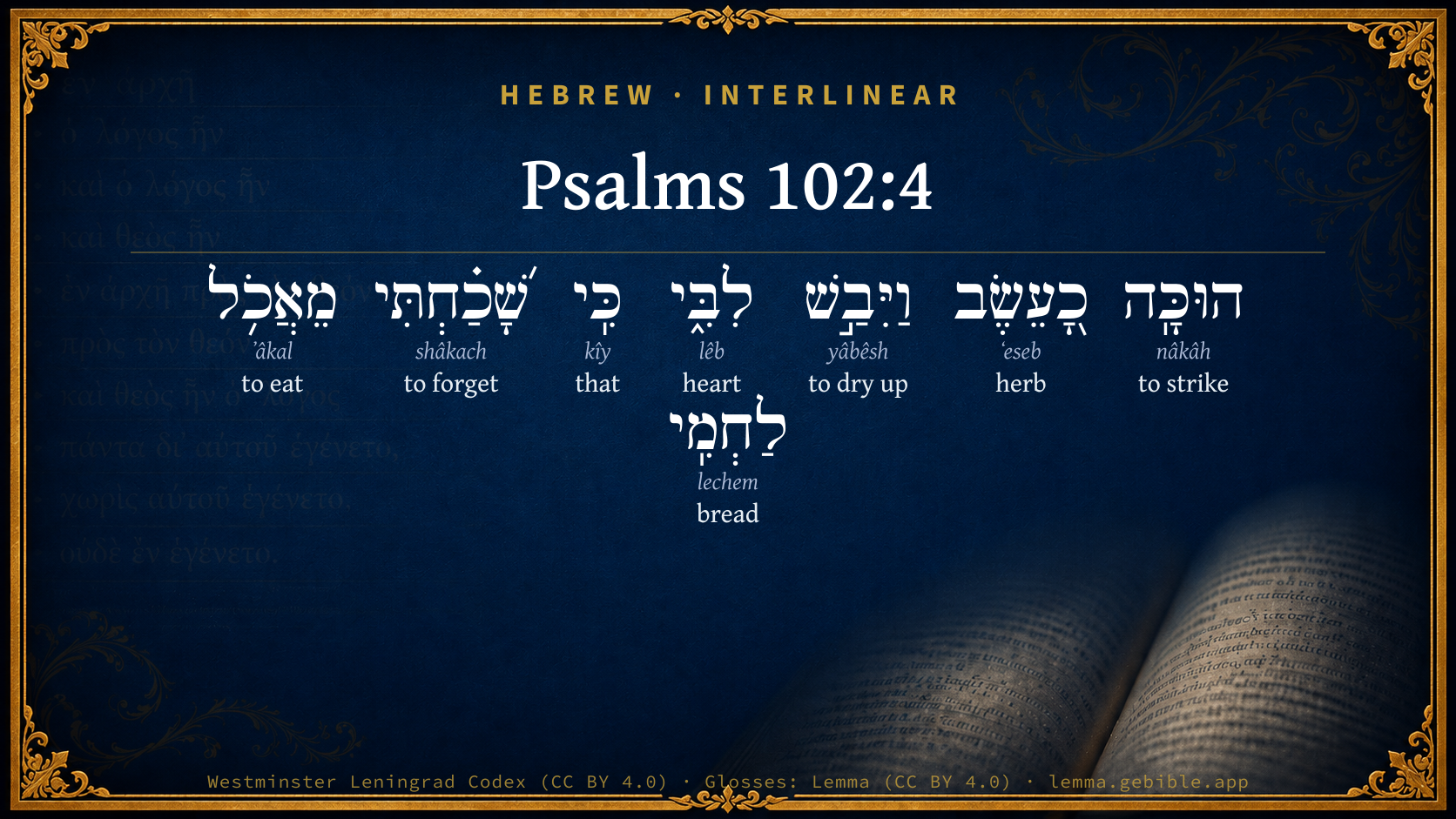
Hebrew (Westminster Leningrad Codex) Psalms 102:4 appears in the Hebrew Old Testament. The text above is from the Westminster Leningrad Codex. Each word links to its Strong’s number, a concise gloss, and parsing drawn from the Open Scriptures Hebrew Bible morphology. Click any word for its full Brown-Driver-Briggs (BDB) entry.
Download image
Cite this verse

Psalms 102:4 (World English Bible). Public Domain. Lemma interlinear Bible study tool, https://lemma.gebible.app/v/psalms/102/4.

Show BibTeX & RIS
BibTeX
RIS
English Translation
My heart is blighted like grass, and withered, For I forget to eat my bread.
World English Bible · Public Domain
Download a study sheet

One document with this verse’s original text, its word-by-word gloss line, the meaning frame, cross-references with their text, attributed commentary, and full source and license credits — printable, and it pastes into notes with its structure intact.

This verse Autodidact and up

Study sheet (.html) Plain text (.txt)

A passage Seminary Student

Up to 50 verses in one chapter. A passage sheet keeps up to 6 commentary sources and 12 cross-references per verse, in the order this page ranks them, and says so on the sheet whenever that leaves anything out. Ask for a single verse and you get the Autodidact verse sheet above.

Everything on this page stays free to read, with no account — the sheet is a download of what is already on screen, not access to it.

Want to remove ads? Support Godless Engineer
Compare translations 3

The same verse in 3 English versions, stacked beneath the original-language interlinear above. Click any original word for its lexicon entry.

Each is an independent rendering of the whole verse — the interlinear is not word-aligned to these translations.

Highlighted words mark where these versions differ — a whole-verse word diff, not a word-by-word alignment.

  • World English Bible Public Domain
    My heart is blighted like grass, and withered, For I forget to eat my bread.
  • King James Version Public Domain
    My heart is smitten, and withered like grass; so that I forget to eat my bread.
  • unfoldingWord Literal Text CC BY-SA 4.0
    My heart is struck like grass and withered, for I have forgotten to eat my bread.

unfoldingWord Literal Text — © unfoldingWord, licensed CC BY-SA 4.0. Word-aligned USFM3 via Door43 (git.door43.org/unfoldingWord/en_ult).

Versions to compare (up to 4)

3 of 4 selected

Show all 18 translations

Every available English version of this verse, each an independent rendering of the whole verse.

  • World English Bible Public Domain
    My heart is blighted like grass, and withered, For I forget to eat my bread.
  • Berean Standard Bible Public Domain
    My heart is afflicted, and withered like grass; I even forget to eat my bread.
  • Majority Standard Bible Public Domain
    My heart is afflicted, and withered like grass; I even forget to eat my bread.
  • King James Version Public Domain
    My heart is smitten, and withered like grass; so that I forget to eat my bread.
  • American Standard Version (1901) Public Domain
    My heart is smitten like grass, and withered; For I forget to eat my bread.
  • Revised Version (1885) Public Domain
    My heart is smitten like grass, and withered; for I forget to eat my bread.
  • Geneva Bible (1599) Public Domain
    Mine heart is smitten and withereth like grasse, because I forgate to eate my bread.
  • Douay-Rheims (1899) Public Domain
    For my days are vanished like smoke: and my bones are grown dry like fuel for the fire.
  • Young's Literal Translation Public Domain
    Smitten as the herb, and withered, is my heart, For I have forgotten to eat my bread.
  • Literal Standard Version CC BY-SA 4.0
    Struck as the herb, and withered, is my heart, || For I have forgotten to eat my bread.
  • Unlocked Literal Bible CC BY-SA 4.0
    My heart is crushed, and I am like grass that has withered. I forget to eat any food.
  • unfoldingWord Literal Text CC BY-SA 4.0
    My heart is struck like grass and withered, for I have forgotten to eat my bread.
  • Darby Bible Public Domain
    My heart is smitten and withered like grass; yea, I have forgotten to eat my bread.
  • World Messianic Bible Public Domain
    My heart is blighted like grass, and withered, for I forget to eat my bread.
  • Webster's Bible Public Domain
    \\102:3\\For my days are consumed like smoke, and my bones are burned as an hearth.
  • Free Bible Version CC BY-SA 4.0
    I'm like grass that's dried up, withered away—I even forget to eat!
  • Bible in Basic English Public Domain
    My heart is broken; it has become dry and dead like grass, so that I give no thought to food.
  • JPS Tanakh (1917) Public Domain
    (102-5) My heart is smitten like grass, and withered; for I forget to eat my bread.

Literal Standard Version (2020), Covenant Press — licensed CC BY-SA 4.0. Text via the HelloAO Bible API (eBible.org). Unlocked Literal Bible (unfoldingWord) — licensed CC BY-SA 4.0. Text via the HelloAO Bible API (eBible.org). unfoldingWord Literal Text — © unfoldingWord, licensed CC BY-SA 4.0. Word-aligned USFM3 via Door43 (git.door43.org/unfoldingWord/en_ult). Free Bible Version, Dr. Jonathan Gallagher — licensed CC BY-SA 4.0. Text via the HelloAO Bible API (eBible.org).

Word by word

More ways to search: Search by grammar → Find every occurrence → Compare this word →

Practice this passage: Drill this verse → Learn its vocabulary →

כָ֭עֵשֶׂב
ʻeseb
H6212
“like/as the · herb”
Preposition, Determined + Noun, Common, Masculine, Singular, Absolute
Part of Speech
Preposition + Noun
Type
Common
Gender
Masculine
Number
Singular
State
Absolute
Full BDB Definition

Origin: from an unused root meaning to glisten (or be green)

TWOT: 1707a

herb, herbage, grass, green plants
  1. הוּכָּֽה nâkâh H5221 “to strike” Verb, Hophal, Perfect, 3rd Person, Masculine, Singular
  2. וַיִּבַ֣שׁ yâbêsh H3001 “and · to dry up” Conjunction + Verb, Qal, Sequential Imperfect, 3rd Person, Masculine, Singular
  3. לִבִּ֑י lêb H3820 “heart · my” Noun, Common, Masculine, Singular, Construct + Suffix, Personal, 1st Person, Common, Singular
  4. כִּֽי kîy H3588 “that” Conjunction
  5. שָׁ֝כַ֗חְתִּי shâkach H7911 “to forget” Verb, Qal, Perfect, 1st Person, Common, Singular
  6. מֵאֲכֹ֥ל ʼâkal H398 “from · to eat” Preposition + Verb, Qal, Infinitive Construct
  7. לַחְמִֽי lechem H3899 “bread · my” Noun, Common, Both, Singular, Construct + Suffix, Personal, 1st Person, Common, Singular

About this verse

These counts appear in no published source. They are computed here, from the morphology-tagged text and Lemma’s own curated glosses. What Lemma adds →

8
words
8
distinct lemmas
Wisdom
section

Shared distinctive vocabulary

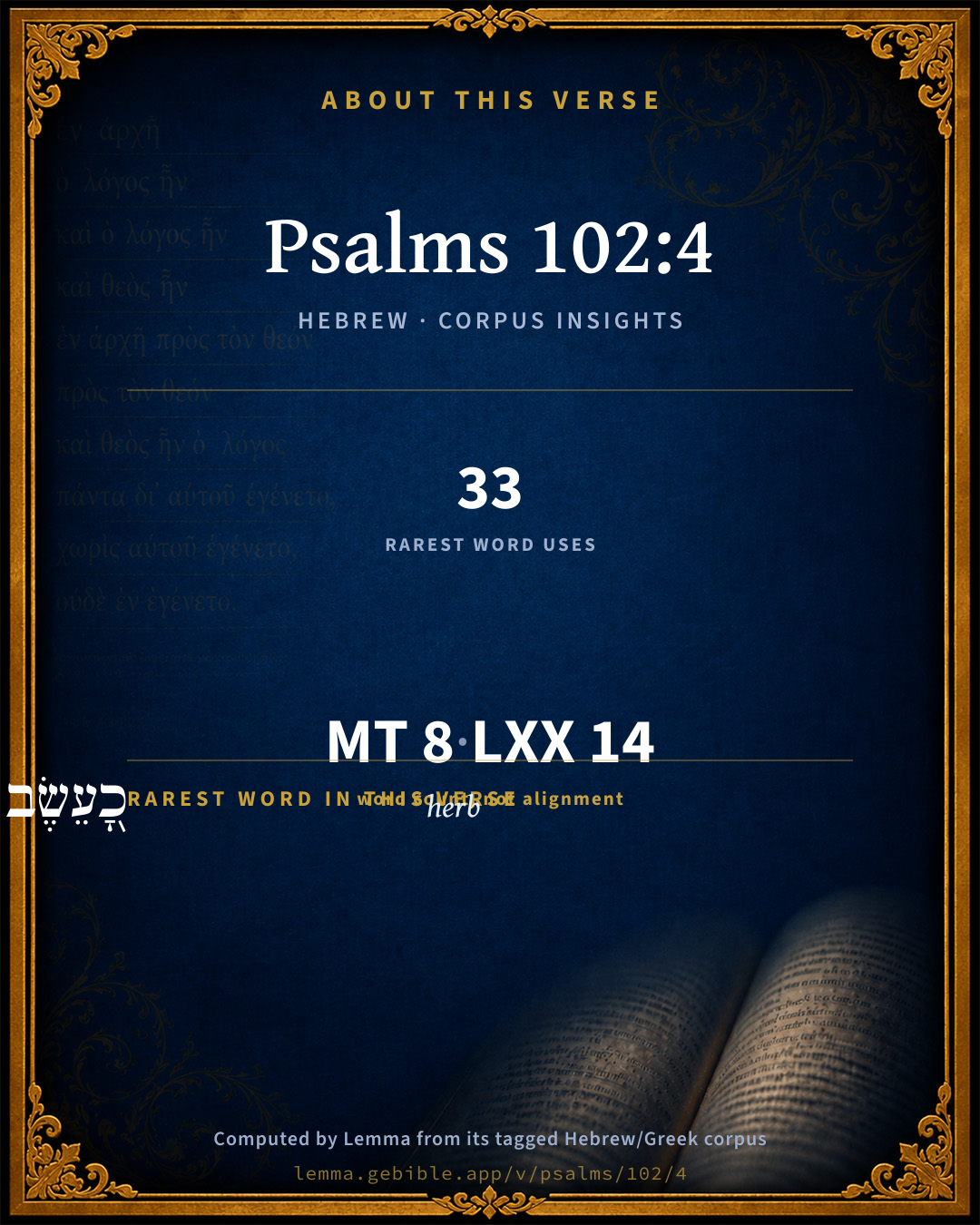
כָ֭עֵשֶׂב herb H6212 occurs in 32 verses of the Hebrew Bible. Also found in:

Grammatical profile

  • 4 verbs
  • 3 nouns
  • 1 conjunction

Verb forms

  • הוּכָּֽה Hophal · Perfect
  • וַיִּבַ֣שׁ Qal · Sequential Imperfect
  • שָׁ֝כַ֗חְתִּי Qal · Perfect
  • מֵאֲכֹ֥ל Qal · Infinitive Construct

Hebrew & Septuagint length

In English translation the verse runs 15 words from the Hebrew and 19 from the Septuagint (LXX English) — closely comparable.

A rough comparison of the two English renderings, which tokenize alike — not a word-level alignment.

Word counts can differ between the Hebrew and the Greek without any difference in meaning — e.g. the Hebrew direct-object marker אֵת has no separate Greek word, and Greek often adds the article ὁ.

In the original languages it is 8 Hebrew tokens and 14 Greek tokens — but the two are counted differently (Hebrew bundles its prefixes and suffixes into one token; the Greek is in lemma form), so that isn’t a like-for-like length.

Cross-references

20

Topical passages linked to Psalms 102:4 in the Treasury of Scripture Knowledge — connected by theme and wording, ordered by reader-vote popularity; previews shown in the World English Bible.

  • Isaiah 40:7 The grass withers, the flower fades, because the breath of Yahweh blows on it; surely the people is grass.
  • Psalms 37:2 For they shall soon be cut down like the grass, And wither like the green herb.
  • 1 Samuel 1:7–8 [as] he did so year by year, when she went up to the house of Yahweh, so she provoked her; therefore she wept, and did not eat.
  • Ezra 10:6 Then Ezra rose up from before the house of God, and went into the chamber of Jehohanan the son of Eliashib: and [when] he came there, he ate no bread, nor drink water; for he mourned because of the trespass of them of the captivity.
  • Psalms 77:3 I remember God, and I groan. I complain, and my spirit is overwhelmed. Selah.
  • Matthew 26:37–38 He took with him Peter and the two sons of Zebedee, and began to be sorrowful and severely troubled.
  • Acts 9:9 He was without sight for three days, and neither ate nor drank.
  • 2 Samuel 12:17 The elders of his house arose, [and stood] beside him, to raise him up from the earth: but he would not, neither did he eat bread with them.
  • Job 6:4 For the arrows of the Almighty are within me, My spirit drinks up their poison. The terrors of God set themselves in array against me.
  • Job 10:1 "My soul is weary of my life; I will give free course to my complaint. I will speak in the bitterness of my soul.
  • Job 33:20 So that his life abhors bread, And his soul dainty food.
  • Psalms 6:2–3 Have mercy on me, Yahweh, for I am faint. Yahweh, heal me, for my bones are troubled.
  • Psalms 42:6 My God, my soul is in despair within me. Therefore I remember you from the land of the Jordan, The heights of Hermon, from the hill Mizar.
  • Psalms 55:4–5 My heart is severely pained within me. The terrors of death have fallen on me.
  • Psalms 69:20 Reproach has broken my heart, and I am full of heaviness. I looked for some to take pity, but there was none; For comforters, but I found none.
  • Psalms 102:9 For I have eaten ashes like bread, And mixed my drink with tears,
  • Psalms 102:11 My days are like a long shadow. I have withered like grass.
  • Psalms 143:3–4 For the enemy pursues my soul. He has struck my life down to the ground. He has made me live in dark places, as those who have been long dead.
  • Lamentations 3:13 He has caused the shafts of his quiver to enter into my reins.
  • Lamentations 3:20 My soul still remembers them, and is bowed down within me.

Cross-references courtesy of OpenBible.info (CC BY 4.0).

Hebrew and Greek witnesses Masoretic Hebrew ↔ Greek Septuagint

The same verse in the two great witnesses to the Old Testament, shown verse-for-verse.

You’re reading Greek Psalm 101 (Hebrew Psalm 102). The Septuagint counts the superscription, so verse numbers can differ from the Hebrew — chapter-level alignment, not verse-by-verse. Numbering follows Rahlfs.

These are two independent witnesses, not word-aligned to each other, and the Septuagint is shown in lemma (dictionary) form.

Hebrew Psalms 102:4 Masoretic · Westminster Leningrad Codex

הוּכָּֽה כָ֭עֵשֶׂב וַיִּבַ֣שׁ לִבִּ֑י כִּֽי שָׁ֝כַ֗חְתִּי מֵאֲכֹ֥ל לַחְמִֽי

My heart is blighted like grass, and withered, For I forget to eat my bread.

World English Bible · Public Domain

Greek LXX Greek Psalm 101:4 Septuagint · lemma form

ὅτι ἐκλείπω ὡσεί καπνός ὁ ἡμέρα ἐγώ καί ὁ ὀστέον ἐγώ ὡσεί φρύγιον συνφρύγω

I am blighted like grass, and my heart is dried up; for I have forgotten to eat my bread.

LXX2012 (modern English Septuagint) · Public Domain

Hebrew: Westminster Leningrad Codex (CC BY 4.0). Greek: Septuagint (public domain); English from LXX2012 (modern English Septuagint) (Public Domain). How the Septuagint differs from the Hebrew →

Commentary

Notes on Psalms 102:4 from classic Christian and Jewish commentators (each source and its license shown beneath its notes). The classic Christian expositions comment on the surrounding passage and are grouped to its opening verse, so a note may address several verses; the Jewish commentaries on the Tanakh (Rashi and others) are per-verse, so they appear only where the commentator wrote on this verse.

Lemma curates 59 commentaries, every one of them public domain or Creative Commons licensed, each selected and text-cleaned for this edition rather than reprinted as found. About our sources →

Trapp's Complete Commentary

John Trapp

Psa 102:4 My heart is smitten, and withered like grass; so that I forget to eat my bread.

Ver. 4. My heart is smitten] Blasted with thine indignation, that ventus urens et exsiccans.

So that I forget to eat my bread] I am stomachless, through want of that heat that my heart should supply.

John Trapp, A Commentary or Exposition upon All the Books of the Old and New Testament (1647–1656) — public domain. Text from a community e-Sword module.

Joseph Benson's Commentary

Psa 102:4-7. My heart is withered like grass — Which is smitten and withered by the heat of the sun, either while it stands, or after it is cut down. So that I forget to eat my bread — Because my mind is wholly swallowed up with the contemplation of my own miseries. My bones cleave to my skin — My flesh being quite consumed with excessive sorrow. I am like a pelican in the wilderness — “There are two species of pelicans, one of which lives in the water on fish, the other in the wilderness, upon serpents and reptiles.” The word קאת, kaath, here used, is rendered cormorant, (which is a corruption of corvorant,) Isa 34:11; Zep 2:14. “By the owl of the desert many understand the bittern, and by the bird that sits solitary on the house-top, the owl.” Dr. Waterland and Houbigant, instead of sparrow alone, read the solitary bird; and the latter, for pelican, reads onocrotalus.

Joseph Benson's Commentary on the Old and New Testaments (1811–1818) — public domain. Text from a community e-Sword module.

J. A. Alexander on Psalms

Joseph Addison Alexander

5. (Psa 102:4) Smitten like grass and withered is my heart, for I have forgotten to eat my bread. The first verb is used to describe the effect of the sun on plants, Psa 121:6, Isa 49:10. (Compare Jon 4:7.) The heart is mentioned as the seat of life. The common version of the last clause (so that I forget) is ungrammatical. The failure of the strength is rather described as immediately occasioned by the want of food (1Sa 28:20), and this by loss of appetite from extreme distress. See below, on Psa 107:18, and compare 1Sa 1:7; 1Sa 20:34, 1Ki 21:4. Forgotten to eat, literally forgotten from eating, so as not to eat, a common idiomatic use of the preposition from in Hebrew.

Joseph Addison Alexander, The Psalms Translated and Explained (1850) — public domain. Text from a community e-Sword module.

Tyndale Open Study Notes

Tyndale Open Resources

102:4 Like dried grass, the psalmist senses his life ebbing away.

Tyndale Open Study Notes — © Tyndale Open Resources, licensed CC BY-SA 4.0. Text via the HelloAO Bible API.

Geneva Bible (1599)

Geneva Bible translators

My sorrows were so great, that I passed not for mine ordinary food.

Geneva Bible (1599) marginal notes — public domain. Text via Bolls.life.

Adam Clarke's Commentary

Verse 4. My heart is smitten, and withered like grass] The metaphor here is taken from grass cut down in the meadow. It is first smitten with the scythe, and then withered by the sun. Thus the Jews were smitten with the judgments of God; and they are now withered under the fire of the Chaldeans.

Adam Clarke's Commentary on the Bible (1810–1826) — public domain. Text from a community e-Sword/MySword module.

John Calvin's Commentaries

4 My heart is smitten, and dried up like grass Here he employs a third similitude, declaring that his heart is withered, and wholly dried up like mown grass. But he intends to express something more than that his heart was withered, and his bones reduced to a state of dryness. His language implies, that as the grass, when it is cut down, can no longer receive juice from the earth, nor retain the life and rigor which it derived from the root, so his heart being, as it were, torn and cut off from its root, was deprived of its natural nourishment. The meaning of the last clause, I have forgotten to eat my bread, is, My sorrow has been so great, that I have neglected my ordinary food. The Jews, it is true, during their captivity in Babylon, did eat their food; and it would have been an evidence of their having fallen into sinful despair, had they starved themselves to death. But what he means to say is, that he was so afflicted with sorrow as to refuse all delights, and to deprive himself even of food and drink. True believers may cease for a time to partake of their ordinary food, when, by voluntary fasting, they humbly beseech God to turn away his wrath, but the prophet does not here speak of that kind of abstinence from bodily sustenance. He speaks of such as is the effect of extreme mental distress, which is accompanied with a loathing of food, and a weariness of all things. In the close of the verse, he adds, that his body was, as it were, consuming or wasting away, so that his bones clave to his skin.

John Calvin's Commentaries (1540-1563) — public domain. Text from the Calvin Translation Society English edition (1840s-50s) via the Christian Classics Ethereal Library (ccel.org). Calvin's coverage is partial (roughly two-thirds of the Bible); uncommented books and verses are honest gaps, never fabricated. The 19th-century editor's footnotes and remarks are omitted so the notes are faithfully Calvin's own voice.

Ellicott's Commentary for English Readers

(4) Smitten.—As by the sun. Exactly as in Hos_9:16.

So that I forget.—Better, for I have forgotten, &c. For this mark of deep sorrow comp. 1Sa_1:7; 1Sa_20:34, &c. (Comp. Homer, Iliad, xxiv. 129.)

A Bible Commentary for English Readers, edited by Charles John Ellicott (1878–1897) — public domain. Text from a community e-Sword module.

The Cambridge Bible for Schools and Colleges

gen. ed. J. J. S. Perowne

4. My heart is smitten like grass, and withered;

Yea, I forget to eat my bread.

His heart, the centre of vital force and vigour, is dried up like a plant struck by the fierce heat of the sun and withered (Psa_121:6; Hos_9:16). Sorrow and sickness have deprived him of all appetite for food. Cp. 1Sa_1:7-8; Job_33:20.

The Cambridge Bible for Schools and Colleges (gen. ed. J. J. S. Perowne; Cambridge University Press, 1878–1918) — public domain. Text from a community e-Sword module.

John Gill's Exposition

By reason of the voice of my groaning,.... Under the burden of sin, and pressure of afflictions:

my bones cleave to my skin; was quite emaciated, reduced to a skeleton, became nothing but skin and bone (e); which sometimes is occasioned, as by outward afflictions, so by soul troubles: or "to my flesh" (f); flesh is put for skin; see Job 19:20.

(e) "Ossa atque pellis sum", Plauti Capteivei, Act. 1. Sc. 2. v. 26. Asinaria 3. 6. v. 28. (f) "carni meae", V. L. Pagninus, Montanus, &c.

John Gill's Exposition of the Whole Bible (1746–1763) — public domain (CC PDM 1.0). Text via the HelloAO Bible API.

Albert Barnes' Notes on the Bible

My heart is smitten - Broken; crushed with grief. We now speak of “a broken heart.” Even death is often caused by such excessive sorrow as to crush and break the heart.

And withered like grass - It is dried up as grass is by drought, or as when it is cut down. It loses its support; and having no strength of its own, it dies.

So that I forget to eat my bread - I am so absorbed in my trials; they so entirely engross my attention, that I think of nothing else, not even of those things which are necessary to the support of life. Grief has the effect of taking away the appetite, but this does not seem to be the idea here. It is that of such a complete absorption in trouble that everything else is forgotten.

Albert Barnes' Notes on the Bible (1834–1885) — public domain. Text from a community e-Sword/MySword module.

Matthew Poole's English Annotations

Like grass; which is smitten and withered by the heat of the sun, either whilst it stands, or after it is cut down.

I forget to eat my bread, because my mind is wholly swallowed up with the contemplation of my own miseries.

Matthew Poole's English Annotations on the Holy Bible (1683–1685) — public domain. Text from a community e-Sword/MySword module.

The Treasury of David

Charles H. Spurgeon

Ver. 4. My heart is smitten, like a plant parched by the fierce heat of a tropical sun, and withered like grass, which dries up when once the scythe has laid it low. The psalmist's heart was as a wilted, withered flower, a burned up mass of what once was verdure. His energy, beauty, freshness, and joy, were utterly gone, through the wasting influence of his anguish.

So that I forget to eat my bread, or "because I forget to eat my bread." Grief often destroys the appetite, and the neglect of food tends further to injure the constitution and create a yet deeper sinking of spirit. As the smitten flower no longer drinks in the dew, or draws up nutriment from the soil, so a heart parched with intense grief often refuses consolation for itself and nourishment for the bodily frame, and descends at a doubly rapid rate into weakness, despondency, and dismay. The case here described is by no means rare, we have frequently met with individuals so disordered by sorrow that their memory has failed them even upon such pressing matters as their meals, and we must confess that we have passed through the same condition ourselves. One sharp pang has filled the soul, monopolized the mind, and driven everything else into the background, so that such common matters as eating and drinking have been utterly despised, and the appointed hours of refreshment have gone by unheeded, leaving no manifest faintness of body, but an increased weariness of heart.

Ver. 4. My heart is smitten and withered like grass. The metaphor here is taken from grass, cut down in the meadow. It is first "smitten" with the scythe, and then "withered" by the sun. Thus the Jews were smitten with the judgments of God; and they are now withered under the fire of the Chaldeans. Adam Clarke.

Ver. 4. I forget to eat my bread. I have heard of some that have forgotten their own names, but I never heard of any that forget to eat his meat; for there is a certain prompter called hunger that will make a man to remember his meat in spite of his teeth. And yet it is true, when the heart is blasted and withered like grass, such a forgetfulness of necessity will follow. Is it that the withering of the heart is the prime cause of sorrow; at least cause of the prime sorrow; and immoderate sorrow is the mother of stupidity, stupifying and benumbing the animal faculties, that neither the understanding nor the memory can execute their functions? Or is it, that sorrow is so intentire to that it sorrows for, that it cannot intent to think anything else? Or is it, that nature makes account, that to feed in sorrow were to feed sorrow, and therefore thinks best to forbear all eating? Or is it, that as sorrow draws moisture from the brain and fills the eyes with water; so it draws a like juice from other parts, which fills the stomach instead of meat? However it be, it shews a wonderful operation that is in sorrow; to make not only the stomach to refuse its meat, but to make the brain forget the stomach, between whom there is so natural a sympathy and so near a correspondence. But as the vigour of the heart breeds plenty of spirits, which convey to all the parts, gives everyone a natural appetite; so when the heart is blasted and withered like grass, and that there is no more any rigour in it, the spirits are presently at a stand, and then no marvel if the stomach lose its appetite, and forget to eat bread. Sir R. Baker.

Ver. 4. I forget to eat my bread. When grief hath thus dejected the spirits, the man has no appetite for that food which is to recruit and elevate them. Ahab, smitten with one kind of grief, David with another, and Daniel with a third, all forgot, or refused, to eat their bread. 1Ki 21:4; 2Sa 12:16; Da 10:3. Such natural companions are mourning and fasting. Samuel Burder.

Ver. 4. Unbelieving sorrow makes us forget to use proper means for our support.

1. We forget the promises.

2. Forget the past and its expcriences.

3. Forget the Lord Jesus, our life.

4. Forget the everlasting love of God. This leads to weakness, faintness, etc., and is to be avoided.

Psalms 102:5*

Charles H. Spurgeon's The Treasury of David (1869–1885) — public domain. Psalms only. Text from a community e-Sword/MySword module.

Whedon's Commentary on the Bible

Daniel D. Whedon

4. My heart is smitten, and withered like grass—The word here translated “smitten,” in Psa_121:6, denotes a sunstroke. “Withered like grass,” is an allusion to the effect of the sirocco, or, perhaps, to the June sun, which, in that climate, withers the grass upon the hills to a brown and desolate appearance. On the sirocco, see note on Psa_103:16, and on the heat of the sun in May and June, see Mat_13:6.

Forget to eat my bread—The loss of appetite is a natural effect of great sorrow. Psa_107:18; Job_33:20

Daniel D. Whedon (gen. ed.), Commentary on the Old and New Testaments (1874–1909) — public domain. Text from a community e-Sword module.

The Pulpit Commentary

My heart is smitten. As with a stroke from the sun. (see Psa_121:6 Hos_9:16) And withered like grass. As grass upon the house tops, (Psa_129:6) or, indeed, in any exposed place under an Eastern sun. So that I forget to eat my bread; literally, for I forget, etc. The fact is adduced as a proof of the heart"s condition. (comp. Job_33:20 1Sa_1:7 1Sa_20:34, etc.)

The Pulpit Commentary (1880–1919), ed. H.D.M. Spence-Jones & Joseph S. Exell — public domain. Text from a community e-Sword module.

Rashi

Rabbi Shlomo Yitzchaki (Rashi)

are dried up Heb. נחרו. The “nun” serves as a prefix, as: נַעֲשׂוּ, they were made, נִקְנוּ, they were acquired; and it is an expression of dryness, as (Job 30:30): “and my bones dried out (חרה) from the heat”; (Jer. 6:29), “the bellows is heated (נחר).”

Rashi on the Tanakh — English translations: “The Judaica Press complete Tanach with Rashi, translated by A. J. Rosenberg” (CC BY 4.0); “Pentateuch with Rashi's commentary by M. Rosenbaum and A.M. Silbermann, 1929-1934” (public domain); “The Metsudah Tanach series, Lakewood, N.J” (CC BY 4.0); and “The Book of Joshua, Metsudah Publications, 1997” (CC BY 4.0). Text via Sefaria.

Lesson kit

Teaching starters — assembled from the data on this page, not authored interpretation. Every prompt links to the verse data it draws on. Edit before teaching.

Psalms, in the Wisdom, opens this verse with 8 words (8 distinct Hebrew lemmas). Its most distinctive word is ʻeseb (“herb”). A historical commentator’s framing appears above. Read the whole chapter for the surrounding context.

Discussion questions

  1. The word ʻeseb carries the sense “herb.” How does it shape the verse?
  2. How does Genesis 1:11, which shares the word «herb», read alongside this verse?
  3. These translations render this verse differently; the difference is in the English rendering, not the original. What questions does that raise?
  4. «הוּכָּֽה» is a Hophal Perfect verb. How does that grammatical form shape the action described?
  5. Compare how Trapp's Complete Commentary and Joseph Benson's Commentary read this verse. Where do they agree or differ?

Things to notice

Reading settings

Reading text

Shown beneath each verse's original-language words.

Old Testament
Old Testament edition

Read the OT as the Masoretic Hebrew (MT) or the Greek Septuagint (LXX).

English shown for the Greek Septuagint (in the Hebrew ↔ Greek comparison).

Comparing translations? Open the Compare panel on any verse page to stack up to four side by side.