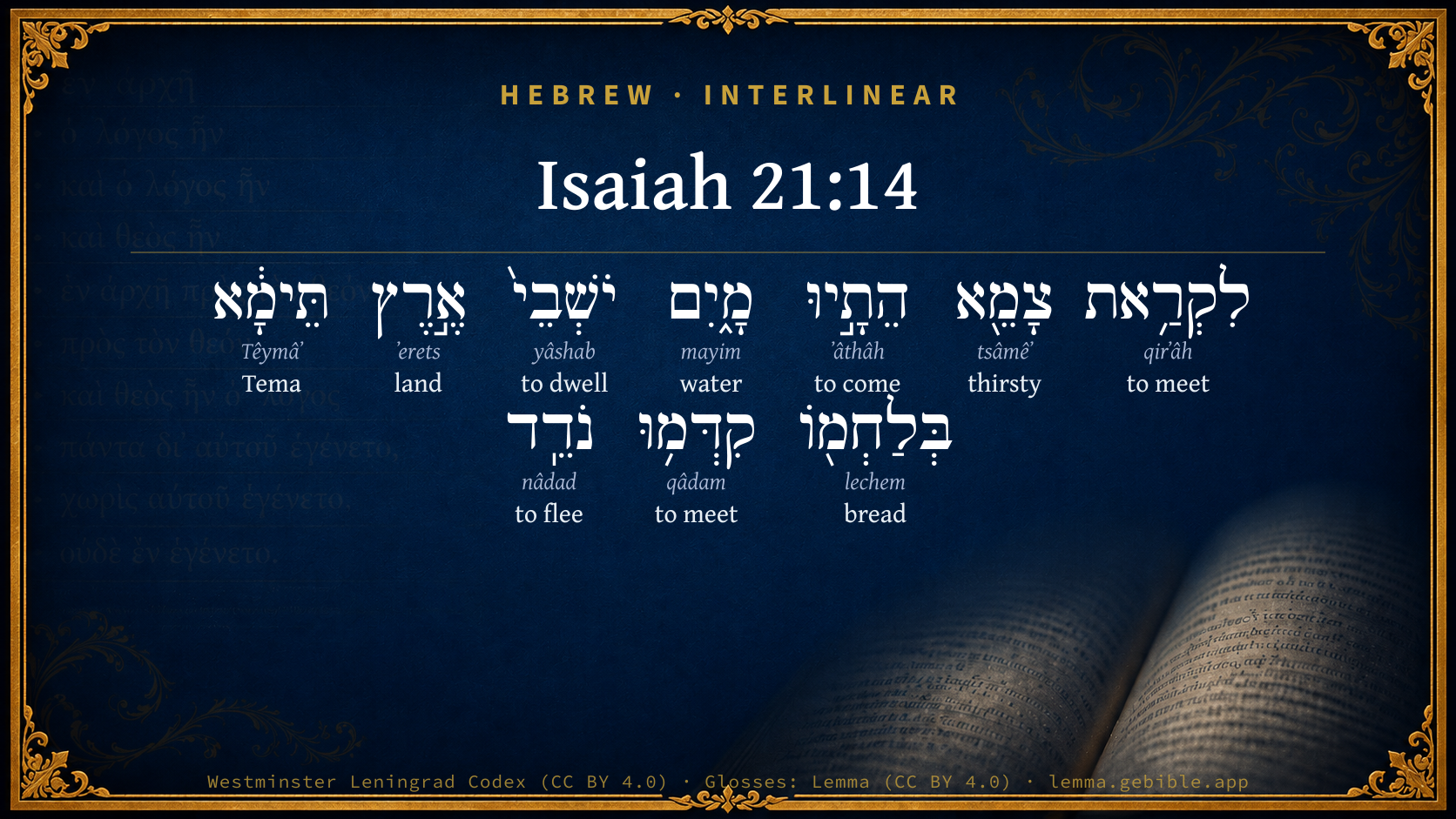
Isaiah 21:14

Hebrew (Westminster Leningrad Codex) Isaiah 21:14 appears in the Hebrew Old Testament. The text above is from the Westminster Leningrad Codex. Each word links to its Strong’s number, a concise gloss, and parsing drawn from the Open Scriptures Hebrew Bible morphology. Click any word for its full Brown-Driver-Briggs (BDB) entry.
Download image
Cite this verse

Isaiah 21:14 (World English Bible). Public Domain. Lemma interlinear Bible study tool, https://lemma.gebible.app/v/isaiah/21/14.

Show BibTeX & RIS
BibTeX
RIS
English Translation
To him who was thirsty they brought water; the inhabitants of the land of Tema did meet the fugitives with their bread.
World English Bible · Public Domain
Download a study sheet

One document with this verse’s original text, its word-by-word gloss line, the meaning frame, cross-references with their text, attributed commentary, and full source and license credits — printable, and it pastes into notes with its structure intact.

This verse Autodidact and up

Study sheet (.html) Plain text (.txt)

A passage Seminary Student

Up to 50 verses in one chapter. A passage sheet keeps up to 6 commentary sources and 12 cross-references per verse, in the order this page ranks them, and says so on the sheet whenever that leaves anything out. Ask for a single verse and you get the Autodidact verse sheet above.

Everything on this page stays free to read, with no account — the sheet is a download of what is already on screen, not access to it.

Want to remove ads? Support Godless Engineer
Compare translations 3

The same verse in 3 English versions, stacked beneath the original-language interlinear above. Click any original word for its lexicon entry.

Each is an independent rendering of the whole verse — the interlinear is not word-aligned to these translations.

Highlighted words mark where these versions differ — a whole-verse word diff, not a word-by-word alignment.

  • World English Bible Public Domain
    To him who was thirsty they brought water; the inhabitants of the land of Tema did meet the fugitives with their bread.
  • King James Version Public Domain
    The inhabitants of the land of Tema brought water to him that was thirsty, they prevented with their bread him that fled.
  • unfoldingWord Literal Text CC BY-SA 4.0
    To meet the thirsty one, bring water, dwellers of the land of Tema. With its bread, they met the fugitive.

unfoldingWord Literal Text — © unfoldingWord, licensed CC BY-SA 4.0. Word-aligned USFM3 via Door43 (git.door43.org/unfoldingWord/en_ult).

Versions to compare (up to 4)

3 of 4 selected

Show all 18 translations

Every available English version of this verse, each an independent rendering of the whole verse.

  • World English Bible Public Domain
    To him who was thirsty they brought water; the inhabitants of the land of Tema did meet the fugitives with their bread.
  • Berean Standard Bible Public Domain
    Bring water for the thirsty, O dwellers of Tema; meet the refugees with food.
  • Majority Standard Bible Public Domain
    Bring water for the thirsty, O dwellers of Tema; meet the refugees with food.
  • King James Version Public Domain
    The inhabitants of the land of Tema brought water to him that was thirsty, they prevented with their bread him that fled.
  • American Standard Version (1901) Public Domain
    Unto him that was thirsty they brought water; the inhabitants of the land of Tema did meet the fugitives with their bread.
  • Revised Version (1885) Public Domain
    Unto him that was thirsty they brought water; the inhabitants of the land of Tema did meet the fugitives with their bread.
  • Geneva Bible (1599) Public Domain
    O inhabitants of the lande of Tema, bring foorth water to meete the thirstie, and preuent him that fleeth with his bread.
  • Douay-Rheims (1899) Public Domain
    Meeting the thirsty bring him water, you that inhabit the land of the south, meet with bread him that fleeth.
  • Young's Literal Translation Public Domain
    To meet the thirsty brought water have Inhabitants of the land of Tema, With his bread they came before a fugitive.
  • Literal Standard Version CC BY-SA 4.0
    Inhabitants of the land of Tema || Have brought water to meet the thirsty, || With his bread they came before a fugitive.
  • Unlocked Literal Bible CC BY-SA 4.0
    Bring water for the thirsty; inhabitants of the land of Tema, meet the fugitives with bread.
  • unfoldingWord Literal Text CC BY-SA 4.0
    To meet the thirsty one, bring water, dwellers of the land of Tema. With its bread, they met the fugitive.
  • Darby Bible Public Domain
    Bring ye water to meet the thirsty! The inhabitants of the land of Tema come forth with their bread for him that fleeth.
  • World Messianic Bible Public Domain
    They brought water to him who was thirsty. The inhabitants of the land of Tema met the fugitives with their bread.
  • Webster's Bible Public Domain
    The inhabitants of the land of Tema brought water to him that was thirsty, they met with their bread him that fled.
  • Free Bible Version CC BY-SA 4.0
    People of Tema, take water to the thirsty, meet the refugees with food.
  • Bible in Basic English Public Domain
    Give water to him who is in need of water; give bread, O men of the land of Tema, to those in flight.
  • JPS Tanakh (1917) Public Domain
    Unto him that is thirsty bring ye water! The inhabitants of the land of Tema did meet the fugitive with his bread.

Literal Standard Version (2020), Covenant Press — licensed CC BY-SA 4.0. Text via the HelloAO Bible API (eBible.org). Unlocked Literal Bible (unfoldingWord) — licensed CC BY-SA 4.0. Text via the HelloAO Bible API (eBible.org). unfoldingWord Literal Text — © unfoldingWord, licensed CC BY-SA 4.0. Word-aligned USFM3 via Door43 (git.door43.org/unfoldingWord/en_ult). Free Bible Version, Dr. Jonathan Gallagher — licensed CC BY-SA 4.0. Text via the HelloAO Bible API (eBible.org).

Word by word

More ways to search: Search by grammar → Find every occurrence → Compare this word →

Practice this passage: Drill this verse → Learn its vocabulary →

About this verse

These counts appear in no published source. They are computed here, from the morphology-tagged text and Lemma’s own curated glosses. What Lemma adds →

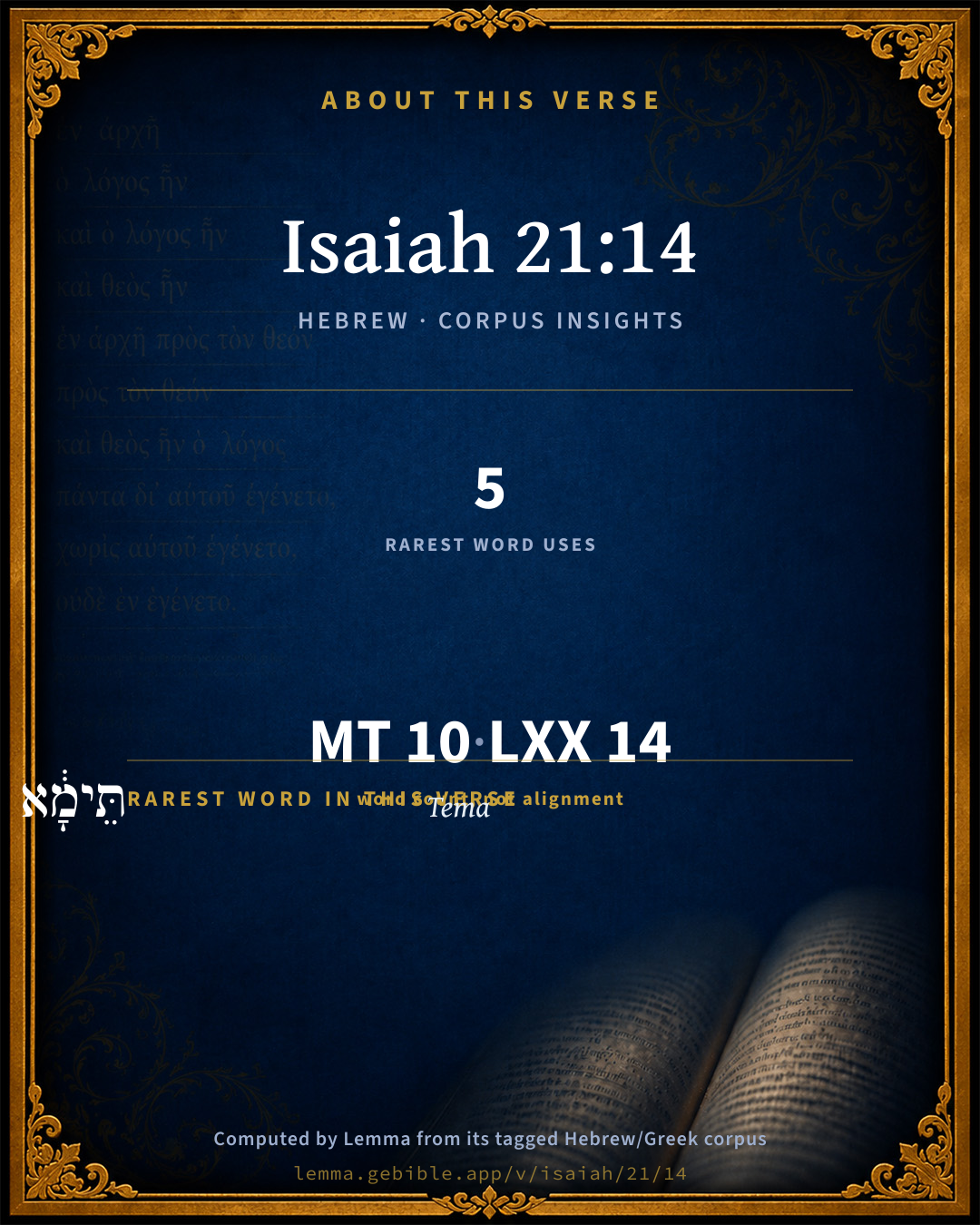
10
words
10
distinct lemmas
Prophets
section

Notable vocabulary

The rarest word here is תֵּימָ֔א Tema H8485 — appearing just 5 times in the whole Hebrew Bible.

Shared distinctive vocabulary

תֵּימָ֔א Tema H8485 occurs in 5 verses of the Hebrew Bible. Also found in:

Grammatical profile

  • 5 verbs
  • 4 nouns
  • 1 adjective

Verb forms

  • לִקְרַ֥את Qal · Infinitive Construct
  • הֵתָ֣יוּ Hiphil · Imperative
  • יֹשְׁבֵי֙ Qal · Participle Active
  • קִדְּמ֥וּ Piel · Perfect
  • נֹדֵֽד Qal · Participle Active

Hebrew & Septuagint length

In English translation the verse runs 22 words from the Hebrew and 16 from the Septuagint (LXX English) — closely comparable.

A rough comparison of the two English renderings, which tokenize alike — not a word-level alignment.

Word counts can differ between the Hebrew and the Greek without any difference in meaning — e.g. the Hebrew direct-object marker אֵת has no separate Greek word, and Greek often adds the article ὁ.

In the original languages it is 10 Hebrew tokens and 14 Greek tokens — but the two are counted differently (Hebrew bundles its prefixes and suffixes into one token; the Greek is in lemma form), so that isn’t a like-for-like length.

Cross-references

8

Topical passages linked to Isaiah 21:14 in the Treasury of Scripture Knowledge — connected by theme and wording, ordered by reader-vote popularity; previews shown in the World English Bible.

  • Genesis 25:15 Hadad, Tema, Jetur, Naphish, and Kedemah.
  • Job 6:19 The caravans of Tema looked, The companies of Sheba waited for them.
  • Proverbs 25:21 If your enemy is hungry, give him food to eat; If he is thirsty, give him water to drink:
  • Romans 12:20 Therefore "If your enemy is hungry, feed him. If he is thirsty, give him a drink. For in doing so, you will heap coals of fire on his head."
  • Judges 8:4–8 Gideon came to the Jordan, [and] passed over, he, and the three hundred men who were with him, faint, yet pursuing.
  • 1 Chronicles 1:30 Mishma, and Dumah, Massa, Hadad, and Tema,
  • Isaiah 16:3–4 Give counsel, execute justice; make your shade as the night in the midst of the noonday; hide the outcasts; don't betray the fugitive.
  • 1 Peter 4:9 Be hospitable one to another without grumbling.

Cross-references courtesy of OpenBible.info (CC BY 4.0).

Hebrew and Greek witnesses Masoretic Hebrew ↔ Greek Septuagint

The same verse in the two great witnesses to the Old Testament, shown verse-for-verse.

These are two independent witnesses, not word-aligned to each other, and the Septuagint is shown in lemma (dictionary) form.

Hebrew Isaiah 21:14 Masoretic · Westminster Leningrad Codex

לִקְרַ֥את צָמֵ֖א הֵתָ֣יוּ מָ֑יִם יֹשְׁבֵי֙ אֶ֣רֶץ תֵּימָ֔א בְּלַחְמ֖וֹ קִדְּמ֥וּ נֹדֵֽד

To him who was thirsty they brought water; the inhabitants of the land of Tema did meet the fugitives with their bread.

World English Bible · Public Domain

Greek LXX Isaiah 21:14 Septuagint · lemma form

εἰς συνάντησις διψάω ὕδωρ φέρω ὁ ἐνοἰκέω ἐν χώρα θαιμαν ἄρτος συναντάω ὁ φεύγω

You⌃ that dwell in the country of Thaeman, bring water to meet him that is thirsty;

LXX2012 (modern English Septuagint) · Public Domain

On this verse, Albert Barnes' Notes on the Bible discusses the Septuagint’s reading. Read the note in Commentary ↓

Hebrew: Westminster Leningrad Codex (CC BY 4.0). Greek: Septuagint (public domain); English from LXX2012 (modern English Septuagint) (Public Domain). How the Septuagint differs from the Hebrew →

Targum (Aramaic paraphrase)

1

The Targum is the ancient Jewish Aramaic paraphrase of the Hebrew Scriptures — an interpretive translation, not the Hebrew text itself. Onkelos (literal) and Pseudo-Jonathan (expansive) render the Torah, and Jonathan the Prophets. Coverage is partial: where no permissively-licensed English translation exists for a verse, only the Aramaic is shown. This is verse-level text, not a word-by-word alignment to the Hebrew.

  1. Targum Jonathan Prophets (Joshua–Malachi)
    לְאַפֵּי צַחְיָא פּוּקוּ נַגְדִין דְמַיָא דְיָתְבֵי בְּאַרְעָא דְרוֹמָא לַחְמָא דְאַתּוּן אָכְלִין זַמִינוּ לִמְעַרְקַיָא:

    Bring bottles of water before the thirsty, who dwell in land of the south; prepare for the fugitives the daily food which ye eat.

    Targum Jonathan — Aramaic: “Mikraot Gedolot” (public domain). English: “Sefaria Community Translation” (CC0 1.0 (public-domain dedication)); “London "Chaldee Paraphrase," 1871” (public domain). Text via Sefaria.

Commentary

Notes on Isaiah 21:14 from classic Christian and Jewish commentators (each source and its license shown beneath its notes). The classic Christian expositions comment on the surrounding passage and are grouped to its opening verse, so a note may address several verses; the Jewish commentaries on the Tanakh (Rashi and others) are per-verse, so they appear only where the commentator wrote on this verse.

Lemma curates 59 commentaries, every one of them public domain or Creative Commons licensed, each selected and text-cleaned for this edition rather than reprinted as found. About our sources →

Trapp's Complete Commentary

John Trapp

Isa 21:14 The inhabitants of the land of Tema brought water to him that was thirsty, they prevented with their bread him that fled.

Ver. 14. Brought water to the thirsty.] Or, Bring forth water wherewith to meet the thirsty; with your bread prevent those that flee; be speedy and spontaneous in your beneficence. "Blessed is the man that considereth the poor and needy"; {Psa 41:1} qui praeoccupat vocem petitari - which preventeth the request of the poor beggar; so Augustine rendereth it.

John Trapp, A Commentary or Exposition upon All the Books of the Old and New Testament (1647–1656) — public domain. Text from a community e-Sword module.

Joseph Benson's Commentary

Isa 21:14-15. The inhabitants of the land of Tema — Another part of Arabia, (of which see Job 6:19; Jer 25:23,) namely, the posterity of Tema, Ishmael’s son; brought water to him that was thirsty — To the Dedanites, who are here represented as being reduced to great straits, being forced to flee from the enemy without any provision for their subsistence. They prevented with bread him that fled — That is, that fled for his life from the sword of the enemy, as is more fully expressed in the next verse. “To bring forth bread and water, in such cases of distress, is an instance of common humanity; especially in these desert countries, in which the common necessaries of life, more particularly water, are not easily met with, or procured.” See Deu 23:4.

Joseph Benson's Commentary on the Old and New Testaments (1811–1818) — public domain. Text from a community e-Sword module.

Tyndale Open Study Notes

Tyndale Open Resources

21:14 Tema was an oasis in Arabia on a main trade route from Babylon.

Tyndale Open Study Notes — © Tyndale Open Resources, licensed CC BY-SA 4.0. Text via the HelloAO Bible API.

Geneva Bible (1599)

Geneva Bible translators

Signifying, that for fear they shall not tarry to eat nor drink.

Geneva Bible (1599) marginal notes — public domain. Text via Bolls.life.

Jamieson, Fausset & Brown

Robert Jamieson, A. R. Fausset & David Brown

Tema--a kindred tribe: an oasis in that region (Jer 25:23). The Temeans give water to the faint and thirsting Dedanites; the greatest act of hospitality in the burning lands of the East, where water is so scarce.

prevented--that is, anticipated the wants of the fugitive Dedanites by supplying bread (Gen 14:18).

their bread--rather, "his (the fugitive's) bread"; the bread due to him, necessary for his support; so "thy grave" (Isa 14:19), [MAURER].

Jamieson, Fausset & Brown — Commentary Critical and Explanatory on the Whole Bible (1871) — public domain (CC PDM 1.0). Text via the HelloAO Bible API.

Adam Clarke's Commentary

Verse 14. The land of Tema - "The southern country"] Θαιμαν, Sept.; Austri, Vulg. They read תימן teiman, which seems to be right; for probably the inhabitants of Tema might be involved in the same calamity with their brethren and neighbours of Kedar, and not in a condition to give them assistance, and to relieve them, in their flight before the enemy, with bread and water. To bring forth bread and water is an instance of common humanity in such cases of distress; especially in those desert countries in which the common necessaries of life, more particularly water, are not easily to be met with or procured. Moses forbids the Ammonite and Moabite to be admitted into the congregation of the Lord to the tenth generation. One reason which he gives for this reprobation is their omission of the common offices of humanity towards the Israelites; "because they met them not with bread and water in the way, when they came forth out of Egypt," De 23:4.

Adam Clarke's Commentary on the Bible (1810–1826) — public domain. Text from a community e-Sword/MySword module.

Ellicott's Commentary for English Readers

(14) The inhabitants of . . . Tema . . .—Another element of suffering comes into the picture. The Dedanites, driven out of their usual route into the desert, find their provisions fail them, and the men of Tema, fearing to invite them to their tents, lest they too should be smitten by the invader, are compelled to take out bread and water stealthily. The name of Tema (now Taima), is found on the pilgrim route from Damascus to Mecca, and again on that between Palmyra and Petra, on the east of the Haurân mountains.

They prevented with their bread—i.e., they went out to welcome him (the fugitive), without waiting till he came as a suppliant. Their very hospitality, in strange contrast with Arab usage, had to be practised in secret.

A Bible Commentary for English Readers, edited by Charles John Ellicott (1878–1897) — public domain. Text from a community e-Sword module.

The Cambridge Bible for Schools and Colleges

gen. ed. J. J. S. Perowne

14. The caravans are reduced to the direst straits through having to shun the stations on the regular route where alone their stock of food and water could be replenished. The prophet calls on the inhabitants of Tema to supply their necessities. The verse should be rendered: To the thirsty bring water, O ye inhabitants of the land of Tema, meet the fugitive with bread (suitable) for him. (See R.V. marg.)

Tema (Gen_25:14; Job_6:19) is the modern Teima in the northern highlands of Arabia, east of the great pilgrim route from Damascus to Mecca. In O.T. times it was the seat of an important commercial tribe, friendly therefore to the Dedanites.

The Cambridge Bible for Schools and Colleges (gen. ed. J. J. S. Perowne; Cambridge University Press, 1878–1918) — public domain. Text from a community e-Sword module.

John Gill's Exposition

The inhabitants of the land of Tema,.... This country had its name from Tema, one of the sons of Ishmael, Gen 25:15. The Targum calls it the land of the south, as if it was Teman. These people were Arabians, and are here said to assist their countrymen, the Dedanites, in distress:

brought water to him that was thirsty; as travellers are wont to be, especially in a desert land, and when fleeing from an enemy; in which circumstances the travelling companies of Dedanim now were:

they prevented with their bread him that fled; gave it to him, being hungry and necessitous, without asking for it. Now all this seems to show what calamities should come upon the inhabitants of some parts of Arabia; that they should lodge in a forest, be hungry and thirsty, and flee before their enemy, as follows.

John Gill's Exposition of the Whole Bible (1746–1763) — public domain (CC PDM 1.0). Text via the HelloAO Bible API.

Albert Barnes' Notes on the Bible

Of the land of Tema - Tema was one of the sons of Ishmael Gen 25:15, and is supposed to have populated the city of Thema in Arabia Deserta. The word denotes hero one of the tribes of Ishmael, or of the Arabians. Job speaks Job 6:19 of ‘the troops of Tema,’ and Jeremiah Jer 25:23 connects Tema and Dedan together. Jerome and Eusebius say that the village of Theman (Θαιμάν Thaiman) existed in their time. It was, according to Jerome, five, and according to Eusebius, fifteen miles from Petra, and was then occupied as a Roman garrison (Onomas Urb. et Locor). Ptolemy speaks of a city called Themme (Θαιμάν Themmē) in Arabia Deserta. This city lies, according to D’Anville, in longitude 57 degrees East, and in latitude 27 degrees North. According to Seetsen, it is on the road usually pursued by caravans from Mecca to Damascus. Lowth renders it ‘The southern country,’ but without authority. The Septuagint renders it, Θαιμάν Thaiman - ‘Thaiman.’

Brought water - Margin, ‘Bring ye.’ This might be rendered in the imperative, but the connection seems rather to require that it be read as a declaration that they did so. To bring water to the thirsty was an act of hospitality, and especially in eastern countries, where water was so scarce, and where it was of so much consequence to the traveler in the burning sands and deserts. The idea is, that the inhabitants of the land would be oppressed and pursued by an enemy; and that the Arabians, referred to by the prophet Isa 21:13, would be driven from their homes; and be dependent on others; that they would wander through the vast deserts, deprived of the necessaries of life; and that they would be dependent on the charity of the people of Tema for the supply of their needs. The following illustration of this passage has been kindly furnished me by the Rev. Eli Smith, missionary to Syria, showing that Isaiah, in mentioning “hospitality” as one of the virtues of the inhabitants of Tema, drew from the life. ‘Even in Hebrew prophecy hospitality is distinctly recognized as a trait in the Arab character. Isaiah says, “the inhabitants of Tema,” etc. Tema is known as an oasis in the heart of Arabia, between Syria and Mecca. And among the scraps of ante-Mahometan poetry that have reached us, is one by Samaciel, a prince of this same Tema. In extolling the virtues of his tribe he says -

“No fire of ours was ever extinguished at night without a guest, and of our guests never did one disparage us.”

‘In the passage quoted from Isaiah, it is to the thirsty and hungry in flight, that the inhabitants of Tema are represented as bringing water and bread, as if hastening to afford them protection. The extent to which this protection is sometimes carried, is finely illustrated by a traditionary anecdote in the life of Samaciel, the prince and poet of Tema just mentioned. In some feud among the tribes in his neighborhood, a prince (Amru el-Keis) fled to Samaciel, left with him his treasures, and was conducted by him beyond the reach of his enemies. They assembled their forces, and marched upon Tema. On their way Samaciel’s son fell into their hands. Presenting the young man before his castle, they proposed to the father the dreadful alternative, of delivering up to them what his guest had left, or seeing his son massacred. Samaciel’s sense of honor dictated the reply -

“He honored me, and I’ll honor him ... Treachery is a chain to the neck that never wears out.” So he defended the rights of his guest, and his son was slain.’

They prevented - Our word ‘prevent’ usually means at present, to hinder, to obstruct. But in the Scriptures, and in the Old English sense of the word, it means to anticipate, to go before. That is the sense of the word קדמוּ qidemû here. They “anticipated” their needs by bread; that is, they supplied them. This was an ancient and an honorable rite of hospitality. Thus Melchizedek Gen 14:17-18 is said to have come out and met Abraham, when returning victorious from the slaughter of Chedorlaomer, with bread and wine.

Him that fled - The inhabitant of the land of Arabia that fled before the invader, perhaps the inhabitants of Kedar Isa 21:16, or of some other part of Arabia. It is not meant that the “whole” land of Arabia would be desolate, but that the invasion would come upon certain parts of it; and the inhabitants of other portions - as of Tema - would supply the needs of the fugitives.

Albert Barnes' Notes on the Bible (1834–1885) — public domain. Text from a community e-Sword/MySword module.

Haydock's Catholic Bible Commentary

Water. To neglect this was to be accessary to another’s death, in those dreary regions, chap. xvi. 3., and Deuteronomy xxiii. 2.

George Leo Haydock (1774–1849), Haydock's Catholic Family Bible and Commentary, 1859 edition — public domain. Excludes Psalms (Douay-Rheims chapter numbering differs from Protestant) and Deuterocanonical books (Catholic canon only).

Matthew Poole's English Annotations

Tema; a part of Arabia; of which see Job 6:19; Jer 25:23.

They prevented with their bread him that fled; whereby he implies that those other Arabians, against whom this prophecy is principally directed, should be reduced to great scarcity of all necessary provisions, and forced to flee for their lives from a bloody enemy, as is more fully expressed in the next verse.

Matthew Poole's English Annotations on the Holy Bible (1683–1685) — public domain. Text from a community e-Sword/MySword module.

Whedon's Commentary on the Bible

Daniel D. Whedon

14. Tema — If this place has been identified, as is claimed, it lay on the present pilgrim road from Damascus to Mecca. Its people are commanded to supply provisions to the caravans, who were fleeing from “the drawn sword, the bent bow, and the grievousness of war.”

Daniel D. Whedon (gen. ed.), Commentary on the Old and New Testaments (1874–1909) — public domain. Text from a community e-Sword module.

The Pulpit Commentary

The inhabitants of the land of Tema brought water; rather, bring? water, O inhabitants. Tema is reasonably identified with the modern Taima, a village of the Hauran, on the caravan route between Palmyra and Peira. Its inhabitants are exhorted to bring water to the thirsty Dedanites, as they pass along this route with their "travelling companies." (For other mentions of Tome, which must not be confounded with Teman, see Job_6:19 and Jer_25:23) They prevented with their bread him that fled. Several commentators take this clause as imperative, like the last, and render, "With his bread meet the fugitive;" but the existing Hebrew text seems to require the rendering of the Authorized Version. Dr. Kay understands the prophet to mean that the men of Tema did not need exhortation; already of their own accord had they given of their bread to the fugitive Dedanites.

The Pulpit Commentary (1880–1919), ed. H.D.M. Spence-Jones & Joseph S. Exell — public domain. Text from a community e-Sword module.

John Wesley's Explanatory Notes

Tema - A part of Arabia. Fled - Whereby he implies, that those other Arabians, against whom this prophecy is principally directed, should be reduced to great scarcity, and forced to flee for their lives, from a bloody enemy.

John Wesley, Explanatory Notes Upon the Whole Bible (1754–1765) — public domain. Text via the GEBible commentary corpus.

J. A. Alexander on Isaiah

Joseph Addison Alexander

“To meet the thirsty they bring water, the inhabitants of the land of Tema; with his bread they prevent (i.e., meet or anticipate) the fugitive.” The men of Tema, another Arabian tribe, also engaged in trade (Jer 25:23: Job 6:19) are described as bringing food and drink, not to the Dedanim mentioned in v. 13, but to the people of the wasted country. His bread is rendered in the English Version as a collective (their bread), referring to the men of Tema; but the pronoun relates rather to the fugitive himself, and the whole phrase means his portion of food, the food necessary for him, his daily bread.

Joseph Addison Alexander, The Prophecies of Isaiah (1846–1847; New York: Scribner, 1870–1878) — public domain. Text from a community e-Sword module.

Rashi

Rabbi Shlomo Yitzchaki (Rashi)

Toward the thirsty it is customary to bring water, but you, the inhabitants of the land of Tema, did not do so, but with his bread they came before the wanderer; they brought them sorts of salty foods and blown up flasks full of air, and he would eat and ask to drink, and he would put the opening of the flask into his mouth, and the air would go into his innards, and he would die. Another explanation of “Toward the thirsty they bring water,” is as follows: I did not do so to your forefather, Ishmael; when he was thirsty, I revealed to him a well of water.

Rashi on the Tanakh — English translations: “The Judaica Press complete Tanach with Rashi, translated by A. J. Rosenberg” (CC BY 4.0); “Pentateuch with Rashi's commentary by M. Rosenbaum and A.M. Silbermann, 1929-1934” (public domain); “The Metsudah Tanach series, Lakewood, N.J” (CC BY 4.0); and “The Book of Joshua, Metsudah Publications, 1997” (CC BY 4.0). Text via Sefaria.

Ibn Ezra

Rabbi Abraham ibn Ezra

Bring water. The prophet tells them to be kind to the caravans, and to give them water, for Moab was rebuked for not having done so (Deut. 23:5).

התיו Bring. ה is instead of.א

Tema. Comp. Gen. 25:15.

With his bread. With the bread of him that is now thirsty.—Be kind to him, for he used to feed every one that came wandering to him.

They prevented. They, that is, he and his men or friends.

Ibn Ezra on the Tanakh — English translations: “Sefaria Community Translation” (CC0 1.0 (public-domain dedication)); “Yalkut, Sifsei Chachomim Chumash, Metsudah Publications, 2009” (CC BY 4.0); and “Commentary of Ibn Ezra on Isaiah - trans. by M. Friedlander, 1873” (public domain). Text via Sefaria.

Lesson kit

Teaching starters — assembled from the data on this page, not authored interpretation. Every prompt links to the verse data it draws on. Edit before teaching.

Isaiah, in the Prophets, opens this verse with 10 words (10 distinct Hebrew lemmas). Its most distinctive word is Têymâʼ (“Tema”). A historical commentator’s framing appears above. Read the whole chapter for the surrounding context.

Discussion questions

  1. How does “Tema” (Têymâʼ) shape what this verse is saying?
  2. How does Genesis 25:15, which shares the word «Tema», read alongside this verse?
  3. The translations on this page render this verse differently — a whole-verse word diff, not a word-by-word alignment. What might account for the different wordings?
  4. «לִקְרַ֥את» is a Qal Infinitive Construct verb. How does that grammatical form shape the action described?
  5. Compare how Trapp's Complete Commentary and Joseph Benson's Commentary read this verse. Where do they agree or differ?

Things to notice

Reading settings

Reading text

Shown beneath each verse's original-language words.

Old Testament
Old Testament edition

Read the OT as the Masoretic Hebrew (MT) or the Greek Septuagint (LXX).

English shown for the Greek Septuagint (in the Hebrew ↔ Greek comparison).

Comparing translations? Open the Compare panel on any verse page to stack up to four side by side.