
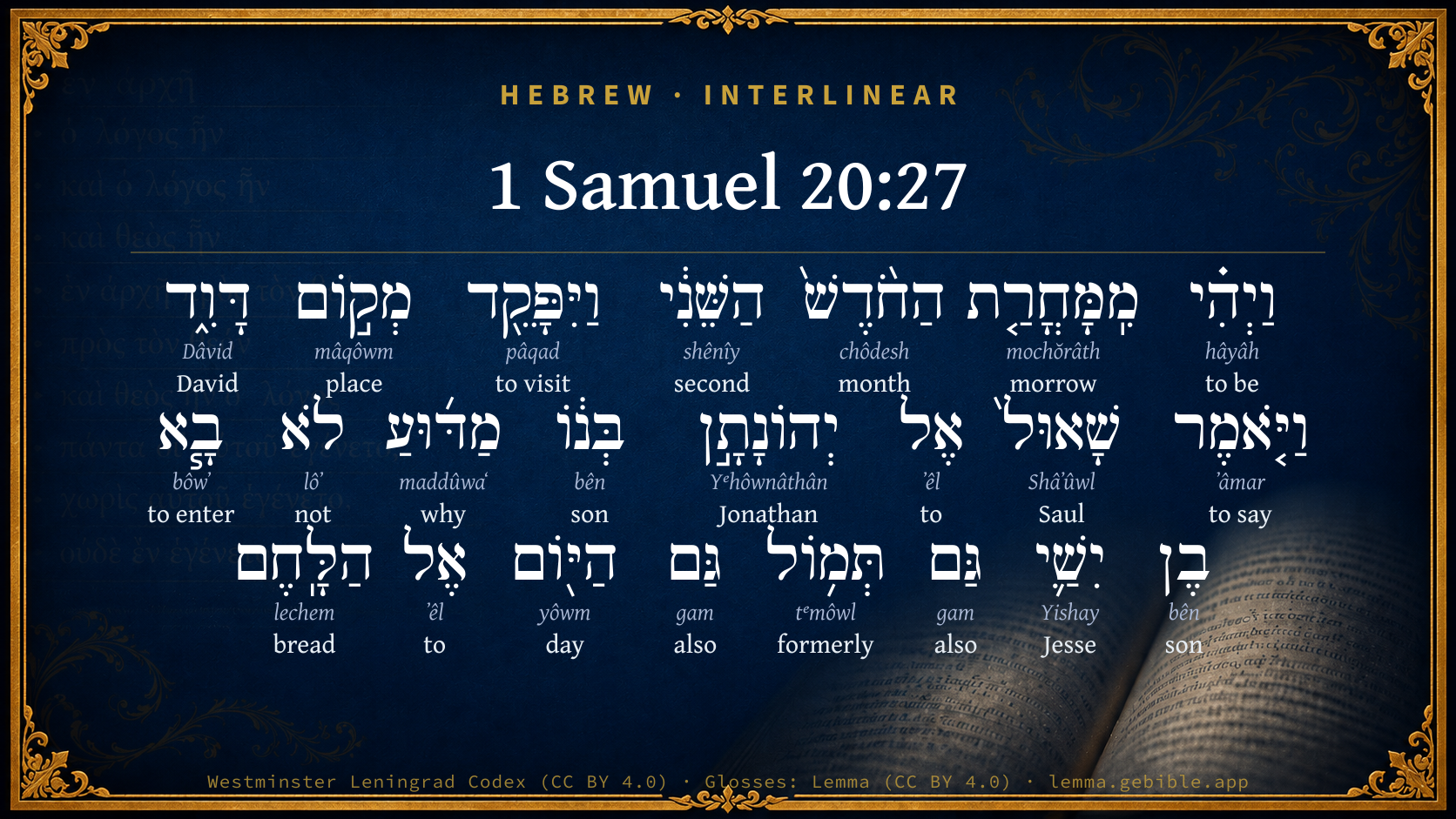
1 Samuel 20:27

Hebrew (Westminster Leningrad Codex) 1 Samuel 20:27 appears in the Hebrew Old Testament. The text above is from the Westminster Leningrad Codex. Each word links to its Strong’s number, a concise gloss, and parsing drawn from the Open Scriptures Hebrew Bible morphology. Click any word for its full Brown-Driver-Briggs (BDB) entry.
Download image
Cite this verse

1 Samuel 20:27 (World English Bible). Public Domain. Lemma interlinear Bible study tool, https://lemma.gebible.app/v/1-samuel/20/27.

Show BibTeX & RIS
BibTeX
RIS
English Translation
It happened on the next day after the new moon, [which was] the second [day], that David's place was empty: and Saul said to Jonathan his son, Why doesn't the son of Jesse come to meat, neither yesterday, nor today?
World English Bible · Public Domain
Download a study sheet

One document with this verse’s original text, its word-by-word gloss line, the meaning frame, cross-references with their text, attributed commentary, and full source and license credits — printable, and it pastes into notes with its structure intact.

This verse Autodidact and up

Study sheet (.html) Plain text (.txt)

A passage Seminary Student

Up to 50 verses in one chapter. A passage sheet keeps up to 6 commentary sources and 12 cross-references per verse, in the order this page ranks them, and says so on the sheet whenever that leaves anything out. Ask for a single verse and you get the Autodidact verse sheet above.

Everything on this page stays free to read, with no account — the sheet is a download of what is already on screen, not access to it.

Want to remove ads? Support Godless Engineer
Compare translations 3

The same verse in 3 English versions, stacked beneath the original-language interlinear above. Click any original word for its lexicon entry.

Each is an independent rendering of the whole verse — the interlinear is not word-aligned to these translations.

Highlighted words mark where these versions differ — a whole-verse word diff, not a word-by-word alignment.

  • World English Bible Public Domain
    It happened on the next day after the new moon, [which was] the second [day], that David's place was empty: and Saul said to Jonathan his son, Why doesn't the son of Jesse come to meat, neither yesterday, nor today?
  • King James Version Public Domain
    And it came to pass on the morrow, which was the second day of the month, that David's place was empty: and Saul said unto Jonathan his son, Wherefore cometh not the son of Jesse to meat, neither yesterday, nor to day?
  • unfoldingWord Literal Text CC BY-SA 4.0
    And it happened on the next day of the new moon, the second, that the place of David was missing. And Saul said to Jonathan his son, “Why has the son of Jesse not come, both yesterday and today, to the food?”

unfoldingWord Literal Text — © unfoldingWord, licensed CC BY-SA 4.0. Word-aligned USFM3 via Door43 (git.door43.org/unfoldingWord/en_ult).

Versions to compare (up to 4)

3 of 4 selected

Show all 18 translations

Every available English version of this verse, each an independent rendering of the whole verse.

  • World English Bible Public Domain
    It happened on the next day after the new moon, [which was] the second [day], that David's place was empty: and Saul said to Jonathan his son, Why doesn't the son of Jesse come to meat, neither yesterday, nor today?
  • Berean Standard Bible Public Domain
    But on the day after the New Moon, the second day, David’s place was still empty, and Saul asked his son Jonathan, “Why hasn’t the son of Jesse come to the meal either yesterday or today?”
  • Majority Standard Bible Public Domain
    But on the day after the New Moon, the second day, David’s place was still empty, and Saul asked his son Jonathan, “Why hasn’t the son of Jesse come to the meal either yesterday or today?”
  • King James Version Public Domain
    And it came to pass on the morrow, which was the second day of the month, that David's place was empty: and Saul said unto Jonathan his son, Wherefore cometh not the son of Jesse to meat, neither yesterday, nor to day?
  • American Standard Version (1901) Public Domain
    And it came to pass on the morrow after the new moon, `which was' the second `day', that David's place was empty: and Saul said unto Jonathan his son, Wherefore cometh not the son of Jesse to meat, neither yesterday, nor to-day?
  • Revised Version (1885) Public Domain
    And it came to pass on the morrow after the new moon, which was the second day, that David’s place was empty: and Saul said unto Jonathan his son, Wherefore cometh not the son of Jesse to meat, neither yesterday, nor today?
  • Geneva Bible (1599) Public Domain
    But on the morowe which was the second day of the moneth, Dauids place was emptie againe: and Saul sayde vnto Ionathan his sonne, Wherefore commeth not the sonne of Ishai to meate, neither yesterday nor to day?
  • Douay-Rheims (1899) Public Domain
    And when the second day after the new moon was come, David's place appeared empty again. And Saul said to Jonathan his son: Why cometh not the son of Isai to meat neither yesterday nor to day?
  • Young's Literal Translation Public Domain
    And it cometh to pass on the second morrow of the new moon, that David's place is looked after, and Saul saith unto Jonathan his son, `Wherefore hath the son of Jesse not come in, either yesterday or to-day, unto the food?'
  • Literal Standard Version CC BY-SA 4.0
    And it comes to pass on the second day of the new moon, that David’s place is looked after, and Saul says to his son Jonathan, “Why has the son of Jesse not come in, either yesterday or today, to the food?”
  • Unlocked Literal Bible CC BY-SA 4.0
    But on the second day, the day after the new moon, David's place was empty. Saul said to Jonathan his son, “Why has the son of Jesse not come to the meal either yesterday or today?”
  • unfoldingWord Literal Text CC BY-SA 4.0
    And it happened on the next day of the new moon, the second, that the place of David was missing. And Saul said to Jonathan his son, “Why has the son of Jesse not come, both yesterday and today, to the food?”
  • Darby Bible Public Domain
    And it came to pass the next day after the new moon, the second [day of the month], as David's place was empty, that Saul said to Jonathan his son, Why has not the son of Jesse come to table, neither yesterday nor to-day?
  • World Messianic Bible Public Domain
    On the next day after the new moon, the second day, David’s place was empty. Saul said to Jonathan his son, “Why didn’t the son of Jesse come to eat, either yesterday, or today?”
  • Webster's Bible Public Domain
    And it came to pass on the morrow, which was the second day of the month, that David's place was empty: and Saul said to Jonathan his son, Why cometh not the son of Jesse to eat, neither yesterday, nor to-day?
  • Free Bible Version CC BY-SA 4.0
    But the second day, the day after the New Moon, David's place was still empty. Saul asked his son Jonathan, “Why hasn't the son of Jesse come to dinner either yesterday or today?”
  • Bible in Basic English Public Domain
    And on the day after the new moon, that is, the second day, there was still no one in David's seat: and Saul said to his son Jonathan, Why has the son of Jesse not come to the feast yesterday or today?
  • JPS Tanakh (1917) Public Domain
    And it came to pass on the morrow after the new moon, which was the second day, that David's place was empty; and Saul said unto Jonathan his son: 'Wherefore cometh not the son of Jesse to the meal, neither yesterday, nor to-day?'

Literal Standard Version (2020), Covenant Press — licensed CC BY-SA 4.0. Text via the HelloAO Bible API (eBible.org). Unlocked Literal Bible (unfoldingWord) — licensed CC BY-SA 4.0. Text via the HelloAO Bible API (eBible.org). unfoldingWord Literal Text — © unfoldingWord, licensed CC BY-SA 4.0. Word-aligned USFM3 via Door43 (git.door43.org/unfoldingWord/en_ult). Free Bible Version, Dr. Jonathan Gallagher — licensed CC BY-SA 4.0. Text via the HelloAO Bible API (eBible.org).

Word by word

More ways to search: Search by grammar → Find every occurrence → Compare this word →

Practice this passage: Drill this verse → Learn its vocabulary →

תְּמ֥וֹל
tᵉmôwl
H8543
“formerly”
Adverb
Part of Speech
Adverb
Full BDB Definition

Origin: probably for H865

TWOT: 2521

before, before that time, beforetime, heretofore, of late, of old, these days, time(s) past, yesterday, day before yesterday, recently, formerly - yesterday - recently, formerly (usual usage) (figuratively) - as formerly, so more recently - from yesterday, already
  1. וַיְהִ֗י hâyâh H1961 “and · to be” Conjunction + Verb, Qal, Sequential Imperfect, 3rd Person, Masculine, Singular
  2. מִֽמָּחֳרַ֤ת mochŏrâth H4283 “from · morrow of” Preposition + Noun, Common, Feminine, Singular, Construct
  3. הַחֹ֨דֶשׁ֙ chôdesh H2320 “the · month” Particle, Definite Article + Noun, Common, Masculine, Singular, Absolute
  4. הַשֵּׁנִ֔י shênîy H8145 “the · second” Particle, Definite Article + Adjective, Ordinal number, Masculine, Singular, Absolute
  5. וַיִּפָּקֵ֖ד pâqad H6485 “and · to visit” Conjunction + Verb, Niphal, Sequential Imperfect, 3rd Person, Masculine, Singular
  6. מְק֣וֹם mâqôwm H4725 “place of” Noun, Common, Masculine, Singular, Construct
  7. דָּוִ֑ד Dâvid H1732 “David” Noun, Proper
  8. וַיֹּ֤אמֶר ʼâmar H559 “and · to say” Conjunction + Verb, Qal, Sequential Imperfect, 3rd Person, Masculine, Singular
  9. שָׁאוּל֙ Shâʼûwl H7586 “Saul” Noun, Proper
  10. אֶל ʼêl H413 “to” Preposition
  11. יְהוֹנָתָ֣ן Yᵉhôwnâthân H3083 “Jonathan” Noun, Proper
  12. בְּנ֔וֹ bên H1121 “son · his” Noun, Common, Masculine, Singular, Construct + Suffix, Personal, 3rd Person, Masculine, Singular
  13. מַדּ֜וּעַ maddûwaʻ H4069 “why” Particle, Interrogative
  14. לֹא lôʼ H3808 “not” Particle, Negative
  15. בָ֧א bôwʼ H935 “to enter” Verb, Qal, Perfect, 3rd Person, Masculine, Singular
  16. בֶן bên H1121 “son of” Noun, Common, Masculine, Singular, Construct
  17. יִשַׁ֛י Yishay H3448 “Jesse” Noun, Proper
  18. גַּם gam H1571 “also” Particle, Accusative
  19. גַּם gam H1571 “also” Particle, Accusative
  20. הַיּ֖וֹם yôwm H3117 “the · day” Particle, Definite Article + Noun, Common, Masculine, Singular, Absolute
  21. אֶל ʼêl H413 “to” Preposition
  22. הַלָּֽחֶם lechem H3899 “the · bread” Particle, Definite Article + Noun, Common, Both, Singular, Absolute

About this verse

These counts appear in no published source. They are computed here, from the morphology-tagged text and Lemma’s own curated glosses. What Lemma adds →

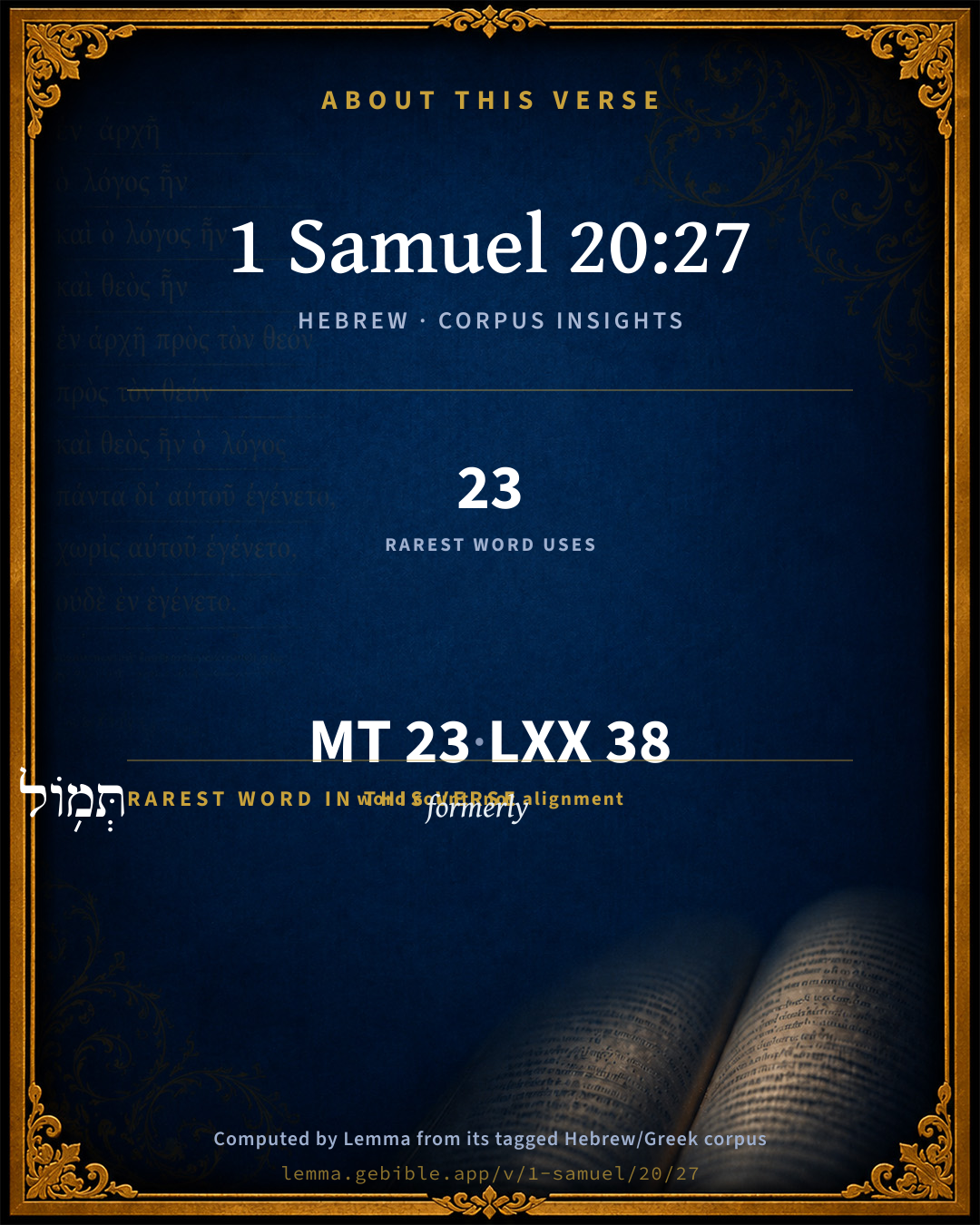
23
words
20
distinct lemmas
Historical
section

Notable vocabulary

The rarest word here is תְּמ֥וֹל formerly H8543 — appearing just 23 times in the whole Hebrew Bible.

Shared distinctive vocabulary

תְּמ֥וֹל formerly H8543 occurs in 22 verses of the Hebrew Bible. Also found in:

Grammatical profile

  • 4 verbs
  • 11 nouns
  • 1 adjective
  • 2 prepositions
  • 1 adverb
  • 4 particles

Verb forms

  • וַיְהִ֗י Qal · Sequential Imperfect
  • וַיִּפָּקֵ֖ד Niphal · Sequential Imperfect
  • וַיֹּ֤אמֶר Qal · Sequential Imperfect
  • בָ֧א Qal · Perfect

Repetition

Words recur within this verse — often emphatic in Hebrew:

  • בְּנ֔וֹ son H1121 ×2
  • גַּם also H1571 ×2
  • אֶל to H413 ×2

Hebrew & Septuagint length

In English translation the verse runs 40 words from the Hebrew and 44 from the Septuagint (LXX English) — closely comparable.

A rough comparison of the two English renderings, which tokenize alike — not a word-level alignment.

Word counts can differ between the Hebrew and the Greek without any difference in meaning — e.g. the Hebrew direct-object marker אֵת has no separate Greek word, and Greek often adds the article ὁ.

In the original languages it is 23 Hebrew tokens and 38 Greek tokens — but the two are counted differently (Hebrew bundles its prefixes and suffixes into one token; the Greek is in lemma form), so that isn’t a like-for-like length.

Cross-references

9

Topical passages linked to 1 Samuel 20:27 in the Treasury of Scripture Knowledge — connected by theme and wording, ordered by reader-vote popularity; previews shown in the World English Bible.

  • 1 Samuel 19:15 Saul sent the messengers to see David, saying, Bring him up to me in the bed, that I may kill him.
  • 1 Samuel 18:11 and Saul cast the spear; for he said, I will strike David even to the wall. David avoided out of his presence twice.
  • 1 Samuel 19:9–10 An evil spirit from Yahweh was on Saul, as he sat in his house with his spear in his hand; and David was playing with his hand.
  • 1 Samuel 22:7–9 Saul said to his servants who stood about him, Hear now, you Benjamites; will the son of Jesse give everyone of you fields and vineyards, will he make you all captains of thousands and captains of hundreds,
  • 1 Samuel 22:13–14 Saul said to him, Why have you conspired against me, you and the son of Jesse, in that you have given him bread, and a sword, and have inquired of God for him, that he should rise against me, to lie in wait, as at this day?
  • 1 Samuel 25:10 Nabal answered David's servants, and said, Who is David? and who is the son of Jesse? there are many servants now-a-days who break away every man from his master.
  • Isaiah 11:1–2 There shall come forth a shoot out of the stock of Jesse, and a branch out of his roots shall bear fruit.
  • Matthew 13:55 Isn't this the carpenter's son? Isn't his mother called Mary, and his brothers, James, Joses, Simon, and Judas?
  • 1 Peter 2:4 coming to him, a living stone, rejected indeed by men, but chosen by God, precious.

Cross-references courtesy of OpenBible.info (CC BY 4.0).

Hebrew and Greek witnesses Masoretic Hebrew ↔ Greek Septuagint

The same verse in the two great witnesses to the Old Testament, shown verse-for-verse.

These are two independent witnesses, not word-aligned to each other, and the Septuagint is shown in lemma (dictionary) form.

Hebrew 1 Samuel 20:27 Masoretic · Westminster Leningrad Codex

וַיְהִ֗י מִֽמָּחֳרַ֤ת הַחֹ֨דֶשׁ֙ הַשֵּׁנִ֔י וַיִּפָּקֵ֖ד מְק֣וֹם דָּוִ֑ד וַיֹּ֤אמֶר שָׁאוּל֙ אֶל יְהוֹנָתָ֣ן בְּנ֔וֹ מַדּ֜וּעַ לֹא בָ֧א בֶן יִשַׁ֛י גַּם תְּמ֥וֹל גַּם הַיּ֖וֹם אֶל הַלָּֽחֶם

It happened on the next day after the new moon, [which was] the second [day], that David's place was empty: and Saul said to Jonathan his son, Why doesn't the son of Jesse come to meat, neither yesterday, nor today?

World English Bible · Public Domain

Greek LXX 1 Samuel 20:27 Septuagint · lemma form

καί γίγνομαι ὁ ἐπαύριον ὁ μήν ὁ ἡμέρα ὁ δεύτερος καί ἐπισκέπτομαι ὁ τόπος ὁ δαυίδ καί εἶπον σαούλ πρός ιωναθαν ὁ υἱός αὐτός τίς ὅτι οὐ παραγίγνομαι ὁ υἱός ιεσσαι καί ἐχθές καί σήμερον ἐπί ὁ τράπεζα

And it came to pass on the morrow, on the second day of the month, that the place of David was empty; and Saul said to Jonathan his son, Why has not the son of Jessae attended both yesterday and today at the table?

LXX2012 (modern English Septuagint) · Public Domain

On this verse, The Pulpit Commentary discusses the Septuagint’s reading. Read the note in Commentary ↓

Hebrew: Westminster Leningrad Codex (CC BY 4.0). Greek: Septuagint (public domain); English from LXX2012 (modern English Septuagint) (Public Domain). How the Septuagint differs from the Hebrew →

Targum (Aramaic paraphrase)

1

The Targum is the ancient Jewish Aramaic paraphrase of the Hebrew Scriptures — an interpretive translation, not the Hebrew text itself. Onkelos (literal) and Pseudo-Jonathan (expansive) render the Torah, and Jonathan the Prophets. Coverage is partial: where no permissively-licensed English translation exists for a verse, only the Aramaic is shown. This is verse-level text, not a word-by-word alignment to the Hebrew.

  1. Targum Jonathan Prophets (Joshua–Malachi)
    וַהֲוָה בְּיוֹמָא דְבַתְרוֹהִי דְהוּא עִבּוּר יַרְחָא תִּנְיָנָא וַהֲוָה אַתְרָא דְדָוִד מַרְוַח וַאֲמַר שָׁאוּל לִיהוֹנָתָן בְּרֵיהּ מָא דֵין לָא אֲתָא בַר יִשַׁי אַף תְּמָלֵי אַף יוֹמָא דֵין לְלַחְמָא:

    (no public-domain English translation for this verse)

    Targum Jonathan — Aramaic: “Mikraot Gedolot” (public domain). English: “Sefaria Community Translation” (CC0 1.0 (public-domain dedication)); “London "Chaldee Paraphrase," 1871” (public domain). Text via Sefaria.

Commentary

Notes on 1 Samuel 20:27 from classic Christian and Jewish commentators (each source and its license shown beneath its notes). The classic Christian expositions comment on the surrounding passage and are grouped to its opening verse, so a note may address several verses; the Jewish commentaries on the Tanakh (Rashi and others) are per-verse, so they appear only where the commentator wrote on this verse.

Lemma curates 59 commentaries, every one of them public domain or Creative Commons licensed, each selected and text-cleaned for this edition rather than reprinted as found. About our sources →

Trapp's Complete Commentary

John Trapp

1Sa 20:27 And it came to pass on the morrow, [which was] the second [day] of the month, that David’s place was empty: and Saul said unto Jonathan his son, Wherefore cometh not the son of Jesse to meat, neither yesterday, nor to day?

Ver. 27. Wherefore cometh not the son of Jesse to meat?] Wherefore should he, say, unless he were weary of his life, which was so lately sought for? But Saul thought, belike, that David would forget old injuries, and make as small account of them as himself who had done them. But what is the old saying in this case?

“ Pulvere, qui laedit, scribit; sed marmore, laesus. ”

John Trapp, A Commentary or Exposition upon All the Books of the Old and New Testament (1647–1656) — public domain. Text from a community e-Sword module.

Joseph Benson's Commentary

1Sa 20:27-28. Wherefore cometh not the son of Jesse? — So he calls him in contempt and scorn, to mark the meanness of his original, and as not deigning to call him by his proper name. Neither yesterday nor to-day — For the uncleanness that came by some accident usually lasted but for one day. David earnestly asked leave of me — Which he, being next to the king, it is likely, had power to grant, as appears from Saul’s demanding of him what was become of David.

Joseph Benson's Commentary on the Old and New Testaments (1811–1818) — public domain. Text from a community e-Sword module.

Geneva Bible (1599)

Geneva Bible translators

Thus he speaketh contemptuously of David.

Geneva Bible (1599) marginal notes — public domain. Text via Bolls.life.

Jamieson, Fausset & Brown

Robert Jamieson, A. R. Fausset & David Brown

on the morrow, which was the second day of the month--The time of the moon's appearance being uncertain--whether at midday, in the evening, or at midnight, the festival was extended over two days. Custom, not the law, had introduced this.

Saul said unto Jonathan his son, Wherefore cometh not the son of Jesse--The question was asked, as it were, casually, and with as great an air of indifference as he could assume. And Jonathan having replied that David had asked and obtained his permission to attend a family anniversary at Beth-lehem [Act 20:28-29], the pent-up passions of the king burst out in a most violent storm of rage and invective against his son.

Jamieson, Fausset & Brown — Commentary Critical and Explanatory on the Whole Bible (1871) — public domain (CC PDM 1.0). Text via the HelloAO Bible API.

Ellicott's Commentary for English Readers

(27) On the morrow.—David’s continued absence on the second day of the feast awoke Saul’s suspicion, and he asked his son, who was sitting by him, what was the reason of his friend’s absence, aware that no accident connected with ceremonial defilement would keep him away two following days.

A Bible Commentary for English Readers, edited by Charles John Ellicott (1878–1897) — public domain. Text from a community e-Sword module.

John Gill's Exposition

And it came to pass on the morrow, which was the second day of the month,.... The Targum is,"and it was on the day after it, which was the intercalation of the second month;''when the beginning of the month was judged of by the appearance of the moon, and there was a difficulty about that, what day it appeared on, two days were kept for it; and Abarbinel (e) is clear for it, that two days were kept in this month; but if this was not the case, since the remainder of peace offerings might be eaten the next day, Lev 7:16. Saul and his guests might meet on the second day for that purpose:

that David's place was empty: on that day also:

and Saul said to Jonathan his son; who he knew was David's friend and confident, and could give the best account of him:

wherefore cometh not the son of Jesse to meat, neither yesterday nor today; he accounted for his not coming yesterday, because he supposed he might be under some ceremonial uncleanness; but then that only lasted to the evening of that day; but not coming the second day when he was clean, he inquires after him; and not owning him for his son-in-law, by way of contempt, and to lessen him in the esteem of all at table, he calls him the son of Jesse.

(e) Comment. in Exod. xii.

John Gill's Exposition of the Whole Bible (1746–1763) — public domain (CC PDM 1.0). Text via the HelloAO Bible API.

Haydock's Catholic Bible Commentary

To-day, which was the sabbath. (Calmet) --- On the new moons people did not travel far. (Menochius)

George Leo Haydock (1774–1849), Haydock's Catholic Family Bible and Commentary, 1859 edition — public domain. Excludes Psalms (Douay-Rheims chapter numbering differs from Protestant) and Deuterocanonical books (Catholic canon only).

Matthew Poole's English Annotations

Which was the second day of the month, or, on the morrow of the new moon, being the second day; either,

1. Of the three days appointed, 1Sa 20:5,19. Or,

2. Of the feast. Or,

3. Of the month. Saul said unto Jonathan, who was David’s friend, and best knew his mind and his ways. He calls him the son of Jesse, in scorn and contempt, to note the meanness of his original; and as not deigning to call him by his proper name: see below, 1Sa 22:9; 25:10.

Neither yesterday, nor to-day; for the uncleanness which came by some chance usually lasted but for one day. See Le 11.

Matthew Poole's English Annotations on the Holy Bible (1683–1685) — public domain. Text from a community e-Sword/MySword module.

Whedon's Commentary on the Bible

Daniel D. Whedon

27. Wherefore cometh not the son of Jesse to meat — But how could Saul reasonably expect him to come after all his dark attempts upon his life? Those attempts had all been made during real or apparent fits of madness, and he probably supposed that David would not regard them as the result of deep-seated intentions. He may also have learned that David had returned from Ramah, and had been seen with Jonathan since he had sent messengers and had gone himself to take him.

Daniel D. Whedon (gen. ed.), Commentary on the Old and New Testaments (1874–1909) — public domain. Text from a community e-Sword module.

The Pulpit Commentary

Vers. 27-29. On the morrow, which was the second day of the month. Hebrew, "on the morrow of the new moon, the second day." David"s absence on the second day made Saul aware that it was no accident, and he demands of Jonathan the reason; whereupon he gives the excuse previously arranged, adding that it was David"s brother who had required his attendance. The Septuagint has brothers, being offended at the singular, because Jesse was still alive. But as the festival was not confined to Jesse"s household, his brother might very properly be the convener, without usurping his father"s place. Let me get away. Literally, "let me escape," "let me get off," a light, half jocose way of speaking adopted by Jonathan, as if the matter were a mere trifle.

The Pulpit Commentary (1880–1919), ed. H.D.M. Spence-Jones & Joseph S. Exell — public domain. Text from a community e-Sword module.

John Wesley's Explanatory Notes

Son of Jesse - So he calls him in scorn, to note the meanness of his original; and as not deigning to call him by his proper name. To day - For the uncleanness which came by some chance, usually lasted but for one day.

John Wesley, Explanatory Notes Upon the Whole Bible (1754–1765) — public domain. Text via the GEBible commentary corpus.

Rashi

Rabbi Shlomo Yitzchaki (Rashi)

The day after the New Moon. The day following the renewal of the moon.

The second [day]. The second day of the month.

Rashi on the Tanakh — English translations: “The Judaica Press complete Tanach with Rashi, translated by A. J. Rosenberg” (CC BY 4.0); “Pentateuch with Rashi's commentary by M. Rosenbaum and A.M. Silbermann, 1929-1934” (public domain); “The Metsudah Tanach series, Lakewood, N.J” (CC BY 4.0); and “The Book of Joshua, Metsudah Publications, 1997” (CC BY 4.0). Text via Sefaria.

Lesson kit

Teaching starters — assembled from the data on this page, not authored interpretation. Every prompt links to the verse data it draws on. Edit before teaching.

1 Samuel, in the Historical, opens this verse with 23 words (20 distinct Hebrew lemmas). Its most distinctive word is tᵉmôwl (“formerly”). A historical commentator’s framing appears above. Read the whole chapter for the surrounding context.

Discussion questions

  1. What does “formerly” (tᵉmôwl) contribute to the verse as a whole?
  2. How does Genesis 31:2, which shares the word «formerly», read alongside this verse?
  3. What does the repetition of “son” (2× in this one verse) do in this verse?
  4. These translations render this verse differently. What is at stake in choosing one wording over another?
  5. «וַיְהִ֗י» is a Qal Sequential Imperfect verb. How does that grammatical form shape the action described?
  6. Compare how Trapp's Complete Commentary and Joseph Benson's Commentary read this verse. Where do they agree or differ?

Things to notice

Reading settings

Reading text

Shown beneath each verse's original-language words.

Old Testament
Old Testament edition

Read the OT as the Masoretic Hebrew (MT) or the Greek Septuagint (LXX).

English shown for the Greek Septuagint (in the Hebrew ↔ Greek comparison).

Comparing translations? Open the Compare panel on any verse page to stack up to four side by side.