
Psalms 105:16

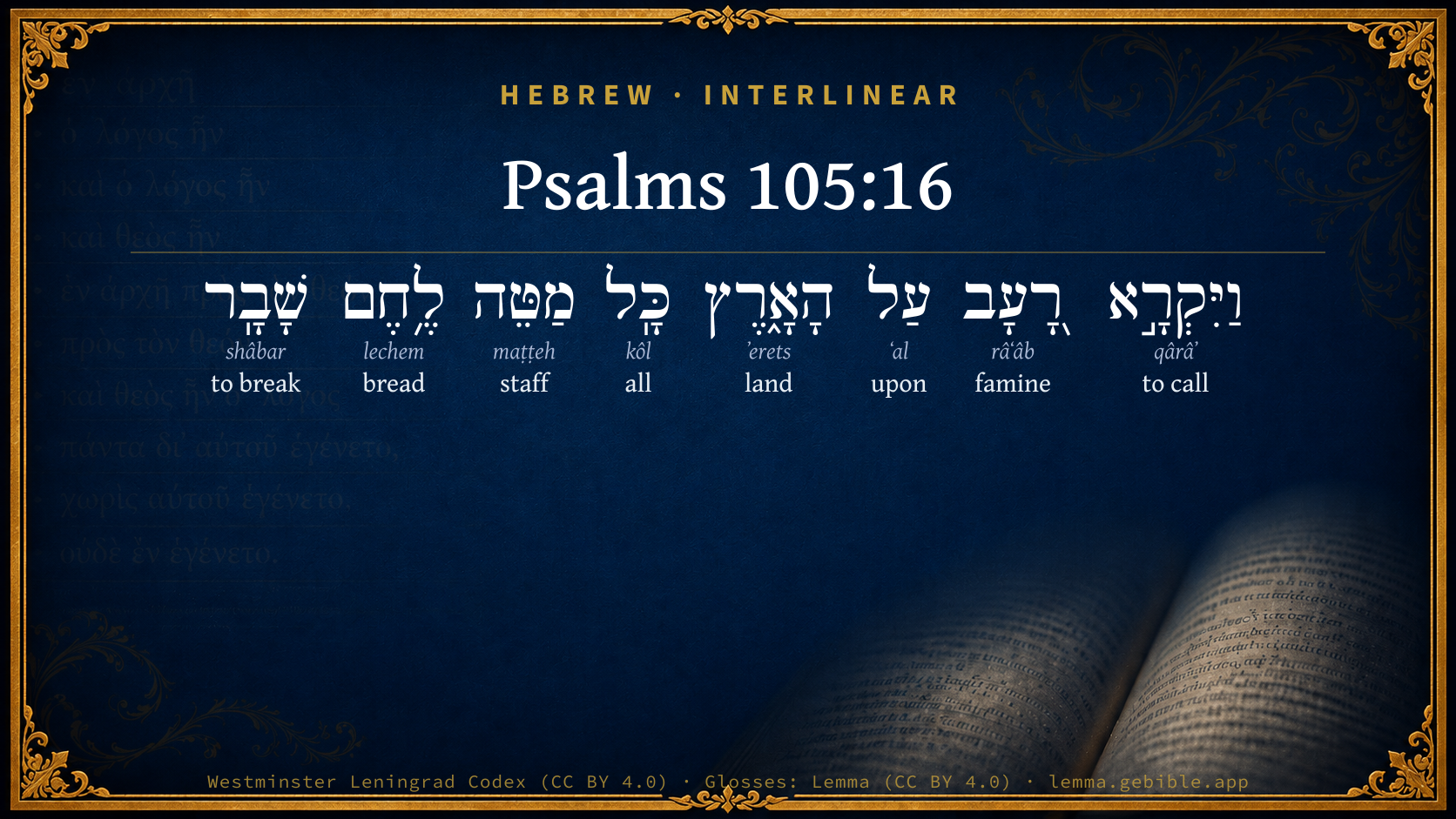
Hebrew (Westminster Leningrad Codex) Psalms 105:16 appears in the Hebrew Old Testament. The text above is from the Westminster Leningrad Codex. Each word links to its Strong’s number, a concise gloss, and parsing drawn from the Open Scriptures Hebrew Bible morphology. Click any word for its full Brown-Driver-Briggs (BDB) entry.
Download image
Cite this verse

Psalms 105:16 (World English Bible). Public Domain. Lemma interlinear Bible study tool, https://lemma.gebible.app/v/psalms/105/16.

Show BibTeX & RIS
BibTeX
RIS
English Translation
He called for a famine on the land. He destroyed the food supplies.
World English Bible · Public Domain
Download a study sheet

One document with this verse’s original text, its word-by-word gloss line, the meaning frame, cross-references with their text, attributed commentary, and full source and license credits — printable, and it pastes into notes with its structure intact.

This verse Autodidact and up

Study sheet (.html) Plain text (.txt)

A passage Seminary Student

Up to 50 verses in one chapter. A passage sheet keeps up to 6 commentary sources and 12 cross-references per verse, in the order this page ranks them, and says so on the sheet whenever that leaves anything out. Ask for a single verse and you get the Autodidact verse sheet above.

Everything on this page stays free to read, with no account — the sheet is a download of what is already on screen, not access to it.

Want to remove ads? Support Godless Engineer
Compare translations 3

The same verse in 3 English versions, stacked beneath the original-language interlinear above. Click any original word for its lexicon entry.

Each is an independent rendering of the whole verse — the interlinear is not word-aligned to these translations.

Highlighted words mark where these versions differ — a whole-verse word diff, not a word-by-word alignment.

  • World English Bible Public Domain
    He called for a famine on the land. He destroyed the food supplies.
  • King James Version Public Domain
    Moreover he called for a famine upon the land: he brake the whole staff of bread.
  • unfoldingWord Literal Text CC BY-SA 4.0
    He called for a famine on the land; he broke all of the staff of bread.

unfoldingWord Literal Text — © unfoldingWord, licensed CC BY-SA 4.0. Word-aligned USFM3 via Door43 (git.door43.org/unfoldingWord/en_ult).

Versions to compare (up to 4)

3 of 4 selected

Show all 18 translations

Every available English version of this verse, each an independent rendering of the whole verse.

  • World English Bible Public Domain
    He called for a famine on the land. He destroyed the food supplies.
  • Berean Standard Bible Public Domain
    He called down famine on the land and cut off all their supplies of food.
  • Majority Standard Bible Public Domain
    He called down famine on the land and cut off all their supplies of food.
  • King James Version Public Domain
    Moreover he called for a famine upon the land: he brake the whole staff of bread.
  • American Standard Version (1901) Public Domain
    And he called for a famine upon the land; He brake the whole staff of bread.
  • Revised Version (1885) Public Domain
    And he called for a famine upon the land; he brake the whole staff of bread.
  • Geneva Bible (1599) Public Domain
    Moreouer, he called a famine vpon ye land, and vtterly brake the staffe of bread.
  • Douay-Rheims (1899) Public Domain
    And he called a famine upon the land: and he broke in pieces all the support of bread.
  • Young's Literal Translation Public Domain
    And He calleth a famine on the land, The whole staff of bread He hath broken.
  • Literal Standard Version CC BY-SA 4.0
    And He calls a famine on the land, || He has broken the whole staff of bread.
  • Unlocked Literal Bible CC BY-SA 4.0
    He called for a famine on the land; he cut off the whole supply of bread.
  • unfoldingWord Literal Text CC BY-SA 4.0
    He called for a famine on the land; he broke all of the staff of bread.
  • Darby Bible Public Domain
    And he called for a famine upon the land; he broke the whole staff of bread.
  • World Messianic Bible Public Domain
    He called for a famine on the land. He destroyed the food supplies.
  • Webster's Bible Public Domain
    Moreover he called for a famine upon the land: he broke the whole staff of bread.
  • Free Bible Version CC BY-SA 4.0
    He caused a famine in the Land of Canaan so that there was no food.
  • Bible in Basic English Public Domain
    And he took away all food from the land, so that the people were without bread.
  • JPS Tanakh (1917) Public Domain
    And He called a famine upon the land; He broke the whole staff of bread.

Literal Standard Version (2020), Covenant Press — licensed CC BY-SA 4.0. Text via the HelloAO Bible API (eBible.org). Unlocked Literal Bible (unfoldingWord) — licensed CC BY-SA 4.0. Text via the HelloAO Bible API (eBible.org). unfoldingWord Literal Text — © unfoldingWord, licensed CC BY-SA 4.0. Word-aligned USFM3 via Door43 (git.door43.org/unfoldingWord/en_ult). Free Bible Version, Dr. Jonathan Gallagher — licensed CC BY-SA 4.0. Text via the HelloAO Bible API (eBible.org).

Word by word

More ways to search: Search by grammar → Find every occurrence → Compare this word →

Practice this passage: Drill this verse → Learn its vocabulary →

About this verse

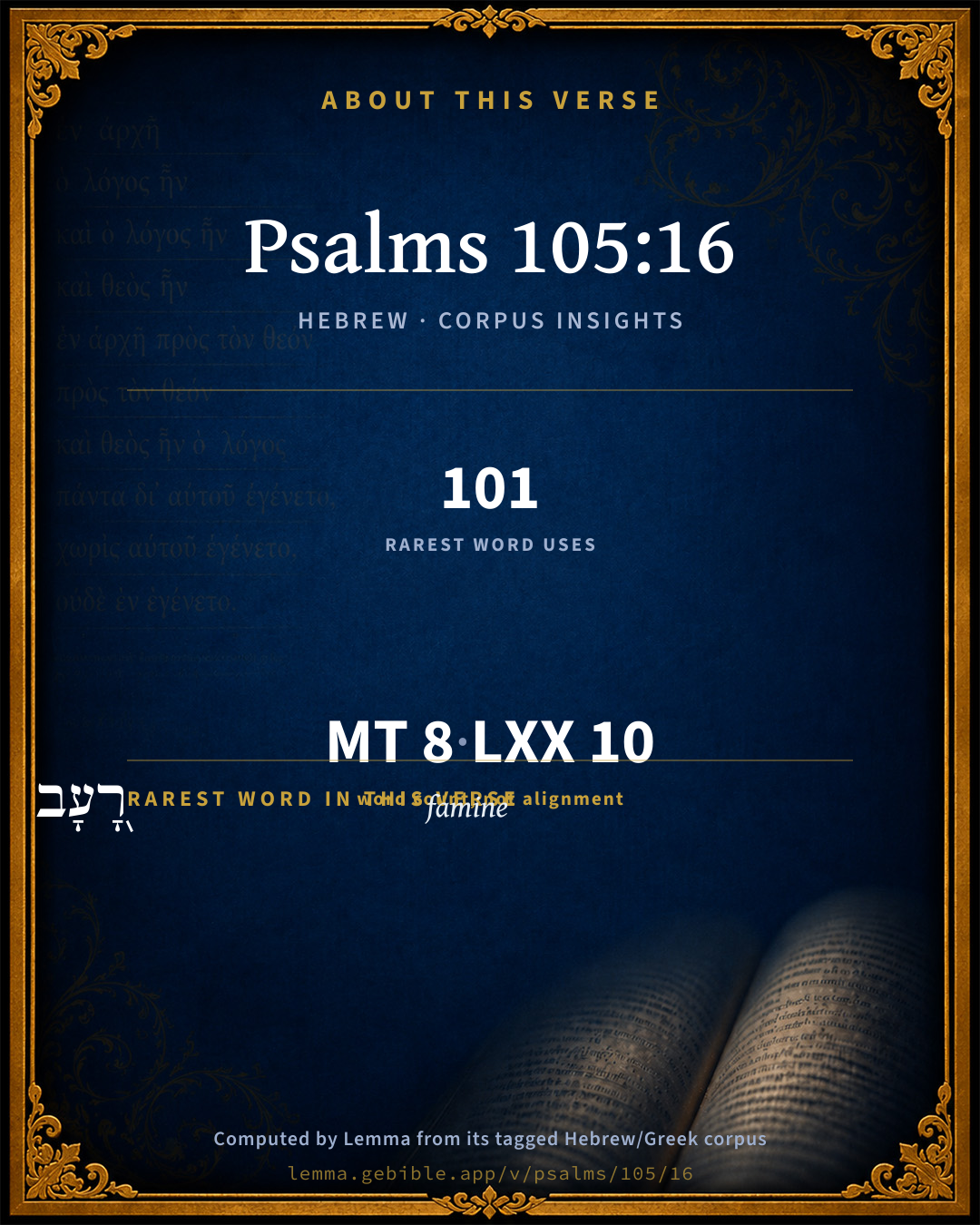
These counts appear in no published source. They are computed here, from the morphology-tagged text and Lemma’s own curated glosses. What Lemma adds →

8
words
8
distinct lemmas
Wisdom
section

Grammatical profile

  • 2 verbs
  • 5 nouns
  • 1 preposition

Verb forms

  • וַיִּקְרָ֣א Qal · Sequential Imperfect
  • שָׁבָֽר Qal · Perfect

Hebrew & Septuagint length

In English translation the verse runs 13 words from the Hebrew and 16 from the Septuagint (LXX English) — closely comparable.

A rough comparison of the two English renderings, which tokenize alike — not a word-level alignment.

Word counts can differ between the Hebrew and the Greek without any difference in meaning — e.g. the Hebrew direct-object marker אֵת has no separate Greek word, and Greek often adds the article ὁ.

In the original languages it is 8 Hebrew tokens and 10 Greek tokens — but the two are counted differently (Hebrew bundles its prefixes and suffixes into one token; the Greek is in lemma form), so that isn’t a like-for-like length.

Cross-references

17

Topical passages linked to Psalms 105:16 in the Treasury of Scripture Knowledge — connected by theme and wording, ordered by reader-vote popularity; previews shown in the World English Bible.

  • Ezekiel 4:16 Moreover he said to me, Son of man, behold, I will break the staff of bread in Jerusalem: and they shall eat bread by weight, and with fearfulness; and they shall drink water by measure, and in dismay:
  • Isaiah 3:1 For, behold, the Lord, Yahweh of Hosts, takes away from Jerusalem and from Judah supply and support, The whole supply of bread, And the whole supply of water;
  • Genesis 41:54 The seven years of famine began to come, just as Joseph had said. There was famine in all lands, but in all the land of Egypt there was bread.
  • Leviticus 26:26 When I break your staff of bread, ten women shall bake your bread in one oven, and they shall deliver your bread again by weight: and you shall eat, and not be satisfied.
  • Acts 7:11 Now a famine came over all the land of Egypt and Canaan, and great affliction. Our fathers found no food.
  • Genesis 47:13 There was no bread in all the land; for the famine was very severe, so that the land of Egypt and the land of Canaan fainted by reason of the famine.
  • 2 Kings 8:1 Now Elisha had spoken to the woman, whose son he had restored to life, saying, Arise, and go you and your household, and sojourn wherever you can sojourn: for Yahweh has called for a famine; and it shall also come on the land seven years.
  • Psalms 104:15 Wine that makes glad the heart of man, Oil to make his face to shine, And bread that strengthens man's heart.
  • Genesis 41:25–32 Joseph said to Pharaoh, "The dream of Pharaoh is one. What God is about to do he has declared to Pharaoh.
  • Genesis 42:5–6 The sons of Israel came to buy among those who came, for the famine was in the land of Canaan.
  • Genesis 47:19 Why should we die before your eyes, both we and our land? Buy us and our land for bread, and we and our land will be servants to Pharaoh. Give us seed, that we may live, and not die, and that the land won't be desolate."
  • Amos 3:6 Does the trumpet alarm sound in a city, Without the people being afraid? Does evil happen to a city, And Yahweh hasn't done it?
  • Amos 7:1–4 Thus the Lord Yahweh showed me: and, behold, he formed locusts in the beginning of the shooting up of the latter growth; and, behold, it was the latter growth after the king's harvest.
  • Haggai 1:10–11 Therefore for your sake the heavens withhold the dew, and the earth withholds its fruit.
  • Haggai 2:17 I struck you with blight, mildew, and hail in all the work of your hands; yet you didn't turn to me,' says Yahweh.
  • Matthew 8:8–9 The centurion answered, "Lord, I'm not worthy for you to come under my roof. Just say the word, and my servant will be healed.
  • Revelation 6:8 And behold, a pale horse, and he who sat on it, his name was Death. Hades followed with him. Authority over one fourth of the earth, to kill with the sword, with famine, with death, and by the wild animals of the earth was given to him.

Cross-references courtesy of OpenBible.info (CC BY 4.0).

Hebrew and Greek witnesses Masoretic Hebrew ↔ Greek Septuagint

The same verse in the two great witnesses to the Old Testament, shown verse-for-verse.

You’re reading Greek Psalm 104 (Hebrew Psalm 105). The Septuagint counts the superscription, so verse numbers can differ from the Hebrew — chapter-level alignment, not verse-by-verse. Numbering follows Rahlfs.

These are two independent witnesses, not word-aligned to each other, and the Septuagint is shown in lemma (dictionary) form.

Hebrew Psalms 105:16 Masoretic · Westminster Leningrad Codex

וַיִּקְרָ֣א רָ֭עָב עַל הָאָ֑רֶץ כָּֽל מַטֵּה לֶ֥חֶם שָׁבָֽר

He called for a famine on the land. He destroyed the food supplies.

World English Bible · Public Domain

Greek LXX Greek Psalm 104:16 Septuagint · lemma form

καί καλέω λιμός ἐπί ὁ γῆ πᾶς στήριγμα ἄρτος συντρίβω

Moreover he called for a famine upon the land; he broke the whole support of bread.

LXX2012 (modern English Septuagint) · Public Domain

Hebrew: Westminster Leningrad Codex (CC BY 4.0). Greek: Septuagint (public domain); English from LXX2012 (modern English Septuagint) (Public Domain). How the Septuagint differs from the Hebrew →

Commentary

Notes on Psalms 105:16 from classic Christian and Jewish commentators (each source and its license shown beneath its notes). The classic Christian expositions comment on the surrounding passage and are grouped to its opening verse, so a note may address several verses; the Jewish commentaries on the Tanakh (Rashi and others) are per-verse, so they appear only where the commentator wrote on this verse.

Lemma curates 59 commentaries, every one of them public domain or Creative Commons licensed, each selected and text-cleaned for this edition rather than reprinted as found. About our sources →

The Cambridge Bible for Schools and Colleges

gen. ed. J. J. S. Perowne

16. And he called] So 2Ki_8:1; Amo_5:8; Amo_7:4; Amo_9:6; Hag_1:11. Observe the emphasis upon direct Divine agency in Psa_105:16,

The Cambridge Bible for Schools and Colleges (gen. ed. J. J. S. Perowne; Cambridge University Press, 1878–1918) — public domain. Text from a community e-Sword module.

Trapp's Complete Commentary

John Trapp

Psa 105:16 Moreover he called for a famine upon the land: he brake the whole staff of bread.

Ver. 16. Moreover he called for a famine] How easy is it with God soon to starve us all by denying us a harvest or two! If he do but call for a famine it is done.

He brake the whole staff of bread] Either by withdrawing bread, that staff of man’s life, or his blessing from it; for man liveth not by bread alone (or at all), but by every word, &c., Mat 4:4, without which bread can no more nourish us than a clod of clay, In pane conclusus est quasi baculus, qui nos sustineat. See Hag 1:6. {See Trapp on "Hag 1:6"}

John Trapp, A Commentary or Exposition upon All the Books of the Old and New Testament (1647–1656) — public domain. Text from a community e-Sword module.

Joseph Benson's Commentary

Psa 105:16-18. He called for a famine — That is, he brought a famine upon the land. He brake the whole staff of bread — Bread, which is the staff or support of men’s lives. He sent a man before them — Who was to nourish them in the famine: sent him, by the direction of his secret providence, many years before the famine began. Such are the foresight and timely care of Divine Providence. Whose feet they hurt with fetters — Being unjustly charged with a most heinous crime. He was laid in iron — Hebrew, נפשׁו ברזל באה, the iron entered his soul, which seems to be added emphatically, to aggravate the misery of his imprisonment, and to show how grievous it was to his very soul. Undoubtedly the false accusation, which was the cause of his imprisonment, the injury which was done him, and the foul and public scandal which lay upon him, must have pained him extremely.

Joseph Benson's Commentary on the Old and New Testaments (1811–1818) — public domain. Text from a community e-Sword module.

J. A. Alexander on Psalms

Joseph Addison Alexander

16. (Psa 105:16) And he called (for) a famine on the land; every staff of bread he brake. The Psalmist now passes from the Patriarchal to the Egyptian period of the history, by stating the occasion of Israel's migration into Egypt. The meaning of the first clause seems to be, that he summoned famine, as his instrument or servant, to come down upon the land, as sent from above, that is to say, from himself. The meaning of the last clause is, that the people were deprived of every customary means and source of subsistence. The figure of a staff or stay is a Mosaic one. See Lev 26:26, and compare Isa 3:1. It is near akin to the description of food as staying or sustaining the heart. See above, on Psa 104:15. The historical reference in the verse before us is to Gen 41:54.

Joseph Addison Alexander, The Psalms Translated and Explained (1850) — public domain. Text from a community e-Sword module.

Tyndale Open Study Notes

Tyndale Open Resources

105:16-22 These verses tell the story of Joseph (see Gen 37–41).

Tyndale Open Study Notes — © Tyndale Open Resources, licensed CC BY-SA 4.0. Text via the HelloAO Bible API.

Geneva Bible (1599)

Geneva Bible translators

Either by sending scarcity, or by taking away the strength and nourishment thereof.

Geneva Bible (1599) marginal notes — public domain. Text via Bolls.life.

John Calvin's Commentaries

16. And he called a famine upon the land Here the inspired writer recounts a most illustrious proof of divine providence towards the chosen people, at the time when the covenant might seem to be void and disannulled. The inheritance of the land of Canaan (as has been stated above) was added, as an earnest or pledge for confirmation. The descent of Jacob into Egypt, which deprived his house of the sight of the land, could not make the covenant to perish. In this the constancy of God shone forth the brighter; yea, by this trial he manifested more plainly how provident a father he was in preserving the seed of Abraham. But it is better to consider each particular in the verse. In the first place, it is taught, that the famine which drove Jacob into Egypt did not happen by chance. Although only one particular famine is here treated of, it is to be held as a general principle, that there is no other cause of any scarcity of sustenance except this, that God, in withdrawing his hand, takes away the means of support. The curse of God is expressed more emphatically, when it is said, that the famine was called; as if it were ready at his command, as a minister of his wrath. By this we are instructed, that famine, pestilence, and other scourges of God, do not visit men by chance, but are directed by his hand whither it pleases him, and are obedient to his will. The manner in which the famine was called is next stated, namely, when he brake the staff of bread The metaphor of staff is very appropriate; for God has put into bread the power and property of strengthening man, by a secret virtue which fits it to sustain us. So long as it pleases him to nourish us by such means, a staff as it were lies hidden within it. This staff is broken in two ways; either, first, when he takes away the supply of grain necessary for our nourishment, the sense in which it seems to be used in Ezekiel

“Moreover, he said unto me, Son of man, behold, I will break the staff of bread in Jerusalem, and they shall eat bread by weight, and with care; and they shall drink water by measure, and with astonishment;” Ezekiel 4:16

or, secondly, when he breathes in anger upon the bread itself, so that those who would satisfy themselves by devouring it, instead of having their hunger thereby removed, remain famished still. And certainly to the barrenness of the earth this second is commonly added, namely, that he takes away the sustaining power which is in bread; for, as it is declared in Deuteronomy 8:3, bread does not give life of itself, but borrows its secret virtue from the mouth of God.

John Calvin's Commentaries (1540-1563) — public domain. Text from the Calvin Translation Society English edition (1840s-50s) via the Christian Classics Ethereal Library (ccel.org). Calvin's coverage is partial (roughly two-thirds of the Bible); uncommented books and verses are honest gaps, never fabricated. The 19th-century editor's footnotes and remarks are omitted so the notes are faithfully Calvin's own voice.

Ellicott's Commentary for English Readers

(16) Called for a famine.—Comp. 2Ki_8:1; and in Ezekiel 14 we see how famine, with war and pestilence and noisome beasts, were regarded as Divine emissaries to be summoned and sent on His missions.

Staff of bread.—Lev_26:26. (See, too, Note on Psa_104:15.)

A Bible Commentary for English Readers, edited by Charles John Ellicott (1878–1897) — public domain. Text from a community e-Sword module.

John Gill's Exposition

Moreover, he called for a famine upon the land,.... On the land of Egypt; or rather on the land of Canaan, where Jacob and his sons sojourned; and which reached to all lands, Gen 41:56 and calling for it, it came, being a servant at the command of the Lord; see Kg2 8:1.

He brake the whole staff of bread; so called, because it is the support of man's life, the principal of his sustenance: as a staff is a support to a feeble person, and which, when broke, ceases to be so. The staff of bread is broken, when either the virtue and efficacy of it for nourishment is taken away or denied; or when there is a scarcity of bread corn; which latter seems to be intended here; see Isa 3:1.

John Gill's Exposition of the Whole Bible (1746–1763) — public domain (CC PDM 1.0). Text via the HelloAO Bible API.

Albert Barnes' Notes on the Bible

Moreover, he called for a famine upon the land - It was not by chance; not by the mere operation of physical laws, but it was because God “ordered” it. The famine here referred to, as the connection shows, was that which occurred in the time of Jacob, and which was the occasion of the migration into Egypt. There was also a famine in the time of Abraham Gen 12:10; but the design of the psalmist here is to refer to that period of the Jewish history which pertained to their residence in Egypt, and to the dealings of God with the nation when there, as furnishing an occasion for gratitude. Gen. 41; 42.

He brake the whole staff of bread - That which supports life, as a staff does a feeble man. See the notes at Isa 3:1.

Albert Barnes' Notes on the Bible (1834–1885) — public domain. Text from a community e-Sword/MySword module.

Matthew Poole's English Annotations

He called for, i.e. he effectually procured, as this word is used, 2Ki 8:1; Isa 47:1,5; 56:7; Rom 4:17.

The whole staff of bread, i.e. bread, which is the staff or support of our animal lives. See Lev 26:26; Psa 104:15; Eze 4:16.

Matthew Poole's English Annotations on the Holy Bible (1683–1685) — public domain. Text from a community e-Sword/MySword module.

The Treasury of David

Charles H. Spurgeon

Ver. 16. Moreover he called for a famine upon the land. He had only to call for it as a man calls for his servant, and it came at once. How grateful ought we to be that he does not often call in that terrible servant of his, so meagre and gaunt, and grim, so pitiless to the women and the children, so bitter to the strong men, who utterly fail before it.

He brake the whole staff of bread. Man's feeble life cannot stand without its staffif bread fail him he fails. As a cripple with a broken staff falls to the ground, so does man when broad no longer sustains him. To God it is as easy to make a famine as to break a stall He could make that famine universal, too, so that all countries should be in like case: then would the race of man fall indeed, and its staff would be broken for ever. There is this sweet comfort in the matter, that the Lord has wise ends to serve even by famine: he meant his people to go down into Egypt, and the scarcity of food was his method of leading them there, for "they heard that there was corn in Egypt."

Ver. 16. He called for a famine. As a master calls for a servant ready to do his bidding. On the contrary, God says (Eze 36:29), "I will call for the corn, and will increase it, and lay no famine upon you." Compare the centurion's words as to sickness being Christ's servant, ready to come or go at his call, Mt 8:8, 9. A.R. Fausset.

Ver. 16.

1. All things come at the call of God. He called for plenty, and it came, for famine, and it came; for captivity, and it came; for deliverance, and it came.

2. The most unlikely means of accomplishing an end with man is often the direct way with God. He fulfilled the promise of Canaan to Abraham by banishing him from it; of plenty, by sending a famine; of freedom, by bringing into captivity. G.R.

Psalms 105:17*

Charles H. Spurgeon's The Treasury of David (1869–1885) — public domain. Psalms only. Text from a community e-Sword/MySword module.

Whedon's Commentary on the Bible

Daniel D. Whedon

16. Famine—Recorded Gen_41:54-57.

Staff of bread—That is, support of bread, their reliance for sustentation. This famine extended over Arabia, Palestine, Syria, and the surrounding nations.

Daniel D. Whedon (gen. ed.), Commentary on the Old and New Testaments (1874–1909) — public domain. Text from a community e-Sword module.

The Pulpit Commentary

Moreover he called for a famine upon the land. To "call for a famine" is the same thing as to create a famine. What God "calls for" immediately exists. (see Gen_1:3) "The land" intended is the land of Canaan. He brake the whole staff of bread. (comp. Lev_26:26 Isa_54:1) Bread is called a "staff," as the great support of life. (For the severity of the famine in Canaan, see Gen_41:1 Gen_42:5 Gen_43:1)

The Pulpit Commentary (1880–1919), ed. H.D.M. Spence-Jones & Joseph S. Exell — public domain. Text from a community e-Sword module.

John Wesley's Explanatory Notes

Staff of bread - Bread, which is the staff or support of our lives.

John Wesley, Explanatory Notes Upon the Whole Bible (1754–1765) — public domain. Text via the GEBible commentary corpus.

Keil & Delitzsch

C. F. Keil & F. Delitzsch

"To call up a famine" is also a prose expression in Kg2 8:1. To break the staff of bread (i.e., the staff which bread is to man) is a very old metaphor, Lev 26:26. That the selling of Joseph was, providentially regarded, a "sending before," he himself says in Gen 45:5. Psa 102:24 throws light upon the meaning of ענּה ב. The Kerמ רגלו is just as much without any occasion to justify it as עינו in Ecc 4:8 (for עיניו). The statement that iron came upon his soul is intended to say that he had to endure in iron fetters sufferings that threatened his life. Most expositors take בּרזל as equivalent to בּבּרזל, but Hitzig rightly takes נפשׁו as an object, following the Targum; for ברזל as a name of an iron fetter

(Note: Also in ancient Arabic firzil (after the Aramaic פרזלא) directly signifies an iron fetter (and the large smith's shears for cutting the iron), whence the verb. denom. Arab. farzala, c. acc. pers., to put any one into iron chains. Iron is called בּרזל from בּרז, to pierce, like the Arabic ḥdı̂d, as being the material of which pointed tools are made.)

can change its gender, as do, e.g., צפון as a name of the north wind, and כבוד as a name of the soul. The imprisonment (so harsh at the commencement) lasted over ten years, until at last Joseph's word cam to pass, viz., the word concerning this exaltation which had been revealed to him in dreams (Gen 42:9). According to Psa 107:20, דברו appears to be the word of Jahve, but then one would expect from Psa 105:19 a more parallel turn of expression. What is meant is Joseph's open-hearted word concerning his visions, and אמרת ה is the revelation of God conveying His promises, which came to him in the same form, which had to try, to prove, and to purify him (צרף as in Psa 17:3, and frequently), inasmuch as he was not to be raised to honour without having in a state of deep abasement proved a faithfulness that wavered not, and a confidence that knew no despair. The divine "word" is conceived of as a living effectual power, as in Psa 119:50. The representation of the exaltation begins, according to Gen 41:14, with שׁלח־מלך

(Note: Here שׁלח is united by Makkeph with the following word, to which it hurries on, whereas in Psa 105:28 it has its own accent, a circumstance to which the Masora has directed attention in the apophthegm: שׁלוחי דמלכא זריזין שׁלוחי דחשׁוכא מתינין (the emissaries of the king are in haste, those of darkness are tardy); vid., Baer, Thorath Emeth, p. 22.)

and follows Gen 41:39-41, Gen 41:44, very closely as to the rest, according to which בּנפשׁו is a collateral definition to לאסּר (with an orthophonic Dag.) in the sense of בּרצונו: by his soul, i.e., by virtue of his will (vid., Psychology, S. 202; tr. p. 239). In consequence of this exaltation of Joseph, Jacob-Israel came then into Egypt, and sojourned there as in a protecting house of shelter (concerning גּוּר, vid., supra, p. 414). Egypt is called (Psa 105:23, Psa 105:27) the land of Chaam, as in Psa 78:51; according to Plutarch, in the vernacular the black land, from the dark ashy grey colouring which the deposited mud of the Nile gives to the ground. There Israel became a powerful, numerous people (Exo 1:7; Deu 26:5), greater than their oppressors.

Keil & Delitzsch — Biblical Commentary on the Old Testament (1861–1891) — public domain (CC PDM 1.0). Text via the HelloAO Bible API. (Old Testament only.)

unfoldingWord translationNotes

Door43 World Missions Community

He called for

"He sent." This means that caused a famine to happen in the land. (See: Idiom)

the whole supply of bread

Here "bread" refers to food in general. AT: "the whole supply of food" (See: Synecdoche)

He sent a man ahead of them; Joseph

It may be helpful to state that he sent him ahead of them to Egypt. AT: "He sent a man ahead of them to Egypt; he sent Joseph who" (See: Assumed Knowledge and Implicit Information)

Joseph was sold as a servant

This can be stated in active form. AT: "Joseph's brothers sold him as a slave" (See: Active or Passive)

translationWords

call

famine

cut off

send

Joseph (OT)

servant

unfoldingWord translationNotes — © Distant Shores Media and the Door43 World Missions Community, licensed CC BY-SA 4.0. Source: git.door43.org/Door43/en_tn.

Rashi

Rabbi Shlomo Yitzchaki (Rashi)

He called a famine in order to exile them to Egypt (I found).

Rashi on the Tanakh — English translations: “The Judaica Press complete Tanach with Rashi, translated by A. J. Rosenberg” (CC BY 4.0); “Pentateuch with Rashi's commentary by M. Rosenbaum and A.M. Silbermann, 1929-1934” (public domain); “The Metsudah Tanach series, Lakewood, N.J” (CC BY 4.0); and “The Book of Joshua, Metsudah Publications, 1997” (CC BY 4.0). Text via Sefaria.

Lesson kit

Teaching starters — assembled from the data on this page, not authored interpretation. Every prompt links to the verse data it draws on. Edit before teaching.

Psalms, in the Wisdom, opens this verse with 8 words (8 distinct Hebrew lemmas). Its most distinctive word is râʻâb (“famine”). A historical commentator’s framing appears above. Read the whole chapter for the surrounding context.

Discussion questions

  1. What does “famine” (râʻâb) contribute to the verse as a whole?
  2. How does Ezekiel 4:16, which shares this passage’s theme, read alongside this verse?
  3. The translations on this page render this verse differently — a whole-verse word diff, not a word-by-word alignment. What might account for the different wordings?
  4. «וַיִּקְרָ֣א» is a Qal Sequential Imperfect verb. How does that grammatical form shape the action described?
  5. Compare how The Cambridge Bible for Schools and Colleges and Trapp's Complete Commentary read this verse. Where do they agree or differ?

Things to notice

Reading settings

Reading text

Shown beneath each verse's original-language words.

Old Testament
Old Testament edition

Read the OT as the Masoretic Hebrew (MT) or the Greek Septuagint (LXX).

English shown for the Greek Septuagint (in the Hebrew ↔ Greek comparison).

Comparing translations? Open the Compare panel on any verse page to stack up to four side by side.