
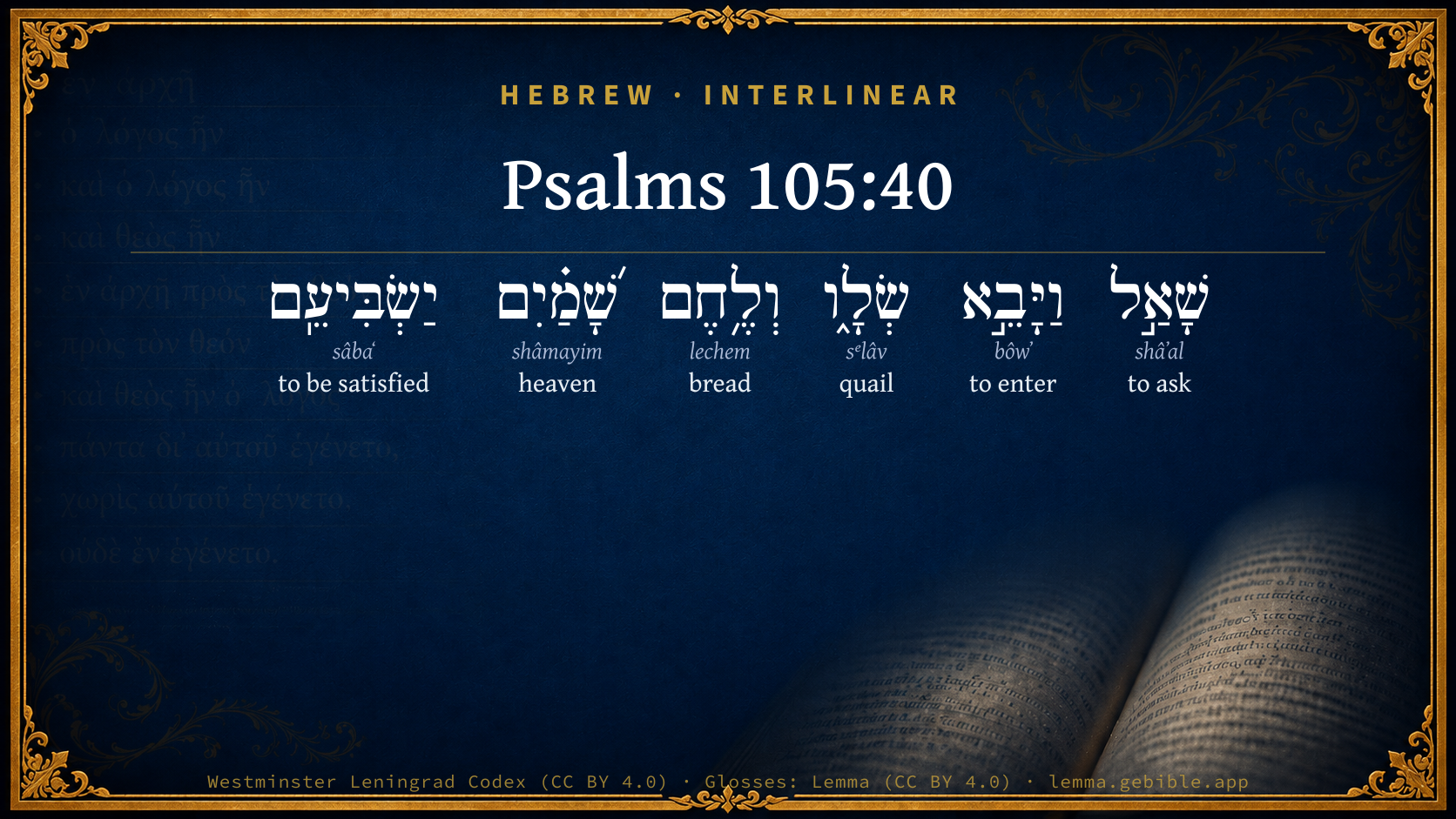
Psalms 105:40

Hebrew (Westminster Leningrad Codex) Psalms 105:40 appears in the Hebrew Old Testament. The text above is from the Westminster Leningrad Codex. Each word links to its Strong’s number, a concise gloss, and parsing drawn from the Open Scriptures Hebrew Bible morphology. Click any word for its full Brown-Driver-Briggs (BDB) entry.
Download image
Cite this verse

Psalms 105:40 (World English Bible). Public Domain. Lemma interlinear Bible study tool, https://lemma.gebible.app/v/psalms/105/40.

Show BibTeX & RIS
BibTeX
RIS
English Translation
They asked, and he brought quails, And satisfied them with the bread of the sky.
World English Bible · Public Domain
Download a study sheet

One document with this verse’s original text, its word-by-word gloss line, the meaning frame, cross-references with their text, attributed commentary, and full source and license credits — printable, and it pastes into notes with its structure intact.

This verse Autodidact and up

Study sheet (.html) Plain text (.txt)

A passage Seminary Student

Up to 50 verses in one chapter. A passage sheet keeps up to 6 commentary sources and 12 cross-references per verse, in the order this page ranks them, and says so on the sheet whenever that leaves anything out. Ask for a single verse and you get the Autodidact verse sheet above.

Everything on this page stays free to read, with no account — the sheet is a download of what is already on screen, not access to it.

Want to remove ads? Support Godless Engineer
Compare translations 3

The same verse in 3 English versions, stacked beneath the original-language interlinear above. Click any original word for its lexicon entry.

Each is an independent rendering of the whole verse — the interlinear is not word-aligned to these translations.

Highlighted words mark where these versions differ — a whole-verse word diff, not a word-by-word alignment.

  • World English Bible Public Domain
    They asked, and he brought quails, And satisfied them with the bread of the sky.
  • King James Version Public Domain
    The people asked, and he brought quails, and satisfied them with the bread of heaven.
  • unfoldingWord Literal Text CC BY-SA 4.0
    He asked, and he brought quail and satisfied them with bread from heaven.

unfoldingWord Literal Text — © unfoldingWord, licensed CC BY-SA 4.0. Word-aligned USFM3 via Door43 (git.door43.org/unfoldingWord/en_ult).

Versions to compare (up to 4)

3 of 4 selected

Show all 18 translations

Every available English version of this verse, each an independent rendering of the whole verse.

  • World English Bible Public Domain
    They asked, and he brought quails, And satisfied them with the bread of the sky.
  • Berean Standard Bible Public Domain
    They asked, and He brought quail and satisfied them with the bread of heaven.
  • Majority Standard Bible Public Domain
    They asked, and He brought quail and satisfied them with the bread of heaven.
  • King James Version Public Domain
    The people asked, and he brought quails, and satisfied them with the bread of heaven.
  • American Standard Version (1901) Public Domain
    They asked, and he brought quails, And satisfied them with the bread of heaven.
  • Revised Version (1885) Public Domain
    They asked, and he brought quails, and satisfied them with the bread of heaven.
  • Geneva Bible (1599) Public Domain
    They asked, and he brought quailes, and he filled them with the bread of heauen.
  • Douay-Rheims (1899) Public Domain
    They asked, and the quail came: and he filled them with the bread of heaven.
  • Young's Literal Translation Public Domain
    They have asked, and He bringeth quails, And `with' bread of heaven satisfieth them.
  • Literal Standard Version CC BY-SA 4.0
    They have asked, and He brings quails, || And satisfies them [with] bread of the heavens.
  • Unlocked Literal Bible CC BY-SA 4.0
    The Israelites asked for food, and he brought quail and satisfied them with bread from heaven.
  • unfoldingWord Literal Text CC BY-SA 4.0
    He asked, and he brought quail and satisfied them with bread from heaven.
  • Darby Bible Public Domain
    They asked, and he brought quails, and satisfied them with the bread of heaven.
  • World Messianic Bible Public Domain
    They asked, and he brought quails, and satisfied them with the bread of the sky.
  • Webster's Bible Public Domain
    The people asked, and he brought quails, and satisfied them with the bread of heaven.
  • Free Bible Version CC BY-SA 4.0
    He gave them quails to eat when they asked him; he fed them with the bread of heaven until they were full.
  • Bible in Basic English Public Domain
    At the people's request he sent birds, and gave them the bread of heaven for food.
  • JPS Tanakh (1917) Public Domain
    They asked, and He brought quails, and gave them in plenty the bread of heaven.

Literal Standard Version (2020), Covenant Press — licensed CC BY-SA 4.0. Text via the HelloAO Bible API (eBible.org). Unlocked Literal Bible (unfoldingWord) — licensed CC BY-SA 4.0. Text via the HelloAO Bible API (eBible.org). unfoldingWord Literal Text — © unfoldingWord, licensed CC BY-SA 4.0. Word-aligned USFM3 via Door43 (git.door43.org/unfoldingWord/en_ult). Free Bible Version, Dr. Jonathan Gallagher — licensed CC BY-SA 4.0. Text via the HelloAO Bible API (eBible.org).

Word by word

More ways to search: Search by grammar → Find every occurrence → Compare this word →

Practice this passage: Drill this verse → Learn its vocabulary →

About this verse

These counts appear in no published source. They are computed here, from the morphology-tagged text and Lemma’s own curated glosses. What Lemma adds →

6
words
6
distinct lemmas
Wisdom
section

Notable vocabulary

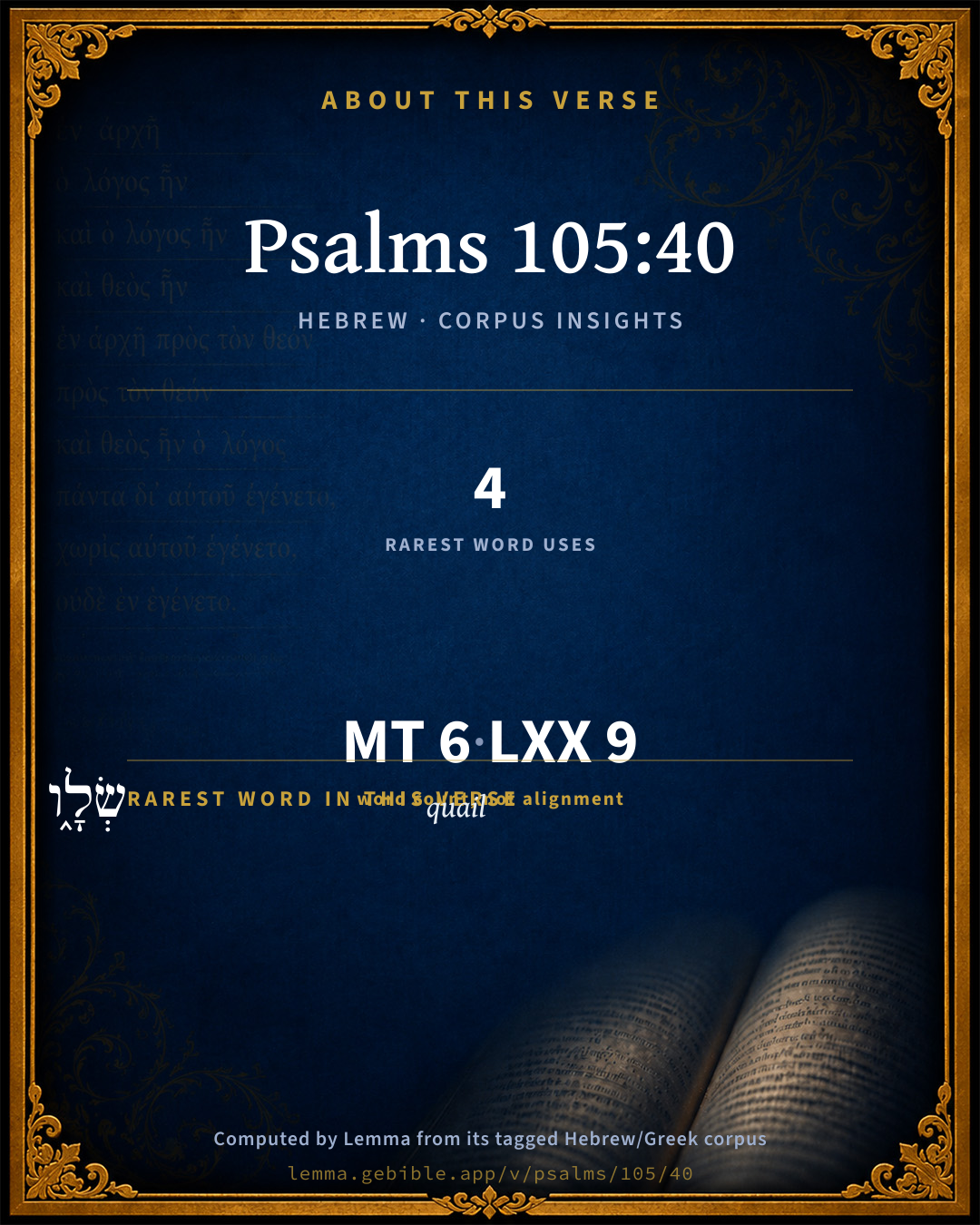
The rarest word here is שְׂלָ֑ו quail H7958 — appearing just 4 times in the whole Hebrew Bible.

Shared distinctive vocabulary

שְׂלָ֑ו quail H7958 occurs in 4 verses of the Hebrew Bible. Also found in:

Grammatical profile

  • 3 verbs
  • 3 nouns

Verb forms

  • שָׁאַ֣ל Qal · Perfect
  • וַיָּבֵ֣א Hiphil · Sequential Imperfect
  • יַשְׂבִּיעֵֽם Hiphil · Imperfect

Hebrew & Septuagint length

In English translation the verse runs 15 words from the Hebrew and 15 from the Septuagint (LXX English) — the same length.

A rough comparison of the two English renderings, which tokenize alike — not a word-level alignment.

Word counts can differ between the Hebrew and the Greek without any difference in meaning — e.g. the Hebrew direct-object marker אֵת has no separate Greek word, and Greek often adds the article ὁ.

In the original languages it is 6 Hebrew tokens and 9 Greek tokens — but the two are counted differently (Hebrew bundles its prefixes and suffixes into one token; the Greek is in lemma form), so that isn’t a like-for-like length.

Cross-references

10

Topical passages linked to Psalms 105:40 in the Treasury of Scripture Knowledge — connected by theme and wording, ordered by reader-vote popularity; previews shown in the World English Bible.

  • Psalms 78:18 They tempted God in their heart By asking food according to their desire.
  • Numbers 11:31–33 There went forth a wind from Yahweh, and brought quails from the sea, and let them fall by the camp, about a day's journey on this side, and a day's journey on the other side, round about the camp, and about two cubits above the surface of the earth.
  • Deuteronomy 8:3 He humbled you, and allowed you to hunger, and fed you with manna, which you didn't know, neither did your fathers know; that he might make you know that man does not live by bread only, but by everything that proceeds out of the mouth of Yahweh does man live.
  • Joshua 5:12 The manna ceased on the next day, after they had eaten of the produce of the land; neither had the children of Israel manna any more; but they ate of the fruit of the land of Canaan that year.
  • Nehemiah 9:20 You gave also your good Spirit to instruct them, and didn't withhold your manna from their mouth, and gave them water for their thirst.
  • Psalms 78:23–28 Yet he commanded the skies above, And opened the doors of heaven.
  • John 6:31–33 Our fathers ate the manna in the wilderness. As it is written, 'He gave them bread out of heaven to eat.'"
  • John 6:48–58 I am the bread of life.
  • Exodus 16:12–35 "I have heard the murmurings of the children of Israel. Speak to them, saying, 'At evening you shall eat meat, and in the morning you shall be filled with bread: and you shall know that I am Yahweh your God.'"
  • Numbers 11:4–9 The mixed multitude that was among them lusted exceedingly: and the children of Israel also wept again, and said, Who shall give us flesh to eat?

Cross-references courtesy of OpenBible.info (CC BY 4.0).

Hebrew and Greek witnesses Masoretic Hebrew ↔ Greek Septuagint

The same verse in the two great witnesses to the Old Testament, shown verse-for-verse.

You’re reading Greek Psalm 104 (Hebrew Psalm 105). The Septuagint counts the superscription, so verse numbers can differ from the Hebrew — chapter-level alignment, not verse-by-verse. Numbering follows Rahlfs.

These are two independent witnesses, not word-aligned to each other, and the Septuagint is shown in lemma (dictionary) form.

Hebrew Psalms 105:40 Masoretic · Westminster Leningrad Codex

שָׁאַ֣ל וַיָּבֵ֣א שְׂלָ֑ו וְלֶ֥חֶם שָׁ֝מַ֗יִם יַשְׂבִּיעֵֽם

They asked, and he brought quails, And satisfied them with the bread of the sky.

World English Bible · Public Domain

Greek LXX Greek Psalm 104:40 Septuagint · lemma form

αἰτέω καί ἔρχομαι ὀρτυγομήτρα καί ἄρτος οὐρανός ἐνπίμπλημι αὐτός

They asked, and the quail came, and he satisfied them with the bread of heaven.

LXX2012 (modern English Septuagint) · Public Domain

On this verse, The Cambridge Bible for Schools and Colleges discusses the Septuagint’s reading. Read the note in Commentary ↓

Hebrew: Westminster Leningrad Codex (CC BY 4.0). Greek: Septuagint (public domain); English from LXX2012 (modern English Septuagint) (Public Domain). How the Septuagint differs from the Hebrew →

Commentary

Notes on Psalms 105:40 from classic Christian and Jewish commentators (each source and its license shown beneath its notes). The classic Christian expositions comment on the surrounding passage and are grouped to its opening verse, so a note may address several verses; the Jewish commentaries on the Tanakh (Rashi and others) are per-verse, so they appear only where the commentator wrote on this verse.

Lemma curates 59 commentaries, every one of them public domain or Creative Commons licensed, each selected and text-cleaned for this edition rather than reprinted as found. About our sources →

Trapp's Complete Commentary

John Trapp

Psa 105:40 [The people] asked, and he brought quails, and satisfied them with the bread of heaven.

Ver. 40. The people asked] Not as suppliants, but as malcontents, and therefore had what they asked, with a vengeance.

And satisfied them with the bread of heaven] Never was any prince in his greatest state so served as these miscreants were; and yet we fare better than they in God’s holy ordinances.

John Trapp, A Commentary or Exposition upon All the Books of the Old and New Testament (1647–1656) — public domain. Text from a community e-Sword module.

Joseph Benson's Commentary

Psa 105:40-41. The people asked, and he brought quails — He speaks of the first instance of his giving quails, mentioned Exo 16:13, which God sent them as a refreshment, graciously pardoning their sin in desiring them; and not of that second instance, recorded Num 11:31, when God gave them quails in judgment, which would not have been mentioned here among God’s favours vouchsafed to them. And satisfied them with the bread of heaven — With manna, which came down from the air, commonly called heaven: see on Psa 78:24-29. He opened the rock — God, in his common providence, fetches water from heaven, and bread out of the earth; but for Israel, the divine power brought bread from the clouds and water from the rocks: so far is the God of nature from being tied to the laws and course of nature! And the waters gushed out — And that not only once, but ran like a river, plentifully and constantly; and, it is thought by many, attended their camp in all their removes, as seems to be implied 1Co 10:4, where they are said to have drunk of the rock that followed them. Hence they complained no more of want of water till they came to Kadesh, Num 20:2, &c. To this instance of the divine goodness that promise alludes, I will give rivers in the desert, to give drink to my people, my chosen, Isa 43:19-20 : see on Psa 78:15.

Joseph Benson's Commentary on the Old and New Testaments (1811–1818) — public domain. Text from a community e-Sword module.

J. A. Alexander on Psalms

Joseph Addison Alexander

40. (Psa 105:40) (The people) asked and he made quails come—and bread of heaven satisfied them. See above, on Psa 78:25-27, and compare Exo 16:4-13, Num 11:31. As to the alternation of the singular and plural forms, see above, on ver. 24 (Psa 105:24). Bread may be either the subject of the verb, as given above, or a qualifying term, (with) bread.

Joseph Addison Alexander, The Psalms Translated and Explained (1850) — public domain. Text from a community e-Sword module.

Geneva Bible (1599)

Geneva Bible translators

Not for necessity, but for satisfying of their lust.

Geneva Bible (1599) marginal notes — public domain. Text via Bolls.life.

The Cambridge Bible for Schools and Colleges

gen. ed. J. J. S. Perowne

40. The people asked] The Heb. verb is in the sing., but with LXX Jer. Syr. Targ. we should read the plural, They asked. See Exodus 16, and cp. Psa_78:18 ff. The murmuring of the Israelites is not mentioned, because the Psalmist’s object is to point to God’s goodness, not to Israel’s faithlessness.

the bread of heaven] The manna: cp. Psa_78:24-25; Neh_9:15.

The Cambridge Bible for Schools and Colleges (gen. ed. J. J. S. Perowne; Cambridge University Press, 1878–1918) — public domain. Text from a community e-Sword module.

John Gill's Exposition

He opened the rock, and the waters gushed out,.... That is, God opened the rock, who before is said to spread the cloud, and bring the quails, for it was a miraculous affair; or Moses, by divine orders, which was done by smiting it, when waters flowed out in great abundance, sufficient to give drink to men and beasts, and which continued, Exo 17:6. This was typical of Christ the Rock, Co1 10:4, and of the opening of his side, from whence flowed blood and water, Joh 19:34 and of his being smitten with the rod of justice, and by the law of Moses, from whom flow abundance of grace, and the blessings of it, freely to all his people; See Gill on Psa 78:15. See Gill on Psa 78:16.

They ran in the dry places like a river; and did not sink and soak into them, but continued their flow, and followed the Israelites, wherever they went; see Co1 10:4.

John Gill's Exposition of the Whole Bible (1746–1763) — public domain (CC PDM 1.0). Text via the HelloAO Bible API.

Albert Barnes' Notes on the Bible

The people asked, and he brought quails - See the notes at Psa 78:26-29.

And satisfied them with the bread of heaven - manna, sent down, as it were, from heaven. In Psa 78:25, it is called “angels’ food.” See the notes at that verse.

Albert Barnes' Notes on the Bible (1834–1885) — public domain. Text from a community e-Sword/MySword module.

Matthew Poole's English Annotations

He speaks of the first giving of quails, Exo 16:13, which God gave them as a refreshment, notwithstanding their sin in desiring them, which he graciously pardoned; and not of that second giving of quails, which God gave them in judgment, Num 11, and therefore would not have been numbered here amongst God’s favours vouchsafed to them. With the bread of heaven; with manna which came out of the air, which is commonly called heaven.

Matthew Poole's English Annotations on the Holy Bible (1683–1685) — public domain. Text from a community e-Sword/MySword module.

The Treasury of David

Charles H. Spurgeon

Ver. 40. The people asked. But how badly, how wickedly! And yet his grace forgave the sin of their murmuring and heard its meaning: or perhaps we may consider that while the multitude murmured there were a few, who were really gracious people, who prayed, and therefore the blessing came.

He brought quails, and satisfied them with the bread of heaven. He gave them what they asked amiss as well as what was good for them, mingling judgment with goodness, for their discipline. The quails were more a curse than a blessing in the end, because of their greed and lust, but in themselves they were a peculiar indulgence, and favour: it was their own fault, that the dainty meat brought death with it. As for the manna it was unmingled good to them, and really satisfied them, which the quails never did. It was bread from heaven, and the bread of heaven, sent by heaven; it was a pity that they were not led to look up to heaven whence it came, and fear and love the God who out of heaven rained it upon them. Thus they were housed beneath the Lord's canopy and fed with food from his own table; never people were so lodged and boarded. O house of Israel, praise ye the Lord.

Ver. 40. Quails. The quail is met with abundantly in Syria and Judaea, and there seems to be little doubt of its identity with the quails so frequently mentioned in the Holy Scriptures. "We have, "says Tristram, "a clear proof of the identity of the common quail with the Hebrew selac, in its Arabic name, salwa, from a root signifying `to be fat' very descriptive of the round, plump form and fat flesh of the quail... It migrates in vast flocks, and regularly crosses the Arabian desert, flying for the most part at night, and when the birds settle they are so utterly exhausted that they may be captured in any numbers by the hand. Notwithstanding their migratory habits, they instinctively select the shortest sea passages, and avail themselves of any island as a halting place. Thus in Spring and Autumn they are slaughtered in numbers on Malta and many of the Greek islands, very few being seen till the period of migration comes round. They also fly with the wind, never facing it like many other birds." "The Israelites `spread them out' when they had taken them before they were sufficiently refreshed to escape; exactly as Herodotus tells us that the Egyptians were in the habit of doing with quailsdrying them in the sun." Brehm mentions having been a witness to the arrival of a huge flock of quails upon the coast of North Africa, and tells us that the weary birds fell at once to the ground completely exhausted by their toilsome journey, and remained therefore some minutes as though stupefied. Cassell's "Book of Birds."

Ver. 40.

Brought from his store, at sute of Israel,

Quails, in whole beavies each remove pursue;

Himself from skies their hunger to repel

Candies the grass with sweet congealed dew.

He wounds the rock, the rock doth wounded, swell;

Swelling affords new streams to channels new,

All for God's mindful will can not be dryven,

From sacred word once to his Abraham given. Sir Philip Sidney, 1554-1586.

Ver. 40.

1. God often gives in love what is not asked. So the bread from heaven which was beyond all they could ask or think.

2. He sometimes gives in anger what is asked. They asked for flesh to eat"and he brought quails." G.R.

Psalms 105:41*

Charles H. Spurgeon's The Treasury of David (1869–1885) — public domain. Psalms only. Text from a community e-Sword/MySword module.

Whedon's Commentary on the Bible

Daniel D. Whedon

40. Quails—This would seem, by the order of events named, to refer to the first supply of quails, Exo_16:12-13. For second supply, see on Psa_78:26.

Bread of heaven—Same as “angels’ food,” “corn of heaven,” manna. Psa_78:24-25, where see note.

Daniel D. Whedon (gen. ed.), Commentary on the Old and New Testaments (1874–1909) — public domain. Text from a community e-Sword module.

The Pulpit Commentary

The people asked, and he brought quails; literally, they asked. (comp. Exo_16:3, 13 Num_11:31) And satisfied them with the bread of heaven. The "bread of heaven" is the manna, which was given to the Israelites continuously from their first encampment in the wilderness of Sin (Exo_16:14, Exo_16:15) to their first Passover in Canaan. (Jos_5:12) The quails seem to have been given only twice.

Vers. 40, 41. The sin of trying to make terms with God.

"The people asked, and he brought quails." The sin of this does not immediately strike the reader. It is not said that the people asked for quails. What we are to understand is, that God was graciously and wonderfully providing their staple food for the people: manna food from the skies, spring waters from the rocks. But the people were discontented with what God, in his infinite wisdom and love, provided, and wanted to arrange with God what he should provide. They wanted to make terms with God; and that meant taking the arrangement of their affairs out of the hands of God, and managing them for themselves; or, rather, making God manage them at their dictation. From this point of view we see their sin plainly enough. God met their desires, but brought upon them a most humbling judgment through the very obtaining of what they wished. He showed them how utterly incapable they were of managing for themselves, and ordering their own lives, by giving them the meat they desired, in plenty, and letting them do what they would with it. See the consequence. Quails were wholesome enough when eaten in moderation. The people devoured them unrestrainedly; they showed no sort of moderation; and the consequence was a disease which became epidemic, and swept away multitudes. On the monument for those dead men this inscription might well have been put, "Never try to make terms with God.

I SEE THIS SIN IN THE LIGHT OF WHAT GOD IS. Take the attributes, and show that God must both know, and be able to do, what is every way wisest and best. Who understands our real needs as God does? Who controls all things as God does? Take the Father name which we are permitted to use for God, and show how wrong children are who attempt to dictate to their father as to what he shall provide.

II SEE THIS SIN IN THE LIGHT OF WHAT GOD HAD DONE. All Jehovah"s relations with his people had been gracious and considerate. They had never wanted any good thing. Defence had been close alongside danger, and provision ready for all need. Signs of distrust and murmuring were most unbecoming.

III SEE THIS SIN IN THE LIGHT OF WHAT THE PEOPLE WERE. Had they any right to the confidence that they knew what was good for them butter than God did? Their past should have taught them submissiveness and humility. R.T.

The Pulpit Commentary (1880–1919), ed. H.D.M. Spence-Jones & Joseph S. Exell — public domain. Text from a community e-Sword module.

John Wesley's Explanatory Notes

Quails - He speaks of the first giving of quails, Exod. xvi, 13, which God gave them as a refreshment, notwithstanding their sin in desiring them, which he graciously pardoned. Bread - With manna which came out of the air, commonly called heaven.

John Wesley, Explanatory Notes Upon the Whole Bible (1754–1765) — public domain. Text via the GEBible commentary corpus.

unfoldingWord translationNotes

Door43 World Missions Community

he brought quail

It may be helpful to make clear that quail are small birds Yahweh sent for them to eat. AT: "Yahweh sent small birds to eat" (See: Assumed Knowledge and Implicit Information)

with bread from heaven

Yahweh caused manna, a type of bread, to fall from the sky. AT: "with bread that fell from the sky" (See: Assumed Knowledge and Implicit Information)

they flowed

"the waters flowed"

called to mind

This means to remember. AT: "remembered" (See: Idiom)

translationWords

bread

heaven

water

desert

mind

holy

promise

Abraham

servant

unfoldingWord translationNotes — © Distant Shores Media and the Door43 World Missions Community, licensed CC BY-SA 4.0. Source: git.door43.org/Door43/en_tn.

Rashi

Rabbi Shlomo Yitzchaki (Rashi)

They asked, and He brought quails Israel asked for meat, and the Holy One, blessed be He, brought them quails.

Rashi on the Tanakh — English translations: “The Judaica Press complete Tanach with Rashi, translated by A. J. Rosenberg” (CC BY 4.0); “Pentateuch with Rashi's commentary by M. Rosenbaum and A.M. Silbermann, 1929-1934” (public domain); “The Metsudah Tanach series, Lakewood, N.J” (CC BY 4.0); and “The Book of Joshua, Metsudah Publications, 1997” (CC BY 4.0). Text via Sefaria.

Lesson kit

Teaching starters — assembled from the data on this page, not authored interpretation. Every prompt links to the verse data it draws on. Edit before teaching.

Psalms, in the Wisdom, opens this verse with 6 words (6 distinct Hebrew lemmas). Its most distinctive word is sᵉlâv (“quail”). A historical commentator’s framing appears above. Read the whole chapter for the surrounding context.

Discussion questions

  1. How does “quail” (sᵉlâv) shape what this verse is saying?
  2. Exodus 16:13 shares the word «quail» with this verse. How do the two illuminate each other?
  3. These translations render this verse differently; the difference is in the English rendering, not the original. What questions does that raise?
  4. The verb «שָׁאַ֣ל» is Qal Perfect. How does its form color the action?
  5. Reading how Trapp's Complete Commentary and Joseph Benson's Commentary read this verse, where do the two commentators agree and where do they part?

Things to notice

Reading settings

Reading text

Shown beneath each verse's original-language words.

Old Testament
Old Testament edition

Read the OT as the Masoretic Hebrew (MT) or the Greek Septuagint (LXX).

English shown for the Greek Septuagint (in the Hebrew ↔ Greek comparison).

Comparing translations? Open the Compare panel on any verse page to stack up to four side by side.