
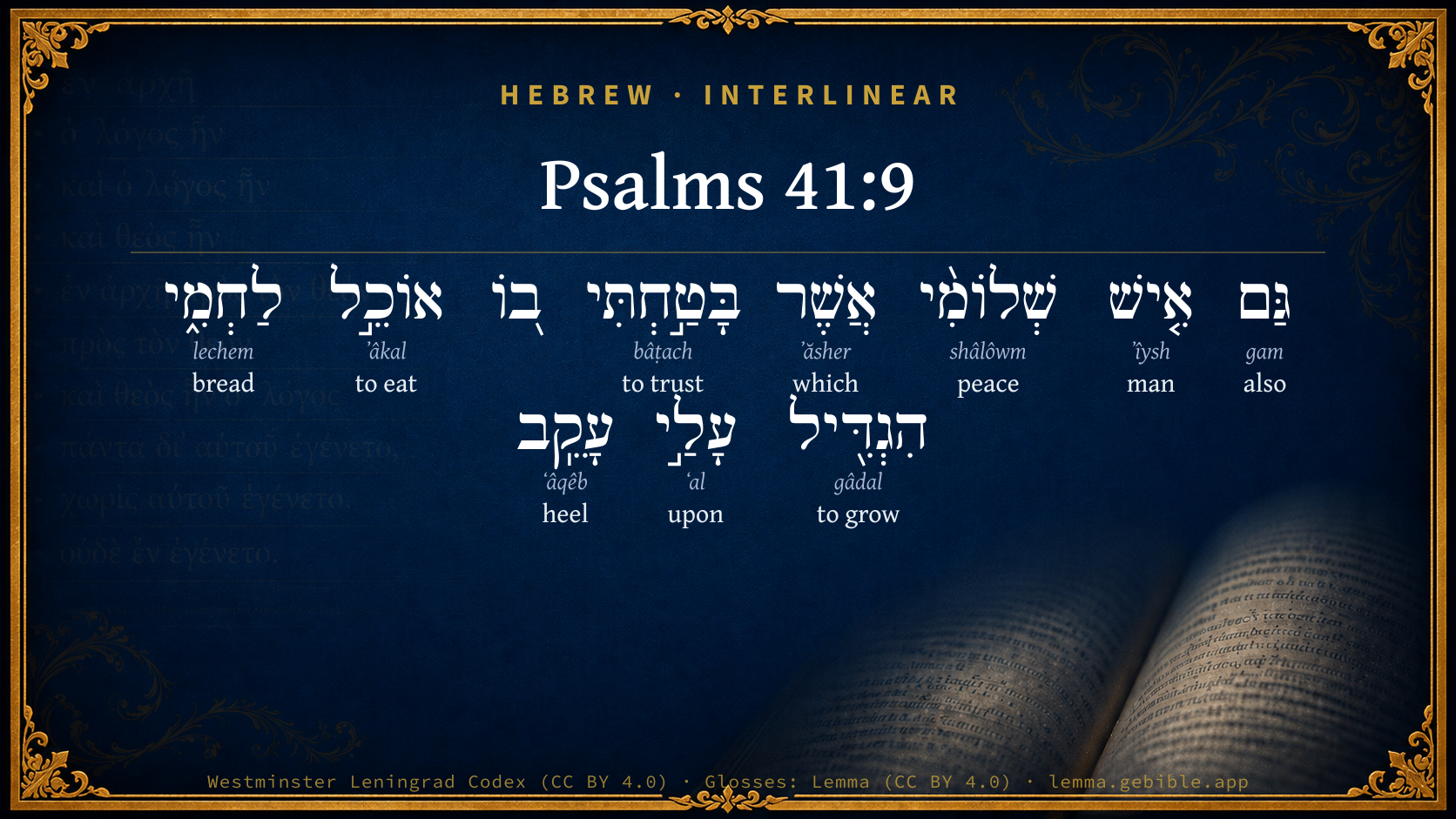
Psalms 41:9

Hebrew (Westminster Leningrad Codex) Psalms 41:9 appears in the Hebrew Old Testament. The text above is from the Westminster Leningrad Codex. Each word links to its Strong’s number, a concise gloss, and parsing drawn from the Open Scriptures Hebrew Bible morphology. Click any word for its full Brown-Driver-Briggs (BDB) entry.
Download image
Cite this verse

Psalms 41:9 (World English Bible). Public Domain. Lemma interlinear Bible study tool, https://lemma.gebible.app/v/psalms/41/9.

Show BibTeX & RIS
BibTeX
RIS
English Translation
Yes, my own familiar friend, in whom I trusted, Who ate bread with me, Has lifted up his heel against me.
World English Bible · Public Domain
Download a study sheet

One document with this verse’s original text, its word-by-word gloss line, the meaning frame, cross-references with their text, attributed commentary, and full source and license credits — printable, and it pastes into notes with its structure intact.

This verse Autodidact and up

Study sheet (.html) Plain text (.txt)

A passage Seminary Student

Up to 50 verses in one chapter. A passage sheet keeps up to 6 commentary sources and 12 cross-references per verse, in the order this page ranks them, and says so on the sheet whenever that leaves anything out. Ask for a single verse and you get the Autodidact verse sheet above.

Everything on this page stays free to read, with no account — the sheet is a download of what is already on screen, not access to it.

Want to remove ads? Support Godless Engineer
Compare translations 3

The same verse in 3 English versions, stacked beneath the original-language interlinear above. Click any original word for its lexicon entry.

Each is an independent rendering of the whole verse — the interlinear is not word-aligned to these translations.

Highlighted words mark where these versions differ — a whole-verse word diff, not a word-by-word alignment.

  • World English Bible Public Domain
    Yes, my own familiar friend, in whom I trusted, Who ate bread with me, Has lifted up his heel against me.
  • King James Version Public Domain
    Yea, mine own familiar friend, in whom I trusted, which did eat of my bread, hath lifted up his heel against me.
  • unfoldingWord Literal Text CC BY-SA 4.0
    Even the man of my peace, whom I trusted in him, the eater of my bread, has made great the heel against me.

unfoldingWord Literal Text — © unfoldingWord, licensed CC BY-SA 4.0. Word-aligned USFM3 via Door43 (git.door43.org/unfoldingWord/en_ult).

Versions to compare (up to 4)

3 of 4 selected

Show all 18 translations

Every available English version of this verse, each an independent rendering of the whole verse.

  • World English Bible Public Domain
    Yes, my own familiar friend, in whom I trusted, Who ate bread with me, Has lifted up his heel against me.
  • Berean Standard Bible Public Domain
    Even my close friend whom I trusted, the one who shared my bread, has lifted up his heel against me.
  • Majority Standard Bible Public Domain
    Even my close friend whom I trusted, the one who shared my bread, has lifted up his heel against me.
  • King James Version Public Domain
    Yea, mine own familiar friend, in whom I trusted, which did eat of my bread, hath lifted up his heel against me.
  • American Standard Version (1901) Public Domain
    Yea, mine own familiar friend, in whom I trusted, Who did eat of my bread, Hath lifted up his heel against me.
  • Revised Version (1885) Public Domain
    Yea, mine own familiar friend, in whom I trusted, which did eat of my bread, hath lifted up his heel against me.
  • Geneva Bible (1599) Public Domain
    Yea, my familiar friend, whom I trusted, which did eate of my bread, hath lifted vp the heele against me.
  • Douay-Rheims (1899) Public Domain
    They determined against me an unjust word: shall he that sleepeth rise again no more?
  • Young's Literal Translation Public Domain
    Even mine ally, in whom I trusted, One eating my bread, made great the heel against me,
  • Literal Standard Version CC BY-SA 4.0
    Even my ally, in whom I trusted, || One eating my bread, || Made the heel great against me,
  • Unlocked Literal Bible CC BY-SA 4.0
    Indeed, even my own close friend, in whom I trusted, who ate my bread, has lifted up his heel against me.
  • unfoldingWord Literal Text CC BY-SA 4.0
    Even the man of my peace, whom I trusted in him, the eater of my bread, has made great the heel against me.
  • Darby Bible Public Domain
    Yea, mine own familiar friend, in whom I confided, who did eat of my bread, hath lifted up [his] heel against me.
  • World Messianic Bible Public Domain
    Yes, my own familiar friend, in whom I trusted, who ate bread with me, has lifted up his heel against me.
  • Webster's Bible Public Domain
    \\41:8\\An evil disease, say they, cleaveth fast to him: and now that he lieth he shall rise no more.
  • Free Bible Version CC BY-SA 4.0
    Even my best friend, the one I trusted, who shared meals with me—even he has turned against me.
  • Bible in Basic English Public Domain
    Even my dearest friend, in whom I had faith, who took bread with me, is turned against me.
  • JPS Tanakh (1917) Public Domain
    (41-10) Yea, mine own familiar friend, in whom I trusted, who did eat of my bread, hath lifted up his heel against me.

Literal Standard Version (2020), Covenant Press — licensed CC BY-SA 4.0. Text via the HelloAO Bible API (eBible.org). Unlocked Literal Bible (unfoldingWord) — licensed CC BY-SA 4.0. Text via the HelloAO Bible API (eBible.org). unfoldingWord Literal Text — © unfoldingWord, licensed CC BY-SA 4.0. Word-aligned USFM3 via Door43 (git.door43.org/unfoldingWord/en_ult). Free Bible Version, Dr. Jonathan Gallagher — licensed CC BY-SA 4.0. Text via the HelloAO Bible API (eBible.org).

Word by word

More ways to search: Search by grammar → Find every occurrence → Compare this word →

Practice this passage: Drill this verse → Learn its vocabulary →

עָקֵֽב
ʻâqêb
H6119
“heel”
Noun, Common, Masculine, Singular, Absolute
Part of Speech
Noun
Type
Common
Gender
Masculine
Number
Singular
State
Absolute
Full BDB Definition

Origin: from H6117

TWOT: 1676a

heel, rear, footprint, hinder part, hoof, rear of a troop, footstep - heel - mark of heel, footprint - hinder part, rear
  1. גַּם gam H1571 “also” Particle, Accusative
  2. אִ֤ישׁ ʼîysh H376 “man of” Noun, Common, Masculine, Singular, Construct
  3. שְׁלוֹמִ֨י shâlôwm H7965 “peace · my” Noun, Common, Masculine, Singular, Construct + Suffix, Personal, 1st Person, Common, Singular
  4. אֲשֶׁר ʼăsher H834 “which” Particle, Relative
  5. בָּטַ֣חְתִּי bâṭach H982 “to trust” Verb, Qal, Perfect, 1st Person, Common, Singular
  6. אוֹכֵ֣ל ʼâkal H398 “eating” Verb, Qal, Participle Active, Masculine, Singular, Absolute
  7. לַחְמִ֑י lechem H3899 “bread · my” Noun, Common, Both, Singular, Construct + Suffix, Personal, 1st Person, Common, Singular
  8. הִגְדִּ֖יל gâdal H1431 “to grow” Verb, Hiphil, Perfect, 3rd Person, Masculine, Singular
  9. עָלַ֣י ʻal H5921 “upon · me” Preposition + Suffix, Personal, 1st Person, Common, Singular

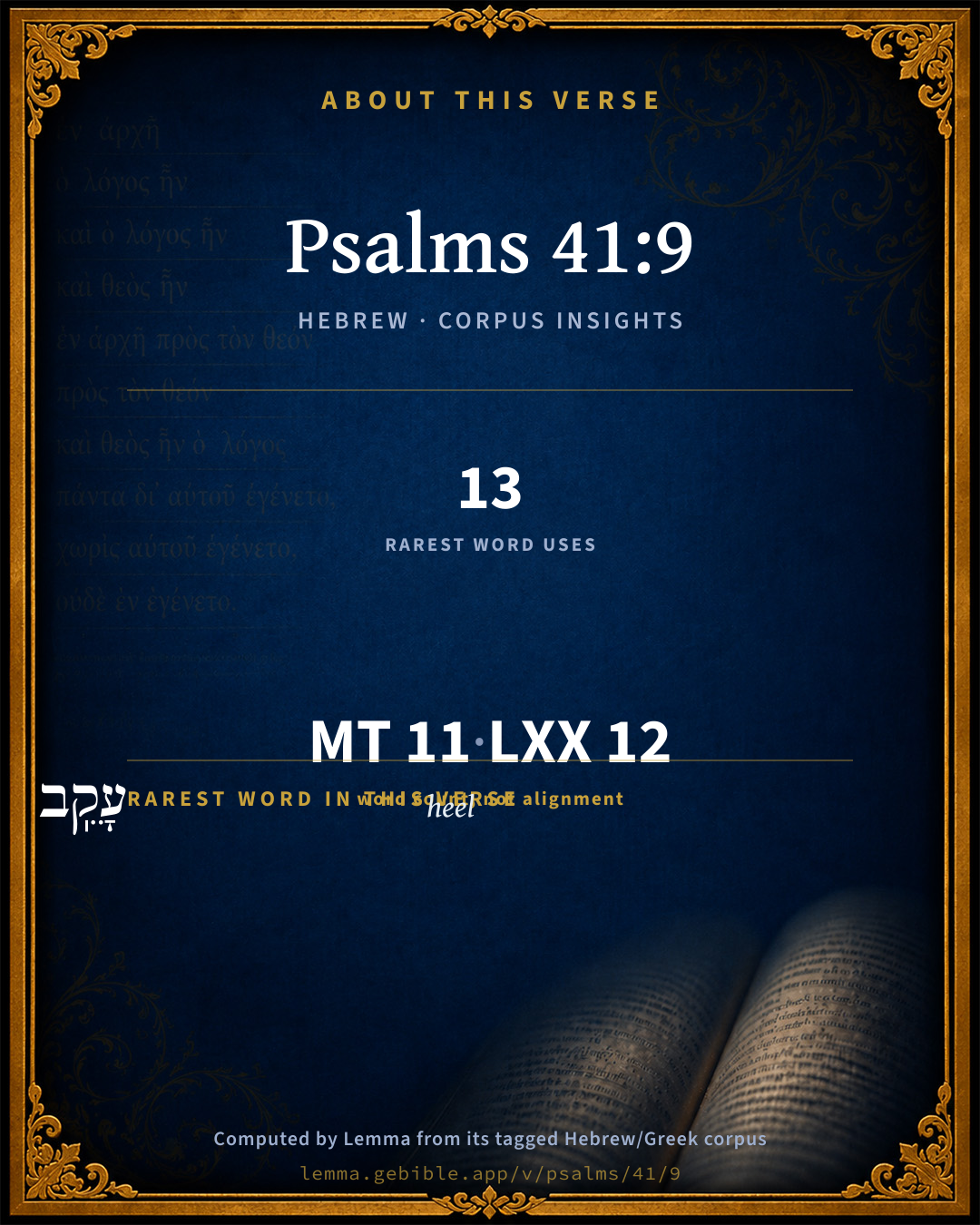
About this verse

These counts appear in no published source. They are computed here, from the morphology-tagged text and Lemma’s own curated glosses. What Lemma adds →

11
words
10
distinct lemmas
Wisdom
section

Notable vocabulary

The rarest word here is עָקֵֽב heel H6119 — appearing just 13 times in the whole Hebrew Bible.

Shared distinctive vocabulary

עָקֵֽב heel H6119 occurs in 13 verses of the Hebrew Bible. Also found in:

Grammatical profile

  • 3 verbs
  • 4 nouns
  • 2 prepositions
  • 2 particles

Verb forms

  • בָּטַ֣חְתִּי Qal · Perfect
  • אוֹכֵ֣ל Qal · Participle Active
  • הִגְדִּ֖יל Hiphil · Perfect

Hebrew & Septuagint length

In English translation the verse runs 21 words from the Hebrew and 21 from the Septuagint (LXX English) — the same length.

A rough comparison of the two English renderings, which tokenize alike — not a word-level alignment.

Word counts can differ between the Hebrew and the Greek without any difference in meaning — e.g. the Hebrew direct-object marker אֵת has no separate Greek word, and Greek often adds the article ὁ.

In the original languages it is 11 Hebrew tokens and 12 Greek tokens — but the two are counted differently (Hebrew bundles its prefixes and suffixes into one token; the Greek is in lemma form), so that isn’t a like-for-like length.

Cross-references

12

Topical passages linked to Psalms 41:9 in the Treasury of Scripture Knowledge — connected by theme and wording, ordered by reader-vote popularity; previews shown in the World English Bible.

  • John 13:18 I don't speak concerning all of you. I know whom I have chosen. But that the Scripture may be fulfilled, 'He who eats bread with me has lifted up his heel against me.'
  • Psalms 55:12–14 For it was not an enemy who insulted me, Then I could have endured it. Neither was it he who hated me who raised himself up against me, Then I would have hid myself from him.
  • Matthew 26:23 He answered, "He who dipped his hand with me in the dish, the same will betray me.
  • Psalms 55:20–22 He raises his hands against his friends. He has violated his covenant.
  • John 13:26–27 Jesus therefore answered, "It is he to whom I will give this piece of bread when I have dipped it." So when he had dipped the piece of bread, he gave it to Judas, the son of Simon Iscariot.
  • Job 19:19 All my familiar friends abhor me. They whom I loved have turned against me.
  • Jeremiah 20:10 For I have heard the defaming of many, terror on every side. Denounce, and we will denounce him, [say] all my familiar friends, those who watch for my fall; peradventure he will be persuaded, and we shall prevail against him, and we shall take our revenge on him.
  • 2 Samuel 15:12 Absalom sent for Ahithophel the Gilonite, David's counselor, from his city, even from Giloh, while he was offering the sacrifices. The conspiracy was strong; for the people increased continually with Absalom.
  • Obadiah 1:7 All the men of your alliance have brought you on your way, even to the border. The men who were at peace with you have deceived you, and prevailed against you. Friends who eat your bread lay a snare under you. There is no understanding in him.
  • Micah 7:5 Don't trust in a neighbor. Don't put confidence in a friend. With the woman lying in your embrace, Be careful of the words of your mouth!
  • Job 19:13 "He has put my brothers far from me. My acquaintances are wholly estranged from me.
  • Deuteronomy 32:15 But Jeshurun grew fat, and kicked: You have grown fat, you are grown thick, you are become sleek; Then he forsook God who made him, Lightly esteemed the Rock of his salvation.

Cross-references courtesy of OpenBible.info (CC BY 4.0).

Hebrew and Greek witnesses Masoretic Hebrew ↔ Greek Septuagint

The same verse in the two great witnesses to the Old Testament, shown verse-for-verse.

You’re reading Greek Psalm 40 (Hebrew Psalm 41). The Septuagint counts the superscription, so verse numbers can differ from the Hebrew — chapter-level alignment, not verse-by-verse. Numbering follows Rahlfs.

These are two independent witnesses, not word-aligned to each other, and the Septuagint is shown in lemma (dictionary) form.

Hebrew Psalms 41:9 Masoretic · Westminster Leningrad Codex

גַּם אִ֤ישׁ שְׁלוֹמִ֨י אֲשֶׁר בָּטַ֣חְתִּי ב֭וֹ אוֹכֵ֣ל לַחְמִ֑י הִגְדִּ֖יל עָלַ֣י עָקֵֽב

Yes, my own familiar friend, in whom I trusted, Who ate bread with me, Has lifted up his heel against me.

World English Bible · Public Domain

Greek LXX Greek Psalm 40:9 Septuagint · lemma form

λόγος παράνομος κατατίθημι κατά ἐγώ μή ὁ κοιμάω οὐ προςτίθημι ὁ ἀναἵστημι

For even the man of my peace, in whom I trusted, who ate my bread, lifted up his heel against me.

LXX2012 (modern English Septuagint) · Public Domain

On this verse, Ellicott's Commentary for English Readers discusses the Septuagint’s reading. Read the note in Commentary ↓

Hebrew: Westminster Leningrad Codex (CC BY 4.0). Greek: Septuagint (public domain); English from LXX2012 (modern English Septuagint) (Public Domain). How the Septuagint differs from the Hebrew →

Commentary

Notes on Psalms 41:9 from classic Christian and Jewish commentators (each source and its license shown beneath its notes). The classic Christian expositions comment on the surrounding passage and are grouped to its opening verse, so a note may address several verses; the Jewish commentaries on the Tanakh (Rashi and others) are per-verse, so they appear only where the commentator wrote on this verse.

Lemma curates 59 commentaries, every one of them public domain or Creative Commons licensed, each selected and text-cleaned for this edition rather than reprinted as found. About our sources →

Trapp's Complete Commentary

John Trapp

Psa 41:9 Yea, mine own familiar friend, in whom I trusted, which did eat of my bread, hath lifted up [his] heel against me.

Ver. 9. Yea, mine own familiar friend] Heb. the man of my peace. This was a great cut to David, τιγαρ μειζον ελκος η φιλος αδικων, saith Sophocles. What greater wound can there be than a treacherous friend? such as was Ahithophel to David, Judas to our Saviour, Brutus to Julius Caesar (who was slain in the Senate house with three and twenty wounds, given for most part by them whose lives he had preserved), Magnentius to Constans, the emperor, who had formerly saved his life from the soldiers’ fury; Michael Balbus to the Emperor Leo Armenius, whom he slew the same night that he had pardoned and released him. This evil dealing made Socrates cry out, φιλοι ουδεις φιλος, Friends, there is hardly a friend to be found; and Queen Elizabeth complain, that in trust she had found treason; and King Antigonus pray to God to preserve him from his friends; and King Alphonsus to complain of the ingratitude of his favourites.

In whom I trusted] So did not our Saviour in Judas, for he knew him better than so, and therefore this clause is left out, Joh 13:18, where he applieth this saying to himself. Jerome and some others apply the whole psalm to Christ, and for that end they render these words actively, Cui credidi, to whom I intrusted or committed my ministry.

Who did eat of my bread] My fellow commoner, with whom I had eaten little less than a bushel of salt. A man’s enemies are many times those of his own house, the birds of his own bosom. Judas dipped in the same dish with Jesus, betrayed him with a kiss. Caveatur osculum Iscarioticum. Beware the kisses of Judas.

Hath lift up his heel against me] Heb. Hath magnified the heel, or the foot sole, sc. to supplant me, or to trample upon me, or to spurn against me. Metaphora ab equis calcitronibus, saith Vatablus, a metaphor from unruly and refractory horses. See Jdg 15:8. It importeth contempt, despite, and cruelty.

John Trapp, A Commentary or Exposition upon All the Books of the Old and New Testament (1647–1656) — public domain. Text from a community e-Sword module.

The Biblical Illustrator

Joseph S. Exell

Psa_41:9

Yea, mine own familiar friend in whom I trusted, which did eat of my bread, hath lifted up his heel against me.

The evil of Christs friends lifting up their heel against Him

The psalmist doth in the text show the cope-stone laid on the maltreatment with which he met in the world by his particular friends turning abusive to him. They who did this were his intimates, his confidants, in whom he trusted; and his dependents, also, for they did eat of his bread. He describes their treatment under the metaphor of a horse that kicks against the man that lays meat before him. Confidence in an unfaithful man in the time of trouble is like a broken tooth, and a foot out of joint. Now, it is evident that what the text speaks of was a typical event. Hence, consider it as it relates to the Lord Jesus Christ. Now, all bread that we eat is the Lords bread: it is He who supplies us with all the necessaries and conveniences of life. But there is a sacred and sacramental bread which we eat at the Lords table for the nourishment of our souls. This is peculiarly His bread.

I. It is a grievous thing that they who eat of the Lords common dread should lift up their heel against him.

1. But they thus lift up their heel when--

(1) They do not serve Him by whom they are maintained. If we live by Him we should surely live for Him.

(2) When their lusts are fed and fattened by Gods good benefits bestowed on them, so that instead of being led to repentance thereby, they are led farther away from God (Jeshurun and Eze_16:49-50). And

(3) when the good things God gives are wasted on our lusts to satisfy their cravings.

(4) When in any manner of way they live to the dishonour of God (Rom_2:3-6).

2. Now, the causes of such evil conduct are--

(1) The corruption of mans nature, which tends to make an ill use of everything.

(2) Our forgetting our dependence upon God.

3. The evil of this practice.

(1) It is monstrous ingratitude. Of. Isaiah.

(2) It has dismal effects, provoking God to take away His bread from men. Therefore let us be humbled on account of this sin, and resolve to reform and amend our ways.

II. It is a very grievous thing that they who eat of the Lords sacramental bread should lift up their heel against him. Note--

1. How His professed friends may do this.

(1) By unsteadiness in their walk. We are bidden walk circumspectly, not as fools, but as wise.

(2) By returning to their openly profane courses (2Pe_2:20-22).

(3) By carnality and worldliness in the ordinary frame of their hearts.

(4) By formality and listlessness in the duties of religion.

(5) By secret dalliance with some bosom idol, to the slighting of Christ.

(6) By neglecting opportunities of communion with God, as Sabbaths and public ordinances.

(7) By the heart losing the esteem it once had for Christ.

(8) By wearying of converse with God.

(9) By habitual neglect of the duties of practical godliness (Gal_2:20). As the life of faith; the acknowledging of God in all our ways; self-examination; mourning for our own sins, and the sins of the land; commending Christ and religion to others who are strangers to Him. (T. Boston, D. D.)

The treachery of Ahithophel

at once occurs to mind. No doubt many treacherous friends have wounded many trustful hearts, but the correspondence of Davids history with this detail is not to be got rid of by the observation that treachery is common. Still less is it sufficient to quote Oba_1:7, where substantially the same language is employed in reference to the enemies of Edom, as supporting the national reference of the present passage. No one denies that false allies may be described by such a figure, or that nations may be personified; but is there any event in the post-exilic history which shows Israel deceived and spurned by trusted allies? The Davidic authorship and the personal reference of the psalm are separable. But if the latter is adopted, it will be hard to find any circumstances answering so fully to the details of the psalm as the Absalomic rebellion and Abithophels treason. Our Lords quotation of part of verse 9, with the significant omission of in whom I trusted, does not imply the Messianic character of the psalm, but is an instance of an event, and a saying which were not meant as prophetic, finding fuller realization in the life of the perfect type of suffering godliness than in the original sufferer. (A. Maclaren, D. D.)

Faithless friendship

Sophocles says that, a faithless friend is the sorest bile that can be touched. Methinks as Jonathan laid aside his bow and arrows approaching to embrace David, so the name of friend should disarm the heart of man, that no instrument of malice should be left to give offence. It is like Gods rainbow in the clouds, a sure token of reconcilement, and preservation: it is the uniting of more souls in one, like the rod of Moses, and the rod of the Egyptians, which were united into one rod (Exo_7:1-25.); that as Joseph said of Pharaohs dreams, the dreams are two, hut the interpretation is but one; so among friends the hearts are two, yet there is but one joy, one desire, and but one affection between them both. O what an accursed crime it is to cancel such a bond, much more to falsify and corrupt it! more unnatural than to divide one living child into two dead parts like the uncompassionate harlot. St. Basil did so cleave to the familiarity of holy Nazianzen, whom he called his necessary friend, that he thought not his knowledge solid, or his study profitable, or the daylight to be clear without him. Xenophon was so inflamed with the love of Proxenus, dear to him as his own soul, that he changed his bookish life, and entered into a dangerous war, as he confesseth, that he might follow him as the shadow did the body. Perfect lawgivers, says Aristotle, have had more careful regard to settle friendship in their polities, than to settle justice; for there is a recompense and satisfaction for any fault that infringeth justice, but it is past our value and exceeds all estimation how to salve up an injury which abuseth friendship: besides, there is prevention in all points of justice that an innocent may sustain no hurt, but the wounds of a false friend, how is it possible to avoid them? such an Ahithophel is like hot iron taken out of the fire which neither glows nor shines, but burns more violently than the flame that threatens. We have a test to try gold, says Euripides, a touchstone to betray deceit in counterfeit metals; but to know the mischief of a dissemblers heart, theres no mark or character to discern it. Moreover, every man hath a share in his whole friend, in all his estate and faculties, but every single man hath but his part in that commonwealth whereof he is a citizen: then reason within yourselves, can he that wrongs a friend, who is all and every whit his own, be true to that kingdom wherein he hath but a share and moiety? As the poet warned the sparrow not to build a nest in Medaeas statue, for she spared not to kill her own young ones, and could the little birds, who were but inmates, expect succour from her? So believe him not that he will be just to others, who was unjust to his other self: let him be rooted out, let him be cut off like unprofitable ivy that undermines the building upon which it creeps. (Bishop Hacker.)

The Biblical Illustrator, edited by Joseph S. Exell (c. 1880s–1900s) — public domain. Text from a community e-Sword module.

Whedon's Commentary on the Bible

Daniel D. Whedon

9. Yea—גם, (gam,) here takes the sense of also, moreover, even, as giving an accession to what had already been said. Not only had enemies conspired against him, but even his own familiar friend—Hebrew, A man of my peace, my trusted counsellor.

Which did eat of my bread—My table companion. A designation of familiar confidence. See a further description, Psa_55:13-14.

Hath lifted up his heel—Hebrew, hath magnified his heel, a proverbial phrase for a formidable and treacherous conspiracy. On “heel,” see note on Psa_49:5, where the same word occurs. The reference is to Ahithophel, 2Sa_16:23. Our Lord quotes this passage as prophetic of Judas Iscariot, Joh_13:18, where in Psa_41:9 he interprets, “lifted up his heel,” by “one of you shall betray me.” See the introductory note of this psalm.

Daniel D. Whedon (gen. ed.), Commentary on the Old and New Testaments (1874–1909) — public domain. Text from a community e-Sword module.

J. A. Alexander on Psalms

Joseph Addison Alexander

10. (Psa 41:9). Even the man of my peace—whom I confided in—eating my bread—has lifted against me the heel. The first word properly means also. Not only foes, but also friends; not only strangers, but likeivise they of my own household. The man of my peace, or my man of peace, is a strong idiomatic expression for the man with whom I was at peace. As to the construction, see above, on Psa 2:6. Eating my bread, not merely as a guest, but as a dependent. Such must have been the current usage of the phrase in David's time. See 2Sa 9:11; 2Sa 9:13; 2Sa 19:29 (28), and compare 1Ki 18:19. Lifted, literally magnified or made great. See above, on Psa 35:26; Psa 38:17 (16). The act described seems to be one of contemptuous violence, but probably with an implicit allusion to supplaning as an act of treachery. Our Lord applies this verse expressly to himself and Judas (Joh 13:18), which shews that he was really included in the class to which the psalm relates. It is remarkable, however, that he only quotes the second of the three descriptive phrases, eating my bread, enjoying my society and subsisting on my bounty, while he omits the other two, because these would have represented Judas as his friend, and one in whom he trusted. But he knew from the beginning who it was that should betray him (Joh 6:64). This accurate distinction seems to confirm the assumption that the psalm has a generic meaning, and is only applicable to our Saviour as the most illustrious representative of the class which it describes. The allusion to Judas would be still more striking if, as some suppose, the phrase man of my peace had reference to the customary use of the word peace in salutation. He who was wont to wish me peace or to say, Peace be with thee. Compare Mat 26:49. But this, although ingenious, is by no means an obvious or natural interpretation.

Joseph Addison Alexander, The Psalms Translated and Explained (1850) — public domain. Text from a community e-Sword module.

Tyndale Open Study Notes

Tyndale Open Resources

41:9 the one who shared my food: Eating together was a sign of unity (Acts 2:42). Refusing to eat with someone indicated hostility (1 Cor 5:11). Jesus experienced the same kind of betrayal (John 13:1, 18).

Tyndale Open Study Notes — © Tyndale Open Resources, licensed CC BY-SA 4.0. Text via the HelloAO Bible API.

Geneva Bible (1599)

Geneva Bible translators

Hebrew, the man of my peace.

As David felt this falsehood, and as it was chiefly accomplished in Christ, John 13:18, so shall his members continually prove the same.

Geneva Bible (1599) marginal notes — public domain. Text via Bolls.life.

Jamieson, Fausset & Brown

Robert Jamieson, A. R. Fausset & David Brown

mine . . . friend--literally, "the man of my peace."

eat . . . bread--who depended on me or was well treated by me.

hath lifted up heel--in scornful violence. As David and his fortunes typified Christ and His (compare Introduction), so these words expressed the treatment he received, and also that of his Son and Lord; hence, though not distinctly prophetical, our Saviour (Joh 13:18) applies them to Judas, "that the Scripture may be fulfilled." This last phrase has a wide use in the New Testament, and is not restricted to denote special prophecies.

Jamieson, Fausset & Brown — Commentary Critical and Explanatory on the Whole Bible (1871) — public domain (CC PDM 1.0). Text via the HelloAO Bible API.

Adam Clarke's Commentary

Verse 9. Mine own familiar friend] This is either a direct prophecy of the treachery of Judas, or it is a fact in David's distresses which our Lord found so similar to the falsity of his treacherous disciple, that he applies it to him, Joh 13:18. What we translate mine own familiar friend, איש שלומי ish shelomi, is the man of my peace. The man who, with the שלום לך shalom lecha, peace be to thee! kissed me; and thus gave the agreed-on signal to my murderers that I was the person whom they should seize, hold fast, and carry away.

Did eat of my bread] Was an inmate in my house. Applied by our Lord to Judas, when eating with him out of the same dish. See Joh 13:18; Joh 13:26. Possibly it may refer to Ahithophel, his counsellor, the man of his peace, his prime minister; who, we know, was the strength of Absalom's conspiracy.

Adam Clarke's Commentary on the Bible (1810–1826) — public domain. Text from a community e-Sword/MySword module.

John Calvin's Commentaries

9. Even the man of my peace. As the very height of all his miseries, David here declares that he had found the same treachery in some one, or, indeed, in many of his greatest friends. For the change of number is very frequent in the Hebrew language, so that he may speak of several individuals as if they were only one person. Thus the meaning would be: Not only the common people, or strangers of whom I had no knowledge or acquaintance, but my greatest friends, nay, even those with whom I was most intimate, and those of my own household, whom I admitted to eat and drink with me at my table, vaunt themselves reproachfully against me. Among the Hebrews, the expression, men of peace, denotes their kinsfolk and connections; but it was a much closer alliance, and one which ought to have secured a stricter observance of the laws of friendship, to eat the bread of David in company with himself: for it is as if he had employed the appellation, My companion. If, however, any would rather understand it of some particular traitor than of several persons, I have no objection to it. To lift up the heel is, in my opinion, to be understood metaphorically, and signifies to rise up disdainfully against a man who is afflicted and cast down. Others explain the expression by to lay wait secretly; but the former interpretation is more appropriate, That the wicked, seeing that David was placed in embarrassed circumstances, or already prostrated in the dust, took occasion from this to assail him indirectly indeed, but, nevertheless, always with insolence; a thing which usually happens among people of a wicked and servile disposition. Christ, in quoting this passage, (John 13:18,) applies it to the person of Judas. And certainly we ought to understand that, although David speaks of himself in this psalm, yet he speaks not as a common and private person, but as one who represented the person of Christ, inasmuch as he was, as it were, the example after which the whole Church should be conformed — a point well entitled to our attention, in order that each of us may prepare himself for the same condition. It was necessary that what was begun in David should be fully accomplished in Christ; and, therefore, it must of necessity come to pass, that the same thing should be fulfilled in each of his members, namely, that they should not only suffer from external violence and force, but also from internal foes, ever ready to betray them, even as Paul declares that the Church shall be assailed, not only by “fightings without,” but also by “fears within,” (2 Corinthians 7:5.)

John Calvin's Commentaries (1540-1563) — public domain. Text from the Calvin Translation Society English edition (1840s-50s) via the Christian Classics Ethereal Library (ccel.org). Calvin's coverage is partial (roughly two-thirds of the Bible); uncommented books and verses are honest gaps, never fabricated. The 19th-century editor's footnotes and remarks are omitted so the notes are faithfully Calvin's own voice.

Ellicott's Commentary for English Readers

(9) Hath lifted up his heel.—See margin. The meaning is, possibly, kicked violently at me. But Böttcher’s conjecture is valuable, “has magnified his fraud against me,” which is supported by the LXX. and Vulg., “has magnified his supplanting of me.” (For the quotation of this verse in Joh_13:18, see New Testament Commentary.) The rights of Oriental hospitality must be remembered, to bring out all the blackness of the treachery here described. The expressive Hebrew idiom, “man of my peace,” is retained in the margin. Possibly (see Note, Oba_1:7) the second clause recalls another idiom, “man of my bread.”

A Bible Commentary for English Readers, edited by Charles John Ellicott (1878–1897) — public domain. Text from a community e-Sword module.

The Cambridge Bible for Schools and Colleges

gen. ed. J. J. S. Perowne

9. mine own familiar friend] Lit. the man of my peace. Cp. Psa_7:4; Jer_20:10; Jer_38:22; Oba_1:7; and the similar complaints of ingratitude in Psa_35:12 ff., Psa_55:12 ff. (where the Heb. for familiar friend is quite different).

which did eat of my bread] Bound to me by the tie of hospitality; and, if the speaker is David, by the honour of entertainment at the royal table. Cp. 2Sa_9:10 ff.; 1Ki_18:19; 2Ki_25:29.

hath lift up his heel against me] Lit. made great the heel: spurned me with brutal violence, exerted himself to trip me up and throw me down. Cp. Psa_55:12; Jer_9:4.

The words ‘he that eateth my bread lifted up his heel against me’ are quoted by Christ in Joh_13:18 as fulfilled by the treachery of Judas.

The words of the Psalm are not a direct prediction, but the treachery and the fate of Ahithophel foreshadowed the treachery and the fate of Judas. What saints of old time had suffered by the desertion of friends must be suffered with an aggravated bitterness by the Son of Man. Their experience must be fulfilled in His. Cp. Joh_17:12; Act_1:16. See Introd. p. lxxix.

The Cambridge Bible for Schools and Colleges (gen. ed. J. J. S. Perowne; Cambridge University Press, 1878–1918) — public domain. Text from a community e-Sword module.

John Gill's Exposition

Yea, mine own familiar friend,.... Or, "the man of my peace" (z); who did live peaceably with him, and ought always to have done so; whom he treated as his friend, as the rest of the apostles; calling him to that high office, and ordaining him to it, and qualifying him for it; and whom he called by the name of friend, when he came to betray him; Judas is meant;

in whom I trusted; with the bag and the money in it, both for the sustenance of his own family, the apostles, and for the relief of the poor, Joh 12:6;

which did eat of my bread; of his bread in common with the rest of the apostles; and who was eating with him when he gave the sign who should betray him; and who seems to have eaten of the bread in the Lord's supper: even this same person

hath lifted up his heel against me; by supplanting him, dealing hypocritically with him, and betraying him into the hands of his enemies: the metaphor is either taken from an unruly horse throwing his rider, and then ungenerously spurning at him, and trampling on him; or from wrestlers, who seek to supplant and trip up each other's heels; which shows the ingratitude, baseness, and treachery of Judas; see Joh 13:18.

(z) "vir pacis meae", Pagninus, Montanus, Vatablus, Cocceius, Gejerus, Michaelis.

John Gill's Exposition of the Whole Bible (1746–1763) — public domain (CC PDM 1.0). Text via the HelloAO Bible API.

Albert Barnes' Notes on the Bible

Yea, mine own familiar friend - Margin, as in Hebrew: “the man of my peace.” The man with whom I was at peace; who had no cause of alienation from me; with whom I was associated in the most peaceful and friendly relations.

In whom I trusted - He whom I made my confidential friend, and on whom I supposed I could rely in the time of trouble.

Which did eat of my bread - This may either denote one who was supported by him as one of his family, or else one who partook of his hospitality. In the former case, if that is the meaning, he bad a right to expect that, as a matter of gratitude, such an one would stand by him, and not be found among his enemies. In the latter case, if that is the meaning, he had a right to expect that one who had shared his hospitality would not be found among his foes.

Hath lifted up his heel against me - Margin, as in Hebrew: “magnified.” So the Septuagint and the Latin Vulgate. Lather renders this, “hath trodden me under his feet.” The figure here is taken from a horse that turns and kicks him that had fed him. This passage is applied Joh 13:18 to Judas, with the statement, in regard to him, that what he had done was done “that the Scripture might be fulfilled:” see the notes at that passage. It is not necessary to suppose that the Saviour meant to say that the passage in the psalm had original and exclusive reference to Judas; the phrase employed by the Saviour, “that the Scripture might be fulfilled,” may have been used by him in that large sense in which these words are often used as denoting, either:

(a) that the language found in the Scriptures, and applicable originally to another case, “would properly express the idea,” or describe the fact; or

(b) that the case referred to was one of a class; or that, as it was accomplished in the case of David, so in a similar sense it was accomplished in the case of the Saviour.

In other words, Judas was regarded as belonging to the same class as the individual to whom the psalm refers. He was one to whom the language of the psalm was applicable; and the Saviour endured the same kind of suffering which the person did who is referred to in the psalm. Thus the language of the Scriptures, applicable to all such cases, received a complete fulfillment in Him. It is remarkable that, in the reference to Judas, the Saviour quotes only a part of the verse: “He that eateth bread with me.” He omits, apparently from design, the former part of the verse in the psalm, “mine own familiar friend, in whom I trusted,” as if he would not even seem to convey the idea that he ever regarded Judas as his intimate friend, or as if he had ever really “trusted” him. He conveys the idea that Judas had partaken largely of his favors, but not that He himself was ever really a stranger to the baseness of his heart, Joh 6:64, Joh 6:70.

Albert Barnes' Notes on the Bible (1834–1885) — public domain. Text from a community e-Sword/MySword module.

Matthew Poole's English Annotations

Mine own familiar friend; he means either Ahithophel, or some other perfidious counsellor or courtier, who was a type of Judas, to whom therefore it is applied, Joh 13:18, as David was a type of Christ in being thus betrayed. So these words were literally fulfilled in David, and yet the Holy Ghost, which dictated them, looked further in them, even to Christ and Judas, in whom they received a further and fuller accomplishment.

Hath lifted up his heel; a phrase implying injury, joined with insolency and contempt; taken from an unruly horse, which kicks at him that owns and feeds him.

Matthew Poole's English Annotations on the Holy Bible (1683–1685) — public domain. Text from a community e-Sword/MySword module.

The Treasury of David

Charles H. Spurgeon

Ver. 9. Yea. Here is the climax of the sufferer's woe, and he places before it the emphatic affirmation, as if he thought that such villainy would scarcely be believed. Mine own familiar friend. "The man of my peace, "so runs the original, with whom I had no differences, with whom I was in league, who had aforetime ministered to my peace and comfort. This was Ahithophel to David, and Iscariot with our Lord. Judas was an apostle, admitted to the privacy of the Great Teacher, hearing his secret thoughts, and, as it were, allowed to read his very heart. "Et tu Brute?" said the expiring Caesar. The kiss of the traitor wounded our Lord's heart as much as the nail wounded his hand. In whom I trusted. Judas was the treasurer of the apostolic college. Where we place great confidence an unkind act is the more severely felt. Which did eat of my bread. Not only as a guest but as a dependant, a pensioner at my board. Judas dipped in the same dish with his Lord, and hence the more accursed was his treachery in his selling his Master for a slave's price. Hath lifted up his heel against me. Not merely turned his back on me, but left me with a heavy kick such as a vicious horse might give. Hard is it to be spurned in our need by those who formerly fed at our table. It is noteworthy that the Redeemer applied only the last words of this verse to Judas, perhaps because, knowing his duplicity, he had never made a familiar friend of him in the fullest sense, and had not placed implicit trust in him. Infernal malice so planned it that every circumstance in Jesus' death should add wormwood to it; and the betrayal was one of the bitterest drops of gall. We are indeed, wretched when our quondam friend becomes our relentless foe, when confidence is betrayed, when all the rites of hospitality are perverted, and ingratitude is the only return for kindness; yet in so deplorable a case we may cast ourselves upon the faithfulness of God, who, having, delivered our Covenant Head, is in verity engaged to be the very present help of all for whom that covenant was made.

Ver. 9. Yea, mine own familiar friend, etc. The sufferings of the church, like those of her Redeemer, generally begin at home: her open enemies can do her no harm, until her pretended friends have delivered her into their hands; and, unnatural as it may seem, they who have waxed fat upon her bounty, are sometimes the first to lift the heel against her. George Horne.

Ver. 9. Mine own familiar friend. He who, on visiting me, continually saluted me with the kiss of love and veneration, and the usual address: peace be to thee. Hermann Venema.

Ver. 9. Which did eat of my beard. If the same sentiment prevailed among the Hebrews, which prevails at the present day among the Bedouin Arabs, of sacred regard to the person and property of one with whom they have eaten bread and salt, the language is very forcible. Hath lifted up his heel: a metaphor drawn from the horse, which attacks with its heel. This language may well have been used by our Saviour, in Joh 13:18, in the way of rhetorical illustration or emphasis. George R. Noyes, D.D.

Ver. 9. Hath lifted up his heel against me. In this phrase he seems to allude to a beast's kicking at his master by whom he is fed, or the custom of men's spurning at or trampling upon those that are cast down on the ground, in a way of despite and contempt. Arthur Jackson.

Ver. 9. Hath lifted up his heel against me; i.e., hath spurned me, hath kicked at me, as a vicious beast of burden does; hath insulted me in my misery. Daniel Cresswell.

Ver. 9. The treachery of Judas.

Psalms 41:10*

Charles H. Spurgeon's The Treasury of David (1869–1885) — public domain. Psalms only. Text from a community e-Sword/MySword module.

The Pulpit Commentary

Yea, mine own familiar friend (literally, the man of my peace), in whom I trusted. Here Ahithophel is almost certainly intended. He is called "the man of my peace," since he was one of David"s official counsellors, (2Sa_15:12) and consequently on the most friendly terms with him. (comp. Psa_55:13, Psa_55:14) Which did eat of my bread. At Oriental courts, the king"s counsellors, together with many other members of the court, habitually" eat at the king"s table". (comp. 2Sa_9:7-13 1Ki_4:23, 27 18:19 Neh_5:17 Est_1:10, 11 3:15, etc.) Hath lifted up his heel against me. (For Ahithophel"s defection from David, and share in Absalom"s conspiracy, see 2Sa_15:12, 31 16:15-23 17:1-23) His conduct is here compared to that of a vicious horse, which kicks his own master. (For the relation of type and antitype between Ahithophel and Judas, see Joh_15:18)

Here is an instance of Very special treachery, which would be regarded as black indeed in the light of Oriental hospitality. Yet he who was in all points tempted like as we are, endured treachery viler still. To this reference is made in Joh_13:18. The note of Bishop Perowne hereon is so truly helpful, that we quote it in full below) C.

The Pulpit Commentary (1880–1919), ed. H.D.M. Spence-Jones & Joseph S. Exell — public domain. Text from a community e-Sword module.

John Wesley's Explanatory Notes

Yea - These words were literally fulfilled in David, and yet the Holy Ghost looked farther in them, even to Christ and Judas, in whom they received a fuller accomplishment. Lift up - A phrase implying injury, joined with insolency and contempt; taken from an unruly horse, which kicks at him that owns and feeds him.

John Wesley, Explanatory Notes Upon the Whole Bible (1754–1765) — public domain. Text via the GEBible commentary corpus.

Scofield Reference Notes

C. I. Scofield

Yea, mine own familiar friend

Psalms 41. is the Psalm of the betrayal of the Son of man, as Jesus Himself taught. Joh 13:18; Joh 13:19. See Psalms 45, next in order of the Messianic Psalms.

trusted (See Scofield "Psa 2:12").

The Scofield Reference Bible (1917 edition), notes by C. I. Scofield — public domain. Text from a community e-Sword module.

Rashi

Rabbi Shlomo Yitzchaki (Rashi)

An evil thing shall be poured into him All the wicked things that he did shall be poured and spilled into his body, and if he lay down, he shall not rise. This is how they curse me.

Rashi on the Tanakh — English translations: “The Judaica Press complete Tanach with Rashi, translated by A. J. Rosenberg” (CC BY 4.0); “Pentateuch with Rashi's commentary by M. Rosenbaum and A.M. Silbermann, 1929-1934” (public domain); “The Metsudah Tanach series, Lakewood, N.J” (CC BY 4.0); and “The Book of Joshua, Metsudah Publications, 1997” (CC BY 4.0). Text via Sefaria.

Lesson kit

Teaching starters — assembled from the data on this page, not authored interpretation. Every prompt links to the verse data it draws on. Edit before teaching.

Psalms, in the Wisdom, opens this verse with 11 words (10 distinct Hebrew lemmas). Its most distinctive word is ʻâqêb (“heel”). A historical commentator’s framing appears above. Read the whole chapter for the surrounding context.

Discussion questions

  1. How does “heel” (ʻâqêb) shape what this verse is saying?
  2. Genesis 3:15 shares the word «heel» with this verse. How do the two illuminate each other?
  3. These translations render this verse differently. What is at stake in choosing one wording over another?
  4. The verb «בָּטַ֣חְתִּי» is Qal Perfect. How does its form color the action?
  5. Reading how Trapp's Complete Commentary and The Biblical Illustrator read this verse, where do the two commentators agree and where do they part?

Things to notice

Reading settings

Reading text

Shown beneath each verse's original-language words.

Old Testament
Old Testament edition

Read the OT as the Masoretic Hebrew (MT) or the Greek Septuagint (LXX).

English shown for the Greek Septuagint (in the Hebrew ↔ Greek comparison).

Comparing translations? Open the Compare panel on any verse page to stack up to four side by side.