
Psalms 102:9

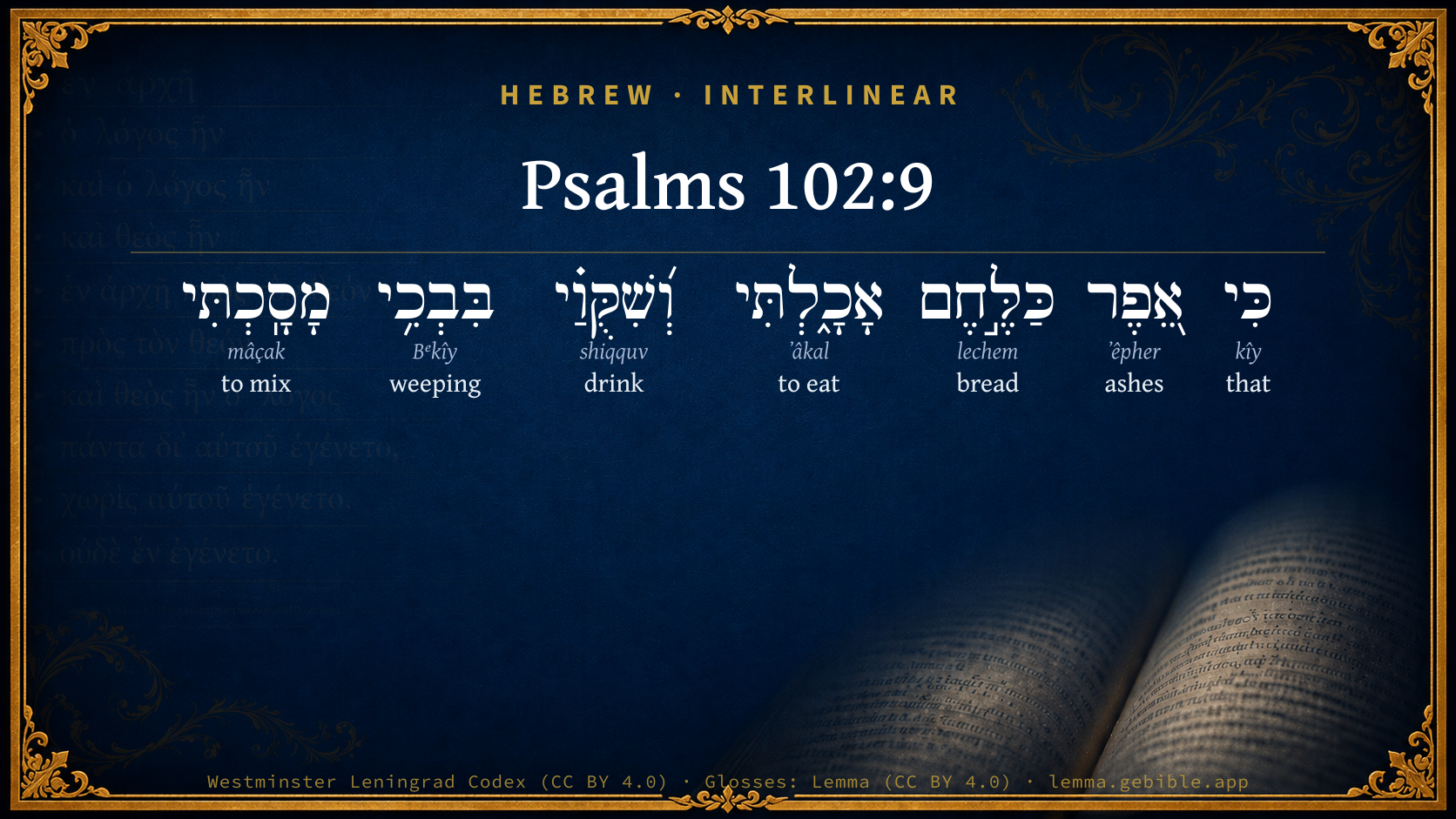
Hebrew (Westminster Leningrad Codex) Psalms 102:9 appears in the Hebrew Old Testament. The text above is from the Westminster Leningrad Codex. Each word links to its Strong’s number, a concise gloss, and parsing drawn from the Open Scriptures Hebrew Bible morphology. Click any word for its full Brown-Driver-Briggs (BDB) entry.
Download image
Cite this verse

Psalms 102:9 (World English Bible). Public Domain. Lemma interlinear Bible study tool, https://lemma.gebible.app/v/psalms/102/9.

Show BibTeX & RIS
BibTeX
RIS
English Translation
For I have eaten ashes like bread, And mixed my drink with tears,
World English Bible · Public Domain
Highlights
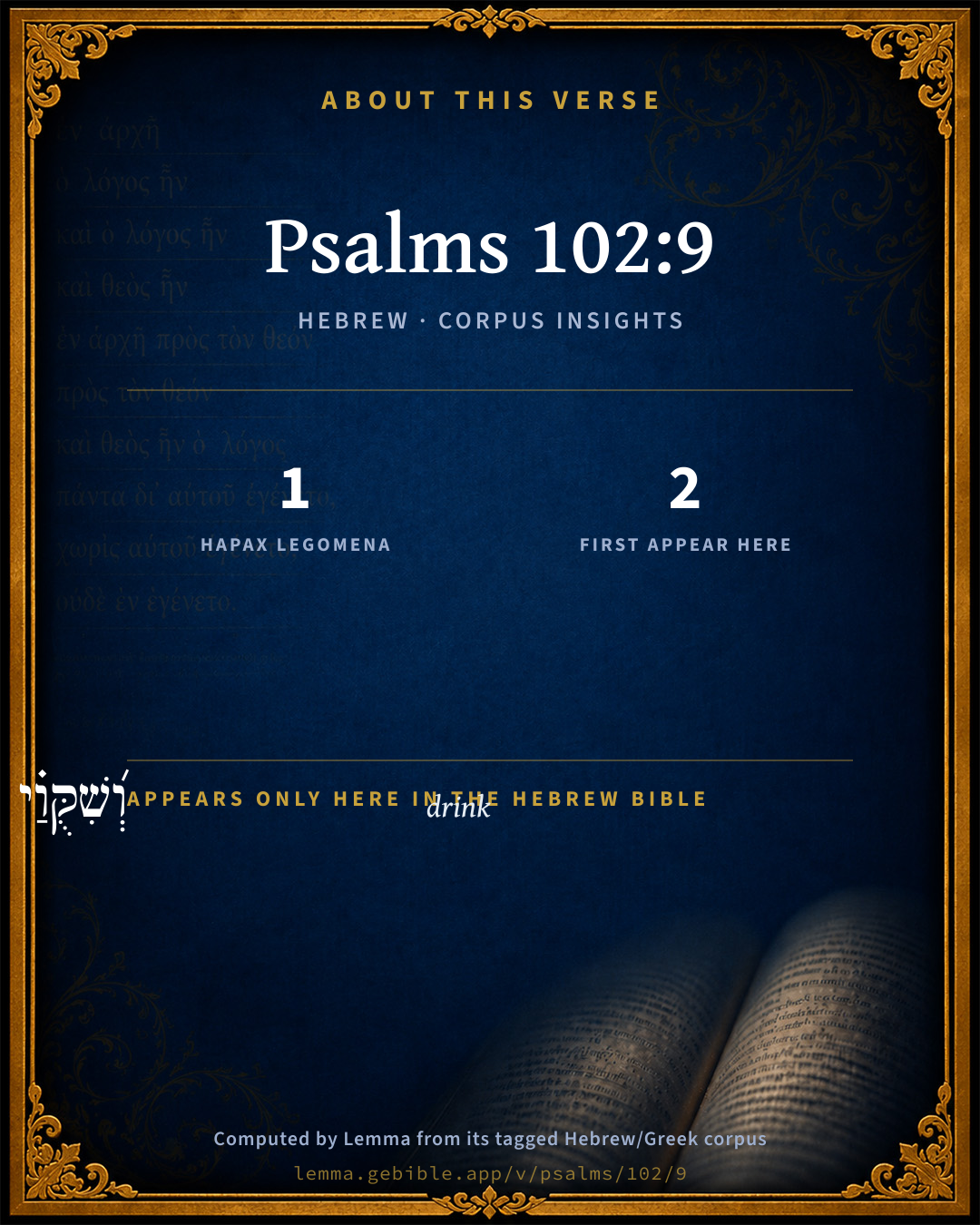
  • 1 hapax legomenon — only here in the Hebrew Bible
  • 2 first appearances in the Hebrew Bible
Full analysis ↓
Download a study sheet

One document with this verse’s original text, its word-by-word gloss line, the meaning frame, cross-references with their text, attributed commentary, and full source and license credits — printable, and it pastes into notes with its structure intact.

This verse Autodidact and up

Study sheet (.html) Plain text (.txt)

A passage Seminary Student

Up to 50 verses in one chapter. A passage sheet keeps up to 6 commentary sources and 12 cross-references per verse, in the order this page ranks them, and says so on the sheet whenever that leaves anything out. Ask for a single verse and you get the Autodidact verse sheet above.

Everything on this page stays free to read, with no account — the sheet is a download of what is already on screen, not access to it.

Want to remove ads? Support Godless Engineer
Compare translations 3

The same verse in 3 English versions, stacked beneath the original-language interlinear above. Click any original word for its lexicon entry.

Each is an independent rendering of the whole verse — the interlinear is not word-aligned to these translations.

Highlighted words mark where these versions differ — a whole-verse word diff, not a word-by-word alignment.

  • World English Bible Public Domain
    For I have eaten ashes like bread, And mixed my drink with tears,
  • King James Version Public Domain
    For I have eaten ashes like bread, and mingled my drink with weeping.
  • unfoldingWord Literal Text CC BY-SA 4.0
    As ashes as bread I eat, and I mix my drink with weeping

unfoldingWord Literal Text — © unfoldingWord, licensed CC BY-SA 4.0. Word-aligned USFM3 via Door43 (git.door43.org/unfoldingWord/en_ult).

Versions to compare (up to 4)

3 of 4 selected

Show all 18 translations

Every available English version of this verse, each an independent rendering of the whole verse.

  • World English Bible Public Domain
    For I have eaten ashes like bread, And mixed my drink with tears,
  • Berean Standard Bible Public Domain
    For I have eaten ashes like bread and mixed my drink with tears
  • Majority Standard Bible Public Domain
    For I have eaten ashes like bread and mixed my drink with tears
  • King James Version Public Domain
    For I have eaten ashes like bread, and mingled my drink with weeping.
  • American Standard Version (1901) Public Domain
    For I have eaten ashes like bread, And mingled my drink with weeping,
  • Revised Version (1885) Public Domain
    For I have eaten ashes like bread, and mingled my drink with weeping.
  • Geneva Bible (1599) Public Domain
    Surely I haue eaten asshes as bread, and mingled my drinke with weeping,
  • Douay-Rheims (1899) Public Domain
    All the day long my enemies reproached me: and they that praised me did swear against me.
  • Young's Literal Translation Public Domain
    Because ashes as bread I have eaten, And my drink with weeping have mingled,
  • Literal Standard Version CC BY-SA 4.0
    Because I have eaten ashes as bread, || And have mingled my drink with weeping,
  • Unlocked Literal Bible CC BY-SA 4.0
    I eat ashes like bread and mix my drink with tears.
  • unfoldingWord Literal Text CC BY-SA 4.0
    As ashes as bread I eat, and I mix my drink with weeping
  • Darby Bible Public Domain
    For I have eaten ashes like bread, and mingled my drink with weeping,
  • World Messianic Bible Public Domain
    For I have eaten ashes like bread, and mixed my drink with tears,
  • Webster's Bible Public Domain
    \\102:8\\My enemies reproach me all the day; and they that are enraged against me are sworn against me.
  • Free Bible Version CC BY-SA 4.0
    Ashes are the food I eat; my tears drip into my drink,
  • Bible in Basic English Public Domain
    I have had dust for bread and my drink has been mixed with weeping:
  • JPS Tanakh (1917) Public Domain
    (102-10) For I have eaten ashes like bread, and mingled my drink with weeping,

Literal Standard Version (2020), Covenant Press — licensed CC BY-SA 4.0. Text via the HelloAO Bible API (eBible.org). Unlocked Literal Bible (unfoldingWord) — licensed CC BY-SA 4.0. Text via the HelloAO Bible API (eBible.org). unfoldingWord Literal Text — © unfoldingWord, licensed CC BY-SA 4.0. Word-aligned USFM3 via Door43 (git.door43.org/unfoldingWord/en_ult). Free Bible Version, Dr. Jonathan Gallagher — licensed CC BY-SA 4.0. Text via the HelloAO Bible API (eBible.org).

Word by word

More ways to search: Search by grammar → Find every occurrence → Compare this word →

Practice this passage: Drill this verse → Learn its vocabulary →

About this verse

These counts appear in no published source. They are computed here, from the morphology-tagged text and Lemma’s own curated glosses. What Lemma adds →

7
words
7
distinct lemmas
Wisdom
section

Notable vocabulary

1 hapax legomenon — a word that appears only here in the entire Hebrew Bible:

  • וְ֝שִׁקֻּוַ֗י drink H8249

First appearance in Scripture

These words make their first canonical appearance in the Hebrew Bible here:

  • וְ֝שִׁקֻּוַ֗י drink H8249
  • מָסָֽכְתִּי to mix H4537

Shared distinctive vocabulary

מָסָֽכְתִּי to mix H4537 occurs in 5 verses of the Hebrew Bible. Also found in:

Grammatical profile

  • 2 verbs
  • 4 nouns
  • 1 conjunction

Verb forms

  • אָכָ֑לְתִּי Qal · Perfect
  • מָסָֽכְתִּי Qal · Perfect

Hebrew & Septuagint length

In English translation the verse runs 13 words from the Hebrew and 15 from the Septuagint (LXX English) — closely comparable.

A rough comparison of the two English renderings, which tokenize alike — not a word-level alignment.

Word counts can differ between the Hebrew and the Greek without any difference in meaning — e.g. the Hebrew direct-object marker אֵת has no separate Greek word, and Greek often adds the article ὁ.

Cross-references

9

Topical passages linked to Psalms 102:9 in the Treasury of Scripture Knowledge — connected by theme and wording, ordered by reader-vote popularity; previews shown in the World English Bible.

  • Psalms 42:3 My tears have been my food day and night, While they continually ask me, "Where is your God?"
  • Job 3:24 For my sighing comes before I eat, My groanings are poured out like water.
  • Psalms 80:5 You have fed them with the bread of tears, And given them tears to drink in large measure.
  • Psalms 69:21 They also gave me gall for my food. In my thirst, they gave me vinegar to drink.
  • Isaiah 44:20 He feeds on ashes; a deceived heart has turned him aside; and he can't deliver his soul, nor say, Is there not a lie in my right hand?
  • Lamentations 3:15–16 He has filled me with bitterness, he has sated me with wormwood.
  • Lamentations 3:48–49 My eye runs down with streams of water, for the destruction of the daughter of my people.
  • Micah 1:10 Don't tell it in Gath, Don't weep at all. At Beth Ophrah I have rolled myself in the dust.
  • Micah 7:17 They will lick the dust like a serpent. Like crawling things of the earth they shall come trembling out of their dens. They will come with fear to Yahweh our God, And will be afraid because of you.

Cross-references courtesy of OpenBible.info (CC BY 4.0).

Hebrew and Greek witnesses Masoretic Hebrew ↔ Greek Septuagint

The same verse in the two great witnesses to the Old Testament, shown verse-for-verse.

You’re reading Greek Psalm 101 (Hebrew Psalm 102). The Septuagint counts the superscription, so verse numbers can differ from the Hebrew — chapter-level alignment, not verse-by-verse. Numbering follows Rahlfs.

These are two independent witnesses, not word-aligned to each other, and the Septuagint is shown in lemma (dictionary) form.

Hebrew Psalms 102:9 Masoretic · Westminster Leningrad Codex

כִּי אֵ֭פֶר כַּלֶּ֣חֶם אָכָ֑לְתִּי וְ֝שִׁקֻּוַ֗י בִּבְכִ֥י מָסָֽכְתִּי

For I have eaten ashes like bread, And mixed my drink with tears,

World English Bible · Public Domain

Greek LXX Greek Psalm 101:9 Septuagint · lemma form

ὅλος ὁ ἡμέρα ὀνειδίζω ἐγώ ὁ ἐχθρός ἐγώ καί ὁ ἐπιαἰνέω ἐγώ κατά ἐγώ ὄμνυμι

For I have eaten ashes as it were bread, and mingled my drink with weeping;

LXX2012 (modern English Septuagint) · Public Domain

Hebrew: Westminster Leningrad Codex (CC BY 4.0). Greek: Septuagint (public domain); English from LXX2012 (modern English Septuagint) (Public Domain). How the Septuagint differs from the Hebrew →

Commentary

Notes on Psalms 102:9 from classic Christian and Jewish commentators (each source and its license shown beneath its notes). The classic Christian expositions comment on the surrounding passage and are grouped to its opening verse, so a note may address several verses; the Jewish commentaries on the Tanakh (Rashi and others) are per-verse, so they appear only where the commentator wrote on this verse.

Lemma curates 59 commentaries, every one of them public domain or Creative Commons licensed, each selected and text-cleaned for this edition rather than reprinted as found. About our sources →

Trapp's Complete Commentary

John Trapp

Psa 102:9 For I have eaten ashes like bread, and mingled my drink with weeping,

Ver. 9. For I have eaten ashes like bread] Being cast on the ground as a mourner, I know not whether I eat bread or dust; this relisheth to me as well as that, my mouth is so out of taste.

And mingled my drink with weeping] I forbare not to weep, no, not while I drank; for tow is dry, and wine driveth away sorrow, we say; not so from me. Wine is called by Simonides in Athenaeus αμυντωρ δυσφροσυναων, an expeller of sadness.

John Trapp, A Commentary or Exposition upon All the Books of the Old and New Testament (1647–1656) — public domain. Text from a community e-Sword module.

Joseph Benson's Commentary

Psa 102:9-10. I have eaten ashes like bread — That is, instead of eating my bread, I have laid down in dust and ashes. Or, dust and ashes are as constant and familiar to me as the eating of my bread; I cover my head with them; I sit, yea, lie down among them, as mourners often did, by which means the ashes might easily be mingled with their meat as tears were with their drink, as mentioned in the next clause. And mingled my drink, &c. — He alludes to the custom of mingling their wine with water. Because of thy indignation, &c. — Because I not only conflict with men, but with the Almighty God, and with his anger. For thou hast lifted me up, and cast me down — As a man lifts up a person or thing as high as he can, that he may cast it down to the ground with greater force. Or, he aggravates his present reproach and misery by the consideration of that great honour and happiness to which God had formerly advanced him, as Job did, chap. 29., 30., and the church, Lam 1:7.

Joseph Benson's Commentary on the Old and New Testaments (1811–1818) — public domain. Text from a community e-Sword module.

J. A. Alexander on Psalms

Joseph Addison Alexander

10. (Psa 102:9) For ashes like bread have I eaten, and my drink with weeping have mixed. The ashes, in which he sat, or with which he was covered, as a sign of mourning, became mingled with his food, and his tears fell into his drink. This last word is, in Hebrew, of the plural number, drinks or beverages, analogous to victuals as a simple synonyme of food. As an opposite example of the same idiomatic difference, the word translated ashes is a singular in Hebrew. The whole verse is a strong poetical description of constant and extreme distress.

Joseph Addison Alexander, The Psalms Translated and Explained (1850) — public domain. Text from a community e-Sword module.

Geneva Bible (1599)

Geneva Bible translators

I have not risen out of my mourning to take my refection.

Geneva Bible (1599) marginal notes — public domain. Text via Bolls.life.

Adam Clarke's Commentary

Verse 9. I have eaten ashes like bread] Fearful of what they might do, we all humbled ourselves before thee, and sought thy protection; well knowing that, unless we were supernaturally assisted, we must all have perished; our enemies having sworn our destruction.

Adam Clarke's Commentary on the Bible (1810–1826) — public domain. Text from a community e-Sword/MySword module.

John Calvin's Commentaries

9 For I have eaten ashes like bread Some think that the order is here inverted, and that the letter כ, caph, the sign of similitude, which is put before לחם, lechem, the word for bread, ought to be placed before אפר, epher, the word for ashes; as if it had been said, I find no more relish for my bread than I do for ashes; and the reason is, because sorrow of heart produces loathing of food. But the simpler meaning is, that lying prostrate on the ground, they licked, as it were, the earth, and so did eat ashes instead of bread. It was customary for those who mourned to stretch themselves at full length with their faces on the ground. The prophet, however, intended to express a different idea — to intimate, that when he partook of his meals, there was no table set before him, but his bread was thrown upon the ground to him in a foul and disgusting manner. Speaking, therefore, in the person of the faithful, he asserts that he was so fixed to the ground that he did not even rise from it to take his food. The same sentiment is expressed in the last part of the verse, I have mingled my drink with weeping; for while mourners usually restrain their sorrow during the short time in which they refresh themselves with food, he declares that his mourning was without intermission. Some, instead of reading in the first clause, as bread, read, in bread; and as the two letters, כ, caph, and ב, beth, nearly resemble each other, I prefer reading in bread, which agrees better with the second clause.

John Calvin's Commentaries (1540-1563) — public domain. Text from the Calvin Translation Society English edition (1840s-50s) via the Christian Classics Ethereal Library (ccel.org). Calvin's coverage is partial (roughly two-thirds of the Bible); uncommented books and verses are honest gaps, never fabricated. The 19th-century editor's footnotes and remarks are omitted so the notes are faithfully Calvin's own voice.

Ellicott's Commentary for English Readers

(9) Ashes like bread.—Lam_3:16. A figurative expression, like “dust shall be the serpent’s meat” (Isa_65:25; comp. Gen_3:14). With the last clause comp. Psa_42:3, “tears have been my meat day and night.” So too, as an emblem of disappointment, a modern poet:—

“But even while I drank the brook, and ate

The goodly apples, all these things at once

Fell into dust, and I was left alone.”

TENNYSON: Holy Grail.

A Bible Commentary for English Readers, edited by Charles John Ellicott (1878–1897) — public domain. Text from a community e-Sword module.

The Cambridge Bible for Schools and Colleges

gen. ed. J. J. S. Perowne

9. They may well do so; for what can be more wretched than his plight? Mourning and tears are as it were his food and drink. Cp. Psa_42:3; Psa_80:5. For ashes as the symbol of mourning, cp. Job_2:8; Lam_3:16; Eze_27:30.

The Cambridge Bible for Schools and Colleges (gen. ed. J. J. S. Perowne; Cambridge University Press, 1878–1918) — public domain. Text from a community e-Sword module.

John Gill's Exposition

Because of thine indignation and thy wrath,.... This was the burden of his complaint, what gave him the greatest uneasiness; not so much the reproach of his enemies, and his other outward afflictions, as the sense he had of God's wrath and indignation. The people of God are as deserving of his wrath as others; and when they are awakened to a sense of sin and danger, or the law enters into their consciences, it works wrath there, and leaves nothing but a fearful looking for of judgment and fiery indignation, till comfort is given; and under afflictive providences they are very ready to conclude, that the wrath of God is upon them; but this is only their apprehension of things; it is not in reality: for God has not appointed them to wrath, and has swore he will not be wroth with them; Christ has bore it for them, in their room and stead; and being justified by his blood and righteousness, they are saved from it; but then the sense they have of it is very terrible, and there is no rest, peace, and comfort in their souls, while under the apprehensions of it:

for thou hast lifted me up, and cast me down; as a man that, in wrestling, has the advantage of his antagonist, lifts him up as high as he can, that he may throw him with the greater force upon the ground; in like manner the psalmist thought the Lord was dealing with him: or this may express his changeable state and condition, sometimes lifted up, and sometimes cast down, and which is the case of every believer, more or less; all have their liftings up, and their castings down: when God first calls them by his grace, he raises them from a low estate, lifts them up out of an horrible pit, takes them from the dunghill, sets them among princes to inherit the throne of glory: when he comforts them with the consolations of his Spirit, he is the lifter up of their heads; when he grants his presence, and lifts up the light of his countenance: when he discovers his love, and makes their mountain to stand strong; when he shows them their interest in himself, as their covenant God, in Christ, as their Redeemer and Saviour, and grants them the communion of the Holy Ghost; and when their graces are in lively exercise, then is it a time of lifting up: and they are cast down when corruptions prevail, when grace is weak, when God hides his face, and when afflictions lie heavy on them: this was now the case of the psalmist, and perhaps the remembrance of his liftings up in former times was an aggravation of it.

John Gill's Exposition of the Whole Bible (1746–1763) — public domain (CC PDM 1.0). Text via the HelloAO Bible API.

Albert Barnes' Notes on the Bible

For I have eaten ashes like bread - I have seated myself in ashes in my grief (compare Job 2:8; Job 42:6; Isa 58:5; Isa 61:3; Jon 3:6; Dan 9:3; Mat 11:21); and ashes have become, as it were, my food. The ashes in which he sat had been mingled with his food.

And mingled my drink with weeping - Tears have fallen into the cup from which I drank, and have become a part of my drink. The idea is, that he had shed copious tears; and that even when he took his food, there was no respite to his grief.

Albert Barnes' Notes on the Bible (1834–1885) — public domain. Text from a community e-Sword/MySword module.

Matthew Poole's English Annotations

For; so this verse gives a reason either of his great sadness, expressed Psa 102:6,7, or why they swore by him in the sense last given. Or, surely, as this particle is oft used. Or, therefore, because of those bitter reproaches last mentioned. I have eaten ashes like bread: the sense is, Dust and ashes are as constant and familiar to me as the eating of my bread; I cover my head with them; I sit, yea, lie down and roll myself in them, as mourners oft did, 2Sa 13:19; Job 2:8,12; 16:15; Isa 47:1; Mic 1:10; by which means the ashes might easily be mingled with their meat, as tears were with their drink in the next clause. Mingled my drink with weeping; he alludes to the custom of mingling their wine with water.

Matthew Poole's English Annotations on the Holy Bible (1683–1685) — public domain. Text from a community e-Sword/MySword module.

The Treasury of David

Charles H. Spurgeon

Ver. 9. For I have eaten ashes like bread. He had so frequently cast ashes upon his head in token of mourning, that they had mixed with his ordinary food, and grated between his teeth when he ate his daily bread. One while he forgot to eat, and then the fit changed, and he ate with such a hunger that even ashes were devoured. Grief has strange moods and tenses.

And mingled my drink with weeping. His drink became as nauseous as his meat, for copious showers of tears had made it brackish. This is a telling description of all-saturating, all-embittering sadness, and this was the portion of one of the best of men, and that for no fault of his own, but because of his love to the Lord's people. If we, too, are called to mourn, let us not be amazed by the fiery trial as though some strange thing had happened unto us. Both in meat and drink we have sinned; it is not therefore wonderful if in both we are made to mourn.

Ver. 9. I have eaten ashes like bread. Though the bread indeed be strange, yet not so strange as this, that having complained before of forgetting to eat his bread, he should now on a sudden fall to eating of ashes like bread. For had he not been better to have forgotten it still, unless it had been more worth remembering? For there is not in nature so unfit a thing to eat as ashes;it is worse than Nebuchadnezzar's grass. Sir R. Baker.

Ver. 9. I have mingled my drink with weeping. If you think his bread to be bad, you will find his drink to be worse; for he mingles his drink with tears: and what are tears, but brinish and salt humours? and is brine a fit liquor to quench one's thirst? May we not say here, the remedy is worse than the disease? for were it not better to endure any thirst, than to seek to quench it with such drink? Is it not a pitiful thing to have no drink to put in the stomach, but that which is drawn out of the eyes? and yet whose case is any better? No man certainly commits sin, but with a design of pleasure; but sin will not be so committed; for whosoever commit sin, let them be sure at some time or other to find a thousand times more trouble about it than ever they found pleasure in it. For all sin is a kind of surfeit, and there is no way to keep it from being mortal but by this strict diet of eating ashes like bread and mingling his drink with tears. O my soul, if these be works of repentance in David, where shall we find a penitent in the world besides himself? To talk of repentance is obvious in everyone's mouth; but where is any that eats ashes like bread, and mingles his drink with tears? Sir R. Baker.

Ver. 9. The sorrows of the saintstheir number, bitterness, sources, correctives, influences, and consolations.

Psalms 102:10*

Charles H. Spurgeon's The Treasury of David (1869–1885) — public domain. Psalms only. Text from a community e-Sword/MySword module.

Whedon's Commentary on the Bible

Daniel D. Whedon

9. Eaten ashes like bread—As a mourner, he sits in, and covers himself with, ashes. (Lam_3:16,) and they mingled with his scanty food. Or, by a strong figure, it may mean “ashes instead of bread.” So, also, “My tears have been my food”— “bread of tears.” Psa_42:3; Psa_80:5

Daniel D. Whedon (gen. ed.), Commentary on the Old and New Testaments (1874–1909) — public domain. Text from a community e-Sword module.

The Pulpit Commentary

For I have eaten ashes like bread; i.e. "the "ashes" of humiliation have been my food. I have, as it were, fed on them." A literal mingling of ashes with his food is not to be thought of. And mingled my drink with weeping. (comp. Job_27:21 Job_30:22)

The real bitterness of human affliction.

"And that because of thine indignation and wrath." The conscience of sin makes men regard affliction as Divine judgment. For man, God"s favour is life, God"s frown is death death of peace, pleasure, hope. Man can lose everything and be rich if he can keep the sense of gracious relations with God. Man can keep everything, and be poor and miserable, if he has lost the sense of God"s favour. While this is true of every man, it is in an especial manner true of the man who has once known the joy of God"s smile and favour. It is such a man who feels the bitterness of human affliction when it is seen as Divine judgment. The Book of Job represents the struggle of good men to get right views of human affliction. And what comes out so clearly from its discussions is, that no one explanation will suffice. It may be Divine judgment; but Job"s friends are wrong when they say that it must be. It may be Divine chastisement for correction; but it would be a mistake to say that it is always chastisement. It may be pure testing, simple culture, God"s way of nourishing the good, and not involving the removal of any bad. When a sufferer can see suffering to be Divine culture, or even Divine chastisement, his trials lose their bitterness. But it is always hard to be compelled to call suffering Divine judgment.

I THIS MAY BE THE VIEW OF OUR TROUBLES THAT OTHERS TAKE. it is the view Job"s friends took at once, and they would hear nothing else. Job had at least secretly sinned, and his suffering was his judgment. Of Messiah it is said, "We did esteem him stricken, smitten of God, and afflicted." It is what we first think of others, and what others first think of us. But it had better never be spoken, for it may not be true, and it will certainly add to the sufferer"s burden. What a mistake to think of the suffering Jesus as a malefactor!

II THIS MAY BE THE VIEW OF OUR TROUBLES THAT WE OURSELVES TAKE RIGHTLY. It may be the explanation. And some heart searching is proper at the beginning of all times of affliction. Perhaps we have been going astray, or becoming wilful or negligent. There are "secret faults," "presumptuous sins," "leavings of first love," which must be dealt thus with. God"s people have to come into judgments which will mark the character of their sins, and into chastisements which will deliver them from their power.

III THIS MAY BE THE VIEW OF OUR TROUBLES THAT WE OURSELVES TAKE WRONGLY. Many good Christians are too ready to think evil of themselves, and write bitter things against themselves. Absolute sincerity and truthfulness should be sought, even in dealing with our own faults and failings. We may even confess too much. R.T.

The Pulpit Commentary (1880–1919), ed. H.D.M. Spence-Jones & Joseph S. Exell — public domain. Text from a community e-Sword module.

John Wesley's Explanatory Notes

Bread - The sense is, dust and ashes are as familiar to me as the eating of my bread; I cover my head with them; I sit, yea, lie down in them, as mourners often did.

John Wesley, Explanatory Notes Upon the Whole Bible (1754–1765) — public domain. Text via the GEBible commentary corpus.

Keil & Delitzsch

C. F. Keil & F. Delitzsch

Ashes are his bread (cf. Lam 3:16), inasmuch as he, a mourner, sits in ashes, and has thrown ashes all over himself, Job 2:8; Eze 27:30. The infected שׁקּוי has שׁקּוּ = שׁקּוּו for its principal form, instead of which it is שׁקּוּי in Hos 2:7. "That Thou hast lifted me up and cast me down" is to be understood according to Job 30:22. First of all God has taken away the firm ground from under his feet, then from aloft He has cast him to the ground - an emblem of the lot of Israel, which is removed from its fatherland and cast into exile, i.e., into a strange land. In that passage the days of his life are כּצל נטוּי, like a lengthened shadow, which grows longer and longer until it is entirely lost in darkness, Psa 109:23. Another figure follows: he there becomes like an (uprooted) plant which dries up.

Keil & Delitzsch — Biblical Commentary on the Old Testament (1861–1891) — public domain (CC PDM 1.0). Text via the HelloAO Bible API. (Old Testament only.)

unfoldingWord translationNotes

Door43 World Missions Community

I eat ashes like bread

David would have sat in ashes as an act of mourning, therefore ashes would have fallen on his food. AT: "I eat ashes like I eat bread" or "As I mourn, ashes fall on the bread that I eat" (See: Simile)

mix my drink with tears

David did not purposefully mix his drink with tears; rather his tear would have fallen into his cup while he mourned and wept. AT: "my tears fall into the cup that I drink" (See: Assumed Knowledge and Implicit Information)

you have lifted me up to throw me down

God has not literally lifted and thrown David's body to the ground; rather David says this to describe what he is feeling and experiencing. AT: "it is like you have lifted me up to throw me down" (See: Metaphor)

translationWords

ash

rage

anger

unfoldingWord translationNotes — © Distant Shores Media and the Door43 World Missions Community, licensed CC BY-SA 4.0. Source: git.door43.org/Door43/en_tn.

Rashi

Rabbi Shlomo Yitzchaki (Rashi)

those who scorn me Heb. מהוללי, those who scorn me, an expression of mockery.

swear by me They saw my misfortune and they swear by me and say, “If it is not so, what happened to Israel should happen to me.” “So may the Lord do to me as to Israel.”

Rashi on the Tanakh — English translations: “The Judaica Press complete Tanach with Rashi, translated by A. J. Rosenberg” (CC BY 4.0); “Pentateuch with Rashi's commentary by M. Rosenbaum and A.M. Silbermann, 1929-1934” (public domain); “The Metsudah Tanach series, Lakewood, N.J” (CC BY 4.0); and “The Book of Joshua, Metsudah Publications, 1997” (CC BY 4.0). Text via Sefaria.

Lesson kit

Teaching starters — assembled from the data on this page, not authored interpretation. Every prompt links to the verse data it draws on. Edit before teaching.

Psalms, in the Wisdom, opens this verse with 7 words (7 distinct Hebrew lemmas). Its most distinctive word is shiqquv (“drink”). A historical commentator’s framing appears above. Read the whole chapter for the surrounding context.

Discussion questions

  1. How does “drink” (shiqquv) shape what this verse is saying?
  2. This verse holds 1 word here found nowhere else in the Hebrew Bible. What might the rare word draw attention to?
  3. 2 words here appear for the first time in Scripture. What is being introduced at this debut?
  4. Proverbs 9:2 shares the word «to mix» with this verse. How do the two illuminate each other?
  5. The translations on this page render this verse differently — a whole-verse word diff, not a word-by-word alignment. What might account for the different wordings?
  6. The verb «אָכָ֑לְתִּי» is Qal Perfect. How does its form color the action?
  7. Reading how Trapp's Complete Commentary and Joseph Benson's Commentary read this verse, where do the two commentators agree and where do they part?

Things to notice

  • 1 word in this verse appears nowhere else in the Hebrew Bible.
  • 2 words make their first canonical appearance in Scripture here.
  • These translations choose different wording for 9 words in this verse.
  • 7 distinct Hebrew lemmas span 7 words in this verse.

Reading settings

Reading text

Shown beneath each verse's original-language words.

Old Testament
Old Testament edition

Read the OT as the Masoretic Hebrew (MT) or the Greek Septuagint (LXX).

English shown for the Greek Septuagint (in the Hebrew ↔ Greek comparison).

Comparing translations? Open the Compare panel on any verse page to stack up to four side by side.