Job 24:5

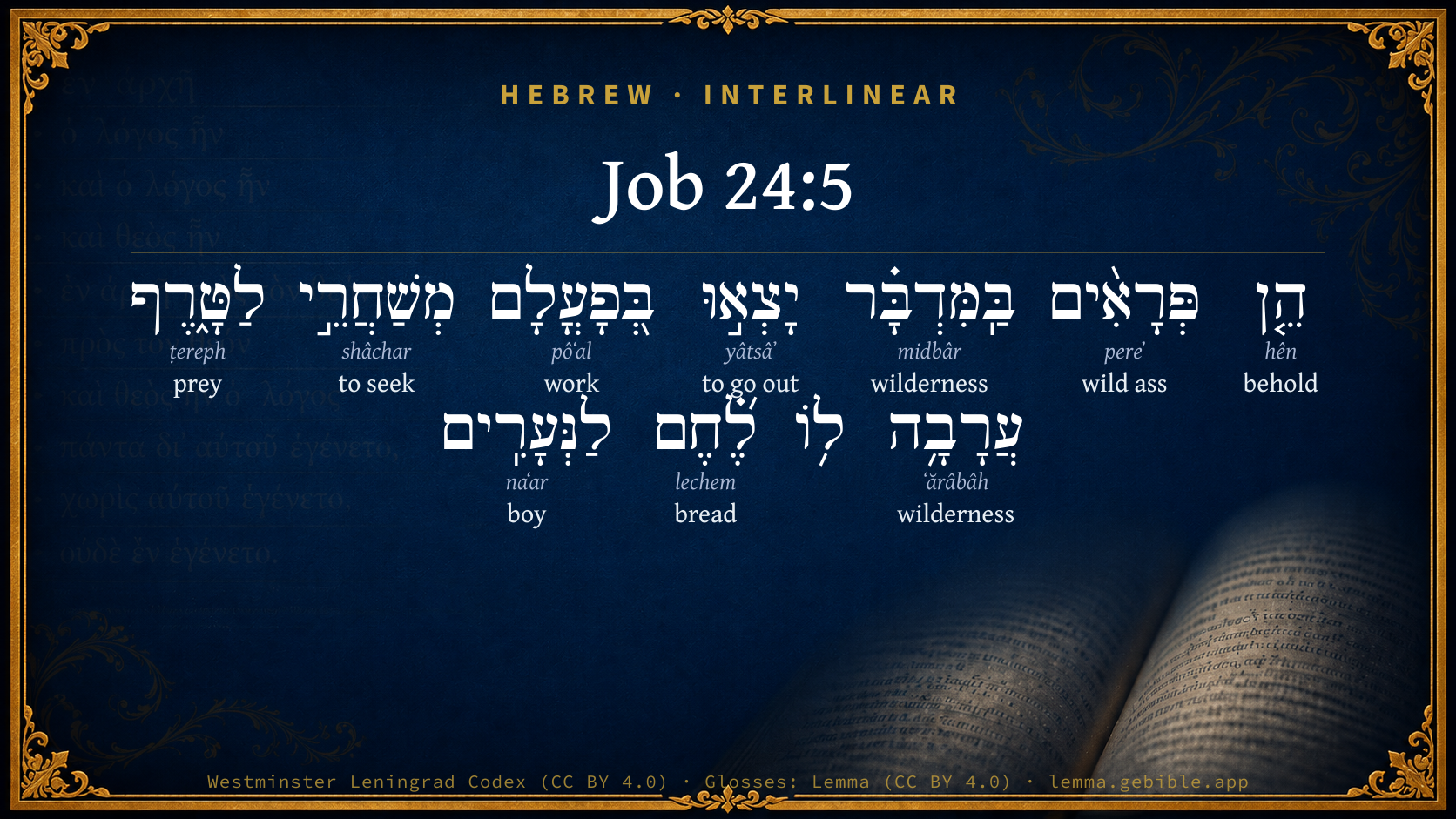
Hebrew (Westminster Leningrad Codex) Job 24:5 appears in the Hebrew Old Testament. The text above is from the Westminster Leningrad Codex. Each word links to its Strong’s number, a concise gloss, and parsing drawn from the Open Scriptures Hebrew Bible morphology. Click any word for its full Brown-Driver-Briggs (BDB) entry.
Download image
Cite this verse

Job 24:5 (World English Bible). Public Domain. Lemma interlinear Bible study tool, https://lemma.gebible.app/v/job/24/5.

Show BibTeX & RIS
BibTeX
RIS
English Translation
Behold, as wild donkeys in the desert, They go forth to their work, seeking diligently for food; The wilderness yields them bread for their children.
World English Bible · Public Domain
Download a study sheet

One document with this verse’s original text, its word-by-word gloss line, the meaning frame, cross-references with their text, attributed commentary, and full source and license credits — printable, and it pastes into notes with its structure intact.

This verse Autodidact and up

Study sheet (.html) Plain text (.txt)

A passage Seminary Student

Up to 50 verses in one chapter. A passage sheet keeps up to 6 commentary sources and 12 cross-references per verse, in the order this page ranks them, and says so on the sheet whenever that leaves anything out. Ask for a single verse and you get the Autodidact verse sheet above.

Everything on this page stays free to read, with no account — the sheet is a download of what is already on screen, not access to it.

Want to remove ads? Support Godless Engineer
Compare translations 3

The same verse in 3 English versions, stacked beneath the original-language interlinear above. Click any original word for its lexicon entry.

Each is an independent rendering of the whole verse — the interlinear is not word-aligned to these translations.

Highlighted words mark where these versions differ — a whole-verse word diff, not a word-by-word alignment.

  • World English Bible Public Domain
    Behold, as wild donkeys in the desert, They go forth to their work, seeking diligently for food; The wilderness yields them bread for their children.
  • King James Version Public Domain
    Behold, as wild asses in the desert, go they forth to their work; rising betimes for a prey: the wilderness yieldeth food for them and for their children.
  • unfoldingWord Literal Text CC BY-SA 4.0
    Behold, wild donkeys in the wilderness they go out in their work, searching for food; the Arabah to him bread for their children.

unfoldingWord Literal Text — © unfoldingWord, licensed CC BY-SA 4.0. Word-aligned USFM3 via Door43 (git.door43.org/unfoldingWord/en_ult).

Versions to compare (up to 4)

3 of 4 selected

Show all 18 translations

Every available English version of this verse, each an independent rendering of the whole verse.

  • World English Bible Public Domain
    Behold, as wild donkeys in the desert, They go forth to their work, seeking diligently for food; The wilderness yields them bread for their children.
  • Berean Standard Bible Public Domain
    Indeed, like wild donkeys in the desert, the poor go to work foraging for food; the wasteland is food for their children.
  • Majority Standard Bible Public Domain
    Indeed, like wild donkeys in the desert, the poor go to work foraging for food; the wasteland is food for their children.
  • King James Version Public Domain
    Behold, as wild asses in the desert, go they forth to their work; rising betimes for a prey: the wilderness yieldeth food for them and for their children.
  • American Standard Version (1901) Public Domain
    Behold, as wild asses in the desert They go forth to their work, seeking diligently for food; The wilderness `yieldeth' them bread for their children.
  • Revised Version (1885) Public Domain
    Behold, as wild asses in the desert they go forth to their work, seeking diligently for meat; the wilderness yieldeth them food for their children.
  • Geneva Bible (1599) Public Domain
    Behold, others as wilde asses in the wildernesse, goe forth to their businesse, and rise early for a praye: the wildernesse giueth him and his children foode.
  • Douay-Rheims (1899) Public Domain
    Others like wild asses in the desert go forth to their work: by watching for a prey they get bread for their children.
  • Young's Literal Translation Public Domain
    Lo, wild asses in a wilderness, They have gone out about their work, Seeking early for prey, A mixture for himself -- food for young ones.
  • Literal Standard Version CC BY-SA 4.0
    Behold, wild donkeys in a wilderness, || They have gone out about their work, || Seeking early for prey, || A mixture for himself—food for young ones.
  • Unlocked Literal Bible CC BY-SA 4.0
    See, these poor people go out to their work like wild donkeys in the wilderness, looking carefully for food; perhaps the Arabah will provide them food for their children.
  • unfoldingWord Literal Text CC BY-SA 4.0
    Behold, wild donkeys in the wilderness they go out in their work, searching for food; the Arabah to him bread for their children.
  • Darby Bible Public Domain
    Lo, [as] wild asses in the desert, they go forth to their work, seeking early for the prey: the wilderness [yieldeth] them food for [their] children.
  • World Messianic Bible Public Domain
    Behold, as wild donkeys in the desert, they go out to their work, seeking diligently for food. The wilderness yields them bread for their children.
  • Webster's Bible Public Domain
    Behold, as wild asses in the desert, they go forth to their work; rising betimes for a prey: the wilderness yieldeth food for them and for their children.
  • Free Bible Version CC BY-SA 4.0
    Like wild donkeys in the desert, the poor have to scavenge for their food, looking for anything to feed their children in the wasteland.
  • Bible in Basic English Public Domain
    Like asses in the waste land they go out to their work, looking for food with care; from the waste land they get bread for their children.
  • JPS Tanakh (1917) Public Domain
    Behold, as wild asses in the wilderness they go forth to their work, seeking diligently for food; the desert yieldeth them bread for their children.

Literal Standard Version (2020), Covenant Press — licensed CC BY-SA 4.0. Text via the HelloAO Bible API (eBible.org). Unlocked Literal Bible (unfoldingWord) — licensed CC BY-SA 4.0. Text via the HelloAO Bible API (eBible.org). unfoldingWord Literal Text — © unfoldingWord, licensed CC BY-SA 4.0. Word-aligned USFM3 via Door43 (git.door43.org/unfoldingWord/en_ult). Free Bible Version, Dr. Jonathan Gallagher — licensed CC BY-SA 4.0. Text via the HelloAO Bible API (eBible.org).

Word by word

More ways to search: Search by grammar → Find every occurrence → Compare this word →

Practice this passage: Drill this verse → Learn its vocabulary →

פְּרָאִ֨ים
pereʼ
H6501
“wild asses”
Noun, Common, Masculine, Plural, Absolute
Part of Speech
Noun
Type
Common
Gender
Masculine
Number
Plural
State
Absolute
Full BDB Definition

Origin: from H6500

TWOT: 1805a

wild ass
  1. הֵ֤ן hên H2005 “behold” Particle, Demonstrative
  2. בַּֽמִּדְבָּ֗ר midbâr H4057 “in/at the · wilderness” Preposition, Determined + Noun, Common, Masculine, Singular, Absolute
  3. יָצְא֣וּ yâtsâʼ H3318 “to go out” Verb, Qal, Perfect, 3rd Person, Common, Plural
  4. בְּ֭פָעֳלָם pôʻal H6467 “in/at · work · their” Preposition + Noun, Common, Masculine, Singular, Construct + Suffix, Personal, 3rd Person, Masculine, Plural
  5. מְשַׁחֲרֵ֣י shâchar H7836 “seeking” Verb, Piel, Participle Active, Masculine, Plural, Construct
  6. לַטָּ֑רֶף ṭereph H2964 “to/for the · prey” Preposition, Determined + Noun, Common, Masculine, Singular, Absolute
  7. עֲרָבָ֥ה ʻărâbâh H6160 “wilderness” Noun, Common, Feminine, Singular, Absolute
  8. לֶ֝֗חֶם lechem H3899 “bread” Noun, Common, Both, Singular, Absolute
  9. לַנְּעָרִֽים naʻar H5288 “to/for the · boys” Preposition, Determined + Noun, Common, Masculine, Plural, Absolute

About this verse

These counts appear in no published source. They are computed here, from the morphology-tagged text and Lemma’s own curated glosses. What Lemma adds →

11
words
10
distinct lemmas
Wisdom
section

Notable vocabulary

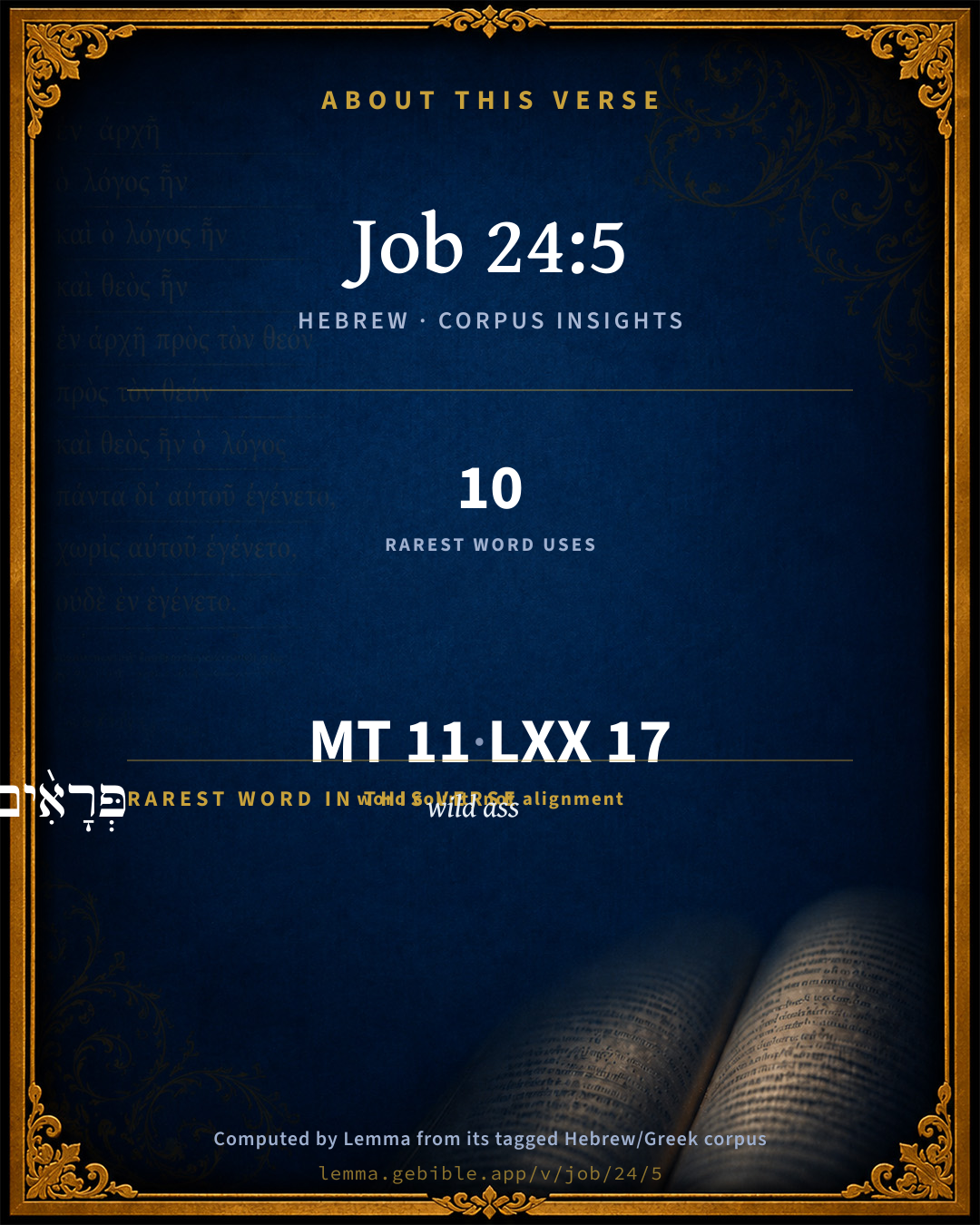
The rarest word here is פְּרָאִ֨ים wild ass H6501 — appearing just 10 times in the whole Hebrew Bible.

Shared distinctive vocabulary

פְּרָאִ֨ים wild ass H6501 occurs in 10 verses of the Hebrew Bible. Also found in:

Grammatical profile

  • 2 verbs
  • 7 nouns
  • 1 preposition
  • 1 particle

Verb forms

  • יָצְא֣וּ Qal · Perfect
  • מְשַׁחֲרֵ֣י Piel · Participle Active

Hebrew & Septuagint length

In English translation the verse runs 25 words from the Hebrew and 28 from the Septuagint (LXX English) — closely comparable.

A rough comparison of the two English renderings, which tokenize alike — not a word-level alignment.

Word counts can differ between the Hebrew and the Greek without any difference in meaning — e.g. the Hebrew direct-object marker אֵת has no separate Greek word, and Greek often adds the article ὁ.

In the original languages it is 11 Hebrew tokens and 17 Greek tokens — but the two are counted differently (Hebrew bundles its prefixes and suffixes into one token; the Greek is in lemma form), so that isn’t a like-for-like length.

Cross-references

15

Topical passages linked to Job 24:5 in the Treasury of Scripture Knowledge — connected by theme and wording, ordered by reader-vote popularity; previews shown in the World English Bible.

  • Job 5:5 Whose harvest the hungry eats up, And take it even out of the thorns; The snare gapes for their substance.
  • Job 39:5–7 "Who has set the wild donkey free? Or who has loosened the bonds of the swift donkey,
  • Psalms 104:23 Man goes forth to his work, To his labor until the evening.
  • Micah 2:1 Woe to those who devise iniquity And work evil on their beds! When the morning is light, they practice it, Because it is in the power of their hand.
  • Genesis 16:12 He will be like a wild donkey among men. His hand will be against every man, and every man's hand against him. He will live opposite all of his brothers."
  • Genesis 27:40 By your sword will you live, and you will serve your brother. It will happen, when you will break loose, That you shall shake his yoke from off your neck."
  • Job 12:6 The tents of robbers prosper, Those who provoke God are secure; Who carry their God in their hands.
  • Job 24:14 The murderer rises with the light. He kills the poor and needy. In the night he is like a thief.
  • Proverbs 4:16 For they don't sleep, unless they do evil. Their sleep is taken away, unless they make someone fall.
  • Jeremiah 2:24 a wild donkey used to the wilderness, that snuffs up the wind in her desire; in her occasion who can turn her away? all those who seek her will not weary themselves; in her month they shall find her.
  • Hosea 7:6 For they have made ready their heart like an oven, While they lie in wait. Their baker sleeps all the night. In the morning it burns as a flaming fire.
  • Hosea 8:9 For they have gone up to Assyria, Like a wild donkey wandering alone. Ephraim has hired lovers for himself.
  • Zephaniah 3:3 Her princes in the midst of her are roaring lions. Her judges are evening wolves. They leave nothing until the next day.
  • John 18:28 They led Jesus therefore from Caiaphas into the Praetorium. It was early, and they themselves didn't enter into the Praetorium, that they might not be defiled, but might eat the Passover.
  • Acts 23:12 When it was day, some of the Jews banded together, and bound themselves under a curse, saying that they would neither eat nor drink until they had killed Paul.

Cross-references courtesy of OpenBible.info (CC BY 4.0).

Hebrew and Greek witnesses Masoretic Hebrew ↔ Greek Septuagint

The same verse in the two great witnesses to the Old Testament, shown verse-for-verse.

These are two independent witnesses, not word-aligned to each other, and the Septuagint is shown in lemma (dictionary) form.

Hebrew Job 24:5 Masoretic · Westminster Leningrad Codex

הֵ֤ן פְּרָאִ֨ים בַּֽמִּדְבָּ֗ר יָצְא֣וּ בְּ֭פָעֳלָם מְשַׁחֲרֵ֣י לַטָּ֑רֶף עֲרָבָ֥ה ל֥וֹ לֶ֝֗חֶם לַנְּעָרִֽים

Behold, as wild donkeys in the desert, They go forth to their work, seeking diligently for food; The wilderness yields them bread for their children.

World English Bible · Public Domain

Greek LXX Job 24:5 Septuagint · lemma form

ἀποβαίνω δέ ὥσπερ ὄνος ἐν ἀγρός ὑπέρ ἐγώ ἐκἔρχομαι ὁ ἑαυτοῦ πρᾶξις ἡδύνω αὐτός ἄρτος εἰς νέος

And they have departed like asses in the field, having gone forth on my account according to their own order: his bread is sweet to his little ones.

LXX2012 (modern English Septuagint) · Public Domain

On this verse, Keil & Delitzsch discusses the Septuagint’s reading. Read the note in Commentary ↓

Hebrew: Westminster Leningrad Codex (CC BY 4.0). Greek: Septuagint (public domain); English from LXX2012 (modern English Septuagint) (Public Domain). How the Septuagint differs from the Hebrew →

Commentary

Notes on Job 24:5 from classic Christian and Jewish commentators (each source and its license shown beneath its notes). The classic Christian expositions comment on the surrounding passage and are grouped to its opening verse, so a note may address several verses; the Jewish commentaries on the Tanakh (Rashi and others) are per-verse, so they appear only where the commentator wrote on this verse.

Lemma curates 59 commentaries, every one of them public domain or Creative Commons licensed, each selected and text-cleaned for this edition rather than reprinted as found. About our sources →

Trapp's Complete Commentary

John Trapp

Job 24:5 Behold, [as] wild asses in the desert, go they forth to their work; rising betimes for a prey: the wilderness [yieldeth] food for them [and] for [their] children.

Ver. 5. Behold, as wild asses in the desert, go they forth to their work] These barbarous and brutish oppressors, skilful to destroy, do live in this world as the wild ass doth in the wilderness, roving and rambling up and down for booty, Onagri inter feras sunt efferatissimi, neque unquam mansuescunt (Merc.), whereunto early in the morning they prepare and harness themselves, as if this were their trade and occupation whereby they must needs get their living. Hic labor, hoc opus, vel artificium eorum est, saith Lavater. As "man goeth forth unto his work and to his labour until the evening," Psa 104:23, so do these greedy cormorants, these evening wolves (as Micah calleth them), these spoilers "that devise iniquity, and work evil upon their beds: when the morning is light they practise it, because it is in the power of their hands. And they covet fields, and take them by violence; and houses, and take them away," &c., Mic 2:1-2. Job had suffered much by the Arabian spoilers, those wild asses, who continue their old trade to this day, catching and snatching, vivitur ex rapto; neither can they be repelled or restrained by reason of their multitudes and their incredible swiftness (Fabric. in descrip. peregr. Hierosol.).

The wilderness yieldeth food, &c.] Their pillage is their tillage, their rapine their revenue, whereby they maintain themselves and theirs; as the wild ass picks out a living in the desert. But shall they thus escape by iniquity? Have they no other ways to work? no better mediums? Never think it. "In thine anger cast down the people, O God," Psa 56:7. He will do it; for the words are prophetic as well as optative. "Treasures of wickedness profit nothing," Pro 10:2. Mammon of iniquity is the next odious name to the devil; and to the devil it will bring a man, 1Ti 6:9. English Hubertus, a covetous oppressor, is said to have made this will: I yield my goods to the king, my body to the grave, my soul to the devil. Pope Sylvester II is said to have given his soul to the devil for seven years’ enjoyment of the popedom.

And for their children] We have a profane and false proverb, Happy is that child whose father goeth to the devil. O faithful drudge! said a graceless son once of such a father, who died and left him great store of ill gotten goods.

John Trapp, A Commentary or Exposition upon All the Books of the Old and New Testament (1647–1656) — public domain. Text from a community e-Sword module.

Joseph Benson's Commentary

Job 24:5. Behold, as wild asses — Which are lawless and fierce, and greedy of prey; in the desert — Which is the proper habitation of wild asses, Jer 2:24 : they go forth to their work — These oppressors go forth to spoil and rob, which is their constant work and trade: rising betimes for the prey — Beginning their work of plunder before the poor go to their daily labour. The wilderness yieldeth food for them — They are so diligent and industrious in their wicked work, that they fetch food for themselves and families even out of desert places, in which the owners can with difficulty subsist.

Joseph Benson's Commentary on the Old and New Testaments (1811–1818) — public domain. Text from a community e-Sword module.

Whedon's Commentary on the Bible

Daniel D. Whedon

Second strophe — Dispossessed of their homes, the poor are driven forth like wild animals into the desert, destitute, Job_24:5-8.

5. Behold… wild asses… desert — Job thus personifies these wretched exiles, driven away into the wilderness. The wild ass was proverbial for being untamable. It lived in great herds far from the haunts of men, and was, according to Ker Porter, of “prodigious swiftness.” See note, Job_11:12. That Job cannot, as Canon Cook thinks, mean robber hordes, is evident from the want of resemblance between them and the wild ass, which is not at all a beast of prey, but a timorous animal, whose only defence is swiftness of foot.

Their work — That of seeking a precarious support; a meaning determined by the last clause of the verse.

For a prey — Tareph; meat, food. The same word as in Pro_31:15. The wilderness, etc. — Literally, The desert to him is food for the children. The desert yields its herbs and roots, the scantiest fare, to him the father, who, as provider, represents the family.

Their children — A stroke of tenderness; for children are the first to feel the pangs of hunger.

Daniel D. Whedon (gen. ed.), Commentary on the Old and New Testaments (1874–1909) — public domain. Text from a community e-Sword module.

Keil & Delitzsch

C. F. Keil & F. Delitzsch

5 Behold, as wild asses in the desert,

They go forth in their work seeking for prey,

The steppe is food to them for the children.

6 In the field they reap the fodder for his cattle,

And they glean the vineyard of the evil-doer.

7 They pass the night in nakedness without a garment,

And have no covering in the cold.

8 They are wet with the torrents of rain upon the mountains,

And they hug the rocks for want of shelter.

The poet could only draw such a picture as this, after having himself seen the home of his hero, and the calamitous fate of such as were driven forth from their original abodes to live a vagrant, poverty-stricken gipsy life. By Job 24:5, one is reminded of Psa 104:21-23, especially since in Job 24:11 of this Psalm the פּראים, onagri (Kulans), are mentioned, - those beautiful animals

(Note: Layard, New Discoveries, p. 270, describes these wild asses' colts. The Arabic name is like the Hebrew, el-ferâ, or also himâr el-wahsh, i.e., wild ass, as we have translated, whose home is on the steppe. For fuller particulars, vid., Wetzstein's note on Job 39:5.)

which, while young, as difficult to be broken in, and when grown up are difficult to be caught; which in their love of freedom are an image of the Beduin, Gen 16:12; their untractableness an image of that which cannot be bound, Job 11:12; and from their roaming about in herds in waste regions, are here an image of a gregarious, vagrant, and freebooter kind of life. The old expositors, as also Rosenm., Umbr., Arnh., and Vaih., are mistaken in thinking that aliud hominum sceleratorum genus is described in Job 24:5. Ewald and Hirz. were the first to perceive that Job 24:5 is the further development of Job 24:4, and that here, as in Job 30:1, those who are driven back into the wastes and caves, and a remnant of the ejected and oppressed aborigines who drag out a miserable existence, are described.

The accentuation rightly connects פראים במדבר; by the omission of the Caph similit., as e.g., Isa 51:12, the comparison (like a wild ass) becomes an equalization (as a wild ass). The perf. יצאוּ is a general uncoloured expression of that which is usual: they go forth בפעלם, in their work (not: to their work, as the Psalmist, in Psa 104:23, expresses himself, exchanging ב for ל). משׁחרי לטּרף, searching after prey, i.e., to satisfy their hunger (Psa 104:21), from טרף, in the primary signification decerpere (vid., Hupfeld on Psa 7:3), describes that which in general forms their daily occupation as they roam about; the constructivus is used here, without any proper genitive relation, as a form of connection, according to Ges. 116, 1. The idea of waylaying is not to be connected with the expression. Job describes those who are perishing in want and misery, not so much as those who themselves are guilty of evil practices, as those who have been brought down to poverty by the wrongdoing of others. As is implied in משׁחרי (comp. the morning Psa 63:2; Isa 26:9), Job describes their going forth in the early morning; the children (נערים, as Job 1:19; Job 29:5) are those who first feel the pangs of hunger. לו refers individually to the father in the company: the steppe (with its scant supply of roots and herbs) is to him food for the children; he snatches it from it, it must furnish it for him. The idea is not: for himself and his family (Hirz., Hahn, and others); for v. 6, which has been much misunderstood, describes how they, particularly the adults, obtain their necessary subsistence. There is no MS authority for reading בּלי־לו instead of בּלילו; the translation "what is not to him" (lxx, Targ., and partially also the Syriac version) is therefore to be rejected. Raschi correctly interprets יבולו as a general explanation, and Ralbag תבואתו: it is, as in Job 6:5, mixed fodder for cattle, farrago, consisting of oats or barley sown among vetches and beans, that is intended. The meaning is not, however, as most expositors explain it, that they seek to satisfy their hunger with food for cattle grown in the fields of the rich evil-doer; for קצר does not signify to sweep together, but to reap in an orderly manner; and if they meant to steal, why did they not seize the better portion of the produce? It is correct to take the suff. as referring to the רשׁע which is mentioned in the next clause, but it is not to be understood that they plunder his fields per nefas; on the contrary, that he hires them to cut the fodder for his cattle, but does not like to entrust the reaping of the better kinds of corn to them. It is impracticable to press the Hiph. יקצירו of the Chethib to favour this rendering; on the contrary, הקציר stands to קצר in like (not causative) signification as הנחה to נחה (vid., on Job 31:18). In like manner, Job 24:6 is to be understood of hired labour. The rich man prudently hesitates to employ these poor people as vintagers; but he makes use of their labour (whilst his own men are fully employed at the wine-vats) to gather the straggling grapes which ripen late, and were therefore left at the vintage season. the older expositors are reminded of לקשׁ, late hay, and explain ילקּשׁוּ as denom. by יכרתו לקשׁו (Aben-Ezra, Immanuel, and others) or יאכלו לקשׁו (Parchon); but how unnatural to think of the second mowing, or even of eating the after-growth of grass, where the vineyard is the subject referred to! On the contrary, לקּשׁ signifies, as it were, serotinare, i.e., serotinos fructus colligere (Rosenm.):

(Note: In the idiom of Hauran, לקשׂ, fut. i, signifies to be late, to come late; in Piel, to delay, e.g., the evening meal, return, etc.; in Hithpa. telaqqas, to arrive too late. Hence laqı̂s לקישׂ and loqsı̂ לקשׂי, delayed, of any matter, e.g., לקישׁ and זרע לקשׂי, late seed (= לקשׁ, Amo 7:1, in connection with which the late rain in April, which often fails, is reckoned on), ולד לקשׂי, a child born late (i.e., in old age); bakı̂r בכיר and bekrı̂ בכרי are the opposites in every signification. - Wetzst.)

this is the work which the rich man assigns to them, because he gains by it, and even in the worst case can lose but little.

Job 30:7 tell how miserably they are obliged to shift for themselves during this autumnal season of labour, and also at other times. Naked (ערום, whether an adverbial form or not, is conceived of after the manner of an accusative: in a naked, stripped condition, Arabic ‛urjânan) they pass the night, without having anything on the body (on לבוּשׁ, vid., on Psa 22:19), and they have no (אין supply להם) covering or veil (corresponding to the notion of בּגד) in the cold.

(Note: All the Beduins sleep naked at night. I once asked why they do this, since they are often disturbed by attacks at night, and I was told that it is a very ancient custom. Their clothing (kiswe, כסוה), both of the nomads of the steppe (bedû) and of the caves (wa‛r), is the same, summer and winter; many perish on the pastures when overtaken by snow-storms, or by cold and want, when their tents and stores are taken from them in the winter time by an enemy. - Wetzst.)

They become thoroughly drenched by the frequent and continuous storms that visit the mountains, and for want of other shelter are obliged to shelter themselves under the overhanging rocks, lying close up to them, and clinging to them, - an idea which is expressed here by חבּקוּ, as in Lam 4:5, where, of those who were luxuriously brought up on purple cushions, it is said that they "embrace dunghills;" for in Palestine and Syria, the forlorn one, who, being afflicted with some loathsome disease, is not allowed to enter the habitations of men, lies on the dunghill (mezâbil), asking alms by day of the passers-by, and at night hiding himself among the ashes which the sun has warmed.

(Note: Wetzstein observes on this passage: In the mind of the speaker, מחסה is the house made of stone, from which localities not unfrequently derive their names, as El-hasa, on the east of the Dead Sea; the well-known commercial town El-has, on the east of the Arabian peninsula, which is generally called Lahs; the two of El-hasja (אלחסיה), north-east of Damascus, etc.: so that חבקו צור forms the antithesis to the comfortable dwellings of the Arab. ḥaḍarı̂, hadarı̂, i.e., one who is firmly settled. The roots חבק, חבך, seem, in the desert, to be only dialectically distinct, and like the root עבק, to signify to be pressed close upon one another. Thus חבקה (pronounced hibtsha), a crowd = zahme, and asâbi‛ mahbûke (מחבוּכה), the closed fingers, etc. The locality, hibikke (Beduin pronunciation for habka, חבכה with the Beduin Dag. euphonicum), described in my Reisebericht, has its name from this circumstance alone, that the houses have been attached to (fastened into) the rocks. Hence חבּק in this passage signifies to press into the fissure of a rock, to seek out a corner which may defend one (dherwe) against the cold winds and rain-torrents (which are far heavier among the mountains than on the plain). The dherwe (from Arab. ḏarâ, to afford protection, shelter, a word frequently used in the desert) plays a prominent part among the nomads; and in the month of March, as it is proverbially said the dherwe is better than the ferwe (the skin), they seek to place their tents for protection under the rocks or high banks of the wadys, on account of the cold strong winds, for the sake of the young of the flocks, to which the cold storms are often very destructive. When the sudden storms come on, it is a general thing for the shepherds and flocks to hasten to take shelter under overhanging rocks, and the caverns (mughr, Arab. mugr) which belong to the troglodyte age, and are e.g., common in the mountains of Hauran; so that, therefore, Job 24:8 can as well refer to concealing themselves only for a time (from rain and storm) in the clefts as to troglodytes, who constantly dwell in caverns, or to those dwelling in tents who, during the storms, seek the dherwe of rock sides.)

The usual accentuation, מזרם with Dech, הרים with Munach, after which it should be translated ab inundatione montes humectantur, is false; in correct Codd. זרם has also Munach; the other Munach is, as in Job 23:5, Job 23:9, Job 24:6, and freq., a substitute for Dech. Having sketched this special class of the oppressed, and those who are abandoned to the bitterest want, Job proceeds with his description of the many forms of wrong which prevail unpunished on the earth:

Keil & Delitzsch — Biblical Commentary on the Old Testament (1861–1891) — public domain (CC PDM 1.0). Text via the HelloAO Bible API. (Old Testament only.)

Geneva Bible (1599)

Geneva Bible translators

He and his live by robbing and murdering.

That is, spareth diligence.

Geneva Bible (1599) marginal notes — public domain. Text via Bolls.life.

Jamieson, Fausset & Brown

Robert Jamieson, A. R. Fausset & David Brown

wild asses-- (Job 11:12). So Ishmael is called a "wild ass-man"; Hebrew (Gen 16:12). These Bedouin robbers, with the unbridled wildness of the ass of the desert, go forth thither. Robbery is their lawless "work." The desert, which yields no food to other men, yields food for the robber and his children by the plunder of caravans.

rising betimes--In the East travelling is begun very early, before the heat comes on.

Jamieson, Fausset & Brown — Commentary Critical and Explanatory on the Whole Bible (1871) — public domain (CC PDM 1.0). Text via the HelloAO Bible API.

Adam Clarke's Commentary

Verse 5. Rising betimes for a prey] The general sense here seems plain enough. There are some who live a lawless roaming life: make a predatory life their employment; for this purpose, frequent the wilderness, where they seize on and appropriate whatsoever they find, and by this method they and their families are supported.

Mr. Good says: "The sense has never yet been understood by any commentator;" and hence he proposes a different division of the words, placing ערבה arabah, the desert or wilderness, in the first hemistich, thus: -

"Rising early for the pillage of the wilderness;

The bread of themselves and of their children."

Others think that the words are spoken solely of the poor under the hand of oppression, who are driven away from their homes, and obliged to seek such support as the wilderness can afford. Such was originally the state of the Bedouins, and of the wandering Arab hordes in general: the oppression of the tyrannous governors obliged them to seek refuge in the deserts, where they still live in a roaming predatory life.

Adam Clarke's Commentary on the Bible (1810–1826) — public domain. Text from a community e-Sword/MySword module.

The Cambridge Bible for Schools and Colleges

gen. ed. J. J. S. Perowne

5. The comparison to wild asses expresses their herding together, their flight far from the dwellings of men, and that they find their home and sustenance in the wilderness.

go forth to their work; rising betimes for a prey] Rather, they go forth to their work, seeking diligently for food. Their “work” is explained by “seeking for food.”

for them and for their children] Rather, food unto them for their children. The roots and herbage of the desert are the only nourishment they can find for their children; comp. ch. Job_30:3-4.

5–8. Job now directs his attention to a particular class of outcasts, giving a pathetic description of their flight from the abodes of men and their herding together like wild asses in the wilderness; their destitution, and the miseries they endure from cold and want, having only the rocks and caves to cover them, and only the roots and garbage of the desert to sustain them. The class of miserables here referred to are, no doubt, as Ewald first pointed out, the aboriginal races of the regions east of the Jordan, whose land and homes had been seized by more powerful tribes, and who had fled from the bitter oppressions to which they were subjected by their conquerors. Another detailed reference is made to them in ch. 30.

The Cambridge Bible for Schools and Colleges (gen. ed. J. J. S. Perowne; Cambridge University Press, 1878–1918) — public domain. Text from a community e-Sword module.

John Gill's Exposition

Behold, as wild asses in the desert,.... The word "as" is a supplement, and may be omitted, and the words be interpreted literally of wild asses, as they are by Sephorno, whose proper place is in the wilderness, to which they are used, and where their food is provided for them, and which they diligently seek for, for them and their young; and so the words may be descriptive of the place where the poor hide themselves, and of the company they are obliged to keep; but the Targum supplies the note of similitude as we do; and others (i) observe it to be wanting, and so it may respect wicked men before described, who may be compared to the wild asses of the wilderness for their folly and stupidity, man being born like a wild ass's colt, Job 11:12; and for their lust and wantonness, and for their rebellion against God and his laws, and their unteachableness. Perhaps some regard may be had to the wild Arabs that were in Job's neighbourhood, the descendants of Ishmael, called the wild man, as he is in Gen 16:12; who lived by plunder and robbery, as these here:

they go forth to their work: of thieving and stealing, robbing and plundering, as their trade, and business, and occupation of life, and as naturally and constantly as men go to their lawful employment, and as if it was one:

rising betimes for a prey; getting up early in a morning to meet the industrious traveller on the road, and make a prey of him, rob him of what he has about him; for they cannot sleep unless they do mischief:

the wilderness yieldeth food for them, and for their children; though they are lurking in a wilderness where no sustenance is to be had, yet, by robbing everyone that passes by, they get enough for them and their families: though some understand all this of the poor, who are obliged to hide themselves from their oppressors, and go into the wilderness in droves like wild asses, and as timorous and as swift as they in fleeing; and are forced to hard service, and to rise early to earn their bread, and get sustenance for their families; and who in the main are obliged to live on berries and roots, and what a wild desert will afford; but the, word "prey" is not applicable to the pains and labours of such industrious people, wherefore the former sense is best; and besides, there seems to be one continued account of wicked men.

(i) Aben Ezra, Ben Gersom, Bar Tzemach.

John Gill's Exposition of the Whole Bible (1746–1763) — public domain (CC PDM 1.0). Text via the HelloAO Bible API.

Albert Barnes' Notes on the Bible

Behold, as wild asses in the desert - In regard to the wild ass, see the notes at Job 6:5. Schultens, Good, Noyes, and Wemyss, understand this, not as referring to the haughty tyrants themselves, but to the oppressed and needy wretches whom they had driven from society, and compelled to seek a precarious subsistence, like the wild ass, in the desert. They suppose that the meaning is, that these outcasts go to their daily toil seeking roots and vegetables in the desert for a subsistence, like wild animals. But it seems to me that the reference is rather to another class of wicked people: to the wandering tribes that live by plunder - who roam through the deserts, and live an unrestrained and a lawless life, like wild animals. The wild ass is distinguished for its fleetness, and the comparison here turns principally on this fact. These marauders move rapidly from place to place, make their assault suddenly and unexpectedly, and, having plundered the traveler, or the caravan, as suddenly disappear. They have no home, cultivate no land, and keep no flocks. The only objection to this interpretation is, that the wild ass is not a beast of prey. But, in reply to this, it may be said, that the comparison does not depend on that, but on the fact that they resemble those animals in their lawless habits of life; see Job 11:12, note; Job 39:5, note.

Go they forth to their work - To their employment - to wit, plunder.

Rising betimes - Rising early. It is a custom of the Orientals everywhere to rise by break of day. In journeys, they usually rise long before day, and travel much in the night, and during the heat of the day they rest. As caravans often traveled early, plunderers would rise early, also, to meet them.

For a prey - For plunder - the business of their lives.

The wilderness - The desert, for so the word wilderness is used in the Scriptures; see Isa 35:1, note; Mat 3:1, note.

Yieldeth food - To wit, by plunder. They obtain subsistence for themselves and their families by plundering the caravans of the desert. The idea of Job is, that they are seen by God, and yet that they are suffered to roam at large.

Albert Barnes' Notes on the Bible (1834–1885) — public domain. Text from a community e-Sword/MySword module.

Haydock's Catholic Bible Commentary

Others. Hebrew, "Behold as," (Haydock) which may be explained of these oppressors, or rather of the poor, who are forced to flee before them to seek for food. (Calmet) --- The Vulgate and Septuagint seem more favourable to the former supposition. (Haydock)

George Leo Haydock (1774–1849), Haydock's Catholic Family Bible and Commentary, 1859 edition — public domain. Excludes Psalms (Douay-Rheims chapter numbering differs from Protestant) and Deuterocanonical books (Catholic canon only).

Matthew Poole's English Annotations

As wild asses; which are wild, and lawless, and unteachable, and fierce, and greedy of prey, or food, which they snatch out of the goods or labours of the husbandman; in all which they are fit emblems of these men. Or, these wild men; for so this word signifies, Gen 16:12, as elsewhere wild asses. The particle as is not in the Hebrew. In the desert, which is the proper habitation of wild asses, Jer 2:24. If this be understood of the wild men, he placeth them in the desert and wilderness, either because they by their spoils and violences have destroyed or driven away the people, as is intimated, Job 24:4, and thereby turned populous places into deserts; or because such places as have but few houses and inhabitants (which are oft so called, as Gen 21:20,21; Jos 15:61,62; 1Ki 2:34; 9:15; Isa 42:11; Mat 3:1) are most fit for their robberies.

Go they; either,

1. The poor, whom they spoiled and drove away from their own former habitations into deserts, where they hid themselves, and wrought hard for a subsistence. Or rather,

2. The oppressors, who are more fitly compared to wild asses, and more truly said to seek for prey, than those poor oppressed persons mentioned Job 24:4, and of whom he speaks both in the foregoing and following verses.

To their work, i.e. to spoil and rob, which is their constant work and trade.

The wilderness yieldeth food for them; they are so diligent and industrious in that work, that they will fetch food for them and theirs even out of desert places, in which the owners can very hardly subsist.

For their children, or servants; for the word signifies both children and servants, even the whole family.

Matthew Poole's English Annotations on the Holy Bible (1683–1685) — public domain. Text from a community e-Sword/MySword module.

The Pulpit Commentary

Behold, as wild asses in the desert, go they forth to their work. Plundering bands of wicked marauders scour the desert, like troops of wild asses, going forth early to their work, and late taking rest rising betimes for a prey, and generally finding it, since the wilderness yieldeth food for them and for their children. They are sure to find some plunder or other ere the day is over.

The Pulpit Commentary (1880–1919), ed. H.D.M. Spence-Jones & Joseph S. Exell — public domain. Text from a community e-Sword module.

John Wesley's Explanatory Notes

Wild asses - Which are lawless, and fierce, and greedy of prey. Desert - Which is the proper habitation of wild asses. They - The oppressors. Go - To spoil and rob.

John Wesley, Explanatory Notes Upon the Whole Bible (1754–1765) — public domain. Text via the GEBible commentary corpus.

unfoldingWord translationNotes

Door43 World Missions Community

Connecting Statement:

Job continues speaking.

these poor people go out to their work like wild donkeys in the wilderness, looking carefully for food

These poor people are spoken of as if they are wild donkeys who do not know where they will find food. AT: "these poor people go out to search for food as if they were wild donkeys in the wilderness" (See: Simile)

wild donkeys

"donkeys that no one owns or cares for"

Poor people reap in the night ... they glean grapes

These two lines describe the same thing and are used together to emphasize that these people are so hungry that they are forced to steal food at night. (See: Parallelism)

They lie naked ... they have no covering

These two lines describe the same thing and are used together to emphasize that these people do not have enough clothing to keep warm. (See: Parallelism)

translationWords

desert

Arabah

reap

glean

grape

harvest

unfoldingWord translationNotes — © Distant Shores Media and the Door43 World Missions Community, licensed CC BY-SA 4.0. Source: git.door43.org/Door43/en_tn.

Rashi

Rabbi Shlomo Yitzchaki (Rashi)

And he says: Behold, [as] wild donkeys in the desert who are used to the desert, to lie in wait for the passersby.

they go out to their work and what is the work? seeking prey They seek to prey.

the wilderness yields bread for his young men For the wicked man’s servants and young men, the wilderness and the desert supply food for their needs, for from there he seizes and eats and steals what they eat.

for...young men They are the ones who go with him to rob, as in (Gen. 14:24), “only what the young men have eaten.”

Rashi on the Tanakh — English translations: “The Judaica Press complete Tanach with Rashi, translated by A. J. Rosenberg” (CC BY 4.0); “Pentateuch with Rashi's commentary by M. Rosenbaum and A.M. Silbermann, 1929-1934” (public domain); “The Metsudah Tanach series, Lakewood, N.J” (CC BY 4.0); and “The Book of Joshua, Metsudah Publications, 1997” (CC BY 4.0). Text via Sefaria.

Lesson kit

Teaching starters — assembled from the data on this page, not authored interpretation. Every prompt links to the verse data it draws on. Edit before teaching.

Job, in the Wisdom, opens this verse with 11 words (10 distinct Hebrew lemmas). Its most distinctive word is pereʼ (“wild ass”). A historical commentator’s framing appears above. Read the whole chapter for the surrounding context.

Discussion questions

  1. The word pereʼ carries the sense “wild ass.” How does it shape the verse?
  2. Genesis 16:12 shares the word «wild ass» with this verse. How do the two illuminate each other?
  3. These translations render this verse differently. What is at stake in choosing one wording over another?
  4. The verb «יָצְא֣וּ» is Qal Perfect. How does its form color the action?
  5. Reading how Trapp's Complete Commentary and Joseph Benson's Commentary read this verse, where do the two commentators agree and where do they part?

Things to notice

Reading settings

Reading text

Shown beneath each verse's original-language words.

Old Testament
Old Testament edition

Read the OT as the Masoretic Hebrew (MT) or the Greek Septuagint (LXX).

English shown for the Greek Septuagint (in the Hebrew ↔ Greek comparison).

Comparing translations? Open the Compare panel on any verse page to stack up to four side by side.