
1 Kings 21:4

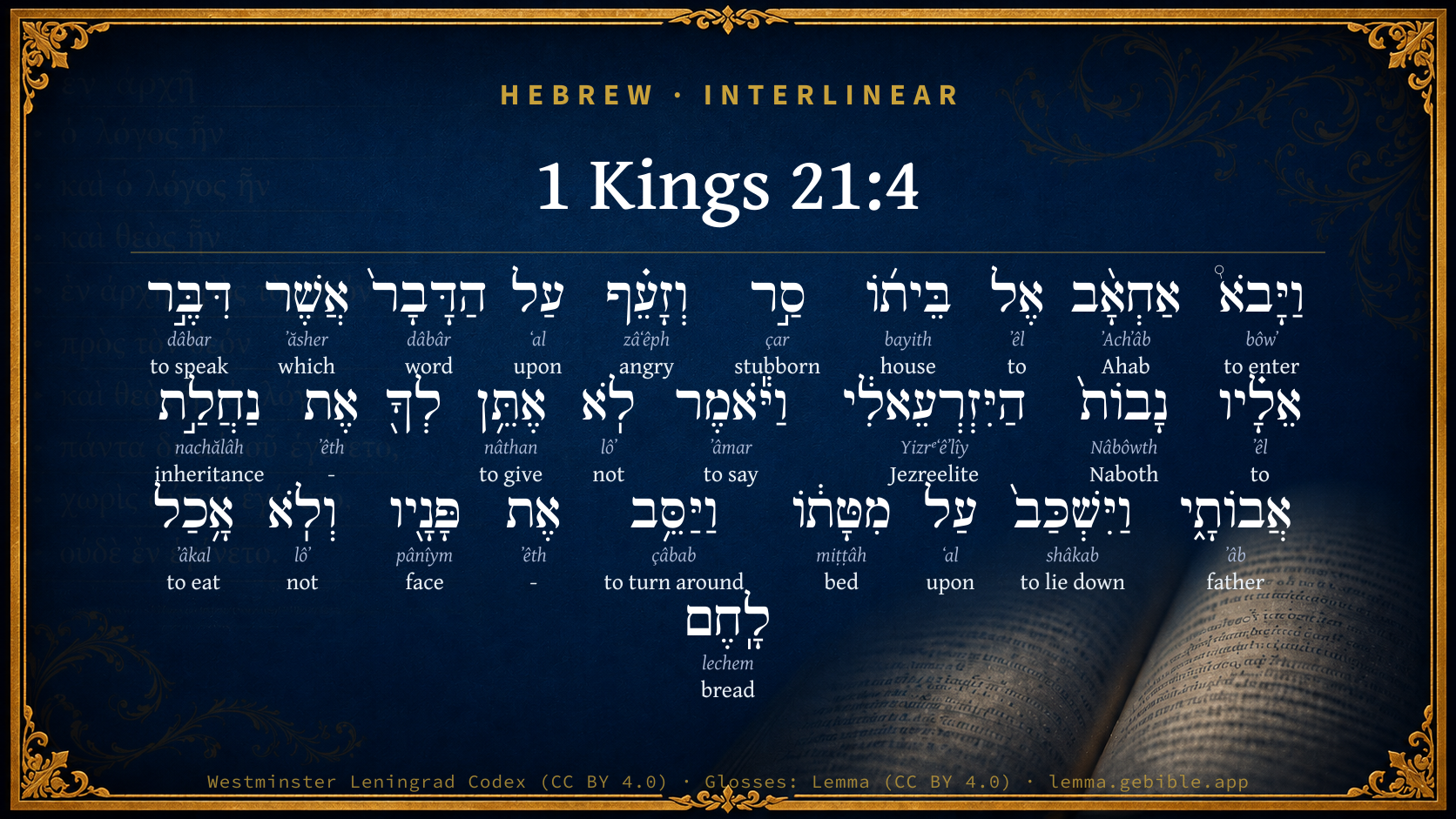
Hebrew (Westminster Leningrad Codex) 1 Kings 21:4 appears in the Hebrew Old Testament. The text above is from the Westminster Leningrad Codex. Each word links to its Strong’s number, a concise gloss, and parsing drawn from the Open Scriptures Hebrew Bible morphology. Click any word for its full Brown-Driver-Briggs (BDB) entry.
Download image
Cite this verse

1 Kings 21:4 (World English Bible). Public Domain. Lemma interlinear Bible study tool, https://lemma.gebible.app/v/1-kings/21/4.

Show BibTeX & RIS
BibTeX
RIS
English Translation
Ahab came into his house sullen and angry because of the word which Naboth the Jezreelite had spoken to him; for he had said, I will not give you the inheritance of my fathers. He laid him down on his bed, and turned away his face, and would eat no bread.
World English Bible · Public Domain
Download a study sheet

One document with this verse’s original text, its word-by-word gloss line, the meaning frame, cross-references with their text, attributed commentary, and full source and license credits — printable, and it pastes into notes with its structure intact.

This verse Autodidact and up

Study sheet (.html) Plain text (.txt)

A passage Seminary Student

Up to 50 verses in one chapter. A passage sheet keeps up to 6 commentary sources and 12 cross-references per verse, in the order this page ranks them, and says so on the sheet whenever that leaves anything out. Ask for a single verse and you get the Autodidact verse sheet above.

Everything on this page stays free to read, with no account — the sheet is a download of what is already on screen, not access to it.

Want to remove ads? Support Godless Engineer
Compare translations 3

The same verse in 3 English versions, stacked beneath the original-language interlinear above. Click any original word for its lexicon entry.

Each is an independent rendering of the whole verse — the interlinear is not word-aligned to these translations.

Highlighted words mark where these versions differ — a whole-verse word diff, not a word-by-word alignment.

  • World English Bible Public Domain
    Ahab came into his house sullen and angry because of the word which Naboth the Jezreelite had spoken to him; for he had said, I will not give you the inheritance of my fathers. He laid him down on his bed, and turned away his face, and would eat no bread.
  • King James Version Public Domain
    And Ahab came into his house heavy and displeased because of the word which Naboth the Jezreelite had spoken to him: for he had said, I will not give thee the inheritance of my fathers. And he laid him down upon his bed, and turned away his face, and would eat no bread.
  • unfoldingWord Literal Text CC BY-SA 4.0
    And Ahab entered into his house sullen and angry because of the word that Naboth the Jezreelite had spoken to him, for he had said, “I will not give to you the inheritance of my fathers.” And he lay down on his bed, and he turned his face away, and he did not eat bread.

unfoldingWord Literal Text — © unfoldingWord, licensed CC BY-SA 4.0. Word-aligned USFM3 via Door43 (git.door43.org/unfoldingWord/en_ult).

Versions to compare (up to 4)

3 of 4 selected

Show all 18 translations

Every available English version of this verse, each an independent rendering of the whole verse.

  • World English Bible Public Domain
    Ahab came into his house sullen and angry because of the word which Naboth the Jezreelite had spoken to him; for he had said, I will not give you the inheritance of my fathers. He laid him down on his bed, and turned away his face, and would eat no bread.
  • Berean Standard Bible Public Domain
    So Ahab went to his palace, sullen and angry because Naboth the Jezreelite had told him, “I will not give you the inheritance of my fathers.” He lay down on his bed, turned his face away, and refused to eat.
  • Majority Standard Bible Public Domain
    So Ahab went to his palace, sullen and angry because Naboth the Jezreelite had told him, “I will not give you the inheritance of my fathers.” He lay down on his bed, turned his face away, and refused to eat.
  • King James Version Public Domain
    And Ahab came into his house heavy and displeased because of the word which Naboth the Jezreelite had spoken to him: for he had said, I will not give thee the inheritance of my fathers. And he laid him down upon his bed, and turned away his face, and would eat no bread.
  • American Standard Version (1901) Public Domain
    And Ahab came into his house heavy and displeased because of the word which Naboth the Jezreelite had spoken to him; for he had said, I will not give thee the inheritance of my fathers. And he laid him down upon his bed, and turned away his face, and would eat no bread.
  • Revised Version (1885) Public Domain
    And Ahab came into his house heavy and displeased because of the word which Naboth the Jezreelite had spoken to him: for he had said, I will not give thee the inheritance of my fathers. And he laid him down upon his bed, and turned away his face, and would eat no bread.
  • Geneva Bible (1599) Public Domain
    Then Ahab came into his house heauie and in displeasure, because of the word which Naboth the Izreelite had spoken vnto him. for hee had sayde, I will not giue thee the inheritance of my fathers, and he lay vpon his bed, and turned his face and would eate no bread.
  • Douay-Rheims (1899) Public Domain
    And Achab came into his house angry and fretting, because of the word that Naboth the Jezrahelite had spoken to him, saying: I will not give thee the inheritance of my fathers. And casting himself upon his bed, he turned away his face to the wall, and would eat no bread.
  • Young's Literal Translation Public Domain
    and Ahab cometh in unto his house, sulky and wroth, because of the word that Naboth the Jezreelite hath spoken unto him when he saith, `I do not give to thee the inheritance of my fathers,' and he lieth down on his bed, and turneth round his face, and hath not eaten bread.
  • Literal Standard Version CC BY-SA 4.0
    and Ahab comes to his house, sulky and angry, because of the word that Naboth the Jezreelite has spoken to him when he says, “I do not give the inheritance of my fathers to you,” and he lies down on his bed, and turns around his face, and has not eaten bread.
  • Unlocked Literal Bible CC BY-SA 4.0
    So Ahab went into his palace resentful and angry because of the answer Naboth the Jezreelite gave him when he said, “I will not give you the inheritance of my ancestors.” He lay down on his bed, turned away his face, and refused to eat any food.
  • unfoldingWord Literal Text CC BY-SA 4.0
    And Ahab entered into his house sullen and angry because of the word that Naboth the Jezreelite had spoken to him, for he had said, “I will not give to you the inheritance of my fathers.” And he lay down on his bed, and he turned his face away, and he did not eat bread.
  • Darby Bible Public Domain
    And Ahab came into his house sullen and vexed because of the word that Naboth the Jizreelite had spoken to him; for he had said, I will not give thee the inheritance of my fathers. And he lay down on his bed, and turned away his face, and ate no bread.
  • World Messianic Bible Public Domain
    Ahab came into his house sullen and angry because of the word which Naboth the Jezreelite had spoken to him, for he had said, “I will not give you the inheritance of my fathers.” He laid himself down on his bed, and turned away his face, and would eat no bread.
  • Webster's Bible Public Domain
    And Ahab came into his house heavy and displeased, because of the word which Naboth the Jezreelite had spoken to him: for he had said, I will not give thee the inheritance of my fathers. And he laid himself down upon his bed, and turned away his face, and would eat no bread.
  • Free Bible Version CC BY-SA 4.0
    Ahab went home sulking and infuriated because Naboth from Jezreel had said, “I will not give you my forefathers' inheritance.” He went to bed, wouldn't look at anyone, and refused to eat.
  • Bible in Basic English Public Domain
    So Ahab came into his house bitter and angry because Naboth the Jezreelite had said to him, I will not give you the heritage of my fathers. And stretching himself on the bed with his face turned away, he would take no food.
  • JPS Tanakh (1917) Public Domain
    And Ahab came into his house sullen and displeased because of the word which Naboth the Jezreelite had spoken to him; for he had said: 'I will not give thee the inheritance of my fathers.' And he laid him down upon his bed, and turned away his face, and would eat no bread.

Literal Standard Version (2020), Covenant Press — licensed CC BY-SA 4.0. Text via the HelloAO Bible API (eBible.org). Unlocked Literal Bible (unfoldingWord) — licensed CC BY-SA 4.0. Text via the HelloAO Bible API (eBible.org). unfoldingWord Literal Text — © unfoldingWord, licensed CC BY-SA 4.0. Word-aligned USFM3 via Door43 (git.door43.org/unfoldingWord/en_ult). Free Bible Version, Dr. Jonathan Gallagher — licensed CC BY-SA 4.0. Text via the HelloAO Bible API (eBible.org).

Word by word

More ways to search: Search by grammar → Find every occurrence → Compare this word →

Practice this passage: Drill this verse → Learn its vocabulary →

וְזָעֵ֗ף
zâʻêph
H2198
“and · angry”
Conjunction + Adjective, Adjective, Masculine, Singular, Absolute
Part of Speech
Conjunction + Adjective
Type
Adjective
Gender
Masculine
Number
Singular
State
Absolute
Full BDB Definition

Origin: from H2196

TWOT: 569b

angry, raging, out of humour, vexed
  1. וַיָּבֹא֩ bôwʼ H935 “and · to enter” Conjunction + Verb, Qal, Sequential Imperfect, 3rd Person, Masculine, Singular
  2. אַחְאָ֨ב ʼAchʼâb H256 “Ahab” Noun, Proper
  3. אֶל ʼêl H413 “to” Preposition
  4. בֵּית֜וֹ bayith H1004 “house · his” Noun, Common, Masculine, Singular, Construct + Suffix, Personal, 3rd Person, Masculine, Singular
  5. סַ֣ר çar H5620 “stubborn” Adjective, Adjective, Masculine, Singular, Absolute
  6. עַל ʻal H5921 “upon” Preposition
  7. הַדָּבָר֙ dâbâr H1697 “the · word” Particle, Definite Article + Noun, Common, Masculine, Singular, Absolute
  8. אֲשֶׁר ʼăsher H834 “which” Particle, Relative
  9. דִּבֶּ֣ר dâbar H1696 “to speak” Verb, Piel, Perfect, 3rd Person, Masculine, Singular
  10. אֵלָ֗יו ʼêl H413 “to · him” Preposition + Suffix, Personal, 3rd Person, Masculine, Singular
  11. נָבוֹת֙ Nâbôwth H5022 “Naboth” Noun, Proper
  12. הַיִּזְרְעֵאלִ֔י Yizrᵉʻêʼlîy H3158 “the · Jezreelite” Particle, Definite Article + Noun, Gentilic, Masculine, Singular, Absolute
  13. וַיֹּ֕אמֶר ʼâmar H559 “and · to say” Conjunction + Verb, Qal, Sequential Imperfect, 3rd Person, Masculine, Singular
  14. לֹֽא lôʼ H3808 “not” Particle, Negative
  15. אֶתֵּ֥ן nâthan H5414 “to give” Verb, Qal, Imperfect, 1st Person, Common, Singular
  16. אֶת ʼêth H853 “-” Particle, Direct Object
  17. נַחֲלַ֣ת nachălâh H5159 “inheritance of” Noun, Common, Feminine, Singular, Construct
  18. אֲבוֹתָ֑י ʼâb H1 “fathers · my” Noun, Common, Masculine, Plural, Construct + Suffix, Personal, 1st Person, Common, Singular
  19. וַיִּשְׁכַּב֙ shâkab H7901 “and · to lie down” Conjunction + Verb, Qal, Sequential Imperfect, 3rd Person, Masculine, Singular
  20. עַל ʻal H5921 “upon” Preposition
  21. מִטָּת֔וֹ miṭṭâh H4296 “bed · his” Noun, Common, Feminine, Singular, Construct + Suffix, Personal, 3rd Person, Masculine, Singular
  22. וַיַּסֵּ֥ב çâbab H5437 “and · to turn around” Conjunction + Verb, Hiphil, Sequential Imperfect, 3rd Person, Masculine, Singular
  23. אֶת ʼêth H853 “-” Particle, Direct Object
  24. פָּנָ֖יו pânîym H6440 “face(s) · his” Noun, Common, Both, Plural, Construct + Suffix, Personal, 3rd Person, Masculine, Singular
  25. וְלֹֽא lôʼ H3808 “and · not” Conjunction + Particle, Negative
  26. אָ֥כַל ʼâkal H398 “to eat” Verb, Qal, Perfect, 3rd Person, Masculine, Singular
  27. לָֽחֶם lechem H3899 “bread” Noun, Common, Both, Singular, Absolute

About this verse

These counts appear in no published source. They are computed here, from the morphology-tagged text and Lemma’s own curated glosses. What Lemma adds →

29
words
24
distinct lemmas
Historical
section

Notable vocabulary

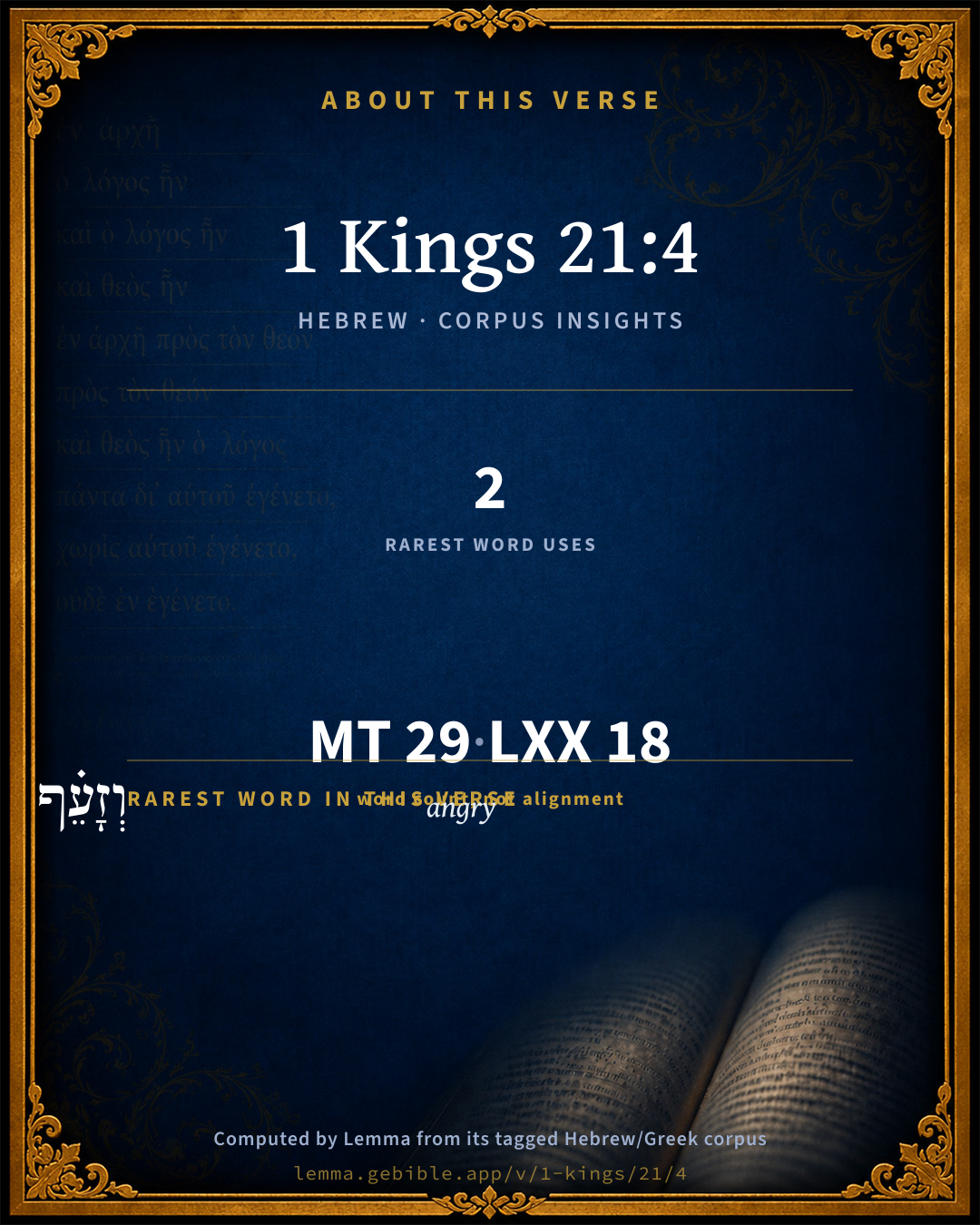
The rarest word here is וְזָעֵ֗ף angry H2198 — appearing just 2 times in the whole Hebrew Bible.

Shared distinctive vocabulary

וְזָעֵ֗ף angry H2198 occurs in 2 verses of the Hebrew Bible. Also found in:

Grammatical profile

  • 7 verbs
  • 10 nouns
  • 2 adjectives
  • 5 prepositions
  • 5 particles

Verb forms

  • וַיָּבֹא֩ Qal · Sequential Imperfect
  • דִּבֶּ֣ר Piel · Perfect
  • וַיֹּ֕אמֶר Qal · Sequential Imperfect
  • אֶתֵּ֥ן Qal · Imperfect
  • וַיִּשְׁכַּב֙ Qal · Sequential Imperfect
  • וַיַּסֵּ֥ב Hiphil · Sequential Imperfect
  • אָ֥כַל Qal · Perfect

Repetition

Words recur within this verse — often emphatic in Hebrew:

Hebrew & Septuagint length

In English translation the verse runs 51 words from the Hebrew and 23 from the Septuagint (LXX English) — the Septuagint runs noticeably shorter here. See the side-by-side →

A rough comparison of the two English renderings, which tokenize alike — not a word-level alignment.

Word counts can differ between the Hebrew and the Greek without any difference in meaning — e.g. the Hebrew direct-object marker אֵת has no separate Greek word, and Greek often adds the article ὁ.

In the original languages it is 29 Hebrew tokens and 18 Greek tokens — but the two are counted differently (Hebrew bundles its prefixes and suffixes into one token; the Greek is in lemma form), so that isn’t a like-for-like length.

Cross-references

15

Topical passages linked to 1 Kings 21:4 in the Treasury of Scripture Knowledge — connected by theme and wording, ordered by reader-vote popularity; previews shown in the World English Bible.

  • 1 Kings 20:43 The king of Israel went to his house sullen and angry, and came to Samaria.
  • James 1:14 But each one is tempted, when he is drawn away by his own lust, and enticed.
  • Genesis 4:5–8 but he didn't respect Cain and his offering. Cain was very angry, and the expression on his face fell.
  • Numbers 22:13–14 Balaam rose up in the morning, and said to the princes of Balak, Get you into your land; for Yahweh refuses to give me leave to go with you.
  • 2 Samuel 13:2 Amnon was so vexed that he fell sick because of his sister Tamar; for she was a virgin; and it seemed hard to Amnon to do anything to her.
  • 2 Samuel 13:4 He said to him, Why, son of the king, are you thus lean from day to day? Won't you tell me? Amnon said to him, I love Tamar, my brother Absalom's sister.
  • 1 Kings 21:3 Naboth said to Ahab, Yahweh forbid it me, that I should give the inheritance of my fathers to you.
  • Job 5:2 For resentment kills the foolish man, And jealousy kills the simple.
  • Ecclesiastes 6:9 Better is the sight of the eyes than the wandering of the desire. This also is vanity and a chasing after wind.
  • Ecclesiastes 7:8–9 Better is the end of a thing than its beginning. The patient in spirit is better than the proud in spirit.
  • Isaiah 57:20–21 But the wicked are like the troubled sea; for it can't rest, and its waters cast up mire and dirt.
  • Jonah 4:1 But it displeased Jonah exceedingly, and he was angry.
  • Jonah 4:9 God said to Jonah, "Is it right for you to be angry about the vine?" He said, "I am right to be angry, even to death."
  • Habakkuk 2:9–12 Woe to him who gets an evil gain for his house, that he may set his nest on high, that he may be delivered from the hand of evil!
  • Ephesians 4:27 neither give place to the devil.

Cross-references courtesy of OpenBible.info (CC BY 4.0).

Hebrew and Greek witnesses Masoretic Hebrew ↔ Greek Septuagint

The same verse in the two great witnesses to the Old Testament, shown verse-for-verse.

Here the Septuagint runs noticeably shorter than the Hebrew — LXX2012 (modern English Septuagint) 23 words vs World English Bible 51. A rough length comparison of the two English translations, not a word-level alignment — read both below.

These are two independent witnesses, not word-aligned to each other, and the Septuagint is shown in lemma (dictionary) form.

Hebrew 1 Kings 21:4 Masoretic · Westminster Leningrad Codex

וַיָּבֹא֩ אַחְאָ֨ב אֶל בֵּית֜וֹ סַ֣ר וְזָעֵ֗ף עַל הַדָּבָר֙ אֲשֶׁר דִּבֶּ֣ר אֵלָ֗יו נָבוֹת֙ הַיִּזְרְעֵאלִ֔י וַיֹּ֕אמֶר לֹֽא אֶתֵּ֥ן לְךָ֖ אֶת נַחֲלַ֣ת אֲבוֹתָ֑י וַיִּשְׁכַּב֙ עַל מִטָּת֔וֹ וַיַּסֵּ֥ב אֶת פָּנָ֖יו וְלֹֽא אָ֥כַל לָֽחֶם

Ahab came into his house sullen and angry because of the word which Naboth the Jezreelite had spoken to him; for he had said, I will not give you the inheritance of my fathers. He laid him down on his bed, and turned away his face, and would eat no bread.

World English Bible · Public Domain

Greek LXX 1 Kings 21:4 Septuagint · lemma form

καί ἀποκρίνω ὁ βασιλεύς ἰσραήλ καί εἶπον καθώς λαλέω κύριος βασιλεύς σός ἐγώ εἰμί καί πᾶς ὁ ἐμός

And the king of Israel answered and said, As you have said, my lord, O king, I am yours, and all mine also.

LXX2012 (modern English Septuagint) · Public Domain

On this verse, The Cambridge Bible for Schools and Colleges discusses the Septuagint’s reading. Read the note in Commentary ↓

Hebrew: Westminster Leningrad Codex (CC BY 4.0). Greek: Septuagint (public domain); English from LXX2012 (modern English Septuagint) (Public Domain). How the Septuagint differs from the Hebrew →

Targum (Aramaic paraphrase)

1

The Targum is the ancient Jewish Aramaic paraphrase of the Hebrew Scriptures — an interpretive translation, not the Hebrew text itself. Onkelos (literal) and Pseudo-Jonathan (expansive) render the Torah, and Jonathan the Prophets. Coverage is partial: where no permissively-licensed English translation exists for a verse, only the Aramaic is shown. This is verse-level text, not a word-by-word alignment to the Hebrew.

  1. Targum Jonathan Prophets (Joshua–Malachi)
    וַאֲתָא אַחְאָב לְבֵיתֵיהּ נְסִיס וְדַוָי עַל פִּתְגָמָא דְמַלֵיל עִמֵיהּ נְבוֹת יִזְרְעֶאלָה וַאֲמַר לָא אֶתֵּן לָךְ יַת אַחְסָנַת אֲבָהָתָי וּשְׁכִיב עַל עַרְסֵיהּ וְאַסְחַר יַת אַפּוֹהִי וְלָא אֲכַל לַחֲמָא:

    (no public-domain English translation for this verse)

    Targum Jonathan — Aramaic: “Mikraot Gedolot” (public domain). English: “Sefaria Community Translation” (CC0 1.0 (public-domain dedication)); “London "Chaldee Paraphrase," 1871” (public domain). Text via Sefaria.

Commentary

Notes on 1 Kings 21:4 from classic Christian and Jewish commentators (each source and its license shown beneath its notes). The classic Christian expositions comment on the surrounding passage and are grouped to its opening verse, so a note may address several verses; the Jewish commentaries on the Tanakh (Rashi and others) are per-verse, so they appear only where the commentator wrote on this verse.

Lemma curates 59 commentaries, every one of them public domain or Creative Commons licensed, each selected and text-cleaned for this edition rather than reprinted as found. About our sources →

Trapp's Complete Commentary

John Trapp

1Ki 21:4 And Ahab came into his house heavy and displeased because of the word which Naboth the Jezreelite had spoken to him: for he had said, I will not give thee the inheritance of my fathers. And he laid him down upon his bed, and turned away his face, and would eat no bread.

Ver. 4. And Ahab came into his house heavy and displeased.] Abalienatus et indignabundus; off the hooks, as we say, and in a great discontent; his heart did more afflict and vex itself with greedy longing for that bit of earth, than the vast and spacious compass of a kingdom could counter comfort. So Haman could say, All this availeth me nothing, &c. And Alexander, the monarch of the world, was grievously troubled, because ivy would not grow in his gardens at Babylon. The devil of discontent, whomsoever it possesseth, it maketh his heart a little hell, {a} saith one.

And he laid him down upon his bed.] Sick of the sullens.

And turned away his face.] As not caring to see any, or to be seen of any one: he was totus in fermento.

And would eat no bread.] As if he would starve himself.

{a} ταραττειν, exinde ταρταρος.

John Trapp, A Commentary or Exposition upon All the Books of the Old and New Testament (1647–1656) — public domain. Text from a community e-Sword module.

The Biblical Illustrator

Joseph S. Exell

1Ki_21:4

And Ahab came into his house heavy and displeased.

Temper-a deadly sin

In other and less dignified words, Ahab, when he could not get his own way, went to bed in a sulk. I take it that all those who have tried even to be close students of human nature are agreed that life as a rule suffers most, not from the heroic sin or from the deep passion, but from little mean and contemptible sins. These sins are like the grit in the eye--they incense and inflame until it happens that a great and noble faculty can be used no more. And I am going to suggest to this audience that the harmony of life, whether it be of the family life or of the social life of any people, suffers most from two classes of people--the cross-grained man and the shrew. These people are ready, as you know, to take umbrage at the faintest slight, even of a fancied kind, to indulge ill-humour over something that was never intended to be even a contradiction of their views; and when not venting their venom and their spite publicly, they are commonly to be found grumbling in a corner; and if not openly growling, then they are secretly sulking and nourishing their temper. Now, will you bear with me while I say a word about the description itself, because there is a lesson which I think we might learn even from the word. The word temper, as you know, is one of the English words which have gradually come to have a bad sense. It meant in its original to moderate or to modify what was unduly harsh or violent, and in that sense, of course, the word has been frequently used. I found, for instance, a quotation out of one of the early English poets, in which he said that the function of the woman was to temper man--that is, not to put him into a temper, but to modify his naturally harsh, sour, and severe disposition--a function that everybody here will agree woman, as a rule, discharges. The word temper, indeed, is used very commonly for either of two purposes; either to describe a calm, serene, and gracious nature, or else to describe a hasty, fiery, and ill-conditioned nature. But when my dictionary was consulted it told me this: that the good use of the word has, in process of years, become obsolete, and that if the word temper is now used by itself, it can always be trusted to have the bad significance. So that I call you to witness it comes to this: that if you want to speak of good temper you must call it good; but if you want to speak of bad temper you can simply describe it as temper, and everybody will know what you mean. I want to ask you that you will distinguish it from what we call passion. Passion, it is quite true, is often guilty of great and terrible crimes, crimes which arise from the fact that a great quality has become the master instead of being the servant of man. But in bad temper there is nothing so great or dignified or strong as passion. Temper thrives on trivialities. There is no detail so silly; no pretext so trumpery, but it will give the reins to the man of temper. Passion is the sublime; temper is really ridiculous save only for this, that the things it does and the misery it causes would turn all our laughter into tears. To take--for I am anxious that you should continue your analysis--another distinction that will occur to you between the two. Passion is always occasional, it is volcanic, it is soon over. It is like the thunderstorm. It bursts and breaks; then the sky clears blue and genial and warm. But it is always the tendency of temper to be chronic and normal, and it corresponds to what we constantly describe as a certain cross-grained and ill-conditioned nature. Yes, passion is volcanic, but passion knows how to forgive and to forget. But temper is not like that. It keeps all its bitterness within. It nourishes its grudges, it cherishes its slights, it broods over its fancied wrongs. I was wondering how I could best illustrate this part of what I am trying to say, and a comparison occurred to me between two kings of your English history--the one whom I always think of as one of the greatest kings who ever wore the British crown, the first Edward, a man of passion, deeply beloved, and even adored by his people; the man of the passionate pilgrimage, which was to be the evidence of his grief for his wife, to whom Charing Cross is the monument even to-night--a man of volcanic humour, with floods of tears for the evil deeds his passion wrought, and of whom Mr. J. R. Green tells the thrilling and touching story, how he summoned his subjects to Westminster Hall, and when he faced them could not speak to them, but simply buried his face in his hands and burst into tears before them all, and then asked forgiveness for wrongs that he had done. That was the passionate man. I contrast with him the king of temper, John, who never rose to a single great thought or a single great deed, but who after all won the loathing and contempt of his subjects, because Dantes hazy smoke was always in his heart--morbid, sullen, spiteful, malicious. And now that brings me very naturally to the discussion of the text which I have taken, and the narrative to which it refers, a quotation that is familiar to you all. You know that it introduces us to one of the most cold-blooded and gruesome crimes of which history contains any record. The real instigator of that crime, and the executor of the deed was Jezebel. But terrible as Jezebels temper is represented here, I venture to say that to every self-respecting mind the character of Ahab is more loathsome and more contemptible. Jezebel did the thing. Ahab was only the weak confederate of his unscrupulous and bold wife, with her heart of marble. And yet think of it, analyse the scene. Does it not remain, as I say, that Jezebel with all her crimes and her blood-stained hands could even extort the measure of admiration when you consider her spirit, her intrepidity, and her initiative, and realise that if these qualities had been devoted to something worthy of them, she would have been a great woman. But about Ahab there is nothing great; there is everything that is contemptible--nothing more heroic than a fit of temper. I have no doubt that his servants went away and said it was an attack of the liver, and that he would shortly be all right. But Jezebel knew him better. She knew that it was black venom, and spite, and malice, and that if he was to get better and recover these must have their vent. And so she did what he wanted to do, but hadnt the courage to do. That is your whole story in a nutshell. And what is its moral? you say. It is so horrible it has no moral for us. I am not so sure of that. Its moral is this, I take it, that to a man thus evilly conditioned, the natural disposition is to every, sorry and cruel suggestion that may come to him from any quarter. For there he is naturally disposed to think the worst of people and to do them ill. Ah, yes; and if it had not ended except in evil word it had been bad enough, for if I may in an aside I would say this: temper has always found its readiest weapon in the tongue, and who in this building can estimate the evil and the injury that has been done when the tongue has lain at the disposition of temper. Ah, but is it not true to say that it is possible for you and me, while we analyse the temper and desire that Gods love will soften and sweeten the heart--is it not possible, for us to feel some genuine sorrow for them? For, after all, remember that nobody else is made quite so unhappy and so miserable as they make themselves. There they are; they are unwelcome guests at every festival, and I fancy that at last they come to know that people anticipate their advent with apprehension and look upon their backs with relief. They are the frost on every budding happiness, the skeleton that sits at every feast. The cross-grained man and the common scold or shrew isolate themselves from humanity, cut themselves off from the genial and generous debt of life. Their heart becomes like the North Pole--absolutely locked in impenetrable ice. And is there no cure? Oh yes, there is something. The mind that was in Christ Jesus, can it be communicated, or can it not? Is Christianity true when it says: He will give you His Spirit, He will make you like Himself? Is it true or is it not? Some of you here to-night, are you doomed and destined to bear to your grave this burden of which I have been speaking, or is there One whose hands can unloose the thongs and set you free? I know that I am right in what I say. Why, there are friends known to you, and to dwell in their company is gradually to feel dissolve and decay within you your bitter thoughts, and your heart come cordially into sympathy with their genial and generous spirit. That is a great thing; but, oh, men and women, to company with Jesus Christ, to live in His presence, beneath His redeeming touch and influence, that is, indeed, to say good-bye to the bitterness of the heart, that is to receive His sweetness into this bitter-thoughted mind and soul, that is to be mellowed for His harvesting, made ripe and gracious fruit for His hands to gather. That is my gospel Jesus Christ can cure. (C. S. Home, M. A.)

The Biblical Illustrator, edited by Joseph S. Exell (c. 1880s–1900s) — public domain. Text from a community e-Sword module.

Joseph Benson's Commentary

1Ki 21:4. Ahab came into his house, heavy and displeased — He was so vexed to be denied by a subject the thing he wanted, that his vexation made him sick, took away his stomach, and made company disagreeable to him; so that his grief and trouble appeared in his countenance. Here we see, 1st, That irregular desire, or “discontent, is a sin that is its own punishment, and makes men torment themselves: it makes the spirit sad, the body sick, and all the enjoyments sour: it is the heaviness of the heart, and the rottenness of the bones; 2d, It is a sin that is its own parent; it arises not from the condition, but from the mind. As we find Paul content in a prison, so Ahab discontent in a palace: he had all the delights of Canaan, that pleasant land, at command; the wealth of a kingdom, the pleasure of a court, and the honours and powers of a throne; and yet all this avails him nothing without Naboth’s vineyard. Inordinate desires expose men to continual vexations; and they that are disposed to fret, be they ever so happy, will always find something or other to fret at.” — Henry.

Joseph Benson's Commentary on the Old and New Testaments (1811–1818) — public domain. Text from a community e-Sword module.

Tyndale Open Study Notes

Tyndale Open Resources

21:4 angry and sullen: Ahab’s reaction was the same when he was rebuked by God’s prophet (20:43). A sullen attitude can easily arise in a stubborn, self-centered person (21:16, 20, 25-26; see 16:31-32; 18:10, 17; 20:42-43; 22:3, 27-30).

Tyndale Open Study Notes — © Tyndale Open Resources, licensed CC BY-SA 4.0. Text via the HelloAO Bible API.

Geneva Bible (1599)

Geneva Bible translators

Thus the wicked consider not what is just and lawful, but fret inwardly, when they cannot have their inordinate appetites satisfied.

Geneva Bible (1599) marginal notes — public domain. Text via Bolls.life.

Jamieson, Fausset & Brown

Robert Jamieson, A. R. Fausset & David Brown

turned away his face--either to conceal from his attendants the vexation of spirit he felt, or, by the affectation of great sorrow, rouse them to devise some means of gratifying his wishes.

Jamieson, Fausset & Brown — Commentary Critical and Explanatory on the Whole Bible (1871) — public domain (CC PDM 1.0). Text via the HelloAO Bible API.

Adam Clarke's Commentary

Verse 4. He laid him down upon his bed] Poor soul! he was lord over ten-twelfths of the land, and became miserable because he could not get a poor man's vineyard added to all that he possessed! It is a true saying, "That soul in which God dwells not, has no happiness: and he who has God has a satisfying portion." Every privation and cross makes an unholy soul unhappy; and privations and crosses it must ever meet with, therefore: -

"Where'er it goes is hell; itself is hell!"

Adam Clarke's Commentary on the Bible (1810–1826) — public domain. Text from a community e-Sword/MySword module.

The Cambridge Bible for Schools and Colleges

gen. ed. J. J. S. Perowne

4. And Ahab came into his house] The last four words are omitted by the LXX., as also the clause ‘because of the word … the inheritance of my fathers.’ It is clear from the continuation of the story that it was to Samaria that Ahab came back after his interview with Naboth.

heavy and displeased] See above, on 1Ki_20:43.

And he laid him down, &c.] This detail shews, like so much else in Ahab’s history, what a feeble character he was, and how thoroughly he would be dominated by the more powerful mind of Jezebel. While absent from her, some signs of improvement might appear, even such as might seem to Elijah to promise hopes of a change; but when she appears they are all gone. And the moodiness here described is rather that of a wayward child, than of a man of mature years and high position.

The Cambridge Bible for Schools and Colleges (gen. ed. J. J. S. Perowne; Cambridge University Press, 1878–1918) — public domain. Text from a community e-Sword module.

John Gill's Exposition

But Jezebel his wife came unto him, and said, why is thy spirit so sad, that thou eatest no bread? She perceived he was low spirited, and supposed he had met with something that had ruffled him, and made him so uneasy that he could not eat his food; and she desired to know what it was, that she might relieve him if possible.

But Jezebel his wife came unto him, and said, why is thy spirit so sad, that thou eatest no bread? She perceived he was low spirited, and supposed he had met with something that had ruffled him, and made him so uneasy that he could not eat his food; and she desired to know what it was, that she might relieve him if possible.

1 Kings 21:6

kg1 21:6

kg1 21:6

kg1 21:6And he said, because I spake unto Naboth the Jezreelite, and said unto him, give me thy vineyard for money,.... Sell it him at his own price:

or else, if it please thee; if he liked it better:

I will give thee another vineyard for it; as good, or better; and he answered, I will not give thee my vineyard; he represents this answer as surly and ill natured, and as the effect of obstinacy, concealing the reason Naboth alleged for his denial.

John Gill's Exposition of the Whole Bible (1746–1763) — public domain (CC PDM 1.0). Text via the HelloAO Bible API.

Albert Barnes' Notes on the Bible

Upon his bed - That is, “upon his couch.” The Jews, like other Orientals, reclined upon couches at their meals (Amo 6:4; Eze 23:41, etc.). Ahab turns his face toward the back of the couch, rejecting all converse with others, and so remains, after the banquet is served, refusing to partake of it. Such an open manifestation of ill temper is thoroughly characteristic of an Oriental king.

Albert Barnes' Notes on the Bible (1834–1885) — public domain. Text from a community e-Sword/MySword module.

Haydock's Catholic Bible Commentary

Fretting. The Hebrew terms are the same as [in] chap. xx. 43. What weakness in Achab! Riches and honours are not capable of ensuring content. (Calmet) --- "Who, thinkest thou, is poor; the man who is content with his own, or he who covets another’s property?" (St. Ambrose, Naboth ii.) --- Wall, as Ezechias did afterwards, in very different dispositions; though both were oppressed with grief, Isaias xxxviii. 2. Septuagint, "he covered his face." (Haydock)

George Leo Haydock (1774–1849), Haydock's Catholic Family Bible and Commentary, 1859 edition — public domain. Excludes Psalms (Douay-Rheims chapter numbering differs from Protestant) and Deuterocanonical books (Catholic canon only).

Matthew Poole's English Annotations

Turned away his face from the light, and company which either then were with him, or might come to him to the wall, as Hezekiah did under a like dejection of spirit, Isa 38:2.

Would eat no bread; refused to eat meat in his usual time.

Matthew Poole's English Annotations on the Holy Bible (1683–1685) — public domain. Text from a community e-Sword/MySword module.

Whedon's Commentary on the Bible

Daniel D. Whedon

4. Heavy and displeased — Sulky and sour, just as he was after receiving the word of the Lord from one of the sons of the prophets. Chap. 1Ki_20:43. His going to bed, and turning away his face, and refusing to eat, shows up most vividly his mean passions and the childish fretfulness of his disposition.

Daniel D. Whedon (gen. ed.), Commentary on the Old and New Testaments (1874–1909) — public domain. Text from a community e-Sword module.

The Pulpit Commentary

And Ahab came into his house At Samaria, as we gather from vers. 18, 14, 16, etc. heavy and displeased Heb. sullen and angry; same words as in 1Ki_20:43. Ewald thinks that we have here a clear reference to that passage because of the word which Naboth the Jezreellte had spoken to him: for Heb. and he had said, I will not give thee the inheritance of my fathers. And he laid him down upon his bed Rawlinson understands this to mean the couch on which the Orientals recline at meals. And hFmi is used with this meaning in Esther Eze_23:41, and elsewhere. But his bed" seems rather to point to his private chamber; see on ver. 5, and turned away his face The Vulgate adds ad parietem. Cf., 2Ki_20:2; from which place it may have been unconsciously introduced here and would eat no bread. Keil contends that" this childish mode of giving expression to his displeasure shows very clearly that Ahab was a man sold under sin (ver. 20), who only wanted the requisite energy to display the wickedness of his heart in vigorous action;" but whether this is a just inference from these words may well be questioned. It rather shows that so little did he meditate evil that he accepted the refusal of Naboth as conclusive, and gave way to childish grief.

The Pulpit Commentary (1880–1919), ed. H.D.M. Spence-Jones & Joseph S. Exell — public domain. Text from a community e-Sword module.

Lesson kit

Teaching starters — assembled from the data on this page, not authored interpretation. Every prompt links to the verse data it draws on. Edit before teaching.

1 Kings, in the Historical, opens this verse with 29 words (24 distinct Hebrew lemmas). Its most distinctive word is zâʻêph (“angry”). The Greek Septuagint runs shorter here. A historical commentator’s framing appears above. Read the whole chapter for the surrounding context.

Discussion questions

  1. The word zâʻêph carries the sense “angry.” How does it shape the verse?
  2. 1 Kings 20:43 shares the word «angry» with this verse. How do the two illuminate each other?
  3. “upon” occurs 2× in this one verse. What is the effect of the repetition?
  4. Compared with the Hebrew, the Septuagint runs shorter here. What questions does that raise?
  5. These translations render this verse differently; the difference is in the English rendering, not the original. What questions does that raise?
  6. The verb «וַיָּבֹא֩» is Qal Sequential Imperfect. How does its form color the action?
  7. Reading how Trapp's Complete Commentary and The Biblical Illustrator read this verse, where do the two commentators agree and where do they part?

Things to notice

Reading settings

Reading text

Shown beneath each verse's original-language words.

Old Testament
Old Testament edition

Read the OT as the Masoretic Hebrew (MT) or the Greek Septuagint (LXX).

English shown for the Greek Septuagint (in the Hebrew ↔ Greek comparison).

Comparing translations? Open the Compare panel on any verse page to stack up to four side by side.