
Proverbs 4:17

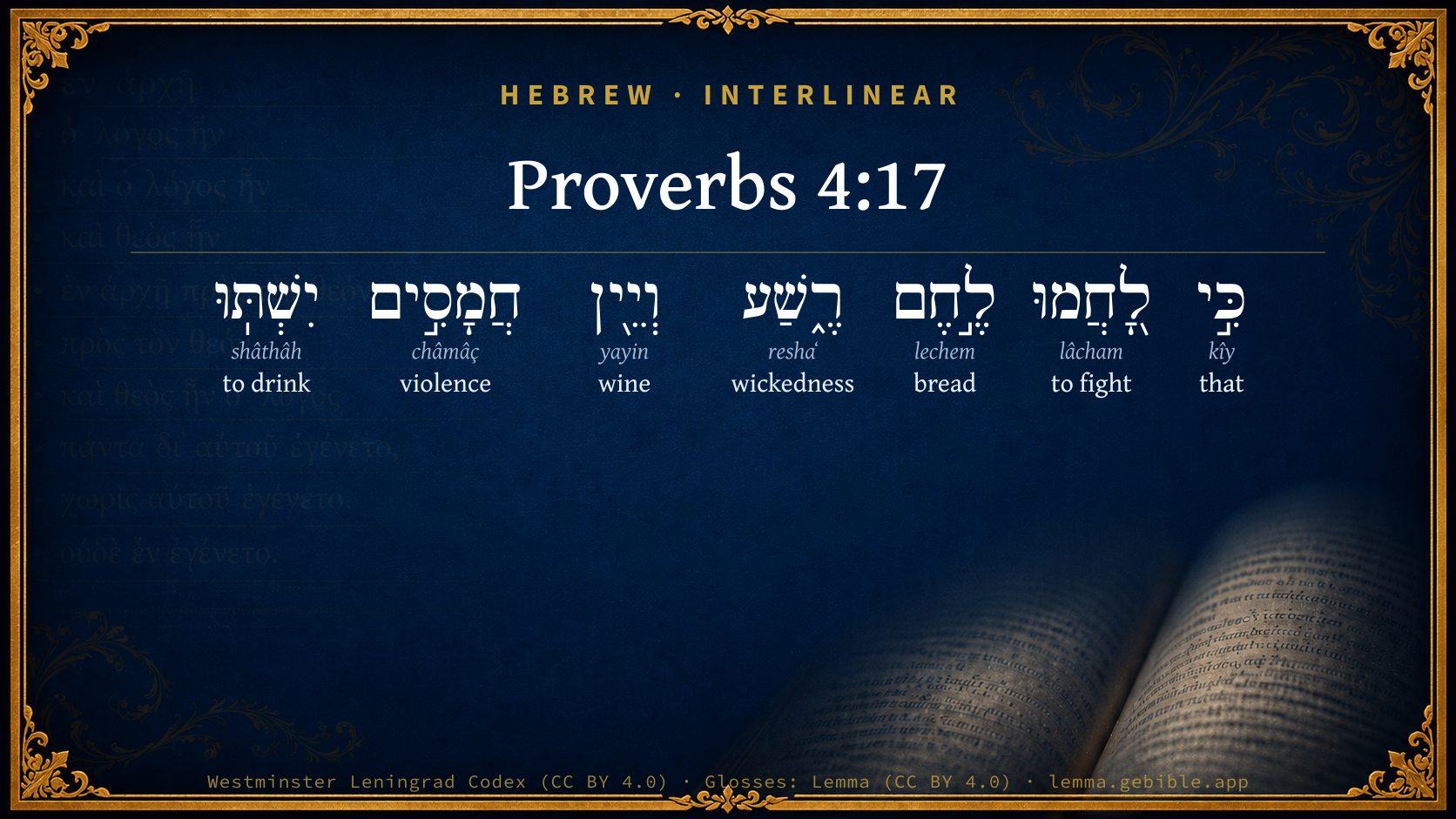
Hebrew (Westminster Leningrad Codex) Proverbs 4:17 appears in the Hebrew Old Testament. The text above is from the Westminster Leningrad Codex. Each word links to its Strong’s number, a concise gloss, and parsing drawn from the Open Scriptures Hebrew Bible morphology. Click any word for its full Brown-Driver-Briggs (BDB) entry.
Download image
Cite this verse

Proverbs 4:17 (World English Bible). Public Domain. Lemma interlinear Bible study tool, https://lemma.gebible.app/v/proverbs/4/17.

Show BibTeX & RIS
BibTeX
RIS
English Translation
For they eat the bread of wickedness, And drink the wine of violence.
World English Bible · Public Domain
Download a study sheet

One document with this verse’s original text, its word-by-word gloss line, the meaning frame, cross-references with their text, attributed commentary, and full source and license credits — printable, and it pastes into notes with its structure intact.

This verse Autodidact and up

Study sheet (.html) Plain text (.txt)

A passage Seminary Student

Up to 50 verses in one chapter. A passage sheet keeps up to 6 commentary sources and 12 cross-references per verse, in the order this page ranks them, and says so on the sheet whenever that leaves anything out. Ask for a single verse and you get the Autodidact verse sheet above.

Everything on this page stays free to read, with no account — the sheet is a download of what is already on screen, not access to it.

Want to remove ads? Support Godless Engineer
Compare translations 3

The same verse in 3 English versions, stacked beneath the original-language interlinear above. Click any original word for its lexicon entry.

Each is an independent rendering of the whole verse — the interlinear is not word-aligned to these translations.

Highlighted words mark where these versions differ — a whole-verse word diff, not a word-by-word alignment.

  • World English Bible Public Domain
    For they eat the bread of wickedness, And drink the wine of violence.
  • King James Version Public Domain
    For they eat the bread of wickedness, and drink the wine of violence.
  • unfoldingWord Literal Text CC BY-SA 4.0
    For they eat the bread of wickedness and the wine of violent, they drink.

unfoldingWord Literal Text — © unfoldingWord, licensed CC BY-SA 4.0. Word-aligned USFM3 via Door43 (git.door43.org/unfoldingWord/en_ult).

Versions to compare (up to 4)

3 of 4 selected

Show all 18 translations

Every available English version of this verse, each an independent rendering of the whole verse.

  • World English Bible Public Domain
    For they eat the bread of wickedness, And drink the wine of violence.
  • Berean Standard Bible Public Domain
    For they eat the bread of wickedness and drink the wine of violence.
  • Majority Standard Bible Public Domain
    For they eat the bread of wickedness and drink the wine of violence.
  • King James Version Public Domain
    For they eat the bread of wickedness, and drink the wine of violence.
  • American Standard Version (1901) Public Domain
    For they eat the bread of wickedness, And drink the wine of violence.
  • Revised Version (1885) Public Domain
    For they eat the bread of wickedness, and drink the wine of violence.
  • Geneva Bible (1599) Public Domain
    For they eate the breade of wickednesse, and drinke the wine of violence.
  • Douay-Rheims (1899) Public Domain
    They eat the bread of wickedness, and drink the wine of iniquity.
  • Young's Literal Translation Public Domain
    For they have eaten bread of wickedness, And wine of violence they drink.
  • Literal Standard Version CC BY-SA 4.0
    For they have eaten bread of wickedness, || And they drink wine of violence.
  • Unlocked Literal Bible CC BY-SA 4.0
    For they eat the bread of wickedness and drink the wine of violence.
  • unfoldingWord Literal Text CC BY-SA 4.0
    For they eat the bread of wickedness and the wine of violent, they drink.
  • Darby Bible Public Domain
    For they eat the bread of wickedness, and drink the wine of violence.
  • World Messianic Bible Public Domain
    For they eat the bread of wickedness and drink the wine of violence.
  • Webster's Bible Public Domain
    For they eat the bread of wickedness, and drink the wine of violence.
  • Free Bible Version CC BY-SA 4.0
    For they eat the bread of wickedness and drink the wine of violence.
  • Bible in Basic English Public Domain
    The bread of evil-doing is their food, the wine of violent acts their drink.
  • JPS Tanakh (1917) Public Domain
    For they eat the bread of wickedness, and drink the wine of violence.

Literal Standard Version (2020), Covenant Press — licensed CC BY-SA 4.0. Text via the HelloAO Bible API (eBible.org). Unlocked Literal Bible (unfoldingWord) — licensed CC BY-SA 4.0. Text via the HelloAO Bible API (eBible.org). unfoldingWord Literal Text — © unfoldingWord, licensed CC BY-SA 4.0. Word-aligned USFM3 via Door43 (git.door43.org/unfoldingWord/en_ult). Free Bible Version, Dr. Jonathan Gallagher — licensed CC BY-SA 4.0. Text via the HelloAO Bible API (eBible.org).

Word by word

More ways to search: Search by grammar → Find every occurrence → Compare this word →

Practice this passage: Drill this verse → Learn its vocabulary →

About this verse

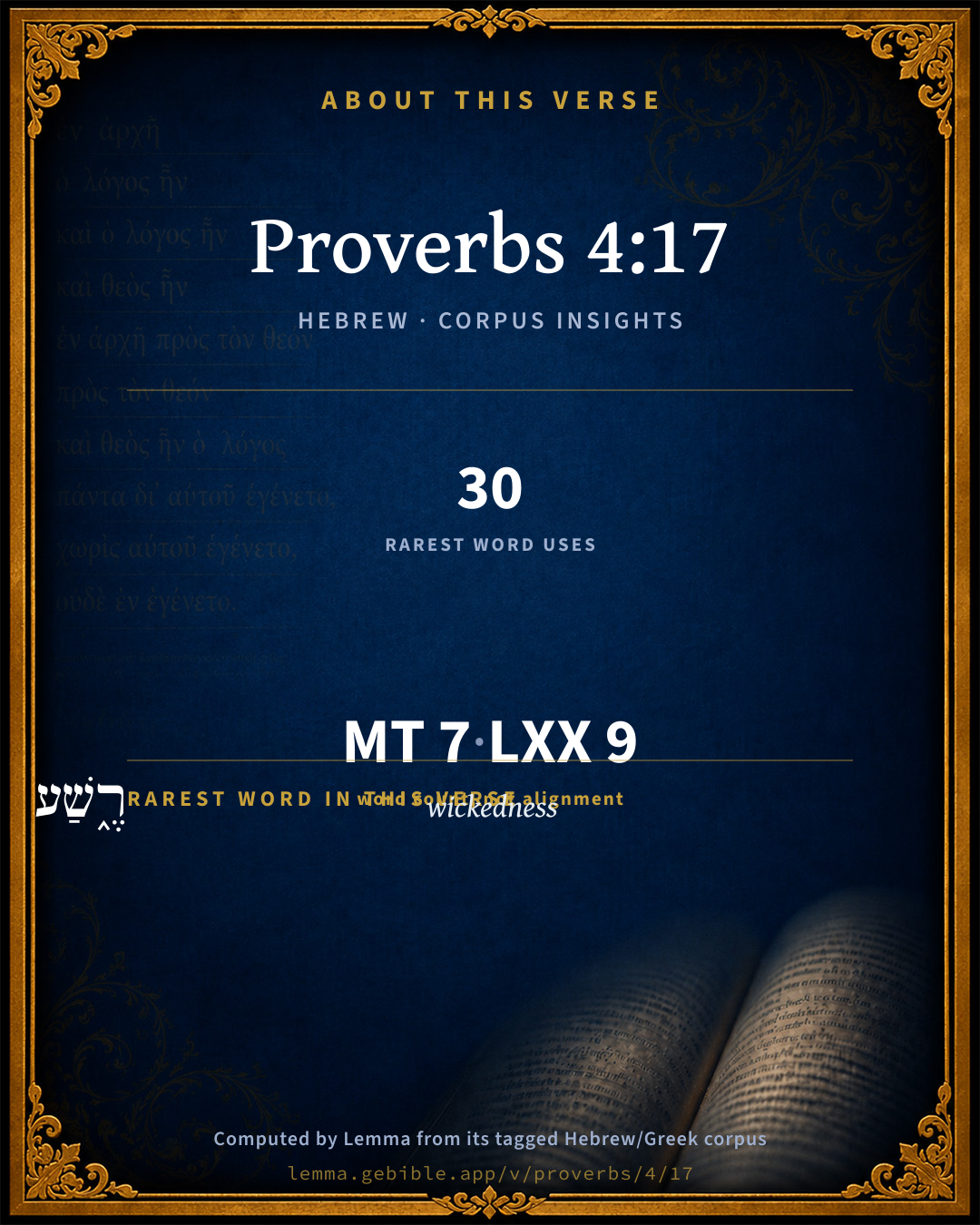
These counts appear in no published source. They are computed here, from the morphology-tagged text and Lemma’s own curated glosses. What Lemma adds →

7
words
7
distinct lemmas
Wisdom
section

Shared distinctive vocabulary

רֶ֑שַׁע wickedness H7562 occurs in 29 verses of the Hebrew Bible. Also found in:

Grammatical profile

  • 2 verbs
  • 4 nouns
  • 1 conjunction

Verb forms

  • לָ֭חֲמוּ Qal · Perfect
  • יִשְׁתּֽוּ Qal · Imperfect

Hebrew & Septuagint length

In English translation the verse runs 13 words from the Hebrew and 15 from the Septuagint (LXX English) — closely comparable.

A rough comparison of the two English renderings, which tokenize alike — not a word-level alignment.

Word counts can differ between the Hebrew and the Greek without any difference in meaning — e.g. the Hebrew direct-object marker אֵת has no separate Greek word, and Greek often adds the article ὁ.

In the original languages it is 7 Hebrew tokens and 9 Greek tokens — but the two are counted differently (Hebrew bundles its prefixes and suffixes into one token; the Greek is in lemma form), so that isn’t a like-for-like length.

Cross-references

12

Topical passages linked to Proverbs 4:17 in the Treasury of Scripture Knowledge — connected by theme and wording, ordered by reader-vote popularity; previews shown in the World English Bible.

  • Psalms 14:4 Have all the workers of iniquity no knowledge, Who eat up my people as they eat bread, And don't call on Yahweh?
  • Proverbs 9:17 "Stolen water is sweet. Food eaten in secret is pleasant."
  • Proverbs 20:17 Fraudulent food is sweet to a man, But afterwards his mouth is filled with gravel.
  • Micah 6:12 Her rich men are full of violence, Her inhabitants speak lies, And their tongue is deceitful in their speech.
  • James 5:4–5 Behold, the wages of the laborers who mowed your fields, which you have kept back by fraud, cry out, and the cries of those who reaped have entered into the ears of the Lord of Hosts.
  • Job 24:5–6 Behold, as wild donkeys in the desert, They go forth to their work, seeking diligently for food; The wilderness yields them bread for their children.
  • Jeremiah 5:26–28 For among my people are found wicked men: they watch, as fowlers lie in wait; they set a trap, they catch men.
  • Ezekiel 22:25–29 There is a conspiracy of her prophets in the midst of it, like a roaring lion ravening the prey: they have devoured souls; they take treasure and precious things; they have made her widows many in the midst of it.
  • Amos 8:4–6 Hear this, you who desire to swallow up the needy, And cause the poor of the land to fail,
  • Micah 3:5 Thus says Yahweh concerning the prophets who lead my people astray; for those who feed their teeth, they proclaim, "Peace!" and whoever doesn't provide for their mouths, they prepare war against him:
  • Zephaniah 3:3 Her princes in the midst of her are roaring lions. Her judges are evening wolves. They leave nothing until the next day.
  • Matthew 23:13 "Woe to you, scribes and Pharisees, hypocrites! For you devour widows' houses, and as a pretense you make long prayers. Therefore you will receive greater condemnation.

Cross-references courtesy of OpenBible.info (CC BY 4.0).

Hebrew and Greek witnesses Masoretic Hebrew ↔ Greek Septuagint

The same verse in the two great witnesses to the Old Testament, shown verse-for-verse.

These are two independent witnesses, not word-aligned to each other, and the Septuagint is shown in lemma (dictionary) form.

Hebrew Proverbs 4:17 Masoretic · Westminster Leningrad Codex

כִּ֣י לָ֭חֲמוּ לֶ֣חֶם רֶ֑שַׁע וְיֵ֖ין חֲמָסִ֣ים יִשְׁתּֽוּ

For they eat the bread of wickedness, And drink the wine of violence.

World English Bible · Public Domain

Greek LXX Proverbs 4:17 Septuagint · lemma form

ὅδε γάρ σιτέομαι σῖτος ἀσέβεια οἶνος δέ παράνομος μεθύω

For these live upon the bread of ungodliness, and are drunken with wine of transgression.

LXX2012 (modern English Septuagint) · Public Domain

Hebrew: Westminster Leningrad Codex (CC BY 4.0). Greek: Septuagint (public domain); English from LXX2012 (modern English Septuagint) (Public Domain). How the Septuagint differs from the Hebrew →

Commentary

Notes on Proverbs 4:17 from classic Christian and Jewish commentators (each source and its license shown beneath its notes). The classic Christian expositions comment on the surrounding passage and are grouped to its opening verse, so a note may address several verses; the Jewish commentaries on the Tanakh (Rashi and others) are per-verse, so they appear only where the commentator wrote on this verse.

Lemma curates 59 commentaries, every one of them public domain or Creative Commons licensed, each selected and text-cleaned for this edition rather than reprinted as found. About our sources →

Trapp's Complete Commentary

John Trapp

Pro 4:17 For they eat the bread of wickedness, and drink the wine of violence.

Ver. 17. For they eat the bread of wickedness.] As Tartarians feed upon dead carcasses of horses, asses, cats, dogs, yea, when they stink, and are full of maggots, and hold them as dainty as we do venison. {a} As spiders feed upon aconite; {b} as Mithridates, and the maid in Pliny, upon spiders; or as the Turkish galley slaves upon opium - they will eat near an ounce at a time, as if it were bread (the tithe whereof would kill him that is not accustomed to it), and can neither sleep nor live without it.

{a} Petcham’s Valley of Vanity.

{b} A genus of poisonous plants, belonging to the family Ranunculaceae. esp. the common European species Aconitum Napellus, called also Monk’s-hood and Wolf’s-bane. Also applied loosely or erroneously to other poisonous plants.

John Trapp, A Commentary or Exposition upon All the Books of the Old and New Testament (1647–1656) — public domain. Text from a community e-Sword module.

Tyndale Open Study Notes

Tyndale Open Resources

4:17 To eat . . . wickedness and drink . . . violence means that those attributes are at the very center of someone’s life. Just as we eat and drink to stay alive, evil people sustain themselves by committing evil acts.

Tyndale Open Study Notes — © Tyndale Open Resources, licensed CC BY-SA 4.0. Text via the HelloAO Bible API.

Geneva Bible (1599)

Geneva Bible translators

Gotten by wicked means and cruel oppression.

Geneva Bible (1599) marginal notes — public domain. Text via Bolls.life.

Adam Clarke's Commentary

Verse 17. For they eat the bread of wickedness] By privately stealing.

And drink the wine of violence.] By highway robbery.

Adam Clarke's Commentary on the Bible (1810–1826) — public domain. Text from a community e-Sword/MySword module.

Ellicott's Commentary for English Readers

(17) The bread of wickedness.—i.e., acquired by wickedness, as (Pro_10:2) “treasures of wickedness.”

A Bible Commentary for English Readers, edited by Charles John Ellicott (1878–1897) — public domain. Text from a community e-Sword module.

The Cambridge Bible for Schools and Colleges

gen. ed. J. J. S. Perowne

17. This verse may be taken either (1) literally, they procure their bread and wine, get their living, by wickedness and violence, or (2) figuratively, wickedness and violence are to them as meat and drink. Comp. Job_15:16; Job_34:7; Joh_4:34.

The Cambridge Bible for Schools and Colleges (gen. ed. J. J. S. Perowne; Cambridge University Press, 1878–1918) — public domain. Text from a community e-Sword module.

John Gill's Exposition

For they eat the bread of wickedness,.... Either that is gotten by wicked and unlawful means, or wickedness itself is bread unto them; it is that to their minds as bread is to their bodies; they feed upon it with as much eagerness, appetite, gust, and pleasure; it is a sweet morsel to them; it is meat, drink, sleep, and everything to them; they take the highest satisfaction and the utmost delight in it;

and drink the wine of violence: either that which is obtained by rapine and violence; or they as greedily commit such acts of oppression and injury as a man drinks a glass of wine; they do not drink up iniquity like water only, but even like wine, the most generous and delicious. Wherefore all society with such men should be avoided.

John Gill's Exposition of the Whole Bible (1746–1763) — public domain (CC PDM 1.0). Text via the HelloAO Bible API.

Haydock's Catholic Bible Commentary

Wickedness. Acquired thereby, or they make sin their food, chap. xxvi. 6.

George Leo Haydock (1774–1849), Haydock's Catholic Family Bible and Commentary, 1859 edition — public domain. Excludes Psalms (Douay-Rheims chapter numbering differs from Protestant) and Deuterocanonical books (Catholic canon only).

Matthew Poole's English Annotations

They eat the bread of wickedness: the sense is either,

1. Wickedness is as necessary and as pleasant to them as their bread; which suits well with the former verse. Or,

2. They live wholly upon what they get by wicked courses; which gives the reason of what he last said, why they could not sleep without prey.

The wine of violence, i.e. gotten by violence. See on the former clause.

Matthew Poole's English Annotations on the Holy Bible (1683–1685) — public domain. Text from a community e-Sword/MySword module.

Whedon's Commentary on the Bible

Daniel D. Whedon

17. Eat… bread of wickedness — The same sentiment in another form. They have as strong an appetite for wickedness and violence as for food and intoxicating drink. Bishop Patrick’s paraphrase is: “They live by robbery and spoil, having no other meat and drink but what is the fruit of rapine and violence, and not of their honest labours.”

Daniel D. Whedon (gen. ed.), Commentary on the Old and New Testaments (1874–1909) — public domain. Text from a community e-Sword module.

The Pulpit Commentary

For (ki, equivalent to the Greek gar ) is here explanatory. It serves not so much to introduce another independent statement, as one which accounts for the statement made in the preceding verse, that the wicked sleep not unless they have done mischief, i.e. it states the reason why they are so conditioned. There is no comparison expressed in the original, as the rendering adopted by Schultens and others implies, "For wickedness do they eat as bread, and violence do they drink as wine," which is evidently based on Job_15:16, "Which drinketh up iniquity like water," and Job_34:7, "Who drinketh up scorning like water." The literal rendering is, for they eat the bread of wickedness, and the wine of violence do they drink. The bread of wickedness (lekhem resha) is not bread which consists in wickedness, but bread which is obtained by wickedness, just as the wine of violence (yiyin khamasim) is not the wine which produces violence, but the wine that is procured by violent deep. Their support, what they eat and drink, is obtained by wickedness and injustice. They live by wrong. For such expressions as "the bread of wickedness" and "the wine of violence," cf. Deu_16:3, "the bread of affliction;" Psa_127:2, "the bread of sorrows;" and Amo_2:8, "the wine of the condemned." There is a charade of tense in the verbs, the first being perfect, "they have eaten," and the second future, "they shall drink," which Delitzsch explains as representing the twofold act first eating the bread, and then washing it down with wine.

The Pulpit Commentary (1880–1919), ed. H.D.M. Spence-Jones & Joseph S. Exell — public domain. Text from a community e-Sword module.

John Wesley's Explanatory Notes

For - Wickedness is as pleasant to them as their bread.

John Wesley, Explanatory Notes Upon the Whole Bible (1754–1765) — public domain. Text via the GEBible commentary corpus.

Lesson kit

Teaching starters — assembled from the data on this page, not authored interpretation. Every prompt links to the verse data it draws on. Edit before teaching.

Proverbs, in the Wisdom, opens this verse with 7 words (7 distinct Hebrew lemmas). Its most distinctive word is reshaʻ (“wickedness”). A historical commentator’s framing appears above. Read the whole chapter for the surrounding context.

Discussion questions

  1. What does “wickedness” (reshaʻ) contribute to the verse as a whole?
  2. How does Deuteronomy 9:27, which shares the word «wickedness», read alongside this verse?
  3. These translations render this verse differently. What is at stake in choosing one wording over another?
  4. «לָ֭חֲמוּ» is a Qal Perfect verb. How does that grammatical form shape the action described?
  5. Compare how Trapp's Complete Commentary and Tyndale Open Study Notes read this verse. Where do they agree or differ?

Things to notice

Reading settings

Reading text

Shown beneath each verse's original-language words.

Old Testament
Old Testament edition

Read the OT as the Masoretic Hebrew (MT) or the Greek Septuagint (LXX).

English shown for the Greek Septuagint (in the Hebrew ↔ Greek comparison).

Comparing translations? Open the Compare panel on any verse page to stack up to four side by side.