
Genesis 43:32

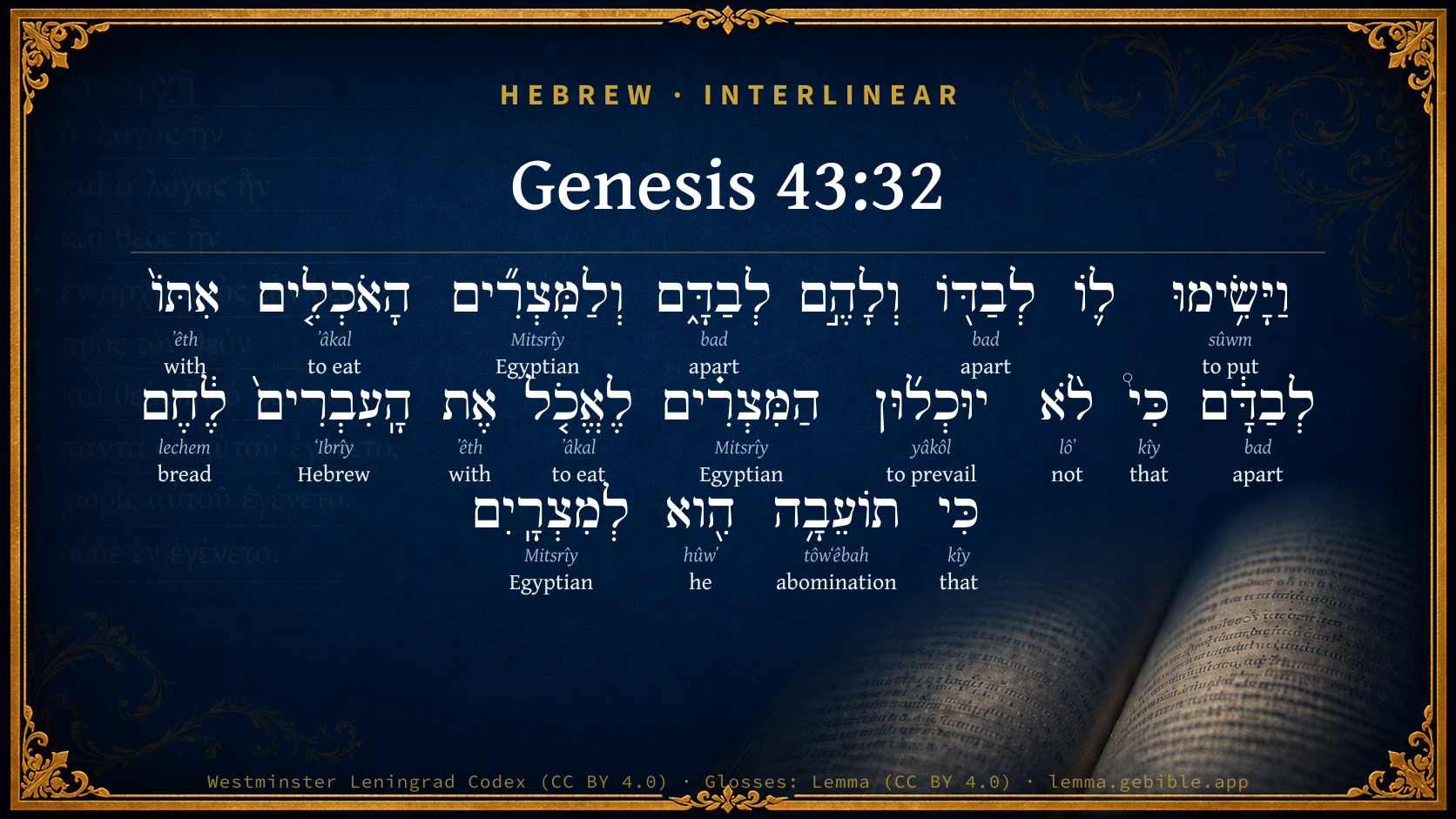
Hebrew (Westminster Leningrad Codex) Genesis 43:32 appears in the Hebrew Old Testament. The text above is from the Westminster Leningrad Codex. Each word links to its Strong’s number, a concise gloss, and parsing drawn from the Open Scriptures Hebrew Bible morphology. Click any word for its full Brown-Driver-Briggs (BDB) entry.
Download image
Cite this verse

Genesis 43:32 (World English Bible). Public Domain. Lemma interlinear Bible study tool, https://lemma.gebible.app/v/genesis/43/32.

Show BibTeX & RIS
BibTeX
RIS
English Translation
They served him by himself, and them by themselves, and the Egyptians, that ate with him, by themselves, because the Egyptians don't eat bread with the Hebrews, for that is an abomination to the Egyptians.
World English Bible · Public Domain
Highlights
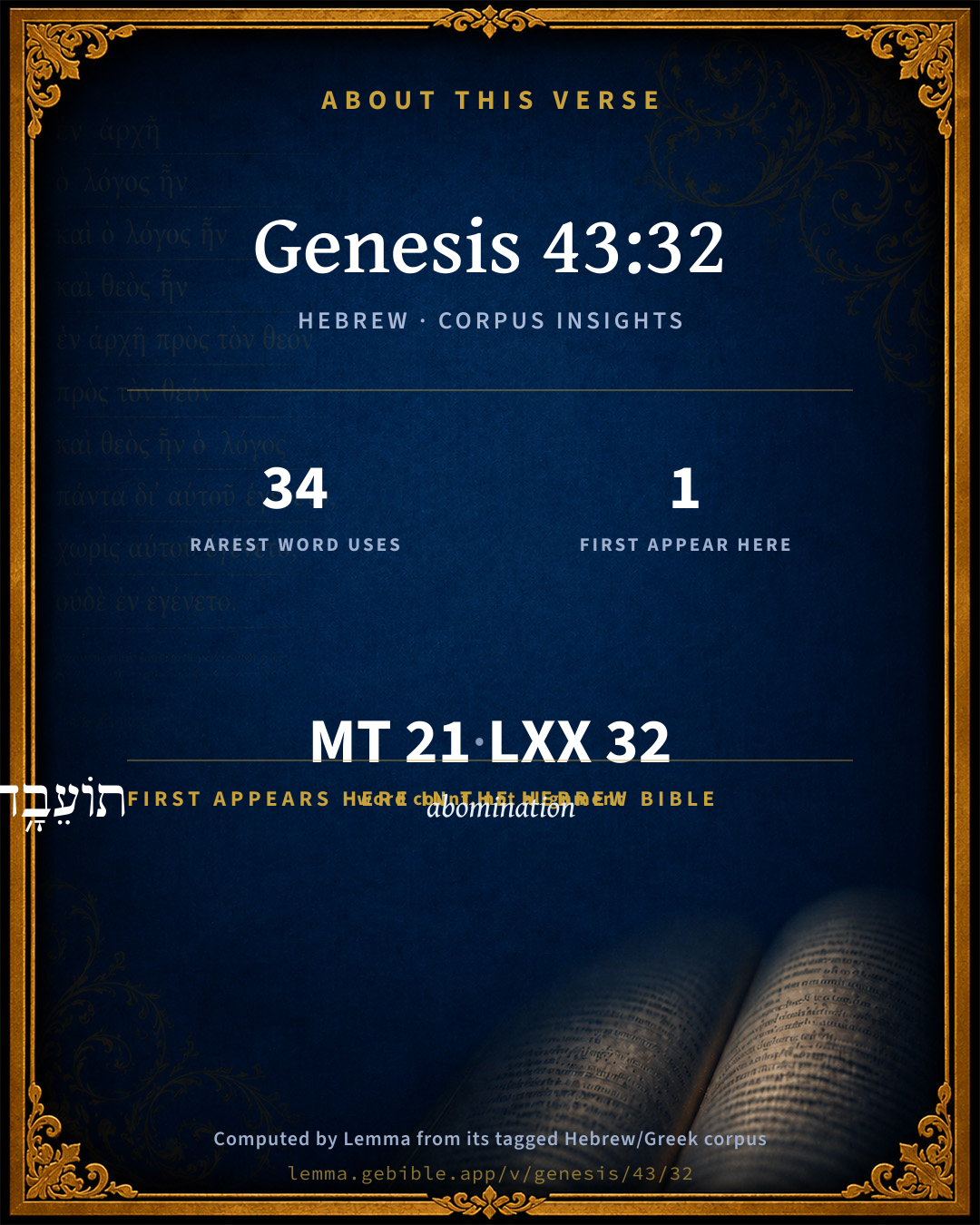
  • 1 first appearance in the Hebrew Bible
Full analysis ↓
Download a study sheet

One document with this verse’s original text, its word-by-word gloss line, the meaning frame, cross-references with their text, attributed commentary, and full source and license credits — printable, and it pastes into notes with its structure intact.

This verse Autodidact and up

Study sheet (.html) Plain text (.txt)

A passage Seminary Student

Up to 50 verses in one chapter. A passage sheet keeps up to 6 commentary sources and 12 cross-references per verse, in the order this page ranks them, and says so on the sheet whenever that leaves anything out. Ask for a single verse and you get the Autodidact verse sheet above.

Everything on this page stays free to read, with no account — the sheet is a download of what is already on screen, not access to it.

Want to remove ads? Support Godless Engineer
Compare translations 3

The same verse in 3 English versions, stacked beneath the original-language interlinear above. Click any original word for its lexicon entry.

Each is an independent rendering of the whole verse — the interlinear is not word-aligned to these translations.

Highlighted words mark where these versions differ — a whole-verse word diff, not a word-by-word alignment.

  • World English Bible Public Domain
    They served him by himself, and them by themselves, and the Egyptians, that ate with him, by themselves, because the Egyptians don't eat bread with the Hebrews, for that is an abomination to the Egyptians.
  • King James Version Public Domain
    And they set on for him by himself, and for them by themselves, and for the Egyptians, which did eat with him, by themselves: because the Egyptians might not eat bread with the Hebrews; for that is an abomination unto the Egyptians.
  • unfoldingWord Literal Text CC BY-SA 4.0
    So they served to him by himself, and to them by themselves, and to the Egyptians who were eating with him by themselves, because Egyptians cannot eat bread with Hebrews, because that an abomination to Egyptians.

unfoldingWord Literal Text — © unfoldingWord, licensed CC BY-SA 4.0. Word-aligned USFM3 via Door43 (git.door43.org/unfoldingWord/en_ult).

Versions to compare (up to 4)

3 of 4 selected

Show all 18 translations

Every available English version of this verse, each an independent rendering of the whole verse.

  • World English Bible Public Domain
    They served him by himself, and them by themselves, and the Egyptians, that ate with him, by themselves, because the Egyptians don't eat bread with the Hebrews, for that is an abomination to the Egyptians.
  • Berean Standard Bible Public Domain
    They separately served Joseph, his brothers, and the Egyptians. They ate separately because the Egyptians would not eat with the Hebrews, since that was detestable to them.
  • Majority Standard Bible Public Domain
    They separately served Joseph, his brothers, and the Egyptians. They ate separately because the Egyptians would not eat with the Hebrews, since that was detestable to them.
  • King James Version Public Domain
    And they set on for him by himself, and for them by themselves, and for the Egyptians, which did eat with him, by themselves: because the Egyptians might not eat bread with the Hebrews; for that is an abomination unto the Egyptians.
  • American Standard Version (1901) Public Domain
    And they set on for him by himself, and for them by themselves, and for the Egyptians, that did eat with him, by themselves: because the Egyptians might not eat bread with the Hebrews; for that is an abomination unto the Egyptians.
  • Revised Version (1885) Public Domain
    And they set on for him by himself, and for them by themselves, and for the Egyptians, which did eat with him, by themselves: because the Egyptians might not eat bread with the Hebrews; for that is an abomination unto the Egyptians.
  • Geneva Bible (1599) Public Domain
    And they prepared for him by himselfe, and for them by themselues, and for the Egyptians, which did eate with him, by themselues, because the Egyptians might not eate bread with the Ebrewes: for that was an abomination vnto the Egyptians.
  • Douay-Rheims (1899) Public Domain
    And when it was set on, for Joseph apart, and for his brethren apart, for the Egyptians also that ate with him, apart, (for it is unlawful for the Egyptians to eat with the Hebrews, and they think such a feast profane:)
  • Young's Literal Translation Public Domain
    And they place for him by himself, and for them by themselves, and for the Egyptians who are eating with him by themselves: for the Egyptians are unable to eat bread with the Hebrews, for it `is' an abomination to the Egyptians.
  • Literal Standard Version CC BY-SA 4.0
    And they place for him by himself, and for them by themselves, and for the Egyptians who are eating with him by themselves: for the Egyptians are unable to eat bread with the Hebrews, for it [is] an abomination to the Egyptians.
  • Unlocked Literal Bible CC BY-SA 4.0
    The servants served Joseph by himself and the brothers by themselves. The Egyptians there ate with him by themselves because the Egyptians could not eat bread with the Hebrews, for that is detestable to the Egyptians.
  • unfoldingWord Literal Text CC BY-SA 4.0
    So they served to him by himself, and to them by themselves, and to the Egyptians who were eating with him by themselves, because Egyptians cannot eat bread with Hebrews, because that an abomination to Egyptians.
  • Darby Bible Public Domain
    And they set on for him by himself, and for them by themselves, and for the Egyptians who ate with him by themselves; because the Egyptians might not eat bread with the Hebrews, for that is an abomination unto the Egyptians.
  • World Messianic Bible Public Domain
    They served him by himself, and them by themselves, and the Egyptians who ate with him by themselves, because the Egyptians don’t eat with the Hebrews, for that is an abomination to the Egyptians.
  • Webster's Bible Public Domain
    \\43:33\\And they sat before him, the first-born according to his birth-right, and the youngest according to his youth: and the men wondered one at another.
  • Free Bible Version CC BY-SA 4.0
    Joseph was served at a table by himself, and his brothers were served at a separate table. The Egyptians were also served at another table, because Egyptians cannot eat with Hebrews because they find this repulsive.
  • Bible in Basic English Public Domain
    And they were all given their seats before him in order of birth, from the oldest to the youngest: so that they were looking at one another in wonder.
  • JPS Tanakh (1917) Public Domain
    And they set on for him by himself, and for them by themselves, and for the Egyptians, that did eat with him, by themselves; because the Egyptians might not eat bread with the Hebrews; for that is an abomination unto the Egyptians.

Literal Standard Version (2020), Covenant Press — licensed CC BY-SA 4.0. Text via the HelloAO Bible API (eBible.org). Unlocked Literal Bible (unfoldingWord) — licensed CC BY-SA 4.0. Text via the HelloAO Bible API (eBible.org). unfoldingWord Literal Text — © unfoldingWord, licensed CC BY-SA 4.0. Word-aligned USFM3 via Door43 (git.door43.org/unfoldingWord/en_ult). Free Bible Version, Dr. Jonathan Gallagher — licensed CC BY-SA 4.0. Text via the HelloAO Bible API (eBible.org).

Word by word

More ways to search: Search by grammar → Find every occurrence → Compare this word →

Practice this passage: Drill this verse → Learn its vocabulary →

הָֽעִבְרִים֙
ʻIbrîy
H5680
“the · Hebrews”
Particle, Definite Article + Noun, Gentilic, Masculine, Plural, Absolute
Part of Speech
Particle + Noun
Type
Gentilic
Gender
Masculine
Number
Plural
State
Absolute
Full BDB Definition

Origin: patronymic from H5677

TWOT: None

Hebrew = "one from beyond" - a designation of the patriarchs and the Israelites (noun proper) - a designation of the patriarchs and the Israelites (adjective)
  1. וַיָּשִׂ֥ימוּ sûwm H7760 “and · to put” Conjunction + Verb, Qal, Sequential Imperfect, 3rd Person, Masculine, Plural
  2. לְבַדּ֖וֹ bad H905 “to/for · apart · his” Preposition + Noun, Common, Masculine, Singular, Construct + Suffix, Personal, 3rd Person, Masculine, Singular
  3. לְבַדָּ֑ם bad H905 “to/for · apart · their” Preposition + Noun, Common, Masculine, Singular, Construct + Suffix, Personal, 3rd Person, Masculine, Plural
  4. וְלַמִּצְרִ֞ים Mitsrîy H4713 “and · to/for the · Egyptians” Conjunction + Preposition, Determined + Noun, Gentilic, Masculine, Plural, Absolute
  5. הָאֹכְלִ֤ים ʼâkal H398 “the · eating” Particle, Definite Article + Verb, Qal, Participle Active, Masculine, Plural, Absolute
  6. אִתּוֹ֙ ʼêth H854 “with · him” Preposition + Suffix, Personal, 3rd Person, Masculine, Singular
  7. לְבַדָּ֔ם bad H905 “to/for · apart · their” Preposition + Noun, Common, Masculine, Singular, Construct + Suffix, Personal, 3rd Person, Masculine, Plural
  8. כִּי֩ kîy H3588 “that” Conjunction
  9. לֹ֨א lôʼ H3808 “not” Particle, Negative
  10. יוּכְל֜וּן yâkôl H3201 “to prevail” Verb, Qal, Imperfect, 3rd Person, Masculine, Plural + Suffix, n
  11. הַמִּצְרִ֗ים Mitsrîy H4713 “the · Egyptians” Particle, Definite Article + Noun, Gentilic, Masculine, Plural, Absolute
  12. לֶאֱכֹ֤ל ʼâkal H398 “to eat” Preposition + Verb, Qal, Infinitive Construct
  13. אֶת ʼêth H854 “with” Preposition
  14. לֶ֔חֶם lechem H3899 “bread” Noun, Common, Both, Singular, Absolute
  15. כִּי kîy H3588 “that” Conjunction
  16. תוֹעֵבָ֥ה tôwʻêbah H8441 “abomination” Noun, Common, Feminine, Singular, Absolute
  17. הִ֖וא hûwʼ H1931 “he” Pronoun, Personal, 3rd Person, Feminine, Singular
  18. לְמִצְרָֽיִם Mitsrîy H4713 “to/for · Egyptian” Preposition + Noun, Proper

About this verse

These counts appear in no published source. They are computed here, from the morphology-tagged text and Lemma’s own curated glosses. What Lemma adds →

21
words
12
distinct lemmas
Pentateuch
section

First appearance in Scripture

This word makes its first canonical appearance in the Hebrew Bible here:

  • תוֹעֵבָ֥ה abomination H8441

Shared distinctive vocabulary

הָֽעִבְרִים֙ Hebrew H5680 occurs in 32 verses of the Hebrew Bible. Also found in:

Grammatical profile

  • 4 verbs
  • 9 nouns
  • 1 pronoun
  • 4 prepositions
  • 2 conjunctions
  • 1 particle

Verb forms

  • וַיָּשִׂ֥ימוּ Qal · Sequential Imperfect
  • הָאֹכְלִ֤ים Qal · Participle Active
  • יוּכְל֜וּן Qal · Imperfect
  • לֶאֱכֹ֤ל Qal · Infinitive Construct

Repetition

Words recur within this verse — often emphatic in Hebrew:

  • לְבַדּ֖וֹ apart H905 ×3
  • וְלַמִּצְרִ֞ים Egyptian H4713 ×3
  • הָאֹכְלִ֤ים to eat H398 ×2
  • אִתּוֹ֙ with H854 ×2
  • כִּי֩ that H3588 ×2

Hebrew & Septuagint length

In English translation the verse runs 35 words from the Hebrew and 40 from the Septuagint (LXX English) — closely comparable.

A rough comparison of the two English renderings, which tokenize alike — not a word-level alignment.

Word counts can differ between the Hebrew and the Greek without any difference in meaning — e.g. the Hebrew direct-object marker אֵת has no separate Greek word, and Greek often adds the article ὁ.

In the original languages it is 21 Hebrew tokens and 32 Greek tokens — but the two are counted differently (Hebrew bundles its prefixes and suffixes into one token; the Greek is in lemma form), so that isn’t a like-for-like length.

Cross-references

4

Topical passages linked to Genesis 43:32 in the Treasury of Scripture Knowledge — connected by theme and wording, ordered by reader-vote popularity; previews shown in the World English Bible.

  • Genesis 46:34 that you shall say, 'Your servants have been keepers of cattle from our youth even until now, both we, and our fathers:' that you may dwell in the land of Goshen; for every shepherd is an abomination to the Egyptians."
  • Exodus 8:26 Moses said, "It isn't appropriate to do so; for we shall sacrifice the abomination of the Egyptians to Yahweh our God. Behold, shall we sacrifice the abomination of the Egyptians before their eyes, and won't they stone us?
  • Genesis 31:54 Jacob offered a sacrifice in the mountain, and called his relatives to eat bread. They ate bread, and stayed all night in the mountain.
  • Genesis 43:16 When Joseph saw Benjamin with them, he said to the steward of his house, "Bring the men into the house, and butcher an animal, and make ready; for the men will dine with me at noon."

Cross-references courtesy of OpenBible.info (CC BY 4.0).

Hebrew and Greek witnesses Masoretic Hebrew ↔ Greek Septuagint

The same verse in the two great witnesses to the Old Testament, shown verse-for-verse.

These are two independent witnesses, not word-aligned to each other, and the Septuagint is shown in lemma (dictionary) form.

Hebrew Genesis 43:32 Masoretic · Westminster Leningrad Codex

וַיָּשִׂ֥ימוּ ל֛וֹ לְבַדּ֖וֹ וְלָהֶ֣ם לְבַדָּ֑ם וְלַמִּצְרִ֞ים הָאֹכְלִ֤ים אִתּוֹ֙ לְבַדָּ֔ם כִּי֩ לֹ֨א יוּכְל֜וּן הַמִּצְרִ֗ים לֶאֱכֹ֤ל אֶת הָֽעִבְרִים֙ לֶ֔חֶם כִּי תוֹעֵבָ֥ה הִ֖וא לְמִצְרָֽיִם

They served him by himself, and them by themselves, and the Egyptians, that ate with him, by themselves, because the Egyptians don't eat bread with the Hebrews, for that is an abomination to the Egyptians.

World English Bible · Public Domain

Greek LXX Genesis 43:32 Septuagint · lemma form

καί παρατίθημι αὐτός μόνος καί αὐτός κατά ἑαυτοῦ καί ὁ αἰγύπτιος ὁ συνδειπνέω μετά αὐτός κατά ἑαυτοῦ οὐ γάρ δύναμαι ὁ αἰγύπτιος συνἐσθίω μετά ὁ εβραῖος ἄρτος βδέλυγμα γάρ εἰμί ὁ αἰγύπτιος

And they set on bread for him alone, and for them by themselves, and for the Egyptians feasting with him by themselves, for the Egyptians could not eat bread with the Hebrews, for it is an abomination to the Egyptians.

LXX2012 (modern English Septuagint) · Public Domain

On this verse, Adam Clarke's Commentary discusses the Septuagint’s reading. Read the note in Commentary ↓

Hebrew: Westminster Leningrad Codex (CC BY 4.0). Greek: Septuagint (public domain); English from LXX2012 (modern English Septuagint) (Public Domain). How the Septuagint differs from the Hebrew →

Targum (Aramaic paraphrase)

2

The Targum is the ancient Jewish Aramaic paraphrase of the Hebrew Scriptures — an interpretive translation, not the Hebrew text itself. Onkelos (literal) and Pseudo-Jonathan (expansive) render the Torah, and Jonathan the Prophets. Coverage is partial: where no permissively-licensed English translation exists for a verse, only the Aramaic is shown. This is verse-level text, not a word-by-word alignment to the Hebrew.

  1. Targum Onkelos Torah (Genesis–Deuteronomy)
    וְשַׁוִּיאוּ לֵהּ בִּלְחוֹדוֹהִי וּלְהוֹן בִּלְחוֹדֵיהוֹן וּלְמִצְרָאֵי דְּאָכְלִין עִמֵּהּ בִּלְחוֹדֵיהוֹן אֲרֵי לָא יָכְלִין מִצְרָאֵי לְמֵיכַל עִם עִבְרָאֵי לַחְמָא אֲרֵי בְעִירָא דְּמִצְרָאֵי דָחֲלִין לֵהּ עִבְרָאֵי אָכְלִין

    (no public-domain English translation for this verse)

    Targum Onkelos — Aramaic: “Onkelos Genesis” (public domain); “Onkelos Exodus” (public domain); “Onkelos Leviticus” (public domain); “Onkelos Numbers” (public domain); “Onkelos Deuteronomy” (public domain). English: “Sefaria Community Translation” (CC0 1.0 (public-domain dedication)); “J.W. Etheridge. The Targums of Onkelos and Jonathan Ben Uzziel on the Pentateuch. London: Longmans, Green, 1862” (public domain). Text via Sefaria.

  2. Targum Pseudo-Jonathan Torah (Genesis–Deuteronomy)
    וְשַׁוִיוּ לֵיהּ בִּלְחוֹדוֹי וּלְהוֹן בִּלְחוֹדֵיהוֹן וּלְמִצְרָאֵי דְאָכְלִין עִמֵיהּ בִּלְחוֹדֵיהוֹן אֲרוּם לָא כַשְׁרִין מִצְרָאֵי לְמֵיכוֹל עִם יְהוּדָאֵי לַחְמָא אֲרוּם בְּעִירָא דְמִצְרָאֵי דַחְלִין לֵיהּ יְהוּדָאֵי אָכְלִין

    And they set for him by himself, and for them by themselves, and for the Mizraee who ate with him by themselves; for it was not proper for the Mizraee to eat bread with the Yehudaee, because the animals which the Mizraee worshipped the Yehudaee ate.

    Targum Pseudo-Jonathan — Aramaic: “Targum Jonathan on Genesis” (public domain); “Targum Jonathan on Exodus” (public domain); “Targum Jonathan on Leviticus” (public domain); “Targum Jonathan on Numbers” (public domain); “Targum Jonathan on Deuteronomy” (public domain). English: “The Targum of Jonathan ben Uzziel, trans. J. W. Etheridge, London, 1862” (public domain). Text via Sefaria.

Commentary

Notes on Genesis 43:32 from classic Christian and Jewish commentators (each source and its license shown beneath its notes). The classic Christian expositions comment on the surrounding passage and are grouped to its opening verse, so a note may address several verses; the Jewish commentaries on the Tanakh (Rashi and others) are per-verse, so they appear only where the commentator wrote on this verse.

Lemma curates 59 commentaries, every one of them public domain or Creative Commons licensed, each selected and text-cleaned for this edition rather than reprinted as found. About our sources →

Trapp's Complete Commentary

John Trapp

Gen 43:32 And they set on for him by himself, and for them by themselves, and for the Egyptians, which did eat with him, by themselves: because the Egyptians might not eat bread with the Hebrews; for that [is] an abomination unto the Egyptians.

Ver. 32. Because the Egyptians might not eat, &c.] Such was their pride and superstition. Such was the hatred between the Jews and Samaritans: as is little less at this day between Papists and Protestants. If a Protestant give thanks at his food, though this chaseth not a Catholic from his dinner, which were to his loss, yet he must forbear to say Amen to it. As on the other side, some Roman Catholics will not say grace, though it be at their own table, when a Protestant is present; thinking it better to leave God unserved, than that a Protestant join in serving him. {a} They hold us no better than dogs, worse than Turks or Jews, damned heretics, cursed captives, unworthy to live on God’s ground, fit for nothing but fire and fagot. Certain it is, that whosoever in this new faith and service hath ended this life, is in hell most certainly, saith Bristow, in his 36th Motive. It cannot be that a Lutheran so dying can escape the damnation of hell, saith Coster the Jesuit; if I lie, let me be damned with Lucifer. {b} Are not God’s Hebrews an utter abomination now to these Romish Egyptians?

{a} Sandys’s Relation of West. Relig., sec. 32.

{b} Coster, Resp. ad Enchirid. Osiand., propos. 8.

John Trapp, A Commentary or Exposition upon All the Books of the Old and New Testament (1647–1656) — public domain. Text from a community e-Sword module.

Joseph Benson's Commentary

Gen 43:32. That is an abomination to the Egyptians — The most generally received opinion has been, according to the paraphrases of Onkelos and Jonathan, that the reason of this was the Hebrews eating the animals which the Egyptians held sacred. To this must be added, however, that the Egyptians were addicted to such superstitious ceremonies in dressing and eating their victuals, that they could not endure to sit at table with persons of other nations. According to Herodotus, it was not only to the Hebrews that they had such an aversion, for he assures us they would not use the pots or knives of the Grecians about their food, lest these utensils should have been defiled with cutting or containing the flesh of those animals which they accounted sacred. There is some reason, notwithstanding, to think that these superstitions had not begun to prevail in Joseph’s days, and that the cause of this abhorrence must be sought for in the difference of the civil rather than the religious manners of the two nations.

Joseph Benson's Commentary on the Old and New Testaments (1811–1818) — public domain. Text from a community e-Sword module.

Geneva Bible (1599)

Geneva Bible translators

To signify his dignity.

The nature of the superstitious is to condemn all others in respect of themselves.

Geneva Bible (1599) marginal notes — public domain. Text via Bolls.life.

Jamieson, Fausset & Brown

Robert Jamieson, A. R. Fausset & David Brown

Egyptians might not eat bread with the Hebrews; for that is an abomination--The prejudice probably arose from the detestation in which, from the oppressions of the shepherd-kings, the nation held all of that occupation.

Jamieson, Fausset & Brown — Commentary Critical and Explanatory on the Whole Bible (1871) — public domain (CC PDM 1.0). Text via the HelloAO Bible API.

Adam Clarke's Commentary

Verse 32. They set on for him by himself, c.] From the text it appears evident that there were three tables, one for Joseph, one for the Egyptians, and one for the eleven brethren.

The Egyptians might not eat bread with the Hebrews] There might have been some political reason for this, with which we are unacquainted but independently of this, two may be assigned.

1. The Hebrews were shepherds; and Egypt had been almost ruined by hordes of lawless wandering banditti, under the name of Hycsos, or King-shepherds, who had but a short time before this been expelled from the land by Amasis, after they had held it in subjection for 259 years, according to Manetho, committing the most wanton cruelties.

2. The Hebrews sacrificed those animals which the Egyptians held sacred, and fed on their flesh.

The Egyptians were in general very superstitious, and would have no social intercourse with people of any other nation; hence we are informed that they would not even use the knife of a Greek, because they might have reason to suspect it had cut the flesh of some of those animals which they held sacred. Among the Hindoos different castes will not eat food cooked in the same vessel. If a person of another caste touch a cooking vessel, it is thrown away. Some are of opinion that the Egyptian idolatry, especially their worship of Apis under the figure of an ox, was posterior to the time of Joseph; ancient monuments are rather against this opinion, but it is impossible to decide either way. The clause in the Alexandrian Septuagint stands thus, Βδελυγμα γαρ εστιν τοις Αιγυπτιοις [πας ποιμην προβατων], "For [every shepherd] is an abomination to the Egyptians;" but this clause is probably borrowed from Ge 46:34, where it stands in the Hebrew as well as in the Greek. See Clarke on Ge 46:34.

Adam Clarke's Commentary on the Bible (1810–1826) — public domain. Text from a community e-Sword/MySword module.

John Calvin's Commentaries

32. Because the Egyptians might not eat, etc Moses says they might not eat with the Hebrews, because they abhorred it, as being unlawful. For seeing that their religion forbade it, they were so bound, that they could not do what they did not dare to do. This passage teaches us how great was the pride of that nation; for, whence did it arise that they so utterly detested the Hebrews, unless because they thought themselves alone to be pure and holy in the world, and acceptable to God? God, indeed, commands his worshipers to abstain from all the pollutions of the Gentiles. But it behoves any one who separates himself from others, to be himself pure and upright. Therefore superstitious persons vainly attempt to claim this privilege for themselves, seeing they carry their impurity within, and are destitute of sincerity. Superstition, also, is affected with another disease; namely, that it is full of pride, so that it despises all men, under the pretext that they are vicious. It is asked, however, whether the Egyptians were separated from Joseph, because they regarded him as polluted: for this the words of Moses seem to intimate. If this interpretation is received, then they esteemed their false religion so highly, that they did not scruple to load their governor with reproaches. I rather conjecture, that Joseph sat apart from them, for the sake of honor; since it would be absurd that they, who disdained to sit at the same table with him, should be invited as his guests. Therefore it is probable that this distinct order was made by Joseph himself, that he might maintain his own dignity; and yet that the sons of Jacob were not mixed with the Egyptians, because the former were an abomination to the latter. For though the origin of Joseph was known, yet he had so passed over to the Egyptians, that he had become as one of their body. For which reason, also, the king had given him a name, when he adorned him with the insignia of his office as chief governor. Now, when we see that the church of God was, at that time, so proudly despised by profane men, we need not wonder that we also, at the present day, are subjected to similar reproach. Meanwhile, we must endeavor to keep ourselves pure from the filth of the world, for the Lord’s sake; and yet this desire must be so at tempered, that we may be alienated from the vices, rather than from the persons of men. For on this account does God sanctify his children, that they may beware of the vices of the unbelievers among whom they are conversant; and nevertheless may allure, as many as are curable, to a participation of their piety. Two things are here to be attended to; first, that we may be fully persuaded of the genuineness of our faith; secondly, that our excessive and fruitless fastidiousness may not entirely alienate many from the Lord, who otherwise might have been won. For we are not expressly commanded so to abhor the wicked, as not eat with them; but to avoid such association as may subject us to the same yoke. Besides, this passage confirms what I have before said, that the Hebrews had derived their name, not from their passing over the river; (as some falsely imagine,) but from their ancestor Heber. Nor was the fame of a single small and distantly situated family, sufficiently celebrated in Egypt, to become the cause of public dissension.

John Calvin's Commentaries (1540-1563) — public domain. Text from the Calvin Translation Society English edition (1840s-50s) via the Christian Classics Ethereal Library (ccel.org). Calvin's coverage is partial (roughly two-thirds of the Bible); uncommented books and verses are honest gaps, never fabricated. The 19th-century editor's footnotes and remarks are omitted so the notes are faithfully Calvin's own voice.

Ellicott's Commentary for English Readers

(32) By himself . . . by themselves.—These caste distinctions were common in ancient times, and still exist in India. Joseph probably had his food served separately because of his high rank; but the word “abomination” shows that eating with foreigners was shunned by the Egyptians for religious considerations. Herodotus (ii. 41) says that the Greeks were equally the objects of their dislike, and that the use even of a Greek knife would render food, otherwise clean, polluted in the eyes of the Egyptians.

A Bible Commentary for English Readers, edited by Charles John Ellicott (1878–1897) — public domain. Text from a community e-Sword module.

The Cambridge Bible for Schools and Colleges

gen. ed. J. J. S. Perowne

32. because the Egyptians … with the Hebrews] Egyptian exclusiveness was proverbial. Their priests were not allowed to eat or drink anything that had come from a foreign country (Porph. iv. 7). Herodotus (ii. 41) mentions that no Egyptian would use any utensil belonging to a Greek. It is noticeable in this passage that Joseph did not eat with the Egyptians. The natural reason for this is not, as some have supposed, because Joseph was a member of the family of a priest (Gen_41:45), or even because he was a Hebrew, but on account of his position as the Grand Vizier.

an abomination] The technical term expressing that which was abhorrent and a source of ceremonial pollution. Cf. Gen_46:34; Exo_8:26. LXX βδέλυγμα; Lat. profanum.

The Cambridge Bible for Schools and Colleges (gen. ed. J. J. S. Perowne; Cambridge University Press, 1878–1918) — public domain. Text from a community e-Sword module.

John Gill's Exposition

And they sat before him,.... At a table, so placed that they were in his sight, and he had a full view of them:

the firstborn according to his birthright, and the youngest according to his youth; everyone according to his age, Reuben, the firstborn, first, and so on to Benjamin the youngest: thus they placed themselves as they used to be in their father's family, or they were so placed by Joseph; and if this was the case, it may be a reason, and a principal one, of what follows:

and the men marvelled one at another; not the Egyptians, the guests of Joseph, seeing eleven brethren placed in this manner, and these being Hebrews, taken so much notice of; but Joseph's brethren, who either wondered at the manner of their being seated so regular, according to their age; or at the honour done them to dine with the governor, and at the grandeur of the entertainment, and at the separate manner in which the governor, and the nobles of Egypt, sat at meals; or at what follows.

John Gill's Exposition of the Whole Bible (1746–1763) — public domain (CC PDM 1.0). Text via the HelloAO Bible API.

Haydock's Catholic Bible Commentary

Hebrews. "They had the same aversion for all who did not adopt their superstition." (Porphyrius, Abstin. iv.) Herod. ii. 41, says, that would not use a knife which had been in the hands of a Greek, nor kiss him. This aversion arose, from their custom of abstaining from various meats which other nations eat. (Chaldean; &c.) They disliked the Hebrews, because they were also shepherds, chap. xlvi. 34 (Calmet); and because they knew they were accustomed to eat goats, oxen, and sheep, the objects of adoration in Egypt, (Exodus viii. 26): though they were not, probably, served upon Joseph’s table. (Tirinus) --- They who dwelt in the towns could not bear even the Egyptian shepherds, because they were of a more stirring and warlike temper. (Calmet) (Cunæus)

George Leo Haydock (1774–1849), Haydock's Catholic Family Bible and Commentary, 1859 edition — public domain. Excludes Psalms (Douay-Rheims chapter numbering differs from Protestant) and Deuterocanonical books (Catholic canon only).

Matthew Poole's English Annotations

They set on for him by himself; partly because the dignity of his place, and the custom of princes, required this state; and partly for the reason here following.

That is an abomination unto the Egyptians; not so much from their pride and disdain of other people, as from their superstition and idolatry; partly because they worshipped the creatures which the Hebrews and others did commonly eat; and partly because of some peculiar rites and customs which they had in the dressing and ordering of their diet. Whence Herodotus affirms, that the Egyptians would not use the pots nor knives of the Grecians about their food. Compare Gen 46:34. See there, Exo 8:26.

Matthew Poole's English Annotations on the Holy Bible (1683–1685) — public domain. Text from a community e-Sword/MySword module.

Whedon's Commentary on the Bible

Daniel D. Whedon

32. For him by himself — He thus maintained his distinction of rank and caste, and conformed to Egyptian ideas and customs.

Egyptians might not eat bread with the Hebrews — Herodotus (ii, 41) says: “No Egyptian, man or woman, will kiss a Grecian on the mouth, or use the knife, spit, or caldron of a Greek, or taste the flesh of a pure ox that has been divided by a Grecian knife.” This same fear of contamination was doubtless held with regard to other nations as well as the Greeks. The Egyptians held in abomination those who slaughtered cows and oxen, animals which they held in highest reverence. Hence it was that they despised shepherds. Gen_46:34.

Daniel D. Whedon (gen. ed.), Commentary on the Old and New Testaments (1874–1909) — public domain. Text from a community e-Sword module.

The Pulpit Commentary

And they set on for him by himself, and for them by themselves, and for the Egyptians, which did eat with him, by themselves. "Joseph eats apart from his brethren, keeping strictly to the Egyptian mode; and the history does not omit to remark that in this point he adhered to the custom of the country" (Havernick, 21). Because the Egyptians might not eat bread with the Hebrews. Herodotus (2:41) affirms that the Egyptians would neither use the knife, spit, or basin of a Grecian, nor taste the flesh of a clean cow if it happened to be cut with a Grecian knife. For that is an abomination unto the Egyptians. The reason for this separation from foreigners being that they dreaded being polluted by such as killed and ate cows, which animals were held in high veneration in Egypt.

The Pulpit Commentary (1880–1919), ed. H.D.M. Spence-Jones & Joseph S. Exell — public domain. Text from a community e-Sword module.

unfoldingWord translationNotes

Door43 World Missions Community

The servants served Joseph by himself and the brothers by themselves. The Egyptians there ate with him by themselves

This means that Joseph, the brothers, and the other Egyptians are eating in three different places within the same room. AT: "The servants served Joseph by himself and the brothers by themselves and the Egyptians, who were eating with him, by themselves"

The Egyptians there ate with him by themselves

These are probably other Egyptian officials who ate with Joseph, but they still sat separately from him and the Hebrew brothers.

because the Egyptians could not eat bread with the Hebrews, for that is detestable to the Egyptians

This can be translated as a new sentence: "They did this because the Egyptians thought it was shameful to eat with the Hebrews"

could not eat bread

Here "bread" stands for food in general. (See: Synecdoche)

The brothers sat before him

It is implied that Joseph had arranged where each brother would sit. You can make clear the implied information. AT: "The brothers sat across from the man, according to how he arranged their places" (See: Assumed Knowledge and Implicit Information)

the firstborn according to his birthright, and the youngest according to his youth

The "firstborn" and the "youngest" are used together to mean all the brothers were sitting in order according to their age. (See: Merism)

The men were astonished together

"The men were very surprised when they realized this"

But Benjamin's portion was five times as much as any of his brothers

The phrase "five times" can be stated more generally. AT: "But Benjamin received a portion that was much bigger than what his brothers received"

translationWords

servant

Joseph (OT)

Egypt

bread

Hebrew

detest

firstborn

birthright

amazed

unfoldingWord translationNotes — © Distant Shores Media and the Door43 World Missions Community, licensed CC BY-SA 4.0. Source: git.door43.org/Door43/en_tn.

Rashi

Rabbi Shlomo Yitzchaki (Rashi)

כי תועבה היא FOR THAT IS AN ABOMINATION — it is a hateful thing to the Egyptians to eat together with the Hebrews. Onkelos states a reason for this.

Rashi on the Tanakh — English translations: “The Judaica Press complete Tanach with Rashi, translated by A. J. Rosenberg” (CC BY 4.0); “Pentateuch with Rashi's commentary by M. Rosenbaum and A.M. Silbermann, 1929-1934” (public domain); “The Metsudah Tanach series, Lakewood, N.J” (CC BY 4.0); and “The Book of Joshua, Metsudah Publications, 1997” (CC BY 4.0). Text via Sefaria.

Radak

Rabbi David Kimhi (Radak)

וישימו לו לבדו, they served him separately as a symbol of his exalted position.

ולהם לבדם, ולמצרים לבדם, and the brothers separately, and the Egyptians separately again, כי לא יוכלון, for the Hebrews were eating meat, as we know from the instructions to slaughter meat which had been issued in verse 15. Egyptians did not eat sheep or goats, and the only reason they raised these animals was for their wool and their milk. [According to Rashi and evidence cited in Torah Shleymah 92,5, the reason why the Egyptians did not eat sheep was that they considered sheep a deity, and it was inconceivable for them to consume their deities.]

Radak on the Tanakh — English translations: “Sefaria Community Translation” (CC0 1.0 (public-domain dedication)); “Eliyahu Munk, HaChut Hameshulash” (CC BY 4.0); “Rabbi Mike Feuer, Jerusalem Anthology” (CC BY 4.0); and “R. David Kimhi on the first book of Psalms, Translated by R.G. Finch, London, 1919” (public domain). Text via Sefaria.

Lesson kit

Teaching starters — assembled from the data on this page, not authored interpretation. Every prompt links to the verse data it draws on. Edit before teaching.

Genesis, in the Pentateuch, opens this verse with 21 words (12 distinct Hebrew lemmas). Its most distinctive word is ʻIbrîy (“Hebrew”). A historical commentator’s framing appears above. Read the whole chapter for the surrounding context.

Discussion questions

  1. What does “Hebrew” (ʻIbrîy) contribute to the verse as a whole?
  2. The word “abomination” first appears here in Scripture. What is being introduced at this debut?
  3. Genesis 14:13 shares the word «Hebrew» with this verse. How do the two illuminate each other?
  4. “apart” occurs 3× in this one verse. What is the effect of the repetition?
  5. These translations render this verse differently; the difference is in the English rendering, not the original. What questions does that raise?
  6. The verb «וַיָּשִׂ֥ימוּ» is Qal Sequential Imperfect. How does its form color the action?
  7. Reading how Trapp's Complete Commentary and Joseph Benson's Commentary read this verse, where do the two commentators agree and where do they part?

Things to notice

Reading settings

Reading text

Shown beneath each verse's original-language words.

Old Testament
Old Testament edition

Read the OT as the Masoretic Hebrew (MT) or the Greek Septuagint (LXX).

English shown for the Greek Septuagint (in the Hebrew ↔ Greek comparison).

Comparing translations? Open the Compare panel on any verse page to stack up to four side by side.