
Leviticus 26:5

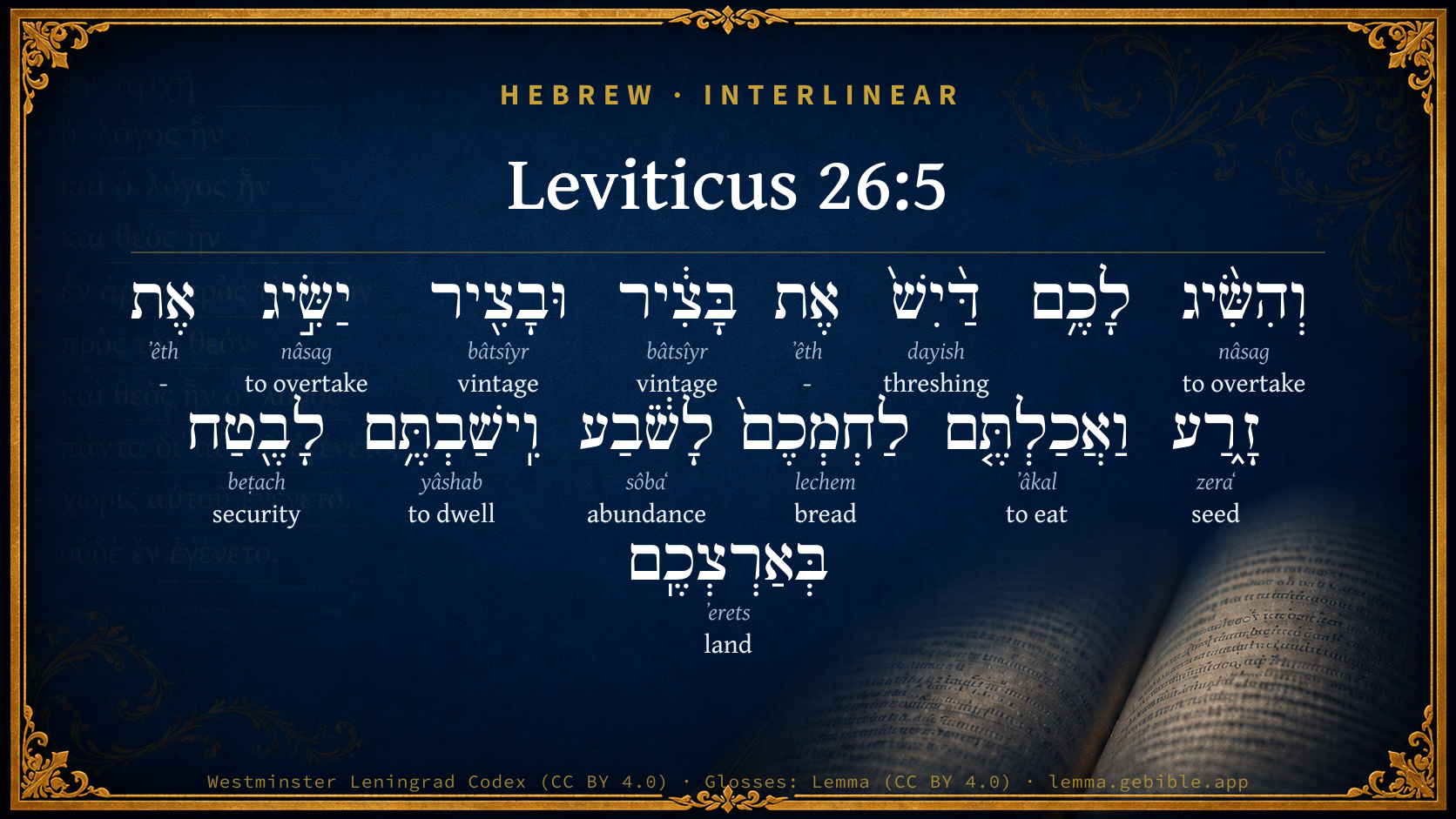
Hebrew (Westminster Leningrad Codex) Leviticus 26:5 appears in the Hebrew Old Testament. The text above is from the Westminster Leningrad Codex. Each word links to its Strong’s number, a concise gloss, and parsing drawn from the Open Scriptures Hebrew Bible morphology. Click any word for its full Brown-Driver-Briggs (BDB) entry.
Download image
Cite this verse

Leviticus 26:5 (World English Bible). Public Domain. Lemma interlinear Bible study tool, https://lemma.gebible.app/v/leviticus/26/5.

Show BibTeX & RIS
BibTeX
RIS
English Translation
Your threshing shall reach to the vintage, and the vintage shall reach to the sowing time; and you shall eat your bread to the full, and dwell in your land safely.
World English Bible · Public Domain
Highlights
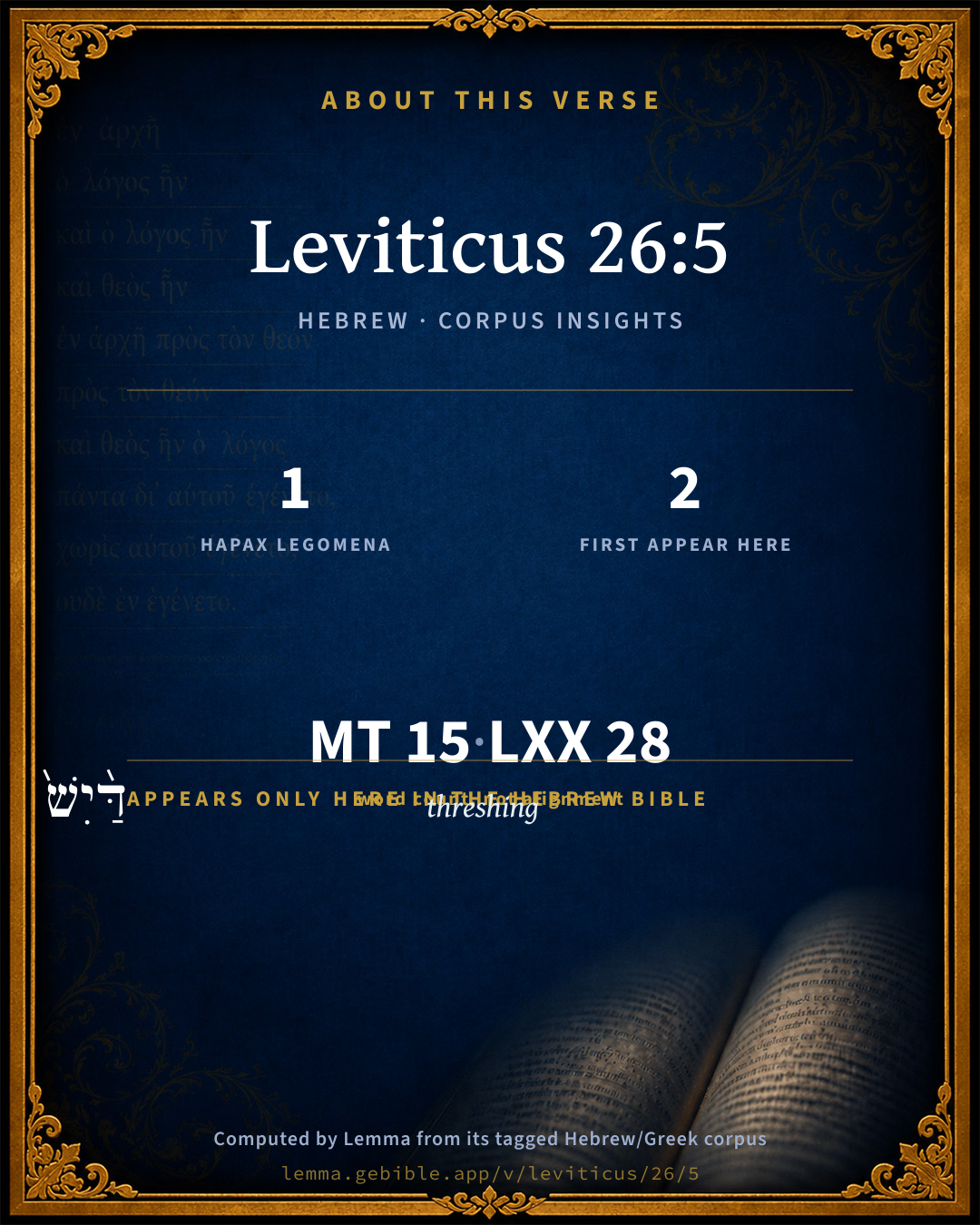
  • 1 hapax legomenon — only here in the Hebrew Bible
  • 2 first appearances in the Hebrew Bible
Full analysis ↓
Download a study sheet

One document with this verse’s original text, its word-by-word gloss line, the meaning frame, cross-references with their text, attributed commentary, and full source and license credits — printable, and it pastes into notes with its structure intact.

This verse Autodidact and up

Study sheet (.html) Plain text (.txt)

A passage Seminary Student

Up to 50 verses in one chapter. A passage sheet keeps up to 6 commentary sources and 12 cross-references per verse, in the order this page ranks them, and says so on the sheet whenever that leaves anything out. Ask for a single verse and you get the Autodidact verse sheet above.

Everything on this page stays free to read, with no account — the sheet is a download of what is already on screen, not access to it.

Want to remove ads? Support Godless Engineer
Compare translations 3

The same verse in 3 English versions, stacked beneath the original-language interlinear above. Click any original word for its lexicon entry.

Each is an independent rendering of the whole verse — the interlinear is not word-aligned to these translations.

Highlighted words mark where these versions differ — a whole-verse word diff, not a word-by-word alignment.

  • World English Bible Public Domain
    Your threshing shall reach to the vintage, and the vintage shall reach to the sowing time; and you shall eat your bread to the full, and dwell in your land safely.
  • King James Version Public Domain
    And your threshing shall reach unto the vintage, and the vintage shall reach unto the sowing time: and ye shall eat your bread to the full, and dwell in your land safely.
  • unfoldingWord Literal Text CC BY-SA 4.0
    And threshing will reach grape harvest for you, and grape harvest will reach seed, and you will eat your bread to satisfaction, and you will dwell in security in your land.

unfoldingWord Literal Text — © unfoldingWord, licensed CC BY-SA 4.0. Word-aligned USFM3 via Door43 (git.door43.org/unfoldingWord/en_ult).

Versions to compare (up to 4)

3 of 4 selected

Show all 18 translations

Every available English version of this verse, each an independent rendering of the whole verse.

  • World English Bible Public Domain
    Your threshing shall reach to the vintage, and the vintage shall reach to the sowing time; and you shall eat your bread to the full, and dwell in your land safely.
  • Berean Standard Bible Public Domain
    Your threshing will continue until the grape harvest, and the grape harvest will continue until sowing time; you will have your fill of food to eat and will dwell securely in your land.
  • Majority Standard Bible Public Domain
    Your threshing will continue until the grape harvest, and the grape harvest will continue until sowing time; you will have your fill of food to eat and will dwell securely in your land.
  • King James Version Public Domain
    And your threshing shall reach unto the vintage, and the vintage shall reach unto the sowing time: and ye shall eat your bread to the full, and dwell in your land safely.
  • American Standard Version (1901) Public Domain
    And your threshing shall reach unto the vintage, and the vintage shall reach unto the sowing time; and ye shall eat your bread to the full, and dwell in your land safely.
  • Revised Version (1885) Public Domain
    And your threshing shall reach unto the vintage, and the vintage shall reach unto the sowing time: and ye shall eat your bread to the full, and dwell in your land safely.
  • Geneva Bible (1599) Public Domain
    And your threshing shall reache vnto the vintage, and the vintage shall reache vnto sowing time, and you shall eate your bread in plenteousnesse, and dwell in your land safely.
  • Douay-Rheims (1899) Public Domain
    The threshing of your harvest shall reach unto the vintage, and the vintage shall reach unto the sowing time: and you shall eat your bread to the full, and dwell in your land without fear.
  • Young's Literal Translation Public Domain
    and reached to you hath the threshing, the gathering, and the gathering doth reach the sowing-`time'; and ye have eaten your bread to satiety, and have dwelt confidently in your land.
  • Literal Standard Version CC BY-SA 4.0
    and the threshing has reached to you, [and] the gathering, and the gathering reaches the sowing-[time]; and you have eaten your bread to satiety, and have dwelt confidently in your land.
  • Unlocked Literal Bible CC BY-SA 4.0
    Your threshing will continue to the time of the grape harvest, and the grape harvest will extend to the planting season. You will eat your bread to the full and live safely where you make your home in the land.
  • unfoldingWord Literal Text CC BY-SA 4.0
    And threshing will reach grape harvest for you, and grape harvest will reach seed, and you will eat your bread to satisfaction, and you will dwell in security in your land.
  • Darby Bible Public Domain
    and your threshing shall reach unto the vintage, and the vintage shall reach unto the sowing-time; and ye shall eat your bread to the full, and dwell in your land securely.
  • World Messianic Bible Public Domain
    Your threshing shall continue until the vintage, and the vintage shall continue until the sowing time. You shall eat your bread to the full, and dwell in your land safely.
  • Webster's Bible Public Domain
    And your threshing shall reach to the vintage, and the vintage shall reach to the sowing time; and ye shall eat your bread to the full, and dwell in your land safely.
  • Free Bible Version CC BY-SA 4.0
    Your time of threshing will last right up to the grape harvest, and the grape harvest until the time you have to sow again. You will have more than enough to eat and you will live in safety in your land.
  • Bible in Basic English Public Domain
    And the crushing of the grain will overtake the cutting of the grapes, and the cutting of the grapes will overtake the planting of the seed, and there will be bread in full measure, and you will be living in your land safely.
  • JPS Tanakh (1917) Public Domain
    And your threshing shall reach unto the vintage, and the vintage shall reach unto the sowing time; and ye shall eat your bread until ye have enough, and dwell in your land safely.

Literal Standard Version (2020), Covenant Press — licensed CC BY-SA 4.0. Text via the HelloAO Bible API (eBible.org). Unlocked Literal Bible (unfoldingWord) — licensed CC BY-SA 4.0. Text via the HelloAO Bible API (eBible.org). unfoldingWord Literal Text — © unfoldingWord, licensed CC BY-SA 4.0. Word-aligned USFM3 via Door43 (git.door43.org/unfoldingWord/en_ult). Free Bible Version, Dr. Jonathan Gallagher — licensed CC BY-SA 4.0. Text via the HelloAO Bible API (eBible.org).

Word by word

More ways to search: Search by grammar → Find every occurrence → Compare this word →

Practice this passage: Drill this verse → Learn its vocabulary →

דַּ֨יִשׁ֙
dayish
H1786
“threshing”
Noun, Common, Masculine, Singular, Absolute
Part of Speech
Noun
Type
Common
Gender
Masculine
Number
Singular
State
Absolute
Full BDB Definition

Origin: from H1758

TWOT: 419a

threshing (the process)
  1. וְהִשִּׂ֨יג nâsag H5381 “and · to overtake” Conjunction + Verb, Hiphil, Sequential Perfect, 3rd Person, Masculine, Singular
  2. אֶת ʼêth H853 “-” Particle, Direct Object
  3. בָּצִ֔יר bâtsîyr H1210 “vintage” Noun, Common, Masculine, Singular, Absolute
  4. וּבָצִ֖יר bâtsîyr H1210 “and · vintage” Conjunction + Noun, Common, Masculine, Singular, Absolute
  5. יַשִּׂ֣יג nâsag H5381 “to overtake” Verb, Hiphil, Imperfect, 3rd Person, Masculine, Singular
  6. אֶת ʼêth H853 “-” Particle, Direct Object
  7. זָ֑רַע zeraʻ H2233 “seed” Noun, Common, Masculine, Singular, Absolute
  8. וַאֲכַלְתֶּ֤ם ʼâkal H398 “and · to eat” Conjunction + Verb, Qal, Sequential Perfect, 2nd Person, Masculine, Plural
  9. לַחְמְכֶם֙ lechem H3899 “bread · your” Noun, Common, Both, Singular, Construct + Suffix, Personal, 2nd Person, Masculine, Plural
  10. לָשֹׂ֔בַע sôbaʻ H7648 “to/for · abundance” Preposition + Noun, Common, Masculine, Singular, Absolute
  11. וִֽישַׁבְתֶּ֥ם yâshab H3427 “and · to dwell” Conjunction + Verb, Qal, Sequential Perfect, 2nd Person, Masculine, Plural
  12. לָבֶ֖טַח beṭach H983 “to/for · security” Preposition + Noun, Common, Masculine, Singular, Absolute
  13. בְּאַרְצְכֶֽם ʼerets H776 “in/at · land · your” Preposition + Noun, Common, Both, Singular, Construct + Suffix, Personal, 2nd Person, Masculine, Plural

About this verse

These counts appear in no published source. They are computed here, from the morphology-tagged text and Lemma’s own curated glosses. What Lemma adds →

15
words
11
distinct lemmas
Pentateuch
section

Notable vocabulary

1 hapax legomenon — a word that appears only here in the entire Hebrew Bible:

  • דַּ֨יִשׁ֙ threshing H1786

First appearance in Scripture

These words make their first canonical appearance in the Hebrew Bible here:

  • דַּ֨יִשׁ֙ threshing H1786
  • בָּצִ֔יר vintage H1210

Shared distinctive vocabulary

בָּצִ֔יר vintage H1210 occurs in 6 verses of the Hebrew Bible. Also found in:

Grammatical profile

  • 4 verbs
  • 8 nouns
  • 1 preposition
  • 2 particles

Verb forms

  • וְהִשִּׂ֨יג Hiphil · Sequential Perfect
  • יַשִּׂ֣יג Hiphil · Imperfect
  • וַאֲכַלְתֶּ֤ם Qal · Sequential Perfect
  • וִֽישַׁבְתֶּ֥ם Qal · Sequential Perfect

Repetition

Words recur within this verse — often emphatic in Hebrew:

  • וְהִשִּׂ֨יג to overtake H5381 ×2
  • בָּצִ֔יר vintage H1210 ×2

Hebrew & Septuagint length

In English translation the verse runs 31 words from the Hebrew and 41 from the Septuagint (LXX English) — closely comparable.

A rough comparison of the two English renderings, which tokenize alike — not a word-level alignment.

Word counts can differ between the Hebrew and the Greek without any difference in meaning — e.g. the Hebrew direct-object marker אֵת has no separate Greek word, and Greek often adds the article ὁ.

In the original languages it is 15 Hebrew tokens and 28 Greek tokens — but the two are counted differently (Hebrew bundles its prefixes and suffixes into one token; the Greek is in lemma form), so that isn’t a like-for-like length.

Cross-references

20

Topical passages linked to Leviticus 26:5 in the Treasury of Scripture Knowledge — connected by theme and wording, ordered by reader-vote popularity; previews shown in the World English Bible.

  • Amos 9:13 "Behold, the days come," says Yahweh, "That the plowman shall overtake the reaper, And the one treading grapes him who sows seed; And sweet wine will drip from the mountains, And flow from the hills.
  • Joel 2:26 You will have plenty to eat, and be satisfied, And will praise the name of Yahweh, your God, Who has dealt wondrously with you; And my people will never again be disappointed.
  • Joel 2:19 Yahweh answered his people, "Behold, I will send you grain, new wine, and oil, And you will be satisfied with them; And I will no more make you a reproach among the nations.
  • Leviticus 25:18–19 "'Therefore you shall do my statutes, and keep my ordinances and do them; and you shall dwell in the land in safety.
  • Deuteronomy 11:15 I will give grass in your fields for your cattle, and you shall eat and be full.
  • Psalms 91:1–14 He who dwells in the secret place of the Most High Will rest in the shadow of the Almighty.
  • Proverbs 1:33 But whoever listens to me will dwell securely, And will be at ease, without fear of harm."
  • Ezekiel 34:25–28 I will make with them a covenant of peace, and will cause evil animals to cease out of the land; and they shall dwell securely in the wilderness, and sleep in the woods.
  • 1 Timothy 6:17 Charge those who are rich in this present world that they not be haughty, nor have their hope set on the uncertainty of riches, but on the living God, who richly provides us with everything to enjoy;
  • Exodus 16:8 Moses said, "Now Yahweh shall give you meat to eat in the evening, and in the morning bread to satisfy you; because Yahweh hears your murmurings which you murmur against him. And who are we? Your murmurings are not against us, but against Yahweh."
  • Job 11:18–19 You shall be secure, because there is hope; Yes, you shall search, and shall take your rest in safety.
  • Psalms 46:1–7 God is our refuge and strength, A very present help in trouble.
  • Psalms 90:1 Lord, you have been our dwelling place for all generations.
  • Proverbs 18:10 The name of Yahweh is a strong tower: The righteous run to him, and are safe.
  • Jeremiah 23:6 In his days Judah shall be saved, and Israel shall dwell safely; and this is his name by which he shall be called: Yahweh our righteousness.
  • Matthew 9:37–38 Then he said to his disciples, "The harvest indeed is plentiful, but the laborers are few.
  • Matthew 23:37 "Jerusalem, Jerusalem, who kills the prophets, and stones those who are sent to her! How often would I have gathered your children together, even as a hen gathers her chickens under her wings, and you would not!
  • John 4:35–36 Don't you say, 'There are yet four months until the harvest?' Behold, I tell you, lift up your eyes, and look at the fields, that they are white for harvest already.
  • Acts 14:17 Yet he didn't leave himself without witness, in that he did good and gave you rains from the sky and fruitful seasons, filling our hearts with food and gladness."
  • 1 Peter 1:5 who by the power of God are guarded through faith for a salvation ready to be revealed in the last time.

Cross-references courtesy of OpenBible.info (CC BY 4.0).

Hebrew and Greek witnesses Masoretic Hebrew ↔ Greek Septuagint

The same verse in the two great witnesses to the Old Testament, shown verse-for-verse.

These are two independent witnesses, not word-aligned to each other, and the Septuagint is shown in lemma (dictionary) form.

Hebrew Leviticus 26:5 Masoretic · Westminster Leningrad Codex

וְהִשִּׂ֨יג לָכֶ֥ם דַּ֨יִשׁ֙ אֶת בָּצִ֔יר וּבָצִ֖יר יַשִּׂ֣יג אֶת זָ֑רַע וַאֲכַלְתֶּ֤ם לַחְמְכֶם֙ לָשֹׂ֔בַע וִֽישַׁבְתֶּ֥ם לָבֶ֖טַח בְּאַרְצְכֶֽם

Your threshing shall reach to the vintage, and the vintage shall reach to the sowing time; and you shall eat your bread to the full, and dwell in your land safely.

World English Bible · Public Domain

Greek LXX Leviticus 26:5 Septuagint · lemma form

καί καταλαμβάνω σύ ὁ ἀλοητός ὁ τρύγητος καί ὁ τρύγητος καταλαμβάνω ὁ σπόρος καί ἐσθίω ὁ ἄρτος σύ εἰς πλησμονή καί καταοἰκέω μετά ἀσφάλεια ἐπί ὁ γῆ σύ

And your threshing time shall overtake the vintage, and your vintage shall overtake your seed time; and you⌃ shall eat your bread to the full; and you⌃ shall dwell safely upon your land, and war shall not go through your land.

LXX2012 (modern English Septuagint) · Public Domain

Hebrew: Westminster Leningrad Codex (CC BY 4.0). Greek: Septuagint (public domain); English from LXX2012 (modern English Septuagint) (Public Domain). How the Septuagint differs from the Hebrew →

Targum (Aramaic paraphrase)

2

The Targum is the ancient Jewish Aramaic paraphrase of the Hebrew Scriptures — an interpretive translation, not the Hebrew text itself. Onkelos (literal) and Pseudo-Jonathan (expansive) render the Torah, and Jonathan the Prophets. Coverage is partial: where no permissively-licensed English translation exists for a verse, only the Aramaic is shown. This is verse-level text, not a word-by-word alignment to the Hebrew.

  1. Targum Onkelos Torah (Genesis–Deuteronomy)
    וִיעָרַע לְכוֹן דְיָשָׁא יָת קְטָפָא וּקְטָפָא יְעָרַע לְאַפּוֹקֵי בַר זַרְעָא וְתֵיכְלוּן לַחְמְכוֹן לְמִשְׂבַּע וְתֵיתְבוּן לְרָחְצָן בְּאַרְעַכוֹן

    (no public-domain English translation for this verse)

    Targum Onkelos — Aramaic: “Onkelos Genesis” (public domain); “Onkelos Exodus” (public domain); “Onkelos Leviticus” (public domain); “Onkelos Numbers” (public domain); “Onkelos Deuteronomy” (public domain). English: “Sefaria Community Translation” (CC0 1.0 (public-domain dedication)); “J.W. Etheridge. The Targums of Onkelos and Jonathan Ben Uzziel on the Pentateuch. London: Longmans, Green, 1862” (public domain). Text via Sefaria.

  2. Targum Pseudo-Jonathan Torah (Genesis–Deuteronomy)
    וְיֶאֱרַע לְכוֹן דַרְכָא יַת קִטְפָא וְקִטְפָא יֶאֱרַע אַפְקוּת בַּר זַרְעָא וְתֵיכְלוּן לַחְמֵיכוֹן וְתִשְבְּעוּן וְתֵתְבוּן לְרוֹחֲצָן בְּאַרְעֲכוֹן

    And with you the threshing shall reach to the vintage, and the vintage unto the springing of the seed, and you shall eat your bread and be satisfied, and dwell securely in your land.

    Targum Pseudo-Jonathan — Aramaic: “Targum Jonathan on Genesis” (public domain); “Targum Jonathan on Exodus” (public domain); “Targum Jonathan on Leviticus” (public domain); “Targum Jonathan on Numbers” (public domain); “Targum Jonathan on Deuteronomy” (public domain). English: “The Targum of Jonathan ben Uzziel, trans. J. W. Etheridge, London, 1862” (public domain). Text via Sefaria.

Commentary

Notes on Leviticus 26:5 from classic Christian and Jewish commentators (each source and its license shown beneath its notes). The classic Christian expositions comment on the surrounding passage and are grouped to its opening verse, so a note may address several verses; the Jewish commentaries on the Tanakh (Rashi and others) are per-verse, so they appear only where the commentator wrote on this verse.

Lemma curates 59 commentaries, every one of them public domain or Creative Commons licensed, each selected and text-cleaned for this edition rather than reprinted as found. About our sources →

Trapp's Complete Commentary

John Trapp

Lev 26:5 And your threshing shall reach unto the vintage, and the vintage shall reach unto the sowing time: and ye shall eat your bread to the full, and dwell in your land safely.

Ver. 5. Dwell in your land safely.] Confidently, fiducially, as boldly relying upon God’s protection.

John Trapp, A Commentary or Exposition upon All the Books of the Old and New Testament (1647–1656) — public domain. Text from a community e-Sword module.

Joseph Benson's Commentary

Lev 26:5. Threshing shall reach unto the vintage, &c. — That is, you shall have such plenty of corn, that before you shall have reaped and threshed it out, the vintage will be ready; and before you shall have pressed out your wine it will be time to sow again. Thus they should scarcely have time enough to receive one blessing before another came upon them. A similar promise is made Amo 9:13; The ploughman shall overtake the reaper, and the treader of grapes him that soweth seed.

Joseph Benson's Commentary on the Old and New Testaments (1811–1818) — public domain. Text from a community e-Sword module.

Tyndale Open Study Notes

Tyndale Open Resources

26:5 Israel’s restoration following captivity also promised a harvest so plentiful that it would run over into the time of planting (see Amos 9:13; Joel 3:18).

Tyndale Open Study Notes — © Tyndale Open Resources, licensed CC BY-SA 4.0. Text via the HelloAO Bible API.

Jamieson, Fausset & Brown

Robert Jamieson, A. R. Fausset & David Brown

your threshing shall reach unto the vintage, and the vintage shall reach unto the sowing time, &c.--The barley harvest in Judea was about the middle of April; the wheat harvest about six weeks after, or in the beginning of June. After the harvest came the vintage, and fruit gathering towards the latter end of July. Moses led the Hebrews to believe that, provided they were faithful to God, there would be no idle time between the harvest and vintage, so great would be the increase. (See Amo 9:13). This promise would be very animating to a people who had come from a country where, for three months, they were pent up without being able to walk abroad because the fields were under water.

Jamieson, Fausset & Brown — Commentary Critical and Explanatory on the Whole Bible (1871) — public domain (CC PDM 1.0). Text via the HelloAO Bible API.

Adam Clarke's Commentary

Verse 5. Your threshing shall reach unto the vintage] According to Pliny, Hist. Nat., l. xviii., c. 18, the Egyptians reaped their barley six months, and their oats seven months, after seed time; for they sowed all their grain about the end of summer, when the overflowings of the Nile had ceased. It was nearly the same in Judaea: they sowed their corn and barley towards the end of autumn, and about the month of October; and they began their barley-harvest after the passover, about the middle of March; and in one month or six weeks after, about pentecost, they began that of their wheat. After their wheat-harvest their vintage commenced. Moses here leads the Hebrews to hope, if they continued faithful to God, that between their harvest and vintage, and between their vintage and seed-time, there should be no interval, so great should the abundance be; and these promises would appear to them the more impressive, as they had just now come out of a country where the inhabitants were obliged to remain for nearly three months shut up within their cities, because the Nile had then inundated the whole country. See Calmet.

"This is a nervous and beautiful promise of such entire plenty of corn and wine, that before they could have reaped and threshed out their corn the vintage should be ready, and before they could have pressed out their wine it would be time to sow again. The Prophet Amos, Am 9:13 expresses the same blessing in the same manner: The ploughman shall overtake the reaper, and the treader of grapes him who soweth seed." - Dodd.

Adam Clarke's Commentary on the Bible (1810–1826) — public domain. Text from a community e-Sword/MySword module.

Ellicott's Commentary for English Readers

(5) And your threshing shall reach unto the vintage.—That is, the corn crop shall be so plentiful that those who shall be employed in threshing about the month of March will not complete it before the vintage, which was about the month of July.

The vintage shall reach unto the sowing time.—The wine, again, is to be so abundant that those who shall be engaged in gathering and pressing the grapes will not be able to finish before the sowing time again arrives, which is about the month of October. A similar promise is made by Amos: “the plowman shall overtake the reaper, and the treader of grapes him who sowed seed” (Amo_9:13).

A Bible Commentary for English Readers, edited by Charles John Ellicott (1878–1897) — public domain. Text from a community e-Sword module.

The Cambridge Bible for Schools and Colleges

gen. ed. J. J. S. Perowne

5. Such shall be the abundant yield of cereals and wine that the ingathering will be continuous from the commencement of harvest till the time arrives for sowing the next crop. Cp. Amo_9:13.

The Cambridge Bible for Schools and Colleges (gen. ed. J. J. S. Perowne; Cambridge University Press, 1878–1918) — public domain. Text from a community e-Sword module.

John Gill's Exposition

And I will give peace in the land,.... Among yourselves, as Aben Ezra; that as safety from enemies is promised before, here it is assured they should be free from insurrections and from riots, broils, contentions, and civil wars among themselves:

and ye shall lie down, and none shall make you afraid; that is, lie down upon their beds, and sleep quietly and comfortably, and not be in any fear of thieves and robbers breaking in upon them, Psa 3:5,

and I will rid evil beasts out of the land: out of the land of Israel, as the Targum of Jonathan, not out of the world, such as lions, bears, wolves, &c. which were sometimes troublesome and mischievous in the land:

neither shall the sword go through your land; either the sword of the enemy, which if it entered should not be suffered to proceed, much less to pervade the land and destroy the inhabitants of it: so the Targum of Jonathan,"they that draw the sword shall not pass through your land,''or the sword of the Lord, that is, the pestilence, Ch1 21:12; as Ainsworth suggests; though the Jews (k) commonly understand it of the sword of peace, as they call it, though that is of one that is not an enemy, but passes through one country to destroy another; which yet is distressing to the country he passes through, as in the case of Pharaoh Necho, whom Josiah went out to meet, Ch2 35:20; though, by what follows, it seems rather to be the first of these.

(k) T. Bab. Taanith, fol. 22. 1. 2.

John Gill's Exposition of the Whole Bible (1746–1763) — public domain (CC PDM 1.0). Text via the HelloAO Bible API.

Haydock's Catholic Bible Commentary

Time. So great shall be the abundance, that you will scarcely have time to get all the work done before you will be called off to something else. (Haydock) --- These promises would be so much the more agreeable to them, as in Egypt they had been forced to keep in their houses two or three months together, on account of the overflowing of the Nile. In that country, as well as in Greece and Palestine, people sow both wheat and barley about October; while in other countries the latter is sown in spring. The harvest is ready in about six months, and that of wheat in seven. (Pliny, [Natural History?] xiii. 19.; Hesiod, ep. 2.) (Calmet)

George Leo Haydock (1774–1849), Haydock's Catholic Family Bible and Commentary, 1859 edition — public domain. Excludes Psalms (Douay-Rheims chapter numbering differs from Protestant) and Deuterocanonical books (Catholic canon only).

Matthew Poole's English Annotations

Your threshing shall reach unto the vintage, i.e. you shall have so plentiful a harvest, that you shall not be able to thresh out your corn in a little time, but that work will last till the vintage.

Matthew Poole's English Annotations on the Holy Bible (1683–1685) — public domain. Text from a community e-Sword/MySword module.

Whedon's Commentary on the Bible

Daniel D. Whedon

5. Threshing — The cereals of constant mention are wheat and barley, and more rarely rye and millet. Wheat was ripe at the pentecost, called also “the feast of harvest, the first fruits of thy labors.” The fifty days included the period of grain harvest, commencing with the offering of the first sheaf of the barley harvest in the passover, in April, and ending with that of the two first loaves made from the wheat harvest. So abundant would be the harvest that six months, from mid Nisan to mid Tisri, would be occupied in gathering the produce of the soil; first the harvesting and threshing of the grain and then the vintage, which would be prolonged till sowing time, about the autumnal equinox. See Amo_9:13, note. “The threshing comes between the reaping and the treading of grapes. Reaping is done in April, May, and June, and the vintage is in September and October. Hence the harvest, according to the promise, is to be so abundant that it will take several months to tread out the grain. And here, again, actual experience suggested the language of the prophecy. In very abundant seasons I have seen the threshing actually prolonged until October. Take the three promises together, and they spread over the entire year of the husbandman.” — Dr. W.M. Thomson.

Daniel D. Whedon (gen. ed.), Commentary on the Old and New Testaments (1874–1909) — public domain. Text from a community e-Sword module.

John Wesley's Explanatory Notes

The vintage - That is, you shall have so plentiful an harvest, that you shall not be able to thresh out your corn in a little time, but that work will last till the vintage.

John Wesley, Explanatory Notes Upon the Whole Bible (1754–1765) — public domain. Text via the GEBible commentary corpus.

unfoldingWord translationNotes

Door43 World Missions Community

will eat your bread to the full

Here bread represents food. "To the full" means until their stomachs were full of food. AT: "will eat food until you are full" or "will have plenty of food to eat" (See: Synecdoche and Idiom)

I will give peace in the land

"I will cause there to be peace in the land"

the sword will not pass through your land

Here the word "sword" represents enemy armies or enemy attacks. AT: "no armies will attack you" (See: Metonymy)

translationWords

thresh

grape

harvest

bread

life

peace

sword

unfoldingWord translationNotes — © Distant Shores Media and the Door43 World Missions Community, licensed CC BY-SA 4.0. Source: git.door43.org/Door43/en_tn.

Rashi

Rabbi Shlomo Yitzchaki (Rashi)

והשיג לכם דיש את בציר AND YOUR THRESHING SHALL REACH UNTO THE VINTAGE — This means that there will be plenty of threshing-work so that you will be busy with it till the vintage, and with the vintage you will be busy till the time of sowing (Sifra, Bechukotai, Chapter 1 7).

ואכלתם לחמכם לשבע AND YE SHALL EAT YOUR BREAD TO THE FULL — This means, one will eat only a little and it will become blessed in his bowels (will fully satisfy him) (Sifra, Bechukotai, Chapter 1 7; cf. Rashi on Leviticus 25:19).

Rashi on the Tanakh — English translations: “The Judaica Press complete Tanach with Rashi, translated by A. J. Rosenberg” (CC BY 4.0); “Pentateuch with Rashi's commentary by M. Rosenbaum and A.M. Silbermann, 1929-1934” (public domain); “The Metsudah Tanach series, Lakewood, N.J” (CC BY 4.0); and “The Book of Joshua, Metsudah Publications, 1997” (CC BY 4.0). Text via Sefaria.

Lesson kit

Teaching starters — assembled from the data on this page, not authored interpretation. Every prompt links to the verse data it draws on. Edit before teaching.

Leviticus, in the Pentateuch, opens this verse with 15 words (11 distinct Hebrew lemmas). Its most distinctive word is dayish (“threshing”). A historical commentator’s framing appears above. Read the whole chapter for the surrounding context.

Discussion questions

  1. How does “threshing” (dayish) shape what this verse is saying?
  2. 1 word here appears nowhere else in the Hebrew Bible. Why might the author reach for such rare wording?
  3. 2 words make their first appearance in Scripture here. What does this debut establish?
  4. How does Judges 8:2, which shares the word «vintage», read alongside this verse?
  5. What does the repetition of “to overtake” (2× in this one verse) do in this verse?
  6. These translations render this verse differently. What is at stake in choosing one wording over another?
  7. «וְהִשִּׂ֨יג» is a Hiphil Sequential Perfect verb. How does that grammatical form shape the action described?
  8. Compare how Trapp's Complete Commentary and Joseph Benson's Commentary read this verse. Where do they agree or differ?

Things to notice

  • 1 word in this verse appears nowhere else in the Hebrew Bible.
  • 2 words make their first canonical appearance in Scripture here.
  • This verse counts 15 Hebrew ↔ 28 Greek words.
  • These translations choose different wording for 13 words in this verse.
  • “to overtake” occurs 2× in this single verse.

Reading settings

Reading text

Shown beneath each verse's original-language words.

Old Testament
Old Testament edition

Read the OT as the Masoretic Hebrew (MT) or the Greek Septuagint (LXX).

English shown for the Greek Septuagint (in the Hebrew ↔ Greek comparison).

Comparing translations? Open the Compare panel on any verse page to stack up to four side by side.