1 Kings 17:11

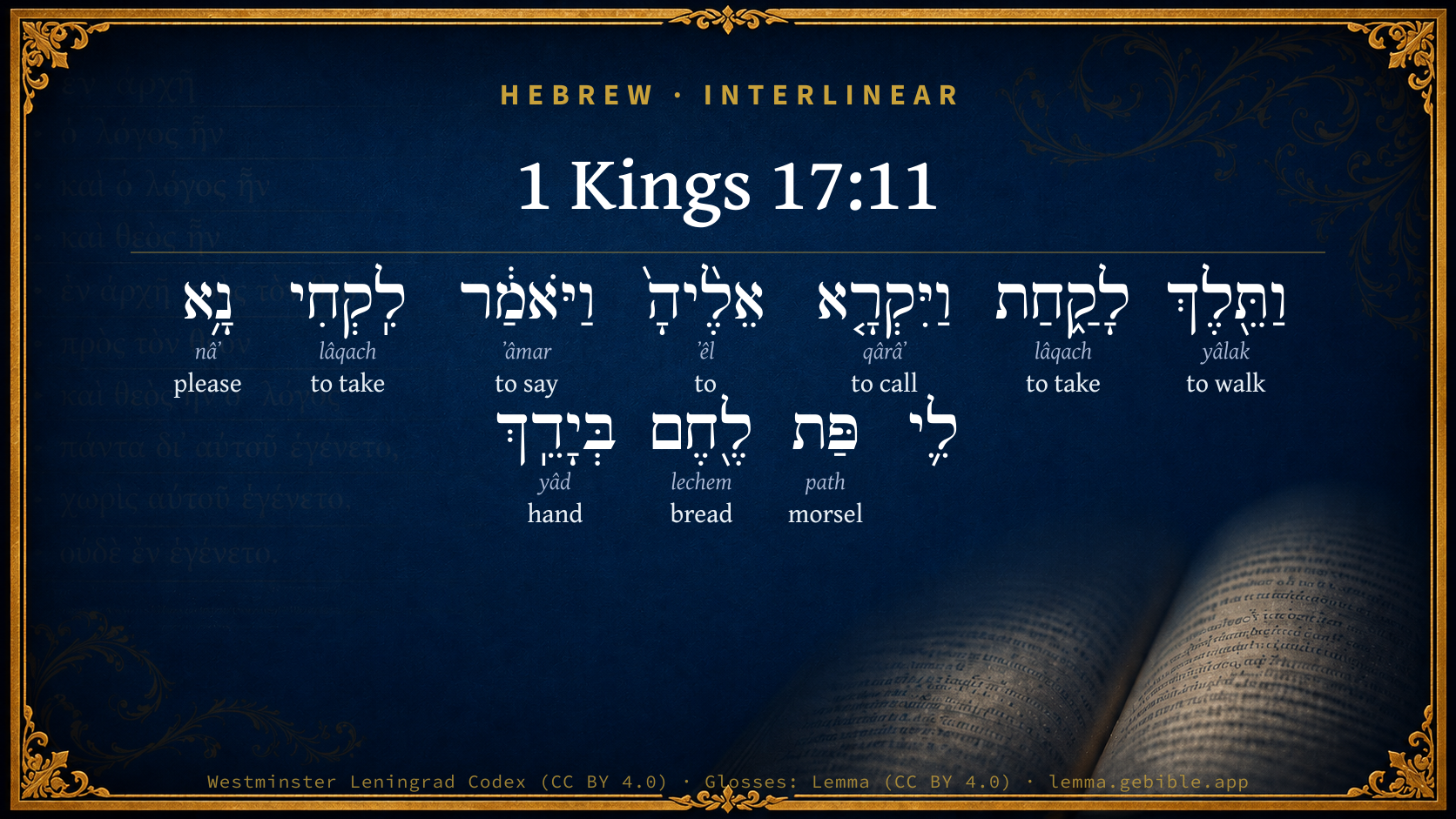
Hebrew (Westminster Leningrad Codex) 1 Kings 17:11 appears in the Hebrew Old Testament. The text above is from the Westminster Leningrad Codex. Each word links to its Strong’s number, a concise gloss, and parsing drawn from the Open Scriptures Hebrew Bible morphology. Click any word for its full Brown-Driver-Briggs (BDB) entry.
Download image
Cite this verse

1 Kings 17:11 (World English Bible). Public Domain. Lemma interlinear Bible study tool, https://lemma.gebible.app/v/1-kings/17/11.

Show BibTeX & RIS
BibTeX
RIS
English Translation
As she was going to get it, he called to her, and said, Please bring me a morsel of bread in your hand.
World English Bible · Public Domain
Download a study sheet

One document with this verse’s original text, its word-by-word gloss line, the meaning frame, cross-references with their text, attributed commentary, and full source and license credits — printable, and it pastes into notes with its structure intact.

This verse Autodidact and up

Study sheet (.html) Plain text (.txt)

A passage Seminary Student

Up to 50 verses in one chapter. A passage sheet keeps up to 6 commentary sources and 12 cross-references per verse, in the order this page ranks them, and says so on the sheet whenever that leaves anything out. Ask for a single verse and you get the Autodidact verse sheet above.

Everything on this page stays free to read, with no account — the sheet is a download of what is already on screen, not access to it.

Want to remove ads? Support Godless Engineer
Compare translations 3

The same verse in 3 English versions, stacked beneath the original-language interlinear above. Click any original word for its lexicon entry.

Each is an independent rendering of the whole verse — the interlinear is not word-aligned to these translations.

Highlighted words mark where these versions differ — a whole-verse word diff, not a word-by-word alignment.

  • World English Bible Public Domain
    As she was going to get it, he called to her, and said, Please bring me a morsel of bread in your hand.
  • King James Version Public Domain
    And as she was going to fetch it, he called to her, and said, Bring me, I pray thee, a morsel of bread in thine hand.
  • unfoldingWord Literal Text CC BY-SA 4.0
    And she went to take, and he called to her and said, “Please take to me a piece of bread in your hand.”

unfoldingWord Literal Text — © unfoldingWord, licensed CC BY-SA 4.0. Word-aligned USFM3 via Door43 (git.door43.org/unfoldingWord/en_ult).

Versions to compare (up to 4)

3 of 4 selected

Show all 18 translations

Every available English version of this verse, each an independent rendering of the whole verse.

  • World English Bible Public Domain
    As she was going to get it, he called to her, and said, Please bring me a morsel of bread in your hand.
  • Berean Standard Bible Public Domain
    And as she was going to get it, he called to her and said, “Please bring me a piece of bread.”
  • Majority Standard Bible Public Domain
    And as she was going to get it, he called to her and said, “Please bring me a piece of bread.”
  • King James Version Public Domain
    And as she was going to fetch it, he called to her, and said, Bring me, I pray thee, a morsel of bread in thine hand.
  • American Standard Version (1901) Public Domain
    And as she was going to fetch it, he called to her, and said, Bring me, I pray thee, a morsel of bread in thy hand.
  • Revised Version (1885) Public Domain
    And as she was going to fetch it, he called to her, and said, Bring me, I pray thee, a morsel of bread in thine hand.
  • Geneva Bible (1599) Public Domain
    And as she was going to fet it, he called to her, and sayde, Bring me, I pray thee, a morsell of bread in thine hand.
  • Douay-Rheims (1899) Public Domain
    And when she was going to fetch it he called after her, saying: Bring me also, I beseech thee, a morsel of bread in thy hand.
  • Young's Literal Translation Public Domain
    And she goeth to bring `it', and he calleth unto her and saith, `Bring, I pray thee, to me a morsel of bread in thy hand.'
  • Literal Standard Version CC BY-SA 4.0
    And she goes to bring [it], and he calls to her and says, “Please bring a morsel of bread to me in your hand.”
  • Unlocked Literal Bible CC BY-SA 4.0
    As she was going to get water he called to her, and said, “Please bring me a piece of bread in your hand.”
  • unfoldingWord Literal Text CC BY-SA 4.0
    And she went to take, and he called to her and said, “Please take to me a piece of bread in your hand.”
  • Darby Bible Public Domain
    And she went to fetch [it], and he called to her and said, Bring me, I pray thee, a morsel of bread in thy hand.
  • World Messianic Bible Public Domain
    As she was going to get it, he called to her and said, “Please bring me a morsel of bread in your hand.”
  • Webster's Bible Public Domain
    And as she was going to bring it, he called to her, and said, Bring me, I pray thee, a morsel of bread in thy hand.
  • Free Bible Version CC BY-SA 4.0
    As she was going to get it, he called after her and said, “Oh, and please bring me a piece of bread.”
  • Bible in Basic English Public Domain
    And when she was going to get it, he said to her, And get me with it a small bit of bread.
  • JPS Tanakh (1917) Public Domain
    And as she was going to fetch it, he called to her, and said: 'Bring me, I pray thee, a morsel of bread in thy hand.'

Literal Standard Version (2020), Covenant Press — licensed CC BY-SA 4.0. Text via the HelloAO Bible API (eBible.org). Unlocked Literal Bible (unfoldingWord) — licensed CC BY-SA 4.0. Text via the HelloAO Bible API (eBible.org). unfoldingWord Literal Text — © unfoldingWord, licensed CC BY-SA 4.0. Word-aligned USFM3 via Door43 (git.door43.org/unfoldingWord/en_ult). Free Bible Version, Dr. Jonathan Gallagher — licensed CC BY-SA 4.0. Text via the HelloAO Bible API (eBible.org).

Word by word

More ways to search: Search by grammar → Find every occurrence → Compare this word →

Practice this passage: Drill this verse → Learn its vocabulary →

פַּת
path
H6595
“morsel of”
Noun, Common, Feminine, Singular, Construct
Part of Speech
Noun
Type
Common
Gender
Feminine
Number
Singular
State
Construct
Full BDB Definition

Origin: from H6626

TWOT: 1862a

fragment, bit, morsel (of bread), piece
  1. וַתֵּ֖לֶךְ yâlak H3212 “and · to walk” Conjunction + Verb, Qal, Sequential Imperfect, 3rd Person, Feminine, Singular
  2. לָקַ֑חַת lâqach H3947 “to take” Preposition + Verb, Qal, Infinitive Construct
  3. וַיִּקְרָ֤א qârâʼ H7121 “and · to call” Conjunction + Verb, Qal, Sequential Imperfect, 3rd Person, Masculine, Singular
  4. אֵלֶ֨יהָ֙ ʼêl H413 “to · her” Preposition + Suffix, Personal, 3rd Person, Feminine, Singular
  5. וַיֹּאמַ֔ר ʼâmar H559 “and · to say” Conjunction + Verb, Qal, Sequential Imperfect, 3rd Person, Masculine, Singular
  6. לִֽקְחִי lâqach H3947 “take” Verb, Qal, Imperative, 2nd Person, Feminine, Singular
  7. נָ֥א nâʼ H4994 “please” Particle, Exhortation
  8. לֶ֖חֶם lechem H3899 “bread” Noun, Common, Both, Singular, Absolute
  9. בְּיָדֵֽךְ yâd H3027 “in/at · hand · your” Preposition + Noun, Common, Both, Singular, Construct + Suffix, Personal, 2nd Person, Feminine, Singular

About this verse

These counts appear in no published source. They are computed here, from the morphology-tagged text and Lemma’s own curated glosses. What Lemma adds →

11
words
9
distinct lemmas
Historical
section

Notable vocabulary

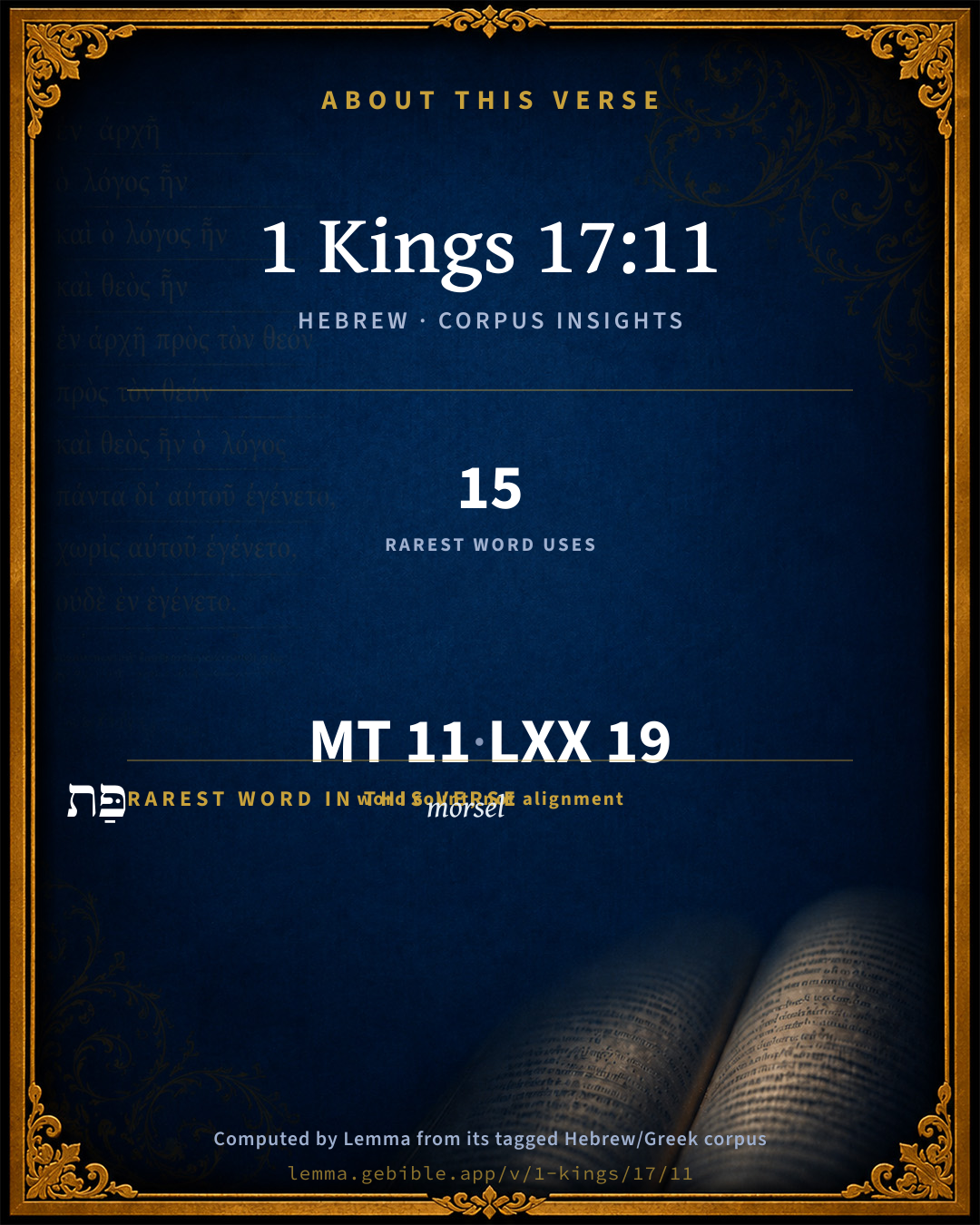
The rarest word here is פַּת morsel H6595 — appearing just 15 times in the whole Hebrew Bible.

Shared distinctive vocabulary

פַּת morsel H6595 occurs in 15 verses of the Hebrew Bible. Also found in:

Grammatical profile

  • 5 verbs
  • 3 nouns
  • 2 prepositions
  • 1 particle

Verb forms

  • וַתֵּ֖לֶךְ Qal · Sequential Imperfect
  • לָקַ֑חַת Qal · Infinitive Construct
  • וַיִּקְרָ֤א Qal · Sequential Imperfect
  • וַיֹּאמַ֔ר Qal · Sequential Imperfect
  • לִֽקְחִי Qal · Imperative

Repetition

A word recurs within this verse — often emphatic in Hebrew:

  • לָקַ֑חַת to take H3947 ×2

Hebrew & Septuagint length

In English translation the verse runs 23 words from the Hebrew and 28 from the Septuagint (LXX English) — closely comparable.

A rough comparison of the two English renderings, which tokenize alike — not a word-level alignment.

Word counts can differ between the Hebrew and the Greek without any difference in meaning — e.g. the Hebrew direct-object marker אֵת has no separate Greek word, and Greek often adds the article ὁ.

In the original languages it is 11 Hebrew tokens and 19 Greek tokens — but the two are counted differently (Hebrew bundles its prefixes and suffixes into one token; the Greek is in lemma form), so that isn’t a like-for-like length.

Cross-references

7

Topical passages linked to 1 Kings 17:11 in the Treasury of Scripture Knowledge — connected by theme and wording, ordered by reader-vote popularity; previews shown in the World English Bible.

  • Genesis 18:5 I will get a morsel of bread so you can refresh your heart. After that you may go your way, now that you have come to your servant." They said, "Very well, do as you have said."
  • Genesis 24:18–19 She said, "Drink, my lord." She hurried, and let down her pitcher on her hand, and gave him drink.
  • 1 Kings 17:9 Arise, get you to Zarephath, which belongs to Sidon, and dwell there: behold, I have commanded a widow there to sustain you.
  • 1 Kings 18:4 for it was so, when Jezebel cut off the prophets of Yahweh, that Obadiah took one hundred prophets, and hid them by fifty in a cave, and fed them with bread and water.)
  • Matthew 10:42 Whoever gives one of these little ones just a cup of cold water to drink in the name of a disciple, most assuredly I tell you he will in no way lose his reward."
  • Matthew 25:35–40 for I was hungry, and you gave me food to eat; I was thirsty, and you gave me drink; I was a stranger, and you took me in;
  • Hebrews 13:2 Don't forget to show hospitality to strangers, for in doing so, some have entertained angels without knowing it.

Cross-references courtesy of OpenBible.info (CC BY 4.0).

Hebrew and Greek witnesses Masoretic Hebrew ↔ Greek Septuagint

The same verse in the two great witnesses to the Old Testament, shown verse-for-verse.

These are two independent witnesses, not word-aligned to each other, and the Septuagint is shown in lemma (dictionary) form.

Hebrew 1 Kings 17:11 Masoretic · Westminster Leningrad Codex

וַתֵּ֖לֶךְ לָקַ֑חַת וַיִּקְרָ֤א אֵלֶ֨יהָ֙ וַיֹּאמַ֔ר לִֽקְחִי נָ֥א לִ֛י פַּת לֶ֖חֶם בְּיָדֵֽךְ

As she was going to get it, he called to her, and said, Please bring me a morsel of bread in your hand.

World English Bible · Public Domain

Greek LXX 1 Kings 17:11 Septuagint · lemma form

καί πορεύομαι λαμβάνω καί βοάω ὀπίσω αὐτός ηλιου καί εἶπον λαμβάνω δή ἐγώ ψωμός ἄρτος ἐν ὁ χείρ σύ

And she went to fetch it; and Eliu cried after her, and said, Bring me, I pray you, a morsel of the bread that is in your hand.

LXX2012 (modern English Septuagint) · Public Domain

On this verse, The Pulpit Commentary discusses the Septuagint’s reading. Read the note in Commentary ↓

Hebrew: Westminster Leningrad Codex (CC BY 4.0). Greek: Septuagint (public domain); English from LXX2012 (modern English Septuagint) (Public Domain). How the Septuagint differs from the Hebrew →

Targum (Aramaic paraphrase)

1

The Targum is the ancient Jewish Aramaic paraphrase of the Hebrew Scriptures — an interpretive translation, not the Hebrew text itself. Onkelos (literal) and Pseudo-Jonathan (expansive) render the Torah, and Jonathan the Prophets. Coverage is partial: where no permissively-licensed English translation exists for a verse, only the Aramaic is shown. This is verse-level text, not a word-by-word alignment to the Hebrew.

  1. Targum Jonathan Prophets (Joshua–Malachi)
    וַאֲזַלַת לְמֵיסַב וּקְרָא לָהּ וַאֲמַר סָבִי כְעַן לִי פִּתָּא דְלַחְמָא בִידִיךְ:

    (no public-domain English translation for this verse)

    Targum Jonathan — Aramaic: “Mikraot Gedolot” (public domain). English: “Sefaria Community Translation” (CC0 1.0 (public-domain dedication)); “London "Chaldee Paraphrase," 1871” (public domain). Text via Sefaria.

Commentary

Notes on 1 Kings 17:11 from classic Christian and Jewish commentators (each source and its license shown beneath its notes). The classic Christian expositions comment on the surrounding passage and are grouped to its opening verse, so a note may address several verses; the Jewish commentaries on the Tanakh (Rashi and others) are per-verse, so they appear only where the commentator wrote on this verse.

Lemma curates 59 commentaries, every one of them public domain or Creative Commons licensed, each selected and text-cleaned for this edition rather than reprinted as found. About our sources →

Trapp's Complete Commentary

John Trapp

1Ki 17:11 And as she was going to fetch [it], he called to her, and said, Bring me, I pray thee, a morsel of bread in thine hand.

Ver. 11. And as she was going, &c.] He found her facile to the first motion, saw God in it, and maketh a second.

Bring me, I pray thee, a morsel of bread.] {a} He calleth not for cates, but bread; and a little of that shall serve him too. It doth ill become a servant of the Highest to be a slave to his palate.

{a} Buccellam, frustum.

John Trapp, A Commentary or Exposition upon All the Books of the Old and New Testament (1647–1656) — public domain. Text from a community e-Sword module.

The Cambridge Bible for Schools and Colleges

gen. ed. J. J. S. Perowne

11. And as she was going to fetch it] She is prepared to obey the request of the stranger. By her language in the next verse ‘As the Lord thy God liveth’ she accepts Elijah as a worshipper of Jehovah. The near neighbourhood of Phœnicia makes it easy to understand that the worship of Jehovah would be known to the inhabitants, and the woman would recognize an Israelite in Elijah both by speech and dress.

The Cambridge Bible for Schools and Colleges (gen. ed. J. J. S. Perowne; Cambridge University Press, 1878–1918) — public domain. Text from a community e-Sword module.

John Gill's Exposition

And as she was going to fetch it,.... For she made no difficulty of granting his request, but immediately set out to fetch him some water from the city, or some spring close by, or her own house; being very ready to do an hospitable act to a stranger, and especially to a good man, and a prophet, as she might perceive by his habit he was, as it seems by what follows:

and said, bring me, I pray thee, a morsel of bread in thine hand; to eat before he drank; this he said still further to try her whether she was the person that was to sustain him, as well as in order to lead on to more discourse with her.

John Gill's Exposition of the Whole Bible (1746–1763) — public domain (CC PDM 1.0). Text via the HelloAO Bible API.

Matthew Poole's English Annotations

Which he said only to try her, and to make way for what follows.

Matthew Poole's English Annotations on the Holy Bible (1683–1685) — public domain. Text from a community e-Sword/MySword module.

The Pulpit Commentary

And as she was going to fetch it The gift of water to the thirsty is always regarded as a sacred duty in the East. "Never yet during many years" residence in Syria and many a long day"s travel, have I been refused a draught of water by a single individual of any sect or race. The Bedawy in the desert has shared with me the last drop in his waterskin" (Porter). It is clear that the water supply of Phoenicia had not entirely failed. "The fresh streams of Lebanon would retain their life giving power long after the scantier springs of Palestine had been dried up," Stanley he called to her, and said, Bring me, I pray thee, a morsel of bread The request for food will soon reveal to him whether this is the widow woman who is to sustain him in thine hand. Bahr would understand here, "Give me a morsel of the bread which thou hast in thine handeinen Bissen des Brodes das du besitzest and he has the LXX, ywmo sou, to support him. But it is fatal to this view

(1) that the verb is yjiqli the same as already used in the request for water (ver. 10), and

(2) that there is no article before bread. "The bread in thine hand" would have been clear, but the words as they stand can only mean, "Bring me, together with the water in the vessel, a morsel of bread in thine hand." Besides, "in thy possession" would probably have been expressed by "under thine hand," as in 1Sa_21:3, 1Sa_21:4, 1Sa_21:8, though "in the hand" is found in Ecc_5:13; Ezr_7:25, in a somewhat similar sense.

The Pulpit Commentary (1880–1919), ed. H.D.M. Spence-Jones & Joseph S. Exell — public domain. Text from a community e-Sword module.

unfoldingWord translationNotes

Door43 World Missions Community

As Yahweh your God lives

This phrase is an oath to emphasize that what she will say is true.

only a handful of meal

"only a little bit of meal"

meal

"flour." This what is used to make bread.

See, I

"Let me tell you what I am doing: I"

two sticks

This may refer to two sticks or to only a few sticks. (See: Numbers)

that we may eat it, and die

It is implied that they will die because they do not have anymore food. AT: "that we may eat. Afterwards, we will starve to death" (See: Assumed Knowledge and Implicit Information)

afterward make some for you and for your son

It is implicit that there would be enough flour and oil to make more bread. (See: Assumed Knowledge and Implicit Information)

translationWords

Yahweh

God

oil

die

Elijah

fear

unfoldingWord translationNotes — © Distant Shores Media and the Door43 World Missions Community, licensed CC BY-SA 4.0. Source: git.door43.org/Door43/en_tn.

Lesson kit

Teaching starters — assembled from the data on this page, not authored interpretation. Every prompt links to the verse data it draws on. Edit before teaching.

1 Kings, in the Historical, opens this verse with 11 words (9 distinct Hebrew lemmas). Its most distinctive word is path (“morsel”). A historical commentator’s framing appears above. Read the whole chapter for the surrounding context.

Discussion questions

  1. How does “morsel” (path) shape what this verse is saying?
  2. How does Genesis 18:5, which shares the word «morsel», read alongside this verse?
  3. What does the repetition of “to take” (2× in this one verse) do in this verse?
  4. These translations render this verse differently; the difference is in the English rendering, not the original. What questions does that raise?
  5. «וַתֵּ֖לֶךְ» is a Qal Sequential Imperfect verb. How does that grammatical form shape the action described?
  6. Compare how Trapp's Complete Commentary and The Cambridge Bible for Schools and Colleges read this verse. Where do they agree or differ?

Things to notice

Reading settings

Reading text

Shown beneath each verse's original-language words.

Old Testament
Old Testament edition

Read the OT as the Masoretic Hebrew (MT) or the Greek Septuagint (LXX).

English shown for the Greek Septuagint (in the Hebrew ↔ Greek comparison).

Comparing translations? Open the Compare panel on any verse page to stack up to four side by side.