
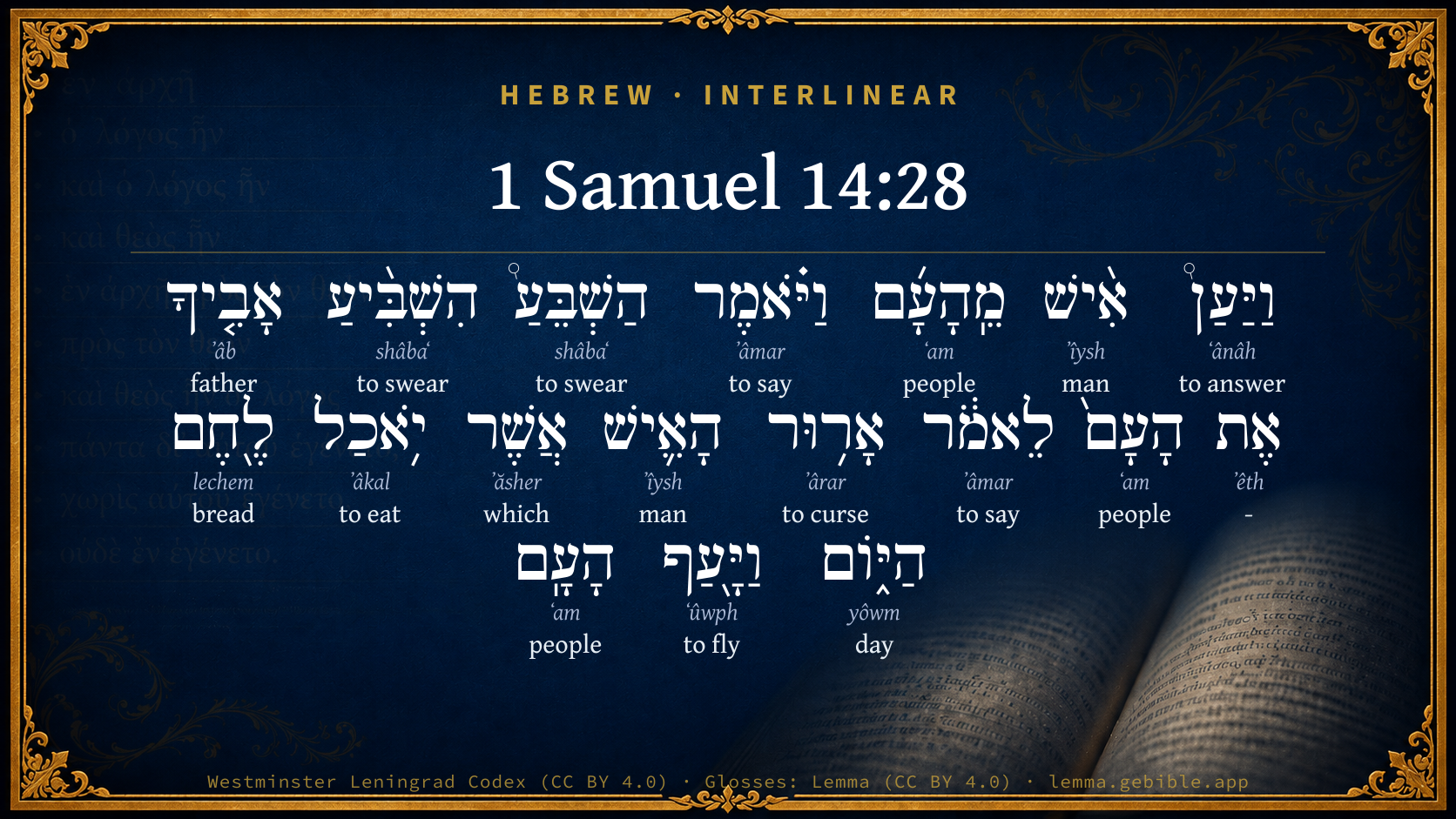
1 Samuel 14:28

Hebrew (Westminster Leningrad Codex) 1 Samuel 14:28 appears in the Hebrew Old Testament. The text above is from the Westminster Leningrad Codex. Each word links to its Strong’s number, a concise gloss, and parsing drawn from the Open Scriptures Hebrew Bible morphology. Click any word for its full Brown-Driver-Briggs (BDB) entry.
Download image
Cite this verse

1 Samuel 14:28 (World English Bible). Public Domain. Lemma interlinear Bible study tool, https://lemma.gebible.app/v/1-samuel/14/28.

Show BibTeX & RIS
BibTeX
RIS
English Translation
Then answered one of the people, and said, Your father directly charged the people with an oath, saying, Cursed be the man who eats food this day. The people were faint.
World English Bible · Public Domain
Download a study sheet

One document with this verse’s original text, its word-by-word gloss line, the meaning frame, cross-references with their text, attributed commentary, and full source and license credits — printable, and it pastes into notes with its structure intact.

This verse Autodidact and up

Study sheet (.html) Plain text (.txt)

A passage Seminary Student

Up to 50 verses in one chapter. A passage sheet keeps up to 6 commentary sources and 12 cross-references per verse, in the order this page ranks them, and says so on the sheet whenever that leaves anything out. Ask for a single verse and you get the Autodidact verse sheet above.

Everything on this page stays free to read, with no account — the sheet is a download of what is already on screen, not access to it.

Want to remove ads? Support Godless Engineer
Compare translations 3

The same verse in 3 English versions, stacked beneath the original-language interlinear above. Click any original word for its lexicon entry.

Each is an independent rendering of the whole verse — the interlinear is not word-aligned to these translations.

Highlighted words mark where these versions differ — a whole-verse word diff, not a word-by-word alignment.

  • World English Bible Public Domain
    Then answered one of the people, and said, Your father directly charged the people with an oath, saying, Cursed be the man who eats food this day. The people were faint.
  • King James Version Public Domain
    Then answered one of the people, and said, Thy father straitly charged the people with an oath, saying, Cursed be the man that eateth any food this day. And the people were faint.
  • unfoldingWord Literal Text CC BY-SA 4.0
    And a man from the people answered and said, “Adjuring, your father adjured the people, saying, ‘Cursed the man who eats bread today.’ So the people are faint.”

unfoldingWord Literal Text — © unfoldingWord, licensed CC BY-SA 4.0. Word-aligned USFM3 via Door43 (git.door43.org/unfoldingWord/en_ult).

Versions to compare (up to 4)

3 of 4 selected

Show all 18 translations

Every available English version of this verse, each an independent rendering of the whole verse.

  • World English Bible Public Domain
    Then answered one of the people, and said, Your father directly charged the people with an oath, saying, Cursed be the man who eats food this day. The people were faint.
  • Berean Standard Bible Public Domain
    Then one of the soldiers told him, “Your father bound the troops with a solemn oath, saying, ‘Cursed is the man who eats food today.’ That is why the people are faint.”
  • Majority Standard Bible Public Domain
    Then one of the soldiers told him, “Your father bound the troops with a solemn oath, saying, ‘Cursed is the man who eats food today.’ That is why the people are faint.”
  • King James Version Public Domain
    Then answered one of the people, and said, Thy father straitly charged the people with an oath, saying, Cursed be the man that eateth any food this day. And the people were faint.
  • American Standard Version (1901) Public Domain
    Then answered one of the people, and said, Thy father straitly charged the people with an oath, saying, Cursed be the man that eateth food this day. And the people were faint.
  • Revised Version (1885) Public Domain
    Then answered one of the people, and said, Thy father straitly charged the people with an oath, saying, Cursed be the man that eateth food this day. And the people were faint.
  • Geneva Bible (1599) Public Domain
    Then answered one of the people, and said, Thy father made the people to sweare, saying, Cursed be the man that eateth sustenance this day: and the people were faint.
  • Douay-Rheims (1899) Public Domain
    And one of the people answering, said: Thy father hath bound the people with an oath, saying: Cursed be the man that shall eat any food this day. (And the people were faint.)
  • Young's Literal Translation Public Domain
    And a man of the people answereth and saith, `Thy father certainly adjured the people, saying, Cursed `is' the man who eateth food to-day; and the people are weary.'
  • Literal Standard Version CC BY-SA 4.0
    And a man of the people answers and says, “Your father certainly adjured the people, saying, Cursed [is] the man who eats food today; and the people are weary.”
  • Unlocked Literal Bible CC BY-SA 4.0
    Then one of the people, answered, “Your father strictly charged the people with an oath, by saying, 'Cursed be the man that eats food on this day,' even though the people are weak from hunger.”
  • unfoldingWord Literal Text CC BY-SA 4.0
    And a man from the people answered and said, “Adjuring, your father adjured the people, saying, ‘Cursed the man who eats bread today.’ So the people are faint.”
  • Darby Bible Public Domain
    Then answered one of the people and said, Thy father strictly adjured the people, saying, Cursed be the man that eateth food this day; and the people are faint.
  • World Messianic Bible Public Domain
    Then one of the people answered, and said, “Your father directly commanded the people with an oath, saying, ‘Cursed is the man who eats food today.’” So the people were faint.
  • Webster's Bible Public Domain
    Then answered one of the people, and said, Thy father strictly charged the people with an oath, saying, Cursed be the man that eateth any food this day. And the people were faint.
  • Free Bible Version CC BY-SA 4.0
    But one of the soldiers told him, “Your father made the army take a solemn oath, saying, ‘Cursed is anyone who eats anything today!’ That is why the men are exhausted.”
  • Bible in Basic English Public Domain
    Then one of the people said to him, Your father put the people under an oath, saying, Let that man be cursed who takes any food this day. And the people were feeble, needing food.
  • JPS Tanakh (1917) Public Domain
    Then answered one of the people, and said: 'Thy father straitly charged the people with an oath, saying: Cursed be the man that eateth food this day; and the people are faint.'

Literal Standard Version (2020), Covenant Press — licensed CC BY-SA 4.0. Text via the HelloAO Bible API (eBible.org). Unlocked Literal Bible (unfoldingWord) — licensed CC BY-SA 4.0. Text via the HelloAO Bible API (eBible.org). unfoldingWord Literal Text — © unfoldingWord, licensed CC BY-SA 4.0. Word-aligned USFM3 via Door43 (git.door43.org/unfoldingWord/en_ult). Free Bible Version, Dr. Jonathan Gallagher — licensed CC BY-SA 4.0. Text via the HelloAO Bible API (eBible.org).

Word by word

More ways to search: Search by grammar → Find every occurrence → Compare this word →

Practice this passage: Drill this verse → Learn its vocabulary →

וַיָּ֖עַף
ʻûwph
H5774
“and · to fly”
Conjunction + Verb, Qal, Sequential Imperfect, 3rd Person, Masculine, Singular
Part of Speech
Conjunction + Verb
Stem
Qal
Form
Sequential Imperfect
Person
3rd Person
Gender
Masculine
Number
Singular
Full BDB Definition

Origin: a primitive root

TWOT: 1582 , 1583 , 1583c

to fly, fly about, fly away (verb) - (Qal) - to fly, hover - to fly away - (Hiphil) to cause to fly, light upon - (Polel) - to fly about or to and fro - to cause to fly to and fro, brandish - (Hithpolel) to fly away - (Qal) to cover, be dark (verb) - gloom (noun feminine)
  1. וַיַּעַן֩ ʻânâh H6030 “and · to answer” Conjunction + Verb, Qal, Sequential Imperfect, 3rd Person, Masculine, Singular
  2. אִ֨ישׁ ʼîysh H376 “man” Noun, Common, Masculine, Singular, Absolute
  3. מֵֽהָעָ֜ם ʻam H5971 “from · the · people” Preposition + Particle, Definite Article + Noun, Common, Masculine, Singular, Absolute
  4. וַיֹּ֗אמֶר ʼâmar H559 “and · to say” Conjunction + Verb, Qal, Sequential Imperfect, 3rd Person, Masculine, Singular
  5. הַשְׁבֵּעַ֩ shâbaʻ H7650 “to swear” Verb, Hiphil, Infinitive Absolute
  6. הִשְׁבִּ֨יעַ shâbaʻ H7650 “to swear” Verb, Hiphil, Perfect, 3rd Person, Masculine, Singular
  7. אָבִ֤יךָ ʼâb H1 “father · your” Noun, Common, Masculine, Singular, Construct + Suffix, Personal, 2nd Person, Masculine, Singular
  8. אֶת ʼêth H853 “-” Particle, Direct Object
  9. הָעָם֙ ʻam H5971 “the · people” Particle, Definite Article + Noun, Common, Masculine, Singular, Absolute
  10. לֵאמֹ֔ר ʼâmar H559 “to say” Preposition + Verb, Qal, Infinitive Construct
  11. אָר֥וּר ʼârar H779 “cursed” Verb, Qal, Participle Passive, Masculine, Singular, Absolute
  12. הָאִ֛ישׁ ʼîysh H376 “the · man” Particle, Definite Article + Noun, Common, Masculine, Singular, Absolute
  13. אֲשֶׁר ʼăsher H834 “which” Particle, Relative
  14. יֹ֥אכַל ʼâkal H398 “to eat” Verb, Qal, Imperfect, 3rd Person, Masculine, Singular
  15. לֶ֖חֶם lechem H3899 “bread” Noun, Common, Both, Singular, Absolute
  16. הַיּ֑וֹם yôwm H3117 “the · day” Particle, Definite Article + Noun, Common, Masculine, Singular, Absolute
  17. הָעָֽם ʻam H5971 “the · people” Particle, Definite Article + Noun, Common, Masculine, Singular, Absolute

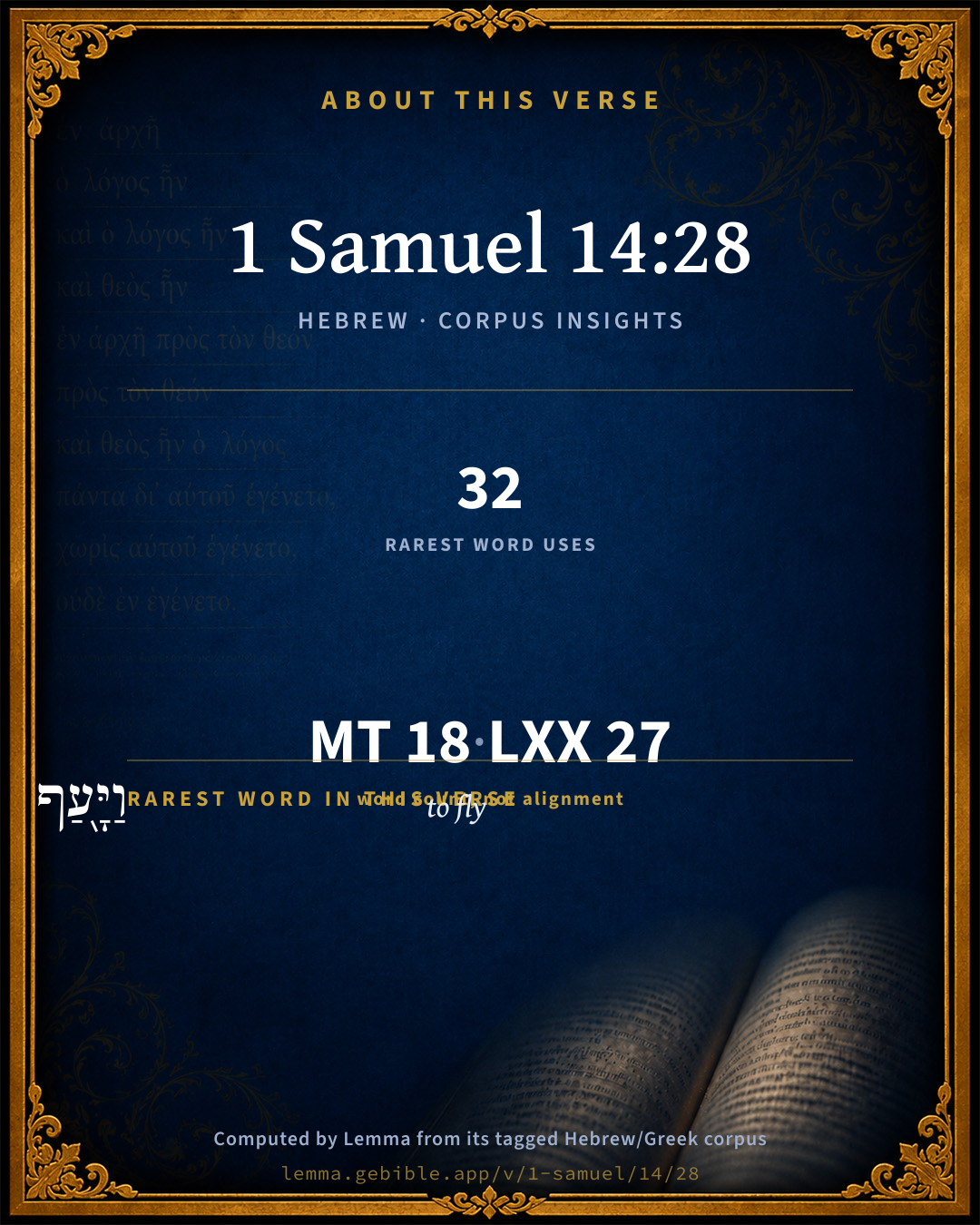
About this verse

These counts appear in no published source. They are computed here, from the morphology-tagged text and Lemma’s own curated glosses. What Lemma adds →

18
words
13
distinct lemmas
Historical
section

Shared distinctive vocabulary

וַיָּ֖עַף to fly H5774 occurs in 29 verses of the Hebrew Bible. Also found in:

Grammatical profile

  • 8 verbs
  • 8 nouns
  • 2 particles

Verb forms

  • וַיַּעַן֩ Qal · Sequential Imperfect
  • וַיֹּ֗אמֶר Qal · Sequential Imperfect
  • הַשְׁבֵּעַ֩ Hiphil · Infinitive Absolute
  • הִשְׁבִּ֨יעַ Hiphil · Perfect
  • לֵאמֹ֔ר Qal · Infinitive Construct
  • אָר֥וּר Qal · Participle Passive
  • יֹ֥אכַל Qal · Imperfect
  • וַיָּ֖עַף Qal · Sequential Imperfect

Repetition

Words recur within this verse — often emphatic in Hebrew:

  • מֵֽהָעָ֜ם people H5971 ×3
  • אִ֨ישׁ man H376 ×2
  • וַיֹּ֗אמֶר to say H559 ×2
  • הַשְׁבֵּעַ֩ to swear H7650 ×2

Hebrew & Septuagint length

In English translation the verse runs 31 words from the Hebrew and 30 from the Septuagint (LXX English) — closely comparable.

A rough comparison of the two English renderings, which tokenize alike — not a word-level alignment.

Word counts can differ between the Hebrew and the Greek without any difference in meaning — e.g. the Hebrew direct-object marker אֵת has no separate Greek word, and Greek often adds the article ὁ.

In the original languages it is 18 Hebrew tokens and 27 Greek tokens — but the two are counted differently (Hebrew bundles its prefixes and suffixes into one token; the Greek is in lemma form), so that isn’t a like-for-like length.

Cross-references

2

Topical passages linked to 1 Samuel 14:28 in the Treasury of Scripture Knowledge — connected by theme and wording, ordered by reader-vote popularity; previews shown in the World English Bible.

  • 1 Samuel 14:24 The men of Israel were distressed that day; for Saul had adjured the people, saying, Cursed be the man who eats any food until it be evening, and I be avenged on my enemies. So none of the people tasted food.
  • 1 Samuel 14:43 Then Saul said to Jonathan, Tell me what you have done. Jonathan told him, and said, I did certainly taste a little honey with the end of the rod that was in my hand; and, behold, I must die.

Cross-references courtesy of OpenBible.info (CC BY 4.0).

Hebrew and Greek witnesses Masoretic Hebrew ↔ Greek Septuagint

The same verse in the two great witnesses to the Old Testament, shown verse-for-verse.

These are two independent witnesses, not word-aligned to each other, and the Septuagint is shown in lemma (dictionary) form.

Hebrew 1 Samuel 14:28 Masoretic · Westminster Leningrad Codex

וַיַּעַן֩ אִ֨ישׁ מֵֽהָעָ֜ם וַיֹּ֗אמֶר הַשְׁבֵּעַ֩ הִשְׁבִּ֨יעַ אָבִ֤יךָ אֶת הָעָם֙ לֵאמֹ֔ר אָר֥וּר הָאִ֛ישׁ אֲשֶׁר יֹ֥אכַל לֶ֖חֶם הַיּ֑וֹם וַיָּ֖עַף הָעָֽם

Then answered one of the people, and said, Your father directly charged the people with an oath, saying, Cursed be the man who eats food this day. The people were faint.

World English Bible · Public Domain

Greek LXX 1 Samuel 14:28 Septuagint · lemma form

καί ἀποκρίνω εἷς ἐκ ὁ λαός καί εἶπον ὁρκίζω ὁρκίζω ὁ πατήρ σύ ὁ λαός λέγω ἐπικατάρατος ὁ ἄνθρωπος ὅς ἐσθίω ἄρτος σήμερον καί ἐκλύω ὁ λαός

And one of the people answered and said, Your father solemnly adjured the people, saying, Cursed is the man who shall eat bread today. And the people were very faint,

LXX2012 (modern English Septuagint) · Public Domain

Hebrew: Westminster Leningrad Codex (CC BY 4.0). Greek: Septuagint (public domain); English from LXX2012 (modern English Septuagint) (Public Domain). How the Septuagint differs from the Hebrew →

Targum (Aramaic paraphrase)

1

The Targum is the ancient Jewish Aramaic paraphrase of the Hebrew Scriptures — an interpretive translation, not the Hebrew text itself. Onkelos (literal) and Pseudo-Jonathan (expansive) render the Torah, and Jonathan the Prophets. Coverage is partial: where no permissively-licensed English translation exists for a verse, only the Aramaic is shown. This is verse-level text, not a word-by-word alignment to the Hebrew.

  1. Targum Jonathan Prophets (Joshua–Malachi)
    וַאֲתֵיב גַבְרָא חַד מֵעַמָא וַאֲמַר אוֹמָאָה אוֹמֵי אֲבוּךְ יַת עַמָא לְמֵימַר לִיט גַבְרָא דְיֵכוּל לַחְמָא יוֹמָא דֵין וְאִשְׁתַּלְהֵי עַמָא:

    (no public-domain English translation for this verse)

    Targum Jonathan — Aramaic: “Mikraot Gedolot” (public domain). English: “Sefaria Community Translation” (CC0 1.0 (public-domain dedication)); “London "Chaldee Paraphrase," 1871” (public domain). Text via Sefaria.

Commentary

Notes on 1 Samuel 14:28 from classic Christian and Jewish commentators (each source and its license shown beneath its notes). The classic Christian expositions comment on the surrounding passage and are grouped to its opening verse, so a note may address several verses; the Jewish commentaries on the Tanakh (Rashi and others) are per-verse, so they appear only where the commentator wrote on this verse.

Lemma curates 59 commentaries, every one of them public domain or Creative Commons licensed, each selected and text-cleaned for this edition rather than reprinted as found. About our sources →

Trapp's Complete Commentary

John Trapp

1Sa 14:28 Then answered one of the people, and said, Thy father straitly charged the people with an oath, saying, Cursed [be] the man that eateth [any] food this day. And the people were faint.

Ver. 28. Then answered one of the people.] To Jonathan, who haply had exhorted them to refresh themselves, as he had done, or to follow hard after the enemies.

And the people were faint.] Weak and weary with hunger and hard labour. Animantis cuiusque vita in fuga est. Were it not for the repair of nutrition, life would soon be extinct.

John Trapp, A Commentary or Exposition upon All the Books of the Old and New Testament (1647–1656) — public domain. Text from a community e-Sword module.

Geneva Bible (1599)

Geneva Bible translators

Or, weary.

Geneva Bible (1599) marginal notes — public domain. Text via Bolls.life.

Ellicott's Commentary for English Readers

(28) Then answered one of the people.—Most probably, in reply to Jonathan’s pointing out the plentiful supply of honey, and inviting the soldiers near him to refresh themselves with it. The words “and the people were faint,” at the close of the verse, should be rendered, and the people are faint; they were part of the speech of the soldier who was telling Jonathan of his father’s rash oath.

A Bible Commentary for English Readers, edited by Charles John Ellicott (1878–1897) — public domain. Text from a community e-Sword module.

The Cambridge Bible for Schools and Colleges

gen. ed. J. J. S. Perowne

28. straitly] i.e. strictly. Cp. Exo_13:19; Jos_6:1.

And the people were faint] Better, and the people are faint, or weary: words of the speaker, not a comment by the historian.

The Cambridge Bible for Schools and Colleges (gen. ed. J. J. S. Perowne; Cambridge University Press, 1878–1918) — public domain. Text from a community e-Sword module.

John Gill's Exposition

Then answered one of the people, and said,.... To Jonathan, who might direct and encourage the people to do as he had done, at least so he did by his example, if not by words; the latter is not improbable: and therefore one of the men that came along with Saul, and had now joined Jonathan, and who heard what Saul had said, replied:

thy father straitly charged the people with an oath; gave them a strict charge, with an oath or imprecation annexed to it:

saying, cursed be the man that eateth any food this day; that is, until the evening, as in Sa1 14:24.

and the people were faint; which is either the observation of the writer of the book; or it may be the words of the man, imputing the faintness of the people to this adjuration of Saul restraining them from food; or as taking notice how strictly the people observed it, though they were hungry, faint, and weary.

John Gill's Exposition of the Whole Bible (1746–1763) — public domain (CC PDM 1.0). Text via the HelloAO Bible API.

Albert Barnes' Notes on the Bible

And the people were faint - Read, “are faint,” the words are part of the man’s complaint.

Albert Barnes' Notes on the Bible (1834–1885) — public domain. Text from a community e-Sword/MySword module.

Matthew Poole's English Annotations

One of the people, who came along with Saul, whose forces were now united with Jonathan’s.

Matthew Poole's English Annotations on the Holy Bible (1683–1685) — public domain. Text from a community e-Sword/MySword module.

The Pulpit Commentary

And the people were faint. There is great diversity of opinion whether this be part or not of the speech of the man who informed Jonathan of the oath forced on the people by Saul. It makes, perhaps, the better sense if regarded as the continuation of the history, and inserted to justify Jonathan"s disapproval of his father"s hasty command. The fight rendering is were weary, as in the margin and Jud_1:4:21.

The Pulpit Commentary (1880–1919), ed. H.D.M. Spence-Jones & Joseph S. Exell — public domain. Text from a community e-Sword module.

John Wesley's Explanatory Notes

People - They that came with Saul, whose forces were now united with Jonathan's.

John Wesley, Explanatory Notes Upon the Whole Bible (1754–1765) — public domain. Text via the GEBible commentary corpus.

Lesson kit

Teaching starters — assembled from the data on this page, not authored interpretation. Every prompt links to the verse data it draws on. Edit before teaching.

1 Samuel, in the Historical, opens this verse with 18 words (13 distinct Hebrew lemmas). Its most distinctive word is ʻûwph (“to fly”). A historical commentator’s framing appears above. Read the whole chapter for the surrounding context.

Discussion questions

  1. What does “to fly” (ʻûwph) contribute to the verse as a whole?
  2. How does Genesis 1:20, which shares the word «to fly», read alongside this verse?
  3. What does the repetition of “people” (3× in this one verse) do in this verse?
  4. These translations render this verse differently; the difference is in the English rendering, not the original. What questions does that raise?
  5. «וַיַּעַן֩» is a Qal Sequential Imperfect verb. How does that grammatical form shape the action described?
  6. Compare how Trapp's Complete Commentary and Geneva Bible (1599) read this verse. Where do they agree or differ?

Things to notice

Reading settings

Reading text

Shown beneath each verse's original-language words.

Old Testament
Old Testament edition

Read the OT as the Masoretic Hebrew (MT) or the Greek Septuagint (LXX).

English shown for the Greek Septuagint (in the Hebrew ↔ Greek comparison).

Comparing translations? Open the Compare panel on any verse page to stack up to four side by side.